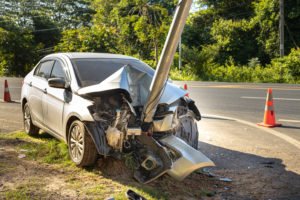
The Law Offices of Anidjar and Levine can help injured victims identify fault, preserve evidence, document injuries, and manage insurance communications after a collision. A Florida Car Accident Lawyer may investigate crash reports, photographs, witness statements, medical records, vehicle damage, phone data, surveillance footage, and roadway conditions.
This evidence can support liability, causation, damages, and settlement negotiations when insurers dispute responsibility.
The sections below explain how legal guidance can strengthen an injury claim after a crash in Florida.
Main Takeaways
- A Florida car accident injury lawyer investigates fault, causation, damages, and insurance issues after a crash.
- Key evidence may include crash reports, photos, witness statements, medical records, repair estimates, and digital vehicle data.
- Investigations often examine distracted driving, speeding, impairment, reckless driving, road hazards, and vehicle defects.
- Medical records, imaging, bills, therapy notes, and future care needs help prove the severity of the injury and damages.
- Legal counsel can preserve evidence, communicate with insurers, evaluate settlement offers, and support a clearer injury claim.
How We Can Help With Your Florida Car Accident Investigation Injury Claim
After a Florida car accident, a thorough investigation can determine whether an injury claim is supported by clear evidence of fault, causation, and damages. A Florida car accident investigation injury lawyer can assist by organizing the claim, identifying needed records, and guiding evidence preservation before important details are lost. This support may include gathering photographs, crash reports, witness information, medical records, repair estimates, and insurance documentation that helps present the matter accurately.
For individuals dedicated to serving others, careful claim preparation helps protect injured people from avoidable delays and incomplete submissions. Legal counsel can communicate with insurers, review statements, evaluate settlement positions, and help ensure that losses are documented consistently. This measured approach supports accountability while reducing the burden on the injured person and family. By coordinating the investigative steps and preserving relevant materials, the lawyer helps build a claim that reflects the full impact of the accident and the responsible party’s conduct.
Understanding Florida Car Accident Investigation Injury Cases


When a collision occurs on a Florida roadway, the investigation often forms the basis for determining how the crash occurred, who may be legally responsible, and what losses resulted from the event. These cases require careful review of reports, photographs, vehicle damage, medical records, and available digital data. Each detail may assist with liability proof, especially when accounts differ or responsibility is denied.
OUR CONSULTATIONSARE FREE
START YOUR FREE CASE REVIEW

For injured individuals and those serving their families, evidence preservation is a central concern. Physical evidence can disappear quickly, and memories may fade before a claim is resolved. Witness credibility also matters, as consistent, reliable statements may support the injured person’s position in insurance disputes.
A Florida car accident investigation injury case is not limited to identifying immediate harm. It also examines how the injury affects daily service, employment, caregiving, and future needs. A structured investigation helps present the claim clearly, responsibly, and with dependable support.
Common Causes of Florida Car Accident Investigation
Common causes of Florida car accident investigations often include distracted driving evidence, speeding and reckless driving, impaired driving factors, and weather or road hazards. Investigators may review phone records, crash scene data, witness statements, and roadway conditions to determine how the collision occurred. Each factor can affect liability, injury claims, and the legal strategy for pursuing compensation.
Distracted Driving Evidence


Because driver inattention is often brief and difficult to observe, evidence of distracted driving can become a crucial part of a Florida car accident investigation. Investigators may examine Cell phone usage records, messaging activity, navigation inputs, and application data to determine whether attention was diverted before impact. Dashcam footage, surveillance video, and witness statements can further clarify hand movements, lane position, braking behavior, and eye direction. This evidence helps protect injured persons by identifying conduct that may otherwise be denied or overlooked.
A careful review also supports fair accountability, allowing insurers, attorneys, and courts to understand how distraction contributed to harm. When gathered promptly, such proof preserves accuracy, strengthens service to victims, and promotes safer driving practices across Florida communities with lasting public responsibility.
Speeding And Reckless Driving
Although excessive speed can last only moments, it often leaves measurable evidence that becomes central to a Florida car accident investigation. Investigators may review skid marks, impact angles, roadway debris, vehicle data, and witness accounts to determine whether a driver exceeded safe limits or ignored traffic conditions. Reckless driving may include aggressive lane changes, tailgating, unsafe passing, or racing behavior that endangers nearby motorists, passengers, pedestrians, and responders. Proper Vehicle maintenance can also affect findings, since worn brakes, poor tires, or faulty handling may worsen the consequences of speeding. Roadway conditions, including pothole hazards, may further explain loss of control, yet they do not excuse careless operation. Careful analysis helps identify responsibility and supports injured people seeking fair accountability through the legal process.
Impaired Driving Factors
When impairment is suspected after a Florida car accident, investigators often examine whether alcohol, controlled substances, prescription medications, or fatigue affected a driver’s perception, judgment, reaction time, and vehicle control. Officers may document driving behavior, physical appearance, speech patterns, odor, balance, and coordination, and review witness statements and available video. Alcohol detection may involve evidence from breath, blood, or urine, depending on the circumstances and legal requirements. Impairment testing can also include standardized field evaluations and drug recognition observations, performed to assess observable signs rather than assign immediate fault. For injured persons, careful documentation helps clarify how impaired choices may have contributed to harm. A thorough review supports fair accountability, protects community safety, and helps those serving victims understand the cause and consequences of the collision.
Weather And Road Hazards
During a Florida car accident investigation, weather and road hazards are reviewed to determine whether environmental conditions contributed to the collision. Investigators may assess rain, fog, standing water, glare, poor lighting, debris, uneven pavement, and malfunctioning traffic signals. These factors can reduce visibility, affect stopping distance, and create sudden risks for drivers, passengers, cyclists, and pedestrians. Careful documentation helps determine whether a driver responded reasonably or whether another party failed to maintain safe conditions. Pedestrian safety is often examined when crosswalks, sidewalks, or warning signs are obscured or damaged. Intersection hazards also receive close attention, especially where drainage problems, faded markings, or blocked sightlines increase the risk of crashes. This review supports fair accountability while helping protect the community through safer roads and stronger preventive measures for all travelers.
Legal Rights of Florida Car Accident Investigation Injury Victims
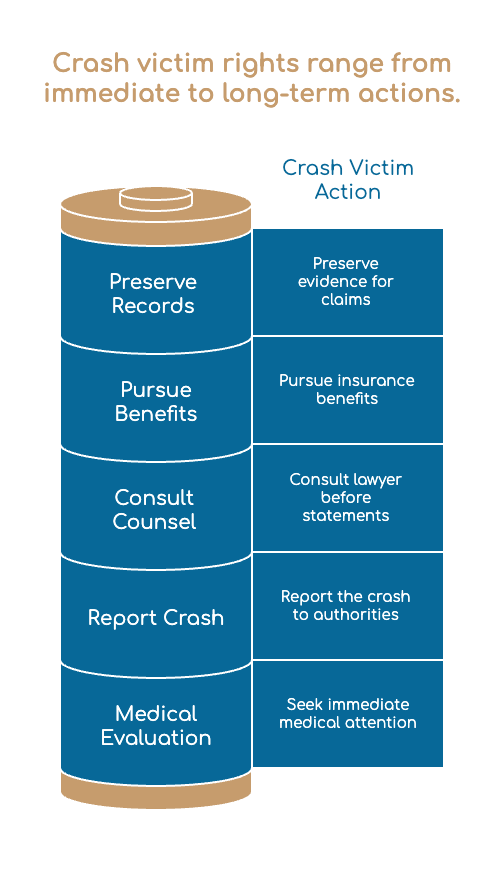
After a serious crash, Florida car accident investigation injury victims may have important legal rights that affect medical care, insurance benefits, and potential compensation. These rights may help injured persons secure treatment, document losses, and respond to Insurance coverage disputes with diligence and purpose. A careful legal review can also provide guidance on preserving evidence and protecting records that may support a claim.
Understanding legal rights after a serious Florida crash can help protect medical care, insurance benefits, and vital evidence.
- The right to seek prompt medical evaluation and maintain treatment documentation.
- The right to report the crash and obtain official investigative records.
- The right to pursue benefits available under applicable Florida insurance policies.
- The right to preserve photographs, witness information, vehicle data, and repair records.
- The right to consult counsel before giving recorded statements or signing releases.
When rights are understood early, victims and their families can make informed decisions. This approach supports accountability, orderly claims handling, and compassionate service to those facing physical, financial, and practical hardship.
Why Do Florida Car Accident Investigation Injuries Happen?
Although every collision has its own facts, injuries from Florida car accidents often result from unsafe conduct, hazardous road conditions, vehicle defects, or delayed emergency responses that combine to create preventable harm. Drivers may speed, follow too closely, drive impaired, or ignore traffic controls, placing others at serious risk. Poor lighting, standing water, worn markings, and obstructed views can also contribute, especially when agencies or property owners fail to correct known dangers.
Investigators review Common Evidence, such as crash reports, photographs, skid marks, vehicle damage, and electronic data, to determine how the harm occurred. Witness Statements may clarify speed, signal use, distraction, or roadway conditions before impact. In serious cases, Biomechanical Analysis can explain how crash forces produced specific injuries. Each finding supports a careful Liability Assessment, identifying responsible parties and helping protect injured persons, families, and community members who rely on fair, orderly accountability after preventable crashes in Florida.
What Should You Do After a Florida Car Accident Investigation Injury?
After a Florida car accident injury, the injured party should first prioritize medical care to identify and treat any immediate or delayed harm. Careful documentation of the scene, including photographs, witness information, and official reports, can help preserve important evidence. Consulting an attorney may also be necessary to protect legal rights, evaluate liability, and pursue appropriate compensation.
Prioritize Medical Care
When injuries may have occurred in a Florida car accident, prompt medical evaluation should be the first priority, even if symptoms appear minor or delayed. A careful examination can identify hidden trauma, support appropriate treatment, and protect the injured person’s ability to care for family, coworkers, and community responsibilities. Medical records also create a clear connection between the collision and the injuries, which may become important during Insurance claim timelines. Delaying care can weaken that connection, impair recovery, and complicate claims for compensation for treatment costs or lost wages. Follow-up appointments, prescribed therapy, and expert referrals should be handled consistently. Because legal deadlines may apply, timely medical attention helps preserve both health and the information needed for any later legal or insurance review.
Document The Scene
Prompt medical care should remain the immediate priority, but scene documentation can also play an important role in a Florida car accident investigation once it is safe to do so. A responsible person may help preserve evidence by photographing the roadway, traffic signals, skid marks, debris, weather conditions, and final vehicle positions. They should document vehicle damage from multiple angles, including close and wide views, without interfering with responders. If injuries are visible, photos of injuries may be taken respectfully, with attention to dignity and privacy. It is also useful to obtain witness contact information, including names, phone numbers, and brief location details, while memories remain fresh. These careful steps can support accurate reporting, protect vulnerable parties, and assist those working to understand what happened after the collision.
Consult An Attorney
In the days following a Florida car accident investigation injury, consulting an attorney can help protect important legal rights and prevent avoidable mistakes. Counsel may review police findings, insurance communications, medical records, and witness accounts to identify responsible parties and preserve evidence. For injured victims or families facing Wrongful Death concerns, legal guidance can clarify eligibility criteria for benefits, damages, and filing deadlines. An attorney may also communicate with insurers, reducing pressure on those focused on recovery or caregiving. If an insurer issues a claim denial, counsel can evaluate the stated reasons, gather supporting proof, and explain available appeal options. Early legal advice helps ensure that decisions are informed, documentation is complete, and any claim is positioned for fair consideration under Florida law.
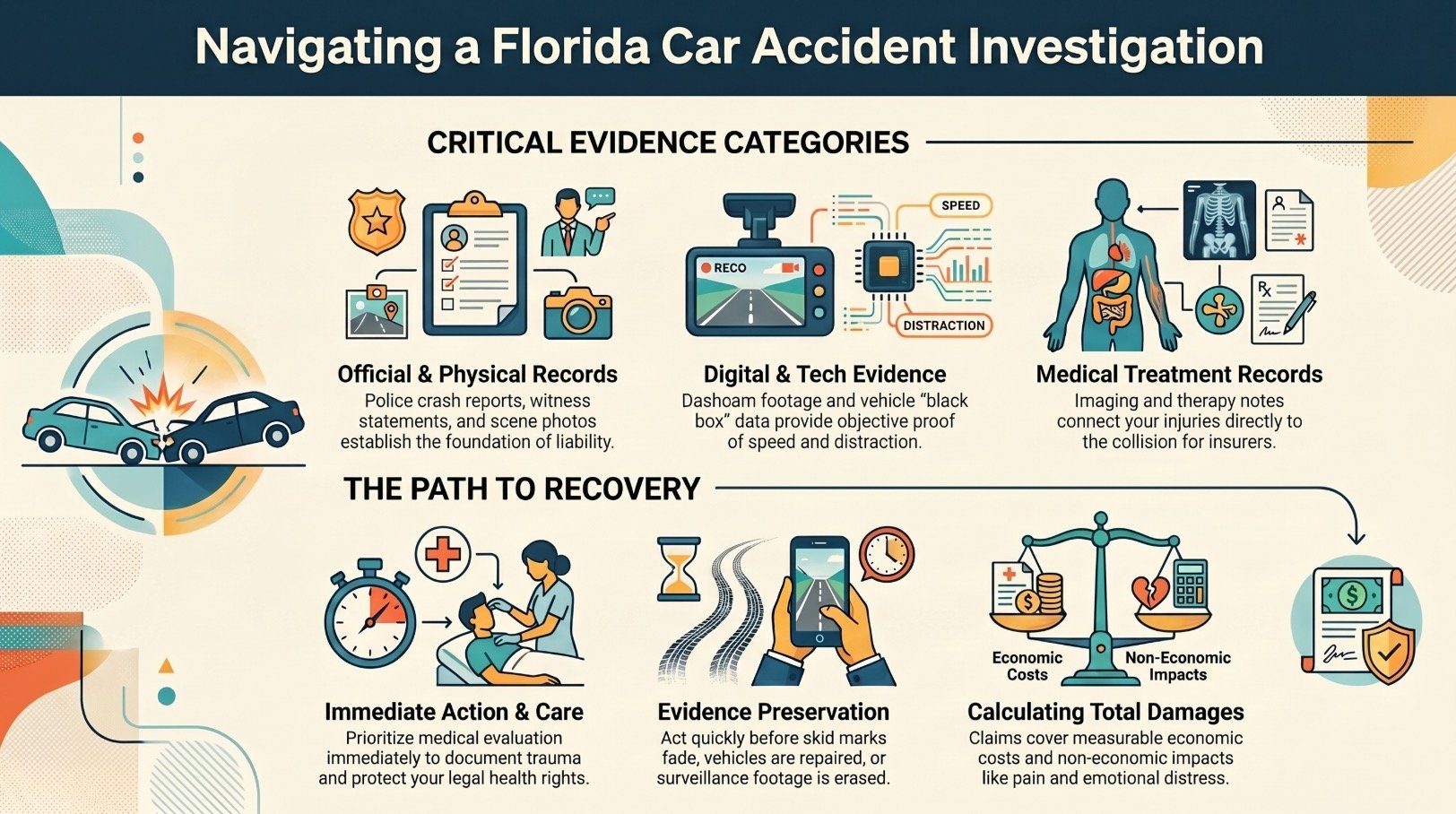
Critical Evidence in a Florida Car Accident Investigation Injury Case
Evidence in a Florida car accident investigation injury case often determines how fault, damages, and insurance liability are evaluated.
Materials may include:
- Police crash reports
- Scene photographs
- Witness statement details
- Medical treatment records
- Vehicle damage documentation
Each category can help establish what occurred, who may be responsible, and how the collision affected the injured person.
Police Crash Reports
After a collision, the police crash report often becomes one of the first organized records of what occurred and who may be responsible. It may identify drivers, passengers, witnesses, insurers, road conditions, citations, and the officer’s preliminary assessment. In a Florida injury case, a careful review helps advocates serve injured people by separating confirmed facts from assumptions. Errors can appear in names, insurance details, vehicle positions, or statements, making crash report corrections a practical issue when accuracy affects a claim.
Counsel may compare the report with medical records, witness accounts, and physical evidence before requesting an amendment through the proper agency. How report access rules also matter, because Florida limits early release to certain parties before the report is publicly available. Timely access supports preservation of rights, fair evaluation, and responsible case development.
Scene Photo Evidence
When photographs are taken promptly, scene photo evidence can preserve details that may disappear within minutes of a Florida car accident. Skid marks, vehicle resting positions, debris fields, traffic signals, weather conditions, and roadway defects may assist an injury lawyer in evaluating fault and damages. Clear scene photos can also document property damage, airbag deployment, license plates, and visible injuries before cleanup, repairs, or medical treatment changes the record.
Nearby businesses, homes, buses, and traffic systems may provide video surveillance that confirms movement, timing, lane position, or the sequence of impacts. A careful investigation can quickly identify these sources because many systems erase footage within days. Preserving visual evidence helps protect injured persons, supports fair claims handling, and serves the broader purpose of accountability after preventable roadway harm.
Witness Statement Details
Photographs and video may show how a crash unfolded, but witness statement details can explain what the images do not capture. In a Florida car accident investigation, statements may identify traffic signal status, vehicle speed, driver distractions, weather conditions, and post-crash conduct. Careful collection supports fairness, protects injured persons, and helps responsible parties understand the harm caused.
A lawyer may compare each account with physical evidence and police findings as part of an eyewitness reliability assessment. This review considers vantage point, lighting, timing, consistency, and possible bias. Accurate summaries also assist with deposition preparation, allowing counsel to address contradictions and preserve truthful testimony. When gathered promptly and respectfully, witness statements can strengthen a claim by providing context, confirming liability, and guiding service-centered advocacy for the injured and their families.
Medical Treatment Records
Medical treatment records document the physical consequences of a crash and often serve as important evidence in a Florida car accident investigation injury case. These records may include emergency room notes, diagnostic imaging, physician evaluations, therapy reports, prescriptions, and follow-up care instructions. Together, they establish the treatment timeline, the nature of the injuries, and the connection between the collision and the claimed harm. For those serving injured individuals, organized records support accurate proof of bodily injury and help identify gaps that may require clarification. They also assist with medical bill management by showing the amounts charged, insurance payments, outstanding balances, and future care needs. Careful review can strengthen settlement discussions, support litigation strategy, and promote fair consideration of the injured person’s needs.
Long-Term Effects of Florida Car Accident Investigation Injuries
Long-term injuries from a Florida car accident may extend beyond the initial investigation, particularly when chronic pain complications affect mobility, work capacity, and daily function. Emotional trauma effects, including anxiety, sleep disruption, and fear of driving, may also influence recovery and claim value. Ongoing medical needs, such as follow-up care, therapy, medication, or specialist treatment, can become central issues in documenting damages.
Chronic Pain Complications
After a Florida car accident, chronic pain can develop even when the initial injuries appear manageable or begin to improve. Persistent neck, back, joint, or nerve pain may limit mobility, reduce endurance, and interfere with daily responsibilities. Careful medical documentation helps link ongoing symptoms to the collision, especially when diagnostic findings are limited or treatment extends over months. Pain Management may include therapy, medication, injections, or coordinated specialty care intended to restore function and prevent further decline. For individuals serving families, workplaces, or communities, these limitations can create serious financial and practical burdens. When chronic pain prevents sustained employment, Disability Benefits may become relevant and require evidence of functional restrictions, treatment history, and work limitations. Legal investigation can preserve records, clarify causation, and support fair evaluation of long-term damages.
Emotional Trauma Effects
Although physical injuries often receive the earliest attention, emotional trauma can become a lasting consequence of a Florida car accident. Survivors may experience anxiety, sleep disruption, fear of driving, irritability, or intrusive memories that affect work, family duties, and community involvement. These harms can be especially serious when a person once served others confidently but now avoids roads, crowds, or responsibilities.
In an injury investigation, emotional symptoms may support claims for psychiatric damages when properly documented through records, witness observations, and qualified professional evaluations. Attorneys examining long-term effects may consider how trauma changes daily function, relationships, and earning capacity. Effective trauma recovery strategies can include counseling, structured coping methods, and supportive routines, helping injured individuals regain stability while preserving evidence of the accident’s lasting psychological impact.
Ongoing Medical Needs
When injuries from a Florida car accident do not fully resolve, ongoing medical needs may become a central issue in an injury investigation. Medical records, expert opinions, and treatment histories help identify care that may be required for months or years. These needs may include surgery, rehabilitation, pain management, mobility assistance, medication, or in-home support. Investigators may examine whether the injury limits daily activities, creates future disability, or reduces the person’s ability to work. In serious cases, vocational assessments may clarify how physical or cognitive limitations affect employment options and earning capacity. Careful documentation allows attorneys, insurers, and courts to understand the full burden placed on the injured person. This process supports fair evaluation while helping families, caregivers, and service providers plan responsibly for continued medical and practical assistance.
Proving Liability in Florida Car Accident Investigation Injury Cases
Because liability determines whether an injured person may recover compensation, a Florida car accident investigation must focus on evidence that shows how the crash occurred and who breached a legal duty of care. Investigators may review crash reports, roadway conditions, vehicle damage, photographs, surveillance footage, and witness statements to identify negligent conduct, such as speeding, distraction, impaired driving, or failure to yield.
Effective evidence preservation is crucial because skid marks fade, vehicles are repaired, and digital records may be overwritten. Prompt collection helps protect the truth and supports a fair evaluation of responsibility. In intricate crashes, reconstruction experts may assess impact angles, braking patterns, and driver actions to clarify disputed facts.
Liability findings also support proving damages, since the injured person must connect the crash to medical treatment, lost income, reduced mobility, and other losses. Careful documentation allows advocates to serve injured individuals with accuracy, diligence, and respect.
Dealing With Insurance Companies After a Florida Car Accident Investigation Injury
After a Florida car accident investigation begins, insurance companies often move quickly to gather statements, review records, and measure potential exposure. Their representatives may appear cooperative, yet their role is to protect the company’s interests while assessing payment obligations. Injured persons, families, and advocates who serve them should approach communications with care, ensuring that statements remain accurate, limited, and consistent with known facts.
Insurance adjusters may question the severity of the injury, the necessity of treatment, or the relationship between the crash and the medical findings. Medical record disputes can arise when records are incomplete, misread, or separated from the broader clinical history. Careful documentation, organized correspondence, and prompt correction of inaccuracies help preserve the integrity of the claim.
When benefits are reduced or refused, Claim denial appeals require focused review of policy language, evidence, and stated reasons for denial. Legal guidance can support fair treatment while allowing injured persons to prioritize recovery, stability, and responsible decision-making.
What to Expect During a Florida Car Accident Investigation Injury Claim Process
The Florida car accident injury claim process typically begins with thorough crash-scene documentation, followed by timely filing of an insurance claim. Attorneys and investigators may then collect evidence of injury, including medical records and expert assessments, to establish the extent of damages. The process often concludes with settlement negotiations, in which liability, insurance coverage, and documented losses are carefully evaluated.
Crash Scene Documentation
When a Florida car accident injury claim begins, crash-scene documentation often forms the foundation for determining how the collision occurred, who may be liable, and what evidence supports the injured person’s claim for damages. Investigators may record roadway conditions, vehicle positions, skid marks, debris fields, weather, lighting, and visible injuries. Photographs, video footage, witness observations, and police measurements can help clarify traffic signal disputes, lane movement, speed, and right-of-way issues. In rear-end collision factors, documentation may show stopping distance, brake use, following distance, and whether a sudden hazard affected driver response.
Careful preservation of these details allows legal and safety professionals to serve injured individuals with accuracy, fairness, and accountability. Strong records also reduce confusion, support medical causation, and strengthen later evaluation of responsibility.
Insurance Claim Filing
During the insurance claim filing stage, the injured person or legal representative typically ensures that the appropriate insurance companies are notified, provides basic collision information, and begins documenting losses related to the Florida car accident. This step may involve reporting the date, location, vehicles involved, known parties, and available claim numbers. Policyholder documentation should be organized carefully, including insurance declarations, correspondence, repair estimates, wage information, and prior communications with adjusters.
A service-minded legal team may help ensure deadlines are respected, statements are accurate, and required forms are submitted without unnecessary delay. If an insurer questions responsibility, available benefits, or the policy’s interpretation, coverage dispute appeals may be necessary. Careful filing supports orderly review, preserves rights, and helps the claim move forward with dignity, accuracy, and accountability.
Injury Evidence Collection
After the claim has been opened and the insurer has received basic notice of the Florida car accident, the focus often shifts to collecting evidence explaining the nature, extent, and cause of the injuries. A careful investigation may include medical records, diagnostic reports, photographs, repair documents, and emergency response materials. Data preservation is important because vehicle information, phone records, and surveillance footage may be lost or overwritten. An organized evidence timeline helps clarify when symptoms appeared, when treatment began, and how limitations affected daily service, work, and family duties. Witness contact should be handled promptly, with respectful attention to accurate statements and availability. Digital proof, including images, messages, and location data, may support injury causation when reviewed carefully and ethically by counsel.
Settlement Negotiation Process
Once the injury evidence is organized, settlement negotiation typically begins with a structured presentation of liability, damages, medical treatment, and the expected long-term effects of the crash. The insurer reviews the demand package, compares documented losses with policy limits, and may issue a counteroffer. Counsel evaluates each response against the Car accident timeline, available proof, and the client’s continuing care needs. Settlement amount factors often include medical expenses, lost income, impairment, pain, comparative fault, and the strength of witness or expert testimony. Negotiations may proceed through several exchanges, requiring patience, accuracy, and disciplined advocacy. A service-minded legal team explains options clearly, protects the claimant from pressure, and seeks a resolution that fairly supports recovery while preserving the ability to pursue litigation if negotiations fail.
Compensation for Florida Car Accident Investigation Injury Damages
When a Florida car accident investigation confirms that another party’s negligence contributed to a crash, the injured person may have grounds to pursue compensation for related damages. This process often depends on evidence gathered from police reports, witness statements, scene documentation, vehicle inspections, and medical records. A lawyer may evaluate whether careless driving, unsafe road conditions, faulty vehicle records, or traffic signal liability played a role in causing harm.
Compensation is intended to address losses that flow from the crash and help restore stability after disruption. In service to injured individuals and their families, legal advocates may identify responsible parties, preserve proof, and present claims to insurers or courts. The investigation can also reveal whether multiple entities share responsibility, including drivers, vehicle owners, maintenance providers, or government agencies. Careful documentation supports a demand that reflects the full impact of the incident while promoting accountability, fairness, and responsible conduct within Florida communities and civil justice systems.
Economic vs Non-Economic Damages in Florida Car Accident Investigation Cases
Florida car accident investigation cases often require a clear distinction between economic and non-economic damages, as each category affects the value of a claim differently. Economic damages include measurable losses such as medical expenses, lost wages, and property damage, while non-economic damages address pain, suffering, and reduced quality of life. Proving the value of damages depends on credible evidence, careful documentation, and a clear connection between the accident and the claimed losses.
Economic Damages Explained
In a Florida car accident investigation, economic damages are the measurable financial losses resulting from the collision, including medical expenses, lost income, reduced earning capacity, vehicle repair costs, and other expenses paid out of pocket. These losses are supported by billing statements, employment records, repair estimates, receipts, tax documents, and medical records. Investigators and attorneys review these materials to link each financial loss to the crash and to identify costs that may continue into the future. When service-minded professionals assist injured individuals, careful documentation helps ensure that practical needs are recognized and addressed. Witness credibility analysis may also support economic claims, especially when testimony confirms missed work, necessary transportation, or property damage. Accurate valuation requires organized evidence, consistent records, and attention to every recoverable financial consequence.
Non-Economic Damages Explained
Non-economic damages refer to the personal, human losses caused by a car accident that do not have a fixed invoice, receipt, or wage statement attached to them. In Florida car accident investigation cases, these damages may include pain, suffering, emotional distress, loss of enjoyment of life, inconvenience, scarring, disability, and harm to close family relationships. They recognize that an injured person may face lasting burdens beyond medical bills or missed income. When injuries change daily routines, caregiving roles, or the ability to serve family and community, non-economic losses can become significant. Wrongful death damages may also include grief, companionship loss, and guidance loss for eligible survivors. Future loss may be considered when the human impact is expected to continue over time after the accident.
Proving Damage Value
After a serious collision, proving the value of damages requires a clear separation between financial losses and personal harms, supported by evidence linking each loss to the accident. Economic damages may include medical bills, lost wages, rehabilitation costs, and vehicle repair expenses. Property damage valuation often relies on repair estimates, market comparisons, photographs, and expert assessments. Non-economic damages, such as pain, emotional distress, and reduced daily function, require careful presentation through medical records, witness statements, and consistent treatment history. Effective documentation methods help investigators and counsel show the full impact of the crash with accuracy and dignity. In Florida car accident cases, thorough proof serves the injured person, the court, and the broader goal of accountability by ensuring that compensation reflects measurable losses and human consequences.
When a Florida Car Accident Investigation Injury Case Goes to Trial vs Settlement
Whether a Florida car accident injury case proceeds to trial or resolves through settlement depends on the strength of the investigation, the clarity of liability, the severity of injuries, and the willingness of the insurance company to offer fair compensation. A careful legal team evaluates medical records, crash evidence, witness accounts, and expert findings to determine the path that best serves the injured person’s recovery and long-term stability.
Settlement may be appropriate when the evidence creates meaningful Settlement Leverage and the insurer recognizes the full value of the harm. Mediation Preparation then becomes crucial, allowing the claim to be presented clearly, respectfully, and persuasively.
Trial may become necessary when responsibility is disputed, damages are minimized, or negotiations fail. Trial Strategy focuses on organizing proof, preparing testimony, and presenting the human consequences of the collision with dignity. Jury Selection also matters because impartial decision-makers must assess evidence and accountability fairly.
Florida Laws That May Affect Your Florida Car Accident Investigation Case
Because Florida car accident claims are formed by state-specific statutes, procedural deadlines, and insurance rules, an effective investigation must account for the legal framework that controls fault, compensation, and proof. These laws guide how evidence is gathered, how responsibility is assessed, and how an injured person’s needs are presented with care and accuracy.
- Florida’s no-fault insurance system often requires initial medical benefits through personal injury protection coverage, regardless of who caused the crash.
- Comparative fault basics may reduce compensation when an injured party shares responsibility for the collision.
- Serious injury thresholds can affect whether a claimant may pursue damages beyond basic insurance benefits.
- A damages overview should include medical costs, lost income, reduced earning ability, and non-economic harm when legally supported.
- Traffic laws, crash reports, witness statements, and vehicle evidence may help establish negligence and protect the interests of those harmed.
A careful legal review helps ensure that the investigation serves injured people responsibly.
The Statute of Limitations for Florida Car Accident Investigation Injury Cases
In Florida car accident injury cases, the statute of limitations sets a strict deadline for filing a lawsuit, making early legal review an important part of ensuring a claim is filed. For many negligence-based injury claims arising from motor vehicle collisions, Florida law generally allows two years from the date of the crash to file suit. Missing this deadline may bar recovery, regardless of the seriousness of the injuries or the strength of the investigation.
Timely action also supports accurate service to injured persons, families, and communities affected by unsafe conduct. Evidence preservation timelines can be much shorter than the filing period because video footage, vehicle data, witness recollections, and roadway conditions can change quickly. Comparative fault rules further increase the need for prompt investigation because each party’s share of responsibility can affect available compensation. Careful attention to deadlines helps ensure that facts remain available and claims are evaluated within the required legal timeframe.
How a Florida Car Accident Investigation Injury Lawyer Can Help You
After a collision, a Florida car accident investigation injury lawyer can help identify the evidence needed to evaluate fault, injuries, and available compensation. This work supports responsible decision-making and helps injured people pursue recovery with dignity, order, and care for their families.
A lawyer may examine records, coordinate experts, and assess whether police procedure affected the accuracy of the crash report. Careful review can reveal missing facts, conflicting statements, or overlooked roadway conditions.
Evidentiary preservation also helps protect photographs, vehicle data, surveillance footage, and witness information before they become unavailable.
- Reviews crash reports, citations, and officer observations for consistency.
- Collects medical records that connect injuries to the collision.
- Identifies witnesses who may clarify how the accident occurred.
- Evaluates insurance coverage, damages, and potential liability sources.
- Coordinates reconstruction or safety experts when facts require support.
Through this process, counsel helps organize complex information into a clear, service-focused path toward accountability.
When to Contact a Florida Car Accident Investigation Injury Lawyer
Timing can strongly influence the quality of a car accident investigation, especially when evidence may disappear within days or weeks. A Florida car accident investigation injury lawyer should be reached soon after medical needs are addressed and immediate safety concerns are handled. Early contact may help preserve photographs, witness statements, vehicle data, surveillance footage, and police documentation before memories fade or records become difficult to obtain.
Prompt communication is also important when injuries worsen, fault is disputed, or an insurer requests recorded statements. A lawyer may review Insurance Coverage issues, identify reporting deadlines, and help ensure that communications do not unintentionally damage a future claim. Contact may be especially important if there is a Claims Denial, delayed payment, missing documentation, or disagreement about the cause of injuries.
For individuals focused on protecting family members and serving others responsibly, timely support enables orderly decision-making, accurate record-keeping, and a more complete understanding of available legal options.
Why You Need an Experienced Florida Car Accident Investigation Injury Lawyer
Because car accident investigations often involve competing accounts, incomplete records, and disputed medical evidence, experience can be crucial to building a reliable claim. An experienced Florida car accident investigation injury lawyer understands how to identify facts that may otherwise be overlooked, including roadway conditions, vehicle damage, surveillance footage, and emergency response records. This careful review supports Evidence preservation and helps protect information that may assist injured individuals, families, and the broader search for accountability.
Experience also matters when evaluating witness credibility. Statements may change, memories may fade, and outside pressures may affect how events are described. A lawyer familiar with Florida injury claims can compare testimony with physical evidence, medical findings, and crash reports to determine which facts are most dependable. This disciplined approach serves those harmed by promoting fairness, accuracy, and responsible resolution. It also helps ensure that claims are presented with the organization and clarity needed for serious consideration.
How to Choose the Right Florida Car Accident Investigation Injury Lawyer for Your Case
How can an injured person identify the right Florida car accident investigation injury lawyer when the strength of a claim may depend on early evidence, careful analysis, and informed legal judgment? The selection should begin with experience in crash investigation, including witness review, police reports, vehicle damage, medical records, and available video or digital data.
A suitable lawyer should explain the case strategy in clear terms, describing how liability, damages, and insurance issues may be evaluated. Client communication is also vital because injured individuals and their families often need timely updates while managing recovery and responsibilities to others. Fee transparency should be addressed at the beginning, including how costs are handled and when legal fees may apply.
The lawyer should also provide realistic guidance about claim timelines, recognizing that careful preparation can require time. A dependable choice is one who combines investigation skills, organized planning, and a service-focused approach to protecting the client’s interests.
About The Law Offices of Anidjar & Levine
For injured individuals seeking legal guidance after a Florida car accident, The Law Offices of Anidjar & Levine offers representation focused on investigation, preparation, and client service. The firm assists clients by reviewing crash evidence, identifying liable parties, evaluating damages, and pursuing compensation through insurance claims or litigation when necessary. Its attorneys and staff work to reduce the burden on injured people and their families, allowing them to focus on recovery as the legal process proceeds.
The firm emphasizes Client communication as a crucial part of effective representation. Clients receive case updates, answers to questions, and guidance about important decisions throughout the claim. This approach supports trust, accountability, and informed participation. The Law Offices of Anidjar & Levine also coordinates with medical providers, experts, and insurers when appropriate, helping build well-supported claims. Through organized advocacy and consistent service, the firm seeks to protect clients’ rights after serious Florida car accidents.
Frequently Asked Questions
Can Dashcam Footage From Another Driver Support My Accident Investigation?
Yes, dashcam footage from another driver can support an accident investigation by showing vehicle positions, signals, speed cues, and road conditions. Investigators may consider Dashcam privacy concerns, especially when footage includes bystanders, passengers, or private property. They also assess the reliability of video metadata to confirm timing, location, and authenticity. When properly preserved and reviewed, such evidence can help clarify fault, protect injured persons, and serve the interests of justice.
Are Florida Crash Reports Always Accurate After Serious Car Accidents?
No, Florida crash reports are not always accurate after serious car accidents. They often reflect preliminary observations, limited evidence, and statements gathered under stressful conditions. Officers may lack complete medical, mechanical, or digital information. Dashcam limitations can affect interpretation, especially when angles, lighting, or timing obscure pivotal events. Witness credibility also requires careful review, since memory and perspective vary. Those serving injured people should treat reports as important, but not conclusive, evidence.
Can Weather Data Help Prove What Happened in My Crash?
Yes. Weather data can help establish conditions surrounding a crash. Weather patterns may indicate rain, fog, wind, or sudden temperature changes that affect roadway safety. Evidence of visibility, including official reports, camera footage, and nearby station records, may help determine whether a driver could see hazards, signals, or other vehicles. Such information helps clarify fault, supports fair evaluation, and assists those serving injured people with accurate, evidence-based guidance.
What if the Other Driver Disputes the Police Report Findings?
If the other driver disputes the police report findings, the record can be tested through independent evidence. Investigators may compare vehicle damage, scene photographs, roadway marks, and available video with insurance statement disputes and witness testimony inconsistencies. Those assisting the injured should preserve documents, request corrections when facts are wrong, and avoid speculation. A police report is influential, but not final, when credible evidence shows a different account of fault.
Do Accident Reconstruction Experts Testify in Florida Injury Cases?
Yes, accident reconstruction experts may testify in Florida injury cases when their opinions assist the court or jury. They analyze physical evidence, vehicle damage, roadway conditions, and crash dynamics to explain how an incident occurred. Their testimony can carry significant Evidentiary weight, especially when supported by reliable methods. Expert credibility depends on qualifications, objectivity, and clear reasoning, helping decision-makers serve justice through accurate, responsible evaluation of disputed facts.
—————————
A Florida car accident investigation can determine fault, preserve evidence, and support an injury claim. Victims may face medical expenses, lost income, and long-term recovery needs, making timely legal guidance critical.
An experienced Florida Car Accident Lawyer can evaluate the evidence, address insurance disputes, and pursue appropriate compensation.
The Law Offices of Anidjar and Levine provides knowledgeable representation, helping injured parties protect their rights and move forward with confidence after a serious collision.