The Law Offices of Anidjar and Levine help vehicle owners seek compensation when a repaired vehicle loses market value after a collision.
A Florida Car Accident Lawyer may review repair records, accident reports, photographs, appraisals, and market data.
Legal counsel can address insurer undervaluation, challenge unsupported estimates, and present organized evidence of the difference between the pre-crash and repaired values.
Timely guidance may protect claim rights and strengthen negotiations, with further details explaining the process, evidence, and options.
Main Takeaways
- A Florida diminished value claim seeks compensation for reduced vehicle market value after proper collision repairs.
- An injury lawyer can help document losses, organize evidence, and communicate with insurance companies.
- Strong claims often use repair records, photos, accident reports, appraisals, and market value comparisons.
- Compensation may reflect the difference between the vehicle’s pre-crash value and its repaired post-crash value.
- Acting quickly matters because Florida’s legal deadlines can affect your ability to recover diminished-value damages.
How We Can Help With Your Florida Diminished Value Claim Injury Claim
When a vehicle loses market value after a collision, even after proper repairs, a Florida diminished value claim may help recover that financial loss. A qualified legal team can guide the owner through documentation, claim valuation, and Insurance negotiation with disciplined attention to detail. This support may include reviewing repair records, accident reports, photographs, appraisal findings, and market data to show how the collision affected resale value.
Counsel may also communicate with insurers, challenge unsupported estimates, and present evidence in a clear, organized manner. For individuals committed to protecting their families, coworkers, or community resources, this process can help preserve financial stability after an unexpected loss. Legal assistance may reduce confusion, prevent missed deadlines, and promote a fair review of the claim. By applying knowledge of Florida claim practices and valuation methods, an attorney can help pursue appropriate compensation while allowing the vehicle owner to focus on practical recovery and responsibilities.
Understanding Florida Diminished Value Claim Injury Cases


Effective legal guidance begins with a clear understanding of how Florida diminished value claim injury cases arise and what must be proven. These matters involve a vehicle that has lost market value after repairs, even when the physical damage appears to have been corrected. The injured party, or vehicle owner, must generally show that the loss is measurable, connected to the incident, and not fully addressed through ordinary repair payments.
OUR CONSULTATIONSARE FREE
START YOUR FREE CASE REVIEW

In Florida, diminished value often requires careful review of auto insurance coverage, repair records, vehicle history, and valuation evidence. Attorneys may coordinate expert reports to explain how prior damage affects resale value, trade-in value, and buyer perception. This documentation helps present the claim in an organized, fair, and useful manner for insurers, courts, or negotiating parties.
A service-focused legal approach recognizes that clients need accurate information, steady communication, and practical advocacy while seeking rightful compensation for a documented loss after a damaging event.
Common Causes of Florida Diminished Value Claim
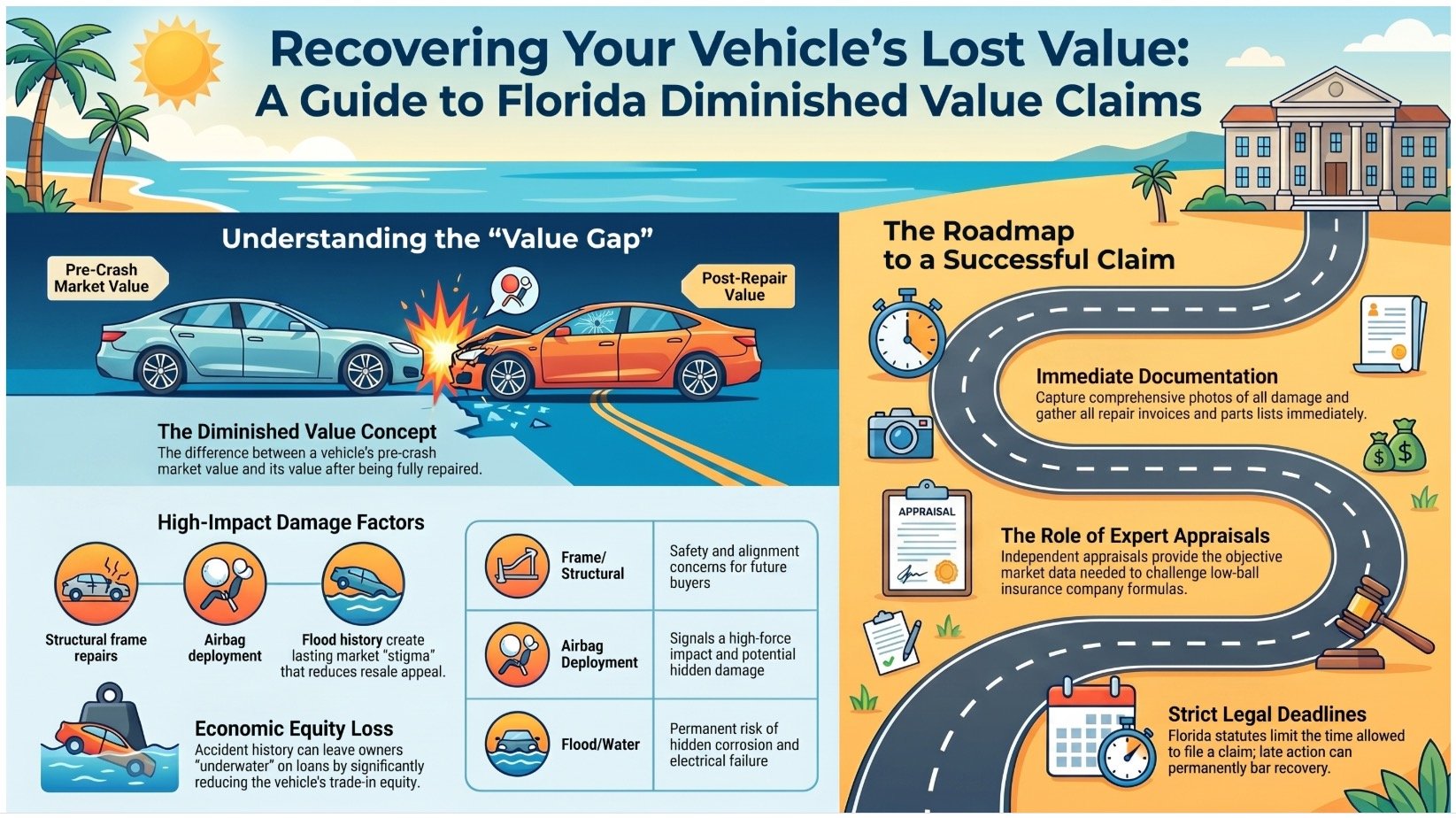
Common causes of a Florida diminished value claim often involve damage that remains significant in a vehicle’s history, even after repairs are completed. Rear-end collision damage, frame and structural damage, flood or water damage, and airbag deployment history may each reduce market value because buyers and appraisers view them as material risk factors. These circumstances can support a diminished value claim when the post-repair vehicle is worth less than it was before the incident.
Rear-End Collision Damage


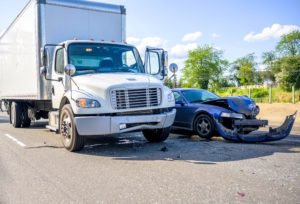
Rear-end collisions often cause damage that extends beyond a visible bumper repair, making them a frequent source of diminished-value claims in Florida. Even after careful repairs, a vehicle history report may show the crash, reducing buyer confidence and resale value. Damage to sensors, trunk components, exhaust parts, and rear safety systems can raise concerns for appraisers and purchasers. Insurance coverage disputes may arise when carriers undervalue the loss or argue that repairs completely returned market value. A lawyer evaluating these claims may review repair invoices, photographs, appraisals, and accident records to document the remaining loss. Effective settlement negotiation tactics can help present the claim clearly, support fair compensation, and protect the injured party’s financial interests after a rear-end crash.
Frame And Structural Damage
Beyond rear-impact repairs, frame and structural damage can create some of the most significant diminished-value concerns in a Florida vehicle claim. When a vehicle’s structural components are bent, cut, welded, or replaced, buyers may question its long-term safety, alignment, and resale reliability. Even after qualified repairs, the documented framework often remains a serious market concern. A careful claim review may examine repair records, measurement reports, photographs, and post-repair inspections to determine whether value loss is supported. Unrelated repair disputes can complicate this process when prior damage or maintenance issues are incorrectly tied to the collision.
Insurance appraisal variance may also arise when adjusters, appraisers, and independent evaluators assign different weights to structural history. Clear documentation helps protect fair recovery and supports service-minded advocacy for injured vehicle owners.
Flood Or Water Damage
When a vehicle is flooded or otherwise water-damaged, diminished value concerns may persist long after visible repairs are completed. Florida buyers often view prior water intrusion as a serious risk, even when mechanical systems appear functional. A careful waterline assessment can help document how high moisture reached, whether carpeting, wiring, connectors, or electronic modules were affected, and whether corrosion may later appear. Service records, photographs, inspection notes, and mold evidence may support the conclusion that the vehicle’s market appeal has been permanently reduced.
For individuals serving injured clients, families, or community members, these details matter because fair compensation should reflect more than repair invoices. A vehicle with a documented flood history may carry a lasting stigma, reduced resale value, and heightened concern among cautious purchasers in Florida’s used-vehicle market.
Airbag Deployment History
Prior water damage is not the only vehicle history issue that can create lasting market resistance, as airbag deployment often signals a collision serious enough to raise buyer concern. In Florida diminished value claims, this history may reduce resale appeal even when repairs appear complete and the vehicle operates safely. Buyers, dealers, and appraisers often view deployed airbags as evidence of structural force, possible frame involvement, or hidden safety concerns. A complete maintenance history and detailed service records can help show that proper replacement parts, diagnostic procedures, and inspections were performed.
However, documentation may not fully restore market confidence. For injured owners seeking fair treatment, understanding how airbag deployment affects value supports accurate claim evaluation and responsible advocacy after a serious accident. This factor often remains visible in vehicle reports.
Legal Rights of Florida Diminished Value Claim Injury Victims
Although diminished value claims often arise from property damage rather than bodily injury, Florida accident victims may have important legal rights after a repaired vehicle loses market value because of a crash history. Understanding the basics of diminished value helps injured parties, caregivers, and advocates recognize when compensation may extend beyond repair costs. Florida law may allow a claim against an at-fault driver’s insurer when evidence shows a measurable post-repair loss.
Diminished value claims may help Florida crash victims recover losses beyond vehicle repair costs.
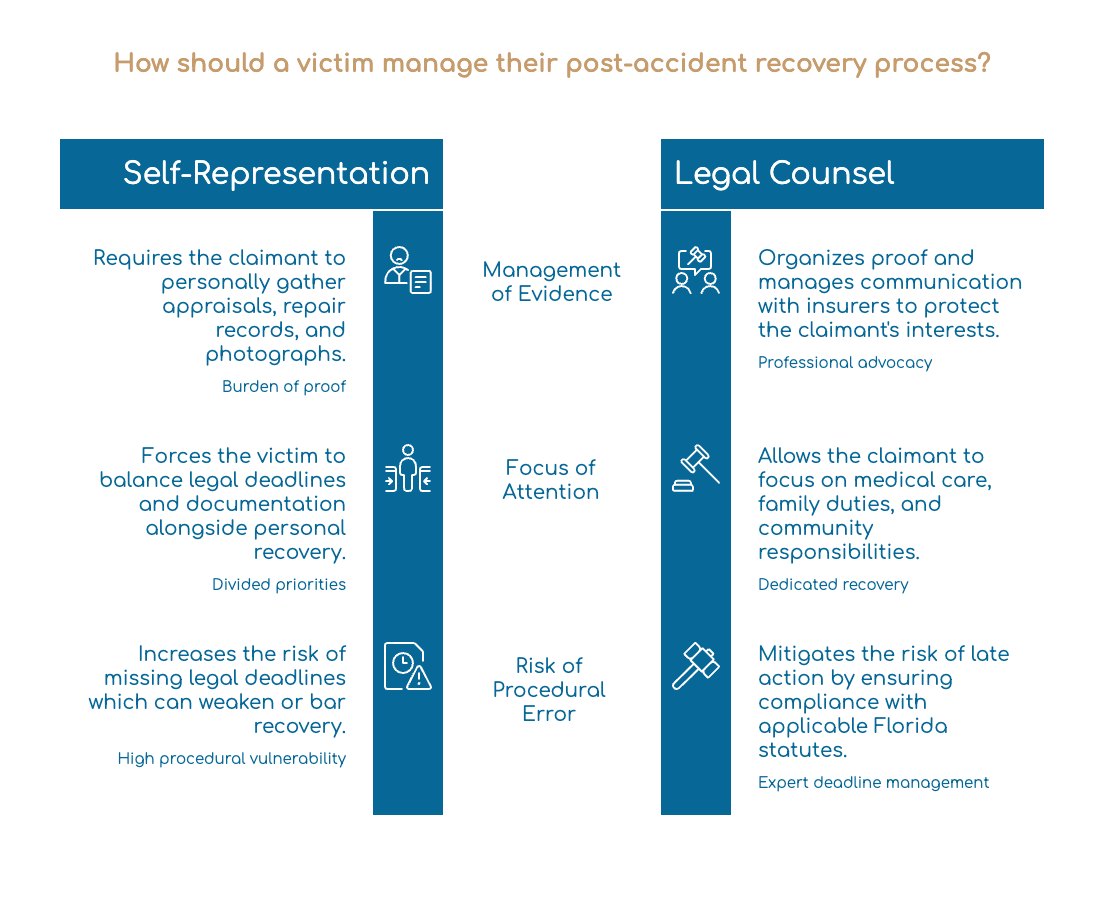
- Victims may seek payment for the difference between the vehicle’s pre-crash value and its repaired value.
- Reliable appraisals, repair records, photographs, and accident reports can support a fair presentation of damages.
- Legal deadline rules matter because late action can weaken or bar recovery under applicable Florida statutes.
- A lawyer may communicate with insurers, organize proof, and protect the claimant’s interests while the person focuses on medical care, family duties, and community responsibilities.
Each claim depends on coverage, fault, documentation, and timely action.
Why Do Florida Diminished Value Claim Injuries Happen?
Diminished value claim injuries occur when a vehicle involved in a collision may sustain a lasting loss of market value, even after proper repairs restore its appearance and function. Buyers, dealers, and appraisers often view accident history as a material defect, reducing confidence in the vehicle’s reliability and future resale potential. This economic harm can affect owners who depend on transportation for work, caregiving, and community service.
In Florida, these injuries may also arise when insurers undervalue the impact of prior damage or rely on narrow valuation methods. The Insurance dispute process can become necessary when a claimant’s documented loss conflicts with the insurer’s assessment. A settlement negotiation may then focus on repair records, comparable sales, expert appraisals, and the extent of structural or cosmetic damage. These claims arise because repaired property can still incur measurable financial loss, underscoring the need for fair evaluation and accountable insurance practices.
What Should You Do After a Florida Diminished Value Claim Injury?
After a Florida diminished value claim injury, an injured person should seek medical attention promptly, even when symptoms appear minor. The vehicle damage should be carefully documented with photographs, repair estimates, and records that show how the collision affected the market value. An attorney may then evaluate the injury and diminished value issues, protect the claimant’s rights, and address insurer disputes.
Seek Medical Attention
When an injury occurs in connection with a Florida diminished value claim, prompt medical evaluation is vital. A qualified medical provider can identify visible and delayed conditions, create treatment records, and help guarantee that the injured person receives appropriate care. This step also supports accurate communication among attorneys, insurers, and service professionals who seek a fair resolution.
Medical documentation may become important when Insurance settlement disputes involve the extent of harm linked to the collision. While repair estimate reviews address vehicle-related valuation concerns, medical records address the human impact and should be handled with equal care. An injured person should follow treatment instructions, attend follow-up appointments, and report new symptoms promptly. Timely care aids health, preserves important evidence, and promotes responsible advocacy for those affected by the incident.
Document Vehicle Damage
Because vehicle condition directly affects a Florida diminished value claim, the damaged automobile should be documented as thoroughly and promptly as possible. The owner should preserve clear Damage photos showing every affected area, including close views, wide angles, paint damage, frame concerns, deployed airbags, and any visible safety-related issues. Images should be taken before repairs begin, when doing so is safe and practical.
The owner should also gather repair estimates, inspection notes, towing receipts, and mileage records, since these materials help establish the vehicle’s condition before and after the collision. Service history, prior appraisals, and purchase documents may also support the claim. Careful organization allows insurers, evaluators, and other responsible parties to review the loss fairly, promoting accountability and informed decision-making after the incident.
Contact An Attorney
Once the vehicle damage has been documented and immediate records have been preserved, the owner should consider contacting an attorney familiar with Florida diminished value claims. Legal guidance can help the owner understand available remedies, deadlines, and the evidence needed to support a fair recovery. An attorney may assist with evaluating insurance disputes, reviewing policy language, and identifying whether the insurer has undervalued the loss.
Counsel can also guide the owner in preserving repair invoices, appraisal reports, photographs, and communications with adjusters. These materials often help establish the vehicle’s pre-loss condition, post-repair value, and remaining market loss. By seeking advice early, the owner supports an orderly claims process, protects important rights, and promotes a resolution that reflects accountability and fair treatment under Florida law for all parties involved.
Critical Evidence in a Florida Diminished Value Claim Injury Case
Critical evidence in a Florida diminished-value claim injury case helps establish how the accident affected the vehicle’s market value and supports a well-documented demand. Key materials often include: 1. Vehicle damage documentation, 2. Repair records, 3. Expert appraisal reports, and 4. Accident scene evidence. Each category can help demonstrate the extent of loss, the quality of repairs, and the relationship between the collision and the vehicle’s reduced resale value.
Vehicle Damage Documentation
In a Florida diminished value claim involving injury-related vehicle damage, documentation serves as the foundation for proving the extent, cause, and financial impact of the loss. Clear photographs, scene notes, vehicle condition images, and dated communications help show how the collision affected market value. This evidence supports fair Claim appraisal methods by giving evaluators objective details rather than assumptions. Thorough documentation also assists attorneys, adjusters, and advocates who seek to protect injured parties with accuracy and integrity. When records are organized, gaps in responsibility become harder to ignore. Proper documentation may also reduce insurance paperwork disputes, especially when insurers question the severity, timing, or relevance of claimed damage. Each item should connect the incident to measurable loss, helping establish a reliable record for negotiation or review.
Repair Records
Repair records build upon damage documentation by showing what was done to restore the vehicle, who performed the work, and whether the repairs fully addressed the collision-related harm. In a Florida diminished value claim, invoices, work orders, parts lists, labor entries, and completion notes can clearly show the repair path. These materials also support insurance documentation by confirming the scope, timing, and cost of corrective work. When organized carefully, they help demonstrate whether structural, cosmetic, or mechanical issues remained relevant after repair. Attorneys may review these records as part of settlement negotiation steps, ensuring the claim reflects the vehicle’s post-accident condition. Complete repair files promote fairness, accountability, and informed decision-making for injured parties seeking responsible compensation after a crash in Florida.
Expert Appraisal Reports
When a vehicle has been repaired after a collision, an expert appraisal report can provide an independent measure of the loss that may remain in its market value. In a Florida diminished value claim, this report may compare pre-loss condition, repair quality, mileage, vehicle history, and market data to determine residual loss. A qualified appraiser’s findings can help clarify valuation disputes, especially when an insurer relies on generalized formulas or incomplete assessments. The report may also support insurance negotiations by presenting well-organized conclusions that counsel, adjusters, and claim representatives can review carefully. For injured parties seeking fair treatment, this evidence promotes accountable decision-making and discourages undervaluation. Its strength depends on the appraiser’s credentials, methodology, documentation, and ability to explain conclusions clearly and credibly.
Accident Scene Evidence
Although valuation often depends on post-repair appraisal work, accident-scene evidence can provide essential context for a Florida diminished-value claim. Prompt collection of scene materials helps document how the collision occurred, the severity of impact, and whether the vehicle’s market perception was harmed by structural or cosmetic damage. Useful evidence may include photographic documentation of vehicle positions, debris fields, skid marks, traffic controls, weather conditions, and visible damage prior to towing or repair. Witness statements, police reports, and nearby surveillance footage may also support liability evidence, which can influence recovery discussions. For injured individuals and families seeking fair treatment, preserving this evidence serves a practical purpose. It helps appraisers, insurers, and legal professionals evaluate the claim with greater accuracy while reducing disputes over fault, causation, and loss of vehicle value.
Long-Term Effects of Florida Diminished Value Claim Injuries
The long-term effects of injuries from Florida diminished value claims can extend well beyond the initial repair process, often resulting in lasting financial losses for the vehicle owner. Reduced vehicle equity may affect resale value, trade-in options, and overall asset recovery after an accident. Ongoing claim challenges can also arise when insurers dispute valuation methods, causation, or the extent of market-based loss.
Lasting Financial Losses
After a vehicle has been repaired, diminished value can create a lasting financial loss that remains separate from the cost of fixing physical damage. This loss may follow the owner for years, especially when accident history reduces market confidence despite quality repairs. For individuals committed to responsible stewardship, recognizing this harm helps protect family resources and future transportation needs. A Florida diminished value claim may require careful documentation, expert appraisal, and informed Insurance negotiation strategies to show how the collision changed the vehicle’s market position. The financial effect often becomes clearer during long-term vehicle resale, when buyers, dealers, or valuation tools account for prior damage. Addressing the issue early can support fair recovery and reduce the burden caused by another party’s negligence.
Reduced Vehicle Equity
Beyond resale concerns, diminished value can also reduce an owner’s equity in a vehicle, creating financial strain that may not be immediately apparent. Equity represents the difference between a vehicle’s value and any remaining loan balance. After a collision, even high-quality repairs may not restore full market confidence, especially when crash documentation is part of the vehicle’s history. In the Florida Vehicle market, this reduction can leave an owner owing more than the vehicle is worth, limiting choices during trade-in, refinancing, or replacement. For households, caregivers, and service-focused workers who rely on dependable transportation, reduced equity can restrict mobility and financial stability. Recognizing this loss helps quantify the true impact of diminished value beyond surface-repair costs and immediate inconvenience. It also supports better planning after a serious accident.
Ongoing Claim Challenges
Often, diminished value claims pose ongoing challenges because the financial loss may remain in dispute long after vehicle repairs are complete. For injured claimants and families seeking stability, these unresolved losses can affect transportation decisions, loan obligations, and future trade-in options. An insurance denial may leave the owner responsible for proving that the repaired vehicle carries reduced market value. Valuation disputes can also require appraisals, repair records, accident history, and market comparisons, each of which demands time and careful organization. When the claim remains unsettled, service providers, caregivers, and advocates may need to help the injured person preserve documents and meet deadlines. A Florida diminished value claim injury lawyer can evaluate the evidence, address insurer objections, and pursue fair compensation that reflects lasting financial harm.
Proving Liability in Florida Diminished Value Claim Injury Cases
When a vehicle loses market value due to a crash, liability must be established before a Florida diminished value claim can be properly valued or pursued. This requires proof that another party’s conduct caused the collision and resulting loss. Attorneys may review police reports, witness statements, photographs, repair records, and evidence from the scene to connect fault to damage. Medical documentation can also help show the force and seriousness of the impact, supporting accident causation when injuries and property damage align.
Florida liability standards require careful attention to comparative fault, because any shared responsibility may affect recovery. A well-prepared claim identifies negligent actions, such as speeding, unsafe lane changes, distracted driving, or failure to yield. The evidence should show not only who caused the crash but also how the damage reduced the vehicle’s resale value. Clear liability proof also strengthens later insurance negotiation, allowing the injured party’s advocate to present the claim with accuracy, purpose, and service-minded diligence.
Dealing With Insurance Companies After a Florida Diminished Value Claim Injury
After liability is established by reliable evidence, the focus often shifts to how insurance companies assess the reduced value and the related injury claim. Adjusters may review repair quality, vehicle history, medical records, market data, and policy limits before assigning value. Their conclusions, however, may reflect internal guidelines rather than the full impact on the injured person.
Insurance negotiation tactics often include early settlement offers, requests for recorded statements, or narrow interpretations of appraisal reports. A careful response helps protect the claimant’s position while maintaining professionalism and respect for all parties involved. Claim documentation mistakes, such as missing repair invoices, inconsistent medical details, or unsupported valuation opinions, can weaken an otherwise valid demand.
A Florida diminished value claim injury attorney may help organize evidence, communicate with insurers, and identify unfair valuation methods. This guidance supports informed decisions and helps ensure that the claim is presented with accuracy, dignity, and service-minded concern.
What to Expect During a Florida Diminished Value Claim Injury Claim Process
A Florida diminished value claim injury process typically begins with an initial claim review, where liability, vehicle records, and supporting documentation are evaluated. The damage value assessment then establishes the claimed loss, followed by structured insurance negotiation steps focused on compensation. Once an agreement is reached, the settlement payment timeline depends on insurer processing, release requirements, and any unresolved claim issues.
Initial Claim Review
How does an initial claim review shape the direction of a Florida diminished value injury claim? It provides a structured first look at the facts, deadlines, and available support for the claimant’s position. During this stage, a lawyer examines accident details, vehicle history, repair records, medical information, and insurance documentation to identify strengths, gaps, and urgent concerns. Careful evidence preservation is addressed early, since photographs, reports, communications, and repair estimates may later support accountability. The review also helps determine whether notice requirements, policy terms, or liability disputes may affect the claim. For clients seeking fair treatment after a loss, this process creates order during uncertainty. It allows legal counsel to protect important information, guide responsible next steps, and prepare the claim for proper development.
Damage Value Assessment
During damage value assessment, the claim begins to move from general review toward a measured analysis of financial loss. The vehicle’s pre-loss condition, accident history, mileage, market demand, and post-repair value may be examined to estimate diminished value. A lawyer may coordinate qualified appraisals, review repair shop records, and compare similar vehicle sales to support a reliable valuation. This stage can also require careful attention to evidence deadlines, because late or incomplete materials may weaken the claim. For injured persons and families seeking fair recovery, organized documentation serves a practical and respectful purpose. It helps present the loss accurately, rather than being based on assumptions. The assessment should remain focused on verifiable data, clear timelines, and the real effect the crash has on the vehicle’s market value.
Insurance Negotiation Steps
Insurance negotiation often begins after the diminished value evidence has been organized, reviewed, and presented to the carrier in a clear demand. The insurer may compare appraisal findings, repair records, vehicle history, and market data before issuing a response. Careful advocates monitor for Documentation Gaps because missing estimates, photographs, or valuation support can weaken the claim. If the carrier raises Coverage Limits, policy language and applicable Florida law should be examined with precision. Claim Denials may require a written rebuttal addressing factual errors, disputed methodology, or incomplete review. During Policy Renewal periods, insureds may need clear communication to avoid confusion about pending rights. Each negotiation step should remain respectful, well-documented, and service-focused, helping the injured party pursue fair recognition of the diminished value of the vehicle.
Settlement Payment Timeline
A claimant’s settlement payment timeline in a Florida diminished value claim often depends on the insurer’s review process, the strength of the valuation evidence, and whether any disputes remain unresolved. After liability and damage issues are addressed, the carrier typically evaluates repair documentation, accident history, market data, and professional appraisal materials to confirm claim valuation. Careful preservation of evidence can help prevent delays, especially when photographs, invoices, and inspection reports document the loss.
During settlement negotiation, payment may follow soon after a written release is signed, though processing times vary by insurer and payment method. If the insurer requests clarification, the timeline may extend. A disciplined approach allows representatives to serve injured parties responsibly, protect documented losses, and pursue fair resolution without unnecessary delay or avoidable confusion.
Compensation for Florida Diminished Value Claim Injury Damages
After a serious collision, assurance for Florida reduced value claim harm damages may include more than the cost of physical repairs. A vehicle may lose market value because a history of crashes follows it, even when certified technicians restore it to safe operating condition. For wounded claimants, this loss can affect transportation stability, work responsibilities, and the ability to care for family or community needs.
A careful claim review often begins with Insurance documentation, including policy terms, estimates, photographs, and communications with adjusters. The repair timeline may also matter, since delays, supplemental repairs, or parts shortages can clarify the vehicle’s post-accident condition. Evidence preservation supports a fair valuation by protecting inspection records, appraisal reports, and evidence of the vehicle’s previous condition. During settlement negotiation, counsel may present these materials to show the measurable reduction in value and the practical impact of the collision. This organized approach helps ensure damages are evaluated with accuracy, fairness, and respect.
Economic vs Non-Economic Damages in Florida Diminished Value Claim Cases
In Florida diminished-value claim cases, economic damages typically include measurable losses such as reduced vehicle market value, repair costs, and related financial impacts. Non-economic losses may arise when the diminished value dispute is connected to injury-related consequences, including inconvenience, stress, or loss of use. Claim valuation often becomes challenging because insurers, appraisers, and claimants may disagree on evidence, causation, and the true extent of compensable harm.
Economic Damage Factors
When a Florida diminished value claim is evaluated, economic damage factors focus on measurable financial losses tied to the vehicle’s reduced market value after an accident. These factors commonly include pre-loss value, post-repair market value, repair quality, accident history, mileage, age, and comparable sales data. Vehicle depreciation is central because even well-repaired vehicles may sell for less once damage appears in public or insurer records. Documentation, including appraisals, repair invoices, photographs, and valuation reports, helps establish the loss with clarity. If an insurer undervalues or unreasonably denies a valid claim, insurance bad-faith concerns may arise. Attorneys reviewing these matters assess whether the financial evidence supports fair compensation, ensuring injured or affected owners can pursue lawful recovery while serving practical needs, family responsibilities, and community obligations with stability.
Non-Economic Losses
Although diminished value claims usually center on financial loss, non-economic losses may still affect how a Florida vehicle owner experiences the consequences of an accident. A repaired vehicle can raise ongoing concerns about safety, reliability, or future transportation needs, particularly when the owner transports family members, clients, or vulnerable passengers. These concerns do not always translate into a direct reduction in market size, yet they may shape the broader impact of the collision. In Florida, proving damages generally requires clear documentation, credible testimony, and a connection between the accident and the claimed harm. Non-economic effects are often harder to present because diminished value claims focus on measurable property loss. Insurance policy limitations may also restrict recovery, requiring careful review before setting expectations or offering service-focused guidance to the vehicle owner.
Claim Valuation Challenges
Valuation challenges often arise because Florida diminished value claims are grounded primarily in measurable economic loss, while related personal concerns may not fit neatly within compensable property damage. The central issue is usually the difference between the vehicle’s pre-loss value and its post-repair market value, supported by credible evidence. Non-economic effects, such as inconvenience or frustration, may influence a claimant’s experience but generally do not establish diminished value. Attorneys serving injured or financially burdened individuals often review repair records, market data, expert opinions, and insurer communications to identify reliable proof. Insurance timeline disputes can complicate this process when delays affect inspections, documentation, or settlement review. Appraisal report discrepancies may also create conflicting valuations, requiring careful analysis to protect the claimant’s interests while maintaining a fair, evidence-based presentation under Florida law.
When a Florida Diminished Value Claim Injury Case Goes to Trial vs Settlement
In a Florida diminished value claim involving injuries, the decision to settle or proceed to trial often depends on the strength of the evidence, the insurer’s valuation position, and the claimant’s broader damages. Insurance negotiation may resolve the matter when both sides recognize credible repair records, market loss opinions, medical documentation, and clear liability facts. Settlement timing can also matter, because early resolution may reduce stress for an injured claimant, while delayed settlement may allow a fuller picture of losses.
When an insurer undervalues the vehicle’s post-accident loss or disputes injury-related damages, trial may become necessary. A careful trial strategy should present the diminished-value claim and the injury’s impact in a clear, organized manner. Evidence strategy often includes expert appraisals, photographs, repair invoices, comparable sales data, and testimony explaining how the crash affected value and daily life. The goal remains practical accountability, supporting fair compensation through either negotiated resolution or courtroom proof.
Florida Laws That May Affect Your Florida Diminished Value Claim Case
Florida law can shape a diminished value claim through rules governing negligence, insurance coverage, damages, and the timing of legal action. These rules influence how responsibility is evaluated, what evidence matters, and how a claimant may present losses after a collision. A careful legal review can help protect fair recovery while supporting honest resolution.
- Negligence principles: Fault must be supported by evidence, including police reports, witness accounts, photographs, and repair records.
- Insurance duties: Policy language may affect available coverage, while insurance investigation strategies can influence how damage, causation, and loss of value are assessed.
- Damage proof: Florida claims often require credible documentation showing the vehicle’s condition before and after repair, including market data and expert opinions.
- Appraisal reliability: Vehicle appraisal standards help assess diminished value consistently, serving injured owners, insurers, and courts by promoting accuracy, transparency, and responsible decision-making throughout the claims process.
The Statute of Limitations for Florida Diminished Value Claim Injury Cases
When a diminished value claim arises after a collision, the deadline for taking legal action can be as important as the evidence proving the loss. In Florida, time limits may depend on the nature of the claim, including whether it is pursued through an insurance policy, against an at-fault driver, or alongside an injury-related action. Missing the applicable limitation period can prevent recovery, even when the vehicle has clearly lost market value.
Careful attention to Insurance documentation timelines supports timely notice, claim review, and preservation of records. Repair invoices, accident reports, photographs, and communications with insurers may become more difficult to obtain as time passes. Expert valuation evidence should also be obtained while vehicle condition, repair quality, and market data remain reliable. For individuals focused on helping families, patients, clients, or community members regain stability after a crash, respecting these deadlines preserves the opportunity to seek fair compensation under Florida’s legal framework.
How a Florida Diminished Value Claim Injury Lawyer Can Help You
After a collision, a Florida diminished value claim injury lawyer can help identify the full extent of a vehicle’s lost market value and determine how that loss fits within the broader claim. This support may guide injured individuals seeking to protect family stability, fulfill responsibilities, and serve others without incurring avoidable financial burdens.
- Valuation review: The lawyer may review repair records, market comparisons, and appraisals to support a fair diminished-value calculation.
- Evidence timelines: Counsel can organize documentation, repair histories, photographs, and expert opinions so important proof remains clear and usable.
- Insurance pitfalls: The lawyer may address low valuations, delayed responses, policy disputes, or statements that could weaken recovery.
- Claim coordination: When injuries, property damage, and vehicle value loss overlap, legal guidance can help present the claim in an orderly, credible manner.
Through this structured assistance, the claim may reflect both economic loss and practical impact.
When to Contact a Florida Diminished Value Claim Injury Lawyer
Because vehicle value loss can become harder to prove as time passes, an injured person should consider contacting a Florida diminished value claim injury lawyer soon after the damaged vehicle has been inspected, repaired, or declared repairable. Early contact helps preserve records that may assist a fair assessment of market loss, including repair invoices, photographs, appraisals, and communications with the insurer.
The timing of evidence collection is important because post-repair conditions, mileage changes, and subsequent damage can complicate the claim. Prompt review may also help identify deadlines, policy provisions, and documentation gaps before they become obstacles. If an insurer questions the loss, delays payment, undervalues the claim, or issues a denial, legal guidance may help organize a response grounded in facts and focused on the injured person’s needs.
Common Insurance denial reasons may include disputed liability, insufficient proof of diminished value, policy exclusions, or arguments that repairs restored the vehicle’s full market value after the collision.
Why You Need an Experienced Florida Diminished Value Claim Injury Lawyer
Although a diminished value claim may appear to depend only on repair records and market estimates, an experienced Florida diminished value claim injury lawyer can help evaluate the legal, factual, and insurance issues that affect recovery. After a collision, insurers may question the vehicle’s pre-loss condition, the quality of repairs, or whether the reduction in resale value is adequately proven. Counsel can organize appraisals, photographs, invoices, Carfax Reports, and Proof of Loss materials so the claim is presented with accuracy and care.
This guidance also supports injured people who must manage medical treatment, work disruption, and family duties while seeking fair compensation. A lawyer can identify policy deadlines, preserve evidence, and respond to undervaluation tactics without placing unnecessary burdens on the claimant. By connecting vehicle damage evidence with applicable Florida insurance principles, experienced representation helps promote an orderly process, protects the claimant’s position, and supports a result that reflects the vehicle’s actual post-accident loss.
How to Choose the Right Florida Diminished Value Claim Injury Lawyer for Your Case
When selecting a Florida diminished value claim injury lawyer, the claimant should consider whether the attorney has direct experience with vehicle valuation disputes, insurance negotiations, and accident-related loss documentation. A qualified lawyer should understand how repaired damage affects resale value and how to present that loss with credible appraisals, repair records, and market comparisons.
The claimant may also evaluate whether the lawyer communicates clearly, respects client concerns, and supports organized case preparation. This includes explaining Medical documentation steps when injuries are connected to the accident, because treatment records may influence related claims and settlement discussions. The lawyer should also provide guidance on Insurance claim timelines, including notice requirements, insurer response periods, and deadlines that may affect recovery.
A careful selection process helps protect the claimant’s interests while promoting responsible advocacy. The right lawyer should demonstrate professionalism, responsiveness, and a service-focused approach that helps injured individuals pursue fair compensation with dignity and informed judgment.
About The Law Offices of Anidjar & Levine
For individuals seeking legal guidance after a vehicle accident, The Law Offices of Anidjar & Levine provides representation focused on protecting a claimant’s financial recovery and legal rights. The firm assists clients with diminished value claims by evaluating vehicle loss, insurance conduct, and related accident evidence. Its attorneys approach each matter with disciplined case preparation, aiming to help injured individuals and vehicle owners pursue fair compensation while reducing avoidable burdens.
The firm’s work may involve Local Accident Investigation, consultation with repair professionals, review of market value records, and communication with insurers. Through careful use of Evidence Preservation Tools, the legal team can help secure photographs, estimates, appraisals, police reports, and other materials that support a claim. This service-centered approach reflects a commitment to helping clients restore stability after a collision. By providing structured guidance and responsive advocacy, The Law Offices of Anidjar & Levine seeks to support those facing financial disruption after a Florida accident.
Frequently Asked Questions
Does Diminished Value Apply to Leased Vehicles in Florida?
Yes, diminished value may apply to a leased vehicle in Florida when another party’s negligence reduces its market value after repair. The claim often depends on lease terms, ownership rights, and insurer liability. Because the leasing company usually owns the vehicle, it may control or share claim rights. A careful review helps protect all responsible interests, ensuring fair recovery and service to those affected by the loss.
Can Prior Accidents Reduce My Diminished Value Claim?
Yes. A Prior Accident can reduce a diminished value claim, as insurers may argue the vehicle had already lost market value before the latest damage. The claimant should meet the Evidence Requirements by providing repair records, valuation reports, photographs, and history reports that separate older damage from new loss. Careful documentation supports fair evaluation, encourages responsible resolution, and helps ensure the claim reflects only the additional value reduction caused by the recent collision.
Should I Get an Independent Diminished Value Appraisal?
Yes, an independent diminished value appraisal is often advisable when a claimant needs credible valuation support. Independent appraisal benefits include objective loss measurement, clearer repair-impact analysis, and stronger negotiation positioning. The strength of evidence matters because insurers may rely on internal estimates that minimize losses. A qualified appraiser can provide a structured report that helps decision-makers evaluate fairness, accountability, and proper compensation, while supporting a service-minded effort to resolve the claim responsibly.
Can I Claim Diminished Value After Poor Repairs?
Yes, diminished value may be claimed after poor repairs when the vehicle remains worth less than it was in its pre-repair condition. The claimant should gather documented estimates, repair invoices, photographs, and an independent appraisal to show remaining defects and market loss. A service-minded approach requires clear evidence, fair valuation, and careful communication with insurers. If liability or repair quality is disputed, professional guidance can help protect the claimant’s position.
Do Luxury Cars Receive Higher Diminished Value Payouts?
Yes, luxury cars often receive higher diminished value payouts because market perception, repair history, and brand reputation affect resale loss more sharply. High-value vehicles may require specialized appraisals, documented repair quality, and evidence of comparable sales. However, recovery depends on liability facts, insurer evaluation, and Policy Limits. A service-minded claimant should present clear records, act promptly, and ensure the claim reflects actual market loss, not assumption or prestige alone.
—————————
A Florida diminished value claim can affect an injury victim’s financial recovery long after repairs are completed. Understanding available rights, documenting losses, and pursuing fair compensation require careful attention to insurance practices and legal deadlines. An experienced attorney can evaluate the claim, address disputed valuations, and protect the client’s interests throughout the process.
The Law Offices of Anidjar and Levine provides informed guidance to individuals seeking accountability and full recovery after an accident that has diminished a vehicle’s value.
A Florida Car Accident Lawyer can help victims navigate these claims and pursue fair compensation.