The Law Offices of Anidjar and Levine protect your rights after a Jacksonville rear-end collision by gathering thorough evidence, preserving medical records, and documenting scene details promptly.
Our team negotiates with insurers to counter lowball offers, interprets technical factors such as vehicle speed and brake dynamics under Florida statutes, and prepares a tailored settlement strategy that maximizes compensation while minimizing delays.
We also assess trial versus settlement options, consider comparative fault impacts, and coordinate with medical and reconstruction experts to strengthen your claim, ensuring you understand every next step.
For help from a Jacksonville Car Accident Lawyer, contact us today.
Main Takeaways
- Hire a Jacksonville rear‑end accident lawyer experienced in negotiating with insurers to secure fair compensation.
- Ensure the attorney gathers comprehensive evidence: photos, dash‑cam footage, police reports, witness statements, and medical records.
- The lawyer should assess technical factors (speed, braking distance, road conditions) under Florida statutes to establish liability.
- An attorney can file claims within Florida’s four‑year personal injury and two‑year wrongful‑death statutes of limitations.
- Evaluate settlement versus trial with the lawyer, weighing certainty of payment against potential higher jury verdicts.
How We Can Help With Your Jacksonville Rear-End Car Injury Accident Claim
When you’re involved in a rear‑end collision in Jacksonville, the aftermath can quickly become overwhelming, but we’re here to guide you through every step of the claim process.
We begin by gathering comprehensive evidence, including detailed witness statements that corroborate your account and strengthen your position. Our team coordinates with medical professionals and law enforcement officials to secure records that substantiate injuries and damages.
By organizing this information early, we can anticipate settlement timelines and set realistic expectations for you. We negotiate directly with insurers, leveraging our skills to counter lowball offers and ensure that compensation reflects both current and future needs.
Throughout, we keep you informed, explaining each development in clear terms while advocating relentlessly on your behalf. Our commitment to serving others drives us to pursue every viable avenue to achieve a fair resolution that respects your rights and restores stability.
Understanding Jacksonville Rear-End Car Accident Injury Cases
If you’ve been hit from behind in Jacksonville, the legal landscape surrounding rear‑end collisions is shaped by specific fault rules, traffic statutes, and insurance regulations that we must navigate jointly.
We begin by examining how brake dynamics influence liability; a sudden loss of traction or delayed response often signals negligence, especially when the leading vehicle’s speed was reasonable.
Impact thresholds also matter, as the force transferred during a collision determines injury severity and the plausibility of a claim.
Jacksonville courts consider both the distance traveled before impact and the vehicle’s velocity to assess whether the rear driver breached a duty of care.
By interpreting these technical factors within the framework of state statutes, we can pinpoint accountability and guide you toward appropriate compensation.
Our collaborative approach guarantees that every detail of the accident is scrutinized, reinforcing a strong legal strategy that serves your best interests.
Common Causes of Jacksonville Rear-End Car Injury Accidents
We see that tailgating and distracted driving often set the stage for rear‑end collisions, especially when drivers fail to maintain a safe following distance.
Sudden stops, combined with poor weather, road conditions, or vehicle maintenance failures, can quickly turn a routine trip into a crash.
Tailgating Pressure and Distracted Driving
Although tailgate pressure and distracted driving may seem unrelated, both create the perfect storm for rear‑end collisions on Jacksonville’s busy roadways.


We observe that driver distraction reduces a motorist’s ability to monitor the distance to the vehicle ahead, while tailgating pressure forces the following driver to react quickly. When a distracted driver’s reaction time lengthens, the trailing vehicle often can’t stop in time, resulting in a crash.
OUR CONSULTATIONSARE FREE
START YOUR FREE CASE REVIEW

We advise that motorists maintain a safe following distance and eliminate distractions such as smartphones or in‑car entertainment. By prioritizing attentiveness and allowing ample time to respond, we can protect fellow drivers and reduce the frequency of severe rear‑end accidents on Jacksonville’s highways.
Sudden Stops and Tailgating
Tailgating combined with sudden stops creates a hazardous mix that frequently leads to rear‑end collisions on Jacksonville’s busy streets.
We observe that drivers who fail to maintain a proper following distance leave little room to react when the vehicle ahead brakes abruptly. In heavy traffic, brake fade can compound the problem, reducing stopping power just when it’s needed most.
When a driver lifts their foot off the accelerator and the brakes engage, the following car often lacks sufficient time to respond, especially if the driver is tailgating. We advise motorists to maintain a safe buffer, monitor traffic flow, and adjust speed to avoid relying on compromised brakes.
Poor Weather and Road Conditions
During rain, fog, or icy pavement, traction drops dramatically and stopping distances increase, turning ordinary driving into a high‑risk activity for rear‑end collisions on Jacksonville’s streets.
We observe that ice accumulation on roadways creates a thin, invisible layer that reduces tire grip, while visibility reduction from heavy rain or dense fog impairs a driver’s ability to react promptly.
In these conditions, even a modest speed can become hazardous, and the margin for error narrows considerably.
We advise motorists to increase following distances, reduce speed, and use headlights to mitigate visibility issues.
Vehicle Maintenance Failures
We notice that neglected vehicle maintenance often leads to rear‑end collisions on Jacksonville’s busy streets, as worn brakes, faulty tires, and malfunctioning lights can suddenly impair a driver’s ability to stop or signal.
We see that ignored brakes reduce stopping power, especially in heavy traffic, and corroded wiring can cause sudden loss of power‑assist or brake‑light function.
When a driver can’t anticipate a slowdown, the following vehicle may have insufficient time to react, resulting in a crash.
We advise regular inspections, timely brake servicing, and thorough electrical system checks to prevent these failures.
Legal Rights of Jacksonville Rear-End Car Accident Victims


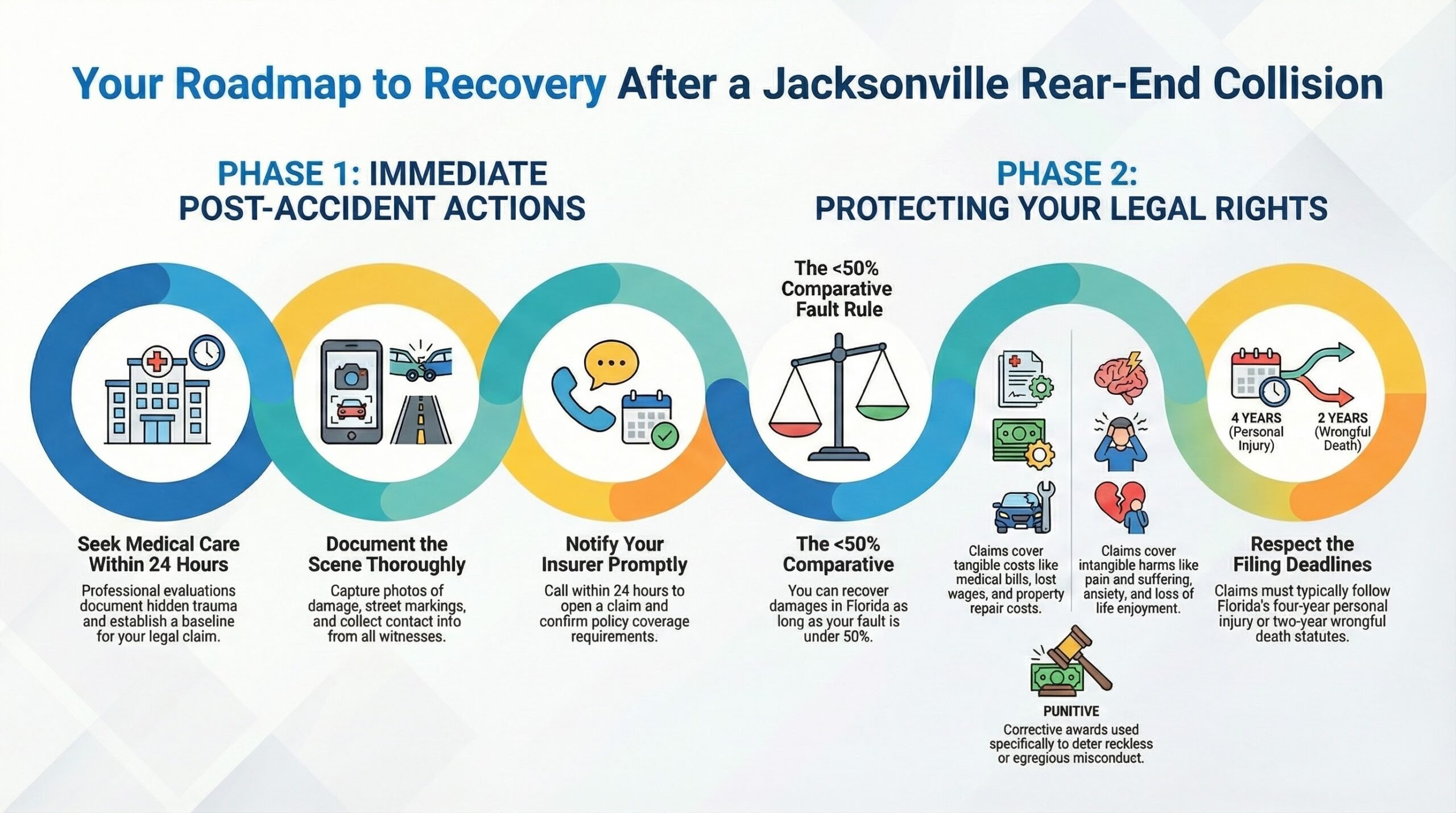
When a rear‑end collision occurs on Jacksonville’s busy streets, victims immediately acquire specific legal protections that guide how we pursue compensation. We must understand that Florida’s comparative fault rule allows us to recover damages even if we share some blame, provided our liability is less than 50 percent.
Insurance disputes often arise when insurers attempt to minimize payouts; knowing our rights equips us to challenge unjust denials. By acting promptly, we preserve evidence, secure medical records, and document loss, thereby strengthening our claim.
Our commitment to serving others drives us to protect every victim’s entitlement to fair restitution.
- Right to medical treatment without delay
- Right to full reimbursement for property damage
- Right to claim lost wages and future earning capacity
- Right to pursue compensation despite partial fault
- Right to contest unfair insurance practices through litigation
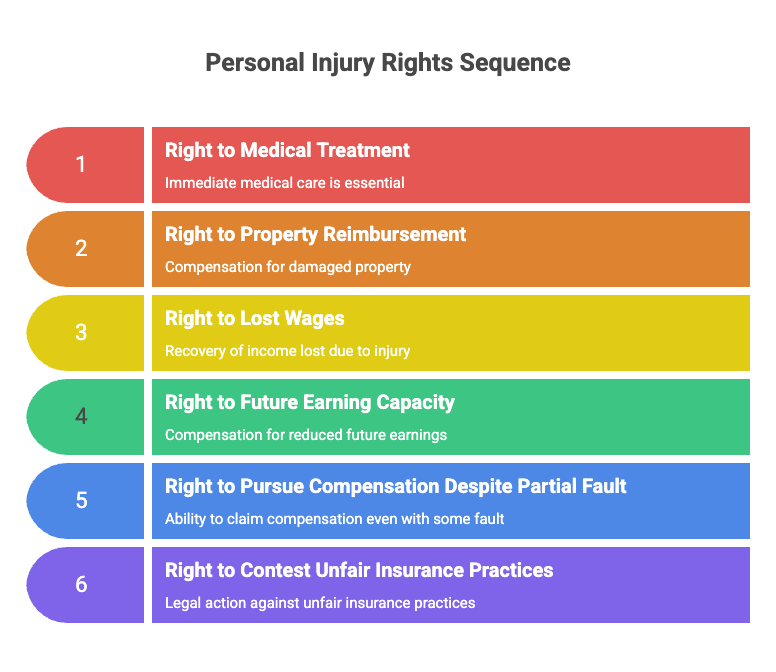
These protections empower us to advocate effectively for those injured in rear‑end crashes.
Steps to Take After a Jacksonville Rear-End Car Accident
We should first make certain that anyone injured receives prompt medical attention, because health and documentation are vital for both recovery and legal claims.
Next, we must carefully document the scene—taking photos, noting vehicle positions, and gathering witness information—to preserve reliable evidence.
Finally, we contact our insurance company without delay, providing a clear account of the incident while preserving our right to pursue further compensation.
Secure Medical Attention
Typically, after a Jacksonville rear‑end collision, we prioritize securing immediate medical attention, even if injuries seem minor, because delayed symptoms can emerge later and complicate both health outcomes and legal claims.
We begin with an immediate assessment at the scene, calling emergency services if needed and ensuring that each person receives a professional evaluation.
Even when you feel fine, we advise seeing a medical provider within 24 hours to document any hidden trauma. Prompt documentation strengthens your case and guides appropriate treatment.
After the initial visit, we schedule follow‑up care to monitor recovery, address emerging issues, and maintain a clear medical record. Consistent follow‑up care demonstrates diligence, supports your claim, and protects your long‑term recovery.
Document Scene Evidence
After we’ve made certain everyone receives prompt medical care, the next step is to document the accident scene thoroughly.
We should first photograph evidence from multiple angles, capturing vehicle damage, street markings, and any debris. Clear, well‑lit images help insurers and courts understand the impact.
While we set up our camera, we must also begin collecting witness statements, noting each person’s name, contact information, and a concise account of what they observed. We encourage witnesses to describe vehicle speeds, braking, and any unusual behavior.
All notes should be written promptly, using precise language and timestamps. By securing visual records and reliable testimonies, we build a solid factual foundation that supports our client’s claim and upholds our commitment to serving others responsibly.
Notify Insurance Promptly
Promptly notifying your insurance company is essential to protect your rights and guarantee a smooth claims process after a Jacksonville rear‑end collision.
We advise you to call your insurer within the first 24 hours, providing a concise account of the incident and confirming that a formal claim will be opened. Prompt reporting demonstrates good faith and helps avoid policy exceptions that could jeopardize coverage.
When you speak with the adjuster, supply the police report number, photographs, and witness contact information, and ask for a written acknowledgment of your claim.
Keep a detailed log of all communications, noting dates, times, and the names of representatives. This disciplined approach makes certain that your documentation aligns with the insurer’s requirements and safeguards your ability to recover damages efficiently.
How a Jacksonville Rear-End Car Accident Lawyer Can Help You
When a rear‑end collision occurs on Jacksonville’s busy streets, the aftermath often brings medical bills, vehicle repairs, and insurance disputes that can overwhelm anyone. We step in to guide you through the intricacies, ensuring your rights are protected while we focus on your recovery.
Our team provides all‑inclusive medical advocacy, coordinating with healthcare providers to document injuries and secure necessary treatment. Simultaneously, we develop a tailored settlement strategy to maximize compensation and minimize delays.
By handling negotiations and paperwork, we free you to concentrate on mending and returning to daily life.
- Conduct a thorough investigation of the accident facts
- Liaise with medical professionals for accurate injury documentation
- Negotiate with insurers to achieve fair settlement terms
- Draft and file legal motions when required
- Keep you informed at every stage of the claim process
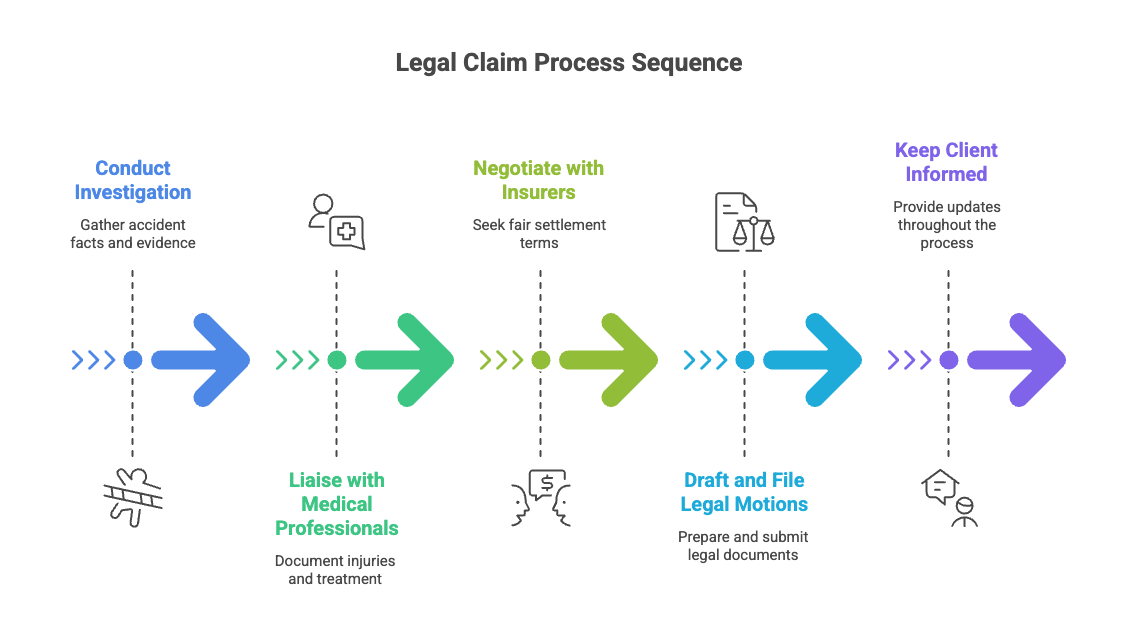
Our commitment is to serve your best interests with skill and dedication.
Long-Term Effects of Jacksonville Rear-End Car Accident Injuries
We recognize that chronic pain often persists long after the initial injury, requiring ongoing medical management and affecting daily activities.
Emotional trauma can manifest as anxiety or depression, influencing both personal relationships and professional performance.
Additionally, many victims experience lasting mobility limitations that restrict their ability to work, drive, or engage in routine tasks.
Chronic Pain Management
Typically, victims of rear‑end collisions in Jacksonville experience chronic pain that persists long after the initial injury, and this lingering discomfort can markedly impair daily functioning and quality of life.
We guide our clients through thorough medication management, ensuring that prescriptions are optimized for efficacy while minimizing side effects.
Simultaneously, we teach mindfulness techniques that help patients focus on breath and body sensations, reducing perceived pain intensity and improving coping skills.
By combining pharmacologic oversight with evidence‑based mindfulness practices, we create a balanced plan that addresses both physical and psychological dimensions of chronic discomfort.
Our approach emphasizes consistency, regular assessment, and adjustments as needed, fostering sustainable relief and enabling clients to regain independence and contribute meaningfully to their communities.
Emotional Trauma Impact
Rear‑end collisions often leave victims grappling with emotional trauma that persists long after physical injuries have mended, and this psychological aftermath can erode confidence, disrupt relationships, and impair occupational performance.
We acknowledge that these effects may surface as heightened anxiety, intrusive memories, and a pervasive sense of vulnerability that can diminish our ability to serve others effectively.
When a crash reactivates childhood triggers, it can destabilize previously learned coping mechanisms, leading to chronic stress and emotional withdrawal.
By recognizing these patterns, we can implement targeted therapeutic strategies, encourage supportive networks, and foster resilience.
Our commitment to addressing emotional trauma guarantees that survivors regain confidence, maintain healthy relationships, and continue contributing meaningfully to their communities.
Long‑Term Mobility Limitations
Experiencing lingering pain and reduced range of motion after a rear‑end collision often signals long‑term mobility limitations that can reshape daily life.
We appreciate that these limitations affect not only personal independence but also the ability to serve clients, families, and communities effectively.
Chronic joint stiffness, nerve damage, or spinal injuries may require assistive devices such as braces, walkers, or custom‑fitted wheelchairs to maintain functional movement.
We also encourage participation in adaptive sports, which can restore confidence, improve cardiovascular health, and demonstrate resilience to those we support.
Proving Liability in Jacksonville Rear-End Car Accident Cases
When a vehicle strikes the back of another in Jacksonville, establishing liability hinges on proving that the driver of the rear‑end car failed to observe a reasonable standard of care.
We begin by gathering all available evidence preservation, including dash‑cam footage, police reports, and vehicle telemetry, which can illustrate the exact moment of impact and the speed of each car.
We also secure photographs of the scene, skid marks, and damage patterns, as these details often reveal whether the front‑end driver stopped abruptly or the rear‑end driver was distracted.
Next, we assess witness credibility; statements from passengers, bystanders, or first responders must be corroborated and evaluated for consistency and potential bias.
By cross‑referencing physical evidence with reliable testimony, we construct a compelling narrative that demonstrates negligence, thereby strengthening the client’s claim for compensation.
This systematic approach guarantees that every relevant fact is presented clearly and persuasively.
Dealing With Insurance Companies After a Jacksonville Rear-End Car Accident
After establishing liability through thorough evidence collection, we turn our focus to managing the insurance process. We guide clients through settlement timelines, ensuring they understand each stage from initial claim filing to final payment.
By anticipating common claim denials, we prepare solid documentation to address insufficient reasoning and protect the client’s right to compensation. We also decode adjuster tactics, recognizing when offers are lowball or when pressure is applied to expedite acceptance without full recovery.
Our team monitors medical liens closely, verifying that healthcare providers’ claims are accurate and that any lien reductions are negotiated on the client’s behalf. Throughout, we maintain transparent communication, updating clients on progress and explaining any procedural nuances.
This proactive approach minimizes delays, safeguards financial interests, and upholds our commitment to serving those affected by rear‑end collisions in Jacksonville.
What to Expect During a Jacksonville Rear-End Car Accident Claim Process
We’ll start by reviewing the initial police report and establishing the medical evaluation timeline, so you understand the evidence and health documentation that will shape your claim.
Next, we’ll outline effective insurance negotiation strategies, highlighting how to present your case and respond to adjuster offers.
Finally, we’ll cover the crucial litigation preparation steps to ensure you’re ready to protect your rights if settlement discussions stall.
Initial Police Report
If a rear‑end collision occurs in Jacksonville, the first official document we’ll rely on is the police report, which captures the essential facts and initial assessments made at the scene.
We advise you to make certain the officer records all witness statements, as they often provide unbiased accounts that strengthen your claim.
Prompt evidence preservation—photographs of vehicle damage, skid marks, and road conditions—helps corroborate the narrative and prevents loss of vital details.
We recommend obtaining a copy of the report as soon as it becomes available, reviewing it for accuracy, and noting any discrepancies.
Medical Evaluation Timeline
When a rear‑end collision occurs, the medical evaluation timeline becomes a pivotal component of your claim, and we guide you through each step to guarantee no detail is overlooked.
First, we recommend an immediate examination to document visible injuries and establish a baseline. Within days, we schedule post-accident monitoring to track symptom progression and make certain that delayed effects are captured.
If initial findings suggest deeper issues, we promptly arrange specialist referrals to prevent gaps in treatment.
Throughout weeks and months, we coordinate follow‑up appointments, imaging studies, and therapy sessions, maintaining a thorough record for your claim.
Our systematic approach safeguards your health, supports accurate injury assessment, and strengthens the evidentiary foundation needed for a fair resolution.
Insurance Negotiation Strategies
Navigating the insurance negotiation phase after a Jacksonville rear‑end collision requires us to remain proactive and methodical, ensuring that every piece of evidence is presented clearly and that the insurer’s offers are thoroughly scrutinized.
We begin by reviewing the policy tactics that shape the insurer’s liability limits and procedural rules, then we craft a demand strategy that quantifies medical expenses, lost wages, and non‑economic damages.
Throughout the process, we maintain consistent communication, supplying documentation promptly while asking clarifying questions to prevent misinterpretation.
When offers fall short, we counter with reasoned adjustments, referencing precedent and the strength of our evidence.
Litigation Preparation Steps
Because a rear‑end collision can quickly move from settlement talks to courtroom proceedings, we begin litigation preparation by assembling a thorough case file that includes police reports, medical records, eyewitness statements, and detailed photographs of vehicle damage.
Next, we focus on evidence preservation, securing video footage, repair estimates, and any electronic communications that support liability.
We then conduct deposition preparation, briefing witnesses on likely questions and coaching them to convey facts clearly.
Throughout, we coordinate with medical experts to quantify injuries and with accident reconstruction professionals to illustrate causation.
Our team drafts pleadings, files motions, and establishes a discovery schedule that aligns with court deadlines.
Compensation for Jacksonville Rear-End Car Accident Damages
Next, we calculate the total monetary impact, including lost wages from missed work, medical bills, and repair costs for damaged property. Our team meticulously documents each expense, using pay stubs, employer statements, and repair estimates to substantiate the claim.
We also assess the degree of fault assigned to each party, as Florida’s comparative‑fault system reduces recovery proportionally to any negligence on the plaintiff’s side.
By presenting a well‑organized, factual dossier, we help the injured party recover the full amount needed to restore financial stability and repair their vehicle, while adhering to legal standards and ethical responsibility.

Economic vs Non-Economic Damages in Jacksonville Rear-End Car Accident Cases
We’ll explain how medical losses and other out‑of‑pocket expenses form the economic damages you can claim, while pain and suffering fall under non‑economic damages that compensate for intangible harms.
In some cases, punitive damages may also be available if the at’s conduct was especially reckless.
Understanding these distinctions helps us assess the full value of your claim and pursue the compensation you merit.
Medical Medical Losses
We evaluate medical losses by separating economic from non‑economic damages, ensuring that each category is clearly quantified and justified.
We gather medical expenses from invoices, pharmacy receipts, and insurance statements, then match them to treatment records that document every visit, procedure, and follow‑up.
By reviewing these records, we confirm that charges reflect necessary care and that no duplicate billing occurs.
We also assess projected costs for ongoing therapy, rehabilitation, and any future surgeries, presenting them as concrete, recoverable amounts.
Our analysis respects the victim’s need for thorough representation while maintaining the objectivity required to persuade insurers and courts.
This disciplined approach safeguards the client’s right to full compensation for genuine medical losses.
Pain And Suffering
We explain how these losses differ from medical expenses, emphasizing that they encompass anxiety, loss of enjoyment, and lingering psychological effects.
In Jacksonville, statutory caps may limit recoverable amounts, yet we assess each case individually to maximize compensation within legal boundaries.
Our team provides compassionate counseling to help clients articulate the intangible impacts of their injuries, ensuring that the full scope of non‑economic harm is documented.
By integrating these narratives with expert testimony, we strengthen the claim for fair restitution.
This approach balances legal constraints with the genuine need for holistic recovery.
Punitive Damages
While we’ve detailed how pain and suffering quantify non‑economic loss, it’s equally important to distinguish punitive damages from both economic and non‑economic damages in Jacksonville rear‑end collisions.
Punitive damages serve a corrective purpose; they aren’t compensation for the victim but a deterrent against egregious conduct. In Jacksonville, courts may award exemplary punishments when a driver’s recklessness rises to wantful misconduct, signaling that mere negligence is insufficient.
These awards differ from excessive fines, which are statutory penalties imposed by government agencies.
When we assess a claim, we evaluate the plaintiff’s actual losses—medical bills, lost wages, and emotional distress—separately from any punitive component. By clarifying this distinction, we help victims understand the full scope of potential recovery and the legal mechanisms that protect public safety.
When a Jacksonville Rear-End Car Accident Case Goes to Trial vs Settlement
If a rear‑end collision in Jacksonville escalates beyond settlement negotiations, we must evaluate the distinct pathways of trial and settlement.
In a jury trial, we present evidence, witness testimony, and legal arguments before a panel of citizens who’ll determine liability and damages. This process demands meticulous preparation, expert witnesses, and a clear narrative that resonates with jurors.
Settlement dynamics, by contrast, involve negotiations between parties, often facilitated by mediators, to reach a mutually agreeable compensation package without exposure in court.
Settlements can be faster, less costly, and preserve privacy, but they may limit the recovery amount compared to a favorable verdict.
We advise clients to weigh the certainty of a negotiated settlement against the potential upside of a trial, considering factors such as the case’s intricacy, the strength of the evidence, and the emotional toll of prolonged litigation. Our role is to guide you through both avenues, ensuring informed decisions that prioritize your best interests.
The Statute of Limitations for Jacksonville Rear-End Car Accident Injury Cases
Because the clock starts ticking the moment a rear‑end collision occurs, we must act promptly to protect our right to file a claim. In Florida, the general statute of limitations for personal injury is four years, but we recognize nuanced variations that can affect Jacksonville rear‑end cases.
If the injured party is a minor or deemed mentally incapacitated, the period may be tolled until the disability ends, extending the deadline. Additionally, discovery tolling can pause the clock when parties engage in formal discovery, allowing us to gather crucial evidence without losing time.
We must also consider that wrongful death claims have a two‑year limit, and any breach of contract related to the accident may follow a different schedule.
Understanding these statute nuances helps us safeguard clients’ rights, ensuring we file within the permissible window while preserving the integrity of the claim.
When to Contact a Jacksonville Rear-End Car Accident Lawyer After a Jacksonville Rear-End Car Accident
The expiration of the statute of limitations means we can’t afford to wait before securing legal counsel. We advise you to schedule an immediate consultation as soon as you assess the damage and medical impact, because the claim timeline begins the moment the accident occurs.
Acting promptly guarantees we can gather evidence, interview witnesses, and preserve essential records before they deteriorate.
We appreciate that many victims prioritize helping others and may feel compelled to delay personal matters; however, the law doesn’t accommodate hesitation. By contacting us within the first 24‑48 hours, we can evaluate liability, estimate damages, and outline the steps required to protect your rights.
Our team will coordinate with medical providers and insurers, keeping the process transparent and focused on your recovery.
Early engagement also prevents procedural pitfalls that could compromise the strength of your claim, allowing us to advocate effectively on your behalf.
Why You Need an Experienced Jacksonville Rear-End Car Accident Lawyer
When a rear‑end collision occurs on Jacksonville’s busy streets, the resulting injuries and property damage can quickly become complicated, and steering through the legal landscape without seasoned know‑how often leads to missed opportunities and costly mistakes.
We understand that driver negligence is rarely a simple matter; insurers will dissect every detail of rear impact biomechanics to minimize payouts. An experienced Jacksonville rear‑end car accident lawyer can translate those complex dynamics into clear, persuasive arguments that protect your rights.
We can identify subtle evidence—such as vehicle deformation patterns and medical causation—that demonstrates the full extent of harm. By leveraging our knowledge of local statutes and case law, we ensure that claimants receive fair compensation for medical expenses, lost wages, and pain and suffering.
Our dedicated approach not only safeguards your financial future but also upholds the principle that accountability must be enforced for the safety of our community.
How to Choose the Right Jacksonville Rear-End Car Accident Lawyer for Your Case
If you’re managing a rear‑end collision claim in Jacksonville, selecting the right attorney is crucial to securing the compensation you deserve. We begin by evaluating local compatibility; a lawyer who knows Jacksonville courts, police departments, and medical providers can navigate procedural nuances more efficiently.
We also review fee structures to ensure they align with your financial situation and risk tolerance—many firms offer contingency fees, while others may propose hourly rates or hybrid models. Transparency in billing prevents surprises and demonstrates the attorney’s confidence in achieving a favorable outcome.
We ask for references and examine case histories to confirm the lawyer’s track record in rear‑end disputes. Communication style matters; we need an attorney who listens, explains options clearly, and updates us regularly.
Finally, we verify licensing and professional standing through the Florida Bar. By systematically assessing these factors, we position ourselves to retain counsel who’ll advocate effectively on our behalf.
About The Law Offices of Anidjar & Levine
Commitment to client advocacy defines The Law Offices of Anidjar & Levine, a Jacksonville‑based firm focusing in personal injury and motor vehicle accident litigation. We’ve built a reputation rooted in a Firm history that spans decades of dedicated service, and we emphasize transparency and results in every case.
Commitment to client advocacy defines The Law Offices of Anidjar & Levine, a Jacksonville‑based personal injury firm.
Our team works closely with each client, listening to concerns and tailoring strategies that reflect both legal proficiency and genuine compassion. Client testimonials consistently highlight our responsiveness, thorough preparation, and ability to secure favorable settlements, reinforcing the trust we earn.
We maintain rigorous standards, conducting detailed investigations, gathering vital evidence, and negotiating assertively on behalf of injured parties. By integrating collaborative communication with disciplined advocacy, we guarantee that every client receives the attention and resources needed to navigate intricate claims.
Our collective experience and unwavering focus on justice position us as a reliable partner for those seeking effective representation after a rear‑end accident.
Frequently Asked Questions
Do I Need a Lawyer if the Other Driver Was Uninsured?
We recommend securing a lawyer when the other driver is uninsured because uninsured motorist coverage may not fully cover your losses.
A qualified attorney can evaluate your policy, assess damages, and explore lawsuit options such as filing a claim against the driver’s assets or pursuing a judgment.
We’ll guide you through negotiations, guarantee proper documentation, and protect your rights, maximizing the likelihood of fair compensation.
Can I Claim for Pain and Suffering Without a Medical Diagnosis?
We can claim pain and suffering without a medical diagnosis, but we must document subjective symptoms clearly and demonstrate how they affect daily life.
We should also disclose any preexisting conditions, as insurers will evaluate whether the injury aggravated those issues. By providing consistent records, witness statements, and professional opinions, we strengthen the claim’s credibility and increase the likelihood of compensation for non‑economic losses.
What if the Accident Involves a Rideshare Driver?
We’ll tell you that rideshare policies generally require the driver’s insurance to cover passengers, while the company’s liability may extend to its own policy when negligence is proven.
We’ll explain that you can pursue claims against both the driver’s personal coverage and the rideshare firm’s corporate insurance, provided you demonstrate fault and satisfy the platform’s reporting deadlines.
We’ll also advise documenting the incident promptly to preserve evidence for both policy and liability assessments.
How Are Damages Calculated for Lost Future Earnings?
We calculate damages for lost future earnings by first estimating your projected wage trajectory, then adjusting for the career impact of the injury.
We consider your age, occupation, work history, and expected promotions, applying discount rates to future wages to present value.
We also factor in reduced earning capacity, potential retraining costs, and any limitations on advancement.
This all‑inclusive approach guarantees the compensation reflects both immediate lost wages and long‑term financial effects.
Will My Claim Be Affected if I Was Partially at Fault?
We’ll confirm that your claim can still succeed, but comparative negligence will reduce any recovery proportionally to your fault.
If you’re found 20 % at fault, the award drops by that percentage, yet we’ll still pursue the full amount to preserve settlement leverage.
Our strategy emphasizes clear documentation of the other party’s liability, ensuring that your partial responsibility doesn’t undermine the overall value of your case.
—————————
At the Law Offices of Anidjar and Levine, we’ll protect your rights, steer the intricacies of Jacksonville rear-end claims, and pursue the compensation you merit.
Our team’s know-how guarantees thorough investigation, strategic negotiation, and aggressive representation if litigation becomes necessary.
For more information, visit our Jacksonville Car Accident Lawyer.
By partnering with us, you gain a dedicated advocate who understands local statutes, insurance practices, and the nuances of personal injury law.
Trust our experience to secure a fair outcome while you focus on recovery.