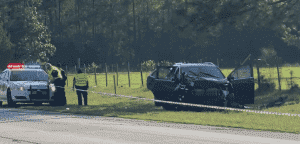
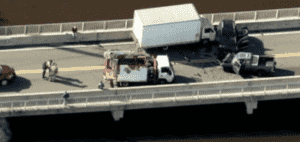
At the Law Offices of Anidjar and Levine, we protect Jacksonville interstate car accident victims by navigating state and federal statutes, preserving vital evidence such as dash-cam footage and police reports, and coordinating expert analysis to establish liability. Our team promptly secures legal representation, meets statutory deadlines, and negotiates with insurers using detailed medical and loss-of-value data to maximize compensation. We also prepare for trial when necessary, ensuring that all economic and non-economic damages are quantified. Continue to discover how our strategic approach safeguards your rights and pursues full recovery. For more information, visit our Jacksonville Car Accident Lawyer.
Main Takeaways
- Hire a Jacksonville attorney experienced in interstate freight regulations and multi‑state liability to navigate complex jurisdictional issues.
- Promptly preserve dash‑cam footage, police reports, and maintenance logs to establish negligence and support fault analysis.
- Ensure the lawyer initiates the claim within Florida’s two‑year statute of limitations to protect your right to recovery.
- Expect the attorney to coordinate expert reconstruction, medical documentation, and comparative‑fault assessment to ensure an accurate damages valuation.
- Choose counsel who can negotiate with insurers and represent you in court to pursue compensation for injuries, vehicle loss, and related expenses.


How We Can Help With Your Jacksonville Interstate Car Accident Claim
We’ll guide you through every step of your Jacksonville interstate car accident claim, ensuring that your rights are protected and your compensation is maximized.
We begin by evaluating the accident under interstate jurisdiction, which often involves multiple state laws and federal regulations. Our team coordinates with local experts to verify liability, gather evidence, and document injuries, so you fully understand the legal landscape.
We then develop a strategic plan that aligns with settlement timelines, prioritizing prompt, fair resolution while preserving your ability to pursue further action if needed. Throughout the process, we keep you informed, explaining each milestone and how it impacts your claim.
OUR CONSULTATIONSARE FREE
START YOUR FREE CASE REVIEW

Understanding Jacksonville Interstate Car Accident Cases
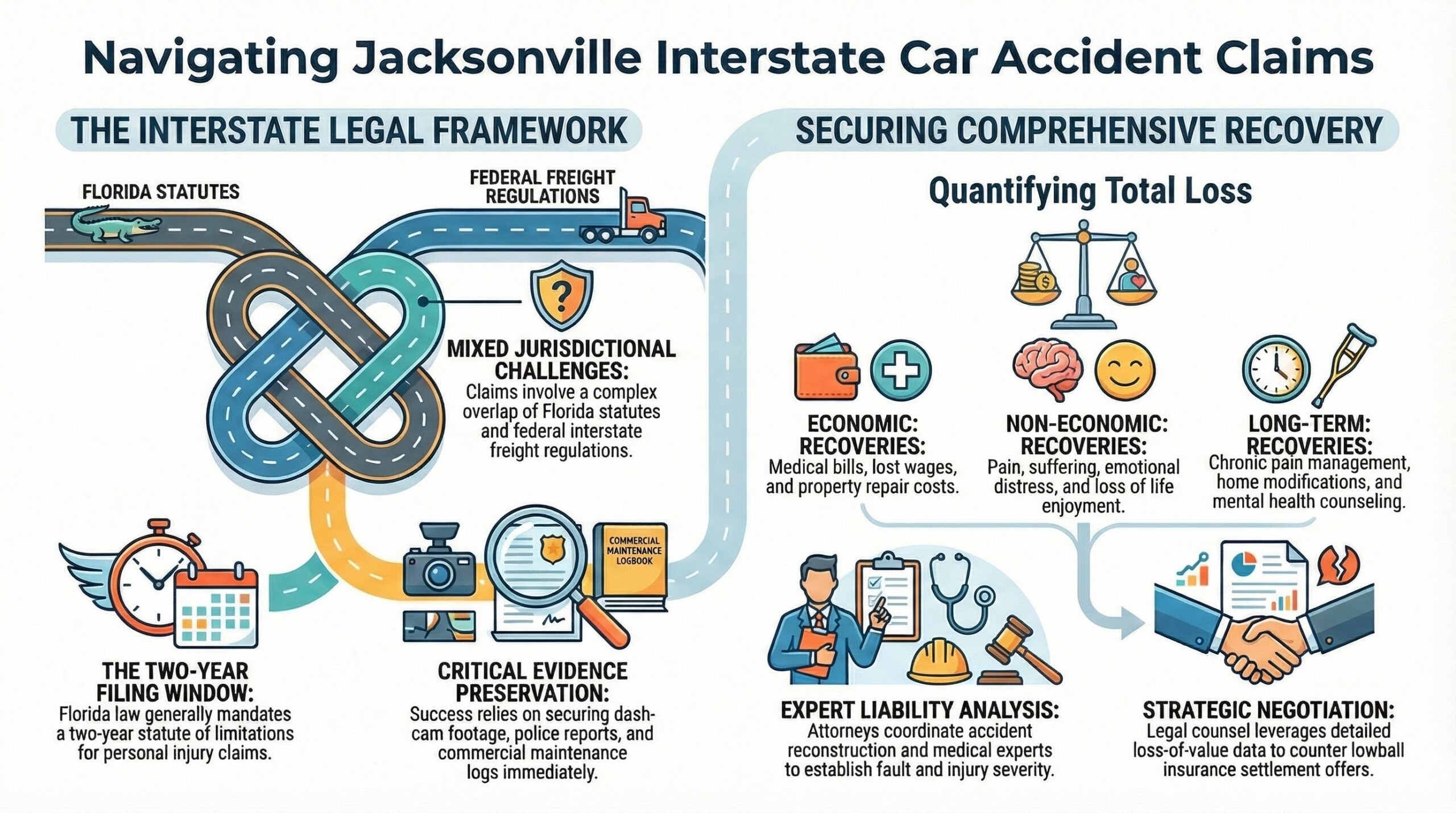
When an accident occurs on an interstate that passes through Jacksonville, the legal landscape becomes more complicated because multiple state statutes and federal regulations may apply.
Interstate accidents in Jacksonville involve tangled state statutes and federal regulations, complicating liability.
We recognize that interstate signage guides drivers across jurisdictional lines, yet variations in signage placement can affect liability assessments.
Freight regulations further complicate matters, as commercial vehicles must adhere to weight limits, routing rules, and safety standards that differ from those for passenger cars.
Our team evaluates how these elements intersect with the factual record, reviewing police reports, dash‑cam footage, and maintenance logs to determine which statutes govern the claim.
We also assess whether the responsible party complied with federal freight regulations, which can shift fault or amplify damages.
Common Causes of Jacksonville Interstate Car Accidents
We see that speeding and reckless driving frequently trigger severe collisions on Jacksonville’s interstates, while distracted or impaired operators contribute markedly to crash frequency.
Improper lane changes often result in side‑impact incidents, and roadway or weather hazards—such as potholes, rain, or fog—can quickly turn a routine drive into a dangerous event.
Understanding these common causes helps us identify liability and protect our clients’ rights.
Speeding and Reckless Driving
Because many drivers underestimate the danger of excessive speed, speeding, and reckless driving have become leading causes of interstate accidents in Jacksonville. We observe that a sudden speed differential between vehicles often leaves little reaction time, causing rear‑end collisions and loss of control. Urban enforcement efforts target high‑risk corridors, yet drivers continue to exceed limits, believing they can outrun penalties.
We emphasize that reckless maneuvers—such as abrupt lane changes and tailgating—compound the hazard, especially when traffic density fluctuates. Our experience shows that these behaviors strain emergency responders and increase the likelihood of severe injuries. By educating the community and advocating for stricter monitoring, we aim to reduce these preventable tragedies and protect those who rely on safe travel.
Distracted or Impaired Operators
Speeding and reckless driving set the stage, but the most pervasive threats on Jacksonville’s interstates stem from drivers who are distracted or impaired.
We see that cellphone addiction pulls attention from the road, causing delayed reactions and missed cues, while prescription misuse can impair judgment and slow response times.
Both factors erode the safety margin that protects commuters and emergency responders alike.
As attorneys who serve victims, we recognize that these behaviors often result in severe injuries and intricate liability questions.
By documenting the extent of distraction or impairment, we help families secure compensation for medical expenses, lost wages, and pain and suffering.
Our thorough investigation and expert testimony guarantee that negligent parties are held accountable, reinforcing the community’s right to safe travel.
Improper Lane Changes
We see that many motorists underestimate the importance of lane discipline, assuming they can cut in without warning. When they ignore blind spot awareness, they expose themselves and others to sudden collisions.
Our experience shows that enforcing consistent signaling, maintaining adequate following distance, and regularly scanning mirrors dramatically reduces risk. We advise drivers to adopt a habit of confirming clear space before any lane shift, especially during peak traffic.
Roadway and Weather Hazards
Handling Jacksonville’s interstates demands constant vigilance, as roadway and weather hazards frequently contribute to serious collisions.
We encounter pothole pavement deterioration that creates uneven surfaces, causing loss of control when drivers can’t anticipate sudden dips or bumps.
Visibility reduction from rain, fog, or glare further impairs reaction time, making lane changes and braking more hazardous.
We advise drivers to maintain safe following distances, adjust speed to match conditions, and use headlights appropriately.
By monitoring weather reports and staying alert to road‑surface warnings, we can reduce the likelihood of crashes and protect fellow travelers.
Our focus on proactive safety measures helps us serve the community, ensuring that every journey on Jacksonville’s interstates remains as secure as possible.


Legal Rights of Jacksonville Interstate Car Accident Victims
When an accident occurs on the interstate near Jacksonville, we must immediately recognize that victims possess distinct legal rights designed to protect their recovery, property, and financial stability.
Our rights overview clarifies that each victim is entitled to seek compensation for medical expenses, lost wages, and pain and suffering.
We also emphasize that compensation options extend beyond immediate payouts to include future care costs and restitution for property damage.
By understanding these entitlements, we can guide clients toward full recovery while upholding justice.
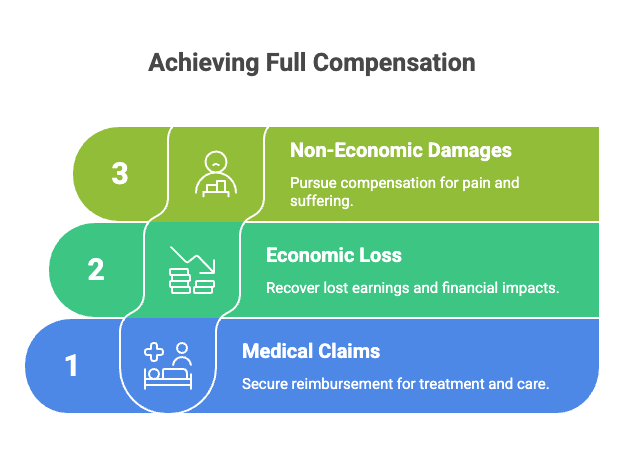
- Medical and Rehabilitation Claims – Secure reimbursement for all treatment, therapy, and long‑term care.
- Economic Loss Recovery – Capture lost earnings, diminished earning capacity, and related financial impacts.
- Non‑Economic Damages – Pursue compensation for pain, suffering, and reduced quality of life.
Our firm remains dedicated to serving those affected, ensuring that every legal avenue is explored with diligence and integrity.
Steps to Take After a Jacksonville Interstate Car Accident
We’ll first make sure everyone is safe and, if possible, move vehicles, then we’ll gather thorough documentation of the scene, including photos, witness statements, and police reports.
After securing evidence, we’ll promptly contact legal representation to protect our rights and guide us through the claims process. These steps form the crucial foundation for a strong case after a Jacksonville interstate car accident.
Secure Safety First
Usually, the first thing we do after a Jacksonville interstate car accident is to ensure everyone’s immediate safety. We check for injuries, call emergency services, and guide passengers to a safe area away from traffic.
If the vehicle is drivable, we move it to secure parking to prevent further collisions, ensuring that lights are on and hazard warnings are visible. We encourage all occupants to wear safety gear, such as seat belts and, if available, reflective vests, to reduce exposure to oncoming traffic.
While assisting others, we remain calm, speak clearly, and keep a watchful eye on the roadway. This disciplined approach protects lives and upholds our commitment to serving the community responsibly.
Document Evidence Thoroughly
Collecting thorough documentation immediately after a Jacksonville interstate car accident is vital for building a strong legal case and ensuring accurate insurance claims.
We advise photographing vehicle damage from multiple angles, capturing street signs, skid marks, and any visible injuries.
Secure witness statements and record their contact information, noting the time and location of each account.
Preserve electronic evidence by saving dash‑cam video and phone recordings, ensuring metadata preservation so timestamps and geolocation data remain intact.
Store all physical and digital items in a secure, organized system to maintain the chain of custody, which protects the evidence from tampering or loss.
Contact Legal Representation Promptly
After a Jacksonville interstate car accident, securing legal representation without delay is vital to protect your rights and preserve the integrity of your claim. We advise you to initiate a statute consultation as soon as possible, because early involvement allows us to assess liability, gather pivotal evidence, and advise on procedural deadlines.
Prompt contact also guarantees we can guide you through insurance negotiations while preventing inadvertent admissions that could weaken your case. When you schedule an appointment, we’ll allocate dedicated time to review medical records, police reports, and witness statements, establishing a solid foundation for your claim.
Our team’s swift response demonstrates our commitment to serving you and other victims, reinforcing the principle that timely legal action is indispensable for achieving fair compensation.
How a Jacksonville Interstate Car Accident Lawyer Can Help You
Negotiating the aftermath of an interstate collision in Jacksonville demands more than just filing a claim; it requires strategic legal guidance that protects your rights and maximizes compensation.
We assess the case holistically, ensuring that every piece of medical documentation is organized and presented effectively.
Our team conducts a thorough liability investigation, gathering police reports, witness statements, and accident reconstruction data to clearly establish fault.
By leveraging our experience, we negotiate with insurers, challenge lowball offers, and pursue the full amount you merit, all while keeping you informed at each step.
- Comprehensive evidence collection – we secure all relevant records, photos, and expert analyses.
- Strategic claim filing – we draft a precise demand package that highlights liability and damages.
- Aggressive settlement advocacy – we engage insurers with data‑driven arguments to achieve peak compensation.
Long-Term Effects of Jacksonville Interstate Car Accident Injuries
We appreciate that chronic pain management often becomes a daily reality after an interstate collision, requiring ongoing medical treatment and medication adjustments.
We also recognize the emotional and psychological impact, such as anxiety and depression, which can persist long after the physical injuries have healed.
Finally, we address long‑term mobility limitations that may restrict daily activities, work duties, and overall quality of life.
Chronic Pain Management
Managing chronic pain after a Jacksonville interstate car accident requires a thorough, long‑term approach that addresses both physical symptoms and the psychological impact of injury.
We guide clients through structured pain rehabilitation that combines physical therapy, targeted exercises, and progressive strength training to restore mobility and reduce reliance on medication.
In parallel, we recommend alternative therapies such as acupuncture, massage, and biofeedback to complement conventional treatments and improve overall well‑being.
By integrating these modalities, we help survivors regain functional independence while minimizing chronic discomfort.
Our collaborative model emphasizes continuous assessment, personalized adjustments, and coordinated care with medical experts, ensuring that each plan reflects the individual’s unique needs.
This disciplined strategy supports sustained recovery and enhances quality of life over the long term.
Emotional and Psychological Impact
When a Jacksonville interstate car accident leaves lasting injuries, the emotional and psychological fallout can be as debilitating as the physical harm.
We recognize that survivors often develop post-traumatic stress, experiencing intrusive memories, heightened anxiety, and sleep disturbances that interfere with daily functioning. These mental health challenges can erode confidence, diminish motivation, and impede the ability to serve others effectively.
Additionally, relationship strain frequently emerges as partners and family members adjust to new caregiving roles, altered communication patterns, and financial pressures.
We advise seeking early counseling, support groups, and stress‑management techniques to mitigate these effects. By addressing emotional well‑being alongside physical recuperation, we help clients rebuild resilience, maintain productive relationships, and continue contributing positively to their communities.
Long‑Term Mobility Limitations
Experiencing persistent pain and reduced range of motion after a Jacksonville interstate car accident often translates into long‑term mobility limitations that affect daily activities and employment prospects.
We appreciate that these limitations can hinder independence and productivity, so we advise clients to assess how mobility aids such as walkers, canchairs, or orthotic devices can restore functional capacity.
We also recommend home modifications—ramp installations, widened doorways, and grab‑bar placements—to guarantee safe navigation within personal spaces.
By integrating these adjustments, we help survivors maintain self‑sufficiency while pursuing vocational goals. Our guidance emphasizes proactive planning, collaboration with occupational therapists, and thorough documentation to support compensation claims.
Ultimately, we aim to empower those we serve to regain confidence and secure a stable future despite lasting injuries.
Proving Liability in Jacksonville Interstate Car Accident Injury Cases
If a driver’s negligence contributed to the crash, we must establish liability by gathering concrete evidence, analyzing police reports, and consulting accident reconstruction experts.
We begin by reviewing traffic‑camera footage, dash‑cam recordings, and witness statements to create a clear timeline of events.
Next, we scrutinize the police report for citations, officer observations, and diagrammatic sketches that often reveal fault.
Comparative fault analysis then allows us to assess each party’s contribution to the incident, ensuring any shared responsibility is accurately quantified.
We also engage expert testimony from engineers and accident reconstruction consultants who can reconstruct vehicle trajectories, speed, and impact forces.
Their professional opinions lend credibility and help the court understand intricate dynamics.
By systematically assembling this documentation and leveraging expert testimony, we build a compelling case demonstrating negligence and supporting our clients’ right to compensation.
This thorough approach reflects our commitment to serving victims and upholding justice.
Dealing With Insurance Companies After a Jacksonville Interstate Car Accident
Our thorough evidence‑gathering establishes liability, but the next hurdle is confronting the insurance companies that will evaluate the claim. We must approach them with organized documentation, clear narratives, and realistic expectations.
By employing proven claims tactics, we can counter lowball offers and prevent premature settlements that undermine fair compensation. We advise you to request detailed loss‑of‑value analyses, medical expense summaries, and independent accident reconstructions to ensure the insurer sees the full scope of damages.
Understanding settlement timelines helps us set strategic milestones; most insurers follow a phased review process, from initial adjuster assessment to final negotiation, which often extends over several weeks. We keep meticulous records of every communication, noting dates, representatives, and promises, which strengthens our position if disputes arise.
Our collaborative stance emphasizes transparency and persistence, guiding you through each step while safeguarding your rights and financial recovery.
What to Expect During a Jacksonville Interstate Car Accident Claim Process
We’ll begin by reviewing the initial police report and gathering thorough medical documentation to establish the factual and health‑related basis of your claim.
Next, we’ll outline insurance negotiation strategies that focus on realistic settlement expectations while protecting your rights.
Finally, we’ll provide an overview of the litigation timeline so you know the crucial milestones and the process’s potential duration.
Initial Police Report
When a Jacksonville interstate collision occurs, the first official document we’ll encounter is the police report, which serves as the cornerstone of the claims process. We’ll explain that police procedures require officers to arrive promptly, secure the scene, and interview parties involved.
Their note-taking includes photographing vehicle damage, collecting witness statements, and preserving any physical evidence, such as debris or skid marks. We’ll advise you to request a copy of the report as soon as it’s filed, because it contains the factual narrative that insurers and courts rely on.
Understanding how the report is compiled helps us assess liability, verify injuries, and make certain that all relevant details are accurately reflected in your claim.
Medical Documentation Review
Gathering and reviewing medical documentation is a vital step in the Jacksonville interstate car accident claim process, as it establishes the link between the collision and the injuries you sustained.
We collect all physician notes, hospital discharge summaries, and therapy records, then verify that each entry aligns with the accident timeline. Our team reviews medical coding details to ensure diagnoses and procedures are accurately represented for claim valuation.
We also scrutinize imaging interpretations, ensuring that X‑ray, MRI, and CT reports clearly reflect the severity and causation of injury. By cross‑checking these sources, we can anticipate potential disputes and strengthen your claim.
This systematic approach protects your rights while supporting fair compensation for the harm you endured.
Insurance Negotiation Strategies
Negotiating the insurance negotiation phase requires us to anticipate the insurer’s tactics and prepare a strong, evidence‑based position.
We begin by reviewing the available policy leverage, identifying clauses that protect our client’s right to full compensation, and noting any limits the insurer may cite.
By assembling medical records, repair estimates, and loss-of-income documentation, we create a clear, quantifiable loss narrative that counters the insurer’s lowball offers.
We then present this narrative confidently, emphasizing the legal standards that support our demand.
Throughout, we monitor settlement timing to ensure that any premature agreement doesn’t compromise future benefits.
Our approach balances assertiveness with strategic patience, guiding the client toward a fair, timely resolution.
Litigation Timeline Overview
After establishing a solid negotiating position, we turn our focus to the litigation timeline that governs a Jacksonville interstate car‑accident claim.
First, we file the complaint and serve the defendant, which initiates the discovery phase; during this period, we exchange documents, take depositions, and assess liability.
Next, motions may be filed to narrow issues or dismiss claims, followed by a pre‑trial conference that sets a trial date.
If the case proceeds to trial, we present evidence and arguments to seek a favorable verdict.
Should the judgment be unfavorable, we explore post‑trial remedies, including motions for a new trial or judgment notwithstanding the verdict.
An appeals timeline then guides any appellate review, ensuring procedural compliance and preserving client rights.
Compensation for Jacksonville Interstate Car Accident Damages
If you’ve been injured on the Jacksonville interstate, understanding the types of compensation available is essential for protecting your rights and covering the full scope of your losses.
Understanding Jacksonville interstate injury compensation safeguards your rights and covers all aspects of loss.
We explain how medical liens can affect the recovery process, ensuring that any funds owed to healthcare providers are properly accounted for while preserving your net settlement.
We also discuss the role of punitive damages, which may be awarded when a party’s conduct is especially reckless or malicious, providing an additional layer of financial redress beyond ordinary liability.
Our approach emphasizes thorough documentation of expenses, loss of earnings, and the impact on daily living, allowing us to present a compelling case for full compensation.
Economic vs Non-Economic Damages in Jacksonville Interstate Car Accident Cases
We’ll start by outlining economic damages, which cover tangible losses such as medical bills, lost wages, and property repair costs.
Next, we’ll explain non‑economic damages, which address intangible impacts like pain, suffering, and emotional distress.
Finally, we’ll show how both categories combine to determine the total compensation you’re entitled to in a Jacksonville interstate car accident case.
Economic Damages Overview
Understanding the distinction between economic and non‑economic damages is vital when evaluating compensation for Jacksonville interstate car accidents. We focus on economic damages, which are tangible losses that can be quantified with receipts, bills, and records.
Lost wages are the income victims lose because injuries prevent them from working, and we calculate them by examining pay stubs, tax returns, and projected earnings.
Property loss includes the cost of repairing or replacing vehicles, personal belongings, and any other assets damaged in the crash; we assess this by reviewing repair estimates, depreciation schedules, and market values.
Non‑Economic Damages Explained
Compensation for Jacksonville interstate car accidents encompasses both measurable financial losses and intangible harms that affect a victim’s quality of life.
We explain non‑economic damages, which cover pain valuation, emotional distress, and loss of enjoyment, as opposed to medical losses. These damages recognize that a severe injury can alter daily routines, relationships, and future aspirations, even when no dollar amount can be attached to the suffering.
When a victim experiences life disfigurement, the impact on self‑esteem and social interaction often warrants substantial compensation, reflecting the profound psychological toll.
Our role is to quantify these intangible harms fairly, ensuring that victims receive restitution that reflects the full scope of their loss, while upholding Jacksonville law.
Calculating Total Compensation
When a Jacksonville interstate collision occurs, we begin by separating the victim’s losses into economic and non‑economic categories to determine the total compensation owed.
We calculate economic damages by adding medical bills, property repair costs, and lost wages, then project future earnings based on the victim’s occupation, age, and career trajectory.
Non‑economic damages cover pain, suffering, and loss of enjoyment, which we quantify using settlement projections that reflect the severity of injury and impact on daily life.
By aggregating these figures, we present a comprehensive compensation estimate that accounts for both tangible expenses and intangible hardships.
Our method guarantees that clients receive a fair, full recovery while upholding the standards of justice and responsibility.
When a Jacksonville Interstate Car Accident Case Goes to Trial vs Settlement
If a Jacksonville interstate car accident case proceeds to trial rather than settlement, we must first assess the strengths and weaknesses of our client’s claim, the available evidence, and the potential jury perception. We examine jury dynamics, recognizing that jurors weigh credibility, emotional impact, and legal nuance.
In parallel, we evaluate settlement leverage, identifying how the defendant’s insurance position, prior statements, and liability exposure can pressure a fair agreement before a verdict.
When trial looms, we prepare exhaustive exhibits, expert testimony, and a clear narrative that highlights causation and damages. We also advise our clients on the risks of a jury trial, including unpredictable awards and extended timelines.
The Statute of Limitations for Jacksonville Interstate Car Accident Cases
Understanding the statute of limitations is essential for anyone involved in a Jacksonville interstate car accident, because it sets the deadline by which a legal claim must be filed or the right to sue is extinguished.
We must recognize that Florida law generally provides a two‑year filing deadline for personal injury claims arising from vehicle collisions on interstate highways. This period begins on the date of the accident, and any delay beyond it typically bars recovery.
However, tolling exceptions can pause or extend the deadline under specific circumstances, such as when a plaintiff is a minor, mentally incapacitated, or when the defendant fraudulently conceals the injury.
We should also note that if the injured party is a dependent, the clock may start when the minor reaches the age of majority.
When to Contact a Jacksonville Interstate Car Accident Lawyer After a Jacksonville Interstate Car Accident
The deadlines we just outlined mean that acting promptly after an accident isn’t optional; it safeguards the legal avenues available to our clients. We advise you to schedule an immediate consultation within 24 hours, as early legal guidance helps you understand your rights and prevent costly missteps.
At that time, we work with you to secure evidence preservation, ensuring that photographs, witness statements, and medical records are collected before they degrade or disappear. Prompt contact also allows us to intervene with insurers and halt premature settlement offers that could undermine your claim.
We recommend contacting our team as soon as you’re medically stable, even if you feel the incident was minor. By reaching out quickly, we can assess liability, preserve essential documentation, and develop a strategic plan that aligns with statutory deadlines. This proactive approach maximizes recovery potential while protecting your interests throughout the process.
Why You Need an Experienced Jacksonville Interstate Car Accident Lawyer
Because Jacksonville interstate accidents involve intricate liability issues, high‑speed impacts, and multiple parties, we insist on retaining an experienced lawyer who can guide us through these challenges efficiently.
Retain an experienced lawyer to navigate Jacksonville interstate accident complexities and protect your interests efficiently.
We appreciate that interstate nuances demand careful analysis of jurisdictional rules, insurance policies, and traffic regulations that many attorneys overlook.
Our team evaluates every detail, from vehicle dynamics to witness statements, ensuring that no element of liability is missed.
By applying a proven trial strategy, we protect your interests from settlement talks through courtroom proceedings, anticipating defenses and counter‑claims before they arise.
This proactive approach allows us to negotiate stronger offers while preserving the option to litigate when necessary.
We also coordinate with medical professionals and accident reconstruction authorities to build a compelling narrative that supports your claim.
Ultimately, our know-how translates into higher recovery amounts and reduced stress for you and your family.
How to Choose the Right Jacksonville Interstate Car Accident Lawyer for Your Case
After reviewing the complexities of interstate accidents, we now turn to selecting the attorney who’ll best represent you.
We begin by examining the lawyer’s local reputation; a strong standing within Jacksonville’s legal community signals reliable service and peer respect. We verify client testimonials, peer endorsements, and any disciplinary history to make certain the attorney consistently delivers favorable outcomes.
Next, we assess the fee structure, demanding transparency on contingency percentages, retainer requirements, and potential out‑of‑pocket expenses. We compare these terms across several firms to confirm that costs align with the sophistication of your case and that there are no hidden charges.
We also prioritize attorneys who demonstrate a clear commitment to serving others, as evidenced by pro bono work and community involvement. By systematically evaluating local reputation and fee structure, we empower ourselves to choose a Jacksonville interstate car accident lawyer who balances knowledge, integrity, and client‑focused advocacy.
About The Law Offices of Anidjar & Levine
While many firms claim proficiency in interstate accident litigation, we’ve built a reputation for delivering results through deep knowledge of Florida’s traffic statutes and federal regulations.
Our firm’s history dates back to 1995, when a small team of dedicated attorneys allied to protect injured motorists traveling across state lines.
Over the years, we’ve expanded our practice while preserving the personal commitment that guides every case.
We pride ourselves on transparent communication, ensuring that each client understands the strategic choices we make on their behalf.
Client testimonials consistently highlight our responsiveness, thorough investigation, and tenacious advocacy in settlement negotiations and courtroom proceedings.
Frequently Asked Questions
Do I Need a Lawyer if I Was Partially at Fault?
We recommend hiring a lawyer even if you were partially at fault, because comparative negligence can reduce your recovery, but doesn’t eliminate it.
An attorney can evaluate the fault percentages, protect your rights, and use settlement leverage to negotiate a fair amount.
Their know-how guarantees that insurance adjusters don’t undervalue your claim and that you receive the compensation you merit despite shared responsibility.
Can I Claim for Emotional Distress After a Car Accident?
We can claim emotional damages after a car accident if the distress is severe, medically documented, and directly linked to the incident. You should obtain psychological treatment to substantiate the claim, as professional records provide crucial evidence of the injury’s impact on daily functioning.
Courts typically require proof that the distress exceeds ordinary frustration and that it resulted from the collision. By securing qualified documentation, we strengthen the case for compensation.
What if the Other Driver Has No Insurance?
If the other driver has no insurance, we can still pursue financial recovery through your uninsured motorist coverage, which compensates for damages when the at-fault party lacks liability insurance.
We’ll file a claim with your insurer, providing documentation of the accident, medical expenses, and any lost wages.
If your policy limits are insufficient, we may explore a lawsuit against the driver’s assets, but the uninsured motorist option remains the most efficient path to compensation.
How Are Future Medical Costs Calculated?
We calculate future medical costs by estimating the necessary treatments, including surgeries, therapies, and medications, based on current medical records and expert prognoses.
We also assess lost earning capacity, projecting how the injury will affect the patient’s ability to work and earn income over the remainder of their career.
These projections incorporate inflation, discount rates, and any anticipated changes in healthcare costs, ensuring a thorough, evidence‑based valuation.
Will My Case Be Affected by Prior Accidents?
Your case may be affected by prior claims and your accident history, but we’ll assess the relevance of each incident.
We’ll examine the timing, severity, and causation of earlier accidents to determine whether they constitute comparative negligence or pre‑existing conditions.
If prior claims are unrelated, they typically won’t diminish your current liability.
However, overlapping injuries or documented patterns can affect settlement values, so we’ll scrutinize every detail to protect your rights.
—————————
We stand ready to protect your rights and secure the compensation you merit after a Jacksonville interstate car accident.
The Law Offices of Anidjar and Levine combines deep legal knowledge with a strategic, client-focused approach, ensuring every step of your claim is handled meticulously.
By choosing us, you gain a trusted advocate dedicated to steering intricate statutes, negotiating with insurers, and, if necessary, litigating aggressively.
Trust our proficiency to guide you toward a fair, timely resolution.
For help, visit our Jacksonville Car Accident Lawyer.