The Law Offices of Anidjar and Levine help injured victims pursue compensation after Jacksonville crashes caused by impaired or distracted driving, including alcohol, drugs, texting, and other unsafe conduct. These cases may involve medical records, crash reports, toxicology evidence, cellphone data, witness statements, and proof of lost income or lasting harm. A Jacksonville Personal Injury Lawyer can help preserve evidence, communicate with insurers, identify liable parties, and manage important deadlines. The sections below explain key rights, case steps, and available support after these collisions.
Main Takeaways
- A Jacksonville impaired and distracted driving lawyer can help prove unsafe conduct caused the crash and resulting injuries.
- Evidence may include crash reports, witness statements, video footage, phone records, toxicology results, and vehicle damage.
- Common causes include alcohol, drugs, prescription medications, texting, navigation use, and other in-car distractions.
- Prompt medical care and documentation help connect injuries to the collision and support a stronger claim.
- Legal representation can manage insurers, deadlines, evidence preservation, and compensation claims for medical bills, lost income, and pain.


How We Can Help With Your Jacksonville Car Accident Impaired & Distracted Driving Injury Claim
After an impaired or distracted driving crash, an injured person may face medical treatment, lost income, vehicle damage, and pressure from insurance companies before the full impact of the collision is understood. Legal support can help organize these burdens into a focused claim that reflects the person’s losses and future needs. A Jacksonville car accident lawyer may gather police reports, witness statements, crash evidence, employment records, and medical documentation to present a clear account of harm. This careful preparation can assist caregivers, family members, and community-minded supporters who are trying to protect the injured person’s stability.
Counsel may also communicate with insurers, evaluate settlement offers, and address insurance disputes arising from liability, treatment costs, or wage loss. By managing deadlines, preserving evidence, and explaining available options, legal representation allows the injured person to concentrate on recovery while the claim is handled with diligence, accuracy, and respect for their circumstances.
OUR CONSULTATIONSARE FREE
START YOUR FREE CASE REVIEW

Understanding Jacksonville Car Accident Impaired & Distracted Driving Injury Cases
When a collision involves impaired or distracted driving, the injury case often turns on conduct that reduced a driver’s ability to operate a vehicle safely and respond to roadway conditions. In Jacksonville, these cases may involve serious harm to motorists, passengers, bicyclists, or distracted pedestrians, and each claim requires careful review of how the crash occurred, what injuries resulted, and who may be legally responsible.
An injury case is not limited to the moment of impact. It may include medical records, crash reports, witness accounts, vehicle damage, and evidence showing whether a driver drifted into an improper lane, failed to stop, or reacted too late. For those committed to serving injured people with care and diligence, understanding these details helps protect the rights of the harmed person. A well-prepared claim can address treatment needs, lost income, pain, long-term limitations, and the accountability required when unsafe driving places others at risk.
Common Causes of Jacksonville Car Accident Impaired & Distracted Driving
Impaired and distracted driving collisions in Jacksonville often arise from preventable conduct, including drunk driving crashes, drugged driving risks, texting behind the wheel, and other in-car distractions. These behaviors can reduce reaction time, impair judgment, and divert attention from traffic conditions, creating serious hazards for drivers, passengers, pedestrians, and cyclists. Identifying the specific cause of a crash is crucial to evaluating liability, insurance issues, and the full extent of resulting injuries.
Drunk Driving Crashes
Because alcohol makes reaction time slower and weakens judgment, drunk driving remains one of the most perilous causes of car accidents in Jacksonville. These crashes often occur when impaired drivers drift from lanes, ignore traffic signals, follow too closely, or enter intersections without adequate awareness. Victims may suffer severe injuries, while families, first responders, and community members are left to manage lasting consequences.
In evaluating a drunk driving crash, investigators may consider sobriety testing, officer observations, witness statements, vehicle damage, and roadway evidence. These details can help determine whether alcohol impairment contributed to unsafe decisions behind the wheel. For those committed to serving injured people, careful review of these facts supports accountability, fortifies claims, and helps ensure that harmed individuals receive appropriate protection under Florida law after collisions.
Drugged Driving Risks
Although alcohol is a well-known hazard on Jacksonville roads, drugged driving can be equally dangerous and more difficult to detect. Illicit substances, marijuana, and misused medications may slow reaction time, distort judgment, and reduce coordination, placing nearby motorists, passengers, cyclists, and pedestrians at risk. Prescription drug impairment is especially concerning because a driver may lawfully possess medication yet remain unsafe behind the wheel. Sedatives, pain relievers, sleep aids, and some anxiety medications can cause drowsiness, blurred vision, or delayed responses, even when taken as directed. After a crash, evidence from a traffic stop may help establish impairment, including officer observations, field sobriety test results, drug recognition evaluations, admissions, pill bottles, toxicology reports, and video footage. Careful review of these details can support accountability and help injured people seek appropriate recovery.
Texting Behind the Wheel
Why does texting behind the wheel remain one of the most dangerous forms of distracted driving in Jacksonville? It combines visual, manual, and cognitive distractions, removing a driver’s eyes, hands, and attention from the road at the same time. A brief message, social media alert, or reply can cause delayed braking, lane drift, or failure to notice pedestrians, cyclists, and stopped vehicles. Even hands-free features may pose risks when drivers focus on composing, listening to, or responding to messages instead of on roadway conditions. For those committed to serving injured people and promoting public safety, texting-related crashes show how quickly preventable choices can harm families and communities. In legal claims, phone records, witness statements, and crash data may help establish distraction and accountability after a serious Jacksonville collision.
In-Car Distractions
Inside a vehicle, routine activities can become dangerous when they divide a driver’s attention from the road. Adjusting climate controls, reaching for items, eating, managing children, or responding to passengers may reduce awareness at crucial moments. These behaviors can delay braking, weaken lane control, and prevent timely responses to pedestrians, cyclists, or changing traffic signals. Mobile distractions often extend beyond texting to include music selection, app use, and hands-free commands that still demand mental focus. Navigation errors may also occur when drivers stare at screens for too long, misread directions, or make sudden turns to correct a missed turn. In Jacksonville traffic, these in-car distractions can cause preventable crashes. Careful driving requires preparation, patience, and a consistent commitment to protecting everyone sharing the roadway.
Don’t Wait. Call Our Florida Personal Injury Lawyers Now!


Legal Rights of Jacksonville Car Accident Impaired & Distracted Driving Injury Victims
When impaired or distracted driving causes a collision in Jacksonville, injured victims have the right to seek compensation from the at-fault driver and, in some cases, other responsible parties. These rights may support recovery for medical expenses, lost income, reduced earning capacity, pain, and long-term care needs. Legal protections also help families, caregivers, and community members respond with structure and purpose.
Injured Jacksonville crash victims may seek compensation when impaired or distracted driving causes preventable harm.
- Victims may pursue claims when evidence shows careless conduct, including intoxication, texting, or unsafe attention to the road.
- Comparative negligence affects the amount recovered if the injured person is found partially at fault for the crash.
- Insurance coverage options may include personal injury protection, bodily injury liability, uninsured motorist coverage, and other applicable policies.
- Timely action preserves evidence, protects claim deadlines, and supports fair evaluation of losses.
Understanding these rights allows injured people and those assisting them to make informed, responsible decisions after serious collisions in Jacksonville.
Why Do Jacksonville Car Accident Impaired & Distracted Driving Injuries Happen?
How do ordinary trips through Jacksonville become the setting for serious impaired and distracted driving injuries? These crashes often arise when a driver’s judgment, perception, or attention is compromised. Alcohol, illegal drugs, prescription medication, fatigue, texting, navigation systems, and conversations can reduce the care owed to others sharing the road.
Jacksonville’s busy corridors, beach routes, bridges, and commuter traffic may increase the consequences of a single unsafe choice. A driver who drifts out of their lane, runs a red light, follows too closely, or reacts too late can put families, workers, cyclists, pedestrians, and volunteers at risk. These injuries happen because safe travel depends on shared responsibility, and impaired or distracted conduct breaks that trust.
Understanding the cause may later involve preserving evidence and assessing witness credibility, since reliable details help explain how a preventable collision occurred. For communities committed to service, recognizing these causes supports accountability, prevention, and protection of vulnerable neighbors.
What Should You Do After a Jacksonville Car Accident Impaired & Distracted Driving Injury?
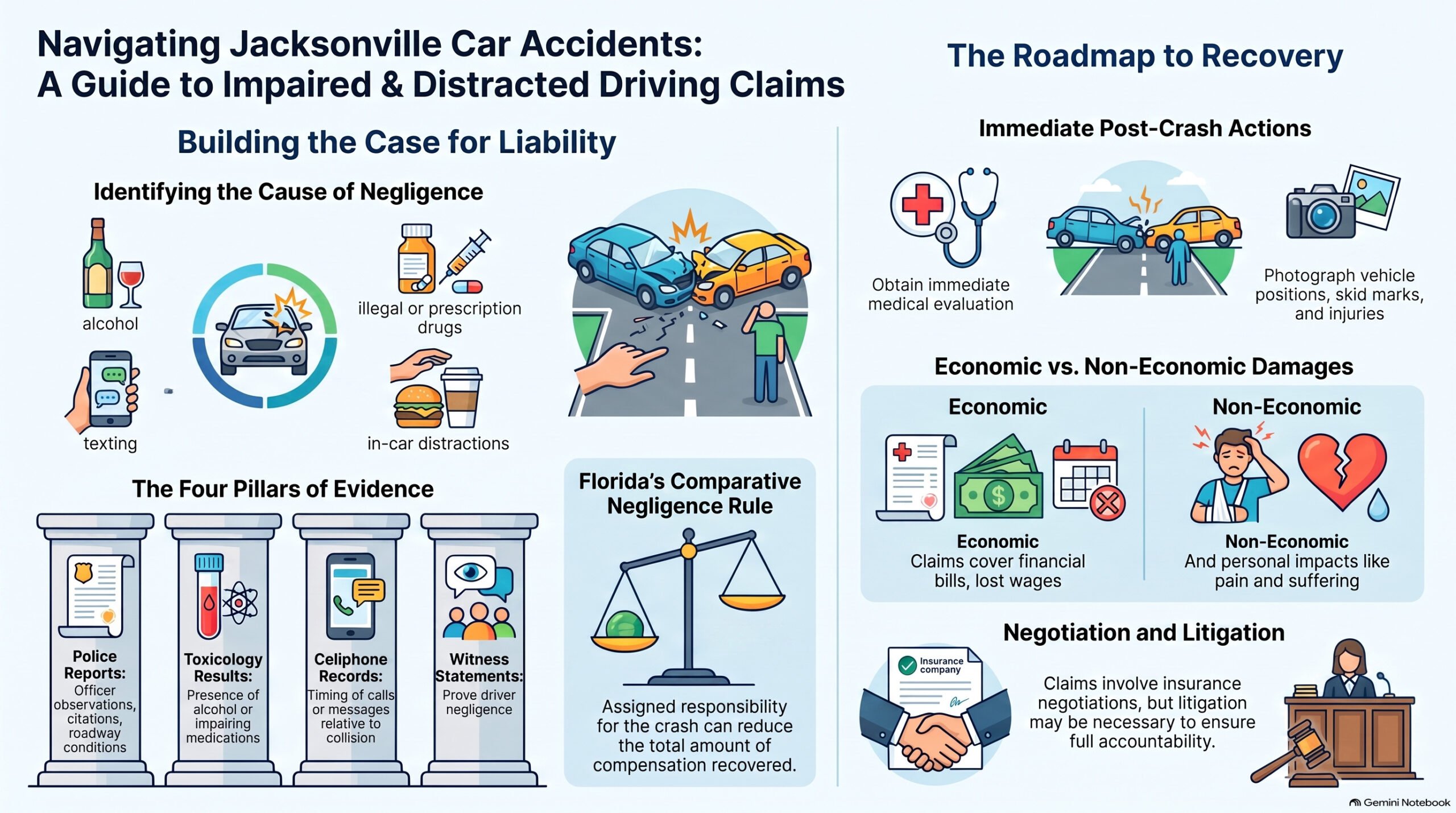
After a Jacksonville car accident involving impaired or distracted driving, an injured person should seek immediate medical care, even when symptoms appear minor. Crash evidence should be documented promptly, including photographs, witness information, police reports, and any details suggesting intoxication or distraction. An attorney may then help preserve vital evidence, address insurance issues, and evaluate potential claims for compensation.
Seek Immediate Medical Care
Following a Jacksonville car accident involving impaired or distracted driving, immediate medical care is urgent, even if injuries do not appear serious at first. Prompt evaluation can identify hidden trauma, including concussions, internal injuries, soft tissue damage, or delayed pain conditions. Medical providers create records that connect symptoms to the collision, supporting post-accident documentation without requiring the injured person to interpret difficult findings. Care also helps restore health, allowing the person to follow treatment plans and reduce long-term complications. For those committed to serving family, coworkers, or community, early treatment preserves the ability to recover responsibly. Medical records may later align with victim witness statements regarding pain, mobility limits, or behavioral changes after the crash. Delaying care can weaken both physical recovery and the reliability of evidence for injury-related claims.
Document Crash Evidence
Medical treatment restores health, but careful evidence documentation helps preserve the facts needed to explain how the Jacksonville collision occurred and why the impaired or distracted driver should be held accountable. A responsible helper may photograph vehicle positions, skid marks, debris, traffic signals, road conditions, injuries, and property damage before the scene changes. Witness names, phone numbers, and brief observations should be recorded carefully and accurately. If nearby businesses, homes, buses, or traffic systems may have cameras, prompt requests to preserve video can prevent important footage from being erased. Spoliation prevention also includes saving damaged vehicles, clothing, dashcam files, rideshare data, phone records, repair estimates, and insurance communications. Organized evidence supports truth, protects injured people, and helps others understand the full impact of negligent driving.
Contact An Attorney
When an injured person has received urgent care and preserved available evidence, contacting a Jacksonville car accident attorney should be considered promptly. Legal counsel can assess whether impaired or distracted driving contributed to the collision, identify responsible parties, and guide the injured person through necessary deadlines. This support may also help protect vulnerable families, coworkers, and community members from avoidable financial strain.
An attorney can coordinate Evidence preservation by requesting surveillance footage, phone records, toxicology reports, crash data, and witness statements before they are lost. Counsel may also manage insurance negotiation, reducing direct contact with adjusters who may seek limited payouts or incomplete statements. With informed representation, the injured person can focus on recovery while claims for medical care, lost income, and lasting harm are properly developed.
Don’t Wait. Call Our Florida Personal Injury Lawyers Now!
Critical Evidence in a Jacksonville Car Accident Impaired & Distracted Driving Injury Case
Substantial evidence in a Jacksonville impaired or distracted driving injury case may establish fault, causation, and the extent of legal responsibility.
Essential materials often include:
1. Police crash reports; 2. Toxicology test results, 3. Cellphone usage records, and 4. Witness statement evidence.
Each source may help clarify whether impairment, distraction, or both contributed to the collision and resulting injuries.
Police Crash Reports
After an impaired or distracted driving crash in Jacksonville, the police crash report often becomes one of the first structured records of what happened. It may identify drivers, passengers, witnesses, roadway conditions, vehicle damage, citations, and the officer’s initial assessment of contributing factors. For injured people and those assisting them, this report can help organize facts before memories fade or evidence is lost. Officer notes may also preserve observations about phone use, erratic driving, admissions, or visible signs of impairment, without replacing later investigation. When available, dashcam footage referenced in the report can further clarify vehicle movement, traffic signals, and conduct at the scene. A careful review allows counsel to compare the report with medical records, witness statements, and physical evidence, while identifying gaps that require follow-up.
Toxicology Test Results
Beyond the police crash report, toxicology test results may provide objective evidence of whether a driver had alcohol, drugs, or impairing substances in the body near the time of the Jacksonville crash. These records can identify Blood Alcohol levels, controlled substances, prescription medications, or combinations that may affect judgment, reaction time, and vehicle control. In an injury case, a careful review helps determine whether impairment contributed to the collision and whether the injured person needs additional protection through civil claims. Testing procedures, collection timing, chain of custody, and laboratory reliability may all influence the strength of the evidence. Toxicology findings should also be compared with Scene Evidence, witness observations, driving behavior, and medical records. Together, these materials can support a fair and responsible assessment of fault.
Cellphone Usage Records
When distraction is suspected, cellphone usage records may help show whether a driver was calling, texting, using data, or interacting with an application near the time of a Jacksonville crash. Carrier logs can identify the timing of calls, message activity, and data sessions, helping investigators compare device use with the collision timeline. In some cases, Telematics evidence from a vehicle or connected device may also reveal movement, speed, braking, or screen-related activity. These records must be preserved promptly, because service providers may retain detailed information for limited periods. A careful review can support an injured person’s claim by clarifying whether the at-fault driver failed to give proper attention to the road, endangering others who relied on safe and responsible driving in the community.
Witness Statement Evidence
Although physical and digital evidence can be powerful, witness statements often provide important context in a Jacksonville car accident involving impaired or distracted driving. Neutral observers may describe erratic lane changes, delayed braking, phone use, open containers, slurred speech, or other conduct that helps explain how the collision occurred. Eyewitness reliability depends on factors such as lighting, distance, vantage point, stress, and the time between the crash and the statement. Promptly obtained recorded statements can preserve details before memories fade or outside influences arise. In an injury case, these accounts may support police findings, clarify disputed facts, and identify additional evidence or witnesses. Careful review allows legal professionals to serve injured people by presenting accurate, fair, and well-supported claims to insurers, judges, or juries.
Long-Term Effects of Jacksonville Car Accident Impaired & Distracted Driving Injuries
Impaired and distracted driving collisions in Jacksonville can leave injured individuals facing consequences that extend far beyond the initial medical emergency. Chronic pain complications, cognitive and emotional changes, and reduced physical capacity may interfere with employment, family responsibilities, and daily independence. These lasting effects often create ongoing financial burdens, including medical expenses, lost income, and the need for continued care or support.
Chronic Pain Complications
After a serious crash, expert pain may become one of the most disruptive long-term complications for victims injured by impaired or distracted drivers in Jacksonville. Persistent neck, back, shoulder, or joint pain can limit mobility, reduce work capacity, and interfere with daily caregiving responsibilities. These conditions may result from spinal injuries, nerve damage, fractures, or soft tissue trauma that does not fully resolve. Effective care often requires injury rehabilitation, consistent medical follow-up, and Medication management tailored to the victim’s functional needs. Providers may coordinate physical therapy, experts, diagnostic testing, and home modifications to support safer routines. For those serving injured individuals, recognizing chronic pain’s ongoing burden is crucial. Its impact may extend for months or years, requiring documentation that accurately reflects future treatment needs.
Cognitive And Emotional Changes
Often, cognitive and emotional changes following a Jacksonville crash involve more than temporary confusion or distress. When impaired or distracted driving causes head trauma, victims may experience Memory impairment that disrupts communication, planning, and daily responsibilities. Emotional instability can also emerge, leading to sudden anger, fear, withdrawal, or difficulty maintaining trusted relationships. These changes may burden caregivers, coworkers, and community members who seek to support recovery with patience and structure. Reaction delay can make ordinary activities unsafe, including driving, crossing streets, or responding to emergencies. Deterioration of judgment may further affect decision-making, impulse control, and awareness of personal limitations. Careful medical evaluation, consistent observation, and well-documented symptoms help clarify the lasting impact of these injuries while guiding appropriate support, treatment, and accountability after a serious collision.
Ongoing Financial Burdens
Over months or years, the financial consequences of a Jacksonville crash may extend far beyond initial emergency care. Injured individuals may face repeated expert visits, therapy costs, medication expenses, mobility equipment needs, and home modifications. When impaired or distracted driving causes lasting harm, families often must balance compassion with difficult financial decisions. Caregivers may reduce work hours, creating additional pressure on household income and savings. Careful budgeting during recovery efforts can help identify medical priorities, transportation needs, and critical living costs. Wage loss planning may also be necessary when injuries limit employment, delay career advancement, or require retraining for a different job. Legal evaluation can support the documentation of future expenses, helping responsible parties remain accountable while families focus on stability, dignity, and continued service to those who depend on them.
Proving Liability in Jacksonville Car Accident Impaired & Distracted Driving Injury Cases
When an impaired or distracted driver causes a crash in Jacksonville, proving liability requires evidence that clearly connects the driver’s unsafe conduct to the victim’s injuries. Investigators may examine police reports, traffic citations, crash reconstruction findings, toxicology results, phone records, witness statements, and nearby video footage. Each item can help show that alcohol, drugs, texting, fatigue, or another distraction reduced the driver’s ability to operate safely.
A careful legal review also addresses impaired defenses, such as claims that the driver was not intoxicated, was lawfully using a device, or that another hazard caused the collision. Florida’s comparative negligence rules make fault allocation especially important, because any assigned responsibility may affect recovery. Service-minded representation focuses on building a clear factual record, protecting the injured person from blame unsupported by evidence, and presenting the full connection between wrongful conduct, medical harm, lost income, and long-term needs. Strong proof supports accountability and fair resolution.
Dealing With Insurance Companies After a Jacksonville Car Accident Impaired & Distracted Driving Injury
After an impaired or distracted driving crash in Jacksonville, insurance companies may begin investigating quickly, often before the injured person understands the full extent of the harm. Adjusters may request recorded statements, medical authorizations, or early settlement discussions that do not reflect future care needs, lost income, or lasting limitations.
A lawyer can help protect the injured person from unfair pressure while ensuring communications remain accurate, respectful, and complete. This support is especially important when the at-fault driver lacks sufficient insurance, requiring careful Uninsured Coverage Negotiation with the injured person’s own carrier. In some situations, an insurer may delay, deny, or undervalue a valid claim despite clear evidence. Those actions may raise concerns involving Bad Faith Claims, which require close review of the insurer’s conduct and obligations.
Careful handling of insurance communications helps preserve dignity, supports responsible recovery, and promotes fair treatment for those harmed by impaired or distracted drivers in the community.
What to Expect During a Jacksonville Car Accident Impaired & Distracted Driving Injury Claim Process
The claim process typically begins with an initial case evaluation, where liability, injuries, and available insurance coverage are reviewed. Evidence collection then becomes central, including police reports, medical records, witness statements, and proof of impairment or distraction. Once the claim is developed, insurance negotiations may lead to a settlement, although litigation may be necessary if fair compensation is not offered.
Initial Case Evaluation
Because impaired and distracted driving claims often involve multiple sources of evidence, the initial case evaluation focuses on identifying how the collision occurred, who may be liable, and what losses resulted from the crash. During this review, counsel considers police reports, available insurance information, medical history, and the injured person’s account of events. The evaluation also addresses whether intoxication, phone use, fatigue, or other unsafe conduct may have contributed to the impact. Witness Evidence Collection may be discussed at a preliminary level to determine whether neutral accounts could support a finding of responsibility. Damages Documentation is also reviewed, including treatment needs, missed work, property damage, and daily limitations. This early assessment helps establish priorities, preserve important issues, and guide a responsible claim strategy. It also supports informed decisions before negotiations begin.
Evidence Collection Process
Gathering evidence in a Jacksonville impaired or distracted driving injury claim often begins with securing records that may explain both the cause of the crash and the resulting harm. Crash documentation may include police reports, traffic citations, body camera footage, photographs, vehicle damage records, and available surveillance video. Medical records are also collected to connect physical injuries with the collision timeline. When impairment or distraction is suspected, relevant materials may involve breath or blood test results, phone records, 911 calls, and officer observations. Witness preservation is equally important, since bystanders, passengers, and first responders may provide details that fade with time. A careful evidence process supports accountability, protects injured individuals, and helps clarify how responsible conduct could have prevented needless harm within the Jacksonville community.
Insurance Claim Negotiations
Insurance claim negotiations in a Jacksonville impaired or distracted driving injury case typically begin after liability evidence, medical documentation, and available insurance coverage have been reviewed. The insurer may evaluate police reports, witness accounts, medical bills, wage records, and proof of negligent conduct. Understanding the basics of liability helps clarify fault, comparative negligence issues, and the value of documented losses. A careful settlement strategy may include presenting a demand package that explains injuries, treatment needs, financial harm, and the broader impact on daily responsibilities. Negotiations often involve multiple responses, requests for clarification, and review of policy limits. A lawyer may protect the injured person from low evaluations while maintaining respectful communication. This process supports fair consideration of harm, preserves dignity, and promotes accountable service to the injured person’s recovery.
Settlement Or Litigation
When negotiations do not produce a fair resolution, a Jacksonville impaired or distracted driving injury claim may proceed toward litigation, although many cases still settle before trial. Litigation begins with a formal complaint, followed by discovery, depositions, and continued evaluation of damages. During this stage, evidence preservation remains critical, including phone records, toxicology reports, crash data, medical documentation, and witness statements. Counsel may also address fault vs. liability, because proving careless conduct does not always establish legal responsibility or available compensation. A court process can encourage more serious settlement discussions, especially when the evidence shows preventable harm. If trial becomes necessary, the injured person’s claim is presented to a judge or jury. Throughout the process, the goal remains accountability, restoration, and service to those harmed.
Compensation for Jacksonville Car Accident Impaired & Distracted Driving Injury Damages
After an impaired or distracted driving crash in Jacksonville, compensation may address both the immediate financial losses and the long-term consequences of a serious injury. A claim may seek payment for emergency treatment, hospitalization, rehabilitation, prescription needs, assistive devices, and future medical care when ongoing care is reasonably expected. Compensation may also cover lost income, reduced earning capacity, transportation to treatment, and the cost of necessary household support.
When a driver chooses to operate a vehicle while intoxicated, drug-impaired, texting, or otherwise dangerously inattentive, the harm often extends beyond the collision itself. A careful damages assessment helps injured people, families, caregivers, and advocates understand what resources may be needed to restore stability and protect dignity. In limited cases, Punitive damages may be pursued to address especially reckless conduct and to promote safer choices within the community. Each category must be supported by records, expert opinions, and credible documentation.
Economic vs Non-Economic Damages in Jacksonville Car Accident Impaired & Distracted Driving Cases
In Jacksonville, impaired and distracted driving cases generally divide damages into economic and non-economic losses. Economic damages may include medical bills, lost income, and repair costs, while non-economic damages may include pain and suffering, emotional distress, and reduced quality of life. Proving these losses requires clear documentation, credible testimony, and a careful connection between the crash and the harm claimed.
Economic Damages Explained
Often, economic damages form the measurable financial foundation of a Jacksonville car accident claim involving impaired or distracted driving. These losses include costs that can be verified through records, invoices, and employment materials. Medical bill calculations may involve emergency care, hospitalization, surgery, rehabilitation, prescriptions, diagnostic testing, and future treatment reasonably tied to the collision. Wage loss documentation helps establish missed work, reduced earning capacity, and interrupted benefits due to injury-related limitations. Repair estimates, rental vehicle charges, transportation costs, and necessary household assistance may also be considered when properly supported. For those serving injured individuals, careful organization of financial proof promotes accountability and fair evaluation. Economic damages do not rely on personal impressions; they depend on credible documentation connecting each expense to the crash and its consequences.
Non-Economic Losses
While economic damages address measurable financial harm, non-economic losses reflect personal consequences that do not appear on invoices or wage records. In Jacksonville impaired and distracted driving cases, these losses may include physical pain, emotional distress, loss of enjoyment of life, anxiety, sleep disruption, and strain on family relationships. A severe crash can alter daily routines, limit independence, and require long-term pain management options that affect personal dignity and community participation. Disability consequences may also reduce a person’s ability to serve others, maintain relationships, or engage in meaningful activities. These harms recognize that injury is not limited to financial disruption. Non-economic damages help account for the human impact of reckless driving, especially when a victim’s health, stability, and sense of purpose have been noticeably diminished after the collision.
Proving Accident Damages
After a Jacksonville crash involving impaired or distracted driving, establishing damages requires more than showing that the other driver acted carelessly. The injured person must establish a causal link between each claimed loss and the collision with reliable evidence. Economic damages may include hospital bills, rehabilitation costs, lost wages, reduced earning capacity, and vehicle repair expenses. Medical treatment documentation is central because it documents diagnoses, treatment needs, pain complaints, and future care plans. Non-economic damages, including suffering, emotional distress, and loss of enjoyment, often require consistent records, witness accounts, and credible testimony. Under Florida comparative negligence, any assigned share of fault may reduce the recovery, making accurate proof especially important. Careful documentation helps ensure that compensation reflects the full extent of the harm caused while supporting a fair process for all involved.
Don’t Wait. Call Our Florida Personal Injury Lawyers Now!
When a Jacksonville Car Accident Impaired & Distracted Driving Injury Case Goes to Trial vs Settlement
When an impaired or distracted driving crash causes serious injuries, the decision to settle or proceed to trial depends on the strength of the evidence, the extent of damages, and the willingness of the insurance company to offer fair compensation. A settlement may allow an injured person to secure needed resources sooner, reduce uncertainty, and avoid the burdens of courtroom testimony. However, when an insurer undervalues medical needs, lost income, pain, or long-term impairment, litigation may become necessary.
Attorneys assess settlement leverage by reviewing police findings, witness accounts, phone records, toxicology evidence, medical documentation, and the credibility of all parties. A clear liability picture often encourages meaningful negotiations. If negotiations fail, the Trial timeline may include discovery, depositions, expert preparation, mediation, and court scheduling. Throughout this process, counsel works to present the harm with accuracy and dignity, seeking accountability while helping the injured person pursue stability, care, and a fair resolution.
Florida Laws That May Affect Your Jacksonville Car Accident Impaired & Distracted Driving Case
Because Florida law shapes nearly every stage of an impaired or distracted driving case, an injured person’s claim may be affected by rules governing fault, insurance coverage, deadlines, and admissible evidence. A careful overview of Florida statutes helps clarify how liability is evaluated and what evidence may support recovery after a Jacksonville collision.
Florida law governs fault, coverage, deadlines, and evidence in impaired or distracted driving collisions.
- Comparative fault rules may reduce compensation if evidence shows the injured person shared responsibility.
- Personal injury protection coverage often applies first, so attention to treatment timing and policy terms is essential.
- DUI evidence, citation records, phone data, and witness statements may influence liability when properly obtained.
- DMV reporting rules can affect license status records, crash documentation, and related administrative history.
These laws serve a broader public purpose by encouraging safer conduct, accurate reporting, and fair accountability. For injured individuals and their families, understanding these rules can support informed decisions while preserving dignity, order, and responsible stewardship throughout the claim process.
The Statute of Limitations for Jacksonville Car Accident Impaired & Distracted Driving Injury Cases
The statute of limitations is an essential deadline in Jacksonville car accident cases involving impaired or distracted driving, as it determines how long an injured person generally has to file a lawsuit in court. In Florida, many negligence-based injury claims must be filed within two years of the crash, though specific facts may affect timing. Missing this deadline can prevent recovery, even when the conduct involved drunk driving, drug impairment, texting, or other dangerous choices.
This deadline operates separately from insurance deadlines, which may require prompt notice, medical documentation, or cooperation after a collision. Careful attention to both timelines helps preserve evidence and supports an orderly path toward accountability. Comparative fault may also influence the case, because any share of responsibility assigned to the injured person can reduce available compensation. For individuals committed to protecting their families and serving others, timely action helps ensure that valid claims are not lost through avoidable delay.
How a Jacksonville Car Accident Impaired & Distracted Driving Lawyer Can Help You
After a collision involving impaired or distracted driving, timely legal guidance can help protect a claim before evidence is lost or deadlines expire.
A Jacksonville lawyer may help injured clients, caregivers, and service-minded families pursue accountability while preserving dignity and practical needs.
- Investigates police reports, witness accounts, phone records, toxicology evidence, crash data, and surveillance footage, with a focus on evidence preservation.
- Communicates with insurers, medical providers, and opposing parties to help prevent statements or paperwork from being used unfairly.
- Calculates damages, including medical care, lost income, reduced earning ability, pain, disability, and future support needs.
- Counters defense tactics, including arguments about preexisting conditions, shared fault, gaps in treatment, and how to reduce settlement strategies.
Through organized advocacy, counsel can present a complete account of harm and responsibility. This support allows injured people to focus on recovery, family obligations, and community responsibilities while the legal process is managed with discipline.
When to Contact a Jacksonville Car Accident Impaired & Distracted Driving Lawyer
Prompt contact with a Jacksonville car accident impaired and distracted driving lawyer is advisable when a crash involves suspected alcohol use, drug impairment, texting, phone use, or other evidence of unsafe attention. Early guidance may help an injured person, a caregiver, or a family member act with care while protecting important information. Contact is also appropriate after serious injuries, conflicting police reports, uninsured drivers, hit-and-run concerns, or pressure from an insurance representative.
An Initial free consultation can provide a structured setting to review basic facts, deadlines, medical treatment, vehicle damage, and available records. During that discussion, the lawyer may offer evidence preservation tips, such as keeping photographs, witness names, medical paperwork, repair estimates, phone records, and communications from insurers. Timely outreach can also help reduce mistakes during a difficult period, especially when the injured person is focused on recovery, family duties, employment concerns, or supporting others affected by the collision.
Why You Need an Experienced Jacksonville Car Accident Impaired & Distracted Driving Lawyer
When a collision involves impaired or distracted driving, an experienced Jacksonville lawyer can help identify liability issues, secure relevant evidence, and address insurance tactics that may affect the claim. These cases often require careful review of police reports, witness statements, phone records, toxicology findings, vehicle data, and roadway conditions. Through an Independent investigation, counsel may uncover facts that support accountability and protect an injured person’s right to fair consideration.
Legal guidance is also important because serious crashes may create medical, financial, and family burdens that extend well beyond the initial emergency. Damages documentation helps connect injuries to treatment costs, lost income, reduced earning ability, pain, and long-term care needs. A lawyer can organize these materials, communicate with insurers, and present the claim in a structured manner. This support allows injured individuals and their families to focus on recovery, caregiving, and restoring stability after preventable harm.
How to Choose the Right Jacksonville Car Accident Impaired & Distracted Driving Lawyer for Your Case
Selecting the right Jacksonville car accident impaired and distracted driving lawyer begins with evaluating whether the attorney has direct experience handling cases involving intoxication, drug impairment, texting, phone use, or other driver inattention. A qualified lawyer should understand how to gather police reports, crash data, witness statements, phone records, and medical evidence to build a clear claim.
Families should also consider Client communication, since injured people often need guidance while making decisions for themselves and those they support. A dependable attorney explains the process, responds with care, and keeps the client informed at each stage. Fee transparency is equally important, because clients should understand costs, contingency arrangements, and potential case expenses before moving forward.
The right lawyer should combine legal skill with disciplined preparation and respect for the client’s needs. This approach helps protect the injured person’s rights while allowing them to focus on recovery, responsibilities, and service to others.
About The Law Offices of Anidjar & Levine
The Law Offices of Anidjar & Levine represents car accident victims in Jacksonville, including those harmed by impaired or distracted drivers.
The firm approaches each matter with careful attention to the client’s medical needs, financial losses, and long-term recovery.
Its attorneys understand how Impaired Driving and Distracted Driving can disrupt families, workplaces, and communities, and they work to hold negligent parties accountable through organized, evidence-based advocacy.
The firm develops a focused Case Strategy for each client, reviewing police reports, medical records, witness statements, and available digital evidence.
While the firm does not provide Legal Defense for at-fault drivers, it pursues civil claims for injured people seeking compensation and stability.
Its team communicates with insurers, evaluates damages, and prepares cases for negotiation or litigation when necessary.
Through disciplined service and client-centered representation, The Law Offices of Anidjar & Levine supports those seeking justice after preventable collisions in Jacksonville.
Frequently Asked Questions
Can Dashcam Footage From Another Driver Help My Case?
Yes, dashcam footage from another driver can help establish fault, timing, lane position, and driver conduct. It may support injured parties seeking accountability and safer roads. However, Admissibility limits may apply if the footage is unclear, edited, or lacks proper foundation. Counsel may act quickly to request preservation, because spoliation threats arise when recordings are deleted, overwritten, or withheld before review, reducing their value as reliable evidence in court.
What if the Impaired Driver Was Working During the Crash?
If the impaired driver was working at the time of the crash, the employer may share responsibility, depending on job duties, supervision, and vehicle use. Investigators may examine hiring practices, training records, dispatch instructions, and workplace safety violations. Liability for subcontractors may also arise when a company controls routes, schedules, or operating procedures. Careful review helps identify every responsible party, supporting accountability and meaningful recovery for those harmed while protecting community safety.
Can Passengers File Claims After Distracted Driving Accidents?
Yes, passengers may file claims after distracted-driving accidents if negligence caused their injuries. Passenger standing is generally strong because a passenger usually bears no responsibility for the driver’s distraction. Claim eligibility may extend to medical costs, lost income, pain, and related losses. A careful review of insurance coverage, crash evidence, and driver conduct helps protect the injured passenger’s interests while supporting fair accountability and responsible service to others.
Do Rideshare Accidents Involving Impairment Have Different Rules?
Yes, rideshare accidents involving impairment may be subject to different rules because Florida rideshare liability can depend on driver status, insurance periods, and platform involvement. Investigators may examine evidence of distracted driving, toxicology results, and app activity to determine fault. DUI defense strategies can affect civil claims, but passenger compensation rights remain central. Those assisting injured passengers should assess all available sources of coverage, including rideshare insurance, personal policies, and claims against impaired drivers.
Will a DUI Conviction Guarantee Compensation for My Injuries?
No, a DUI conviction does not guarantee compensation for injuries. It may strongly support a finding of fault, but the injured person must still prove causation, damages, and available coverage. Impaired insurance issues can complicate recovery, especially when policy limits, exclusions, or multiple claimants exist. The settlement process requires careful documentation of medical needs, lost income, and service-related responsibilities to ensure that any resolution reflects legal accountability and the practical needs of those harmed.
—————————
Impaired and distracted driving crashes in Jacksonville can leave victims facing medical bills, lost income, and lasting harm.
A qualified attorney can investigate the collision, preserve evidence, identify liable parties, and pursue fair compensation through negotiation or litigation.
Jacksonville Personal Injury Lawyer: The Law Offices of Anidjar and Levine provides informed guidance and dedicated representation for injured clients.
Prompt legal action may protect important rights, strengthen a claim, and help victims move forward with greater confidence.