The Law Offices of Anidjar and Levine can evaluate whether airbag nondeployment, late deployment, or excessive force caused crash injuries.
These cases often require preservation of the vehicle, airbag module, crash data, repair records, photographs, and medical documentation.
Liability may involve manufacturers, repair facilities, insurers, or negligent drivers, depending on the evidence.
Timely legal review helps protect filing deadlines, prove causation, and pursue compensation for medical care, lost income, pain, and long-term harm.
For additional guidance, contact a Florida Car Accident Lawyer.
Main Takeaways
- A Florida airbag failure injury lawyer can investigate nondeployment, delayed deployment, or excessive-force deployment after a crash.
- Key evidence may include the vehicle, airbag module, crash data, repair records, photographs, and witness statements.
- Potentially liable parties can include manufacturers, repair shops, insurers, maintenance providers, or other negligent parties.
- Documenting medical treatment, diagnostic findings, and physician opinions helps connect injuries to the defective airbag event.
- Timely legal review is important because Florida’s filing deadlines and evidence-preservation issues can affect your claim.


How We Can Help With Your Florida Airbag Failure Injury Claim
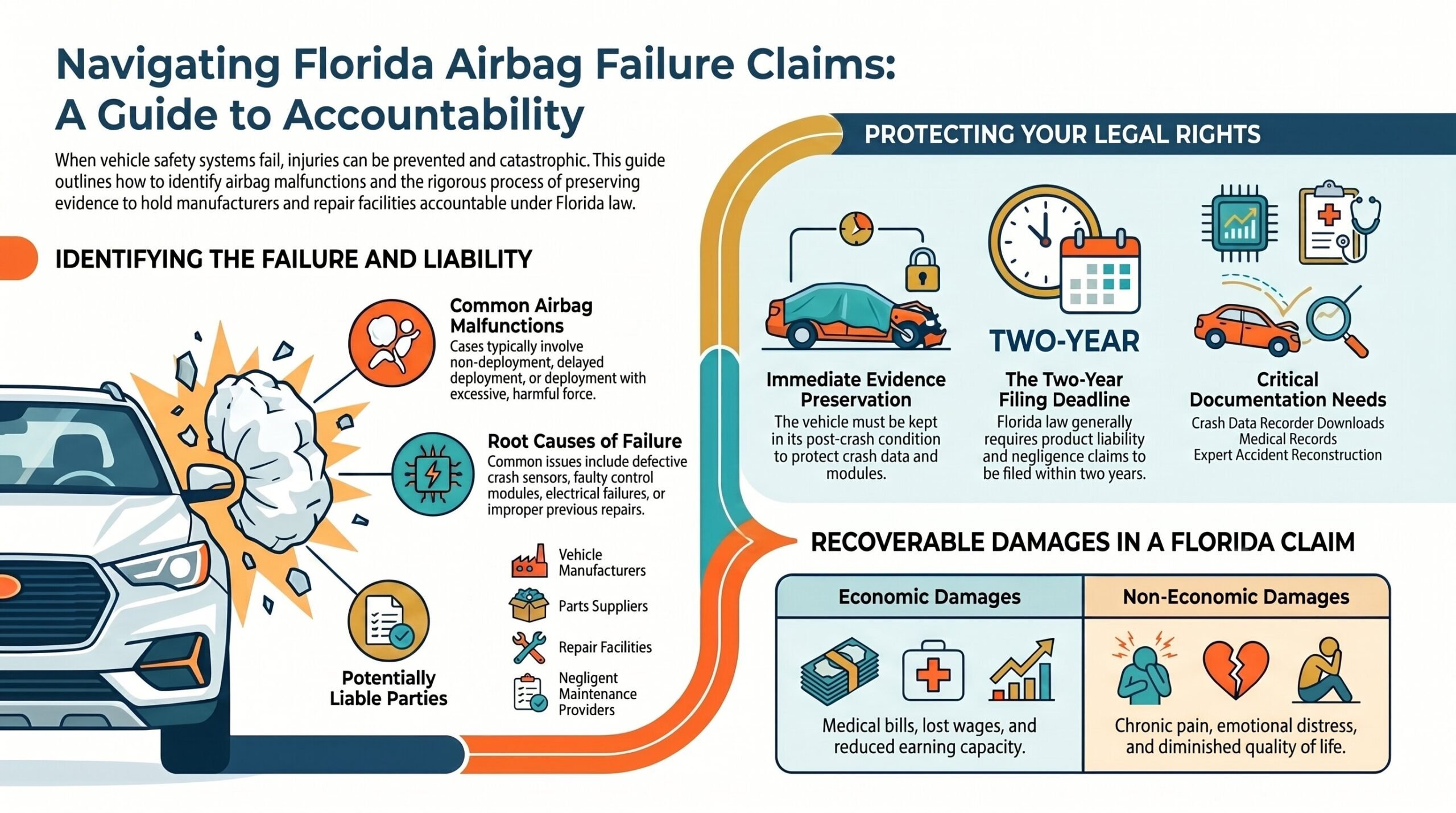
When an airbag fails to deploy, deploys late, or inflates with excessive force, an injury claim may require a detailed investigation into the vehicle, crash data, product design, and the conduct of multiple parties. A Florida airbag failure injury lawyer can help preserve evidence, identify responsible manufacturers, insurers, maintenance providers, and other parties, and coordinate the work needed to support a serious claim.
Legal guidance may include securing Causation evidence, obtaining expert documentation, reviewing medical records, and linking injuries to the crash. Counsel may also address property damage valuation, including vehicle loss, repair assessments, and related documentation that may affect recovery. By organizing records, communicating with insurers, and evaluating liability, the lawyer can develop a settlement strategy focused on accountability and fair compensation. This assistance allows injured individuals and their families to pursue relief while maintaining attention on recuperation, stability, and the practical needs that follow a preventable safety failure.
OUR CONSULTATIONSARE FREE
START YOUR FREE CASE REVIEW

Understanding Florida Airbag Failure Injury Cases
Although airbags are designed to reduce the risk of serious harm in a collision, a defective or improperly functioning system can cause severe, sometimes avoidable injuries. In Florida, these cases often involve careful review of how the restraint system performed during the crash, the nature of the occupant’s injuries, and whether the harm aligns with expected airbag protection.
An airbag failure injury case may require prompt preservation of evidence, including the vehicle, onboard data, photographs, repair records, and witness accounts. This information can help clarify whether the system failed to deploy, deployed late, or caused injury through abnormal force. Strong medical documentation is also vital because treatment records, diagnostic findings, and physician opinions connect the collision to the injuries claimed.
For injured individuals and families seeking accountability, these cases serve a broader purpose. They promote safety, support responsible conduct, and help make sure that preventable dangers are addressed through informed legal action.
Common Causes of Florida Airbag Failure
Airbag failure in Florida injury cases may result from several preventable mechanical or electronic defects. Common causes include defective crash sensors, faulty airbag modules, electrical system failures, and improper vehicle repairs that disrupt the restraint system. Identifying the specific cause is important because liability may extend to manufacturers, repair facilities, or other responsible parties.
Defective Crash Sensors
Because crash sensors serve as the trigger point for an airbag deployment, a defect in these components can prevent the entire system from responding during a collision. In Florida crashes, damaged, poorly calibrated, or improperly installed sensors may fail to recognize the force, angle, or severity of impact. When this occurs, occupants who relied on the vehicle’s safety system may suffer preventable injuries.
Sensor problems may also interact with occupant detection features, creating uncertainty about whether protection should activate for a seated passenger. Investigators often review repair history, recalls, diagnostic codes, and warranty coverage to determine whether a defect was known or should have been corrected. Careful evaluation helps identify responsible parties, supports injured individuals, and promotes safer practices for the broader community through accountability and corrective action.
Faulty Airbag Modules
When the airbag control module malfunctions, the vehicle’s supplemental restraint system may fail to process crash data correctly or may prevent deployment altogether. This module evaluates collision severity, stores diagnostic information, and coordinates restraint timing. If it contains flawed software, internal damage, or improper calibration, occupants may be left without essential protection during a serious crash.
Aftermarket parts can create additional concerns when replacement modules are incompatible, poorly programmed, or installed without proper verification. Responsible repair practices require careful testing, documentation, and attention to recall compliance, especially when manufacturers have identified module defects affecting safety performance. For injured Floridians, evidence from module downloads, service histories, and repair records may help determine whether a preventable failure contributed to harm and whether responsible parties neglected established safety duties.
Electrical System Failures
Although modern restraint systems rely on sophisticated sensors and control units, they also depend on stable electrical power and clean signal pathways to function properly. Electrical system failures can interrupt the communication needed to deploy airbags within milliseconds of a collision. Faulty wiring may prevent crash data from reaching the airbag control module, leaving occupants without the protection designed to reduce severe injury.
Corroded connectors, damaged grounds, weak battery output, or short circuits can also compromise system readiness. In some vehicles, overheating wiring may degrade insulation, increase resistance, or cause signal loss during critical moments. For advocates, caregivers, and professionals serving injured people, these failures matter because they can transform a survivable crash into a devastating event. Careful investigation helps identify whether electrical defects contributed to airbag nondeployment or delayed deployment.
Improper Vehicle Repairs
After a collision or major service, improper vehicle repairs can disrupt the airbag system in ways that are not immediately visible. Technicians may overlook damaged sensors, reconnect wiring incorrectly, or install incompatible replacement parts, leaving occupants unprotected during a later crash. Defective clock springs can also prevent steering wheel airbags from receiving the electrical signal needed to deploy, even when warning lights appear intermittent or absent.
In Florida injury claims, repair histories often become crucial evidence, especially when service records show rushed inspections or incomplete diagnostics. Insurance paperwork delays may further complicate accountability, making it harder for injured people and their advocates to identify negligent repair practices. Careful review of invoices, diagnostic reports, and post-repair warnings can help protect community members seeking safety, fairness, and responsible vehicle maintenance.


Legal Rights of Florida Airbag Failure Injury Victims
Because an airbag failure can turn a survivable collision into a catastrophic injury event, Florida victims may have legal rights against more than one responsible party. These rights may include claims for medical care, lost income, diminished earning capacity, pain, disability, and long-term support needs. Insurance disputes often arise when carriers contest responsibility, minimize injuries, or rely on policy limits to restrict payment.
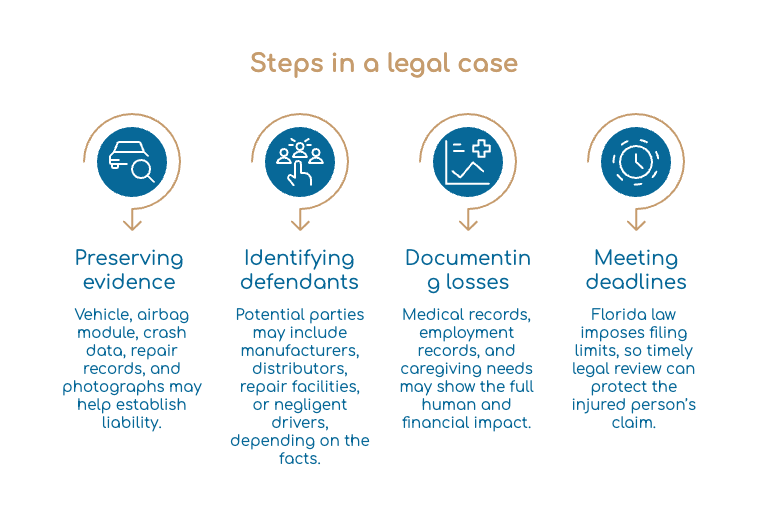
Airbag failures can create serious legal claims involving injuries, insurance disputes, and multiple responsible parties.
- Preserving evidence: The vehicle, airbag module, crash data, repair records, and photographs may help establish liability.
- Identifying defendants: Potential parties may include manufacturers, distributors, repair facilities, or negligent drivers, depending on the facts.
- Documenting losses: Medical records, employment records, and caregiving needs may show the full human and financial impact.
- Meeting deadlines: Florida law imposes filing limits, so timely legal review can protect the injured person’s claim.
A careful legal response can help victims, families, and caregivers pursue accountability with dignity, organization, and purpose.
Why Do Florida Airbag Failure Injuries Happen?
Why do airbag failure injuries occur in crashes where the restraint system should provide critical protection? These injuries may result from defects in design, manufacturing, maintenance, or vehicle electronics. Airbags rely on sensors, control modules, wiring, inflators, and crash algorithms working in unison within milliseconds. Faulty sensor readings can prevent deployment, trigger delayed deployment, or cause unnecessary deployment with harmful force.
Florida crashes may also involve contributing conditions such as prior vehicle damage, improper repairs, recalled components, corrosion, or software errors. In some cases, the airbag deploys but fails to cushion the occupant because the inflation force, timing, or placement is unsafe. Driver negligence considerations may also matter, including speeding, impaired driving, distracted driving, or failing to wear a seat belt, because these factors can affect injury severity and liability analysis.
Understanding these causes helps identify responsible parties and supports accountability for safer vehicles and more appropriate conduct on Florida roads.
What Should You Do After a Florida Airbag Failure Injury?
After a suspected Florida airbag failure injury, an injured person should obtain prompt medical care, even when symptoms appear limited at first. The vehicle, airbag components, crash data, and related evidence should be preserved because later repairs or disposal may compromise a potential claim. Legal counsel should be contacted early to evaluate liability, preserve evidence, and coordinate with insurance or the manufacturer.
Seek Medical Care
When an airbag fails to deploy or deploys improperly, prompt medical evaluation should be treated as a priority. Injuries may involve the head, neck, spine, chest, abdomen, or internal organs, and symptoms can appear hours or days later. A medical professional can identify hidden trauma, recommend treatment, and create records that support responsible care for the injured person.
Post-crash symptom tracking, including pain levels, dizziness, numbness, breathing issues, or cognitive changes, helps providers understand progression and urgency. Consistent documentation also assists those handling an insurance denial appeal, as delayed or incomplete care may be used to dispute injury severity. Follow-up visits, therapy referrals, diagnostic testing, and expert assessments should be completed as advised, ensuring the recovery plan remains medically grounded and properly documented.
Preserve Vehicle Evidence
Because the vehicle may contain vital proof of an airbag defect, it should be preserved in its post-crash condition as soon as reasonably possible. No one should repair, sell, dispose of, or alter the vehicle before proper evidence preservation occurs. Responsible caretakers should arrange secure vehicle storage, preferably indoors, to protect the airbag module, sensors, seat belts, steering components, and event data systems from weather, tampering, or further damage.
Crash scene documentation should also be gathered, including photographs, tow records, police reports, and the names of responding personnel or witnesses. These steps support spoliation prevention and help ensure that those serving the injured person can later evaluate what happened with accuracy. Preserving the vehicle respects the truth, protects accountability, and supports a fair review of the airbag’s failure.
Contact A Lawyer
Legal guidance should be sought promptly after a suspected Florida airbag failure injury, especially where the crash involved a non-deployment, late deployment, unexpected deployment, or inadequate occupant protection. An attorney can help protect the injured person, the family, and others who may face similar dangers by identifying responsible parties and preventing essential evidence from being lost.
Early consultation supports Medical documentation, vehicle inspections, insurer communications, and preservation steps that may be vital to a product liability claim. Counsel may also coordinate with experts to examine crash data, airbag components, seatbelts, and repair history. This involvement helps ensure deadlines are met under Florida law. Prompt legal review allows the injured person’s rights to be evaluated while service-oriented accountability and public safety remain central concerns after the collision.
Critical Evidence in a Florida Airbag Failure Injury Case
Critical evidence in a Florida airbag failure injury case often determines whether a defect, maintenance issue, or collision-related factor caused the restraint system to fail. Key materials may include: 1. Crash Data Recorder, 2. Vehicle Maintenance Records, 3. Airbag Control Module, and 4. Expert Accident Reconstruction. Each source can help clarify what occurred before, during, and after impact, providing a factual basis for evaluating liability and damages.
Crash Data Recorder
When an airbag fails to deploy during a Florida collision, the vehicle’s crash data recorder may provide some of the most important evidence in the injury claim. This device can record speed, braking, seatbelt use, impact severity, and deployment commands immediately before and during a crash. Attorneys may seek prompt preservation of this information because delayed access can risk loss, overwriting, or disputes about authenticity.
The data may help determine whether the airbag system received a deployment signal, whether sensors functioned properly, and whether manufacturer defects contributed to harm. It may also support comparisons with Vehicle repair history and Insurance denial responses, helping clarify disputed facts. For injured occupants, careful review of recorder data can strengthen accountability and guide fair recovery efforts.
Vehicle Maintenance Records
After crash data recorder findings are reviewed, vehicle maintenance records can provide a broader history of the airbag system and related safety components. These records may show prior repairs, warning light complaints, recalls, inspections, or collision work that affected sensors, wiring, or restraint parts. In a Florida airbag-failure injury case, this information helps clarify whether a defect, a negligent repair, or a missed service opportunity contributed to the injury.
Careful timing of fault analysis may involve comparing service dates with crash-site documentation, photographs, and witness accounts to identify meaningful patterns. Attorneys, investigators, and safety professionals often examine invoices, dealership notes, and technician findings to protect injured occupants and promote safer practices. Complete records also help distinguish responsible parties, including manufacturers, repair facilities, prior owners, or maintenance providers.
Airbag Control Module
Because the airbag control module governs how restraint systems respond during a collision, it often becomes one of the most important pieces of evidence in a Florida airbag failure injury case. This electronic unit may store deployment commands, fault codes, warning light activity, and system status before impact. A careful vehicle inspection can help determine whether the module recorded a malfunction, a loss of power, a sensor error, or a disabled component.
These findings may support injured occupants and their families as they seek accountability and safer outcomes for others. The module may also show whether known airbag recalls affected the vehicle and whether corrective service was completed. Promptly preserving this evidence is necessary, since improper handling, repairs, or disposal can limit the ability to evaluate a potential product or maintenance failure.
Expert Accident Reconstruction
The information recovered from an airbag control module is more valuable when compared with a full reconstruction of the crash. Reconstruction experts study vehicle damage, roadway evidence, impact angles, speed estimates, restraint use, and occupant movement to determine whether the airbag system should have deployed. Their findings may confirm a defect, reveal improper calibration, or identify another contributing cause.
In a Florida airbag-failure injury case, this analysis can support injured people, families, and advocates seeking accountability for preventable harm. Eyewitness testimony may help establish the sequence of events, while an engineering review may address compliance with safety standards and manufacturer responsibility. When presented clearly, expert reconstruction gives attorneys, insurers, and courts a reliable framework for understanding how the failure occurred and why it matters.
Long-Term Effects of Florida Airbag Failure Injuries
Airbag failure injuries in Florida may produce long-term consequences that extend well beyond the initial crash and medical treatment. Chronic pain complications, traumatic brain effects, and emotional trauma recovery can affect mobility, cognition, employment, and overall quality of life. These lasting harms often require careful medical documentation, expert evaluation, and a clear assessment of future damages.
Chronic Pain Complications
Chronic pain can emerge after an airbag fails to deploy, deploys late, or deploys with excessive force, leaving an injured person with lasting complications that extend far beyond the initial crash. Persistent neck, back, shoulder, chest, or limb pain may limit mobility, sleep, employment, and daily caregiving responsibilities. These conditions often require ongoing medical evaluation, physical therapy, medication management, and careful documentation of functional loss.
In Florida injury claims, chronic pain should be supported by records that connect the symptoms to the crash and the restraint system failure. A thorough Vehicle defect investigation may help identify whether sensor, module, wiring, or design issues contributed to the harm. An effective Insurance negotiation strategy should account for future treatment, reduced earning capacity, and the continuing burdens placed on the injured person and family.
Traumatic Brain Effects
When an airbag does not function as intended, the head may strike the wheel, dashboard, side window, or other interior surfaces with enough force to cause traumatic brain effects. These injuries may include concussions, contusions, diffuse axonal injury, or lasting cognitive changes that affect memory, concentration, balance, and processing speed. Care providers, advocates, and family members often recognize that symptoms may develop gradually, requiring careful observation and timely evaluation.
Neck injuries can further complicate diagnosis, because headaches, dizziness, and visual disturbance may overlap with whiplash recovery. Long-term care may involve neurological assessment, imaging, rehabilitation, and documented monitoring of daily limitations. In Florida airbag failure cases, identifying these effects helps connect the collision mechanism to the person’s ongoing medical needs and functional losses.
Emotional Trauma Recovery
After a serious collision involving airbag failure, emotional trauma may persist long after the visible injuries have stabilized. Survivors may experience anxiety, sleep disruption, fear of driving, depression, or intrusive memories that interfere with work, family care, and community responsibilities. These effects merit careful documentation because mental health treatment, counseling records, and provider evaluations can help show the full impact of the defective safety system.
During the insurance claim process, clear evidence of emotional harm may support compensation for therapy costs, lost income, and reduced quality of life. Legal deadline awareness is also important, since delayed action can limit available remedies. A Florida airbag failure injury lawyer may help injured individuals preserve records, coordinate expert opinions, and pursue accountability while they focus on recovery and restored stability.
Proving Liability in Florida Airbag Failure Injury Cases
Establishing liability in a Florida airbag failure injury case requires a careful review of how the airbag system was designed, manufactured, installed, and maintained. Attorneys may examine crash data, vehicle history, recall notices, repair records, and expert engineering findings to determine whether a preventable failure occurred. Product defect litigation often focuses on whether the airbag failed to deploy, deployed late, deployed with excessive force, or malfunctioned because of defective sensors, wiring, or control modules.
Responsibility may fall on a manufacturer, parts supplier, dealership, repair facility, or another negligent party. Evidence must connect the defect or misconduct to the injuries sustained, not merely show that a collision occurred. Medical records, treating physician opinions, and accident reconstruction reports can help establish causation and damages. While distinct from Medical negligence claims, these cases require similar discipline in documenting harm, preserving evidence, and presenting reliable expert testimony on behalf of injured individuals.
Dealing With Insurance Companies After a Florida Airbag Failure Injury
In the aftermath of a Florida airbag failure injury, insurance companies often begin evaluating fault, coverage, and damages before the injured person fully understands the extent of the claim. Their representatives may request statements, medical authorizations, vehicle access, or early settlement discussions. Each communication should be handled with care because incomplete answers or broad releases can affect the ability to protect important evidence and serve the injured person’s long-term needs.
Insurers may focus on crash severity, prior repairs, seatbelt use, or alleged driver error. A careful response may require repair inspection records, photographs, diagnostic data, medical documentation, and expert technical testing to address whether the airbag system malfunctioned as intended.
When a claimant is seriously injured, thoughtful advocacy can help ensure that insurers do not minimize losses or overlook product-related concerns. This disciplined approach supports fair evaluation while preserving the dignity, safety, and recovery interests of the injured person.
What to Expect During a Florida Airbag Failure Injury Claim Process
A Florida airbag failure injury claim typically begins with an initial case evaluation, followed by a focused review of the crash facts, injuries, and potential product defects. The process may then involve evidence preservation, expert investigation, and negotiations with insurers or other responsible parties. If a fair resolution cannot be reached, filing a lawsuit may become necessary to pursue compensation through the court system.
Initial Case Evaluation
When an airbag fails to deploy, deploys late, or deploys with excessive force, the initial case evaluation focuses on whether the failure can be linked to a defect, improper maintenance, prior repairs, or another party’s negligence. During this stage, an attorney reviews the injured person’s account, crash timeline, vehicle history, and available claim records to determine whether legal action may serve the client’s recovery and broader safety interests.
Medical treatment documentation is considered to understand injury severity, ongoing care needs, and whether the harm is consistent with an airbag malfunction. The evaluation may also address early insurer conduct, including filing insurance objections when coverage positions are incomplete, inaccurate, or unfair. This process helps identify responsible parties, potential damages, and practical next steps for pursuing accountability under Florida law.
Evidence And Investigation
After the initial review identifies a viable concern, the investigation typically shifts to preserving and analyzing the evidence that may explain why the airbag system did not perform as expected. The vehicle may be secured before repairs, disposal, or alteration, allowing qualified experts to inspect sensors, modules, seatbelts, crash data, and component design. Photographs, police reports, maintenance records, and recall information may also be gathered to build a reliable factual record.
Medical documentation helps connect the occupant’s injuries to the crash and the suspected restraint failure, while also showing the scope of needed care. Investigators may interview witnesses and review roadway conditions, impact angles, and vehicle history. Careful attention to insurance deadlines helps protect the claim and preserve evidence for later legal evaluation.
Insurance Claim Negotiations
During insurance claim negotiations, the focus often shifts from gathering facts to presenting a clear, well-documented demand that explains liability, causation of injury, and the value of the losses. In a Florida airbag failure matter, an insurer may review crash reports, medical records, expert findings, repair data, and product history before responding.
The injured person’s representative may address disputed fault, arguments about delayed treatment, or claims that another component caused the harm. Negotiations may also involve future care costs, lost income, pain, disability, and, in fatal cases, death compensation for surviving family members. When insurers undervalue losses or raise wrongful claims about responsibility, careful documentation helps protect the claimant’s position. This stage often requires patience, firm advocacy, and a service-minded commitment to securing a fair resolution.
Filing A Lawsuit
If insurance negotiations do not lead to a fair resolution, filing a lawsuit may become the next step in a Florida airbag failure injury claim. This process begins with a formal complaint that identifies responsible parties, such as a manufacturer, distributor, repair provider, or negligent driver.
Collecting crash documentation remains crucial, including police reports, medical records, vehicle inspections, photographs, and witness statements. These materials help show how the airbag failed and how the injury affected the claimant’s life.
After filing, both sides exchange evidence through discovery, which may include expert analysis and sworn testimony. Managing fault disputes is often central, especially when defendants argue that impact severity, maintenance issues, or driver conduct caused the harm. A well-prepared lawsuit supports accountability and helps protect injured people seeking necessary care.
Compensation for Florida Airbag Failure Injury Damages
When an airbag fails to deploy or deploys improperly, the resulting injuries may support a claim for substantial compensation under Florida law. The process requires careful attention to the Insurance timeline, because missed deadlines can weaken recovery efforts.
A lawyer may help organize claim documentation, including crash reports, vehicle inspection findings, photographs, witness statements, and repair records. Consistent medical follow-up is also important, as treatment records connect the defect to the injuries and show whether limitations continue over time.
Compensation may reflect the full impact of the incident, but each case depends on proof, causation, and the available parties responsible for the defective system. A thorough pain assessment can help explain how the injury affects daily service to family, work, and community responsibilities. By presenting evidence with accuracy and purpose, counsel can help injured persons pursue accountability while preserving dignity, stability, and needed support during recovery after a preventable airbag failure.
Economic vs Non-Economic Damages in Florida Airbag Failure Cases
In Florida airbag failure cases, damages are generally assessed as economic losses and non-economic harm, each requiring distinct forms of proof. Recoverable economic losses may include medical expenses, lost wages, reduced earning capacity, and other measurable financial costs tied to the defective airbag. Non-economic harm, such as pain, emotional distress, and diminished quality of life, often requires careful valuation supported by medical records, expert opinions, and evidence connecting the injuries to the airbag failure.
Recoverable Economic Losses
Several categories of economic loss may be recoverable in a Florida airbag failure case, depending on the severity of the injuries and the financial impact on the injured person’s life. These losses may include emergency care, hospitalization, surgery, rehabilitation, prescription costs, assistive devices, and future medical treatment. Lost wages, reduced earning capacity, and diminished employment benefits may also be claimed when injuries limit the person’s ability to work.
Medical documentation helps establish the connection among the defective airbag, the required treatment, and the related expenses. Repair or replacement costs for the vehicle may also be considered when supported by evidence. If an insurer unreasonably delays or denies valid payment, insurance bad faith may become a separate concern requiring careful legal review and action.
Non-Economic Harm Valuation
Although economic losses can often be measured through bills, receipts, and wage records, non-economic harm in a Florida airbag failure case requires a more detailed assessment of how the injuries have affected the person’s daily life. This valuation may address pain, emotional distress, scarring, loss of mobility, sleep disruption, and reduced ability to participate in family, work, or community responsibilities.
For service-minded families, these harms may be especially profound when the injured person can no longer care for others as before. Insurers may minimize these losses or issue a wrongful denial, arguing that intangible harm lacks clear value. Careful valuation helps explain the human consequences of the defect, supports fair settlement leverage, and encourages accountability for injuries that extend beyond financial expense.
Proving Airbag Damages
When an airbag fails to deploy, deploys late, or deploys with excessive force, proving damages requires a clear separation between measurable financial losses and the more personal harms that affect daily life. Economic damages may include emergency care, surgery, rehabilitation, lost wages, reduced earning capacity, and future medical needs. These losses depend on medical documentation, employment records, billing statements, and expert analysis.
Non-economic damages address pain, emotional distress, disfigurement, loss of independence, and reduced quality of life. Careful proof connects these harms to the crash and the defective restraint system. Proving fault also requires evidence of liability, including vehicle data, repair histories, recalls, crash reports, and expert inspections. During insurance negotiations, organized evidence helps present the full human and financial impact accurately.
When a Florida Airbag Failure Injury Case Goes to Trial vs Settlement
How does a Florida airbag failure injury case move from negotiation to a courtroom? The path often depends on whether responsible parties acknowledge the defect, accept causation, and offer compensation that reflects the harm suffered. Attorneys serving injured clients evaluate trial risk, settlement leverage, damages valuation, and evidence strategy before recommending resolution or litigation.
Settlement may be appropriate when records, expert opinions, crash data, and medical documentation create a clear picture of liability and loss. A fair agreement can provide needed support without the delay and strain of trial. However, a trial may become necessary when manufacturers, insurers, or other parties dispute the airbag’s failure, minimize injuries, or undervalue future care needs.
In court, the case is presented through testimony, technical analysis, and documented losses. The goal remains service to the injured person, ensuring accountability, promoting safer vehicle systems, and pursuing compensation that reflects the full impact of the failure.
Florida Laws That May Affect Your Florida Airbag Failure Case
In Florida, an airbag failure injury case may be shaped by several state laws that affect liability, filing deadlines, damages, and the evidence needed to prove a claim. These rules help identify responsible parties, guide fair recovery, and support those seeking to serve injured people with care and diligence.
Florida law shapes airbag failure claims by governing liability, deadlines, damages, and the evidence required for recovery.
- Product liability principles may apply when an airbag was defectively designed, manufactured, or marketed, requiring proof that the defect contributed to harm.
- Comparative fault rules may reduce compensation if evidence shows another driver, vehicle occupant, or injured person shared responsibility for the crash or injuries.
- Traffic accident documentation can influence fault findings, especially police reports, crash scene photographs, witness details, and vehicle inspection records.
- Medical record accuracy is important because treatment notes, diagnostic findings, and physician opinions connect the airbag failure to specific injuries.
These laws make careful evidence preservation and responsible case evaluation crucial.
The Statute of Limitations for Florida Airbag Failure Injury Cases
For many injured people, the statute of limitations is one of the most important legal deadlines in a Florida airbag failure case. In Florida, product liability and negligence claims generally must be filed within two years from the date of injury. When an airbag defect contributes to a fatal crash, a wrongful death claim usually must also be filed within two years of death. These deadlines protect the orderly resolution of claims, but they can be unforgiving.
Timely filing matters because evidence may disappear, vehicles may be repaired or destroyed, and witness memories may fade. Comparative fault rules may also affect recovery if another driver, manufacturer, repair shop, or injured person shares responsibility.
In rare cases involving reckless disregard or intentional misconduct, punitive damages awards may be considered, but deadlines still apply. Those who support injured families should recognize that prompt attention to filing periods helps preserve the opportunity for accountability and meaningful financial recovery.
How a Florida Airbag Failure Injury Lawyer Can Help You
After a crash involving a suspected airbag failure, a Florida airbag failure injury lawyer can help determine whether the claim involves a defective design, a manufacturing error, improper installation, a faulty sensor, or an inadequate warning. This guidance can support injured people and families seeking accountable, service-minded solutions.
- Preserving evidence: Counsel may coordinate vehicle inspections, airbag module downloads, maintenance records, and crash data before key proof is lost.
- Identifying responsible parties: The review may include automakers, parts manufacturers, repair shops, dealerships, and insurers, depending on how the failure occurred.
- Addressing insurance disputes: A lawyer can respond to insurance coverage denials, policy defenses, and attempts to shift blame away from defective safety systems.
- Valuing the harm: Medical costs, lost income, disability, caregiving needs, and pain may shape a settlement negotiation strategy grounded in documentation.
Through careful investigation and disciplined advocacy, legal counsel can help pursue compensation while promoting safer practices for the wider community.
When to Contact a Florida Airbag Failure Injury Lawyer
When an airbag fails to deploy, deploys late, or deploys with excessive force, injured occupants should consider contacting a Florida airbag failure injury lawyer as soon as medical needs are stabilized. Early contact helps preserve vehicle evidence, crash data, photographs, medical records, and witness information before these materials are lost or altered.
Prompt legal consultation is also important when injuries require ongoing care, when fault is disputed, or when a manufacturer, repair shop, or insurer requests a statement. Families serving an injured loved one may also seek guidance to understand deadlines within the Florida claim timeline and avoid missed procedural requirements.
Contact may be especially appropriate after an insurer questions causation, minimizes injuries, delays payment, or issues an adverse decision. A timely insurance denial response can protect the record and clarify the basis for further action. Acting early allows responsible parties to be identified while evidence remains available and reliable.
Why You Need an Experienced Florida Airbag Failure Injury Lawyer
Early legal involvement can protect evidence, but the value of that involvement often depends on the lawyer’s experience with airbag defect and crash injury claims. These cases may involve vehicle manufacturers, component suppliers, repair facilities, and insurers, each with separate interests and defenses. An experienced Florida airbag failure injury lawyer can assess crash data, inspection records, recall history, and medical evidence to identify how the restraint system failed and who may be responsible.
Experience also matters when injuries are severe or fatal. Wrongful death claims require careful attention to statutory beneficiaries, economic losses, and the human consequences suffered by the family. At the same time, manufacturers and insurers may raise Comparative negligence defenses, arguing that the injured person’s conduct reduced liability. Skilled legal guidance helps preserve the client’s ability to serve dependents, caregivers, and loved ones through a properly supported claim that seeks accountability and necessary financial recovery.
How to Choose the Right Florida Airbag Failure Injury Lawyer for Your Case
How should an injured person evaluate a lawyer for a Florida airbag failure claim? The selection should begin with experience in defective-product and motor-vehicle injury cases, including familiarity with crash data, vehicle recalls, expert testimony, and manufacturer liability. A suitable lawyer should show disciplined case preparation, respect for the client’s circumstances, and a commitment to protecting the injured person’s ability to recover.
Notable case evaluations can help indicate whether the lawyer understands how to assess liability, damages, and evidence in intricate airbag claims. The injured person should also consider whether the lawyer has access to qualified experts who can examine the vehicle, identify deployment failures, and clearly explain technical issues.
Client communication is equally important. A dependable lawyer should provide timely updates, answer questions directly, and explain legal options without unnecessary confusion. This approach helps injured people make informed decisions while maintaining dignity, trust, and focus throughout the claim.
About The Law Offices of Anidjar & Levine
Focused on representing injured people across Florida, The Law Offices of Anidjar & Levine handles motor vehicle injury and defective product claims with careful attention to evidence, liability, and client recovery.
In airbag failure matters, the firm evaluates crash records, vehicle history, medical documentation, and potential product defects to identify responsible parties and preserve vital proof.
The firm’s Client intake process is designed to help injured individuals explain what happened, report their concerns, and receive clear guidance on possible next steps.
This structured approach supports respectful service, especially for clients facing pain, uncertainty, and financial strain after a collision.
Through case strategy planning, attorneys assess negligence, manufacturer responsibility, insurance coverage, and the full impact of injuries.
Their work may include consulting experts, reviewing recall information, and preparing claims for negotiation or litigation.
The firm’s objective is to pursue accountability while supporting clients with consistent communication and careful legal management.
Frequently Asked Questions
Can Airbags Fail in Low-Speed Florida Crashes?
Yes, airbags can fail in low-speed Florida crashes, depending on crash dynamics, sensor thresholds, vehicle design, and impact direction. Airbag systems are calibrated to deploy only when forces meet specific criteria, so minor collisions may not trigger deployment. However, defects, maintenance issues, or sensor malfunctions can increase deployment risk or prevent proper activation. Those assisting injured occupants should preserve evidence, document injuries, and seek a qualified evaluation of the vehicle system promptly.
Are Recalled Airbags Still Dangerous After Repair?
Recalled airbags may remain dangerous after repair if defective components were not replaced correctly, documentation is incomplete, or related sensors remain compromised. Careful post-repair verification helps protect vehicle occupants and supports those responsible for community safety. A manufacturer inspection may confirm that the remedy was properly performed and that no unresolved recall applies. If warning lights, deployment concerns, or crash history exist, further evaluation should be sought before relying on the system.
Can Aftermarket Parts Affect Airbag Performance?
Yes, aftermarket parts can affect airbag performance, especially when aftermarket sensors, wiring, bumpers, or structural components do not meet original specifications. Airbag systems depend on precise timing, impact detection, and communication between components. Improper fitment or poor calibration may delay deployment or prevent activation. Dealer installation or qualified professional service helps protect occupants, supports safety compliance, and serves the public interest by reducing preventable harm after a collision or repair.
Who Preserves a Vehicle After Airbag Failure?
The vehicle owner, legal representative, insurer, or a court-appointed custodian may preserve a vehicle after airbag failure. Preservation depends on vehicle ownership, insurance reporting, and any pending investigation. The vehicle should remain unaltered, secured, and available for inspection by qualified experts. Those assisting injured persons should promptly document the storage location, prevent repairs or disposal, and notify the involved parties, ensuring that the evidence remains reliable, respectful of responsibilities, and suitable for possible claims.
Can Rental Car Airbags Create Liability Issues?
Yes, Rental Car airbags can create liability issues when deployment failure, delayed deployment, or defective maintenance contributes to injuries. Investigators may examine service records, recall compliance, prior damage, and Crash Evidence to determine responsibility. Insurance Claims may involve the rental company, manufacturer, maintenance provider, or another negligent driver. Third-party liability can arise when separate actors fail to protect occupants, requiring careful documentation to support those serving injured individuals.
—————————
Airbag failure injuries can leave victims facing severe medical, financial, and legal challenges.
A skilled Florida airbag-failure injury attorney can examine the defect, identify responsible parties, preserve evidence, and seek compensation through a product liability or negligence claim.
The Law Offices of Anidjar and Levine provides knowledgeable legal support for injured victims and their families, including assistance from a Florida Car Accident Lawyer.
Timely legal guidance can safeguard important rights and help ensure each claim is handled with diligence, accuracy, and care.