The Law Offices of Anidjar and Levine help victims document medical care, crash evidence, wage losses, and ongoing limitations after a collision.
Rib fractures may affect breathing, mobility, work duties, and daily responsibilities, especially when complications are missed early.
Legal support from a Florida Car Accident Lawyer can address disputes with insurers over fault, coverage, policy limits, and settlement value.
A lawyer may also protect deadlines and communications while pursuing compensation tied to documented losses.
The sections below explain these issues in greater detail.
Main Takeaways
- A Florida broken ribs car accident lawyer can help document medical records, crash evidence, lost wages, and witness statements.
- Rib fractures may affect breathing, mobility, work capacity, and daily responsibilities, making prompt medical evaluation important.
- Legal help can address insurance disputes involving fault, policy limits, PIP benefits, and bodily injury coverage.
- Key evidence includes crash photos, police reports, vehicle damage, airbag deployment, seatbelt marks, and treatment records.
- Compensation may include medical expenses and lost income when another party’s negligence caused lasting harm.


How We Can Help With Your Florida Broken Ribs Car Accident Injury Claim
Pursuing a broken ribs injury claim after a Florida car accident requires careful documentation, timely legal action, and a clear understanding of how the injury affects the claimant’s health, work, and daily life. A qualified legal team can gather medical records, crash reports, wage information, and witness statements to support a well-organized claim strategy. This assistance helps ensure that the injured person’s needs are presented accurately and with dignity.
Counsel may also address Insurance coverage disputes, including disagreements over fault, policy limits, medical necessity, or the value of future care. By coordinating with treating providers, attorneys can help explain Pain management options, recovery planning, and the practical limits created by the injury.
This guidance supports fair evaluation of medical expenses, lost income, and diminished daily function. Through steady advocacy, the legal team serves the claimant by protecting deadlines, communicating with insurers, and pursuing compensation aligned with documented losses.
OUR CONSULTATIONSARE FREE
START YOUR FREE CASE REVIEW

Understanding Florida Broken Ribs Car Accident Injury Cases
When a car accident causes broken ribs, the injury may appear straightforward, but the legal and medical issues often require careful evaluation. In Florida injury cases, rib fractures can affect breathing, mobility, work capacity, and the ability to provide daily care for family or community responsibilities. Proper documentation helps establish the extent of harm and the support needed during recovery.
Diagnostic imaging accuracy is important because some fractures may be missed on initial examination, especially when pain, swelling, or related chest injuries complicate assessment. Medical records, follow-up evaluations, and physicians’ opinions can clarify the severity and link the injury to the accident.
The compensation timeline may depend on treatment duration, insurance review, liability disputes, and the time needed to understand long-term effects. A careful legal evaluation considers medical expenses, lost income, pain, limitations, and future needs, allowing the claim to reflect the full impact of the injury.
Common Causes of Florida Broken Ribs Car Accident
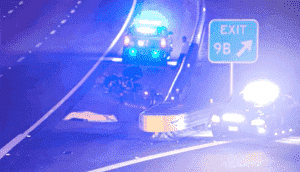
Broken ribs in Florida car accident cases often result from severe crash forces, particularly in high-speed vehicle collisions. Seat belt impact and airbag deployment force may also fracture ribs, even when these safety devices reduce the risk of more catastrophic injuries. Motorcycle and pedestrian crashes present additional dangers, as the body may absorb direct trauma with limited protection.
High-Speed Vehicle Collisions
High-speed vehicle collisions are a leading cause of broken ribs in Florida car accidents because the force of impact can violently compress the chest against a seat belt, wheel, dashboard, or airbag. At elevated speeds, occupants have less time to brace, and emergency responders often encounter severe blunt-force trauma requiring careful evaluation.
These crashes may arise from speeding, aggressive lane changes, impaired driving, or Distracted Driving, each increasing the likelihood of serious chest injury. Rear-end crashes at highway speeds can also transfer substantial force through the torso, especially when traffic stops suddenly. For injured individuals and those assisting them, prompt medical attention is critical, since rib fractures may accompany lung injury or internal bleeding. Careful documentation can support treatment, recovery, and future legal evaluation.
Seat Belt Impact
Often, seat belt impact causes broken ribs in Florida car accidents because the restraint concentrates crash forces across the chest during sudden deceleration. Although seat belts save lives, the pressure from a lap-and-shoulder belt can fracture ribs, bruise soft tissue, or aggravate existing conditions, especially in older adults or medically fragile occupants. These seat belt injuries may indicate severe crash energy rather than improper restraint use.
Caregivers, advocates, and legal professionals should encourage prompt evaluation, because medical documentation connects chest pain, imaging results, and treatment needs to the collision.
In a liability comparison, insurers may examine vehicle speeds, seating position, belt fit, and driver conduct. Clear records support insurance negotiation by showing that the rib fractures resulted from necessary restraint forces, while preserving fair consideration for the injured person’s recovery and ongoing support.
Airbag Deployment Force
Airbag deployment force can cause broken ribs in Florida car accidents when the airbag inflates rapidly and strikes the chest during a frontal or near-frontal collision. Although airbags are designed to reduce fatal injuries, their sudden expansion can create significant pressure on the sternum and rib cage, especially for older occupants, smaller adults, or individuals seated too close to the wheel. These injuries may involve bruising, breathing pain, or internal complications that require prompt medical evaluation.
In some crashes, rib fractures may appear alongside seat belt injuries, making careful documentation important for treatment and claims review. For those serving injured community members, accurate records, crash analysis, and medical findings support liability determinations by clarifying the severity of impact, occupant positions, and whether another driver’s negligence contributed to the collision.
Motorcycle And Pedestrian Crashes
In motorcycle and pedestrian crashes, broken ribs often result from direct impact with a vehicle, the roadway, or surrounding objects after the initial collision. These injuries may occur when a rider is ejected from a motorcycle, pinned beneath a vehicle, or struck while walking near an intersection, parking lot, or roadside. Because these victims have little structural protection, chest trauma can be severe and may involve lung complications, internal bleeding, or extended recovery needs.
Careful investigation may identify speeding, distracted driving, failure to yield, impaired driving, or unsafe lane changes. Comparative negligence may affect recovery if fault is disputed, making accurate evidence collection crucial. Medical records, witness statements, and crash reconstruction can support a settlement strategy that reflects the full impact of the injury.


Legal Rights of Florida Broken Ribs Car Accident Injury Victims
When broken ribs result from a Florida car accident, the injured person may have legal rights that depend on how the crash occurred, the severity of the injury, and the available insurance coverage. These rights may include seeking medical benefits, lost income, and compensation when another party’s negligence caused lasting harm.
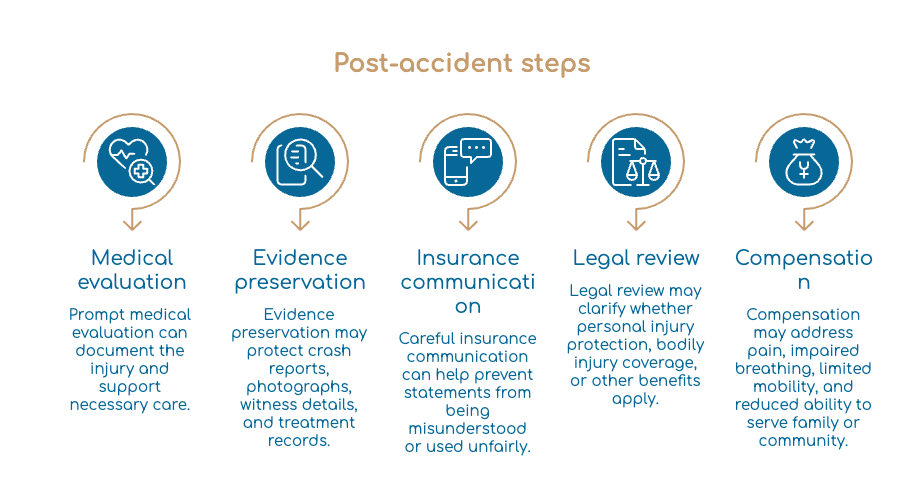
Broken ribs after a Florida car accident may create legal rights tied to fault, injury severity, and insurance coverage.
- Prompt medical evaluation can document the injury and support necessary care.
- Evidence preservation may protect crash reports, photographs, witness details, and treatment records.
- Careful insurance communication can help prevent statements from being misunderstood or used unfairly.
- Legal review may clarify whether personal injury protection, bodily injury coverage, or other benefits apply.
- Compensation may address pain, impaired breathing, limited mobility, and reduced ability to serve family or community.
A victim’s rights should be evaluated with attention to deadlines, medical proof, and insurance limits. Careful guidance can help protect dignity, stability, and access to needed recovery resources.
Why Do Florida Broken Ribs Car Accident Injuries Happen?
Because the rib cage absorbs significant force during a collision, broken ribs in Florida car accidents often occur when the chest strikes a seat belt, wheel, dashboard, door, or deployed airbag. These injuries may also result from side-impact crashes, rollovers, rear-end collisions, or high-speed frontal impacts, especially when the body is thrown against hard interior surfaces. Older adults, individuals with reduced bone density, and those seated close to the steering wheel may be at heightened risk.
Broken ribs happen because crash energy compresses the chest faster than the body can safely absorb. While seat belts save lives, their restraining force can contribute to rib fractures during severe impacts. Such injuries may affect breathing, mobility, and the ability to care for family, work, or serve the community. Medical evaluation often considers lung complications, Pain Management Options, and treatment follow-up, since untreated rib fractures can worsen or mask deeper trauma involving internal organs.
What Should You Do After a Florida Broken Ribs Car Accident Injury?
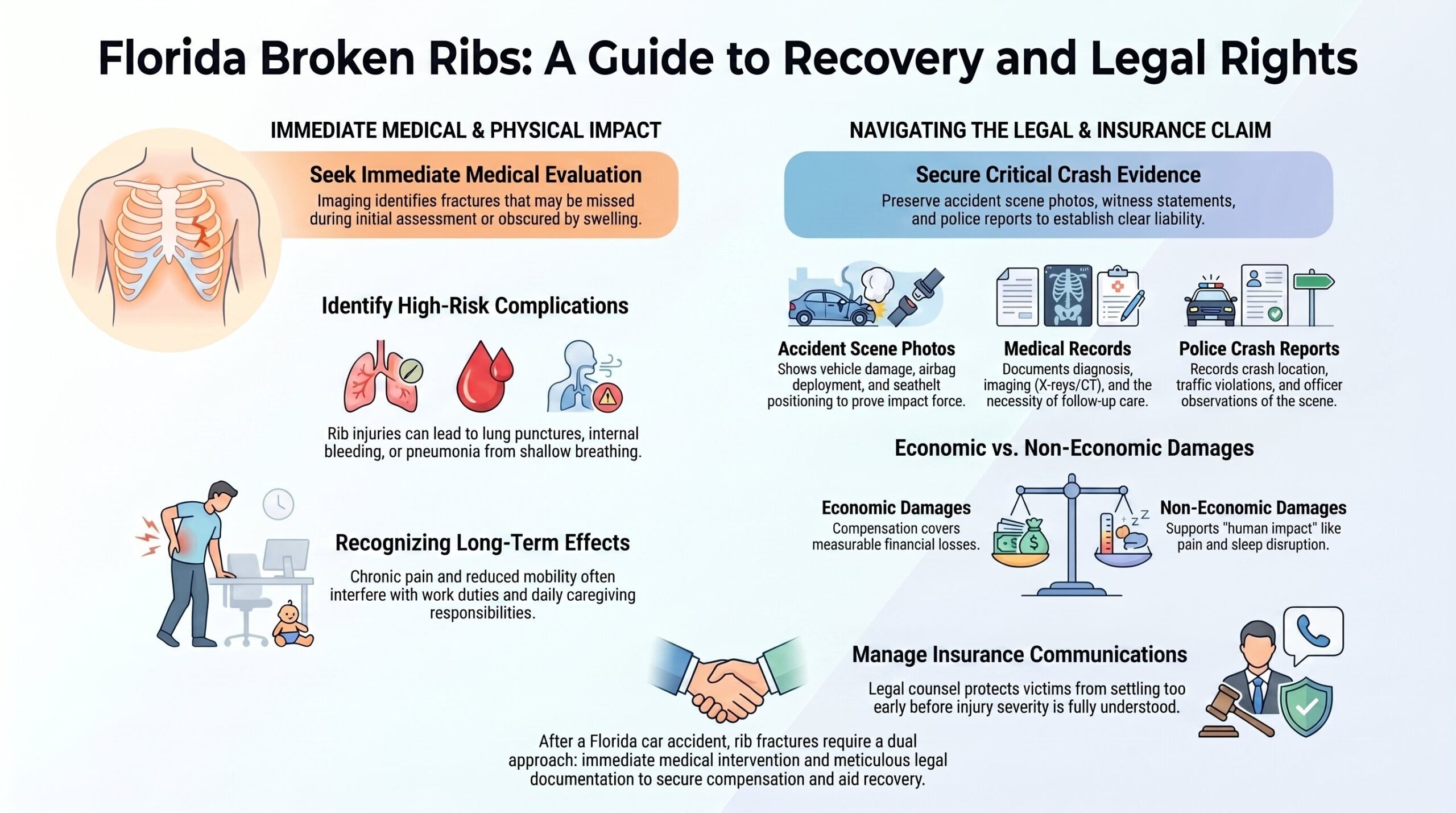
After a Florida car accident causes broken ribs, the injured person should seek immediate medical care to evaluate internal injuries and establish treatment records. The accident should also be documented through photographs, witness information, police reports, and insurance communications. Because broken rib claims may involve high medical costs and disputed liability, contacting a lawyer can help protect the injured person’s rights.
Seek Immediate Medical Care
Although broken ribs may seem less urgent than other traumatic injuries, anyone involved in a Florida car accident should seek immediate medical evaluation if rib pain, chest tenderness, breathing difficulty, bruising, or pain with movement develops. A prompt Emergency room evaluation can identify rib fractures, lung punctures, internal bleeding, or other complications that may worsen without timely care. Medical providers may order imaging, assess oxygen levels, and monitor breathing function to protect the injured person’s health and stability.
Early treatment also allows clinicians to recommend appropriate pain management options, which may help the person breathe deeply, cough safely, and reduce the risk of pneumonia. For individuals committed to caring for family, work, or community responsibilities, obtaining medical attention supports recovery and helps prevent avoidable complications after a serious collision.
Document Your Accident
When a person is physically able to do so, careful documentation of the crash can help preserve important information that may later support an insurance claim or legal case. Photographs of vehicle damage, road conditions, visible injuries, and nearby hazards may clarify how the collision occurred. Witness names, contact details, and the responding officer’s information should be recorded when available.
Medical documentation should also be organized, including emergency records, imaging results, prescriptions, and follow-up instructions. Notes about symptoms, limitations, missed work, pain management options, and daily care needs may show how broken ribs affect long-term recovery. Copies of bills, receipts, and insurance communications should be kept in a single secure file. Accurate records help injured individuals, families, and caregivers respond responsibly and provide support grounded in reliable information.
Contact A Lawyer
In the days following a Florida car accident that causes broken ribs, contacting a lawyer may help protect the injured person’s rights and clarify the next steps in the claims process. Legal counsel can review available records, evaluate insurance communications, and identify deadlines that may affect recovery. For those assisting an injured family member, a lawyer can also help organize medical bills, wage records, and evidence of daily limitations.
A free consultation provides an opportunity to discuss the crash, the injury, and possible compensation without immediate financial pressure. The injured person or caregiver should prepare follow-up questions about medical treatment, insurance forms, fault disputes, and case timelines. Prompt legal guidance may reduce mistakes, support informed decisions, and help the injured person focus on getting better with greater confidence.
Critical Evidence in a Florida Broken Ribs Car Accident Injury Case
Critical evidence can determine how liability, causation, and damages are evaluated in a Florida broken ribs car accident injury case. The most important materials often include:
- Accident scene photos
- Medical records
- Witness statements
- Police crash reports
- Vehicle damage documentation
These records help establish what happened, the severity of the injury, and the connection between the crash and the claimed losses.
Accident Scene Photos
Although medical records confirm the existence of broken ribs, accident scene photos can help explain how the crash occurred and why the injury is consistent with the forces involved. Images of vehicle damage, airbag deployment, seatbelt positioning, skid marks, debris fields, and final resting locations may show the severity and direction of impact. These details can support a careful evaluation of the fault and help connect the collision mechanics to chest trauma.
For injured people and those serving them, prompt photo preservation is important because vehicles are repaired, road conditions change, and evidence may disappear. Photographs may also provide context for broken rib treatment and recovery timeline expectations by showing the force applied to the body. Clear, dated images can strengthen a claim and assist in a fair resolution.
Medical Records
Medical records are often the central evidence in a Florida broken ribs car accident injury case, because they document the diagnosis, treatment, symptoms, and medical progression after the collision. Emergency room notes, imaging reports, physician evaluations, and follow-up records can show how the rib fractures occurred, how severe they were, and whether complications developed. These records may also identify prescribed Pain medication, related side effects, work restrictions, breathing limitations, and the need for continued care.
For those serving injured people, organized documentation helps protect the person’s dignity while presenting facts clearly. Complete records also assist with insurance deadlines, because delayed submissions can invite disputes. When insurers question causation or the extent of injury, accurate medical proof may reduce the risk of claim denials and strengthen the injury claim.
Witness Statements
After the medical records establish the physical diagnosis, witness statements can help explain how the crash occurred and how the injury affected the injured person immediately afterward. In a Florida broken ribs car accident injury case, statement collection may include passengers, nearby drivers, pedestrians, store employees, or others who observed the collision or its aftermath. These accounts can describe pain complaints, breathing difficulty, limited movement, visible distress, or the need for assistance.
Careful review of credibility factors is critical. Useful considerations include the witness’s location, opportunity to observe, consistency, lack of bias, and ability to recall details. Reliable statements may support the injured person’s account, clarify disputed facts, and help legal advocates present the harm with accuracy, dignity, and respect for the person’s recovery needs.
Police Crash Reports
When law enforcement responds to a collision, the resulting police crash report can be a key source of structured information in a Florida broken-ribs car accident injury case. The report may record the crash location, vehicle positions, roadway conditions, insurance information, and officer observations that help clarify how the impact occurred. Traffic citation details may also show whether a driver violated a safety law, which can support a careful liability review.
Although the report may not be admissible in every respect, it often guides further investigation and helps counsel identify evidence requiring preservation. Witness contact info listed in the report can allow a timely follow-up with individuals who observed the crash. For those serving injured persons, this document provides an organized starting point for responsible advocacy.
Long-Term Effects of Florida Broken Ribs Car Accident Injuries
Broken ribs from a Florida car accident may cause lasting medical issues that extend well beyond the initial recovery period. Chronic chest pain, breathing complications, and reduced physical mobility can interfere with work, daily activities, and long-term quality of life. These effects may also influence the value of an injury claim, particularly when ongoing treatment or permanent limitations are documented.
Chronic Chest Pain
Why does chest pain sometimes continue long after a collision? Broken ribs can leave lasting pain when bone restoration irritates nearby nerves, scar tissue forms, or strained chest muscles remain sensitive during daily movement. Even after imaging shows recovery, a person may still struggle with lifting, caregiving, work duties, or restful sleep. Conditions such as sleep apnea may worsen fatigue and make pain feel more difficult to manage, especially when rest is disrupted.
For those serving injured family members, careful documentation of symptoms, medical visits, prescriptions, and activity limits can support a clearer compensation timeline. Chronic chest pain may require follow-up care, pain management, and reduced physical demands. In Florida injury claims, persistent discomfort can affect damages by showing ongoing limitations, treatment needs, and the practical burden placed on household responsibilities.
Breathing Complications
Persistent chest pain after a Florida car accident can also signal deeper breathing complications, particularly where rib fractures have affected lung expansion or altered normal breathing patterns. When breathing becomes shallow to avoid pain, the injured person may face reduced oxygen intake, lingering shortness of breath, or increased risk of pneumonia. These concerns can become more serious when bruised lung tissue, fluid buildup, or an undetected puncture injury is present.
Emergency room follow-up is important because early imaging, oxygen monitoring, and clinical evaluation may reveal complications that were not fully apparent at first. Carefully structured pain management plans can also help patients breathe more effectively, cough safely, and prevent avoidable respiratory decline. For caregivers and advocates, recognizing these warning signs supports timely treatment and better protection of long-term health.
Reduced Physical Mobility
When rib fractures from a Florida car accident disrupt normal movement, reduced physical mobility can become a lasting concern that affects daily function and recovery. Limited twisting, bending, lifting, or reaching may interfere with work duties, caregiving, household tasks, and community service commitments. Because rib pain often worsens with motion, injured individuals may avoid activity, which can lead to stiffness, weakness, and slower rehabilitation.
Medical providers may recommend Pain management options, including prescribed medication, nerve blocks, breathing exercises, or physical therapy, to support safer movement. In more serious cases, assistive mobility devices, such as walkers, braces, or supportive seating, may help reduce strain while the body mends. Careful documentation of mobility limits can help establish how the injury affects independence, service responsibilities, and long-term quality of life.
Proving Liability in Florida Broken Ribs Car Accident Injury Cases
In a Florida car accident case involving broken ribs, proving liability requires evidence that another party acted negligently and that this conduct caused the collision and resulting injuries. Liability may arise from speeding, distracted driving, impaired driving, unsafe lane changes, or failure to yield. In some cases, a Faulty vehicle may also support a claim if defective brakes, tires, lights, or steering components contributed to the crash.
Evidence often includes police reports, witness statements, photographs, video footage, vehicle damage, medical records, and expert analysis. Medical documentation helps connect the rib fractures to the collision, which is essential when demonstrating damages. A lawyer may also evaluate roadway conditions, traffic signals, and maintenance records to identify every responsible party.
Because insurance tactics may focus on minimizing fault or blaming the injured person, careful documentation is important. Strong liability proof supports fair compensation and helps protect the injured person’s ability to recover with dignity.
Dealing With Insurance Companies After a Florida Broken Ribs Car Accident Injury
After a Florida car accident causes broken ribs, communications with insurance companies can materially affect the value and direction of the injury claim. Adjusters may request recorded statements, broad medical authorizations, or quick settlement discussions before the full severity of the injury is understood. A careful response protects the injured person’s interests while allowing legitimate review of necessary facts.
Insurance carriers often evaluate broken rib claims by examining treatment consistency, diagnostic records, work limitations, and evidence of pain-related restrictions. Negotiation tactics may include minimizing symptoms, disputing crash forces, or attributing pain to prior conditions. An injured person’s representatives can answer insurer inquiries, preserve accurate documentation, and challenge unsupported conclusions.
If the at-fault driver lacks adequate insurance, uninsured coverage may become crucial. This coverage can help address losses when another motorist cannot fully pay. Careful handling of all insurer communications supports a fair evaluation and helps prevent avoidable harm to the claim.
What to Expect During a Florida Broken Ribs Car Accident Injury Claim Process
A Florida broken ribs car accident injury claim typically begins with thorough medical documentation, which helps establish the nature, severity, and cause of the injury. The process then moves through insurance claim filing and liability investigation, where records, accident evidence, and fault determinations become central issues. Settlement negotiations often follow, requiring careful evaluation of medical costs, lost income, pain, and any long-term limitations linked to the rib injuries.
Medical Documentation
Thorough medical documentation is one of the most important parts of a Florida broken ribs car accident injury claim, because it helps connect the crash to the diagnosed injuries, treatment needs, and resulting limitations. Records should reflect the initial Traumatic injury evaluation, emergency findings, pain complaints, breathing concerns, and any signs of complications, such as lung involvement or reduced mobility. Diagnostic imaging reports, including X-rays or CT scans, may confirm fractures, displacement, or related chest trauma.
Follow-up notes can show whether the injured person followed medical guidance, attended therapy, limited activities, and required medication or assistive care. Clear documentation also helps caregivers, employers, and legal representatives understand how the injury affects daily service, work duties, and family responsibilities, while preserving an accurate timeline of recovery and continuing medical needs.
Insurance Claim Filing
Once medical records establish the nature and extent of broken rib injuries, the insurance claim filing process typically becomes the next formal step in seeking compensation. The claimant, or a representative acting in service of the injured person, submits notice to the appropriate insurer, including policy details, crash information, and injury documentation. In Florida, this may involve a personal injury protection claim, a bodily injury claim, or an uninsured motorist claim when the at-fault driver lacks adequate coverage.
Insurers may request medical bills, wage records, treatment notes, and proof of ongoing limitations. Careful organization helps ensure that the claim accurately reflects the injury’s true impact, including pain, restricted breathing, and reduced daily functioning. Accurate filing supports fair review while preserving the injured person’s legal rights.
Liability Investigation
After an insurance claim is opened, the liability investigation focuses on determining how the crash occurred and which party, or parties, may be legally responsible for the broken rib injuries. Investigators may review police reports, crash photographs, traffic camera footage, vehicle damage, witness statements, and medical records linking the collision to the rib trauma.
Careful fault documentation helps clarify whether a driver failed to yield, followed too closely, drove distracted, or violated traffic laws. In Florida, Comparative negligence may reduce recovery if the injured person shares responsibility for the crash. Attorneys serving injured clients often organize evidence, identify missing records, and communicate with insurers to prevent inaccurate blame shifting. This phase supports a fair assessment of responsibility before any discussion of compensation occurs in the claim process.
Settlement Negotiations
With liability evidence organized, settlement negotiations generally begin with a focused evaluation of the injured person’s losses and the insurer’s position on fault. The demand package typically explains how the crash caused the rib fractures, supported by Liability proof, medical expenses, diagnostic records, treatment notes, wage information, and documentation of pain limitations. Insurers may question the severity of injury, preexisting conditions, or whether treatment was reasonable.
Counsel responds by presenting clear facts, correcting omissions, and valuing both economic and non-economic harm. Negotiations may involve several offers and counteroffers, each measured against recovery needs and available insurance limits. A careful approach helps protect the injured person from pressure to settle too soon, while keeping the process focused on fair compensation and responsible resolution.
Compensation for Florida Broken Ribs Car Accident Injury Damages
When broken ribs result from a Florida car accident, compensation may include both financial losses and the personal impact of the injury. The claim’s value often depends on medical documentation, crash evidence, treatment duration, and the condition’s impact on daily responsibilities. A lawyer may review emergency care records, imaging results, physician notes, and follow-up recommendations to present a clear account of the harm suffered.
Because fractured ribs can limit breathing, sleep, movement, caregiving, and work capacity, careful claim preparation is important. Insurance timelines may affect when notices, medical bills, and settlement demands should be submitted, especially when multiple insurers are involved. A thoughtful settlement strategy considers liability strength, injury severity, available coverage, and future medical concerns before any offer is accepted.
For injured individuals and families seeking stability, compensation can provide the resources needed for recovery, household support, and continued care, while helping to hold the responsible party accountable under Florida law.
Economic vs Non-Economic Damages in Florida Broken Ribs Car Accident Cases
Florida broken ribs car accident cases often require a clear distinction between economic damages, such as medical bills and lost income, and non-economic damages, including pain, suffering, and reduced quality of life. Each category reflects a different type of loss, but both may materially affect the value of an injury claim. Proving damage value depends on medical evidence, financial records, expert opinions, and a careful assessment of how the injury has affected the claimant’s daily life.
Economic Damage Categories
Although every injury claim depends on its facts, economic damages in a Florida broken ribs car accident case generally refer to the measurable financial losses caused by the crash. These categories often include emergency transportation, hospital care, diagnostic imaging, physician visits, prescription medication, physical therapy, and follow-up treatment. Medical bill documentation helps establish the amount, timing, and purpose of these expenses, supporting a clear record for insurers, counsel, and courts.
Economic losses may also include lost wages, diminished earning capacity, transportation to appointments, medical equipment, and necessary household assistance. For those dedicated to caring for others, accurate records help ensure that needed services are recognized. A thoughtful settlement negotiation strategy evaluates past expenses, projected future costs, and verified income losses before any resolution is considered.
Non-Economic Injury Impacts
Beyond the financial records discussed above, non-economic damages in a Florida broken ribs car accident case address the human impact of the injury that cannot be measured by invoices or wage statements alone. These losses may include physical pain, restricted breathing, sleep disruption, anxiety during recovery, and the loss of ordinary activities that support dignity, family life, and community service.
Broken ribs can make caregiving, worship participation, volunteer work, and simple household assistance difficult or impossible for a period of time. The need for pain management options may also affect daily routines, concentration, and emotional stability. In this scenario, careful handling of court evidence helps preserve the personal character of these harms while maintaining respect, accuracy, and professionalism throughout the legal process in Florida courts.
Proving Damage Value
When damage value is disputed, proof must connect the broken rib injury to both measurable financial losses and the broader personal consequences of the crash. Economic damages may include emergency care, imaging, follow-up treatment, medication, lost wages, reduced earning capacity, and transportation costs for medical visits. Non-economic damages require careful documentation of pain, sleep disruption, breathing limitations, loss of household function, and reduced participation in family or community service.
Evidence preservation steps may include saving medical records, wage statements, photographs, repair documents, witness information, and written symptom logs. An effective Insurance dispute strategy compares these records with policy terms, medical opinions, and any attempt to minimize the injury. Clear proof helps demonstrate how the harm affected daily life and supports fair valuation under Florida law.
When a Florida Broken Ribs Car Accident Injury Case Goes to Trial vs Settlement
Because many Florida broken ribs car accident claims can be resolved through negotiation, a trial usually becomes necessary only when the parties dispute liability, the severity of the injury, or the value of damages. Settlement may serve an injured person by reducing delay, stress, and uncertainty, especially when medical records, wage loss proof, and expert opinions clearly support the claim.
When settlement efforts fail, the case may proceed through a court timeline that includes discovery, motions, mediation, jury selection, testimony, and a verdict. Trial strategy often focuses on presenting the crash facts, explaining the pain and limitations caused by broken ribs, and showing how the injury affected daily responsibilities.
Damages arguments may address medical expenses, lost income, future care, and non-economic harm. A lawyer may also prepare witnesses to communicate honestly and clearly. The decision to settle or try the case should reflect the evidence, client’s needs, and the likelihood of achieving just compensation.
Florida Laws That May Affect Your Florida Broken Ribs Car Accident Case
Several Florida laws may influence the outcome of a broken ribs car accident case, including rules on insurance coverage, fault allocation, filing deadlines, and the proof required to recover damages. These rules guide how an injured person may seek compensation while maintaining fairness for all parties involved.
- Florida’s no-fault insurance system generally requires initial medical benefits through personal injury protection coverage.
- Comparative negligence rules may reduce recovery when the injured person shares responsibility for the crash.
- Personal injury statutes help define recoverable damages, including medical expenses, lost income, and pain-related losses.
- Serious injury thresholds may affect whether a claim may proceed against an at-fault driver beyond no-fault benefits.
- Evidence requirements make medical records, crash reports, witness accounts, and expert opinions important to the claim.
A careful legal review can support responsible decision-making, protect lawful rights, and promote a fair resolution for injured individuals and their families.
The Statute of Limitations for Florida Broken Ribs Car Accident Injury Cases
How long an injured person has to file a Florida broken ribs car accident lawsuit depends on the type of claim, the date of the crash, and any facts that may affect the legal deadline. In many negligence cases, Florida law imposes a limited filing period, and missing it can bar recovery even when the injuries are serious. Claims involving government vehicles, minors, wrongful death, or delayed discovery of related harm may involve different notice rules or deadlines.
Timely action also supports Evidence Preservation. Medical records, crash reports, witness information, vehicle damage, and scene conditions can become harder to document over time. Photography Tips may include capturing bruising, seatbelt marks, vehicle positions, road hazards, and recovery progress, when done safely and respectfully. These materials may later relate to Comparative Negligence, including Fault Percentages assigned among drivers or other parties. Careful attention to deadlines helps protect valid claims while promoting fair accountability.
How a Florida Broken Ribs Car Accident Injury Lawyer Can Help You
After legal deadlines and evidence concerns are identified, a Florida broken ribs car accident injury lawyer can evaluate the claim, identify liable parties, and develop a strategy for pursuing compensation. Counsel may coordinate medical documentation, insurance communications, and damage analysis, allowing the injured person to focus on recovery and family responsibilities.
Legal guidance can help injured people pursue compensation while focusing on recovery, stability, and family responsibilities.
- Reviewing crash reports, treatment records, imaging results, and physician opinions for accuracy.
- Calculating losses related to medical care, missed work, reduced earning capacity, and household support.
- Addressing Proactive pain management needs through records that show ongoing symptoms and limitations.
- Considering long-term disability planning when rib injuries affect breathing, mobility, work duties, or caregiving roles.
- Negotiating with insurers and preparing evidence for litigation when settlement offers do not reflect the harm.
This guidance can help present a complete claim, grounded in service to the injured person’s health, stability, and future needs.
When to Contact a Florida Broken Ribs Car Accident Injury Lawyer
When broken ribs are suspected after a Florida car accident, legal guidance should be sought as soon as the injured person receives appropriate medical attention and the immediate emergency has been addressed.
Early contact allows the injured person, family members, or caregivers to understand important deadlines, including Statute limitations, before time-sensitive rights are placed at risk. Prompt action also supports evidence preservation by securing crash reports, photographs, witness information, medical records, and vehicle damage documentation.
A lawyer may be contacted even while treatment is ongoing, especially when pain, breathing difficulty, missed work, or follow-up care suggest a serious injury. Those serving the injured person should not wait until bills accumulate or insurance calls become difficult to manage.
Timely consultation can help organize important information, identify responsible parties, and protect the claim from avoidable delays. In serious rib injury cases, early direction often provides structure during recovery and supports informed decisions.
Why You Need an Experienced Florida Broken Ribs Car Accident Injury Lawyer
A skilled lawyer can also help connect the injury claim to the full course of treatment. Records should address pain management, including medication limits, breathing concerns, and follow-up care. They should also discuss the role of physical therapy, when ordered, in restoring mobility and preventing complications. By presenting these details clearly, counsel helps protect compensation for medical costs, lost income, caregiving needs, and the broader impact on daily service to others.
How to Choose the Right Florida Broken Ribs Car Accident Injury Lawyer for Your Case
For individuals facing the consequences of broken ribs after a Florida car accident, selecting the right lawyer requires careful review of experience, case strategy, and communication practices. A qualified attorney should understand trauma-related claims, including pain, restricted mobility, lost income, and complications that may require ongoing care. The evaluation should include prior handling of similar injury matters and the ability to present Medical cost documentation clearly and persuasively.
Clients should also consider whether the lawyer explains Insurance dispute timelines, expected procedures, and potential obstacles in a manner that supports informed decision-making. Reliable counsel should maintain organized records, respond promptly, and coordinate evidence without placing unnecessary burdens on the injured person or family members offering assistance.
The right lawyer will approach the case with disciplined preparation, respect for the client’s recovery, and a commitment to protecting the claim’s value. This careful selection can strengthen both legal direction and practical support.
About The Law Offices of Anidjar & Levine
Selecting legal representation also involves understanding the firm’s structure, client service standards, and approach to injury claims.
The Law Offices of Anidjar & Levine represent injured individuals throughout Florida, including those suffering broken ribs after car accidents.
The firm’s work is centered on helping clients pursue compensation while reducing the burdens that often follow serious collisions.
Its attorneys review medical records, accident reports, insurance communications, and available evidence to evaluate liability and damages.
Their process may include coordinated case management, direct communication with insurers, and guidance intended to help clients focus on recovery and family responsibilities.
Negotiation tactics are used to address settlement discussions with insurers that may undervalue pain, medical care, or lost income.
When resolution is not appropriate, trial preparation may support a stronger position.
This includes organizing evidence, identifying witnesses, and preparing legal arguments designed to present the client’s losses clearly and responsibly.
Frequently Asked Questions
Can Broken Ribs From a Car Accident Worsen Days Later?
Yes, broken ribs from a car accident can worsen days later. Pain escalation may occur as swelling increases, movement continues, or breathing becomes guarded. Delayed complications, such as pneumonia, internal injury, or poor ventilation, may emerge after the initial trauma. A prompt medical evaluation helps confirm the injury, assess risks, and guide safe care. The recovery timeline varies, but worsening symptoms require attention to protect the injured person’s health.
Can I Fly With Broken Ribs After a Car Accident?
Flying with broken ribs after a car accident may be unsafe unless a physician confirms stability, especially if breathing is painful, lung injury, or complications exist. Emergency flight risks include reduced oxygen tolerance, worsening pain, and limited access to urgent care during travel. Caregivers should support medical evaluation before departure. Pain management tips include taking prescribed medication, using a pillow for splinting, moving carefully, and avoiding heavy lifting or strain.
How Are Broken Ribs Diagnosed After a Florida Crash?
Broken ribs after a crash are diagnosed through emergency room evaluation, physical examination, and medically needed imaging. A clinician assesses breathing, chest tenderness, bruising, and signs of internal injury. X-rays may identify many fractures, while CT scans can reveal smaller breaks or lung complications. Those assisting an injured person should encourage prompt care, preserve medical records, and follow discharge instructions to ensure safety, accurate documentation, and appropriate continuity of treatment after the collision.
Should I Sleep Upright With Broken Ribs After an Accident?
Sleeping upright may help with broken ribs after an accident, especially during early recovery, by reducing pressure and easing breathing. A clinician should guide on safe sleeping positions, since poor positioning may worsen pain or limit rest. Semi-reclined support with pillows is often preferred. Pain management options may include prescribed medication, ice, and breathing exercises. Caregivers serving others should promptly monitor for shortness of breath, fever, or worsening chest pain.
Can Seat Belts Cause Broken Ribs During a Crash?
Yes, seat belts can cause broken ribs during a crash, especially when forceful restraint loads the chest. Seat belt mechanics are designed to reduce fatal movement, but rapid deceleration may concentrate pressure across the rib cage. Rib fracture risk increases with high-speed impacts, older age, osteoporosis, or improper belt position. Caregivers should encourage prompt medical evaluation, because rib injuries may accompany lung bruising, internal bleeding, or other serious trauma.
—————————
Broken rib injuries from Florida car accidents can create serious medical, financial, and legal challenges.
Victims may have the right to pursue compensation for treatment, lost income, pain, and related damages when another party’s negligence caused the crash.
A qualified Florida Car Accident Lawyer can evaluate the claim, protect legal rights, and manage negotiations with insurers.
The Law Offices of Anidjar and Levine provide experienced guidance for injured clients seeking accountability and recovery.