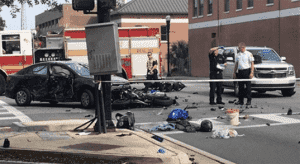
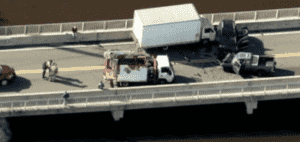
The Law Offices of Anidjar and Levine protect Jacksonville accident victims of failure-to-obey traffic signals by preserving scene evidence, securing dash-cam and police records, and establishing the causal link between the signal violation and your injuries.
Our team gathers detailed photographs, witness statements, and signal timing data to demonstrate negligence under Florida traffic statutes.
We assess economic and non-economic damages, negotiate with insurers, and, if necessary, pursue litigation to maximize recovery.
Continue to discover how our proficiency can guide your claim, and learn more from our Jacksonville Car Accident Lawyer.
Main Takeaways
- Jacksonville traffic‑signal violation attorneys specialize in proving driver negligence by documenting signal timing, dash‑cam footage, and police reports.
- They gather and preserve evidence—photos, witness statements, vehicle debris, and digital logs—to establish causation and liability.
- Experienced lawyers assess Florida traffic codes, calculate damages (medical, lost wages, pain‑and‑suffering), and craft comprehensive demand packages.
- They negotiate with insurers, scrutinizing policy limits, deductibles, and counter‑offers to secure fair compensation.
- If settlement fails, they initiate litigation, manage discovery, file complaints, and prepare for trial to hold negligent parties accountable.


How We Can Help With Your Jacksonville Failure To Obey Traffic Signal Accident Claim
We recognize that a failure to obey a traffic signal can result in severe injuries and complex legal challenges, and we’re prepared to guide you through every step of your claim.
Our team begins by gathering all-encompassing evidence, including thorough witness interviews that capture key perspectives and corroborate your account. We then assess liability, quantify damages, and develop a strategic plan that aligns with your goal of serving the community by holding negligent parties accountable.
Throughout the process, we keep you informed about settlement timelines, explaining each phase and the factors that may accelerate or delay resolution. Our know-how enables us to negotiate effectively with insurers, ensuring that any offer reflects the full scope of medical expenses, lost wages, and pain and suffering.
OUR CONSULTATIONSARE FREE
START YOUR FREE CASE REVIEW

Understanding Jacksonville Failure To Obey Traffic Signal Accident Cases
When a driver runs a red light or ignores a stop sign, the resulting collision often involves multiple vehicles and severe injuries, making the legal landscape particularly complicated.
We examine Jacksonville failure‑to‑obey traffic signal accident cases by first outlining the factual elements that courts consider: the existence of a functional signal, the driver’s duty to obey, and the causal link between the violation and the injuries sustained.
Recent traffic signalization trends in Jacksonville show increased use of advanced timing and sensor‑based controls, which can affect driver expectations and liability assessments.
We emphasize that thorough driver education reduces the likelihood of such violations and strengthens our advocacy for victims.
By reviewing police reports, dash‑cam footage, and medical records, we construct a compelling narrative demonstrating negligence and quantifying damages.
Our approach balances rigorous legal analysis with a commitment to serving those harmed by reckless disregard for traffic signals.
Common Causes of Jacksonville Failure To Obey Traffic Signal Accidents
We’ve found that distracted driving, especially when drivers are texting or using navigation devices, often leads to missed signals.
Speeding through intersections and failing to yield to oncoming traffic further increases the risk of collisions.
Improper signal timing, whether caused by malfunctioning lights or poor coordination, can also create dangerous situations that result in accidents.
Distracted Driving
Often, drivers become distracted as they approach a traffic signal, and this lapse in attention frequently leads to failure to obey the light.
We recognize that phone distraction remains a primary cause, as texting or scrolling diverts attention from the intersection.
Likewise, pedestrian distraction can occur when drivers focus on nearby walkers, assuming they’ll yield, while the signal demands a different response.
In our practice, we emphasize that these split‑second decisions compromise safety for everyone on the road.
By educating the community about the risks of multitasking while driving, we help reduce violations and protect lives.
Our commitment to serving victims and preventing future accidents drives us to advocate for stricter enforcement and public awareness campaigns.
Speeding Through an Intersection
Frequently, drivers enter Jacksonville intersections at speeds exceeding posted limits, reducing the time they have to react to a changing signal and making it difficult to stop safely when the light turns red.
We recognize that red light running often stems from this over‑speeding, because higher momentum shortens the window for safe braking.
When intersection timing misaligns with driver expectations, the risk escalates, especially for those who underestimate the distance required to stop.
As a community focused on serving others, we emphasize the importance of adhering to posted speed limits and respecting signal phases.
Failure to Yield
When a driver fails to yield at a Jacksonville traffic signal, the resulting collisions often stem from misjudging right‑of‑way, distraction, or impatience.
We see motorists overlooking pedestrian priority, especially when a crosswalk is present, and assuming they can proceed without confirming the signal’s indication.
At rural intersections, limited visibility and the absence of dedicated turn lanes increase the temptation to “beat the light,” leading to side‑impact crashes.
Drivers who are preoccupied with mobile devices or conversing with passengers frequently miss the subtle cues indicating a need to yield.
Improper Signal Timing
If a traffic signal’s timing is misaligned with actual traffic flow, drivers may misinterpret the green phase as an invitation to proceed, leading to rear‑end or side‑impact collisions.
We see that improper signal timing often stems from inadequate synchronization of signals at adjacent intersections, creating gaps that confuse motorists.
In Jacksonville, rapid development and fluctuating traffic volumes can outpace the original design parameters, so outdated timing plans become a liability.
Conducting regular timing audits helps us identify mismatches, adjust cycle lengths, and guarantee that the green interval matches real‑world demand.


Legal Rights of Jacksonville Failure To Obey Traffic Signal Accident, Victims
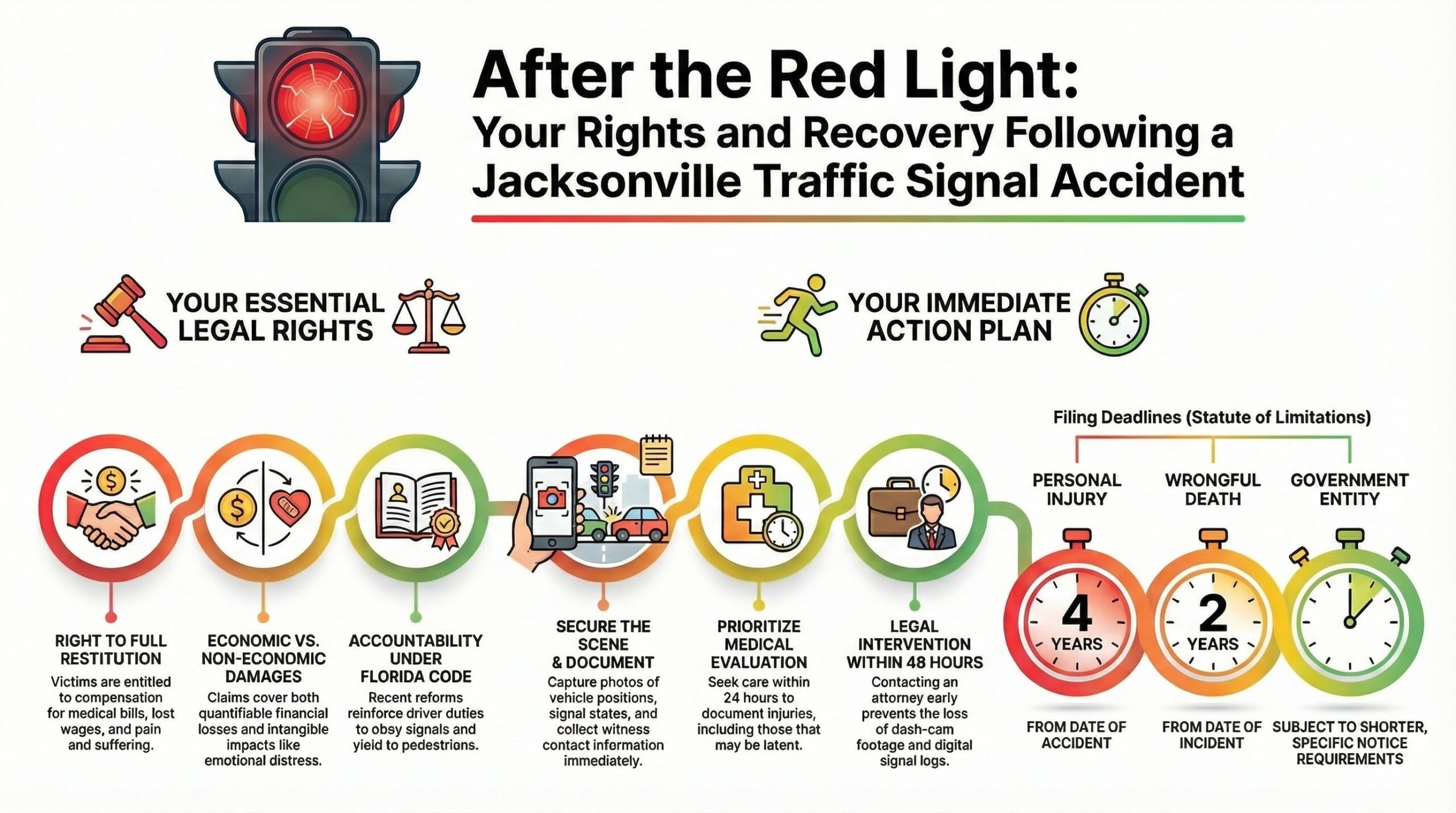
Because a driver runs a red light and causes a collision, victims in Jacksonville acquire specific legal rights that protect their interests and enable them to seek compensation.
We must understand those rights to advocate effectively for ourselves and others. Our legal framework guarantees that the responsible party’s negligence is addressed, and that victims receive fair restitution for medical expenses, lost wages, and pain. suffering.
Furthermore, recent traffic signalization reforms emphasize accountability, while pedestrian rights reinforce drivers’ duty to yield to pedestrians.
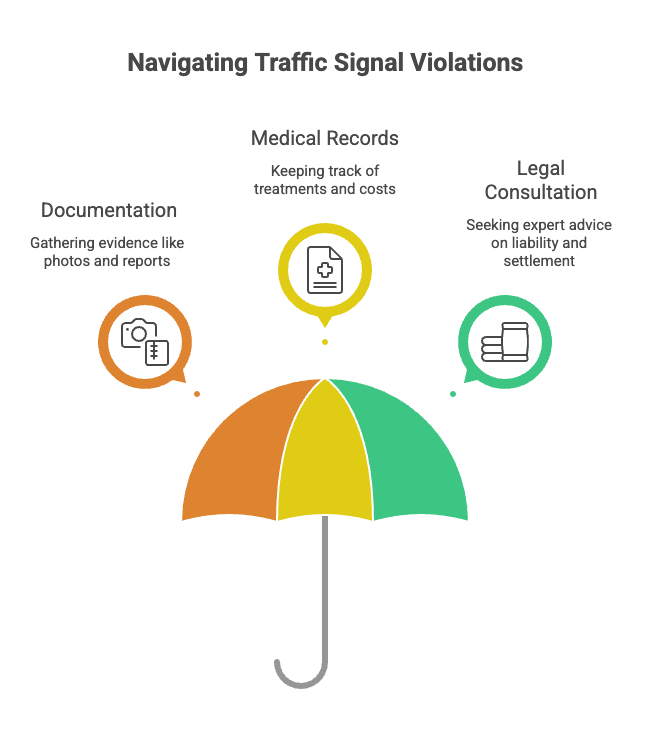
To steer through this landscape, we focus on three vital actions:
- Document the accident thoroughly, including photographs, witness statements, and police reports.
- Preserve all medical records and expense receipts to substantiate claims.
- Consult a qualified attorney who concentrates in traffic signal violations to evaluate liability and negotiate a settlement.
Steps to Take After a Jacksonville Failure To Obey Traffic Signal Accident
We should first secure the scene and document everything, including photos, witness statements, and any police reports, because thorough evidence protects our claim.
Prompt medical attention is crucial not only for health but also for creating a clear record of injuries that may affect compensation.
Finally, we must contact a qualified traffic lawyer who can guide us through the legal process and make certain our rights are fully defended.
Secure Scene Documentation
Typically, we begin by preserving every detail of the crash scene before it changes, because thorough documentation is essential for establishing liability and supporting a future claim.
We secure the area, photograph vehicle positions, road markings, and any traffic‑signal evidence, ensuring that each angle captures the context for later analysis.
We collect witness statements promptly, noting each observer’s contact information and a concise recount of what they saw.
Accurate scene preservation also involves recording weather conditions, lighting, and any debris that may affect reconstruction.
We label each photo with timestamps and location markers, and we store all digital files in a secure, organized folder.
This disciplined approach creates a reliable evidentiary record that strengthens our client’s case and upholds our commitment to serving others responsibly.
Medical Attention Promptly
If a traffic‑signal violation leaves you injured, securing prompt medical attention should be your immediate priority, as timely care not only protects your health but also creates crucial documentation for any future claim.
We advise you to call emergency services immediately so that emergency triage can assess injuries on site and initiate stabilization.
Even if you feel fine, we recommend a thorough medical evaluation because latent injuries often surface later.
After the initial visit, schedule a follow-up with a medical expert to monitor recovery and document progress.
Keep all medical records, imaging results, and physician notes organized, as they’ll support your claim and demonstrate the extent of harm.
Contact Traffic Lawyer
Following a Jacksonville failure‑to‑obey traffic‑signal accident, the next pivotal step is to contact a qualified traffic lawyer without delay.
We advise you to gather all documentation, including police reports, witness statements, and photographs, before the client intake interview.
During intake, we’ll explain how traffic statutes apply to your case and assess liability, damages, and potential defenses.
Our team will then outline the legal strategy, emphasizing swift filing deadlines and evidence preservation.
How a Jacksonville Failure To Obey Traffic Signal Accident Lawyer Can Help You
When a driver disregards a traffic signal in Jacksonville, the resulting accident can cause severe injuries, property damage, and intricate legal challenges that many victims struggle to find their way through alone.
We guide you through the maze of liability, ensuring that signal compliance is thoroughly examined and that you receive a thorough legal consultation.
Our team evaluates evidence, negotiates with insurers, and prepares litigation if necessary, always prioritizing your recovery and fairness.
- Evidence Preservation – We secure dash‑cam footage, police reports, and witness statements to establish the violation and its impact.
- Claim Development – We calculate medical expenses, lost wages, and pain‑and‑suffering, building a sturdy demand package.
- Litigation Strategy – We file lawsuits, represent you in court, and pursue maximum compensation while upholding ethical standards.
Long-Term Effects of Jacksonville’s Failure To Obey Traffic Signals: Accident Injuries
We recognize that chronic pain can persist long after the collision, often requiring ongoing medical treatment and medication management.
Emotional trauma may also surface, affecting sleep, relationships, and daily functioning, which can compound the physical injuries.
Additionally, the risk of long‑term disability increases when injuries limit work capacity or mobility, potentially altering a victim’s future livelihood.
Chronic Pain Management
If a driver ignores a Jacksonville traffic signal, the resulting crash often leaves victims with persistent, debilitating pain that extends far beyond the initial injury.
We recognize that chronic pain can dominate daily life, impairing our ability to serve others and maintain productivity.
To address this, we promote self‑management strategies that empower patients to monitor symptoms, engage in guided exercise, and practice mindfulness techniques.
Opioid alternatives, such as non‑addictive medications and nerve‑block therapies, reduce reliance on risky prescriptions while delivering effective relief.
Interdisciplinary care unites physical therapists, pain clinicians, and mental‑health professionals, ensuring a coordinated plan that balances physical rehabilitation with emotional support.
By adopting these evidence‑based practices, we help survivors regain function, preserve dignity, and continue contributing positively to their communities.
Emotional Trauma Effects
Ignoring a Jacksonville traffic signal can trigger lasting emotional wounds that extend far beyond the physical injuries. We observe that survivors often develop post‑traumatic stress, manifesting as intrusive memories, heightened vigilance, and avoidance of driving situations.
These reactions can erode confidence in our ability to serve others safely, prompting us to seek professional counseling and peer support.
Sleep disturbances frequently accompany this stress, leading to fragmented rest, difficulty falling asleep, and frequent awakenings, which further diminish daytime functioning. As a community of caregivers, we must recognize these signs early, encourage open dialogue, and connect affected individuals with resources that address both mental health and restorative sleep.
Proactive intervention helps mitigate long‑term emotional decline and preserves our capacity to assist those in need.
Long‑Term Disability Risks
When a driver fails to obey a Jacksonville traffic signal, the resulting injuries can evolve into chronic conditions that jeopardize a victim’s ability to work and perform daily activities for years to come.
We must recognize that long‑term disability risks extend beyond immediate pain, affecting future employability and eligibility for benefits. Persistent joint degeneration, nerve damage, and post‑concussive syndrome can limit mobility, reduce stamina, and impair cognitive function, all of which diminish job performance and career advancement.
These impairments often qualify workers for workers’ compensation, Social Security Disability, and private insurance benefits, yet the application process requires thorough documentation.
Proving Liability in Jacksonville Failure To Obey Traffic Signal Accident Car Accident Cases
Establishing liability in Jacksonville failure‑to‑obey traffic signal accidents requires a systematic examination of the crash scene, the applicable traffic statutes, and the conduct of each driver involved.
Systematic analysis of crash scenes, statutes, and driver conduct determines liability in Jacksonville signal violations.
We begin by analyzing signal timing records to verify whether the light displayed the proper indication at the moment of impact. Police reports, intersection diagrams, and video footage help us reconstruct the sequence of events and identify any deviation from lawful behavior.
Next, we assess witness credibility, comparing statements for consistency, proximity, and potential bias. When witnesses corroborate the timing discrepancy, their testimony strengthens our case.
We also evaluate driver actions, such as failure to yield or running a red light, against Florida’s traffic codes. By integrating these elements—signal timing data, credible eyewitness accounts, and statutory violations—we can confidently demonstrate negligence and secure compensation for injured parties.
This methodical approach guarantees that justice is delivered and victims receive the support they merit.
Dealing With Insurance Companies After a Jacksonville Failure To Obey a Traffic Signal Accident
Orchestrating the claims process after a Jacksonville failure‑to‑obey traffic-signal accident requires a strategic approach that protects our clients’ rights while confronting insurers’ tactics.
We begin by gathering a thorough post-accident record, documenting medical bills, repair estimates, and witness statements to establish a solid factual base.
Understanding the claim timeline allows us to anticipate deadlines, respond promptly to adjuster strategy, and avoid pitfalls that could diminish recovery.
We advise clients to refrain from accepting early settlement offers until we’ve evaluated the full extent of damages, because insurers often employ lowball tactics to close cases quickly.
By maintaining consistent communication, we can negotiate settlement tactics that reflect true losses and future expenses.
Our team monitors each phase, ensuring that every submission meets statutory requirements and that any counter‑offers are scrutinized for fairness.
This disciplined method safeguards our clients’ interests and maximizes the likelihood of a just resolution.
What to Expect During a Jacksonville Failure To Obey Traffic Signal Accident Claim Process
We’ll start by reviewing the initial police report and assembling an evidence‑collection checklist, then guide you through each step of the insurance negotiation, and finally outline the litigation timeline so you know what to expect at every stage of the claim process.
Initial Police Report
When we begin the claim process for a Jacksonville failure‑to‑obey traffic signal accident, the initial police report serves as the cornerstone of our case.
We explain that police procedures require officers to promptly document scene conditions, driver statements, and witness accounts.
Report timing is crucial; the report is usually filed within 24‑48 hours, ensuring evidence remains fresh and reliable.
We advise clients to request a copy as soon as it becomes available, because the report will outline fault, contributing factors, and any citations issued.
Understanding the report’s structure helps us assess liability and anticipate insurer arguments.
Evidence Collection Checklist
Typically, the evidence collection phase begins shortly after the police report is secured, and we guide clients through a systematic checklist to preserve every pertinent detail.
We start by photographing the scene, noting vehicle positions, traffic signal states, and road markings, while ensuring each image retains its original digital metadata.
Next, we obtain witness statements and secure their contact information, emphasizing the importance of a proper chain of custody for all recorded testimonies.
We also retrieve dash‑cam footage, cell‑phone logs, and any applicable surveillance video, confirming that each file is copied and stored with intact metadata.
Finally, we preserve physical debris, tire marks, and damaged vehicle parts, labeling them meticulously to maintain an unbroken chain of custody throughout the claim process.
Insurance Negotiation Steps
After gathering photographs, witness statements, and video records, we turn our attention to the insurance negotiation phase.
First, we review the policy details and identify policy tactics that strengthen our position, ensuring every deductible, limit, and endorsement is accounted for.
Next, we submit a thorough demand package, including medical bills, lost‑wage documentation, and repair estimates, while anticipating claim audits that the insurer may conduct.
We then engage the adjuster, presenting clear, itemized losses and responding promptly to any requests for additional evidence.
Throughout, we maintain transparent communication with our client, explaining each step and reinforcing the importance of accurate documentation.
Litigation Timeline Overview
If the case proceeds beyond settlement, we’ll guide you through a structured litigation timeline that maps each pivotal phase of a Jacksonville failure‑to‑obey traffic‑signal claim.
First, we file the complaint and serve the defendant, initiating the case timeline. Next, discovery begins, and we must meet strict discovery deadlines for interrogatories, document requests, and depositions.
Throughout this stage, we evaluate evidence, interview witnesses, and consult experts to strengthen your claim.
After discovery, we file dispositive motions, and the court may schedule a pre‑trial conference to explore settlement possibilities.
If trial remains necessary, we prepare opening statements, witness examinations, and closing arguments.
Finally, the jury renders a verdict, and we manage post‑trial motions or appeals as needed.
Compensation for Jacksonville Failure To Obey Traffic Signal Accident Damages
When a driver runs a red light in Jacksonville, the resulting accident can generate a wide range of damages, and we must assess each component to determine the compensation you’re entitled to.
We begin by itemizing medical expenses, which include emergency care, hospital stays, surgery, rehabilitation, and ongoing therapy. Detailed documentation of every bill and receipt is vital to substantiate the claim.
Next, we calculate lost wages, considering both the income forfeited during recovery and the impact on future earning capacity. We gather payroll records, employer statements, and tax documents to accurately quantify this loss.
Economic vs Non-Economic Damages in Jacksonville Failure To Obey Traffic Signal Accident Cases
We’ll first outline what counts as economic damages, such as medical bills and lost wages, before explaining how non‑economic damages cover pain, suffering, and loss of enjoyment.
Next, we’ll clarify the legal standards for each category so you understand what the court expects.
Finally, we’ll discuss how we substantiate both types of losses with documentation and expert testimony.
Economic Damages Overview
Because traffic‑signal violations in Jacksonville often result in serious injuries, understanding how economic damages differ from non‑economic damages is essential for anyone pursuing a claim.
We explain that economic damages represent quantifiable monetary losses directly tied to the accident. Lost wages are calculated by examining pre‑injury earnings, the duration of incapacity, and any future earning potential diminished by the injury.
Medical expenses, including ongoing rehabilitation and prescription costs, are added to these figures. Property damage covers repair or replacement of the vehicle and any personal items destroyed in the collision.
Non‑Economic Damages Explained
After outlining the quantifiable losses that make up economic damages, we turn our attention to the non‑economic side of a claim. Non‑economic damages address the intangible impacts of a traffic‑signal collision, such as pain valuation, emotional distress, and loss of enjoyment of daily activities.
We explain how courts assess these losses by considering the severity of physical suffering, the duration of recovery, and the extent to which the victim’s life has been altered. In Jacksonville cases, we often reference comparable precedent to establish a reasonable range for compensation, ensuring that victims receive fair restitution for diminished quality of life.
Proving Damages in Court
When a Jacksonville driver fails to obey a traffic signal and causes a collision, we must clearly separate and substantiate both economic and non‑economic damages to meet the court’s evidentiary standards.
Economic losses include medical bills, property repair, and lost wages, and we quantify them with receipts, invoices, and payroll records. We also address medical liens by obtaining statements from providers and ensuring they’re reflected in the settlement.
Non‑economic damages cover pain, suffering, and emotional distress; we support these with physician reports and personal testimony.
Future earning capacity is vital when the injury affects long‑term income, so we enlist vocational experts to project lost earnings. By presenting organized, documented evidence, we help the court accurately assess total loss.
When a Jacksonville Failure To Obey Traffic Signal Accident Case Goes to Trial vs Settlement
If a Jacksonville failure‑to‑obey traffic signal accident proceeds to trial rather than settlement, we must first assess how the evidentiary requirements, procedural timelines, and potential jury perceptions will shape the case.
At trial, we present police reports, witness statements, and expert testimony to establish liability and damages, while anticipating jury unpredictability that can dramatically sway awards.
Settlement negotiations, however, allow us to leverage the strength of our evidence to secure a fair resolution without exposing the client to the volatility of a jury verdict.
We must balance the client’s desire for swift relief with the possibility of a higher recovery at trial, recognizing that the opponent may settle if they perceive strong proof.
By managing settlement leverage effectively, we protect the client’s interests, reduce litigation costs, and avoid the emotional strain of a protracted courtroom battle.
This strategic approach assures that we serve the client’s best interests while upholding professional responsibility.
The Statute of Limitations for Jacksonville Failure To Obey Traffic Signal Accident Case
Understanding the time limits for filing a claim is as important as evaluating trial versus settlement strategies. We must recognize that the statute nuances governing Jacksonville failure‑to‑obey traffic signal accidents dictate strict filing deadlines, and any misstep can forfeit the right to recover.
In Florida, the general limitation period for personal injury is four years from the date of injury, but exceptions may apply if the negligent party is a government entity or if the claim involves wrongful death, which shortens the window to two years.
We advise clients to act promptly, documenting the incident and preserving evidence well before the deadline expires.
By staying vigilant about these filing deadlines, we protect the victim’s interests and uphold our commitment to serving those harmed by reckless driving. Our disciplined approach guarantees that each case proceeds within the legal timeframe, preserving the chance for just compensation.
When to Contact a Jacksonville Failure To Obey Traffic Signal Accident Lawyer After a Jacksonville Failure To Obey Traffic Signal Accident
After a Jacksonville failure‑to‑obey traffic‑signal accident, we recommend contacting a qualified attorney as soon as possible, ideally within the first 24‑48 hours, because early intervention preserves essential evidence, secures witness statements, and guarantees that medical documentation is properly linked to the incident.
Contact a Jacksonville traffic‑signal accident attorney within 24‑48 hours to preserve evidence, secure witnesses, and link medical records.
Prompt contact enables us to initiate witness preservation before memories fade or parties become unavailable, ensuring that each account is accurately recorded.
We also begin coordinating with healthcare providers to track medical liens, preventing future disputes over reimbursement and protecting your right to full compensation.
By acting quickly, we can request police reports, obtain surveillance footage, and preserve physical evidence at the scene, all of which strengthen your claim.
Delaying may result in lost data, weakened credibility, and increased difficulty in establishing liability.
Consequently, we advise you to reach out within the first two days to secure the strongest possible foundation for your case.
Why You Need an Experienced Jacksonville Failure To Obey Traffic Signal Accident Lawyer
Contacting an attorney promptly after a signal‑violation crash sets the stage for a solid case, but the real advantage lies in retaining a lawyer who’s repeatedly handled Jacksonville failure‑to‑obey traffic‑signal accidents.
We appreciate that local legislation governs fault, damages, and comparative negligence, and an experienced practitioner can steer these statutes to protect our clients’ rights. We also know that attorney fees can be structured to align with the outcome, allowing victims to pursue justice without prohibitive upfront costs.
By leveraging proven litigation strategies, we can gather indispensable evidence, interview witnesses, and challenge improper police reports. Our track record shows that seasoned counsel secures higher settlements and reduces the likelihood of costly appeals.
When we act quickly and skillfully, we preserve critical evidence and strengthen the claim, ensuring that the injured party receives fair compensation while upholding our community’s standards.
How to Choose the Right Jacksonville Failure To Obey Traffic Signal Accident Lawyer for Your Case
When you’re faced with a failure‑to‑obey traffic‑signal accident in Jacksonville, selecting the right attorney can make the difference between a modest settlement and full compensation for your losses.
We begin by reviewing each firm’s track record in traffic lawyering, focusing on cases that mirror our own. Look for attorneys who demonstrate transparent client-selection practices and accept cases in which liability is clear and damages are quantifiable. We assess communication style, confirming that the lawyer provides regular updates and explains strategy in plain terms.
Additionally, we verify that the attorney possesses a deep understanding of Jacksonville’s traffic statutes and local court procedures. Finally, we compare fee structures, preferring contingency arrangements that align the lawyer’s incentives with our recovery goals.
About The Law Offices of Anidjar & Levine
Our firm, Anidjar & Levine, has built a reputation in Jacksonville for handling traffic‑signal injury claims with relentless focus on client outcomes.
We guide readers through the firm’s history, which began over three decades ago, when a small team of dedicated attorneys recognized the need for compassionate advocacy in intricate personal‑injury matters.
Our approach blends rigorous legal strategy with a genuine commitment to serving those harmed by negligent drivers.
Client testimonials consistently highlight our responsiveness, transparency, and tenacious negotiation tactics that secure fair compensation.
By maintaining open communication, we ensure each client understands the procedural steps and feels empowered throughout litigation.
Our attorneys regularly contribute to community education, reinforcing the principle that justice should be accessible to all.
We remain steadfast in delivering results while upholding ethical standards, and we invite you to evaluate how our proven track record aligns with your expectations for competent, caring representation.
Frequently Asked Questions
Can I Sue for Emotional Distress After a Traffic‑Signal Accident?
We can pursue a claim for emotional distress after a traffic signal accident if the incident caused severe mental suffering that’s medically documented.
Emotional damages must be linked directly to the collision, and a qualified professional should conduct a psychological evaluation to substantiate the claim.
Courts typically require proof that the distress is significant, persistent, and not merely transient anxiety.
Consulting an experienced attorney guarantees we gather necessary evidence and present a compelling case.
Do I Need a Police Report to File a Claim?
We advise you to obtain a police report before filing a claim, as police involvement provides vital documentation and strengthens your case.
Prompt claim timing is crucial; filing within the statutory window preserves your rights and prevents delays.
The report details the incident, the parties, and any citations relied on by insurers and courts.
What if the Driver Ran a Red Light Due to a Medical Emergency?
We recognize that a medical emergency can create a sudden incapacitation, making a red‑light violation appear unavoidable.
However, the law still holds drivers to a reasonable standard of care, even when medical necessity compels immediate action.
We advise you to document the emergency, obtain medical records, and secure witness statements.
Collectively, this evidence can demonstrate that the driver’s conduct was a direct result of the emergency, not negligence.
Can I Recover Damages for Lost Future Earning Capacity?
We can help you recover damages for lost future income by proving that your earning capacity has been diminished.
A thorough vocational assessment will quantify the reduction in your career trajectory and demonstrate the financial impact of the injury.
Are There Caps on Non‑Economic Damages in Florida?
We can confirm that Florida caps non‑economic damages at $250,000 for most personal‑injury cases, though the caps question often arises when statutory exceptions apply.
Certain medical malpractice claims, wrongful death actions, and cases involving catastrophic injuries may exceed that limit under statutory exceptions.
We advise reviewing the specific statutory language and recent case law to determine whether your claim qualifies for an exception and to ensure accurate damage calculations.
—————————
We stand ready to protect your rights and secure the compensation you merit after a Jacksonville failure-to-obey traffic signal accident.
The Law Offices of Anidjar and Levine will evaluate your case, guide you through each procedural step, and advocate fiercely on your behalf.
By leveraging our know-how and resources, we aim to achieve a fair resolution efficiently.
Contact us promptly or learn more from our Jacksonville Car Accident Lawyer to make certain your claim is handled with the utmost professionalism and diligence.