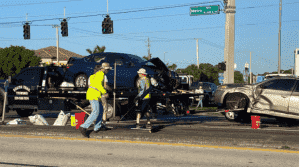
Florida drivers injured in crashes involving speeding or other traffic violations may benefit from consulting a qualified car accident lawyer. The Law Offices of Anidjar and Levine can investigate police reports, citations, witness accounts, vehicle damage, video footage, medical records, and electronic data to assess liability and damages. A citation does not automatically establish civil responsibility, while its absence does not prevent a negligence claim. Legal guidance can help protect injury victims during insurer communications, address comparative negligence, and pursue compensation for medical treatment, lost income, pain, disability, and future care. Learn more by consulting a Florida Personal Injury Lawyer.
Main Takeaways
- A Florida speeding or traffic citation does not automatically establish civil liability for crash-related injuries.
- Liability requires evidence that a driver breached a legal duty and caused the collision and resulting injuries.
- Important evidence includes crash reports, photographs, witnesses, vehicle damage, surveillance, medical records, and electronic speed data.
- Seek medical care, report the accident, preserve evidence, and avoid guessing or accepting fault when speaking with insurers.
- Florida comparative negligence rules may reduce compensation when multiple parties contributed to the accident.
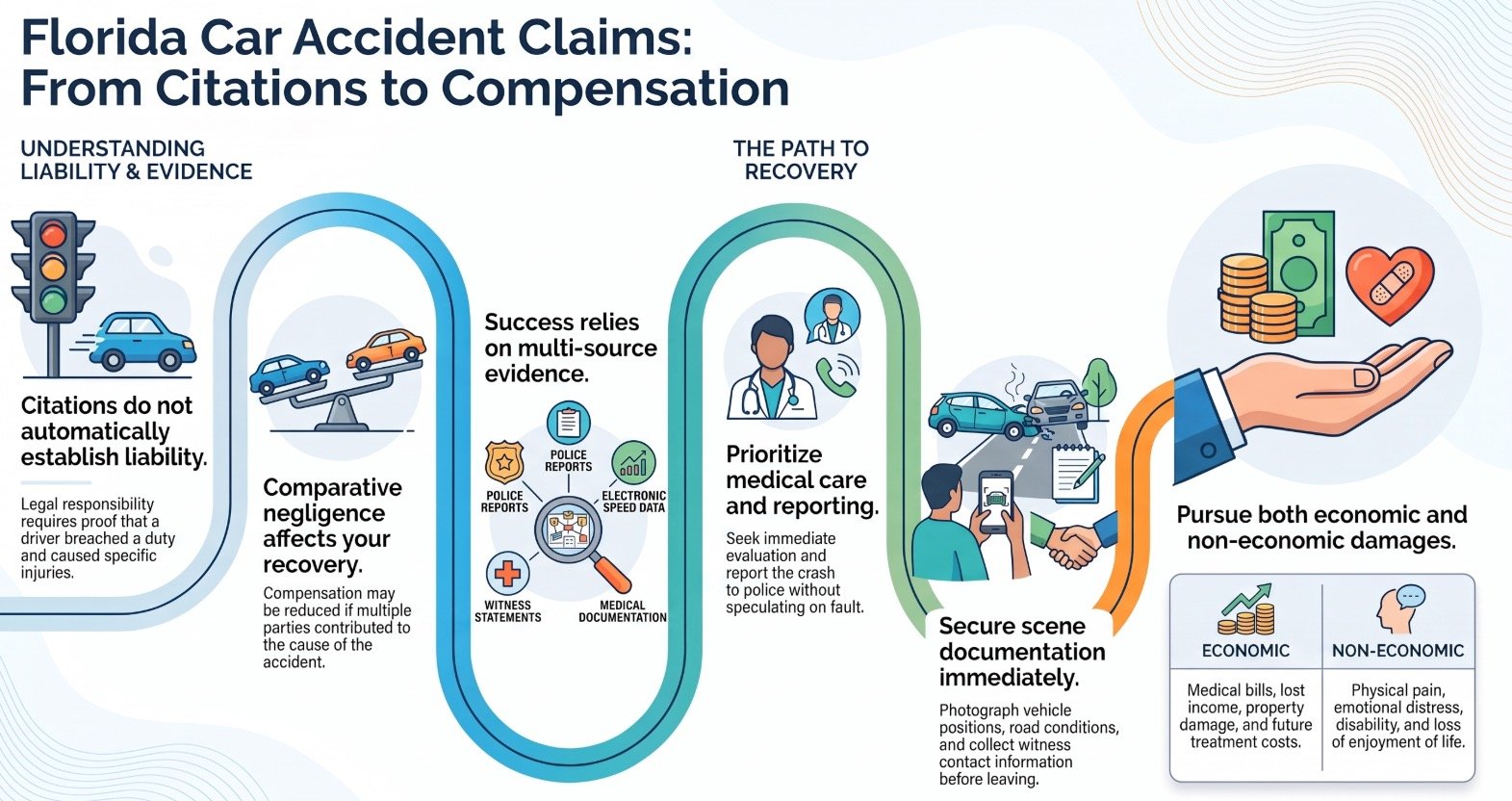
How We Can Help With Your Florida Car Accident Traffic Violations & Speeding Injury Claim
Florida car accident and speeding injury claims often require a careful evaluation of traffic violations, crash evidence, and the resulting damages. A qualified legal team can organize relevant records, communicate with insurers, and protect an injured person from premature settlement decisions. Counsel may review police reports, witness accounts, medical documentation, vehicle damage, and employment records to develop a clear presentation of the claim.
Effective Negotiation Tactics focus on establishing responsibility, documenting losses, and addressing the long-term effects of an injury. When appropriate, representatives can pursue constructive discussions while remaining prepared to proceed through formal legal channels. They may also explain the Traffic Court Process, coordinate deadlines, and help ensure that a traffic citation does not unfairly determine the separate injury claim.
Understanding Florida Car Accident Traffic Violations & Speeding Injury Cases


When a traffic violation or speeding allegation contributes to a collision, the resulting injury case may involve both traffic-law issues and a separate claim for financial damages. A citation, however, does not automatically establish civil liability, and the absence of a citation does not eliminate it. Evidence may include collision reports, witness statements, vehicle data, photographs, medical records, and surveillance footage.
OUR CONSULTATIONSARE FREE
START YOUR FREE CASE REVIEW

A Traffic light violation may support an argument about right of way, while crosswalk disputes can require careful analysis of pedestrian conduct, driver attentiveness, and roadway conditions. In rear-end crashes, responsibility may depend on following distance, visibility, reaction time, and the condition of each vehicle. Brake failure claims may raise separate questions concerning maintenance, manufacturing defects, or reasonable driver response.
An injury case may seek compensation for medical treatment, lost income, disability, pain, and other losses. Careful investigation helps protect injured individuals and promotes a fair resolution while distinguishing proven facts from unsupported assumptions.
Don’t Wait. Call Our Florida Personal Injury Lawyers Now!
Common Causes of Florida Car Accident Traffic Violations & Speeding
Common causes of Florida car accident traffic violations and speeding include speeding, reckless driving, and other unsafe driving practices. Distracted driving, failure to yield, and impaired driving offenses can also create conditions that lead to collisions and legal penalties. Each violation may affect liability, insurance claims, and the rights of individuals injured in the accident.
Speeding And Reckless Driving


Speeding and reckless driving are among the most significant causes of car accidents and related traffic violations in Florida. Excessive speed reduces reaction time, increases stopping distance, and intensifies crash forces. Reckless conduct, including aggressive passing, tailgating, and racing, can endanger everyone using the roadway and may result in citations, license penalties, civil liability, or criminal charges.
Roadway engineering also influences risk, particularly where poorly designed intersections, limited visibility, or inconsistent speed limits encourage dangerous behavior. Communities may address these concerns through traffic calming solutions, clearer signage, improved lighting, and targeted enforcement. Compliance technology updates, such as electronic monitoring and automated speed detection, can support lawful driving when properly implemented. Vehicle safety systems may also reduce injury severity, but they cannot replace prudent speed, adequate following distances, and responsible decision-making by drivers.
Distracted Driving Violations
Distracted driving violations occur when a driver diverts attention from operating the vehicle, whether by texting, using a mobile device, adjusting navigation, eating, or engaging with passengers. These behaviors can delay reactions, reduce awareness, and increase the likelihood of a collision. Florida law restricts texting while driving and supports cellphone use enforcement, particularly in circumstances involving active roadway risks. Officers may issue citations when observable conduct demonstrates unlawful device use or unsafe distraction. Drivers must also watch for distracted pedestrian hazards, including people crossing near intersections, transit stops, schools, and parking areas. A momentary lapse can endanger occupants, pedestrians, cyclists, and other motorists. Legal guidance may help injured individuals understand citation records, insurance issues, and available remedies. Promoting attentive driving protects communities and supports safer transportation for everyone.
Failure To Yield
Failure to yield occurs when a driver proceeds without giving the right-of-way required by Florida traffic laws, often at intersections, crosswalks, merging points, or when turning left. Such conduct can cause collisions involving vehicles, pedestrians, or cyclists and may result in citations, insurance claims, and civil liability. Investigators typically examine traffic signals, lane positions, witness accounts, vehicle damage, and available video evidence to determine which driver had priority. Clear documentation can help injured individuals and other affected parties understand their legal options. Comparative negligence disputes may arise when each driver alleges that the other contributed to the crash. In some cases, traffic citation defenses may challenge whether the observed conduct violated a specific rule or whether the evidence supports the alleged violation. Legal guidance can help preserve records and promote fair resolution.
Impaired Driving Offenses
Impaired driving offenses involve operating a motor vehicle while affected by alcohol, drugs, or a combination of substances, and they are a significant cause of Florida traffic crashes. Alcohol and controlled substances can reduce judgment, reaction time, coordination, and awareness of surrounding traffic. Drivers may disregard Intersection safety rules, misjudge distances, or make Avoidable lane changes that place other motorists, bicyclists, and pedestrians at risk. Florida law prohibits driving with an unlawful blood or breath alcohol concentration and may impose penalties for drug-impaired operation. Investigations can involve chemical testing, field observations, witness statements, and crash evidence. Individuals affected by these offenses may face injury, property loss, arrest, license consequences, and civil claims. Prompt legal guidance can help affected people understand available remedies, preserve evidence, and support safer outcomes for the community.
Legal Rights of Florida Car Accident Traffic Violations & Speeding Injury Victims
When a Florida car accident involves speeding or another traffic violation, injured victims may have legal rights to seek compensation for damages caused by another party’s negligence. These rights can include recovery for medical expenses, lost income, property damage, and pain and suffering, subject to evidence and applicable deadlines. A lawyer can help preserve records, identify responsible parties, and communicate with insurers while protecting the victim’s interests.
Florida car accident victims may pursue compensation for medical expenses, lost income, property damage, and pain and suffering.
- Victims may pursue a civil claim even when prosecutors do not file criminal charges. Understanding Criminal vs civil proceedings helps clarify that separate standards and remedies apply.
- Accident reports, citations, witness accounts, photographs, and medical documentation may support liability and damage calculations.
- Florida’s comparative negligence rules and statute of limitations can affect recovery, making prompt legal evaluation important.
A traffic citation does not automatically establish civil liability, and a traffic ticket defense may involve issues distinct from an injury claim. Legal guidance can help families make informed decisions and pursue fair treatment while focusing on medical recovery and long-term stability.
Why Do Florida Car Accident Traffic Violations & Speeding Injuries Happen?
Florida car accident traffic violations and speeding injuries often arise from unsafe decisions, roadway conditions, vehicle problems, or a combination of these factors. Excessive speed reduces reaction time and increases impact force, while distracted driving can keep a motorist from recognizing changing traffic conditions. Impairment, aggressive passing, following too closely, and ignoring signals may create violations that place other road users at substantial risk.
Environmental conditions also contribute. Rain, standing water, uneven pavement, construction zones, and poor Nighttime visibility can make lane markings or hazards difficult to recognize. Fatigue, distraction, or inadequate control can cause a sudden lane departure, especially on unfamiliar roads.
Mechanical problems can further increase danger. Tire damage, defective steering components, and other vehicle defects may interfere with safe operation. Brake failure can prevent a driver from stopping before a collision, even when they exercise reasonable caution. Understanding these contributing causes helps identify preventable risks and supports greater accountability for protecting Florida communities.
What Should You Do After a Florida Car Accident Traffic Violations & Speeding Injury?
After a Florida car accident involving a traffic violation or speeding injury, the injured person should seek immediate medical care, even if symptoms seem minor at first. The accident should also be reported promptly to law enforcement, and relevant records and evidence should be preserved. Consulting a qualified traffic lawyer can help protect legal rights and assess potential claims.
Seek Immediate Medical Care
Prompt medical evaluation should be a priority for anyone injured in a Florida car accident involving an alleged traffic violation or speeding. A qualified provider can identify visible and hidden conditions, establish treatment needs, and reduce the risk that delayed symptoms will worsen. Anyone experiencing severe pain, bleeding, breathing difficulty, confusion, or suspected spinal injury should get emergency care immediately. Medical records can help document injuries, prescribed treatment, and limitations accurately. Patients should follow medical instructions and attend recommended appointments, even when discomfort initially appears minor. Understanding insurance coverage basics may help injured individuals arrange necessary care without postponement. Until they get legal guidance, they should avoid recorded statements that speculate about fault, symptoms, or future recovery. Prompt attention supports health and preserves reliable evidence concerning the injury.
Report the Accident
If a Florida car accident may involve speeding or another traffic violation, the drivers should report it promptly to law enforcement, especially when anyone is injured, property is damaged, or the circumstances are disputed. Officers can secure the scene, arrange medical assistance, document conditions, and investigate possible violations. Drivers should provide identification, insurance information, and a factual account without guessing about speed, fault, or injuries. If safe, they should photograph vehicle positions, roadway conditions, signs, visible damage, and relevant debris before the scene changes. Witness account collection should include names and contact information, along with brief, accurate observations. Dashcam footage preservation is also important; original files should be saved without editing or overwriting them. Injured individuals should cooperate with responders and promptly follow recommended medical care.
Consult a Traffic Lawyer
A Florida traffic lawyer can help an injured driver or other accident participant evaluate whether speeding or another traffic violation contributed to the crash and determine what legal steps should follow. Counsel can review the crash report, citations, witness accounts, photographs, and medical records to identify inconsistencies or evidence supporting liability. If a ticket was issued, experienced traffic ticket defense can protect the client’s driving privileges while challenging inaccurate allegations. A lawyer can also explain insurance procedures, preserve evidence, and coordinate communications with insurers or opposing parties. Court Date Preparation may include reviewing testimony, organizing documents, and explaining what to expect in court. Prompt legal guidance can help an injured person meet deadlines, pursue available compensation, and avoid statements that could undermine a claim. Legal assistance also supports responsible advocacy for affected families and communities.
Critical Evidence in a Florida Car Accident Traffic Violations & Speeding Injury Case
Critical evidence can establish whether a traffic violation or speeding caused the collision and the resulting injuries.
Key sources include:
- Crash scene documentation, police reports, citations, and witness statements or testimony;
- Medical records and bills connecting the injuries to the crash; and
- Additional physical or electronic evidence that clarifies fault, impact, and damages.
Crash Scene Documentation
Because physical evidence can change or disappear shortly after a collision, prompt crash scene documentation is essential in a Florida car accident case involving traffic violations or speeding injuries. Photographs should capture vehicle positions, damage, skid marks, debris, traffic controls, road conditions, lighting, and nearby sight obstructions. Measurements and scene diagrams can help establish distances, travel paths, and potential points of impact. Witness contact information and contemporaneous observations may also preserve details that later become uncertain.
How evidence is preserved can affect whether it remains useful in evaluating fault and injury causation. Inspect vehicles before repairs, and identify and secure damaged components, event data, and relevant surveillance when available. Investigators may review roadway design, visibility, weather, tire marks, vehicle damage patterns, and electronic records, while avoiding premature conclusions about responsibility.
Police Reports And Citations
When law enforcement responds to a Florida crash, the resulting police report and any traffic citations may provide important evidence regarding the circumstances of the collision. Officers may document roadway conditions, vehicle positions, apparent damage, injuries, weather, and statements made during the investigation. Citations for speeding, careless driving, following too closely, or other violations can help establish potential negligence, although a citation alone does not automatically determine civil liability. The report may also identify relevant traffic-stop evidence, including observations that led to an enforcement action before the crash. Careful review can reveal inconsistencies, omissions, or descriptions in a driver’s statement that conflict with physical evidence. Because reports can contain errors or preliminary conclusions, an attorney may compare them with medical records, photographs, vehicle data, and applicable Florida traffic laws when evaluating an injured person’s claim.
Witness Statements And Testimony
Witness statements can provide an independent account of how a Florida collision occurred, particularly when the involved drivers offer conflicting descriptions. Eyewitness credibility depends on the person’s location, visibility, attention, and ability to recall events accurately. Investigators may compare each account with roadway conditions, vehicle positions, citations, and other available evidence. Statement contradictions do not automatically disprove a witness’s testimony, but significant inconsistencies can affect its weight and reliability. A witness who observed speeding, an improper lane change, failure to yield, or distracted driving may clarify disputed traffic violations. The officer’s bodycam may preserve interviews, statements made at the scene, and observations that support or challenge later testimony. Nearby security footage, dash-camera recordings, and other video evidence can further corroborate accounts. Careful collection and preservation of this information helps ensure injured individuals are treated fairly.
Medical Records And Bills
Medical records and bills provide crucial evidence of the injuries, treatment, and financial losses associated with a Florida car accident involving alleged speeding or other traffic violations. Records may document diagnoses, emergency care, imaging, medications, therapy, surgical recommendations, and continuing symptoms. Consistent medical documentation can connect the reported injuries to the collision and clarify their severity. Explain treatment delays carefully because insurers may argue that postponed care indicates a minor injury or another cause. Bills, payment receipts, and provider statements help establish past medical expenses, while treatment plans may support anticipated costs. Preserve insurance documentation, including claim forms, coverage decisions, and payment histories, with these materials. Organized records help attorneys, insurers, and courts evaluate damages fairly and serve injured individuals responsibly.
Don’t Wait. Call Our Florida Personal Injury Lawyers Now!
Long-Term Effects of Florida Car Accident Traffic Violations & Speeding Injuries
Florida car accident traffic violations and speeding injuries may result in chronic pain, permanent disability, or limitations that affect daily activities. Ongoing medical expenses can include treatment, rehabilitation, medication, assistive equipment, and future care. These lasting consequences may also create significant emotional and financial strain for injured individuals and their families.
Chronic Pain And Disability
Although some injuries from traffic violations or speeding collisions appear to improve within weeks, others develop into chronic pain, reduced mobility, or permanent disability. Persistent symptoms may limit walking, lifting, concentrating, driving, or maintaining consistent work attendance. A careful medical record can document functional restrictions, treatment responses, and the expected duration of impairment. Those unable to sustain employment may need information about Social Security disability benefits, while eligibility generally depends on medical evidence and the severity of limitations. Evaluating work capacity helps clarify whether an injured person can return to prior duties, perform modified work, or requires vocational rehabilitation for a different occupation. Supportive professionals can assist survivors by identifying appropriate resources, preserving relevant records, and recognizing how lasting impairment affects independence, family responsibilities, and participation in daily life without assuming recovery will occur quickly.
Ongoing Medical Expenses
Long-term impairment can also create ongoing medical expenses after a Florida car accident involving an alleged traffic violation or excessive speed. Treatment may include subspecialist visits, prescription medication, physical therapy, diagnostic testing, assistive devices, and future procedures. When injuries require continuing care, an accurate medical record helps identify services already received and those reasonably anticipated. Same-day evidence, including photographs, witness information, crash reports, and initial treatment records, may help establish how the collision occurred and connect the injuries to the incident. Insurers sometimes issue Insurance Denials, challenge medical necessity, or argue that later conditions arose from unrelated causes. Careful documentation from physicians and providers can clarify the diagnosis, prognosis, treatment plan, and expected duration of care. Legal guidance may help injured individuals pursue appropriate compensation for medically supported expenses.
Emotional And Financial Strain
Serious injuries from a Florida car accident involving an alleged traffic violation or excessive speed can produce emotional and financial strain that extends well beyond initial treatment. Victims may experience anxiety, depression, sleep disruption, or reduced confidence while adapting to pain, disability, and changes in daily responsibilities. Coping with stress can become more difficult when injuries prevent employment or limit participation in family and community activities. Financial pressure may increase because of lost wages, rehabilitation costs, prescription expenses, transportation needs, and ongoing care. Managing medical expenses often requires careful documentation, communication with providers, and a clear understanding of available insurance benefits. Family members may also provide unpaid care, creating additional burdens. Legal guidance can help preserve evidence, identify responsible parties, and pursue compensation that supports recovery, stability, and long-term care.
Proving Liability in Florida Car Accident Traffic Violations & Speeding Injury Cases
Proving liability in a Florida car accident involving a traffic violation or speeding requires evidence that the driver breached a legal duty and that the violation caused the collision and resulting injuries. Relevant evidence may include crash reports, photographs, surveillance footage, vehicle damage, witness statements, and electronic data documenting speed or braking. A citation or Traffic Stop record can support the claim, but it does not automatically establish civil liability. Investigators must connect the conduct to the crash by showing that exceeding the Speed Limit, failing to yield, or disregarding a signal created a foreseeable risk. Medical records and expert testimony can help demonstrate that the collision caused specific injuries and related losses. Florida’s comparative negligence rules may also affect recovery if another party contributed to the accident. Attorneys serving injured individuals often preserve evidence promptly, interview witnesses, analyze roadway conditions, and present a clear account of how the violation produced the harm.
Dealing With Insurance Companies After a Florida Car Accident Traffic Violations & Speeding Injury
After you preserve liability evidence, communicating with insurance companies becomes an important part of protecting a Florida car accident claim involving a traffic violation or speeding. An injured person should provide accurate information while avoiding speculation, recorded statements without preparation, or comments that could be interpreted as accepting fault. Adjusters may ask about vehicle damage, medical treatment, the traffic light sequence, or whether distracted driving contributed to the collision. Responses should remain truthful, concise, and consistent with available records.
Insurance representatives may request medical authorizations, employment information, photographs, and expense documentation. Review such requests carefully, because overly broad releases can expose unrelated health or financial information. A written account of symptoms, treatment, lost income, and ongoing limitations can help preserve important details. Communications should also identify the responsible driver’s policy information and applicable coverage limits when available. An attorney can handle negotiations, address disputed evidence, and help ensure that settlement discussions do not undermine the injured person’s rights or the interests of supportive family members.
What to Expect During a Florida Car Accident Traffic Violations & Speeding Injury Claim Process
The claim process typically begins with an initial case evaluation to assess liability, injuries, damages, and applicable traffic violations. Evidence is then gathered, followed by negotiations with the insurance companies to pursue appropriate compensation. If the parties cannot reach a satisfactory settlement, the matter may proceed to trial.
Initial Case Evaluation
A Florida car accident traffic-violation and speeding injury claim typically begins with an initial case evaluation to determine liability, insurance coverage, and the nature and extent of the claimant’s injuries. During this consultation, a legal professional reviews the incident’s basic circumstances, identifies potentially applicable traffic violations, and explains possible legal remedies. The claimant may discuss medical treatment, missed work, vehicle damage, communications with insurers, and recovery concerns. Particular attention may be given to Faulty Officer Reporting, including inaccurate descriptions or omissions that could affect how responsibility is assessed. The evaluation also addresses Evidence Preservation responsibilities, helping prevent accidental loss of relevant materials while avoiding premature conclusions about admissibility. Counsel generally outlines deadlines, expected communications, and potential challenges, enabling the claimant to make informed decisions and pursue fair treatment throughout the process.
Gathering Evidence
When a Florida car accident involves alleged speeding or another traffic violation, evidence gathering establishes the factual basis for evaluating fault, causation, and damages. Counsel may obtain crash reports, citations, photographs, witness statements, traffic-camera footage, and available electronic data. A timely Vehicle inspection can document impact points, mechanical conditions, seat-belt use, and other details that may support or challenge allegations. Medical records and employment information help connect injuries to the collision and establish financial losses. A documentation checklist commonly includes the policy, incident reports, treatment records, bills, photographs, repair estimates, and correspondence. Preserving these materials protects accuracy as the Insurance claim develops. If coverage or responsibility is questioned, counsel may examine denial reasons and request supporting information. Evidence collection remains separate from later negotiations over settlement value.
Insurance Negotiations
Once the available evidence is assembled, insurance negotiations address how the insurer will review the collision, alleged traffic violation, injuries, and financial losses. The adjuster may review police reports, medical records, photographs, witness statements, and documented expenses before determining responsibility and potential coverage. A representative may request additional information, question treatment decisions, or dispute whether speeding contributed to the crash. Careful, accurate responses help prevent misunderstandings and protect the injured person’s interests. Legal guidance can also clarify policy limits, comparative fault principles, and the significance of recorded statements. Addressing misconceptions about claims is important because an initial offer may not reflect all supported losses or future medical needs. Clear communication helps establish realistic settlement timeline expectations while negotiations continue. Keep records organized, and monitor deadlines under Florida law and applicable policies closely.
Settlement Or Trial
If insurance negotiations do not resolve the dispute, the injured person may proceed toward either a settlement or trial in a Florida car accident claim involving alleged traffic violations or speeding. A settlement may provide compensation sooner and reduce uncertainty, but its terms should address medical expenses, lost income, property damage, and potential future needs. Counsel typically develops a negotiation strategy based on evidence, liability, damages, and the likely strength of the insurance defense. If negotiations fail, litigation may require discovery, depositions, expert testimony, and motion practice before trial. A judge or jury may then evaluate whether speeding or another violation contributed to the collision and determine recoverable damages. Throughout either path, careful documentation and informed decisions help protect the injured person’s interests while supporting a fair outcome.
Compensation for Florida Car Accident Traffic Violations & Speeding Injury Damages
Compensation for injuries caused by a Florida traffic violation or speeding-related crash may include medical expenses, lost income, property damage, and non-economic losses such as pain and emotional distress. A thorough claim should connect the driver’s unlawful conduct to the collision and document the resulting harm through medical records, wage information, repair estimates, and other reliable evidence.
Florida’s comparative negligence rules may reduce a recovery when the injured person shares responsibility for the crash. Fault assessments can thus affect settlement negotiations and any court award. Insurance coverage also remains central, including the at-fault driver’s liability policy, the injured person’s personal injury protection, and potentially uninsured or underinsured motorist benefits.
An attorney may help preserve evidence, communicate with insurers, evaluate available coverage, and seek compensation that reflects the client’s circumstances. Prompt legal guidance can also protect deadlines and prevent statements or releases from undermining a valid claim. These efforts support fair treatment, hold negligent motorists accountable, and assist affected families.
Don’t Wait. Call Our Florida Personal Injury Lawyers Now!
Economic vs Non-Economic Damages in Florida Car Accident Traffic Violations & Speeding Cases
Florida car accident cases involving traffic violations or speeding may produce both economic and non-economic damages. Economic damages include measurable losses such as medical expenses, lost income, and property damage, while non-economic losses may involve pain, emotional distress, and reduced quality of life. Establishing these damages generally requires organized documentation, credible evidence, and a clear connection between the accident and the claimed losses.
Economic Damages Explained
Economic damages in a Florida car accident case generally refer to the measurable financial losses caused by the crash, including medical expenses, lost income, property damage, and future costs associated with ongoing treatment or reduced earning capacity. Accurate medical bill documentation helps establish the treatment provided, amounts charged, and expenses paid or outstanding. Records from physicians, hospitals, pharmacies, therapists, and transportation providers may support a complete claim. Employment records, pay statements, tax documents, and employer verification can assist with lost wage recovery when injuries prevent work or reduce earning ability. Property damage estimates and repair invoices may demonstrate vehicle-related losses. For serious injuries, financial professionals or medical experts may evaluate future care and diminished earning capacity. Careful documentation allows responsible advocates to present an organized, evidence-based request for compensation and serve affected individuals effectively.
Non-Economic Losses
Non-economic losses reflect the personal consequences of a Florida car accident, including physical pain, emotional distress, inconvenience, scarring, disfigurement, and diminished enjoyment of life. Unlike medical bills or lost wages, these losses do not have fixed prices. They recognize how an injury can alter relationships, independence, daily routines, and participation in meaningful activities. A person may also experience anxiety, sleep disruption, embarrassment, or reduced confidence after a collision. The assessment may account for lasting limitations and Future health costs when an injury is expected to affect quality of life. In appropriate cases, proving emotional distress involves showing the condition’s impact through treatment, personal observations, and consistent conduct. Florida law may permit recovery for these harms, helping injured individuals obtain support and acknowledge consequences that financial records cannot fully capture.
Proving Accident Damages
To prove accident damages in a Florida car accident involving an alleged traffic violation or speeding, an injured person must connect the driver’s conduct to documented financial losses and identifiable personal harm. Economic damages may include medical bills, rehabilitation costs, lost wages, reduced earning capacity, property damage, and future treatment expenses. Records, expert testimony, employment documentation, and receipts can help establish these amounts. Non-economic damages address pain, emotional distress, disfigurement, disability, loss of enjoyment, and diminished quality of life. Medical testimony and consistent personal accounts may support these claims. Comparative negligence can reduce recovery if the injured person contributed to the crash. In exceptional cases involving intentional misconduct or gross negligence, punitive damages may be available, although they require stronger proof than ordinary negligence damages. Careful evidence preservation assists fair compensation.
When a Florida Car Accident Traffic Violations & Speeding Injury Case Goes to Trial vs Settlement
When a Florida car accident injury claim involves alleged traffic violations or speeding, the decision to pursue settlement or proceed to trial depends on the strength of the evidence, the extent of the injuries, and the parties’ willingness to accept a specific outcome. Trial vs settlement factors may include disputed fault, conflicting witness accounts, available vehicle or roadway evidence, medical documentation, and the projected cost of continued litigation.
Settlement can provide earlier financial support and greater predictability, particularly when liability appears reasonably clear, and the injured person’s damages are well documented. An effective insurance negotiation strategy evaluates policy limits, treatment records, lost income, future care needs, and comparable claim outcomes without overstating the evidence.
Trial may become necessary when an insurer denies responsibility, undervalues substantial injuries, or refuses to negotiate meaningfully. A courtroom decision carries uncertainty, expense, and delay, but it may allow a fact finder to assess credibility and damages independently. Counsel can help injured individuals weigh these considerations while pursuing a fair resolution.
Florida Laws That May Affect Your Florida Car Accident Traffic Violations & Speeding Case
Florida car accident traffic violations and speeding cases may be affected by statutes governing traffic offenses, negligence, insurance coverage, and damage recovery. Florida law may establish whether a driver violated a speed limit, failed to yield, followed too closely, or operated a vehicle carelessly.
Those findings can influence liability, available insurance benefits, and the evidence presented during negotiations or trial.
- Traffic statutes: Speed calculations, roadway conditions, signage, and officer observations may determine whether a citation is supportable. Speeding defenses can address measurement reliability, emergency circumstances, or improper notice of restrictions.
- Negligence rules: Comparative-fault principles may reduce recovery when an injured person contributed to the collision. Witness statements, vehicle damage, photographs, and eyewitness accuracy can materially affect fault determinations.
- Insurance provisions: Personal injury protection, bodily-injury coverage, and applicable policy exclusions may shape payment sources and claim valuation.
A careful legal review helps clarify duties, preserve reliable evidence, and support fair treatment for all affected individuals without assuming that a citation alone establishes civil liability.
The Statute of Limitations for Florida Car Accident Traffic Violations & Speeding Injury Cases
Strict filing deadlines may determine whether an injured person can pursue a civil claim arising from a Florida car accident, traffic violation, or speeding-related injury. Florida generally allows two years to file a negligence action involving bodily injury, although the applicable period can vary by claim, date of discovery, and the parties involved. Claims against governmental entities may require earlier notice and shorter deadlines. Wrongful-death actions also have specific limitation rules.
The Traffic Ticket Process does not automatically extend the civil filing period. Likewise, completing Insurance Claim Steps, negotiating with an insurer, or awaiting a settlement generally does not preserve a lawsuit indefinitely. Certain circumstances, including a minor’s status, incapacity, fraud, or delayed discovery, may affect when the period begins or whether it is paused. Because missed deadlines can permanently bar recovery, injured individuals and families should promptly preserve records, identify responsible parties, and obtain reliable legal information about the governing limitation period before communicating final settlement decisions.
How a Florida Car Accident Traffic Violations & Speeding Lawyer Can Help You
A Florida car accident traffic violations and speeding lawyer can evaluate the circumstances of a collision, identify potentially responsible parties, and develop a legal strategy based on the available evidence. The lawyer’s work may support injured individuals, families, and community members seeking fair treatment after a crash.
A Florida traffic violations and speeding lawyer helps crash victims evaluate fault, preserve evidence, and pursue fair compensation.
- Counsel can preserve evidence, including photographs, vehicle data, witness statements, medical records, and relevant traffic or surveillance materials, before information disappears.
- Counsel can interpret citations, speeding allegations, right-of-way rules, and other violations to explain how traffic conduct may affect fault and available remedies.
- Counsel can develop insurance claim strategies, communicate with adjusters, assess settlement proposals, and pursue compensation supported by documented losses.
A lawyer may also coordinate with medical professionals, accident reconstruction experts, and other witnesses when technical testimony is necessary. By organizing facts and presenting them clearly, legal counsel can help protect a claimant’s interests while promoting accountability. The process provides informed guidance and effective advocacy for those affected by preventable roadway conduct.
When to Contact a Florida Car Accident Traffic Violations & Speeding Lawyer
When a crash results in injuries, disputed fault, a citation, or significant property damage, contacting a Florida car accident traffic violations and speeding lawyer promptly may help protect the affected person’s legal and financial interests. Early guidance can help preserve evidence, identify reporting deadlines, and clarify whether a traffic charge may influence an injury or property-damage claim.
A lawyer may also help organize Insurance claim documentation, including medical records, repair estimates, photographs, witness information, and insurer correspondence. Prompt contact is especially important when an adjuster requests a recorded statement, proposes a settlement, or assigns responsibility before the facts are fully established. Individuals should seek assistance if injuries develop after the collision, treatment continues, or lost income and caregiving needs become significant.
Understanding the Crash settlement timeline can help affected families plan responsibly while avoiding premature decisions. Legal consultation may also be appropriate when a citation involves speeding, careless driving, or another alleged violation. Timely attention supports accurate communication and protects the ability to respond as circumstances evolve.
Why You Need an Experienced Florida Car Accident Traffic Violations & Speeding Lawyer
Experienced legal counsel can be essential after a Florida crash involving alleged speeding, disputed fault, injuries, or substantial property damage. An experienced Florida car accident traffic violations and speeding lawyer can examine police reports, roadway evidence, vehicle damage, medical records, and applicable traffic statutes to clarify what occurred. This analysis may expose inaccurate assumptions about speed, braking, visibility, or right-of-way before those assumptions influence liability decisions.
Counsel also helps protect an injured person from Insurance claim mistakes, including recorded statements, incomplete descriptions of symptoms, premature settlements, or releases that limit future recovery. Witness reliability issues can materially affect a case when accounts conflict, memories change, or observations were made from poor vantage points. A lawyer can preserve relevant evidence, address procedural deadlines, and present the client’s position responsibly while communicating with insurers and opposing parties. Such guidance supports fair treatment, reduces avoidable complications, and helps families, workers, and community members pursue appropriate compensation without sacrificing accuracy or accountability during a difficult recovery.
How to Choose the Right Florida Car Accident Traffic Violations & Speeding Lawyer for Your Case
Selecting the right Florida car accident traffic violations and speeding lawyer requires careful review of the attorney’s experience with cases involving contested speed, citations, disputed liability, and injury claims. A qualified lawyer should explain how evidence, including crash reports, photographs, vehicle data, witness accounts, and medical records, may affect the claim.
Prospective clients should ask whether the attorney personally evaluates traffic violations, identifies insurer tactics, and communicates promptly throughout the case. Clear answers about fees, litigation risks, deadlines, and expected decisions can help individuals choose informed representation while protecting their interests.
The lawyer’s trial strategy also merits attention. Counsel should be prepared to challenge inaccurate citations, address comparative fault, present persuasive evidence, and respond to opposing arguments without making unsupported promises. Experience with local court procedures and Florida negligence principles may further strengthen case preparation.
A careful selection process allows an injured person to work with counsel whose judgment, resources, and professional commitment align with the case’s needs and the goal of obtaining fair treatment.
About The Law Offices of Anidjar & Levine
The Law Offices of Anidjar & Levine represents individuals involved in Florida car accidents, including matters involving traffic violations, speeding allegations, disputed liability, and injury claims. The firm carefully evaluates each client’s circumstances, recognizing that a citation, crash report, or insurance position may not fully explain what occurred. Its attorneys review available evidence, communicate with involved parties, and identify legal issues that may affect responsibility and compensation.
Client consultations allow you to discuss accident details, medical treatment, property damage, deadlines, and potential claims. Based on that information, the firm develops a case strategy to protect the client’s interests and present supported arguments. This may include investigating roadway conditions, reviewing vehicle and phone records, consulting qualified professionals, and negotiating with insurers. When appropriate, the firm can also pursue litigation. Its work emphasizes informed decision-making, clear communication, and diligent representation for individuals seeking assistance after a Florida collision involving alleged traffic violations or speeding.
Frequently Asked Questions
Can a Speeding Ticket Affect My Florida Driver’s License Points and Insurance Rates?
A Florida speeding ticket can add License Points to a driver’s record, depending on the alleged speed and circumstances. Accumulating points may trigger warnings, suspension, or other administrative consequences. The ticket may also create an Insurance Impact because insurers commonly review driving histories when setting premiums or renewing coverage. A driver may reduce consequences by reviewing eligibility for traffic school, contesting an inaccurate citation, and seeking qualified legal guidance promptly before deadlines expire.
What Happens if I Miss My Florida Traffic Court Date?
Missing a Florida traffic court date may lead the court to impose additional penalties, suspend driving privileges, or report the failure to the Florida Department of Highway Safety and Motor Vehicles. In some cases, a judge may issue a Bench Warrant, particularly when the underlying charge requires a mandatory appearance. Consequences: Incarceration is uncommon for ordinary civil infractions but may arise from criminal traffic offenses. Contacting the clerk or qualified counsel promptly can clarify available remedies.
Can I Contest a Florida Speeding Ticket Without Appearing in Court?
A Florida driver may contest a speeding ticket without appearing in court, depending on the citation, county procedures, and the court’s authorization. Online contest options may permit electronic submission, while a mail-in plea can request a hearing or adjudication. Administrative review requests may address factual or procedural concerns. The driver should verify deadlines and hardship waiver eligibility, because missing required appearances can result in additional penalties, suspension, or other enforcement action.
Are Florida Traffic Violations Eligible for Traffic School or Driver Improvement Courses?
Florida traffic violations may qualify for traffic school or approved driver improvement courses, depending on the offense, license status, and prior election history. Traffic School Eligibility generally requires timely selection and payment through the clerk, while certain serious violations or commercial license circumstances may be excluded. Driver Improvement Options can reduce points or prevent insurance consequences, but completion deadlines and course approval matter. Florida drivers should verify current requirements with the clerk or an authorized provider.
How Do Out-Of-State Drivers Handle Florida Speeding Tickets and Traffic Citations?
Out-of-state drivers should promptly review the citation and identify the issuing Florida court. The out-of-state process may permit remote payments, approved driver improvement courses, or other citation compliance options, depending on the violation and county procedures. Drivers must verify deadlines, eligibility, and license-reporting consequences with the clerk. Some matters require court appearances, particularly contested citations or serious offenses. Timely legal guidance can protect driving privileges and clarify available resolutions.
—————————
Florida car accidents involving traffic violations or speeding can raise complex issues involving liability, injuries, insurance coverage, and compensation. Prompt legal guidance may help preserve evidence, address disputed fault, and protect an injured person’s rights throughout the claims process. An experienced Florida car accident lawyer can assess the circumstances, explain available legal options, and pursue appropriate compensation. The Law Offices of Anidjar and Levine offer informed representation tailored to each client’s case. Learn more from a Florida Personal Injury Lawyer.