

The Law Offices of Anidjar and Levine help Boynton Beach crash victims investigate impaired or distracted driving cases, preserve evidence, and pursue compensation.
Potential claims may involve alcohol, drugs, texting, navigation systems, fatigue, or other conduct that breached a driver’s duty of care.
Counsel can review crash reports, medical records, witness accounts, video, vehicle data, and insurance coverage while addressing attempts to minimize injuries.
Victims should seek medical care, call 911, document the scene when safe, and learn how legal guidance may support recovery.
To explore your options, contact a Boynton Beach Personal Injury Lawyer.
Main Takeaways
- A Boynton Beach impaired and distracted driving injury lawyer can investigate the crash, identify liable parties, and protect your legal rights.
- Potential evidence includes police reports, medical records, witness statements, traffic footage, vehicle data, and electronic device records.
- Impairment may involve alcohol, cannabis, unlawful substances, or prescription medication misuse; distraction may involve texting, navigation, eating, or reaching.
- Victims may pursue compensation for medical expenses, lost income, reduced earning capacity, pain and suffering, and other documented losses.
- Seek medical care, call 911, preserve evidence, and consult counsel promptly because insurance tactics, comparative fault, and deadlines may affect recovery.
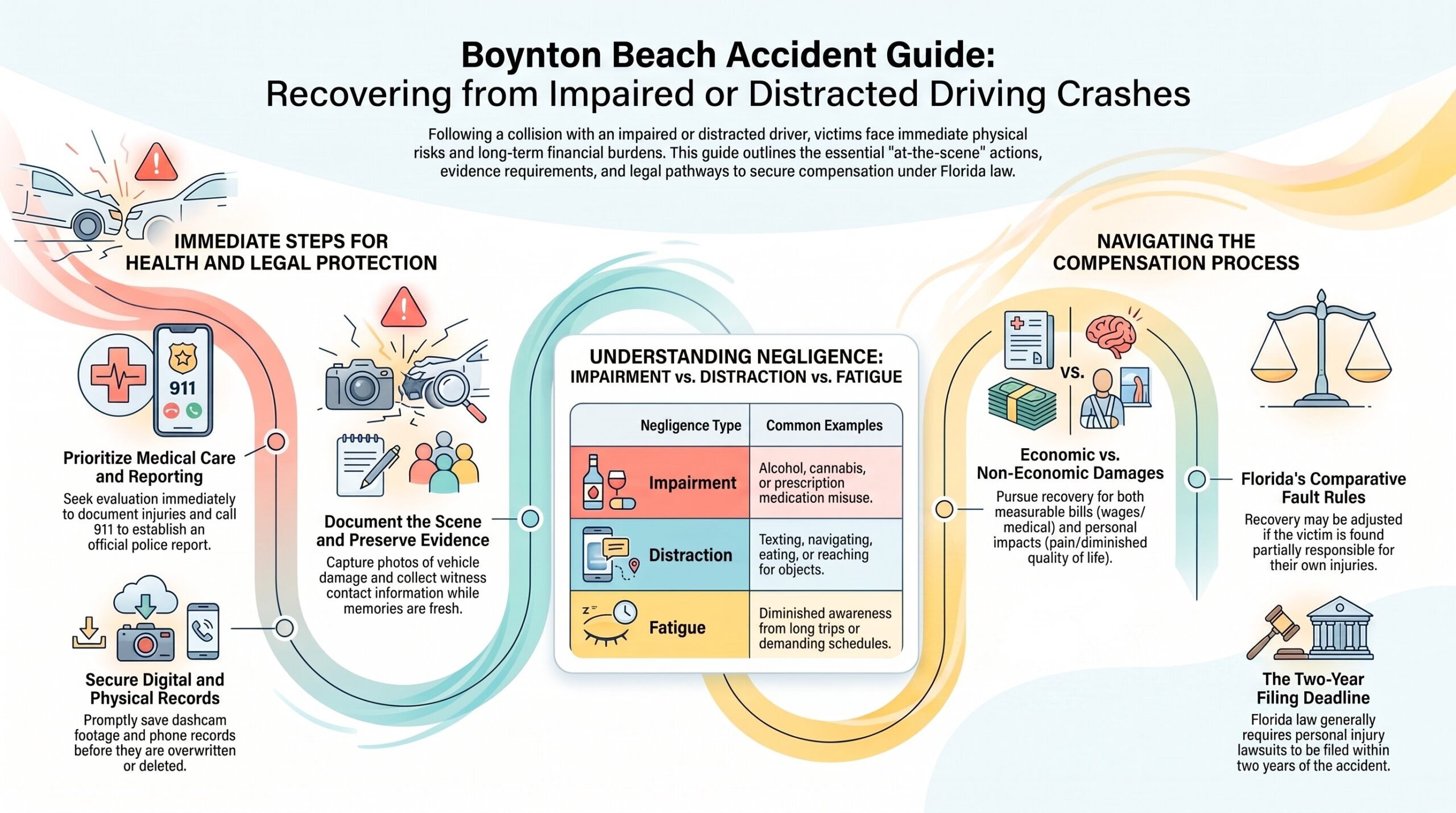


How We Can Help With Your Boynton Beach Impaired & Distracted Driving Injury Claim
When an impaired or distracted driver causes a collision, an experienced Boynton Beach injury lawyer can help protect the injured person’s legal rights and pursue appropriate compensation. The lawyer can provide steady guidance while the victim witness focuses on medical care and recovery.
A legal team may investigate the crash, identify potential sources of liability, and gather records that clarify what occurred. Evidence preservation can include securing photographs, traffic-camera footage, vehicle data, medical documentation, and statements from available witnesses. Counsel may also communicate with insurers, review settlement proposals, and address attempts to minimize the injury’s seriousness.
OUR CONSULTATIONSARE FREE
START YOUR FREE CASE REVIEW

Understanding Boynton Beach Impaired & Distracted Driving Injury Cases
Understanding a Boynton Beach impaired or distracted driving injury case requires examining both the circumstances of the collision and the legal consequences that may follow. Evidence may include crash reports, medical records, witness accounts, vehicle data, and available video footage. These materials can help establish whether another person’s conduct breached a duty of care and caused compensable harm.
Impairment may involve alcohol, unlawful substances, or prescription medication misuse, while distraction can involve device activity, attention diverted from traffic, or distracted navigation systems. Each case requires careful evaluation because liability depends on the facts, applicable Florida law, and the connection between the conduct and the injuries.
An injured person may seek compensation for medical treatment, lost income, reduced earning capacity, pain and suffering, and other documented losses. Families may also face additional consequences when injuries require ongoing assistance. A legal professional can organize evidence, communicate with insurers, protect procedural rights, and pursue a resolution that supports the injured person’s recovery and dignity.
Common Causes of Boynton Beach Impaired & Distracted Driving
Common causes of impaired and distracted driving in Boynton Beach include texting while driving, alcohol-impaired driving, and drug-impaired driving. Eating or drinking behind the wheel can also divert attention and reduce a driver’s ability to respond to changing traffic conditions. Each behavior may increase the risk of crashes and lead to significant legal and personal consequences for injured individuals.
Texting While Driving
Texting while driving is a leading form of distracted driving in Boynton Beach because it diverts a motorist’s visual, manual, and cognitive attention from the road. Reading or composing a message can require several seconds of inattention, during which a vehicle may travel the length of a football field. These phone distractions can prevent a driver from recognizing pedestrians, cyclists, traffic signals, or sudden changes in roadway conditions. Teen driving presents particular concerns because inexperienced motorists may underestimate the risks of texting or feel pressure to respond immediately.
However, drivers of every age can cause serious collisions when they use a phone behind the wheel. Individuals injured in crashes may benefit from prompt medical care, evidence preservation, and guidance from a qualified attorney regarding available legal remedies and responsible parties.
Alcohol-Impaired Driving
Alcohol-impaired driving is another significant cause of collisions in Boynton Beach, as alcohol can reduce judgment, slow reaction time, impair coordination, and weaken a driver’s ability to assess roadway hazards. Even moderate consumption may affect speed control, lane position, following distance, and responses to changing traffic conditions. Drivers suspected of impairment may face field sobriety testing, chemical testing, arrest, and other investigative procedures.
A conviction can result in substantial DUI penalties, including fines, license suspension, ignition-interlock requirements, probation, and incarceration, depending on the circumstances and prior history. Collisions involving an alcohol-impaired motorist may leave injured individuals facing medical expenses, lost income, rehabilitation needs, and lasting emotional harm. Prompt legal guidance can help preserve evidence, clarify available claims, and support injured people seeking accountability and meaningful compensation after preventable crashes.
Drug-Impaired Driving
Drug-impaired driving can occur when a motorist operates a vehicle after using prescription medications, over-the-counter drugs, cannabis, or illicit substances that affect alertness, coordination, judgment, or reaction time. Prescription Misuse may involve taking medication without authorization, combining drugs improperly, or exceeding prescribed dosages. Even appropriate medication use can create risks when warnings address drowsiness, blurred vision, or delayed responses. Cannabis and illicit substances may further impair perception, decision-making, and motor control, increasing the likelihood of a collision.
Some substances remain active longer than a driver expects, particularly when combined with alcohol or other medications. Responsible motorists should review labels, consult healthcare professionals, and arrange alternative transportation when impairment is possible. These precautions support Road Safety and help protect passengers, pedestrians, and other roadway users from preventable injuries and losses.
Distracted Eating And Drinking
Eating and drinking while driving can divert a motorist’s attention from traffic, even when the vehicle remains in motion and the conduct appears routine. Reaching for a cup, unwrapping food, or managing a spill can require visual, manual, and mental attention that should remain focused on safe vehicle operation. Hot beverages may cause sudden reactions, while improperly secured containers can roll beneath pedals or obstruct controls. Although hydration supports alertness, impairment may arise when a driver becomes overly focused on drinking, especially in congested traffic or during changing road conditions.
Food distractions also include chewing, opening packages, and cleaning hands, each of which can delay braking or guiding responses. Drivers who recognize these risks can protect passengers, pedestrians, and other motorists by stopping in a safe location before eating or drinking.


Legal Rights of Boynton Beach Impaired & Distracted Driving Injury Victims
When a collision in Boynton Beach results from impaired or distracted driving, injured victims may have the right to pursue compensation from the responsible party. Florida law may allow recovery for medical expenses, lost income, property damage, pain and suffering, and ongoing rehabilitation.
A victim can preserve important rights by seeking prompt medical care, documenting losses, and avoiding statements that could be interpreted as an admission of fault.
- A claim may proceed through insurance negotiations or a personal injury lawsuit, depending on the evidence and available coverage.
- Florida DUI reporting, crash records, witness accounts, and electronic evidence may help establish negligent or wrongful conduct.
- Distracted driving penalties are separate from a civil claim, so a criminal citation does not automatically determine compensation.
Because deadlines and comparative-fault rules can affect recovery, legal guidance may help a victim evaluate options and protect evidence. A qualified Boynton Beach attorney can communicate with insurers, coordinate documentation, and pursue accountability, allowing the injured person to focus on treatment and recovery. Serving victims requires careful advocacy grounded in verified facts.
Don’t Wait. Call Our Florida Personal Injury Lawyers Now!
Why Do Boynton Beach Impaired & Distracted Driving Injuries Happen?
Impaired and distracted driving injuries in Boynton Beach often occur when a driver’s judgment, attention, or ability to respond is compromised. Alcohol, cannabis, prescription medication, and illegal substances may reduce coordination, slow reaction time, or impair decision-making. Distraction creates similar dangers when motorists text, adjust navigation systems, eat, reach for objects, or focus on passengers instead of traffic.
Fatigue can further diminish awareness, especially during long trips, overnight travel, or demanding work schedules. Speeding, aggressive driving, and disregard for signals or following distances may amplify the consequences of impairment or inattention. Some collisions also involve mechanical problems that could have been addressed through timely Vehicle Maintenance, including defective brakes, worn tires, or failed lights. Drivers who experience breakdowns may face added hazards if they remain near active traffic without Roadside Assistance. Weather, congestion, and unfamiliar roads can increase risks, but responsible driving practices and attentive vehicle care help protect passengers, pedestrians, and other motorists from preventable injuries.
What Should You Do After a Boynton Beach Impaired & Distracted Driving Injury?
After an impaired or distracted driving injury, the injured person should seek immediate medical care, even if symptoms initially appear minor. The crash should be reported to law enforcement, and, when safely possible, relevant details, photographs, witness information, and other evidence should be documented at the scene.
Seek Immediate Medical Care
Prompt medical evaluation should follow any Boynton Beach crash involving suspected impaired or distracted driving, even if the injured person initially feels well. Adrenaline can mask pain, while concussions, internal injuries, and soft-tissue damage may develop gradually. A physician can assess the severity of an injury, identify conditions requiring urgent treatment, and establish appropriate care instructions. Medical records also provide emergency documentation of reported symptoms, diagnostic findings, prescriptions, and recommended restrictions.
Injured individuals should follow those instructions carefully and attend all referrals, including imaging, physical therapy, or expert evaluations. Maintaining symptom tracking can help clinicians recognize changes, measure treatment progress, and adjust care promptly. Consistent appointments may also clarify the recovery timeline and support a safe return to work, school, or daily activities. Prompt attention protects health and preserves an accurate account of medical needs.
Report the Crash
Once medical needs have been addressed, the crash should be reported promptly to the appropriate authorities. Calling 911 allows law enforcement and Emergency Response personnel to assess injuries, control hazards, and establish Scene Safety for everyone involved. The injured person should provide a clear, factual account without speculating about fault or impairment. Officers may conduct appropriate evaluations and create an official crash report, which can support later insurance or legal proceedings.
If witnesses are present, their identifying information may be provided to officers for Witness Outreach. Cooperation with investigators helps preserve reliable accounts while memories remain fresh. Evidence Preservation also begins with timely reporting, since authorities may identify involved drivers, secure dangerous conditions, and record relevant circumstances. Individuals should follow medical guidance, avoid confrontation, and direct questions about legal rights to qualified counsel.
Document the Scene
Documenting the crash scene can preserve important evidence concerning vehicle positions, road conditions, visible injuries, and possible signs of impairment or distraction. If medically able, an injured person or witness should first address immediate hazard safety by moving away from traffic, activating hazard lights, and requesting emergency assistance. Photographs or videos may capture vehicle damage, skid marks, debris, traffic signals, lane markings, lighting, weather, and nearby surveillance cameras. Images should be taken from several distances without entering unsafe areas or interfering with responders.
Names and contact information for witnesses can help preserve independent accounts. Dashcam preservation is also important; recordings should be saved promptly and protected from automatic deletion. A person should avoid arguing with involved drivers or posting evidence online. Medical needs and official instructions should remain the priority while documentation is gathered.
Critical Evidence in a Boynton Beach Impaired & Distracted Driving Injury Case
Critical evidence can establish how the collision occurred, whether impairment or distraction contributed, and the extent of the resulting injuries.
Key sources may include:
- Police reports and witness statements describing the incident and driver conduct
- Video footage and phone records indicating distraction or impairment
- Medical documentation connecting the injuries to the collision and supporting damages
Reviewing these materials helps clarify liability and supports a well-founded injury claim.
Police Reports
Police reports often provide an initial, contemporaneous account of an impaired or distracted driving crash in Boynton Beach. They may identify the responding officers, roadway conditions, vehicle positions, apparent injuries, and statements recorded at the scene. Officer observations can document signs of impairment, such as an odor of alcohol, slurred speech, poor coordination, or admissions concerning device use. These details may support an incident timeline and help clarify events before, during, and after the collision.
Body cam footage, when available, can supplement written descriptions by preserving conduct, environmental conditions, and investigative procedures. A report may also identify potential sources relevant to witness credibility, although credibility determinations require careful review of all available evidence. Because reports can contain omissions or inaccuracies, legal counsel may compare them with medical records, photographs, and other objective materials.
Witness Statements
Witness statements can help establish how an impaired or distracted driver behaved before, during, and after a collision in Boynton Beach. Observers may describe swerving, delayed reactions, unusual speech, open containers, or attention directed away from traffic. Their accounts can clarify events that the injured person could not fully perceive.
Prompt statement collection is important because memories may change, witnesses may become difficult to locate, and details may become inaccurate. A careful record should identify each witness, preserve the person’s exact observations, and distinguish firsthand knowledge from assumptions. Investigators may also evaluate witness credibility by considering visibility, distance, lighting, consistency, and potential bias. Independent accounts that align on significant facts may strengthen a claim, while conflicting descriptions require careful review. Respectful interviews help preserve reliable evidence and support fair treatment for everyone affected.
Video And Phone Records
Video and phone records can provide objective evidence of an impaired or distracted driver’s actions before and during a collision in Boynton Beach. Nearby businesses, traffic signals, residences, and vehicle systems may capture video data showing lane departures, speeding, sudden braking, or visible phone use. Dashcam footage can also preserve events that witnesses may have viewed only briefly. Phone logs may help establish whether a driver placed or received calls, sent messages, or used data services around the time of the collision.
Investigators can compare these records with crash reports, roadway conditions, and witness accounts to develop a reliable timeline. Because digital evidence may be overwritten, altered, or difficult to obtain, prompt preservation requests and lawful subpoenas can protect relevant information. Careful review helps clarify responsibility and support fair assistance.
Medical Documentation
Medical documentation provides an objective record of the injuries, treatment, and limitations associated with an impaired or distracted driving collision in Boynton Beach. Prompt evaluation can connect symptoms to the crash and identify conditions that may worsen without care. Emergency department records, diagnostic imaging, physician notes, prescriptions, therapy reports, and work restrictions may establish the severity and continuing effects of harm. Consistent follow-up also demonstrates that the injured person took reasonable steps toward recovery.
Medical providers should receive complete information about pain, cognitive changes, mobility problems, and emotional effects, even when symptoms initially appear minor. Alongside Crash scene photos and witness contact details, these records can clarify causation and damages. Preserving bills, appointment histories, referrals, and prognoses helps counsel present an accurate claim while supporting access to appropriate treatment and compensation.
Long-Term Effects of Boynton Beach Impaired & Distracted Driving Injuries
Long-term injuries from impaired or distracted driving crashes may cause chronic pain, reduced mobility, and lasting physical limitations. Cognitive and emotional changes, including memory difficulties, anxiety, or depression, can also affect a person’s ability to work and maintain daily routines. These conditions may require ongoing treatment and create substantial medical expenses over time.
Chronic Pain And Mobility
Chronic pain and reduced mobility can persist long after an impaired or distracted driving collision in Boynton Beach, particularly when victims sustain spinal injuries, fractures, nerve damage, or severe soft-tissue trauma. Ongoing symptoms may limit walking, lifting, driving, working, or completing household responsibilities. Victims may require physical therapy, medication management, assistive devices, home modifications, or additional procedures to preserve function and independence.
Caregivers often help coordinate appointments, transportation, and daily support while medical providers assess whether limitations are temporary or permanent. A detailed record of treatment, pain levels, mobility restrictions, and related expenses can clarify future needs. Disability planning may address workplace accommodations, income changes, accessible housing, and long-term care. Although emotional trauma may accompany physical limitations, this discussion focuses on functional losses and practical services needed for sustained recovery.
Cognitive And Emotional Changes
Cognitive and emotional changes may emerge after an impaired or distracted driving collision in Boynton Beach, particularly when injuries involve the brain, oxygen deprivation, severe pain, or substantial psychological trauma. Survivors may experience memory difficulties, slowed reasoning, attention drift, irritability, anxiety, depression, or altered judgment. These symptoms can interfere with employment, relationships, household responsibilities, and participation in community life.
Some individuals withdraw from supportive networks because of embarrassment, frustration, or fear of being misunderstood. Others may exhibit emotional shutdown, limiting communication and making it harder to provide needed assistance. Peer pressure can further complicate recovery when friends or coworkers minimize symptoms or encourage unsafe efforts to resume normal activities. Careful documentation of behavioral changes, treatment recommendations, and functional limitations can help families, advocates, and legal professionals respond appropriately.
Ongoing Medical Expenses
After an impaired or distracted driving collision in Boynton Beach, ongoing medical expenses may continue long after the initial emergency treatment ends. Patients may require surgery, rehabilitation, prescription medication, counseling, mobility equipment, or home assistance. Some injuries also require periodic evaluations and future procedures, making accurate documentation crucial for estimating lifetime costs. Medical records, treatment plans, invoices, and expert opinions can help establish the connection between the collision and continuing care.
During liability disputes, a police investigation may provide evidence regarding impairment, distraction, and fault. Insurance coverage often determines whether immediate bills and anticipated expenses receive appropriate consideration. Witness credibility can also influence how insurers evaluate contested events. Careful preparation helps protect access to necessary treatment and supports a fair assessment of damages for affected individuals and families.
Don’t Wait. Call Our Florida Personal Injury Lawyers Now!
Proving Liability in Boynton Beach Impaired & Distracted Driving Injury Cases
To prove liability in a Boynton Beach impaired or distracted driving injury case, the injured party generally must establish that the driver breached a legal duty of care and that the breach caused the resulting injuries and damages. Evidence may include police reports, eyewitness accounts, traffic-camera footage, cellphone records, toxicology results, and vehicle data. Medical records and testimony can connect the collision to specific physical, emotional, and financial harm. Investigators may also examine whether the driver violated traffic laws, ignored warning signs, or operated a vehicle while impaired.
Other responsible parties may warrant consideration. Negligent entrustment theories can apply when an owner knowingly permits an unsafe or unqualified person to drive. Vehicle maintenance lapses, such as defective brakes or failed lights, may support claims against an owner, maintenance provider, or other responsible entity when those conditions contributed to the crash. Careful evidence preservation helps clarify disputed facts and supports an objective evaluation of each party’s conduct, causation, and legal responsibility.
Dealing With Insurance Companies After a Boynton Beach Impaired & Distracted Driving Injury
Insurance companies may scrutinize an impaired or distracted driving claim before offering compensation, particularly when liability, medical treatment, or the extent of damages remain disputed. Adjusters may request recorded statements, medical authorizations, employment records, and other information that could affect valuation. An injured person should provide accurate, consistent documentation while avoiding speculation, admissions, or casual statements about recovery. Treatment records, bills, wage information, photographs, and crash evidence can help establish the financial impact and support a fair evaluation.
Families pursuing Wrongful death claims may need to document funeral expenses, lost financial support, and other legally recognized losses. If an insurer delays communication, misrepresents policy terms, undervalues evidence, or refuses payment without a reasonable basis, the conduct may raise concerns involving insurance bad faith. A qualified attorney can communicate with adjusters, protect relevant evidence, identify coverage issues, and advocate for the claimant’s interests. Prompt, careful communication may reduce preventable disputes and help preserve available legal remedies for injured individuals and families.
What to Expect During a Boynton Beach Impaired & Distracted Driving Injury Claim Process
The claim process typically begins with an initial case evaluation to assess liability, injuries, and potential damages. Evidence is then gathered, followed by negotiations with the responsible insurer to pursue appropriate compensation. If settlement efforts fail, the matter may proceed to trial for judicial resolution.
Initial Case Evaluation
Several factors shape the initial evaluation of an impaired or distracted driving injury claim in Boynton Beach, including the collision circumstances, available evidence, medical records, and the extent of the injured person’s losses. During this consultation, an attorney typically reviews how the crash occurred, whether impairment or distraction may have contributed, and which parties or insurers could bear responsibility. The injured person may discuss symptoms, treatment, work limitations, property damage, and financial pressures resulting from the incident.
Early preservation of evidence and witness identification can help protect important information, although detailed evidence gathering generally occurs at a later stage. The attorney may also explain potential legal options, claim deadlines, anticipated challenges, and the documentation needed to evaluate damages. This process helps determine whether representation can responsibly advance the injured person’s interests.
Evidence Gathering
Evidence gathering establishes the factual foundation of an impaired or distracted driving injury claim in Boynton Beach. After the initial evaluation, counsel may identify witnesses, obtain crash reports, and organize medical records documenting the injuries and treatment. Photographs of vehicles, roadway conditions, traffic controls, and visible harm can help clarify how the collision occurred.
Footage preservation is often important when nearby businesses, residences, traffic cameras, or vehicle systems may have recorded relevant events. Because recordings can be overwritten, timely requests may protect potentially useful information. A Vehicle inspection can document impact points, mechanical conditions, seatbelt use, and possible collision-related damage before repairs alter the evidence. Investigators may also review phone records, toxicology information, and other lawfully obtainable materials. This organized process helps present reliable facts while respecting witnesses, privacy, and the needs of injured individuals.
Insurance Negotiations
Once the relevant records and documentation are organized, insurance negotiations typically begin with a claim presented to the at-fault driver’s insurer. The demand generally describes the collision, explains the basics of liability, and identifies the injuries, treatment, expenses, and other documented losses. Evidence preservation remains important because photographs, medical records, witness accounts, phone data, and crash reports may support the position presented to the carrier.
The insurer assigns an adjuster who reviews responsibility, coverage, medical documentation, and claimed damages. The adjuster may request additional records, question treatment, or offer an initial response that does not reflect the full value of the losses. A representative can communicate with the insurer, address inaccurate statements, and organize supporting information while protecting the injured person’s interests. Clear, consistent documentation helps negotiations proceed efficiently and fairly.
Settlement Or Trial
A settlement or trial is the point at which a Boynton Beach impaired or distracted driving injury claim moves toward resolution. After reviewing medical records, evidence, and projected damages, the parties may pursue Insurance negotiations to reach an agreement without resorting to court proceedings. A proposed settlement should account for treatment costs, lost income, pain and suffering, future care, and other documented losses. The injured person generally retains the authority to accept or reject an offer, while legal counsel explains potential benefits and limitations.
If negotiations fail, the claim may proceed to trial. Trial strategy can include presenting witness testimony, accident evidence, medical opinions, and proof of the driver’s impairment or distraction. A judge or jury then determines liability and damages. Throughout either path, careful preparation helps protect the claimant’s interests and supports a fair resolution for those affected.
Compensation for Boynton Beach Impaired & Distracted Driving Injury Damages
When impaired or distracted driving causes a collision in Boynton Beach, an injured person may pursue compensation for the full range of losses supported by the facts and available evidence. A claim may address medical treatment, future care needs, lost income, reduced earning capacity, property damage, and other consequences established through records and qualified testimony. Evidence can include crash reports, witness statements, medical evaluations, employment documentation, and electronic data demonstrating impairment or distraction.
Damages Calculation should account for the injury’s duration, required services, recovery prospects, and effect on daily responsibilities. When a fatal collision occurs, surviving relatives may have a Wrongful Death claim for losses recognized under Florida law, subject to statutory requirements and available proof. Counsel may help preserve evidence, identify responsible parties, assess applicable insurance coverage, and present a complete demand. Because deadlines and procedural rules can affect recovery, prompt consultation supports informed decisions and helps protect the interests of injured individuals and families.
Economic vs Non-Economic Damages in Boynton Beach Impaired & Distracted Driving Cases
In Boynton Beach impaired and distracted driving cases, economic damages may cover quantifiable losses such as medical expenses, lost income, and property damage. Non-economic damages address less measurable harm, including pain, emotional distress, and diminished quality of life. Establishing both categories generally requires organized records, credible testimony, and evidence connecting the losses to the collision.
Economic Damages
Economic damages in a Boynton Beach impaired or distracted driving case compensate an injured person for measurable financial losses caused by the collision. These losses may include emergency services, hospital care, surgery, medication, rehabilitation, assistive devices, and future medical treatment. Documented income loss can also support recovery for missed work, reduced earning capacity, or necessary job retraining when injuries affect employment. Medical treatment documentation, including invoices, diagnostic reports, prescriptions, and provider opinions, helps establish the amount and necessity of care.
Employment records, tax documents, and wage statements may substantiate financial losses. Witness credibility statements can reinforce evidence concerning the crash, resulting injuries, and work limitations. A careful damages assessment identifies past and reasonably anticipated expenses, allowing legal advocates to pursue compensation that addresses practical needs and supports the injured person’s recovery.
Non-Economic Damages
Non-economic damages address the personal effects of an impaired or distracted driving collision that do not have a fixed price. In Boynton Beach cases, these damages may reflect Chronic Pain, reduced mobility, disfigurement, and the loss of ordinary physical enjoyment. They can also encompass Emotional Trauma, including anxiety, depression, sleep disruption, fear of driving, and distress caused by permanent changes in daily life. Unlike medical bills or lost wages, these losses are not measured by invoices or pay records.
Their purpose is to recognize the human consequences that remain after treatment and financial recovery efforts. Family relationships, hobbies, independence, and personal dignity may all be affected. Careful legal guidance helps injured individuals understand how Florida law distinguishes these personal harms from economic losses, enabling them to pursue fair treatment.
Proving Your Losses
Establishing losses after an impaired or distracted driving collision in Boynton Beach requires clear evidence connecting each claimed harm to the crash. Economic damages may include medical bills, rehabilitation costs, lost wages, reduced earning capacity, property damage, and future care needs. Records from providers, employers, insurers, and financial professionals can support a reliable Damages calculation. Non-economic damages address pain, emotional distress, disability, disfigurement, loss of enjoyment, and effects on family relationships.
Although these harms lack fixed invoices, treatment histories, personal journals, testimony, and professional evaluations may demonstrate their extent. Effective evidence preservation begins immediately by securing photographs, crash reports, electronic communications, surveillance footage, witness information, and relevant medical records. A thorough presentation helps decision-makers evaluate both measurable expenses and lasting human consequences while responsibly serving the injured person’s interests.
When a Boynton Beach Impaired & Distracted Driving Injury Case Goes to Trial vs Settlement
When a Boynton Beach impaired or distracted driving injury case proceeds, the injured party and the opposing insurer must determine whether settlement or trial offers the more appropriate resolution. A settlement can provide earlier payment, reduce uncertainty, and spare the injured person from giving testimony and facing cross-examination. It may also allow the parties to address medical needs and other documented losses without prolonged litigation.
Trial strategy overview should consider witness credibility, available evidence, disputed responsibility, and the clarity of the claimed damages. A trial may be appropriate when an insurer undervalues the injury, refuses reasonable negotiations, or disputes facts that the evidence strongly supports. Settlement leverage factors can include consistent medical records, expert opinions, persuasive witness testimony, and proof of lasting effects on daily life or earning capacity.
Counsel can evaluate risks, costs, timing, and the client’s priorities before recommending a path. A careful decision-making process helps preserve resources, support recovery, and pursue a resolution that serves the injured person’s long-term interests.
Florida Laws That May Affect Your Boynton Beach Impaired & Distracted Driving Case
Florida laws governing impaired and distracted driving may affect both liability and the damages available to an injured person in Boynton Beach. State statutes prohibit driving under the influence, texting while driving, and other conduct that diverts attention from traffic. Evidence of a violation may support a negligence claim, although causation and actual injury must still be established.
Important considerations may include:
- Traffic crash severity, medical evidence, and property damage can help demonstrate the nature and extent of resulting losses.
- Florida’s comparative fault rules may reduce an injured person’s recovery if that person contributed to the collision.
- Insurance requirements, coverage limits, and applicable negligence standards may influence available compensation.
A court may consider police reports, toxicology results, phone records, witness testimony, and video footage when evaluating responsibility. Florida law may also permit recovery for medical expenses, lost income, rehabilitation, pain, and other legally recognized losses. Careful preservation of evidence allows counsel to present the matter accurately and to support the interests of affected individuals and their families.
Don’t Wait. Call Our Florida Personal Injury Lawyers Now!
The Statute of Limitations for Boynton Beach Impaired & Distracted Driving Injury Cases
The statute of limitations sets the deadline for filing a civil injury lawsuit arising from a collision caused by impaired or distracted driving in Boynton Beach. In Florida, personal injury claims generally must be filed within two years after the accident, although certain circumstances may alter that period. Wrongful death claims commonly have a separate two-year deadline, while claims involving governmental entities may require earlier notice and additional procedures.
Missing applicable Court Deadlines can permanently prevent an injured person or surviving family from seeking compensation, regardless of the apparent strength of the evidence. The filing period may depend on the injury’s nature, the date it was discovered, the identity of responsible parties, and whether special legal rules apply. Prompt attention also helps preserve records, witness recollections, medical documentation, and other information relevant to case eligibility. Each matter requires careful evaluation because exceptions and different deadlines can affect available remedies. Timely legal review supports informed decisions and protects the interests of those seeking accountability.
How a Boynton Beach Impaired & Distracted Driving Injury Lawyer Can Help You
A Boynton Beach impaired and distracted driving injury lawyer can help identify responsible parties, preserve evidence, and evaluate the full scope of an injured person’s losses. Legal counsel may coordinate with investigators, review crash reports, obtain available video, and consult qualified experts regarding fault and causation.
Representation can also support:
- Calculating medical expenses, lost income, future care needs, and nonfinancial damages.
- Addressing medical billing disputes and reviewing reductions, liens, or reimbursement claims.
- Applying insurance negotiation tactics when carriers question liability, treatment, or claim value.
A lawyer can organize documentation, communicate with insurers, and protect an injured person from statements that could undermine recovery. Counsel may prepare a demand supported by records and evidence, then assess settlement proposals against documented losses. If negotiations do not yield a fair resolution, the lawyer can manage litigation and present evidence in court. This assistance allows injured individuals and their families to focus on treatment, rehabilitation, and serving their communities while qualified representation handles the legal and financial intricacies of the claim.
When to Contact a Boynton Beach Impaired & Distracted Driving Injury Lawyer
Prompt consultation is generally appropriate when an impaired or distracted driver may have caused a collision resulting in injury, significant property damage, or a fatality. Early contact allows an attorney to identify urgent concerns while memories remain clear and relevant records may still be available.
A consultation can help preserve Witness cooperation, including contact information and timely statements from individuals who observed the crash, driver behavior, or surrounding conditions. It may also support efforts to secure video evidence from traffic cameras, businesses, vehicles, or residences before recordings are overwritten. Reviewing initial damages, such as medical expenses, lost income, vehicle repairs, and continuing care needs, can clarify the immediate impact.
Legal guidance may also help an injured person recognize insurance tactics, including premature settlement offers or requests for broad recorded statements. Contact is especially important when injuries worsen, fault is disputed, a death occurs, or multiple parties and insurers are involved. Prompt action supports informed decisions while protecting available evidence and interests.
Why You Need an Experienced Boynton Beach Impaired & Distracted Driving Injury Lawyer
Because impaired and distracted driving claims often involve disputed facts and multiple sources of compensation, experienced legal representation can provide essential structure and protection. A qualified Boynton Beach attorney can evaluate collision reports, medical records, witness accounts, phone data, and available insurance coverage to establish how the crash occurred and who may be responsible.
Skilled proof gathering is especially important when evidence may disappear, memories may change, or opposing parties challenge the injured person’s account. Counsel can also coordinate communications with insurers, helping prevent premature statements or settlements that fail to reflect long-term medical needs, lost income, and other damages.
When negotiations do not produce a fair resolution, experience in civil litigation allows an attorney to prepare persuasive claims, meet procedural requirements, and present evidence effectively. This support enables injured individuals and their families to focus on treatment and recovery while their legal interests receive careful, responsible attention. Experienced counsel also promotes accountability and helps protect access to compensation needed for continued care and stability.
How to Choose the Right Boynton Beach Impaired & Distracted Driving Injury Lawyer for Your Case
Selecting the right Boynton Beach impaired and distracted driving injury lawyer requires careful consideration of the attorney’s experience, investigative resources, communication practices, and record handling cases involving complex liability. Choosing Lawyer Credentials includes reviewing licensure, years of practice, trial experience, and results in comparable injury claims. A lawyer who understands impaired-driving evidence, distracted-driving patterns, medical documentation, and insurance tactics can evaluate responsibility more accurately.
Local Court Experience may also influence case preparation. Familiarity with Palm Beach County procedures, judicial expectations, opposing counsel, and filing requirements can help prevent avoidable delays and support informed strategy. Prospective clients may ask how the lawyer investigates collisions, preserves vehicle and phone evidence, consults medical professionals, and explains litigation risks.
Clear communication is critical, particularly when an injured person needs reliable guidance during recovery. The lawyer should provide realistic assessments rather than promises, explain fees and timelines, and identify who will handle daily questions. Careful comparison enables clients to select representation aligned with their needs and interests.
About The Law Offices of Anidjar & Levine
The Law Offices of Anidjar & Levine represent individuals injured in collisions involving impaired or distracted drivers in Boynton Beach and throughout South Florida.
The firm evaluates each matter carefully, recognizing that injured people may face medical expenses, lost income, vehicle damage, and uncertainty about recovery.
Its attorneys investigate collision circumstances, review available records, identify witnesses, and assess whether alcohol, drugs, mobile-device use, fatigue, or other distractions contributed to the crash.
When a client Can’t find evidence independently, the legal team may pursue relevant documentation through appropriate investigative and legal methods.
A thoughtful police report strategy can help address inaccurate descriptions, missing details, or disputed fault.
The firm also communicates with insurers and works to protect clients from premature or inadequate settlement demands.
Its approach to insurance dispute settlement focuses on documented losses, evidence of liability, and the client’s long-term interests.
By handling negotiations and legal procedures, the firm allows clients to concentrate on medical care and rebuilding their lives.
Frequently Asked Questions
Can I Still Recover Damages if I Was Not Wearing a Seatbelt?
A person may still recover damages after failing to wear a seatbelt, although the failure can reduce compensation. Florida’s Comparative Fault principles may assign the injured person a percentage of responsibility for resulting injuries. The opposing party may also raise a Seatbelt Defense, arguing that proper restraint would have limited the harm. Evidence concerning vehicle impact, medical findings, and causation remains important. Legal guidance can help protect the person’s interests and support a fair evaluation.
What Happens if the At-Fault Driver Fled the Accident Scene?
A driver who flees may face criminal penalties and civil liability for resulting injuries, even if identification takes time. Fleeing driver liability generally depends on proving negligence, causation, and damages through available evidence. Evidence preservation tips include promptly reporting the crash, obtaining medical care, photographing injuries and vehicle damage, collecting witness information, requesting nearby surveillance footage, and retaining communications or repair records. Authorities and legal professionals can assist with identification and recovery efforts.
Can Passengers File Claims Against Impaired or Distracted Drivers?
Yes, passengers can generally file injury claims against impaired or distracted drivers, including drivers of the vehicle in which they were riding. Passenger liability may arise if the passenger knowingly encouraged dangerous conduct, but ordinary passengers are not responsible for a driver’s decisions. Insurers may argue shared negligence when a passenger failed to use a seat belt or accepted an obviously hazardous ride. Evidence, medical records, and witness accounts help establish responsibility and damages.
Will a Criminal DUI Case Affect My Personal Injury Claim?
A criminal DUI case can affect a personal injury claim, but it does not determine the civil outcome. Evidence from the criminal investigation, including test results, officer observations, and conviction records, may support admissibility in the injury action. The criminal penalties primarily concern punishment imposed by the state, while the civil claim addresses compensation for medical expenses, lost income, and other damages. Each proceeding follows separate standards and procedures.
Can I Pursue Compensation if the At-Fault Driver Was Uninsured?
Yes, an injured person may pursue compensation even when the at-fault driver is uninsured. Available recovery often depends on the injured person’s uninsured coverage, including uninsured motorist benefits under an applicable automobile policy. Counsel can review policy terms, document damages, and negotiate settlement with the insurer. Other potential sources may include additional liable parties or personal assets, although collecting directly from an uninsured driver can prove difficult and requires careful legal assessment.
—————————
Victims of impaired or distracted driving crashes may face significant medical expenses, lost income, and lasting physical or emotional consequences.
An experienced Boynton Beach Personal Injury Lawyer can investigate the collision, identify liable parties, preserve crucial evidence, and pursue compensation supported by the facts.
The Law Offices of Anidjar and Levine provide knowledgeable representation tailored to each client’s circumstances.
Prompt legal guidance can protect a victim’s rights and help ensure that responsible parties are held accountable under Florida law.

