

The Law Offices of Anidjar and Levine evaluates whether a rear-end, side-impact, head-on, rollover, or multi-vehicle crash resulted from negligence, roadway hazards, or vehicle defects. The firm preserves photographs, reports, vehicle damage records, witness accounts, traffic footage, and medical documentation while addressing comparative fault and insurance disputes. Prompt medical care and organized records help establish causation, damages, and long-term effects. For guidance about your legal rights and potential claim, contact a Boynton Beach Personal Injury Lawyer.
Main Takeaways
- A Boynton Beach car accident lawyer can identify the collision type and evaluate liability without assuming fault solely from how the crash occurred.
- Rear-end, side-impact, head-on, rollover, and multi-vehicle collisions require different evidence and reconstruction approaches.
- Liability evidence may include photographs, vehicle damage, traffic-camera footage, witness statements, police reports, and event data.
- Lawyers can assess negligence involving speeding, distraction, impaired driving, unsafe lane changes, failure to yield, or hazardous roadway conditions.
- Injury claims should document medical treatment, anticipated losses, comparative fault issues, insurance coverage, and settlement offers before acceptance.
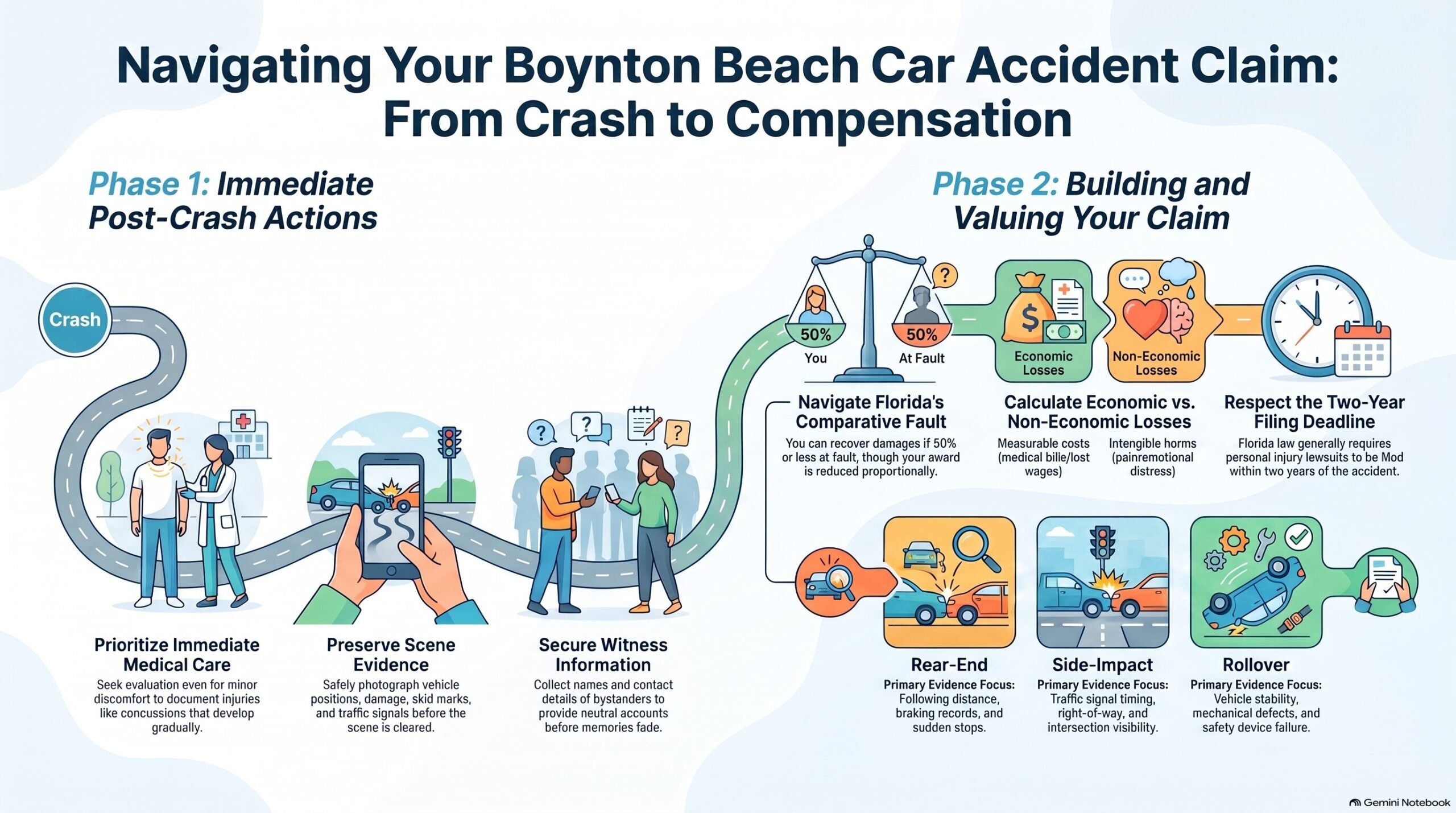


How We Can Help With Your Boynton Beach Car Accident Collision Types Injury Claim
A Boynton Beach car accident lawyer can help identify the type of collision, establish liability, and pursue compensation for injuries and related losses. Legal assistance may include preserving photographs, reports, medical records, witness accounts, and other evidence needed to present a clear claim. Counsel can communicate with insurers, evaluate coverage, and develop strategies for insurance denials when a carrier disputes responsibility or minimizes damages.
A lawyer may also assess Florida Negligence Defenses raised by opposing parties, including comparative fault allegations, and respond with evidence addressing each contention. Effective representation requires careful preparation rather than pressure. Settlement Negotiation Tips may include calculating past and anticipated losses, documenting treatment, and evaluating proposed releases before acceptance. Demand letter basics generally include a factual summary of the collision, a liability analysis, injury documentation, an itemized damages list, and a specific settlement request. Through organized advocacy, the lawyer can help protect a claimant’s interests, support informed decisions, and pursue a fair resolution while respecting the client’s recovery, privacy, and long-term needs.
OUR CONSULTATIONSARE FREE
START YOUR FREE CASE REVIEW

Understanding Boynton Beach Car Accident Collision Types Injury Cases
Understanding the type of collision is an important first step in evaluating a Boynton Beach car accident injury case because the manner of impact often affects liability, the available evidence, and the severity of the resulting harm. Rear-end, side-impact, head-on, and multi-vehicle crashes may produce different injury patterns and require distinct methods of reconstructing events. A careful review considers vehicle positions, damage locations, photographs, witness accounts, medical records, and applicable traffic laws.
Negligence standards guide the evaluation of whether a driver, vehicle owner, or another responsible party failed to exercise reasonable care. The analysis may address speed, following distance, lane use, visibility, and the timing of driver actions without assuming fault solely from the collision format. Under comparative fault rules, an injured person’s recovery may be reduced by a share of responsibility assigned to that person. A thorough case assessment in turn seeks accurate evidence, protects the injured party’s interests, and supports a fair resolution that helps affected individuals and families move forward.
Common Causes of Boynton Beach Car Accident Collision Types
Common causes of Boynton Beach car accident collisions include distracted driving, speeding, reckless driving, and impaired driving. Failure to yield is another frequent contributing factor, particularly at intersections and pedestrian crossings. Identifying the cause of a collision can help clarify liability and support the evaluation of resulting injury claims.
Distracted Driving
When drivers divert their attention from traffic, even briefly, they increase the risk of causing a serious collision in Boynton Beach. Distracted driving may involve texting, dialing, adjusting navigation, eating, grooming, or reaching for items inside a vehicle. Phone use remains a significant concern because visual, manual, and mental distractions can occur simultaneously, reducing a driver’s ability to recognize hazards and respond appropriately. Passenger conversations and outside activity may also draw attention away from surrounding traffic. Effective distraction awareness encourages drivers to secure devices, complete necessary adjustments before moving, and stop safely when an urgent task arises. Understanding these behaviors can help injured individuals, families, and community advocates identify contributing factors after a crash. Careful documentation, witness accounts, and available electronic evidence may help clarify responsibility and support those affected.
Speeding And Reckless Driving
Speeding and reckless driving can turn an otherwise manageable traffic situation into a severe collision in Boynton Beach. Excessive speed reduces reaction time, increases stopping distance, and magnifies the force transferred during impact. Aggressive lane changes, tailgating, sudden passing, and driving against traffic further endanger motorists, passengers, cyclists, and pedestrians. Road rage incidents may intensify these behaviors when drivers respond to perceived slights with intimidation or deliberate pursuit. Traffic signal violations, including running red lights or ignoring stop signs, create especially dangerous crossing movements and often cause side-impact crashes. Evidence such as traffic-camera footage, vehicle damage, witness accounts, and event data may help establish how speed or unsafe conduct contributed. A careful review can support injured individuals seeking accountability and assistance after a collision.
Impaired Driving
Impaired driving is a significant cause of Boynton Beach car accidents because alcohol, prescription medications, illegal drugs, and other substances can diminish judgment, coordination, vision, and reaction time. Drivers affected by these substances may misjudge distances, drift across lanes, overlook traffic signals, or respond too slowly to changing roadway conditions. Law enforcement officers may investigate suspected impairment through observations, Field sobriety tests, and chemical testing. A DUI blood alcohol measurement can provide evidence of alcohol concentration, while drug-related investigations may involve blood or urine analysis. These cases can result in serious injuries, property damage, and complex legal questions regarding liability and compensation. Community members can help reduce harm by arranging sober transportation, preventing impaired individuals from driving, and reporting immediate dangers to appropriate authorities. Victims may seek guidance regarding available legal protections.
Failure To Yield
Failure to yield is a common cause of car accidents in Boynton Beach, particularly at intersections, traffic circles, crosswalks, and merging areas. Drivers may enter another vehicle’s path without confirming that traffic conditions permit safe movement. These incidents often involve turning vehicles, lane changes, pedestrians, or cyclists who possess the legal right of way. Traffic signal violations, including running red lights or ignoring protected turn signals, can further increase the risk of collisions. Confusion about roadway markings and right-of-way disputes may also contribute, especially where multiple lanes converge. A driver’s failure to yield can cause side-impact crashes, pedestrian injuries, and chain-reaction collisions. Careful attention, proper signaling, and patience help protect all road users. Individuals injured in these accidents may benefit from prompt medical care, evidence preservation, and informed legal guidance.


Legal Rights of Boynton Beach Car Accident Collision Types Injury Victims
When a car accident in Boynton Beach causes injuries, victims may have legal rights to seek compensation from a negligent driver or other responsible party. Those rights can include payment for medical treatment, lost income, property damage, and documented pain-related losses.
Florida’s comparative fault rules may reduce recovery when an injured person shares responsibility, making the determination of fault percentages an important part of a claim.
- A police report, photographs, witness statements, and medical records can form a clear factual path from the collision to the injury.
- An attorney may evaluate insurance coverage, preserve evidence, and pursue a fair settlement or court remedy.
- Careful documentation supports recovering damages estimates that reflect both current expenses and reasonably anticipated needs.
Victims should avoid signing broad releases or providing recorded statements before understanding their legal position. Prompt consultation with a qualified Boynton Beach car accident lawyer can help protect deadlines, clarify available remedies, and support informed decisions while the injured person focuses on recovery and family responsibilities.
Don’t Wait. Call Our Florida Personal Injury Lawyers Now!
Why Do Boynton Beach Car Accident Collision Types Injuries Happen?
Understanding why different collision types cause injuries helps clarify how negligence, vehicle dynamics, and roadway conditions may contribute to a claim. Rear-end crashes can produce whiplash when a vehicle is struck suddenly, while head-on collisions generate severe forces that may affect multiple body regions. Side-impact crashes are especially dangerous because doors and limited side structure provide less protection. Rollover events can cause injuries when occupants are thrown against the interior or ejected.
Common contributing factors include distracted driving, speeding, impaired operation, unsafe lane changes, and failure to yield. Road Rage may lead to aggressive maneuvering, tailgating, or intentional contact, increasing crash severity. Poor lighting, standing water, defective signs, and uneven pavement can also reduce a driver’s ability to avoid a collision. Vehicle Defects, including failed brakes, defective tires, or malfunctioning airbags, may create hazards independent of driver conduct. Understanding these causes helps clarify how responsibility and resulting harm may be evaluated for injured individuals.
What Should You Do After a Boynton Beach Car Accident Collision Types Injury?
After a car accident in Boynton Beach, the individual should seek immediate medical care, even if symptoms initially appear minor. The crash scene should be documented through photographs, witness information, police records, and medical documentation. Contacting a car accident lawyer can help protect legal rights and assess potential compensation.
Seek Immediate Medical Care
Seeking immediate medical care should be a priority after a Boynton Beach car accident, even if the injured person believes the collision caused only minor discomfort. Some conditions, including concussions, internal bleeding, and soft-tissue injuries, may develop gradually and require prompt evaluation. A healthcare provider can identify potential harm, recommend treatment, and create records connecting symptoms to the collision. Emergency room documentation may also help explain the injury’s timing, severity, and necessary care. The injured person should follow all medical instructions, attend scheduled appointments, and report changes in symptoms without delay. To protect recovery and maintain clear communication, injured individuals should avoid speaking with insurers before receiving legal guidance, particularly when questions involve fault or medical history. Prompt care supports the injured person and helps family members coordinate appropriate assistance.
Document The Crash Scene
When conditions permit, documenting the crash scene can preserve important evidence concerning how a Boynton Beach collision occurred and the injuries it caused. Safety remains paramount, so an injured person should not enter traffic or delay emergency treatment to collect information. A Scene safety checklist may include moving to a protected location, activating hazard lights, and requesting medical or police assistance. From a safe position, individuals can photograph vehicle positions, roadway conditions, traffic signals, visible damage, debris, skid marks, and relevant signs. Witness names and contact information should be recorded, along with the other driver’s insurance and identifying details. A necessary document checklist should include the incident report number, medical records, photographs, and written observations made promptly after the collision. Accurate documentation can support those assisting injured individuals.
Contact A Car Accident Lawyer
Prompt legal guidance can help preserve a claim once medical needs are addressed and the crash scene has been documented. A Boynton Beach car accident lawyer can evaluate collision circumstances, identify potentially responsible parties, and explain available remedies without disrupting medical recovery. An emergency consultation may be appropriate when injuries are severe, insurance representatives request statements, or liability is disputed. The injured person should provide photographs, medical records, witness information, and insurance correspondence for review. Legal guidance can also help protect the individual from recorded statements or settlement offers that undervalue long-term treatment needs. A lawyer may coordinate with medical providers, investigators, and insurers while the client focuses on recovering and supporting family responsibilities. Prompt representation can preserve evidence, clarify deadlines, and promote a fair, orderly resolution.
Critical Evidence in a Boynton Beach Car Accident Collision Types Injury Case
Critical evidence can clarify how a Boynton Beach collision occurred and document the resulting injuries.
Key materials include:
- Crash-scene photographs and police accident reports;
- Medical treatment records; and
- Witness contact information.
Together, these records may help establish liability, the nature of the injuries, and the damages involved.
Crash Scene Photos
How can crash scene photographs clarify what occurred in a Boynton Beach car accident? Images may preserve the vehicles’ final positions, impact points, roadway markings, debris patterns, and visible property damage before conditions change. They can help illustrate whether a collision involved a rear impact, side impact, lane departure, or another event, while supporting careful reconstruction of the sequence. Photographs of intersections may also document Traffic signal evidence, including signal placement, visibility, obstructions, and relevant signs. Close images of skid marks, tire tracks, lighting, weather conditions, and surface defects can provide additional context. When appropriate, prompt documentation supports the preservation of witness statements by helping witnesses accurately identify locations and physical details. A person assisting an injured individual should photograph safely, avoid disturbing evidence, and protect privacy while maintaining original files and timestamps.
Police Accident Reports
Police accident reports can provide an important record of the circumstances surrounding a Boynton Beach car accident, including the reported collision type, roadway conditions, the vehicles involved, apparent injuries, and statements made at the scene. Officers may document traffic-control devices, vehicle positions, damage, weather conditions, and witness accounts to help establish crash-scene timelines. The report may also identify Florida traffic citations issued after the collision, although a citation does not automatically determine civil liability. Because reports can contain observations, diagrams, and recorded statements, they may help evaluate disputed facts and explain how the impact occurred. An attorney can review the document for omissions, inconsistencies, or evidence requiring clarification through additional investigation. Promptly obtaining the report may preserve information that supports a careful, service-oriented assessment of the injured person’s legal options.
Medical Treatment Records
Medical treatment records can establish the nature, extent, and progression of injuries sustained in a Boynton Beach car accident. Emergency department notes, diagnostic imaging, physician evaluations, and therapy records may help link reported symptoms to the collision and document the necessary care. Consistent treatment plan documentation can show that an injured person followed medical recommendations, attended appointments, and required continuing services. These records may also identify limitations, prescribed medications, procedures, and anticipated recovery periods, helping to evaluate damages more accurately. Prompt medical attention supports reliable evidence, while gaps in care may create questions about injury severity or causation. Records should be gathered systematically and preserved securely for review. They can clarify Insurance claim timelines, support settlement discussions, and assist legal professionals in presenting a complete, well-supported injury claim.
Witness Contact Information
Witness contact information can preserve independent accounts of a Boynton Beach car accident and clarify disputed facts concerning vehicle movements, traffic signals, road conditions, and the sequence of events. Prompt witness identification may help preserve names, telephone numbers, email addresses, and observations before memories fade. A person who witnessed the collision should be asked for contact details without coaching or pressuring them. Investigators may later obtain a written or recorded statement of claims, subject to applicable legal and insurance procedures. Witnesses can also identify photographs, surveillance footage, or other evidence supporting an accurate reconstruction. Preserving neutral testimony benefits injured individuals, insurers, courts, and communities by promoting accountability over speculation. Accident reports may contain witness information, but independent verification remains valuable when records are incomplete, inconsistent, or unavailable.
Long-Term Effects of Boynton Beach Car Accident Collision Types Injuries
Long-term injuries from Boynton Beach car collisions may cause chronic pain conditions that persist well beyond initial treatment. Ongoing mobility challenges can limit work, household responsibilities, and daily independence. These physical effects may also create substantial emotional and financial strain for injured individuals and their families.
Chronic Pain Conditions
After a Boynton Beach car accident, some injuries can develop into chronic pain conditions that persist well beyond the initial recovery period. Whiplash, nerve irritation, spinal damage, and soft-tissue trauma may produce recurring discomfort, burning sensations, or heightened sensitivity. These symptoms can interfere with sleep, concentration, employment, and ordinary responsibilities, creating lasting burdens for injured individuals and their families. Effective pain management may involve medical evaluations, physical therapy, prescription medication, counseling, or coordinated care from multiple experts. Treatment plans should be documented carefully because chronic symptoms may fluctuate and require continuing adjustments. Medication side effects can include fatigue, nausea, impaired concentration, or dependence concerns, making professional supervision indispensable. Medical records, treatment expenses, and pain journals can help demonstrate the condition’s duration, severity, and impact when seeking legal support.
Ongoing Mobility Challenges
Ongoing mobility challenges can arise when a Boynton Beach car accident causes lasting damage to the spine, joints, muscles, or nerves. Survivors may experience restricted movement, weakness, impaired balance, or difficulty standing and walking for extended periods. These limitations can affect vital activities, including bathing, dressing, driving, and returning to work. Some individuals require canes, walkers, braces, or modified vehicles, while others need continuing physical or occupational therapy to preserve function. Treatment may involve orthopedic care, neurological evaluation, rehabilitation exercises, and periodic reassessment as symptoms change. Mobility limitations can also increase vulnerability near traffic areas, making Bike Lane Safety and Pedestrian Crosswalks important considerations for safe community access. Caregivers and service providers may assist with transportation, home modifications, and coordinated medical appointments while rehabilitation experts work to support the highest practical level of independence.
Emotional and Financial Strain
Emotional and financial strain frequently develops when injuries from a Boynton Beach car accident collision type continue to affect daily life, employment, and personal independence. Persistent pain, limited mobility, and disrupted routines may contribute to Traumatic stress, anxiety, depression, or sleep difficulties. These conditions can impair relationships and make rehabilitation more difficult, particularly when injured individuals must rely on family members for transportation, household tasks, or personal care.
Financial pressure may increase as treatment continues. Hospital charges, therapy expenses, prescription costs, and reduced income can create obligations that exceed available resources. Careful documentation of medical needs, missed work, and continuing limitations can help clarify the injury’s long-term impact. Legal guidance may also help families pursue relief from medical bills and other compensation while protecting access to appropriate care. Supportive services can assist recovery and preserve dignity.
Proving Liability in Boynton Beach Car Accident Collision Types Injury Cases
In Boynton Beach car accident injury cases, proving liability requires establishing that another driver or responsible party caused the collision through negligence, a traffic violation, or another wrongful act. Evidence may include photographs, vehicle damage records, traffic-camera footage, witness statements, police reports, and medical records connecting the injuries to the crash. A careful review of roadway conditions, vehicle maintenance, and driver conduct can reveal contributing factors involving a motorist, an employer, a manufacturer, or a property owner. Florida’s comparative negligence rules also make accurate allocation of responsibility important when more than one party contributed to the incident. Counsel may organize evidence, interview witnesses, consult accident-reconstruction professionals, and identify inconsistencies in opposing accounts. Documentation should support both liability and the claimed losses, including treatment expenses, lost income, continuing care, and non-economic harm. A precise damages calculation relies on complete medical records, employment information, receipts, and insurance documentation. Timely preservation of evidence helps protect injured individuals and supports a fair resolution.
Dealing With Insurance Companies After a Boynton Beach Car Accident: Collision Types and Injury
After a Boynton Beach car accident, insurance companies may request statements, medical records, photographs, and other information while evaluating coverage and fault. Injured individuals should provide accurate, consistent information while avoiding speculation, admissions, or recorded statements that could be taken out of context. An insurer may assign an adjuster whose responsibility is to protect the company’s financial interests, not necessarily to identify every available benefit. Legal guidance can help preserve evidence, communicate documented injuries, and address requests without compromising the claim. Effective Negotiation Tactics may include presenting organized medical documentation, repair estimates, wage records, and evidence connecting the collision to the injury. Insurers may make early settlement offers before the full medical impact is known, requiring careful evaluation rather than immediate acceptance. Claim Denials should be reviewed for stated reasons, policy language, and supporting evidence. A representative may challenge unsupported conclusions and seek fair treatment while maintaining professionalism, accuracy, and respect for all involved parties.
Don’t Wait. Call Our Florida Personal Injury Lawyers Now!
What to Expect During a Boynton Beach Car Accident Collision Types Injury Claim Process
A Boynton Beach car accident injury claim typically begins with promptly reporting the collision and documenting the circumstances. The claimant then gathers medical evidence linking the injuries to the accident while insurers evaluate liability and damages during negotiations. If a fair settlement is not reached, pursuing legal compensation through formal legal action may become necessary.
Reporting the Collision
Promptly reporting a collision to law enforcement is a vital first step in the Boynton Beach car accident injury claim process. Officers can secure the scene, document apparent conditions, identify involved parties, and prepare an official report. Individuals should provide accurate facts without speculating about fault, minimizing injuries, or altering details. Police Documentation Tips include requesting the report number, recording the responding agency, and preserving photographs of vehicles, traffic controls, and roadway conditions. Witness Statement Scripts can help individuals ask witnesses for names, contact information, and neutral descriptions of what they observed. The Crash Reporting Checklist should include driver information, insurance details, location, time, damage, and officer information. Understanding Insurance Claim Basics also helps prevent premature statements or unsupported conclusions when notifying insurers promptly.
Gathering Medical Evidence
Because medical records establish the nature, timing, and extent of collision-related injuries, gathering this evidence is a central part of the Boynton Beach car accident injury claim process. The injured person should obtain emergency department records, diagnostic images, physician notes, prescriptions, therapy reports, and billing statements. A documentation checklist can help track appointments, symptoms, limitations, and recommended treatment without omissions.
Prompt medical attention also supports evidence preservation by connecting conditions to the crash and recording changes over time. Providers should receive accurate information about symptoms, prior conditions, and how the collision occurred. A post-crash witness may describe visible distress or requests for medical assistance, but clinical records generally provide the primary proof of injury. This organized evidence permits an informed evaluation before any insurer negotiations begin and helps protect the claimant’s ability to meet legitimate needs responsibly.
Negotiating With Insurers
Once medical evidence is organized, negotiations with the insurer typically begin with a review of liability, documented injuries, treatment, and related losses. The adjuster may request statements, records, photographs, employment information, and other documentation before evaluating the claim. Claim valuation strategies generally compare medical expenses, lost income, continuing care needs, pain-related effects, and available insurance coverage. Insurer settlement tactics can include emphasizing disputed fault, questioning treatment, delaying responses, or presenting an early offer before the full impact of an injury is known. A careful review helps identify missing evidence and prevents premature conclusions about claim value. Communications should remain accurate, consistent, and respectful, particularly when the process affects an injured person and family. Negotiations may involve written demands, supporting records, and reasoned responses as each side evaluates the documented losses and applicable policy terms.
Pursuing Legal Compensation
Pursuing legal compensation in a Boynton Beach car accident injury claim generally involves establishing liability, documenting the full extent of damages, and presenting the claim within applicable deadlines. The process may begin with gathering witness statements, obtaining crash reports, preserving photographs, and reviewing medical records. An attorney may analyze collision dynamics, insurance coverage, and comparative fault before sending an evidence-supported demand. Damages can include medical expenses, lost income, property damage, pain, and reduced quality of life. Proving future damages often requires testimony from physicians, economists, or vocational experts who can explain anticipated treatment, earning losses, and lasting limitations. If negotiations do not produce a fair resolution, the injured person may pursue litigation. Throughout the claim, careful communication and organized documentation can support accountability and help protect the claimant’s legal interests.
Compensation for Boynton Beach Car Accident Collision Types Injury Damages
Compensation for a Boynton Beach car accident depends on the collision type, the severity of resulting injuries, and the losses supported by available evidence. A careful claim may address medical treatment, ongoing care, property damage, and other accident-related needs, supported by records, receipts, and professional evaluations. Rear-end crashes, intersection collisions, sideswipes, and rollovers can create different proof requirements because fault may involve following distance, traffic signals, lane changes, or vehicle control.
Insurance companies may question causation, minimize the severity of injuries, or cite policy exclusions. Understanding common Insurance denial reasons helps identify missing documentation, disputed liability, late notice, or alleged preexisting conditions. Prompt reporting and consistent medical care can strengthen a claim’s presentation. Rental reimbursement disputes may also arise when insurers challenge the duration of repairs, the necessity of the vehicle, or the rental rates. A qualified Boynton Beach car accident lawyer can communicate with insurers, preserve evidence, and pursue fair resolution while helping injured individuals and families protect their recovery interests through each stage of the process.
Economic vs Non-Economic Damages in Boynton Beach Car Accident Collision Types Cases
Economic damages may include medical expenses, lost income, property damage, and other measurable financial losses resulting from a collision. Non-economic damages address less tangible harms, such as pain, emotional distress, and diminished quality of life, which require careful valuation. Calculating total compensation involves evaluating both categories alongside the severity of injuries, available evidence, and the circumstances of the accident.
Economic Damages Explained
When a Boynton Beach car accident causes measurable financial losses, those losses may qualify as economic damages in a personal injury claim. These damages commonly include emergency treatment, hospital care, prescription medication, follow-up appointments, and other reasonable medical expenses. Medical bill proof, such as itemized statements, receipts, and insurance records, can help establish the amount incurred and connect treatment to the collision. Economic damages may also cover anticipated medical care when qualified professionals document a need for continued treatment. If injuries limit employment, a claim may include lost wages, reduced earning capacity, and costs associated with vocational rehab services. Property repair or replacement expenses may also qualify. Accurate records, employment documentation, and professional assessments help provide a complete and reliable calculation of the injured person’s financial losses.
Non-Economic Damages Valued
Although non-economic damages do not have fixed receipts or invoices, they may represent a substantial part of a Boynton Beach car accident claim. These damages can include pain, emotional distress, reduced enjoyment of life, inconvenience, and lasting limitations resulting from collision injuries. Their value depends on credible evidence, including medical opinions, treatment records, personal journals, and testimony from relatives or coworkers who observe changes in daily functioning. Future medical documentation may help establish whether discomfort, impairment, or psychological effects are expected to continue. Insurance settlement strategies should present these consequences clearly while recognizing that adjusters may challenge subjective claims or minimize permanent effects. A careful evaluation considers consistency between reported symptoms, clinical findings, treatment history, and the injured person’s responsibilities, relationships, and ordinary activities without treating human suffering as a purely financial calculation.
Calculating Collision Compensation
Calculating collision compensation in a Boynton Beach car accident case requires separating economic damages from non-economic damages while evaluating how each category relates to the collision’s circumstances and resulting injuries. Economic damages may include emergency care, ongoing medical treatment, rehabilitation, prescription costs, lost income, diminished earning capacity, property damage, and necessary household assistance. Medical documentation and treatment timelines help establish which expenses arose from the collision and whether care was reasonably necessary. Non-economic damages address pain, emotional distress, inconvenience, disfigurement, disability, and reduced enjoyment of life. Their value depends on injury severity, recovery duration, lasting limitations, and the collision’s effect on daily responsibilities. A careful evaluation also considers insurance coverage, comparative fault, and available evidence, enabling counsel to pursue compensation that supports the injured person’s recovery and future needs.
When a Boynton Beach Car Accident Collision Types Injury Case Goes to Trial vs Settlement
A Boynton Beach car accident injury case may proceed to trial or resolve through settlement depending on liability, the severity of the injuries, the available insurance coverage, and the strength of the supporting evidence. Settlement discussions can provide an efficient resolution, allowing an injured person to obtain compensation without the uncertainty, expense, and time associated with courtroom proceedings. Negotiations may continue as medical treatment develops and damages become clearer.
A trial becomes more likely when the parties dispute fault, the severity of injuries, or the value of losses. Medical documentation timelines can demonstrate how symptoms developed, what treatments were provided, and whether ongoing care is reasonably necessary. Witness statements, photographs, employment records, and expert opinions may also support the claim.
Counsel typically evaluates settlement offers against projected needs and litigation risks. A careful trial preparation strategy includes organizing evidence, preparing witnesses, reviewing testimony, and clearly presenting damages. The decision should reflect the injured person’s interests, practical circumstances, and need for dependable support while pursuing a fair outcome.
Florida Laws That May Affect Your Boynton Beach Car Accident Collision Types Case
Florida law may affect a Boynton Beach car accident case through rules governing negligence, comparative fault, insurance coverage, and the time limits for pursuing a claim. These rules can influence responsibility, available compensation, and the evidence needed to support an injured person’s interests.
- Fault comparison laws may reduce damages when an injured party contributed to the collision, making accurate scene documentation, witness accounts, and medical records important.
- Florida’s no-fault system generally requires an injured driver to seek initial benefits through personal injury protection coverage, subject to policy terms and statutory requirements.
- Liability claims may depend on insurance coverage limits, bodily injury evidence, vehicle damage, and proof that another driver’s conduct caused legally recognized harm.
A careful review can help identify responsible parties, applicable policies, and potential defenses. Counsel serving accident victims may also evaluate uninsured or underinsured motorist coverage and whether serious injuries meet the requirements to pursue damages beyond personal injury protection. Each case requires individualized analysis because roadway conditions, driver conduct, medical findings, and policy language can materially affect the outcome.
The Statute of Limitations for Boynton Beach Car Accident Collision Types Injury Cases
The time available to pursue a Boynton Beach car accident injury claim depends on Florida’s statute of limitations and the circumstances surrounding the collision. In many personal injury cases, Florida law generally allows 2 years from the date of the accident to file a lawsuit. Wrongful death claims typically must be filed within two years of the death, while certain claims involving government entities may require shorter notice periods.
Missing the applicable deadline can permanently bar recovery, regardless of injury severity or insurance coverage. Accident victims should promptly identify the filing deadline, preserve medical and collision records, and avoid assuming that settlement discussions extend the limitations period. Comparative negligence may affect the amount recoverable, but it generally does not extend the deadline for filing injury claims. Special rules may apply when an injured person is a minor, an injury is discovered later, or another legal exception exists. Accurate timeline assessment is therefore critical to protecting available legal rights.
Don’t Wait. Call Our Florida Personal Injury Lawyers Now!
How a Boynton Beach Car Accident Collision Types Lawyer Can Help You
After a Boynton Beach car accident, legal counsel can help an injured person evaluate liability, identify applicable insurance coverage, and preserve evidence before pivotal deadlines expire. A lawyer can organize medical records, photographs, witness accounts, vehicle data, and other documentation into a clear account of the collision. This support allows an injured person to serve family members, coworkers, and the broader community while focusing on recovery.
- Liability review: Counsel may compare traffic laws, statements, physical evidence, and available reports to determine how responsibility should be presented.
- Damages calculation: An attorney can assess medical costs, lost income, rehabilitation needs, property damage, and future effects without overlooking less visible losses.
- Insurance strategy: Legal guidance can address policy limits, exclusions, multiple insurers, and communications that might affect a potential claim.
Counsel can also prepare persuasive demands, respond to disputed facts, and pursue fair resolution through negotiation or litigation. The lawyer’s role is to protect the injured person’s interests through informed decisions and disciplined case preparation.
When to Contact a Boynton Beach Car Accident Collision Types Lawyer
Prompt legal guidance can be important as soon as a Boynton Beach car accident causes injury, property damage, disputed facts, or uncertainty about insurance coverage. A collision types lawyer may be contacted promptly when medical treatment is required, a driver leaves the scene, multiple vehicles are involved, or liability appears contested. Early assistance can help preserve relevant records, identify reporting deadlines, and organize communications while evidence remains available.
Legal contact is also appropriate after an insurer requests a recorded statement, presents a settlement, denies coverage, or assigns fault without a clear explanation. An attorney can conduct an Insurance Report Review, compare the report with photographs and witness accounts, and identify factual inconsistencies that may require correction. Individuals who are helping injured relatives or community members may seek guidance before signing documents or accepting payment. In urgent circumstances, Emergency Legal Steps may include documenting injuries, protecting damaged property, and directing all insurance communications through appropriate channels. Prompt consultation supports informed decisions without unnecessary delay.
Why You Need an Experienced Boynton Beach Car Accident Collision Types Lawyer
An experienced Boynton Beach car accident collision types lawyer can evaluate how the specific manner of a crash affects liability, available insurance coverage, and potential damages. Different collisions, including rear-end, sideswipe, head-on, and intersection crashes, may require distinct evidence and legal analysis.
Counsel can identify contributing conduct, assess roadway and vehicle conditions, and determine whether another driver, employer, manufacturer, or property owner may share responsibility. Applying Florida negligence standards requires careful examination of duty, breach, causation, and documented losses. An attorney can also coordinate Witness testimony preservation before memories fade, securing statements that clarify traffic signals, vehicle movements, visibility, and driver behavior.
Experienced legal guidance helps protect injured individuals from premature settlements that fail to account for medical treatment, lost income, future care, and non-economic harm. It also supports families and community members seeking accountability through orderly, ethical advocacy. By managing insurer communications and evidence development, counsel allows the injured person to focus on recovery while the claim receives informed attention.
How to Choose the Right Boynton Beach Car Accident Collision Types Lawyer for Your Case
Selecting the right Boynton Beach car accident collision types lawyer requires more than reviewing general experience or advertising claims. A careful evaluation should consider whether the attorney regularly handles the specific collision involved, including rear-end crashes, intersection impacts, sideswipes, or multi-vehicle incidents. Relevant knowledge can improve investigation, evidence preservation, and communication with insurers.
Client communication is another important consideration. The prospective lawyer should explain case developments clearly, respond within reasonable timeframes, and identify who will handle routine questions. During an initial consultation, the injured person can ask how evidence will be gathered, what challenges may arise, and which outcomes are realistically available.
Fee transparency also deserves close attention. The representation agreement should describe contingency percentages, case expenses, and any payment obligations if recovery is unsuccessful. Reviews, professional standing, and references may provide additional perspective, but they should supplement, not replace, direct questions about strategy, accessibility, and commitment to protecting the client’s interests throughout the legal process.
About The Law Offices of Anidjar & Levine
The Law Offices of Anidjar & Levine represents individuals injured in Boynton Beach car accidents, including collisions involving rear-end impacts, intersections, sideswipes, and multiple vehicles.
The firm evaluates the circumstances surrounding each crash, including reported injuries, vehicle damage, available insurance coverage, and potential liability.
Its attorneys may assist with evidence collection, communication with insurers, medical documentation, and negotiations involving compensation for eligible losses.
A Client First legal strategy emphasizes clear communication, informed decision-making, and attention to each person’s recovery needs.
Rather than applying a uniform approach, the legal team reviews the facts of the collision and develops a response suited to the client’s circumstances.
Representation may address medical expenses, lost income, property damage, and other legally recognized harm.
The firm offers free case evaluation consultations, allowing injured individuals to discuss their concerns and potential legal options without an initial consultation fee.
Prospective clients can learn about applicable deadlines, required documentation, and potential next steps as they decide whether legal representation aligns with their interests.
Frequently Asked Questions
Can I Recover Damages if I Was Partially at Fault for the Collision?
A partially at-fault driver may still recover damages, depending on Florida’s modified comparative negligence rules. Comparative negligence impacts the amount awarded by assigning each party a percentage of responsibility. If the injured person is 50 percent or less at fault, recovery may be reduced by that percentage; exceeding 50 percent generally bars recovery. Evidence, insurance coverage, medical records, and settlement negotiations can affect the final settlement value reduction. Legal evaluation helps protect an injured person’s rights.
What Collision Types Commonly Involve Uninsured or Underinsured Drivers?
Uninsured or underinsured drivers commonly appear in rear-end collisions, intersection crashes, and multi-vehicle pileups, where fault may be disputed and coverage may prove inadequate. Hit-and-run issues frequently involve uninsured motorists because the responsible driver leaves before identification or insurance information can be obtained. Commercial Trucking crashes also pose substantial risk, particularly when trucking companies or drivers carry insufficient coverage for severe injuries, property damage, and long-term losses.
How Do Weather and Road Conditions Affect Collision Investigations?
Weather and road conditions can materially affect collision investigations by changing visibility, traction, braking distance, and driver response. Investigators assess rainfall, standing water, fog, lighting, debris, pavement defects, and temporary hazards at the relevant time. Safety skidmarks may be shortened, obscured, or replaced by tire tracks in wet conditions, requiring careful interpretation. Visibility documentation, including photographs, weather records, and witness accounts, helps establish whether environmental factors contributed to the collision and informs fair assessments of responsibility.
Can Passengers File Separate Claims After a Boynton Beach Car Accident?
Passengers may file separate insurance claims after a Boynton Beach accident, even when they were riding in the same vehicle. Passenger eligibility generally depends on injury evidence, applicable coverage, and the parties’ respective liability. A passenger may pursue benefits under the driver’s policy, personal coverage, or another responsible motorist’s insurance. Prompt medical evaluation, documented losses, and timely notice help protect separate insurance claims. Legal guidance can clarify competing coverage and deadlines.
What Happens if the At-Fault Driver Leaves Florida After the Crash?
If the at-fault driver leaves Florida after a crash, a claim may still proceed through insurance, service of legal papers, and, when necessary, interstate enforcement procedures. The injured party should promptly pursue the preservation of evidence, including photographs, medical records, witness information, and vehicle data. A police report review can clarify fault, identify coverage, and document the driver’s departure. Legal counsel may coordinate service, negotiations, and litigation across state lines.
—————————
Car accident collisions in Boynton Beach can result in serious injuries, financial losses, and complex insurance disputes.
Victims may benefit from prompt medical attention, thorough documentation, and guidance from a qualified Boynton Beach Personal Injury Lawyer when pursuing compensation.
The Law Offices of Anidjar and Levine can evaluate the circumstances, identify potentially responsible parties, and explain available legal options.
Their experience may help protect an injured person’s rights while developing a well-supported claim for medical expenses, lost income, property damage, and other recoverable losses.

