

The Law Offices of Anidjar and Levine helps injured individuals identify every potentially responsible driver, vehicle owner, employer, manufacturer, insurer, or property entity after a car accident. Counsel investigates duty, negligence, causation, comparative fault, and available coverage using collision reports, photographs, witness accounts, vehicle data, medical records, and financial documentation. The firm also addresses medical expenses, lost income, pain, long-term limitations, insurance negotiations, and Florida filing deadlines. For guidance regarding liability disputes and damages, visit the Boynton Beach Personal Injury Lawyer.
Main Takeaways
- A Boynton Beach car accident lawyer can identify all potentially at-fault parties, including drivers, vehicle owners, employers, manufacturers, and property-related entities.
- Liability depends on each party’s duty, conduct, causation, and contribution to your injuries—not solely on the police report or injury severity.
- Evidence may include collision reports, photographs, witness statements, vehicle data, surveillance footage, medical records, and insurance documents.
- Florida’s comparative fault rules may reduce compensation if your actions contributed to the collision or resulting damages.
- An attorney can evaluate insurance coverage, calculate medical and financial losses, communicate with insurers, and protect applicable filing deadlines.


How We Can Help With Your Boynton Beach Car Accident At-Fault Parties Injury Claim
When a car accident in Boynton Beach results in injuries, determining which parties may be legally responsible is often essential to pursuing compensation. A legal team can help injured individuals organize medical records, employment documentation, photographs, witness information, and other evidence supporting an injury claim. Counsel may also communicate with insurers, evaluate settlement proposals, and explain how available coverage could affect recovery.
Because Insurance claim deadlines can influence negotiations and documentation, prompt attention may protect a person’s ability to pursue benefits. Attorneys can identify applicable Florida injury timelines, calculate potential damages, and prepare required filings before important deadlines expire. They may also coordinate with medical providers and help clients understand treatment-related decisions without interfering with care.
Through careful case assessment, legal professionals can clarify procedural options and provide steady guidance during a difficult period. Their assistance may reduce administrative burdens, preserve relevant evidence, and support informed decisions while the injured person focuses on recovery and family responsibilities.
OUR CONSULTATIONSARE FREE
START YOUR FREE CASE REVIEW

Understanding Boynton Beach Car Accident At-Fault Parties Injury Cases
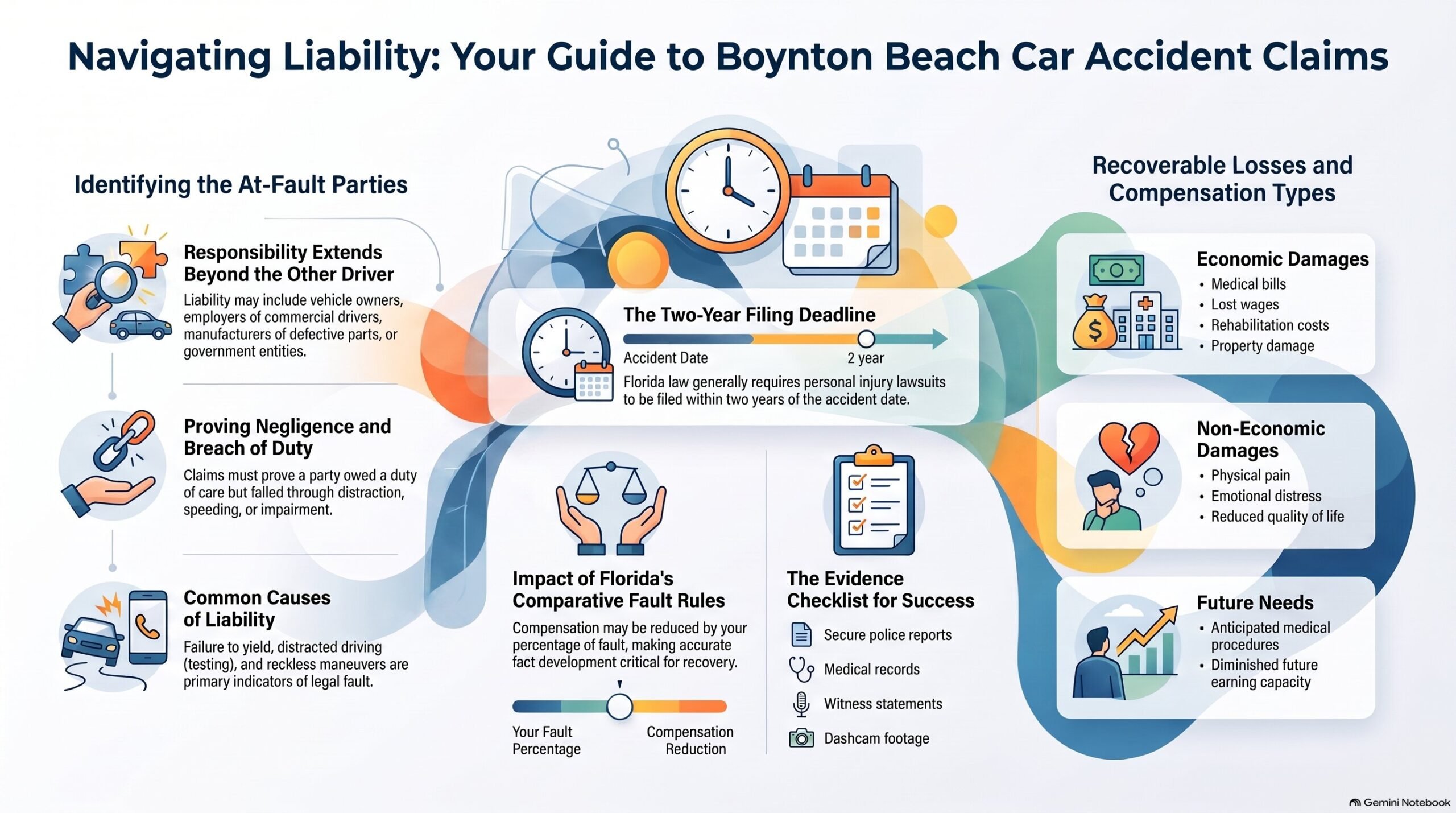
Understanding a Boynton Beach car accident injury case begins with identifying every person or entity whose conduct may have contributed to the collision. Potentially responsible parties can include drivers, vehicle owners, employers, manufacturers, commercial carriers, or property-related entities, depending on the evidence and applicable law. Responsibility is not determined solely by the severity of an injury or a police report. It requires evaluating duties, actions, causation, and resulting damages.
Comparative Fault Basics help explain how an injured person’s own conduct may affect financial recovery. Florida’s current comparative fault framework may reduce compensation when the claimant shares responsibility, making accurate fact development critical. A Claim Evidence Checklist can include photographs, medical records, witness information, collision reports, vehicle data, insurance documents, and employment records. Preserving this material allows counsel to assess liability and damages systematically. A careful review also helps identify overlooked parties and supports a fair, informed presentation of claims for individuals seeking meaningful assistance after serious collisions in Boynton Beach.
Common Causes of Boynton Beach Car Accident At-Fault Parties
Common causes of car accidents in Boynton Beach include distracted driving, speeding, and other reckless driving behaviors. Impaired driving can further compromise judgment, coordination, and reaction time, increasing the likelihood of a collision. Failure to yield is another frequent contributing factor that may help establish which parties bear legal responsibility.
Distracted Driving
Distracted driving is a significant cause of collisions in Boynton Beach, particularly when drivers divert their attention from traffic, road conditions, or nearby vehicles. Common distractions include texting, adjusting navigation systems, eating, grooming, and engaging with passengers. Even hands-free devices can create hands-free texting risks because mental attention remains focused on the conversation rather than immediate roadway conditions. A driver who fails to observe traffic signals, pedestrians, or changing traffic conditions may cause a crash and bear responsibility for any resulting injuries and losses. Florida law restricts texting while driving, and violations may support evidence of negligence depending on the circumstances. Distracted driving penalties can include fines, points, and other consequences, while civil claims may address medical expenses, lost income, and pain. Careful investigation can help identify the responsible party and protect affected individuals.
Speeding And Reckless Driving
Speeding and reckless driving are frequent causes of serious collisions in Boynton Beach, particularly when motorists exceed posted speed limits, weave through traffic, run red lights, or maneuver aggressively around other vehicles. These actions reduce reaction time, increase stopping distances, and intensify the force transferred during impact. Traffic violations include racing, tailgating, unsafe lane changes, passing on shoulders, and disregarding right-of-way rules. Each may help establish negligent or reckless conduct when investigating the cause of an accident. Florida safety standards require drivers to operate vehicles with reasonable care, maintain control, and adjust speed for traffic, weather, and roadway conditions. Attorneys serving injured individuals may examine crash reports, photographs, witness statements, vehicle data, and citations to identify responsible parties. Prompt investigation can preserve evidence, clarify liability, and support fair compensation for affected people and families.
Impaired Driving
Impaired driving is a significant cause of Boynton Beach car accidents, particularly when alcohol, illegal drugs, prescription medication, or other substances diminish a motorist’s judgment and coordination. Affected drivers may misjudge traffic conditions, react slowly, or lose control, creating serious risks for passengers, pedestrians, and other motorists. Determining fault can require reviewing breathalyzer results, toxicology reports, field sobriety evaluations, and video evidence. DUI checkpoints may generate records that help establish whether a driver was impaired before a collision. Police testimony can further describe observed behavior, statements, and testing procedures, although officer credibility may become important if the driver disputes those observations. Families seeking accountability may benefit from promptly preserving medical records, crash reports, witness information, and other evidence. Legal guidance can help clarify available remedies and support affected individuals.
Failure To Yield
Failure to yield is another common cause of car accidents in Boynton Beach, particularly at intersections, crosswalks, roundabouts, and merging lanes. Drivers who disregard traffic signals, stop signs, pedestrian crossings, or established lane priorities may create immediate hazards for others. Intersection negligence can involve turning without allowing approaching vehicles to proceed, entering a roadway prematurely, or failing to recognize a pedestrian’s protected crossing. A right-of-way failure may also occur when motorists merge without checking blind spots or provide insufficient space for vehicles already traveling in a lane. Determining responsibility generally requires reviewing traffic laws, witness statements, surveillance footage, vehicle damage, and driver accounts. A Boynton Beach car accident attorney can help injured individuals understand available legal options and pursue accountability while protecting the interests of those affected by preventable roadway conduct.
Don’t Wait. Call Our Florida Personal Injury Lawyers Now!


Legal Rights of Boynton Beach Car Accident At-Fault Parties Injury Victims
Even when a driver is considered at fault for a Boynton Beach car accident, injured individuals retain important legal rights. Fault does not automatically eliminate access to compensation or fair treatment during the claims process. Victims may pursue guidance from a qualified attorney who can protect their interests and communicate with insurers.
Important legal considerations may include:
- Insurance coverage questions involving liability limits, medical payments, and applicable policies
- Comparative negligence defenses that could reduce, but not necessarily prevent, recovery
- Documentation of medical care, lost income, property damage, and ongoing needs
- Timely negotiation or litigation when an insurer disputes responsibility or damages
An injured person may also obtain medical evaluation, preserve evidence, and avoid recorded statements that could be misread. Legal counsel can assess whether multiple parties share responsibility and identify available sources of recovery. Serving injured individuals requires careful attention to dignity, accurate information, and informed decision-making. Each claim depends on its facts, applicable Florida law, insurance language, and procedural deadlines. Professional advice helps ensure those rights are not overlooked.
Why Do Boynton Beach Car Accident At-Fault Parties Injuries Happen?
Understanding the causes of injuries can help clarify how responsibility is evaluated after a Boynton Beach car accident. Injuries commonly occur when a driver speeds, follows too closely, changes lanes carelessly, drives while distracted, or operates a vehicle under the influence. Failure to yield and disregard for traffic signals can also lead to severe collisions, particularly at busy intersections.
The impact of vehicle defects may further influence how injuries happen and which parties bear responsibility. Defective brakes, tires, airbags, steering components, or seat belts can prevent a driver from avoiding impact or protect occupants during a crash. In such circumstances, manufacturers, repair facilities, or distributors may warrant review alongside the involved motorists.
The role of road conditions is also significant. Poor lighting, inadequate signage, standing water, potholes, uneven pavement, or improperly designed intersections can contribute to a collision. Government entities or contractors may have duties concerning maintenance and warnings. Multiple contributing causes may, as a consequence, require careful, objective evaluation to serve affected individuals fairly.
What Should You Do After a Boynton Beach Car Accident At-Fault Parties Injury?
After an injury, the individual should seek immediate medical care, even when symptoms initially appear minor. The accident scene should be documented through photographs, witness information, police records, and relevant medical documentation. Consulting an injury lawyer can help preserve evidence, assess potential at-fault parties, and protect the individual’s legal rights.
Seek Immediate Medical Care
Prompt medical evaluation is essential after a Boynton Beach car accident, even when an injury appears minor or symptoms have not yet developed. An injured person should request emergency first aid when necessary and follow paramedics’ instructions without delay. If emergency transport is not required, prompt evaluation at an appropriate medical facility can identify concussion symptoms, internal injuries, soft-tissue damage, or other conditions that may worsen. The person should avoid self-treatment, including taking medication or returning to strenuous activities without professional guidance. Medical providers should receive accurate information about symptoms, medical history, and the circumstances of the collision. For insurance claim tips, the injured person should preserve communication records with providers, insurers, and representatives, and retain bills and treatment instructions. Consistent follow-up care supports recovery and documents the injury’s progression.
Document the Accident Scene
Because evidence can change or disappear quickly, an injured person should document the Boynton Beach accident scene as soon as it is safe to do so. Scene safety first means moving away from traffic, avoiding confrontation, and following emergency personnel’s directions. If medical needs permit, the person or a trusted witness can photograph vehicle positions, visible damage, road conditions, traffic controls, skid marks, debris, and relevant surroundings. Images should include wide views and closer details, with the date and location preserved when possible. Names and contact information for witnesses, drivers, and responding officers should be recorded accurately. Evidence preservation tips include saving photographs in their original form, noting weather and lighting conditions, and avoiding repairs or removal of property before documentation. A brief written account should capture the sequence of events while memories remain clear.
Consult an Injury Lawyer
Consulting a personal injury lawyer can help an injured person evaluate potential at-fault parties, preserve evidence, and pursue compensation after a Boynton Beach car accident. An attorney can review crash reports, medical records, photographs, witness statements, and available vehicle or roadway evidence to determine whether another driver, employer, manufacturer, or government entity may share responsibility. Evidence preservation should begin promptly because surveillance footage, electronic vehicle data, and physical conditions may change or disappear. Legal counsel can also explain filing deadlines, applicable insurance coverage, and the consequences of recorded statements or early settlement offers. During insurance negotiations, a lawyer may communicate with adjusters, organize documented losses, and challenge attempts to undervalue the claim. This guidance allows the injured person to protect legal rights while focusing on medical recovery and supporting family responsibilities.
Critical Evidence in a Boynton Beach Car Accident At-Fault Parties Injury Case
Critical evidence can clarify how the crash occurred, identify at-fault parties, and establish the full extent of resulting losses.
Critical sources include:
- Police accident reports
- Photographs and video
- Witness statements
- Medical and financial records
Together, these materials can support liability and strengthen an injured party’s claim.
Police Accident Reports
When a collision occurs, the police accident report may provide important evidence to identify the parties responsible and document the circumstances of the crash. It typically records vehicle positions, roadway conditions, apparent injuries, insurance information, and each driver’s account. The investigating officer may also note witness information, suspected violations, and whether Florida traffic citations were issued. Although the report is not always conclusive proof of fault, it can guide further investigation and help clarify disputed facts. Recording officer statements and obtaining supplemental materials may reveal observations omitted from the initial narrative. Prompt evidence preservation is important because reports, dispatch records, and related agency materials may become more difficult to obtain over time. Counsel may review the report alongside medical records, vehicle damage, and Dashcam footage to identify responsible parties and support an injured person’s claim.
Photographs And Video
Photographs and video can preserve objective evidence in a Boynton Beach car accident at-fault party injury case before vehicles, roadway conditions, and visible injuries change. Images may document vehicle positions, impact points, damage patterns, traffic signals, lane markings, lighting, weather, debris, and relevant property damage. Photographs of bruising or other visible injuries can establish their condition soon after the collision, while later images may show progression or recovery. Dashcam footage can provide a continuous view of events, including vehicle movements leading up to an impact. Nearby businesses, residences, intersections, or traffic systems may have surveillance cameras that recorded useful footage, although recordings can be overwritten quickly. Evidence should be preserved in its original form with dates and source information. A legal professional can help obtain, authenticate, and present these materials while protecting the interests of affected individuals.
Witness Statements
Witness statements can provide important evidence in a Boynton Beach car accident at-fault party’s injury case by describing what occurred before, during, and after the collision. Independent observers may clarify traffic signals, vehicle speeds, lane positions, driver actions, and roadway conditions. Their accounts can help identify responsible parties when physical evidence does not fully explain the crash. Eyewitness credibility depends on the person’s vantage point, attention, ability to perceive events, and relationship to those involved. Investigators may compare each account with photographs, video, and other collision evidence. Statement inconsistencies do not automatically disprove a witness’s observations, because stress and limited viewing angles can affect recollection. However, substantial contradictions may require careful examination. Promptly documenting contact information and preserving original statements can help ensure that relevant witnesses remain available to assist a fair determination of responsibility.
Medical And Financial Records
Medical and financial records provide essential evidence in a Boynton Beach car accident at-fault party’s injury case by documenting the nature of the injuries, treatment received, and financial losses incurred. Physicians’ notes, diagnostic images, prescriptions, and therapy records establish objective evidence linking medical conditions to the collision. Billing statements and employment documentation can demonstrate treatment costs, lost wages, reduced earning capacity, and related expenses. Complete, consistent records may help prevent an insurance denial based on alleged gaps in treatment or unsupported claims. An independent medical evaluation may address disputes concerning causation, severity, or future care requirements. Financial documentation also assists counsel in payout negotiations by providing a defensible calculation of economic damages. Preserving these materials promptly supports accurate case evaluation and helps injured individuals serve their families and communities while pursuing appropriate compensation.
Long-Term Effects of Boynton Beach Car Accident At-Fault Parties Injuries
Long-term injuries from a Boynton Beach car accident may cause chronic pain, reduced mobility, or permanent disability that affects employment and daily activities. Emotional and mental health effects, including anxiety, depression, or trauma-related symptoms, may also persist after physical recovery. Ongoing medical expenses for treatment, rehabilitation, medication, and assistive care can create substantial financial burdens for injured individuals.
Chronic Pain and Disability
Chronic pain and disability can persist after a Boynton Beach car accident, even when initial injuries appear manageable or treatment seems successful. Persistent spinal, joint, nerve, or soft-tissue damage may restrict walking, lifting, driving, working, and performing household tasks. Medical providers can document symptoms, functional limitations, prognosis, and the need for continuing care. Pain management options may include physical therapy, prescription medication, injections, assistive devices, and carefully supervised procedures, depending on the diagnosis and medical history. Rehabilitation experts can also develop long-term mobility planning to address home modifications, transportation needs, workplace accommodations, and possible future surgeries. Thorough records help establish how injuries affect daily life and earning capacity. A qualified attorney may help injured individuals pursue compensation for treatment, lost income, equipment, caregiving, and anticipated disability-related expenses.
Emotional and Mental Health
Emotional and mental health effects may continue after a Boynton Beach car accident, particularly when injuries cause persistent pain, reduced independence, financial strain, or uncertainty about recovery. Survivors may experience anxiety, depression, sleep disruption, irritability, or fear of driving and traveling near the crash location. Some may withdraw from family, employment, or community activities, while others struggle with concentration and confidence. Trauma recovery can involve counseling, medical evaluation, supportive relationships, and gradual restoration of daily routines. Anxiety support from qualified professionals may help identify coping strategies and address symptoms before they become more disabling. Family members and caregivers can provide encouragement to patients without minimizing their distress. Documentation of psychological symptoms, treatment, and functional effects may help clarify the injury’s long-term impact when evaluating responsibility and compensation.
Ongoing Medical Expenses
When injuries from a Boynton Beach car accident require continuing treatment, medical expenses may remain significant long after the initial emergency care. Ongoing costs can include doctor visits, physical therapy, prescription medication, diagnostic testing, assistive devices, and future procedures. A complete record of Treatment plan documentation may help establish the expected duration and necessity of care. Medical providers can explain whether injuries are likely to require permanent management, additional rehabilitation, or periodic monitoring. These evaluations may also support disability benefits claims when accident-related limitations affect employment and daily activities. Patients and families should preserve invoices, insurance statements, mileage records, and receipts for related expenses. Careful documentation enables responsible advocates to present a clearer account of financial needs and helps injured individuals pursue appropriate compensation and continued access to essential medical services.
Proving Liability in Boynton Beach Car Accident At-Fault Parties Injury Cases
Establishing liability in a Boynton Beach car accident injury case requires evidence showing that another party owed a duty of care, breached that duty, and caused the resulting injuries and losses. A careful investigation may examine police reports, traffic citations, roadway conditions, vehicle damage, medical records, and witness statements. Photographs or video footage can help establish vehicle positions, visibility, speed, and traffic signals at the time of impact. Evidence preservation tips include photographing the scene promptly, retaining damaged personal property, recording witness contact information, and avoiding repairs or alterations until appropriate documentation is completed.
A Comparative fault analysis may determine whether multiple drivers, a vehicle owner, an employer, or another responsible entity contributed to the collision. Florida’s comparative negligence rules can affect the amount recoverable when an injured person shares responsibility. Attorneys may also consult accident reconstruction experts and medical professionals to connect the conduct directly to physical injuries, ongoing limitations, and documented losses. Clear, organized evidence supports fair accountability and informed decisions.
Dealing With Insurance Companies After a Boynton Beach Car Accident At-Fault Parties Injury
Insurance companies often begin evaluating a Boynton Beach car accident claim soon after the collision, making prompt and careful communication important. An injured person should provide accurate facts, preserve medical records, and avoid speculative statements about fault or recovery. Adjusters may request recorded interviews, authorizations, or broad documentation that could affect available benefits. Legal counsel can review these requests and help protect the claimant’s interests while maintaining professional communication.
Policy negotiation tactics may include documenting losses, identifying applicable coverage, comparing the insurer’s position with supporting evidence, and presenting a reasoned demand. Medical expenses, lost income, property damage, and continuing treatment should be supported by reliable records. If an insurer undervalues responsibility or refuses payment, denied claim appeals may require a written explanation, policy review, and additional evidence. Counsel can help organize that response and communicate with all involved carriers. Serving an injured community member effectively requires patience, accuracy, and careful protection of legal and financial rights throughout insurance communications.
What to Expect During a Boynton Beach Car Accident At-Fault Parties Injury Claim Process
A Boynton Beach car accident injury claim typically begins with an assessment of liability, damages, and available insurance coverage. The process then involves gathering evidence of the accident, documenting injuries, and negotiating with insurers to secure appropriate compensation. If negotiations fail, the injured party may consider legal action to protect the claim and seek recovery in court.
Initial Claim Assessment
When a Boynton Beach car accident claim is first assessed, the parties involved, available insurance coverage, and circumstances contributing to the collision are examined in detail. This preliminary review establishes the claim’s scope and identifies which drivers, vehicle owners, employers, or insurers may bear legal responsibility. A liability determination considers applicable traffic laws, possible comparative negligence, and whether a defective vehicle or roadway condition contributed to the event. The injured person’s reported symptoms, treatment status, and anticipated losses are also evaluated to understand the claim’s potential value without prematurely assigning a final figure. Policy limits, exclusions, and notice requirements receive careful attention. Counsel may communicate with insurers to resolve insurance disputes through informed negotiations, while protecting the claimant’s interests and preserving access to appropriate medical and financial support.
Gathering Accident Evidence
Building on the initial claim assessment, gathering accident evidence establishes the factual basis for determining which parties may be liable. During this stage, counsel conducts a liability investigation by reviewing crash reports, photographs, traffic-camera footage, vehicle damage, witness statements, and available roadway records. Evidence preservation is critical because vehicles may be repaired, surveillance systems may overwrite recordings, and physical conditions can change. A legal team may send preservation requests to relevant businesses, government agencies, drivers, and insurers. Victim documentation also supports an accurate account of injuries, treatment, lost income, and daily limitations. Medical records, employment information, photographs, and a personal recovery journal can clarify the accident’s effects. Taken together, these materials provide support for claims and help identify negligent motorists, vehicle owners, employers, manufacturers, or other responsible entities before formal liability positions are addressed.
Negotiating With Insurers
During negotiations, insurers evaluate liability, medical documentation, the claimant’s recorded statements, and the extent of financial losses before making or responding to a settlement demand. Adjusters may question treatment timelines, disputed fault, future care, lost income, and property damage. A claimant generally benefits from providing accurate records while avoiding speculation or unnecessary admissions. Dealing with medical bills may require tracking balances, insurance payments, and outstanding expenses so the settlement request reflects documented needs. A settlement negotiation strategy typically addresses economic losses, pain and suffering, comparative fault, and anticipated medical care. Insurers may begin with a low offer, request additional evidence, or delay responses while reviewing the claim. Careful communication and organized documentation can support a fair evaluation. Any proposed agreement should be reviewed carefully before acceptance, because it may resolve related claims.
Pursuing Legal Action
Pursuing legal action may become necessary if negotiations fail, liability remains disputed, or the insurer does not offer compensation that reflects the documented losses. The process generally begins with filing a complaint identifying the responsible parties and the damages sought. Each defendant receives an opportunity to respond, after which both sides exchange evidence through discovery. Medical records, accident reports, witness statements, employment documentation, and expert opinions may clarify fault and the extent of losses. Negotiating insurance may continue during litigation, and many claims resolve through mediation or settlement conferences. If no acceptable resolution is reached, trial preparation becomes critical. Counsel may organize exhibits, prepare witnesses, and develop arguments for presenting liability and damages to a judge or jury. A structured approach helps protect the injured person’s interests throughout the proceeding.
Compensation for Boynton Beach Car Accident At-Fault Parties Injury Damages
Compensation for injury damages in a Boynton Beach car accident may be available when another driver’s negligence caused the collision. An injured person can seek guidance from a qualified attorney to identify liable parties, preserve evidence, and present a well-supported claim. Recoverable compensation may address medical treatment, rehabilitation, lost income, reduced earning ability, and other documented consequences of the crash.
A successful insurance negotiation strategy begins with gathering medical records, employment documentation, accident reports, witness statements, and photographs. Counsel may communicate with insurers, evaluate proposed releases, and protect the injured person from accepting an inadequate resolution. Settlement value factors can include the severity and duration of injuries, treatment needs, available insurance coverage, liability evidence, and the claimant’s recovery outlook.
If negotiations do not produce a fair outcome, filing a lawsuit may preserve legal rights and encourage meaningful discussions. Prompt consultation helps ensure deadlines are observed and allows a legal team to serve the injured person’s interests with diligence, respect, and informed advocacy.
Don’t Wait. Call Our Florida Personal Injury Lawyers Now!
Economic vs Non-Economic Damages in Boynton Beach Car Accident At-Fault Parties Cases
Economic damages compensate documented financial losses, including medical expenses, lost wages, and future treatment costs. Non-economic damages address less tangible harm, such as pain, emotional distress, and diminished quality of life. Establishing the value of either category requires organized evidence, credible documentation, and a clear connection between the accident and claimed losses.
Economic Damages Explained
When a Boynton Beach car accident results from another party’s negligence, the injured person may seek economic and non-economic damages through an insurance claim or civil action. Economic damages compensate for measurable financial losses caused by the collision. Recoverable expenses may include emergency treatment, rehabilitation, prescriptions, transportation to appointments, and other medical billing supported by records. An injured person may also pursue lost wages when the injury prevents them from working, as well as reduced future earnings if medical limitations affect their long-term capacity for employment. Property damage claims can address vehicle repairs, replacement costs, and damaged personal belongings, subject to applicable coverage and evidence. Accurate documentation, such as invoices, pay statements, repair estimates, and medical records, helps establish the amount requested. Legal counsel may assist with identifying losses and presenting organized proof to insurers or courts.
Non-Economic Damages Explained
Beyond documented financial losses, a Boynton Beach car accident claim may include non-economic damages for physical pain, emotional distress, inconvenience, and reduced quality of life resulting from the collision. These damages address personal consequences that do not arrive as invoices, including discomfort during recovery, anxiety while driving, sleep disruption, and limitations on family, work, or community activities. Unlike economic damages, they are not calculated solely from medical bills, lost wages, or repair costs. PIP coverage options may help with certain initial medical expenses and lost income, but they generally do not compensate for every non-economic harm. Car accident evidence, such as medical records and credible accounts of daily limitations, may help explain the collision’s human impact. A qualified lawyer can identify potentially responsible parties and protect an injured person’s interests.
Proving Damages Value
Establishing damages in a Boynton Beach car accident claim requires evidence that separates measurable financial losses from the collision’s personal effects. Economic damages may include medical bills, rehabilitation costs, property damage, and documented income reductions. A reliable lost wages calculation should address missed work, diminished earning capacity, employment benefits, and supporting payroll or tax records. Non-economic damages, including pain, emotional distress, inconvenience, and reduced enjoyment of life, require evidence that describes how the injuries affect daily activities and relationships. Medical evaluations, treatment histories, witness statements, and a consistent personal account can help demonstrate these effects. Settlement value also depends on liability evidence, injury severity, prognosis, and available Insurance coverage limits. Careful documentation allows the injured person’s representatives to present a fair, well-supported demand while serving the interests of all affected parties.
When a Boynton Beach Car Accident At-Fault Parties Injury Case Goes to Trial vs Settlement
A Boynton Beach car accident injury case may proceed to trial or resolve through settlement, depending on the strength of the evidence, the parties’ willingness to negotiate, and the extent of the claimed damages. Counsel evaluates the strength of the evidence, including medical records, witness accounts, photographs, and vehicle information, before recommending a course of action. Settlement discussions may provide earlier compensation, greater privacy, and more predictable outcomes, while a trial allows a judge or jury to determine liability and damages after the formal presentation of evidence.
The trial timeline can extend for months or longer because discovery, expert review, motions, and scheduling require careful preparation. Settlement leverage may increase when liability proof is persuasive, damages are well documented, and litigation expenses create meaningful pressure. Attorneys also perform a risk assessment that considers disputed facts, credibility concerns, potential awards, and the possibility of receiving less than requested. A service-oriented legal team keeps the injured person informed and pursues the resolution that best supports recovery and long-term stability.
Florida Laws That May Affect Your Boynton Beach Car Accident At-Fault Parties Case
Florida laws may affect how responsibility, damages, insurance coverage, and recovery are determined in a Boynton Beach car accident case. Understanding these rules helps injured people and their families make informed decisions while supporting fair outcomes.
- Florida traffic fault may depend on evidence, including reports, photographs, witness statements, and vehicle data.
- Comparative negligence rules can reduce compensation when an injured person shares responsibility for the collision.
- Florida’s no-fault insurance system generally requires personal injury protection coverage before certain claims proceed against another driver.
- Negligence evidence may support claims for medical expenses, lost income, property damage, and other legally recognized losses.
A driver’s violations, unsafe conduct, or failure to exercise reasonable care can influence liability. Multiple parties, such as vehicle owners, employers, manufacturers, or insurers, may also have legally significant roles. Insurance policy language and required coverage limits can affect available recovery. Because these issues often involve competing accounts and technical evidence, a qualified attorney may help preserve records, evaluate responsibility, and protect the interests of those seeking assistance.
The Statute of Limitations for Boynton Beach Car Accident At-Fault Parties Injury Cases
In Florida, the statute of limitations sets the deadline for filing a personal injury lawsuit after a Boynton Beach car accident. Generally, an injured person has two years from the date of the crash to bring a negligence claim, although certain circumstances may alter that period. Claims involving government entities can require earlier notice and shorter deadlines. The filing period may also differ when injuries are discovered later, a minor is involved, or another legal exception applies. Under Florida’s Comparative negligence rules, a claimant’s recovery may be reduced by the percentage of fault assigned to that person, but the lawsuit still must be filed on time. When a collision causes a death, representatives should promptly evaluate the Wrongful death timeline, which generally allows two years from the date of death to file. Missing an applicable deadline can permanently bar recovery, regardless of the severity of the harm. Preserving records and identifying the correct deadline supports informed, responsible decisions for affected families.
How a Boynton Beach Car Accident At-Fault Parties Lawyer Can Help You
When deadlines may determine whether a claim can proceed, guidance from a Boynton Beach car accident at-fault parties lawyer can help protect an injured person’s legal options. The lawyer can organize facts, identify responsible parties, and explain how insurance coverage may affect recovery. A careful review may address:
Guidance can clarify deadlines, identify responsible parties, and protect an injured person’s legal options after a car accident.
- Negligence basics, including duty, breach, causation, and damages
- Evidence such as crash reports, photographs, medical records, and witness statements
- Potentially liable drivers, employers, vehicle owners, or other entities
- Florida defenses that may reduce or defeat compensation
The lawyer can communicate with insurers, evaluate settlement proposals, and prepare a claim supported by documented losses. If disputes arise, legal counsel can present evidence and advocate for the injured person’s interests through appropriate proceedings. This assistance also helps families and community members pursue accountability while reducing the burden of handling intricate legal requirements alone. Counsel may coordinate with medical providers and other professionals to clarify the injury’s effects, future care needs, lost income, and related financial consequences before negotiations or litigation progress.
Don’t Wait. Call Our Florida Personal Injury Lawyers Now!
When to Contact a Boynton Beach Car Accident At-Fault Parties Lawyer
Prompt consultation with a Boynton Beach car accident at-fault parties lawyer can help preserve evidence, identify all potentially responsible parties, and prevent avoidable errors in an injury claim. A consultation should occur soon after the collision, particularly when injuries require medical care, liability is disputed, or multiple vehicles, drivers, employers, or insurers may be involved. Early guidance can support communication with insurers while protecting the injured person from statements that could be misunderstood or used against the claim.
Legal assistance is also valuable before filing initial paperwork, because deadlines, required forms, and supporting records can affect the ability to pursue compensation. A lawyer may help organize medical documentation, crash reports, witness information, and repair estimates. When insurers begin negotiating settlement offers, consultation can help evaluate whether proposed compensation reasonably addresses documented losses and future needs. Contact becomes especially important before signing releases or accepting payment, since those actions may limit further recovery. Acting promptly allows the injured person to make informed decisions while preserving the opportunity to serve family and community responsibilities.
Why You Need an Experienced Boynton Beach Car Accident At-Fault Parties Lawyer
Experienced legal representation can greatly affect the outcome of a car accident claim, particularly when fault is contested or several parties may share responsibility. An experienced Boynton Beach attorney can identify every potentially liable driver, employer, vehicle owner, manufacturer, or other responsible entity while protecting the injured person’s interests.
Effective evidence preservation may include securing photographs, traffic-camera footage, electronic vehicle data, medical records, witness statements, and accident reports before information disappears. A disciplined negotiation strategy can address disputed facts, comparative fault, and the full extent of medical expenses, lost income, and future needs. Careful communication with insurers also helps prevent damaging statements, premature settlements, or confusion involving multiple insurers.
When negotiations fail, trial readiness demonstrates that the claim will be supported with organized evidence and persuasive legal arguments. This preparation can promote accountability and help preserve resources for recovery, family responsibilities, and continued service to others during a difficult period. An experienced lawyer also coordinates deadlines and professional consultations, reducing procedural mistakes that could weaken a valid claim.
How to Choose the Right Boynton Beach Car Accident At-Fault Parties Lawyer for Your Case
Selecting the right Boynton Beach car accident at-fault parties lawyer requires more than comparing advertisements or initial consultation fees. A thorough evaluation should consider experience identifying every potentially responsible party, familiarity with Florida negligence standards, and the ability to explain complicated issues clearly. The lawyer should demonstrate a systematic approach to reviewing crash reports, medical records, insurance policies, witness accounts, and available evidence.
Client eligibility screening can reveal whether the firm understands the circumstances before accepting representation. This process should address deadlines, injury documentation, liability concerns, and potential conflicts without making unsupported promises. Prospective clients should also request clarity on the fee agreement, including the contingency percentage, litigation expenses, case-related costs, and circumstances that could create financial responsibility.
Effective communication is equally important. A suitable lawyer sets realistic expectations, responds within reasonable timeframes, and explains major decisions before taking action. Compassion, integrity, and consistent preparation help ensure that an injured person receives informed guidance while pursuing accountability and fair compensation.
About The Law Offices of Anidjar & Levine
The Law Offices of Anidjar & Levine represents individuals pursuing compensation after motor vehicle collisions in Boynton Beach and throughout Florida.
Its attorneys examine each matter carefully to identify potentially responsible drivers, vehicle owners, employers, manufacturers, or other parties.
Understanding the At-Fault Definition under Florida law can help establish who may owe damages and why.
The firm assists clients with Negligence Claims involving distracted driving, impairment, speeding, unsafe lane changes, and other conduct that may cause injury.
Its legal team also supports Evidence Collection, including crash reports, medical records, photographs, witness statements, vehicle data, and available surveillance footage.
This preparation can clarify liability and strengthen settlement negotiations or litigation.
The Law Offices of Anidjar & Levine also addresses Insurance Disputes when carriers delay investigations, undervalue losses, or deny valid claims.
By handling communications and evaluating available legal options, the firm seeks to reduce burdens on injured individuals and families while pursuing compensation consistent with the evidence and applicable law.
Frequently Asked Questions
Can I Recover Damages if the At-Fault Driver Was Uninsured or Underinsured?
Yes, an injured person may recover damages when the responsible driver lacks insurance or carries insufficient coverage. Uninsured motorist protection can address medical expenses, lost income, and qualifying pain-related losses, while underinsured benefits may apply when the driver’s Policy limits are inadequate. Coverage depends on the applicable policy and Florida law. Insurers may dispute responsibility or valuation, making appeals of claim denials and timely legal review important for protecting available compensation rights.
What Happens if Multiple Drivers Contributed to My Boynton Beach Car Accident?
When multiple drivers contributed to a Boynton Beach accident, Comparative negligence may assign each party a percentage of responsibility. A claimant’s compensation can be reduced according to that person’s share of fault, while each liable driver may owe damages proportionate to their assigned percentage. Multiple claimants can complicate available insurance coverage, especially when policy limits are insufficient. An attorney can investigate evidence, identify responsible parties, and pursue appropriate recovery for injured individuals.
Can a Passenger File a Claim Against the Driver Responsible for the Accident?
A passenger can generally file a claim against the driver responsible for the accident, seeking compensation for medical expenses, lost income, and related damages. Passenger Legal Rights may also permit claims against multiple negligent drivers or applicable insurance policies. Contributory Negligence Limits could reduce or bar recovery if the passenger contributed to the injuries, such as by knowingly accepting an unsafe ride. Evidence, insurance rules, and deadlines require careful evaluation.
Will My Accident Claim Affect My Florida Driver’s License or Insurance Rates?
An accident claim alone typically does not affect a Florida driver’s license, particularly when the driver was not at fault. However, a citation, conviction, or qualifying violation may create license point impacts, including possible suspension for repeated offenses. Insurers evaluate fault, claim severity, driving history, and policy terms separately when determining changes to insurance premiums. A claimant should report the incident accurately, preserve records, and obtain guidance before accepting responsibility or signing settlement documents.
Can I Pursue Compensation for a Defective Vehicle or Dangerous Roadway Condition?
An injured person may pursue compensation when a defective vehicle or dangerous roadway condition substantially caused the collision. Potentially responsible parties can include manufacturers, distributors, repair providers, government agencies, or contractors. Claims may involve product defects, negligent maintenance, inadequate warnings, or hazardous roadway design. Evidence such as inspection records, photographs, expert opinions, and medical documentation is important. Because notice requirements and filing deadlines may apply, prompt legal evaluation is advisable.
—————————
Determining liability after a Boynton Beach car accident may require careful review of evidence, insurance coverage, medical records, and applicable Florida law.
Injured individuals may be entitled to pursue compensation from negligent drivers or other responsible parties, but deadlines and procedural requirements can affect their claims.
The Law Offices of Anidjar and Levine can evaluate the circumstances, explain available legal options, and pursue appropriate compensation.
For guidance, consult a Boynton Beach Personal Injury Lawyer promptly to help preserve evidence and make informed decisions throughout the injury claim process.

