



At the Law Offices of Anidjar and Levine, we launch immediate investigations into waste management truck crashes, capturing dashcam footage, telematics data, and maintenance records to establish liability.
As your dedicated Miami Truck Accident Attorney, we coordinate medical documentation, manage insurance communications, and fight for compensation covering treatment, lost wages, and future care.
We identify every liable party, from private contractors to municipalities, and prepare cases for trial to maximize settlement leverage.
Our team protects your rights, tracks all deadlines, and keeps you informed.
Continue to learn how we build strong, timely claims.
Key Takeaways
- Hire a Miami lawyer experienced in sanitation fleets to quickly investigate safety logs, route data, and maintenance records.
- Your legal team can secure dashcam/telematics, witness statements, and police reports before data is overwritten.
- They identify all liable parties—municipalities, contractors, and insurers—and prepare the case as if for trial to maximize compensation.
- Expect help coordinating medical documentation, calculating lost income and future care, and challenging low settlement offers.
- Evaluate attorneys by responsiveness, contingency terms, past results, and transparency about risks, costs, and expert use.
How We Can Help With Your Miami Waste Management Truck Accident Claim



From the outset, we move quickly to secure and preserve evidence, identify all liable parties, and position your claim for maximum recovery. We coordinate medical documentation, obtain official reports, and collect digital data, ensuring a clear record of fault and damages.
Dig Deeper – Read our in-depth case study: An Analytical Framework for Liability in Miami Waste Management Vehicle Accidents
We communicate with insurers, protect you from low offers, and press for full compensation supported by expert analysis and case law.
We conduct independent investigations, interview witnesses, and consult experts in trucking operations and human factors. Our team calculates economic and non-economic losses with precision, aligning your recovery with long-term needs.
We prepare every case as if it will proceed to trial, strengthening our negotiation posture and ensuring accountability.
Beyond the claim, we engage in Community outreach to promote safer streets and informed reporting practices. When appropriate, we advocate Policy reform that addresses recurring hazards, using insights from your case to drive systemic improvements.
Through diligent advocacy, we seek justice for you and safer neighborhoods for all.
Understanding Miami Waste Management Truck Accident Cases
Although every collision has unique facts, Miami waste management truck accident cases share distinct features that shape liability and recovery. We evaluate municipal contracts, franchise agreements, and insurance layers, because responsibility may involve public and private entities.
We also examine operational protocols, including vehicle inspection logs, driver qualification files, and waste routing policies, to determine whether deviations contributed to harm.
We gather evidence quickly, securing on-board camera footage, telematics data, and dispatch records before they’re overwritten. We coordinate with investigators and, when needed, expert witnesses to reconstruct movements, workloads, and compliance with safety standards.
We document injuries and losses with precision, connecting medical findings to functional limitations and future care.


We engage with neighborhoods through community outreach, identifying witnesses, pattern hazards, and route conditions that official reports may miss. We preserve claims under Florida law, track notice requirements, and safeguard your right to compensation, seeking results that promote accountability and protect the public.
Common Causes of Miami Waste Management Truck Accidents
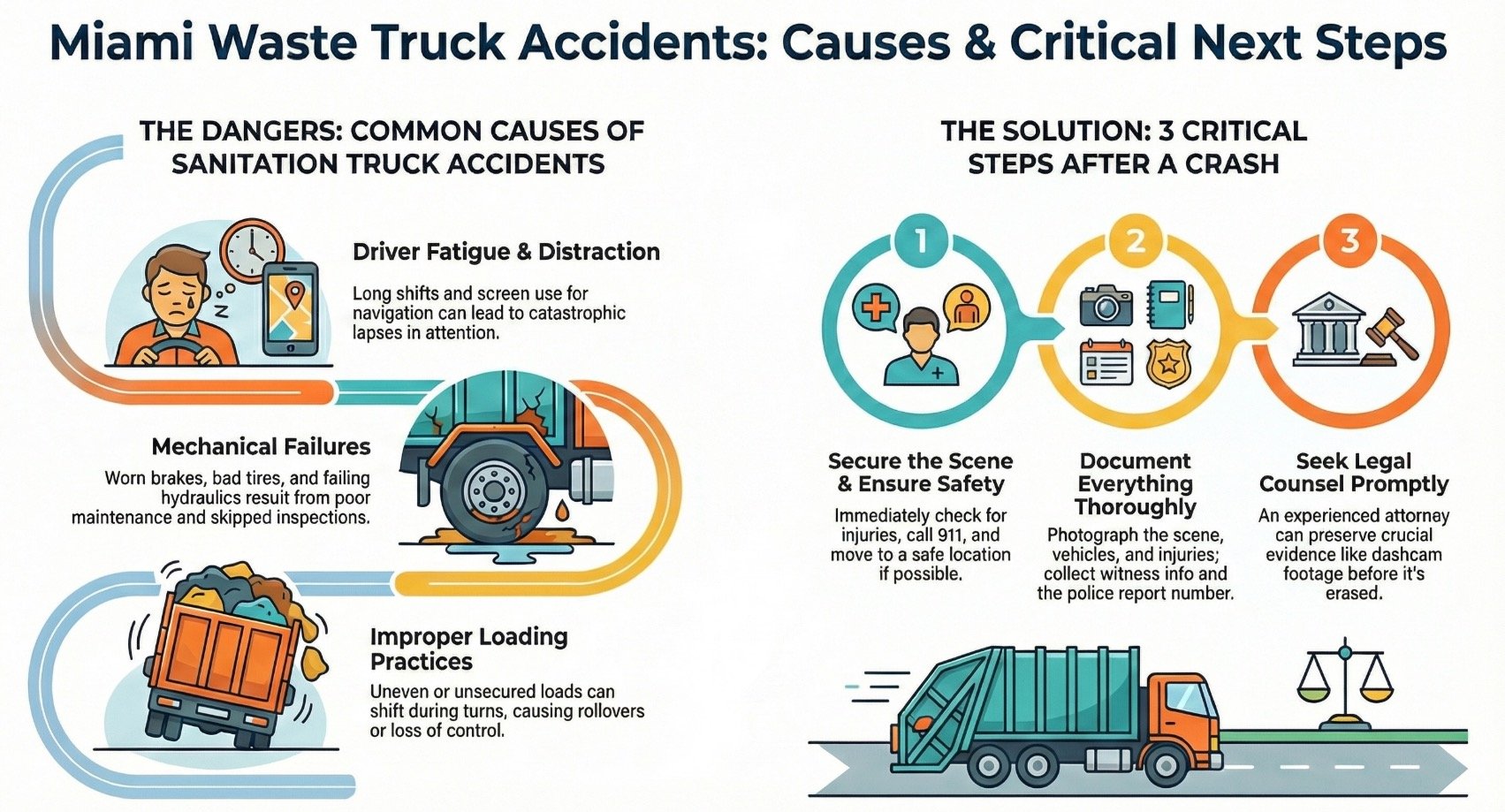
As we assess liability in Miami waste management truck accidents, we must examine how driver fatigue and distraction, mechanical failures tied to poor maintenance, and improper loading practices create significant risks.
We also consider the unique challenges of urban traffic patterns and limited visibility around large vehicles, which can amplify minor errors into severe collisions.
Driver Fatigue and Distraction
While Miami’s waste collection follows strict schedules, driver fatigue and distraction remain two of the most persistent and preventable causes of serious truck accidents.
We often see how rotating shift schedules disrupt sleep patterns, leading to micro sleeps that last seconds but carry catastrophic consequences.
Route monotony compounds the risk, dulling attention during repetitive stops and starts, while screen use for navigation or dispatch updates diverts eyes and cognition from the roadway.
We work to show how companies must manage workloads responsibly, enforce rest periods, and train drivers to recognize early signs of fatigue.
We also examine cab policies on device handling and hands-free protocols, ensuring compliance is real rather than theoretical.
When lapses occur, we gather logs, telematics data, and witness accounts to establish distraction or fatigue and to protect your rights.
Mechanical Failures and Maintenance
Pinpoint the hazard in plain terms: preventable mechanical failures often sit at the heart of Miami waste management truck crashes, and they’re rooted in poor maintenance and ignored defects. We routinely see worn brake components, underinflated or delaminating tires, and failing hydraulic systems create catastrophic loss of control.
These outcomes are avoidable with disciplined preventive inspections, meticulous recordkeeping, and prompt repairs.
We examine maintenance logs, diagnostic reports, and parts sourcing trails to identify where standards slipped. When operators stretch service intervals, install inferior components, or skip post-repair testing, they endanger everyone on the route.
We work to secure evidence quickly, preserve telematics, and consult independent mechanics. Our goal is to prove the defect pathway, hold every responsible party accountable, and drive safer fleet practices across Miami.
Improper Loading Practices
Though routes and schedules often get the blame, improper loading practices are a frequent and preventable cause of Miami waste management truck accidents. When crews rush or skip protocols, debris can sit unevenly, straps loosen, and bins remain unsecured.
These errors create dangerous load shifting, undermining vehicle stability during braking and turns. Poor weight distribution increases rollover risk, lengthens stopping distances, and strains brakes, guidance, and suspension.
We investigate loading logs, scale tickets, and onboard data to pinpoint where procedures failed. We also examine training records and supervisor oversight to determine systemic gaps.
Urban Traffic and Visibility


Amid Miami’s dense urban grid, traffic intricacy and limited sightlines create a hazardous environment for waste management trucks. We recognize how tight corridors, frequent stops, and turning radii near curbs compress space, reducing reaction time for drivers and bystanders.
Intersections with obstructed pedestrian sightlines, parked vehicles, and delivery zones compound risk, particularly when routes overlap with school areas or transit hubs.
We also account for nighttime visibility, which degrades depth perception and can mask hazards such as cyclists, e-scooters, and joggers. Glare from storefronts and wet pavement further interferes with hazard detection.
To protect the public, we analyze camera footage, route logs, and lighting conditions to determine liability. We advocate for better mirror alignment, side guards, enhanced lighting, and predictable routing that prioritizes vulnerable road users.
Legal Rights of Miami Waste Management Truck Accident Victims
Because waste collection vehicles operate in dense neighborhoods and on tight schedules, victims of Miami waste management truck accidents must understand the legal rights that protect their recovery. We’ve the right to pursue compensation for medical expenses, lost income, pain and suffering, and property damage.
We may also seek punitive damages when gross negligence is proven. These rights arise under Florida negligence law, municipal safety regulations, and federal motor carrier standards.
We can strengthen our claims by documenting violations, preserving evidence, and identifying all responsible parties, including contractors and municipalities when applicable. Our advocacy should extend beyond individual cases, using community outreach and policy reform to address recurring hazards and promote safer routes, training, and maintenance protocols.
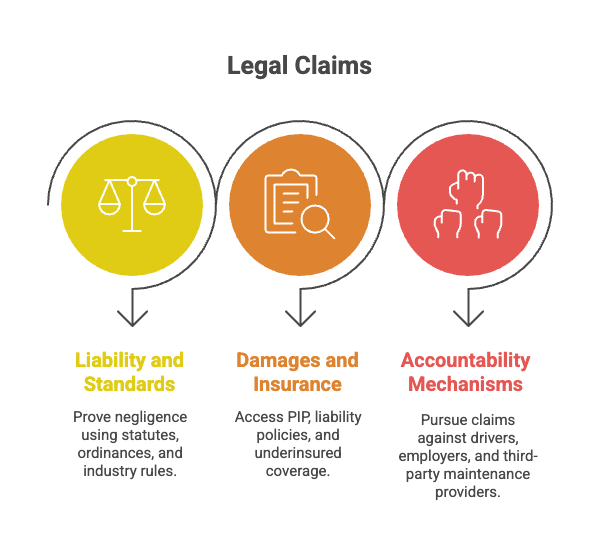
- Liability and Standards: Prove negligence using statutes, ordinances, and industry rules.
- Damages and Insurance: Access PIP, liability policies, and underinsured coverage.
- Accountability Mechanisms: Pursue claims against drivers, employers, and third-party maintenance providers.
Steps to Take After a Miami Waste Management Truck Accident
After a waste management truck crash in Miami, we first secure the scene, check for injuries, and call 911 to protect health and preserve safety.
We then document evidence thoroughly by photographing vehicles, debris, road conditions, and injuries, gathering witness information, and obtaining the police report details.
Finally, we notify the insurer promptly, provide crucial facts without speculation, and preserve all records to protect your claim.
Ensure Safety First
Prioritizing safety in the immediate aftermath of a Miami waste management truck accident protects lives and preserves your legal position.
We first assess injuries, call 911, and remain at the scene unless emergency personnel instruct otherwise.
We emphasize seatbelts importance, since restraining all occupants reduces secondary injuries while we await help.
If vehicles can move, we relocate to a secure shoulder or nearby lot, activate hazard lights, and set reflective triangles if available.
We practice emergency preparedness by keeping a basic kit, including a flashlight, gloves, and first-aid supplies, to stabilize minor injuries until paramedics arrive.
We avoid standing between vehicles or near traffic, and we shut off ignitions to reduce fire risk.
We speak calmly, check on others respectfully, and follow responder directions precisely.
Document Evidence Thoroughly
While emergency services are en route and the scene is stable, we begin documenting evidence methodically to safeguard your claim.
We photograph vehicle positions, skid marks, road debris, traffic controls, and weather or lighting, then capture close-ups of damage and injuries.
We collect names, roles, and contact information for drivers, passengers, and witnesses, and we note badge numbers for responding officers.
We secure the truck’s identifying details, DOT numbers, and visible company markings.
We preserve electronic data by requesting nearby surveillance footage and dashcam files, emphasizing digital records preservation before overwrites occur.
We store medical records, tow receipts, and repair estimates in an organized file.
We maintain an unbroken chain of custody for physical items and device copies, documenting who held each item, when, and why.
Notify Insurer Promptly
Prompt notification to your insurer protects coverage and preserves vital rights, so we report the collision as soon as it’s safe to do so. We contact the insurer within 24 hours, provide basic facts, and confirm the claim number in writing.
We avoid speculation about fault, share the police report when available, and note any injuries, vehicle damage, and potential witnesses.
We review the policy’s prompt-reporting clause and coverage limits to ensure no deadlines are missed. We document the date, time, and representative’s name for every call. We don’t consent to recorded statements or broad medical authorizations before legal guidance.
We also let you know about any applicable umbrella policies. Early, accurate notice helps prevent denials, preserves medical and property benefits, and positions your claim for a fair evaluation.
How a Miami Waste Management Truck Accident Lawyer Can Help You
Because collisions with heavy municipal vehicles raise complex legal and factual issues, we step in to stabilize your case quickly and build leverage from the outset. We secure evidence, coordinate medical documentation, and manage communications with government entities and insurers.
Our approach protects your rights, preserves fault findings, and positions your claim for a strong resolution that serves you and the broader public.
We combine casework with community outreach and policy reform, seeking safer routes, clearer protocols, and better training standards. By pushing for systemic improvements, we help reduce future harm while advancing your claim efficiently and ethically.
- Liability development: We review maintenance logs, GPS data, dashcam footage, and route compliance, then consult experts to establish causation and identify regulatory breaches.
- Damages proof: We document medical care, lost income, and service needs, coordinating credible evaluations that withstand scrutiny.
- Negotiation and litigation: We challenge low offers, pursue sovereign immunity exceptions, and, when necessary, litigate decisively to obtain just compensation.
Long-Term Effects of Miami Waste Management Truck Accident Injuries
When waste management truck crashes cause lasting injuries, we often see chronic pain syndromes that limit mobility, require ongoing treatment, and erode quality of life.
We also recognize the deep psychological trauma these events can trigger, including anxiety, depression, or PTSD that complicates recovery and daily functioning.
Collectively, these conditions can lead to sustained financial strain through medical expenses, reduced earning capacity, and disrupted careers, which we must address with an all-encompassing legal strategy.
Chronic Pain Syndromes
Although many injuries from a Miami waste management truck crash heal over time, chronic pain syndromes can persist for months or years and reshape daily life. We often see lingering neck, back, and joint pain that limits mobility, disrupts sleep, and undermines work and caregiving.
Chronic fatigue frequently accompanies these conditions, compounding limitations and reducing resilience.
We help you document symptoms with consistent medical records, objective testing, and detailed pain journals. Effective pain management may include multimodal therapy, such as targeted medications, interventional procedures, physical therapy, and complementary care when appropriate.
We coordinate with experts to establish causation, forecast future care, and quantify costs. By building a thorough record, we position your claim to recover medical expenses, lost wages, diminished earning capacity, and vital supportive services.
Psychological Trauma Impact
Shock can fade, yet the psychological impact of a Miami waste management truck accident often endures and shapes daily functioning. Many survivors experience intrusive memories, sleep disturbances, and hypervigilance, which are hallmark PTSD symptoms.
These reactions can strain relationships, reduce community engagement, and erode confidence in once-routine tasks. We approach this with care and structure, encouraging early screening, consistent therapy, and supportive routines.
We help you identify triggers, build practical coping strategies, and coordinate evidence-based treatment, including trauma-focused counseling and, when appropriate, medication management. Mindfulness practices, gradual exposure, and peer support groups can restore a sense of control and resilience.
We also document symptom patterns, track progress, and communicate with providers to align care. By stabilizing mental health, we support recovery that honors your values and service to others.
Financial and Work Loss
Stabilizing mental health is only part of restoring a life after a Miami waste management truck accident; the economic fallout can persist for years and demands equal attention. We help you calculate the full scope of financial harm, including lost wages, diminished earning capacity, and the cost of retraining. We document missed shifts, overtime, and contract income, then project future losses using medical restrictions and vocational assessments.
We also evaluate benefits eligibility, ensuring you access short- and long-term disability, workers’ compensation, and public assistance when available. We coordinate leave protections, preserve employment records, and challenge improper denials.
When injuries force a career change, we secure funding for certification, mobility aids, and workplace accommodations. Our approach integrates precise accounting with legal strategy, positioning your claim for thorough, durable compensation.
Proving Liability in Miami Waste Management Truck Accident Cases
When a waste management truck collides with a passenger vehicle in Miami, establishing who’s legally responsible demands a disciplined investigation and a clear theory of fault.
Establishing legal responsibility requires disciplined investigation and a clear, evidence-backed theory of fault.
We begin by securing evidence at once, preserving vehicle data, dash or route cameras, and driver logs before they’re altered. We document the scene, interview witnesses, and request maintenance histories and dispatch records to test compliance with safety rules and municipal contracts.
We then build a reliable evidentiary record, maintaining a strict chain of custody for physical items, electronic control module downloads, and photographic files. We analyze hours-of-service compliance, route planning, blind-spot hazards, and loading practices that can affect braking and handling.
Where needed, we retain reconstruction engineers and industry experts, ensuring their expert testimony links each breach to the collision. We also evaluate employer liability through negligent hiring, supervision, or training. With disciplined case management, we align facts, regulations, and science to prove fault.
Compensation for Miami Waste Management Truck Accident Damages
Although liability establishes the foundation, meaningful recovery depends on identifying and proving every category of compensable loss under Florida law. We assess the full scope of damages, documenting medical expenses, rehabilitation, and in-home care needs.
We calculate lost income, diminished earning capacity, and household services you can no longer provide. We also present pain and suffering, mental anguish, and loss of enjoyment with credible support, including expert testimony and client journals.
Our loss valuation process is meticulous and evidence-driven. We gather bills, employment records, and expert life-care plans, then translate future costs into present value. Property damage, including totaled vehicles and specialized equipment, is verified with appraisals and repair estimates.
In egregious cases involving reckless conduct, we pursue punitive damages to punish and deter, when permitted by statute.
We coordinate insurance benefits, address liens, and protect net recovery. Ultimately, we frame damages so a claims adjuster, mediator, or jury sees the human and economic impact clearly.
The Statute of Limitations for Miami Waste Management Truck Accident Cases
Having mapped the full spectrum of damages, we must act within Florida’s strict filing deadlines to preserve your rights. Florida generally imposes a two-year statute of limitations for negligence-based injury and wrongful death claims arising from truck crashes, and missing that window can permanently bar recovery.
We’ll verify the precise trigger date, which usually starts on the accident day, but can shift under limited statute nuances.
We promptly secure evidence, document medical timelines, and identify every responsible party, because adding defendants late can be risky. Certain tolling exceptions may pause the clock, such as when a defendant conceals identity, when the injured person is a minor, or when incapacity prevents timely filing.
Government-related claims can carry shorter notice requirements, so we calendar those immediately.
To serve you effectively, we would like to assess all deadlines at intake, monitor changes in law, and file proactively. Acting early protects leverage, preserves proof, and positions your claim for a timely, lawful resolution.
Why You Need an Experienced Miami Waste Management Truck Accident Lawyer
Because waste management truck cases involve unique hazards and complex liability webs, you need counsel who knows this niche and moves decisively.
We grasp how municipal contracts, private haulers, and maintenance vendors intersect, and we trace responsibility with precision. We investigate quickly, preserve electronic logs, and secure route data before it disappears, ensuring your claim starts on solid ground.
Our experience translates into disciplined negotiation and courtroom readiness. We build damages models that capture medical costs, lost income, and long-term care, then align them with tailored settlement strategies that pressure insurers to pay full value.
When needed, we litigate aggressively, using expert testimony on vehicle dynamics and industry safety standards.
We measure our impact by outcomes and by service. Client testimonials reflect our commitment to communication, empathy, and results. We shoulder the legal burden so you can focus on recovery and rightful care, while we pursue accountability with unwavering diligence.
How to Choose the Right Miami Waste Management Truck Accident Lawyer for Your Case
While the stakes are high after a waste management truck crash, selecting the right Miami attorney doesn’t need to be uncertain. We begin by verifying focused experience with commercial vehicle collisions, municipal contractors, and sanitation fleet policies.
We then assess case results, not just verdict headlines, but patterns of timely settlements and client-centered outcomes.
We recommend structured client interviews to gauge communication style and strategic clarity. Ask how the lawyer investigates safety logs, route data, and maintenance records, and who on the team handles expert coordination.
Evaluate responsiveness: turnaround times, update frequency, and transparency on risks.
Scrutinize fee structures early. Confirm contingency percentages, litigation cost advances, and whether mediation, experts, and depositions are billed separately or deducted at resolution: demand written terms and plain-language explanations.
Finally, check professional reputation through peer ratings, disciplinary history, and local referrals. When these criteria align, we can trust the counsel to protect your rights and amplify your recovery.
About the Law Offices of Anidjar and Levine
Rooted in South Florida and focused on results, the Law Offices of Anidjar & Levine brings a disciplined, client-first approach to complex truck accident litigation, including waste management and sanitation fleet cases.
We recognize the high stakes after a collision with a commercial vehicle and respond with a prompt investigation, careful documentation, and decisive advocacy.
Our attorneys coordinate medical care, protect evidence, and build cases that position you for full and fair compensation.
We measure our work by the relief we deliver to clients and the safety improvements we help encourage.
Through community outreach, we share knowledge on roadway safety and municipal fleet practices, aiming to reduce preventable harm. Our client testimonials reflect consistent communication, meticulous preparation, and effective negotiation strategies.
We’re trial-ready, yet pragmatic, pursuing efficient resolutions when they serve your interests.
When you retain us, you gain a dedicated team that treats your case as a mission, not a file.

Frequently Asked Questions
What Insurance Coverage Do Miami Waste Management Trucks Typically Carry?
They typically carry commercial liability coverage for bodily injury and property damage, often with higher limits due to vehicle weight and urban routes.
We also see cargo insurance for transported waste, plus physical damage coverage for the truck itself.
Employers usually maintain workers’ compensation, while motor carrier or MCS-90 endorsements may apply.
We verify umbrella policies for catastrophic losses, and we confirm endorsements addressing hazardous materials, environmental impairment, and uninsured or underinsured motorists.
Do you think Dashcam or Ring Footage can help My Truck Accident Case?
Yes, dashcam or Ring footage can decisively strengthen your truck accident case. We use dashcam evidence to establish fault, verify timelines, and counter disputed narratives.
We quickly secure and preserve recordings, authenticate sources, and align footage with reports and witness statements.
We address privacy concerns by obtaining consent, limiting requests, and adhering to admissibility rules. We also send preservation letters to prevent deletion, ensuring crucial visual proof supports your claim and serves justice for all involved.
Are Sanitation Workers’ Union Policies Relevant to My Claim?
Yes, they’re often relevant. Union rules and collective bargaining agreements may define training standards, route scheduling, safety protocols, and disciplinary procedures, which can inform whether the employer exercised reasonable care.
We examine mandated rest periods, equipment checks, incident reporting, and supervision requirements. If policies were ignored or inadequately enforced, that evidence can support liability or punitive claims.
We’ll obtain the agreements, interview stewards, and compare practices against industry norms to advance your claim and support community safety.
How Do City Contracts With Haulers Affect Who I Can Sue?
City contracts can limit who we can sue by defining responsible parties and allocating risk. We review contract assignments to determine whether liability shifted to a subcontractor or remains with the primary hauler.
Some agreements include immunity waivers or indemnity clauses that alter governmental protections and direct claims to private entities. We examine notice provisions, third‑party beneficiary language, and insurance requirements, ensuring we pursue the proper defendants and preserve all recoverable damages within statutory deadlines.
What if the Truck Was Collecting During Restricted Hours or Routes?
If the truck was collected during restricted hours or on restricted routes, we can argue negligence per se, thereby strengthening liability.
Late-night pickups or operations that violate residential restrictions may violate municipal ordinances, contract terms, or safety protocols.
We’d document route data, dispatch records, GPS logs, and noise or curfew complaints, then identify the responsible entities—driver, contractor, and possibly the city.
We’d preserve evidence quickly, notify insurers, and pursue claims reflecting the increased risk created by the violations.
———————
If a Miami waste management truck accident disrupted your life, our Miami Truck Accident Attorney is ready to protect your rights and pursue full compensation.
We’ll investigate the crash, preserve evidence, work with experts, and negotiate firmly with insurers.
If necessary, we’ll litigate to secure the recovery you merit. Time limits apply, so prompt action matters.
Contact the Law Offices of Anidjar & Levine for a free consultation. We’ll answer your questions, outline your options, and start building a strong case immediately.


We Can Help.