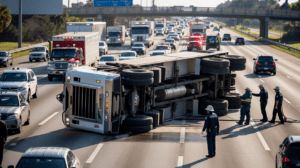
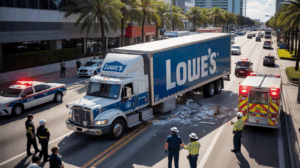
1.0 Introduction: The Unique Challenges of Jackknife Accident Litigation in Miami
Proving liability in a jackknife truck accident requires a specialized litigation strategy that accounts for the unique intersection of complex factors present in the Miami area. These cases are distinct from other motor vehicle collisions, involving the intricate dynamics of multi-axle, articulated commercial vehicles that can lose control with catastrophic results.
Learn More: Miami Jackknife Truck Accident Lawyer
The challenge is magnified by local conditions, where the high-traffic corridors of I-95 and the Palmetto Expressway are frequently subjected to intense rain bands and roadway drainage issues. Successfully litigating these claims demands a comprehensive understanding of how these environmental factors interact with driver behavior, vehicle mechanics, and cargo management, all within the precise requirements of Florida’s legal framework.
The core of a successful liability claim is built upon a disciplined, evidence-based approach that deconstructs the chain of causation event by event. This process must begin in the moments immediately following the crash, as the data and physical evidence required to prove negligence are highly perishable.
Proving liability is therefore not a matter of conjecture but of methodical reconstruction, linking specific failures—whether by the driver, the carrier, or another party—directly to the resulting harm. This rigorous analysis starts with the critical discipline of immediate evidence preservation.


2.0 The Critical First Actions: A Framework for Evidence Preservation and Spoliation Prevention
The foundation of any successful liability claim in a jackknife truck accident is built upon the rapid and comprehensive preservation of evidence. From the moment a crash occurs, critical data from electronic systems, physical roadway evidence, and corporate records are at risk of being lost, altered, or lawfully destroyed.
Failure to act decisively can result in the permanent loss of the very information needed to prove negligence, thereby compromising the entire case before it can be fully developed. The evidence-gathering process unfolds in two distinct but overlapping phases: immediate on-scene documentation and formal legal preservation.
- Immediate On-Scene Documentation The first priority is to capture a complete and accurate record of the crash scene before it is cleared. This initial data provides an objective snapshot of the event that can be used to reconstruct the accident’s dynamics. Key actions include:
- Comprehensive Photography: Capturing wide-angle shots of the entire jackknife configuration, followed by close-up images of vehicle damage, skid marks, road debris, and prevailing weather and lighting conditions. Photographs should also document lane markings, traffic signals, and any nearby surveillance cameras.
- Vehicle and Party Identification: Recording license plates, Department of Transportation (DOT) numbers, and trailer identifiers for all involved commercial vehicles.
- Witness Information: Gathering the names, contact information, and brief initial statements from any witnesses while their memories are fresh and unfiltered.
- Official Reports: Securing official documentation such as police and 911 records, which provide a formal, time-stamped account of the initial response and on-scene findings.
- Formal Evidence Preservation and Discovery Following the immediate on-scene efforts, formal legal action is required to secure evidence controlled by the trucking company and other defendants. This is accomplished by sending formal preservation notices—often called spoliation letters—that legally obligate the parties to secure and not destroy specified evidence pending litigation. This process is essential for obtaining:
- Electronic Control Module (ECM) / “Black Box” Data: This device captures critical operational data in the moments before a crash, including the truck’s speed, brake application, and driver hours of service, which can reveal abrupt maneuvers or driver fatigue.
- Dashcam Footage: Obtaining footage from the truck’s own onboard cameras as well as any nearby surveillance footage that may have captured the event.
- Corporate Records: Securing internal documents that provide context for the crash, including dispatch logs, driver logs (to verify compliance with hours-of-service regulations), vehicle maintenance histories, inspection records, and any notices of component recalls.
- Cargo Documentation: Reviewing key documents like bills of lading and loading logs to analyze weight distribution and compliance with federal cargo securement standards.
This meticulously preserved body of evidence provides the raw material needed to deconstruct the root causes of the accident and establish clear lines of liability.
3.0 Deconstructing Causation: Analyzing Common Triggers and Liability Pathways
A successful litigation strategy moves beyond identifying the immediate trigger of a jackknife accident to analyze the full chain of causation. Liability rarely rests solely with the driver; it often extends to the motor carrier, maintenance providers, cargo shippers, and loaders whose decisions or failures contributed to the loss of control. By systematically investigating each potential point of failure, we can build a comprehensive liability case against all responsible parties.
3.1 Driver Actions and Decisions
Driver error remains a primary factor in jackknife accidents, particularly in Miami’s demanding driving environment. Certain actions directly correlate to a finding of negligence.
| Driver Action | Analysis of Associated Negligence |
| Sudden Braking and Skidding | When a driver’s abrupt braking causes the tractor to slow faster than the trailer, a jackknife can occur. This is often the result of negligence, including failure to maintain proper following distances or engage in anticipatory braking. These lapses necessitate panic stops that can cause the wheels to lock and control to be lost. |
| Speeding in Wet Conditions | Exceeding a safe speed on wet Miami roads like I-95 or the Palmetto Expressway significantly lengthens stopping distances and elevates hydroplaning risk. This failure to adjust speed for adverse weather conditions constitutes a clear breach of the driver’s duty of care and is a primary cause of instability. |
3.2 Mechanical and Equipment Failures
Brake or Tire Failures are a frequent cause of jackknife accidents, shifting liability toward the motor carrier or its third-party maintenance contractors. When brakes overheat and fade, stopping power is reduced, forcing abrupt steering inputs that can lock an axle and initiate a trailer swing.
Similarly, a sudden tire blowout can shift the vehicle’s weight and traction so unevenly that the driver cannot correct the resulting yaw, a danger that is particularly acute when the failure occurs on a guiding or trailer axle. Evidence from maintenance logs, inspection records, and component recall notices is critical to establishing that negligent maintenance practices—such as failing to replace worn brake liners or using faulty parts—were the root cause of the mechanical failure.
3.3 Cargo Management and Securement
Improper Cargo Loading can create inherent instability in a tractor-trailer, making it susceptible to a jackknife even during routine maneuvers. Liability for these incidents can fall on the carrier, the shipper, or the loading company. An unevenly distributed load shifts the trailer’s center of gravity, while an overloaded trailer strains the braking system. Unsecured freight that shifts suddenly during transit can provide the force needed to pivot the trailer into the cab. By analyzing bills of lading, loading logs, and inspection reports, a case can be made that violations of federal cargo securement standards directly caused the unsafe condition.
Identifying these distinct causes is the first step; the next is to use expert witnesses to explain these complex technical findings in a clear and persuasive manner.
4.0 Building the Causal Narrative: The Strategic Role of Expert Witnesses
In jackknife truck accident litigation, expert testimony is indispensable. The raw data collected from an accident scene—from ECM printouts to skid mark measurements—is often too technical for insurers, judges, or juries to interpret without guidance. Experts are retained to translate this complex information into a clear, credible, and persuasive causal narrative that definitively links negligent actions or omissions to the accident itself. It is their testimony that forges raw data into the unassailable technical foundation of the liability claim.
Key experts and their contributions include:
- Accident Reconstructionists: These experts use physical evidence from the scene, such as vehicle positions and skid mark measurements, along with electronic data from the truck’s “black box,” to create a scientific model of the crash. Their analysis can pinpoint the sequence of events, vehicle speeds, and the critical moment when control was lost, thereby identifying the primary cause of the jackknife.
- Engineers: Mechanical and automotive engineers are crucial for analyzing equipment failures. They can assess brake liner measurements to identify brake fade, examine tire carcass evidence to determine the cause of a blowout, and analyze loading logs and trailer dynamics to prove that improper cargo weight distribution violated safety standards and created an unstable vehicle.
- Meteorological Experts: In a Miami-based case, a meteorologist’s testimony is often vital. They can analyze weather data to establish the precise timing and intensity of rapid rain bands, evaluate roadway drainage characteristics, and determine how visibility was affected at the time of the crash. This context is essential for assessing whether the truck driver’s speed and control inputs were reasonable for the conditions.
The causal narrative constructed by this team of experts provides the factual foundation needed to apply Florida’s specific legal statutes and frameworks.


5.0 Application of Florida Law: Comparative Negligence and Statutory Deadlines
A technically sound case proving causation is only effective if it is perfectly aligned with the governing legal framework. In Miami, two legal parameters are most critical in shaping litigation strategy: Florida’s comparative negligence rule and its strict statute of limitations. Navigating these rules correctly is essential to protecting a client’s right to recovery.
Florida’s Comparative Negligence Framework
Florida law now follows a modified comparative negligence standard. Under this rule, a claimant who is found to be more than 50% at fault for their own injuries is barred from recovering any damages. If the claimant is 50% or less at fault, their financial recovery is reduced by their percentage of fault. The strategic implication of this 51% bar is profound: it is more critical than ever to conduct a thorough investigation to identify all potentially liable parties—including the truck driver, motor carrier, maintenance providers, and cargo shippers. By meticulously assigning fault across all negligent actors, we work to minimize the claimant’s percentage of fault, thereby protecting their right to recovery. However, identifying all parties is a time-intensive process that must be executed within Florida’s unforgiving statutory deadlines.
The Statute of Limitations
In commercial trucking litigation, time is a weapon for the defense. Florida imposes a strict two-year filing deadline for most personal injury and wrongful death actions arising from a truck accident. This means a lawsuit must be formally filed in court within two years of the date of the crash. Failure to meet this deadline will almost certainly result in the complete forfeiture of the right to sue. While very limited tolling exceptions exist (such as for an injured minor), they are rare. The short timeframe underscores the critical importance of acting promptly to retain counsel, preserve evidence, and initiate legal proceedings well before the statutory window closes.
Once liability has been firmly established within this legal framework, the strategic focus shifts to proving the full and fair value of the client’s damages.
6.0 Quantifying Damages: A Comprehensive Approach to Compensation
In a jackknife truck accident case, the goal of compensation is to provide a recovery that accounts for the full cascade of losses an individual suffers. These damages are not limited to immediate medical bills but extend to long-term economic costs, profound non-economic harm, and the lasting impact on a victim’s quality of life. A comprehensive approach is required to document and quantify each category of loss.
- Economic Damages These are the tangible, calculable financial losses resulting from the accident. They include all past and future medical expenses, such as emergency treatment, hospitalization, rehabilitation, and ongoing care. This category also covers lost income from time away from work and, for those with permanent injuries, a diminished future earning capacity.
- Non-Economic Damages These damages compensate for the intangible, personal harms that have no exact price tag but are nonetheless significant. This includes physical pain and suffering, emotional distress, loss of enjoyment of life, and loss of consortium (the negative impact on a marital relationship).
- Long-Term Consequences The lasting effects of a serious jackknife accident must be carefully documented and quantified, as they often represent the most significant component of a claim.
- Chronic Pain and Mobility Issues: Many survivors experience persistent stiffness and limited mobility that requires ongoing physical therapy or the use of assistive devices to perform daily functions.
- Cognitive and Emotional Trauma: The psychological impact can be severe, leading to conditions such as Post-Traumatic Stress Disorder (PTSD), anxiety, memory lapses, and difficulty concentrating, all of which disrupt personal and professional life.
- Financial and Lifestyle Changes: The combination of ongoing medical costs and a diminished earning capacity can create immense financial strain. Victims may also require home modifications or long-term care to accommodate permanent disabilities.
- Punitive Damages In cases where the evidence demonstrates that a defendant acted with reckless indifference to safety—for example, by knowingly operating a dangerously maintained vehicle—punitive damages may be pursued. These are intended not to compensate the victim but to punish the wrongdoer and deter similar misconduct in the future.
Successfully recovering these damages depends on a strategy that integrates meticulous evidence, expert analysis, and a deep understanding of Florida law into a cohesive case from start to finish.
7.0 Conclusion: Strategic Imperatives for Litigators in Jackknife Cases
Successfully litigating a Miami jackknife truck accident claim hinges on a disciplined and proactive methodology designed to overcome the complexities of commercial vehicle dynamics, local environmental factors, and Florida’s specific legal requirements. The process demands more than just a reaction to an event; it requires a forward-thinking strategy that anticipates defensive tactics and builds an irrefutable, evidence-based case for liability and damages. From the initial crash scene investigation to the final settlement negotiations, every action must be guided by a clear set of strategic principles aimed at protecting the client’s rights and maximizing their recovery.
For legal professionals navigating these challenging cases, the core methodologies can be distilled into three essential imperatives:
- Act with Urgency: The non-negotiable first step is immediate evidence preservation. Securing perishable electronic data from the ECM and dashcams, along with physical scene evidence before it is lost, provides the objective foundation upon which the entire liability case is built.
- Build a Multi-Disciplinary Team: Proving causation requires translating complex technical facts into a clear narrative. This necessitates coordinating legal strategy with a team of technical experts, including accident reconstructionists and engineers, to construct an irrefutable account of how and why the accident occurred.
- Prepare for Trial from Day One: The strength of a claim is maximized when defendants and their insurers know that a legal team is fully prepared to take the case to trial. This state of readiness creates critical leverage during negotiations and ensures the claim’s integrity is protected through every stage of the legal process.