



If you suspect assisted living abuse in Fort Lauderdale, prioritize your loved one’s safety and seek medical care right away.
Call 911 if there’s immediate danger, report concerns to the Florida Abuse Hotline, and contact law enforcement if you suspect assault, theft, or financial exploitation.
Document injuries with photos, save texts and emails, and request copies of care plans, incident reports, and medication logs.
The Law Offices of Anidjar and Levine can help preserve critical evidence, protect your loved one from retaliation, and pursue financial compensation for their harm.
Learn more about your options by speaking with a Fort Lauderdale Nursing Home Abuse and Neglect Lawyer.
Key Takeaways
- Prioritize immediate safety: call 911 if there is danger, seek medical evaluation, and relocate your loved one if harm is ongoing.
- Report suspected abuse to the Florida Abuse Hotline and Fort Lauderdale Police, and keep all report numbers for follow-up.
- Preserve evidence with photos, a dated timeline, witness contacts, and saved texts, voicemails, emails, clothing, and bedding.
- Request facility records promptly, including care plans, medication logs, incident reports, staffing schedules, and surveillance footage.
- A Fort Lauderdale assisted living abuse lawyer can help stop retaliation, involve regulators, and pursue negligence, abuse, or exploitation claims.
How We Can Help With Your Fort Lauderdale Assisted Living Abuse Claim
Take action now to protect your loved one and hold the facility accountable. You don’t have to shoulder this alone—you can focus on care while we handle the legal work.
You’ll get a clear plan, quick communication, and guidance grounded in resident rights and dignity.
You can rely on us to listen closely, gather records, secure witness statements, and preserve essential evidence before it disappears. We’ll coordinate with medical professionals to connect the harm to the neglect or misconduct, then calculate losses with care, including medical needs and future support.
You’ll see every step, because transparent family advocacy builds stronger outcomes and honors your loved one’s voice.
We’ll handle calls, paperwork, and deadlines, and we’ll push back when the facility denies responsibility. If settlement talks don’t deliver fairness, you’ll be prepared to pursue the next step with confidence and purpose.
Understanding Fort Lauderdale Assisted Living Abuse Cases



Although many families assume assisted living is automatically safe, abuse and neglect can happen quietly when staffing, training, or oversight breaks down. You help your loved one most by learning what “abuse” and “neglect” can look like in Fort Lauderdale facilities and how cases are evaluated.
You may see physical harm, emotional intimidation, sexual misconduct, financial exploitation, medication errors, or basic care withheld. Neglect can involve poor hygiene, unsafe conditions, dehydration, malnutrition, pressure injuries, or missed medical attention.
You don’t need proof beyond doubt to act; you need clear concerns, dates, and details that show a pattern or a serious incident. Save photos, messages, care plans, bills, and incident reports, and document who you spoke with.
Strong resident advocacy centers your loved one’s voice and dignity. Steady family support keeps them safe during reporting, transfers, and follow-up care.
Common Causes of Fort Lauderdale Assisted Living Abuses
When you look at why assisted living abuse happens in Fort Lauderdale, you’ll often find understaffing and overworked caregivers at the center of it.
You may also see harm tied to inadequate staff training and to poor supervision or oversight that allows warning signs to go unchecked. Medication errors and neglect can follow fast, putting your loved one’s health and safety at risk.
Understaffing And Overwork
Because many Fort Lauderdale assisted living facilities operate on tight staffing budgets, caregivers often juggle too many residents and too few hours per shift. When you’re trying to serve with compassion, that pressure can turn small lapses into serious harm—missed call lights, delayed toileting, skipped hydration checks, and rushed transfers that lead to falls.


Understaffing also fuels staff burnout, so even dedicated aides may grow exhausted, irritable, or numb to residents’ needs. Facilities facing recruitment challenges may rely on overtime, double shifts, and rotating assignments, leaving you without consistent coverage for the same vulnerable person.
If you notice chronic short staffing, long response times, or residents left unattended, you can document patterns and push for safer staffing levels quickly.
Inadequate Staff Training
Even with enough hands on the floor, weak training sets residents up for preventable harm.
When you don’t learn safe transfer techniques, fall risks rise.
If you’re unsure how to respond to choking, strokes, or blood sugar swings, minutes get lost.
Inadequate instruction on dementia care can trigger agitation, missed cues, and avoidable restraint use.
Medication errors happen when you haven’t been taught the “rights” of administration or how to document refusals and side effects.
You can serve residents better by insisting on clear protocols, skill checkoffs, and ongoing refresher sessions tied to staff certification.
You should also push for regular training audits that test real-world readiness, not just paperwork.
Strong training protects residents’ dignity, health, and trust every day.
Poor Supervision And Oversight
Cutting corners on supervision leaves residents exposed to neglect and abuse that should never slip through the cracks. When you don’t monitor routines, document concerns, and respond fast, harmful behavior can hide in plain sight.
You can strengthen staff accountability by setting clear check-ins, assigning float coverage, and requiring incident follow-up the same day. Regular facility audits help you spot patterns—missed rounds, ignored call lights, or unsafe interactions—before someone gets hurt.
If you’re serving vulnerable adults, you can’t rely on trust alone; you must verify.
| Oversight gap | What you can do |
|---|---|
| Unseen interactions | Increase hallway rounding |
| Missed care tasks | Use shift checklists |
| Weak reporting | Require immediate escalation |
| No trend review | Hold weekly huddles |
| Lax leadership | Document corrective action |
Medication Errors And Neglect
When medication routines break down, assisted living residents can suffer fast and severe harm. You may see missed doses, double-dosing, wrong pills, or dangerous drug interactions—especially after hospital discharges or provider changes.
If staff don’t confirm orders, monitor side effects, and document administration, a simple mistake can become a crisis.
You can help prevent harm by insisting on medication reconciliation at every shift in care and by asking clear questions about each drug’s purpose, timing, and risks. Strong pharmacy coordination matters too; it reduces refill gaps, catches contraindications, and verifies packaging and labeling.
Watch for sudden confusion, falls, lethargy, tremors, or worsening pain, and report concerns immediately. If the facility dismisses red flags or repeats errors, you should consider legal support to protect the resident and others.
Legal Rights of Fort Lauderdale Assisted Living Abuse Victims


Although assisted living facilities promise safety and dignity, Florida law gives you powerful rights if a caregiver or facility in Fort Lauderdale abuses, neglects, or exploits a resident. You’re entitled to respectful care, freedom from retaliation, and services that honor Resident autonomy, including informed choices about daily routines, medication, and visitors.
You can also expect transparency: facilities must maintain proper staffing, training, and records, and they can’t hide incidents from you or your loved one.
When you serve and protect an elder, Family advocacy becomes an essential safeguard, and the law supports your voice.
- Demand access to care plans and relevant facility records
- Report concerns and receive protection against retaliation
- Seek accountability for negligence, abuse, or financial exploitation
- Pursue compensation for medical costs, pain, suffering, and dignity lost

You don’t have to accept excuses or silence—Florida statutes and federal regulations reinforce your right to humane, attentive, and secure assisted living care.
Steps to Take After a Fort Lauderdale Assisted Living Abuse
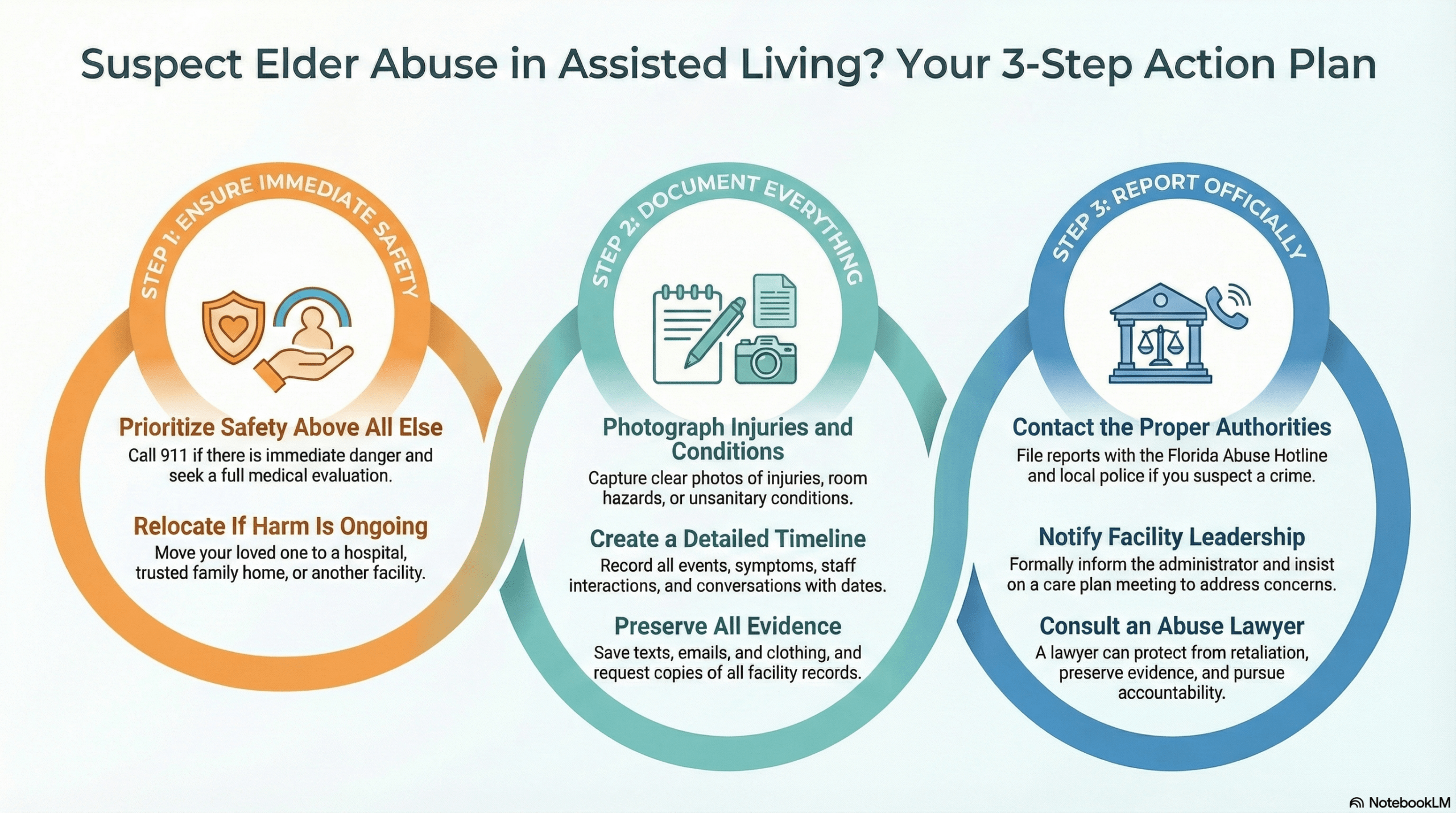
After you suspect assisted living abuse in Fort Lauderdale, you’ve got to guarantee your loved one’s immediate safety by removing them from harm and securing proper medical care.
Next, document everything thoroughly—photos, injuries, dates, witness names, and facility records—to preserve crucial evidence.
Then report the abuse and neglect to the facility leadership and the appropriate Florida authorities so an investigation can begin.
Ensure Immediate Safety
Start by getting your loved one out of harm’s way and into a safe, supervised environment you trust.
If you believe danger is ongoing, call 911 and request a welfare check.
Ask a physician to evaluate urgent medical needs, and move them to a hospital, trusted family home, or another licensed facility as part of an emergency relocation plan.
Notify the facility administrator that you’re removing your loved one and limit staff access until they’re safe.
If your loved one can’t consent or you fear interference, speak with an attorney about temporary guardianship so you can make immediate care and placement decisions.
Coordinate transportation, medications, and continuity of care, and stay present to provide calm reassurance and advocacy throughout.
Document Evidence Thoroughly
Once your loved one’s immediate safety is secured, you’ll want to lock down proof of what happened before it disappears or gets rewritten.
Start a dated timeline of events, symptoms, and staff interactions, and keep it in one place. Ask for copies of care plans, medication logs, incident notes, and billing records, then save them digitally and in print.
Photograph injuries in good lighting from multiple angles, and include full-body context shots when possible.
Capture the room setup, hazards, restraints, or unsanitary conditions exactly as you find them. Preserve clothing or bedding that shows stains or damage in a clean bag.
If other residents, visitors, or staff saw anything, politely record witness statements with names, dates, and contact details. Keep all texts, voicemails, and emails.
Report Abuse And Neglect
Speak up quickly and report suspected abuse or neglect to the proper authorities so the facility can’t quietly cover it up.
If there’s immediate danger, call 911. Then contact the Florida Abuse Hotline and ask for a report number.
Notify the Fort Lauderdale Police if you suspect assault, theft, or financial exploitation.
Write down who you spoke with, when, and what they said, and follow up in writing.
Ask the facility to schedule a care plan meeting and insist on documented changes, supervision, and medication reviews.
Bring advocates to family conferences so your loved one isn’t isolated or pressured.
If staff retaliates or delays records, escalate to the long-term care ombudsman and state regulators.
Reporting protects your loved one and others, too.
How a Fort Lauderdale Assisted Living Abuse Lawyer Can Help You
When you suspect a loved one has suffered abuse or neglect in a Fort Lauderdale assisted living facility, a local assisted living abuse lawyer can step in quickly to protect their safety and your legal rights. You don’t have to carry the burden alone; your lawyer can coordinate immediate reporting, preserve records, and push the facility to stop harmful conduct while your loved one receives proper care.
- Gather medical files, incident reports, videos, and witness statements before they disappear
- Investigate staffing, training, and policy violations to identify who’s responsible
- Address financial exploitation by tracing missing funds, stopping unauthorized access, and seeking restitution
- Use family mediation when appropriate to align relatives, reduce conflict, and focus on the resident’s dignity

You’ll also get guidance on communicating with administrators and regulators so your advocacy stays calm, clear, and effective.
If a claim is needed, your lawyer can calculate damages and pursue accountability through settlement or court, keeping your loved one’s well-being at the center.
Long Term Effects of Fort Lauderdale Assisted Living Abuse Injuries
When you or your loved one suffers abuse in an assisted living facility, the harm can follow you long after the bruises fade.
You may face chronic physical disability, lasting psychological trauma, and a reduced ability to live independently.
In severe cases, these injuries can also raise morbidity risks and even increase mortality.
Chronic Physical Disability Risks
Even if an injury seems minor at first, assisted living abuse can trigger chronic physical disabilities that limit your mobility and independence long after the bruises fade. A poorly treated fracture, repeated falls, or forced restraints can leave you with lasting pain, reduced range of motion, nerve damage, or worsening arthritis. You may need mobility aids sooner than expected, and daily tasks like bathing, cooking, or transferring from bed can become unsafe without help.
As disability progresses, you might require accessible transportation for medical visits, therapy, and community activities that help you stay connected and able to serve others. You can’t pour into others if you’re fighting preventable limitations. By documenting symptoms, following treatment plans, and insisting on proper care, you protect your body and your capacity to live with dignity.
Lasting Psychological Trauma Impacts
Although bruises and broken bones can heal, assisted living abuse often leaves lasting psychological trauma that reshapes how you feel, think, and trust others. You may relive moments through nightmares, startle at routine care, or withdraw from people who want to help.
Anxiety and depression can cloud memory, disrupt sleep, and make daily decisions feel exhausting.
You can also carry shame, even though you did nothing wrong. When you pursue trauma recovery, you give yourself permission to feel safe again through counseling, peer support, and consistent, respectful caregiving.
You also help others by choosing stigma reduction—speaking plainly about abuse, reporting concerns, and affirming the survivor’s dignity. With patient support, you can rebuild confidence, set boundaries, and restore trust in compassionate care teams again.
Increased Mortality And Morbidity
Psychological trauma can shadow you for years, and the physical harm from assisted living abuse can shorten those years. When neglect causes infections, falls, or untreated wounds, you’re left managing chronic pain, disability, and recurring hospitalizations that raise mortality risk.
Elderly isolation worsens depression, slows recovery, and can trigger rapid decline. Nutritional deficiencies weaken immunity, thin skin, and impair cognition, making minor illnesses deadly. If you serve an older loved one, you can honor their dignity by documenting changes, insisting on timely care, and seeking accountability.
| Harm you see | What it can become | Why it matters |
|---|---|---|
| Dehydration | Kidney failure | Days matter |
| Bedsores | Sepsis | Life-threatening |
| Falls | Brain bleed | Sudden loss |
| Missed meds | Stroke | Preventable |
| Fear | Withdrawal | Faster decline |
Proving Liability in Fort Lauderdale Assisted Living Abuse Cases
Build a strong case by proving who caused the harm, how it happened, and why the assisted living facility should be held responsible. You’ll focus on duty, breach, causation, and damages, showing the resident merited safe, dignified care and didn’t receive it.
Start by preserving documentary proof: care plans, medication logs, incident reports, staffing schedules, training records, and surveillance footage. Request the resident’s chart quickly so missing pages and late entries stand out. Use photos, wound measurements, hospital records, and timeline notes to connect neglect to specific injuries or decline.
Establish staff accountability by identifying who was assigned, what policies were required, and where supervision failed. Compare actions to Florida regulations, internal protocols, and accepted care standards. Interview witnesses—family, roommates, former employees, EMTs—and document prior complaints or state inspection findings. When you tie those facts to the injury, you make liability hard to deny.
Compensation for Fort Lauderdale Assisted Living Abuse Damages
Once you’ve shown who caused the harm and how the facility failed its duty, the next step is demanding compensation that reflects what the abuse or neglect has cost the resident and your family.
You can pursue damages for emergency care, hospitalization, medications, therapy, mobility aids, and future treatment tied to the injury. You can also seek financial restitution for stolen funds, unauthorized charges, or improper billing.
You should include non-economic losses too, such as pain, fear, humiliation, and diminished quality of life, because serving a vulnerable elder means honoring their dignity, not just their balance sheet.
If abuse forced a move, add relocation expenses and the cost of higher-level care. When conduct was reckless or intentional, you may request punitive damages to hold wrongdoers accountable and deter repeat harm.
With a clear demand package, you help your loved one heal and protect other residents.
The Statute of Limitations for Fort Lauderdale Assisted Living Abuse Cases
Even if you’ve gathered strong evidence of abuse or neglect, you can’t wait forever to file a claim because Florida law sets strict deadlines for assisted living abuse cases. These time limits protect fairness, but they can also block justice if you miss them, so you’ll want to act promptly for your loved one’s safety and dignity.
In many cases, the clock starts when the injury occurs, yet some claims follow Discovery deadlines that begin when you knew or should’ve known abuse caused the harm.
Records, incident reports, and medical notes can reveal patterns that weren’t obvious at first. Still, you shouldn’t assume you have extra time; delays can erase witnesses and footage.
Florida also recognizes tolling exceptions in limited situations, such as when the resident lacks capacity or misconduct is concealed. If tolling applies, you may gain time, but you must prove it with solid documentation and careful timelines.
Why You Need an Experienced Fort Lauderdale Assisted Living Abuse Lawyer
Deadlines can close fast, and the same delay that risks a statute-of-limitations problem can also give a facility time to “lose” records or polish its story. An experienced Fort Lauderdale assisted living abuse lawyer moves quickly to preserve charts, incident reports, staffing logs, surveillance footage, and witness statements before they vanish. You don’t just need sympathy—you need a plan that protects your loved one and others still inside.
You’ll face intricate regulations, insurance defenses, and medical causation questions. A seasoned lawyer connects the dots between injuries, patterns of neglect, and systemic failures, then presses for immediate safety measures, not just a payout.
They also help you steer Family dynamics, keeping communication focused on the resident’s dignity while reducing conflict over decisions. Finally, they integrate Financial planning by projecting care costs, replacement services, and long-term support, so any recovery truly funds healing and stability.
How to Choose the Right Fort Lauderdale Assisted Living Abuse Lawyer for Your Case
Because assisted living abuse cases can turn on details that facilities control, you need a lawyer who can act fast, prove neglect with hard evidence, and communicate clearly with your family. Start by choosing someone who treats your case as a mission of resident advocacy, not just paperwork, and who knows how to secure records, photos, incident reports, and witness statements before they disappear.
Use legal consultations to test responsiveness: ask who will handle your matter, how often you’ll get updates, and what next steps they’ll take in the first week. You should also look for courtroom readiness, not just settlement talk, so the facility takes accountability seriously.
| What you should ask | What a strong answer signals |
|---|---|
| How will you protect evidence? | Immediate preservation letters and subpoenas |
| How do you support the resident? | Safety planning and compassionate communication |
| What’s your case strategy? | Clear timeline, damages, and negotiation plan |
About the Law Offices of Anidjar and Levine
Choosing the right lawyer comes down to who can move quickly, protect your loved one, and build a case the facility can’t ignore—and that’s the approach the Law Offices of Anidjar and Levine bring to assisted living abuse claims.
You get a team that listens, acts fast to preserve records, and pushes for accountability through strong demand packages and, when needed, litigation.
You don’t have to manage reports, medical documentation, or insurer tactics alone.
They coordinate with investigators and medical professionals, pursue compensation for harm, and press for changes that help other residents stay safe.
If your situation touches elder law issues—like guardianship concerns, capacity questions, or decision-making authority—they help you understand options and next steps.
They can also flag practical estate planning considerations, so your family’s documents align with your loved one’s care needs.
You stay informed, supported, and focused on protecting dignity.
Frequently Asked Questions
What Should I Bring to My First Consultation About Assisted Living Abuse?
Bring any medical records, photos of injuries, incident notes, and a timeline of what you’ve seen.
Bring the resident’s care plan, medication lists, billing statements, and any complaints you’ve filed with the facility or state.
Bring contact details for witnesses and staff names.
If you hold power of attorney, bring that document too.
You’ll help protect your loved one by sharing clear facts and questions.
Can I Report Abuse Anonymously Without Risking Retaliation Against My Loved One?
Yes—you can often use anonymous reporting, but it doesn’t guarantee zero risk.
You can report to state regulators, adult protective services, or an ombudsman and request confidentiality.
You should document concerns, share only necessary details, and ask the agency about witness protection options and safety planning.
You can also alert trusted staff, move your loved one if needed, and keep monitoring for subtle retaliation.
Act quickly, compassionately, and persistently.
How Do I Obtain Facility Surveillance Footage Before It’s Deleted?
Act fast: you should send a written spoliation letter demanding a preservation order and specifying dates, cameras, and retention policies.
You can request a copy through the facility, your loved one’s representative, or via public records if applicable.
If they resist, you’ll file for an emergency court order.
Document every handoff to protect the chain of custody.
Keep serving your loved one by staying calm, precise, and persistent throughout.
Will My Loved One Need to Testify in an Assisted Living Abuse Case?
Your loved one won’t always need to testify in an assisted living abuse case. You can often rely on medical records, staff statements, surveillance, and expert opinions instead.
If testimony helps, you’ll arrange capacity evaluations to confirm they can participate safely and credibly. You’ll also use witness preparation to reduce stress, clarify questions, and honor their dignity.
When your goal is protecting others, you’ll choose the least burdensome path.
How Are Attorney’s Fees and Costs Handled in Assisted Living Abuse Lawsuits?
You’ll usually handle attorney’s fees through contingency agreements, so you don’t pay upfront and your lawyer gets paid from any recovery.
You may still cover case costs—records, experts, filing fees—either as you go or from the settlement.
In some cases, statutes or contracts allow prevailing party fees, meaning the winner can seek fees from the other side.
You’ll review all terms in writing before you proceed.
———————
You don’t have to face assisted living abuse in Fort Lauderdale alone.
If you suspect neglect, physical harm, emotional mistreatment, or financial exploitation, act quickly to protect your loved one and preserve critical evidence.
You may be entitled to seek compensation and hold the facility accountable.
The Law Offices of Anidjar and Levine can guide you through reporting the abuse, investigating what happened, and building a strong claim before important deadlines expire.
Learn more about your options by speaking with a Fort Lauderdale Nursing Home Abuse and Neglect Lawyer today.


We Can Help.