

If you suspect a hospital or facility didn’t adequately observe, reassess, or respond to warning signs, the Law Offices of Anidjar and Levine can protect your claim.
You’ll get help securing medical records, staffing logs, and alarm histories, preserving evidence, and building a clear timeline of symptoms and staff responses.
A West Palm Beach Medical Malpractice Lawyer can manage communications with insurers and the facility, prepare a documented demand, and file suit if needed.
Main Takeaways
- A West Palm Beach failure-to-monitor lawyer reviews charts, staffing logs, and protocols to identify missed warnings and documentation gaps.
- Counsel preserves evidence by securing monitoring logs, medication records, alarm data, and witness statements before they’re lost or altered.
- Your lawyer manages communications with facilities and insurers, preventing pressure to accept inadequate explanations or low settlements.
- Proving liability requires showing duty, breach, and causation; experts can connect monitoring lapses to injuries and long-term disability costs.
- Choose a firm with transparent contingency fees, strong medical-expert access, fast investigation resources, and responsive scheduling, including after-hours contact.
How We Can Help With Your West Palm Beach Failure to Monitor Patient Injury Claim
When a hospital, nursing home, or medical provider fails to monitor a patient, and that lapse leads to injury, you don’t have to sort through the fallout alone.
You can rely on our team to shoulder the legal burden so you can stay focused on care, recovery, and the well-being of those who depend on you.
You’ll receive a clear plan from the start.
We gather records, interview witnesses, coordinate with qualified professionals, and preserve crucial evidence before it’s lost.
We handle all communications with the facility and its attorneys, and we present your damages in a disciplined, well-documented demand.
If settlement talks stall, we’re ready to file suit and litigate with purpose.
Throughout the process, you’ll get emotional support that respects your values.
You’ll also receive practical insurance guidance to avoid missteps, protect benefits, and move your claim forward efficiently.
Understanding West Palm Beach Failure to Monitor Patient Injury Cases
You’ve seen how our team can take on the legal workload, and the next step is to understand what a West Palm Beach failure-to-monitor case actually involves.
You’re dealing with a claim that a provider didn’t properly observe, reassess, or document a patient’s condition, and that lapse contributed to a preventable injury.
To evaluate your case, you focus on the duty of care, the monitoring that should’ve occurred, and whether the care team followed accepted training standards for your setting.
You also connect the timeline of critical signs, symptoms, and responses to the harm you suffered, so causation doesn’t rely on assumptions.
You’ll gather records, protocols, staffing notes, and communications to show what the facility knew, what it did, and what it failed to do.
When you pursue accountability, you’re not only seeking compensation, you’re supporting safer practices that protect others, including through community outreach that raises awareness and encourages better oversight.
Common Causes of West Palm Beach Failure to Monitor Patient Injuries
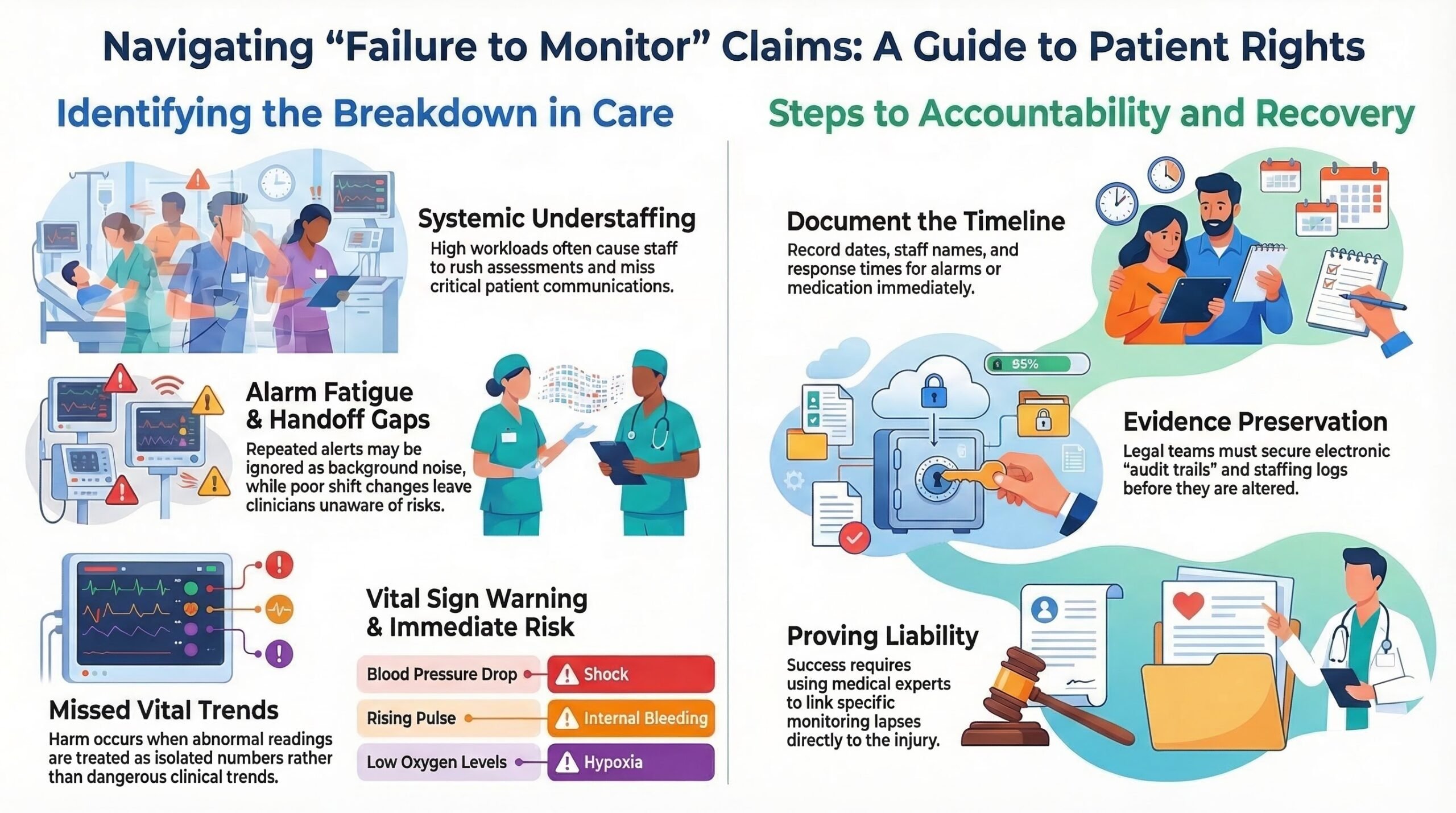
You’ll often see failure to monitor injuries stem from understaffing and high workloads, which can narrow attention and disrupt consistent patient checks.
You may also face missed essential sign changes and poor shift handoff communication, where crucial information doesn’t transfer clearly or promptly between caregivers.
When alarms go unanswered or responses are delayed, you can end up with preventable complications that escalate quickly.
Understaffing And High Workloads
Understaffing and high workloads often lie at the center of failure to monitor injuries because they reduce the time and attention staff can devote to each patient.
When you’re responsible for too many rooms, you may rush assessments, delay rounding, and miss critical communications during handoffs, even while trying to serve with excellence.
You also face more interruptions, which increase documentation gaps and weaken follow-through on provider orders.
You can often trace these risks to systemic staffing decisions rather than personal dedication.
Facilities that invest in recruitment strategies and staff retention tend to stabilize teams, preserve institutional knowledge, and reduce reliance on overextended float or agency coverage.
When leaders set realistic assignments and protect break coverage, you can stay present, respond promptly, and sustain the careful oversight patients depend on.
Missed Vital Sign Changes


High workloads often create the conditions where crucial sign changes go unnoticed, but the injury usually occurs when abnormal readings aren’t recognized, rechecked, or acted on in time. You serve patients best by treating trends as warnings, not single numbers, and by confirming unexpected results before documenting them as stable.
Wearable tech can strengthen oversight by flagging subtle deterioration, yet you must still validate alerts and promptly escalate care. Patient education also matters because informed patients report dizziness, shortness of breath, or new pain sooner.
| Essential sign | Risk if missed | Your immediate action |
|---|---|---|
| Blood pressure drop | Shock | Recheck, notify provider |
| Rising pulse | Bleeding | Assess, escalate |
| Low oxygen | Hypoxia | Apply O2, reassess |
| Fever | Sepsis | Culture, treat, monitor |
Poor Shift Handoff Communication
Although charting systems capture vast amounts of data, poor shift handoff communication still causes critical details to fall through the cracks when responsibility changes from one care team to the next.
OUR CONSULTATIONSARE FREE
START YOUR FREE CASE REVIEW

When you receive a patient, you can’t assume the record tells the whole story, because nuanced concerns, evolving symptoms, and family observations may not be emphasized. If you give report without structure, you may omit recent changes, pending labs, medication effects, or mobility limits, leaving the next clinician unaware of risk.
You protect patients best when you use Standardized Checklists to confirm diagnoses, current priorities, and required reassessments. You also strengthen safety by investing in Communication Training that promotes clear summaries, closed-loop questions, and respectful clarification.
Delayed Response To Alarms


Even when a shift handoff is thorough, patients can still suffer if bedside alarms don’t prompt timely action. When you’re stretched thin, repeated alerts can blend into background noise, and Alarm Fatigue can delay an urgent bedside check. You may also dismiss warnings after frequent False Alarms, yet the next signal could mark hypoxia, bleeding, or a fall risk.
You serve best by treating every alarm as time-sensitive: confirm the patient first, then troubleshoot the equipment.
| Breakdown | What you may see | Patient risk |
|---|---|---|
| Alarm overload | nonstop beeps | delayed intervention |
| Poor routing | alerts not escalated | missed deterioration |
| Device issues | loose leads, low battery | inaccurate readings |
If delays caused harm, you can document timelines, preserve monitor logs, and seek counsel promptly.
Legal Rights of West Palm Beach Failure to Monitor Patient Injury Victims
When a hospital, nursing home, or care facility in West Palm Beach fails to properly monitor a patient, and that lapse causes harm, you still have enforceable legal rights under Florida law.
You can seek accountability in a way that honors the patient’s dignity, supports safer care for others, and respects the realities of serious injury.
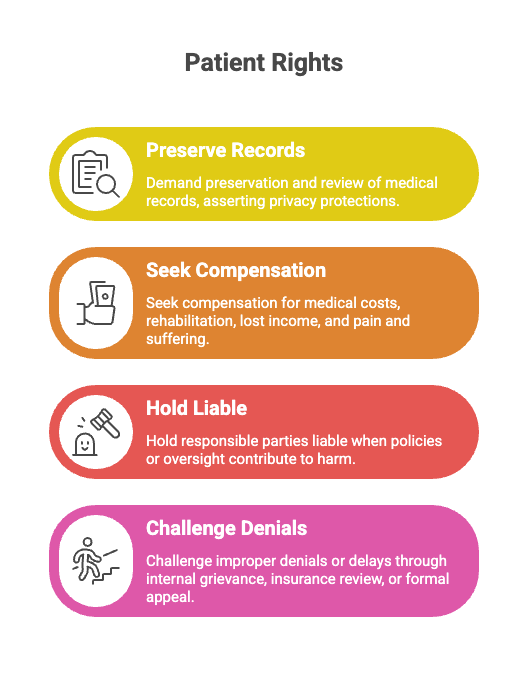
- You can demand preservation and review of medical records, including logs, staffing notes, and device data, while asserting strict privacy protections.
- You can seek compensation for medical costs, rehabilitation, lost income, and pain and suffering resulting from negligent monitoring.
- You can hold responsible parties liable, including facilities, contractors, and supervising clinicians, when policies or oversight contribute to the harm.
- You can challenge improper denials or delays through an internal grievance process, an insurance review, or a formal appeal, depending on the setting.
You don’t have to accept vague explanations, and you may insist on clear documentation and truthful answers.
Steps to Take After a West Palm Beach Failure to Monitor Patient Injury
Get immediate medical care to stabilize your condition and make sure your injuries are properly evaluated, even if symptoms seem minor at first.
Document the monitoring lapses as thoroughly as you can, including dates, times, staff names, and any records or communications that show what was missed or ignored.
Then contact a local attorney in West Palm Beach, because you’ll need timely guidance to preserve evidence and protect your rights.
Seek Immediate Medical Care
How quickly you respond after a failure to monitor can shape both your recovery and the strength of any later claim.
If you notice Emergency Symptoms such as chest pain, shortness of breath, confusion, uncontrolled bleeding, or a sudden change in consciousness, you shouldn’t wait or “see if it passes.” Call 911 or go to the nearest emergency department so clinicians can stabilize you and start a Rapid Assessment.
Even if symptoms seem mild, seek prompt evaluation from a qualified provider who can check critical signs, order appropriate tests, and adjust treatment before complications escalate. Tell the medical team what happened, including when you noticed the changes, and ask what warning signs should prompt an urgent return to care.
Acting quickly protects your health and supports your commitment to others who rely on you.
Document Monitoring Lapses
Even if you’re focused on treatment, you should begin documenting any monitoring lapse as soon as you can, because accurate records often determine what clinicians can fix now and what can be proven later.
Write a clear timeline of symptoms, alarms, essential sign checks, medication times, and staff responses, and note names and roles when you can.
Save discharge papers, visit summaries, and medication lists, and request copies of relevant chart entries.
If the facility uses electronic records, ask that Audit Trails be preserved so access, edits, and timestamps remain visible.
Keep your own files organized with Version Control, labeling each update by date so details don’t shift over time.
If others witnessed the lapse, ask them to write brief, factual statements.
Store everything securely, and share only with your care team.
Contact A Local Attorney
After you’ve secured immediate care and pulled your initial records collectively, contacting a West Palm Beach attorney who handles failure-to-monitor cases can help you protect your options before critical evidence disappears.
You can ask the lawyer to request chart audits, staffing logs, alarm histories, and surveillance footage, and to send preservation notices promptly.
During your consultation, you should share your timeline, names of providers, and any communications you kept, so the legal team can assess duty, breach, and causation.
Prioritize firms with clear Appointment Scheduling, because timely meetings support decisive next steps.
Also confirm Office Accessibility, including after-hours contact options and accommodations, so you can stay engaged while focusing on recovery.
When you act quickly, you also strengthen accountability and help protect future patients in your community.
How a West Palm Beach Failure to Monitor Patient Lawyer Can Help You
When a hospital or care facility fails to observe changes in a patient’s condition, the consequences can escalate quickly.
You may be left trying to understand what went wrong and who should be held responsible.
A West Palm Beach failure-to-monitor-patient lawyer helps you act with purpose, protect those you serve, and pursue accountability without adding unnecessary strain.
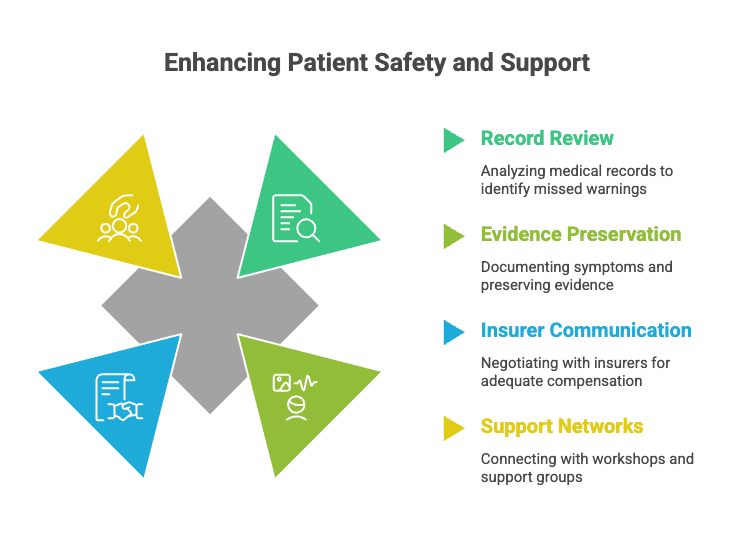
- You’ll get a clear review of records, staffing logs, and monitoring protocols to identify missed warnings.
- You’ll receive guidance on preserving evidence, documenting symptoms, and coordinating timely follow-up care.
- Your lawyer can communicate with insurers and facilities, so you don’t face pressure to accept an inadequate explanation.
- You can connect with Preventive Workshops and Support Networks that strengthen families, caregivers, and community advocates.
Long-Term Effects of West Palm Beach’s Failure to Monitor Patient Injuries
When a facility fails to monitor you properly, you can face chronic disability and persistent pain that limit your mobility, work, and independence.
You may also experience cognitive and neurological decline, including confusion, memory problems, or worsening function, especially when complications go unrecognized for too long.
As these injuries progress, you’re often left managing mounting medical bills, ongoing therapy, and increased caregiving needs that can strain your finances and long-term plans.
Chronic Disability And Pain
Although a missed change in your condition may seem minor at first, a failure to monitor a patient in West Palm Beach can trigger chronic disability and persistent pain that lasts for years.
When staff overlooks worsening symptoms, you may lose strength, mobility, and independence, making routine tasks harder and limiting how you serve your family and community.
Delayed intervention can also allow treatable complications to become permanent, increasing your need for assistive devices, home support, and ongoing therapy.
You’re then forced into long-term Pain Management, often involving frequent appointments, medications, and coordinated care that should’ve started sooner.
At the same time, Lifestyle Adjustments become necessary, such as modified work duties, structured rest, and safe movement plans.
Careful documentation of setbacks, limitations, and treatment gaps can later clarify accountability and support your recovery needs.
Cognitive And Neurological Decline
Chronic pain and disability often bring lasting physical limits, but a failure to monitor a patient in West Palm Beach can also cause cognitive and neurological decline that reshapes your daily function.
You may notice slower processing, memory lapses, headaches, dizziness, or new mood changes that make it harder to serve others with steadiness and patience. When monitoring is missed, untreated infections, medication toxicity, oxygen deprivation, or strokes can progress, and these injuries may compound over time.
You can support recovery by documenting symptoms, requesting a timely neurological assessment, and following a structured plan that includes neuroplasticity training to rebuild attention and coordination. You can also apply dietary neuroprotection through clinician-approved nutrition, hydration, and sleep routines, which can help stabilize energy levels, reduce inflammation, and protect brain health.
Financial And Care Burdens
Financial strain often becomes the most persistent consequence of a West Palm Beach failure to monitor a patient, because preventable complications can turn a short hospital stay into years of added care.
You may face escalating Medical expenses, including rehospitalizations, specialty providers, prescriptions, mobility devices, and home modifications that insurance may not fully cover.
When work hours drop to coordinate treatment, lost income compounds the damage and threatens long-term stability.
You also carry the daily operational burden of care.
You may need to manage medications, appointments, wound care, and safety supervision, often without adequate training or respite.
Over time, constant vigilance can lead to Caregiver burnout, which undermines your health and your ability to serve your loved one well.
Care planning and legal guidance can help you pursue accountability and stabilize support.
Proving Liability in West Palm Beach Failure to Monitor Patient Car Accident Injury Cases
When a medical provider fails to monitor a patient, and that lapse contributes to a car crash, you must prove liability with clear, well-supported evidence.
You’ll focus on duty, breach, causation, and foreseeable harm, showing how proper monitoring would’ve identified warning signs and prevented an unsafe condition from reaching the roadway.
Prove duty, breach, causation, and foreseeable harm—showing proper monitoring would’ve caught warnings before an unsafe condition reached the road.
Start with Evidence Preservation.
You should request complete medical records, monitoring logs, medication administration sheets, discharge instructions, and follow-up notes, then secure 911 calls, crash reports, vehicle data, and witness statements.
You’ll also document timelines that link clinical changes to the driving event, since gaps and delays often reveal negligence.
Next, use Expert Testimony to explain the applicable standard of care and why the provider’s choices fell below it.
A qualified clinician can connect the monitoring failure to impaired driving capacity, while a crash reconstruction expert can clarify how that impairment affected the collision sequence.
Compensation for West Palm Beach Failure to Monitor Patient Damages
How do you calculate fair compensation after a provider’s failure to monitor a patient helps set the stage for a serious car crash?
You start by documenting every measurable loss and every human cost, then you connect each item to the monitoring lapse and the collision’s aftermath.
You may recover medical expenses, rehabilitation, future care, lost income, reduced earning capacity, and property damage, along with pain, disability, and loss of enjoyment of life.
When your injuries affect your ability to serve your family, patients, or community, that functional impact warrants careful valuation.
In appropriate cases, you may also pursue punitive damages to address reckless disregard for patient safety and to promote higher standards of care.
Your attorney can evaluate whether structured settlements fit your long-term needs, especially when future treatment or household support is expected.
Clear records, credible experts, and consistent testimony strengthen your demand and help you reach a fair resolution.
The Statute of Limitations for West Palm Beach Failure to Monitor Patient Injury Cases
Fair compensation won’t matter if you miss the legal deadline to file, so you should address timing as carefully as you document damages.
In West Palm Beach, failure to monitor cases, Florida’s medical malpractice statute of limitations often controls, and it can move faster than you expect when the harm involves delayed recognition of warning signs.
You should identify the first date you knew, or reasonably should’ve known, that negligent monitoring caused injury, because the discovery rule may start the clock then, not on the day of treatment.
Pinpoint when you knew, or should’ve known, negligent monitoring caused harm—the discovery rule may start the deadline then.
Even so, you can’t assume extra time will apply.
Strict outer deadlines may still bar older claims, and courts apply them carefully.
You should also preserve records early, since tolling exceptions are narrow and fact-specific, such as concealment, incapacity, or other legally recognized barriers.
Acting promptly supports accountability and protects the patient’s right to care and justice.
Why You Need an Experienced West Palm Beach Failure to Monitor Patient Lawyer
Although failure-to-monitor cases may look straightforward on the surface, you’ll need an experienced West Palm Beach failure-to-monitor patient lawyer to identify exactly where the care team fell short and to prove that the lapse caused measurable harm.
You’ll rely on counsel to secure records, interpret physiological readings and nursing notes, and coordinate qualified experts who can explain how delayed action changed the outcome.
You also need a lawyer who can quantify losses, including follow-up care, diminished earning capacity, and the practical burdens your family now carries while serving a recovering loved one.
| What must be shown | Evidence you’ll need | How experience helps |
|---|---|---|
| Duty and breach | Policies, logs, staffing | Exposes system gaps |
| Causation | Timelines, expert review | Links lapse to injury |
| Damages | Bills, projections, testimony | Proves full impact |
An experienced advocate can also support Preventative education and Policy advocacy, so safer monitoring practices protect future patients.
How to Choose the Right West Palm Beach Failure to Monitor Patient Lawyer for Your Case
When you’re deciding which West Palm Beach failure to monitor patient lawyer to trust, focus on proven case selection, disciplined investigation, and a track record of results in medically complicated claims.
You should choose counsel who evaluates facts carefully, declines weak matters, and commits resources to cases that can truly protect patients and families.
Use a Consultation checklist to compare firms consistently.
Ask who’ll handle your file, how they obtain and review records, and whether they work with qualified medical experts.
Confirm they understand hospital monitoring standards, medication safety, and rapid-response protocols, then ask how they’ll prove causation and damages.
Request clear timelines for updates, and look for responsiveness that reflects respect for your responsibility to others.
Insist on Fee transparency from the start.
You should receive a written explanation of costs, contingency terms, and how expenses are handled if recovery doesn’t occur.
About the Law Offices of Anidjar and Levine
Selecting counsel is only the first step; you also need a firm that has the resources and discipline to investigate monitoring failures and present them persuasively.
With the Law Offices of Anidjar and Levine, you’ll work with a team that keeps the focus on patient safety, accountability, and service to families facing preventable harm.
You can review the firm’s history to understand how the practice has built systems for timely evidence gathering, record analysis, and coordination with qualified medical reviewers.
You’ll also find attorney profiles that show who’ll handle your matter, what experience they bring, and how they communicate with clients throughout the process.
When you’re called to help a loved one after a serious lapse in care, you need advocates who act decisively, document every failure to monitor, and pursue fair compensation with professional resolve.
You’ll receive clear updates, practical guidance, and disciplined preparation at each stage.
Frequently Asked Questions
What Is the Difference Between Failure to Monitor and Nursing Negligence?
Failure to monitor is a specific type of nursing negligence focused on inadequate observation, missed reassessments, or delayed responses to changes under accepted Monitoring Standards.
Nursing negligence is broader, covering any Duty Breach in care, such as medication errors, poor documentation, unsafe transfers, or failure to communicate.
You’ll distinguish them by asking whether the primary lapse involved ongoing surveillance and timely intervention, or another clinical responsibility within the nurse’s role overall.
Can I Sue if the Patient Was Already Terminally Ill?
Yes, you can sue even if the patient was terminally ill, if negligent care worsened suffering or shortened life.
You’ll need evidence that providers breached a duty and caused measurable harm beyond the underlying disease.
If the patient died, you may pursue wrongful death for survivors’ losses, and a survival action claim for the patient’s pain, medical costs, and other damages incurred before death.
You serve others by seeking accountability.
How Are Medical Records Obtained if the Hospital Refuses Access?
If the hospital refuses access, you can obtain records by submitting a written HIPAA request to its medical records department and documenting all denials.
You should ask your attorney to issue an attorney subpoena for certified copies when a lawsuit is filed.
If the facility still blocks production, you can request a court order compelling release and sanctions.
You’ll best serve the patient’s interests by maintaining timelines, proof of delivery, and complete correspondence.
Will Filing a Claim Affect the Patient’s Immigration Status or Benefits?
Filing a claim usually won’t affect your immigration status or public benefits, but you must consider Visa Impact and Benefit Eligibility in your specific situation.
You should avoid false statements, since inconsistencies can create complications in immigration or agency reviews.
You can pursue compensation without disclosing unnecessary immigration details, and you should request legal guidance before accepting settlements that change income or assets.
You’ll protect yourself and better serve your family and community.
Can I Pursue a Claim if the Incident Happened in a Rehabilitation Facility?
Yes, you can pursue a claim if the incident occurred in a rehabilitation facility, and you should act promptly.
You’ll evaluate whether staff met licensing requirements and followed accepted care standards.
You can also review the facility’s contractual obligations to you, including supervision, safety, and documentation duties.
Gather incident reports, care plans, and witness names, then request records in writing.
—————————
If you’ve suffered harm because a medical provider didn’t properly monitor your condition, you don’t have to face the aftermath alone.
You can protect your rights by documenting what happened, seeking appropriate care, and consulting the Law Offices of Anidjar and Levine.
An experienced West Palm Beach failure to monitor patient lawyer or West Palm Beach Medical Malpractice Lawyer can evaluate liability, gather records, and pursue compensation for your losses.
Act promptly, because strict deadlines may limit your ability to file.

