

We handle Port St. Lucie truck accident cases by securing the scene evidence fast, identifying witnesses, and sending preservation letters to protect ELD data, onboard video, maintenance files, and dispatch records before they’re lost.
The Law Offices of Anidjar and Levine then builds liability around FMCSA regulations, comparing logs to fuel, toll, and telematics records, and targeting all responsible parties, including carriers, brokers, and maintenance providers.
We document medical impacts and wage loss to support full damages and stronger settlement leverage.
to learn the next steps and what to expect with a Port St. Lucie Truck Accident Lawyer.
Main Takeaways
- A Port St. Lucie truck accident lawyer can investigate FMCSR violations, such as hours-of-service, maintenance, and driver qualification noncompliance, to prove negligence.
- Fast evidence preservation matters: send spoliation letters, secure ELD/telematics and onboard video, and document the chain of custody before data is overwritten.
- A regulations-focused investigation compares logs to fuel, toll, and dispatch records to expose falsified timelines and fatigue-related driving.
- The lawyer can target all liable entities, including carriers, dispatch controllers, brokers, maintenance providers, and cargo handlers involved in safety decisions.
- Strong claims link regulatory violations to causation and damages, using medical records, wage-loss documentation, and audit-ready evidence for settlement or trial.


How We Can Help With Your Port St. Lucie Truck Accident Federal Regulations Claim
Act quickly after a Port St. Lucie truck crash, because essential records can disappear and witnesses’ memories can fade.
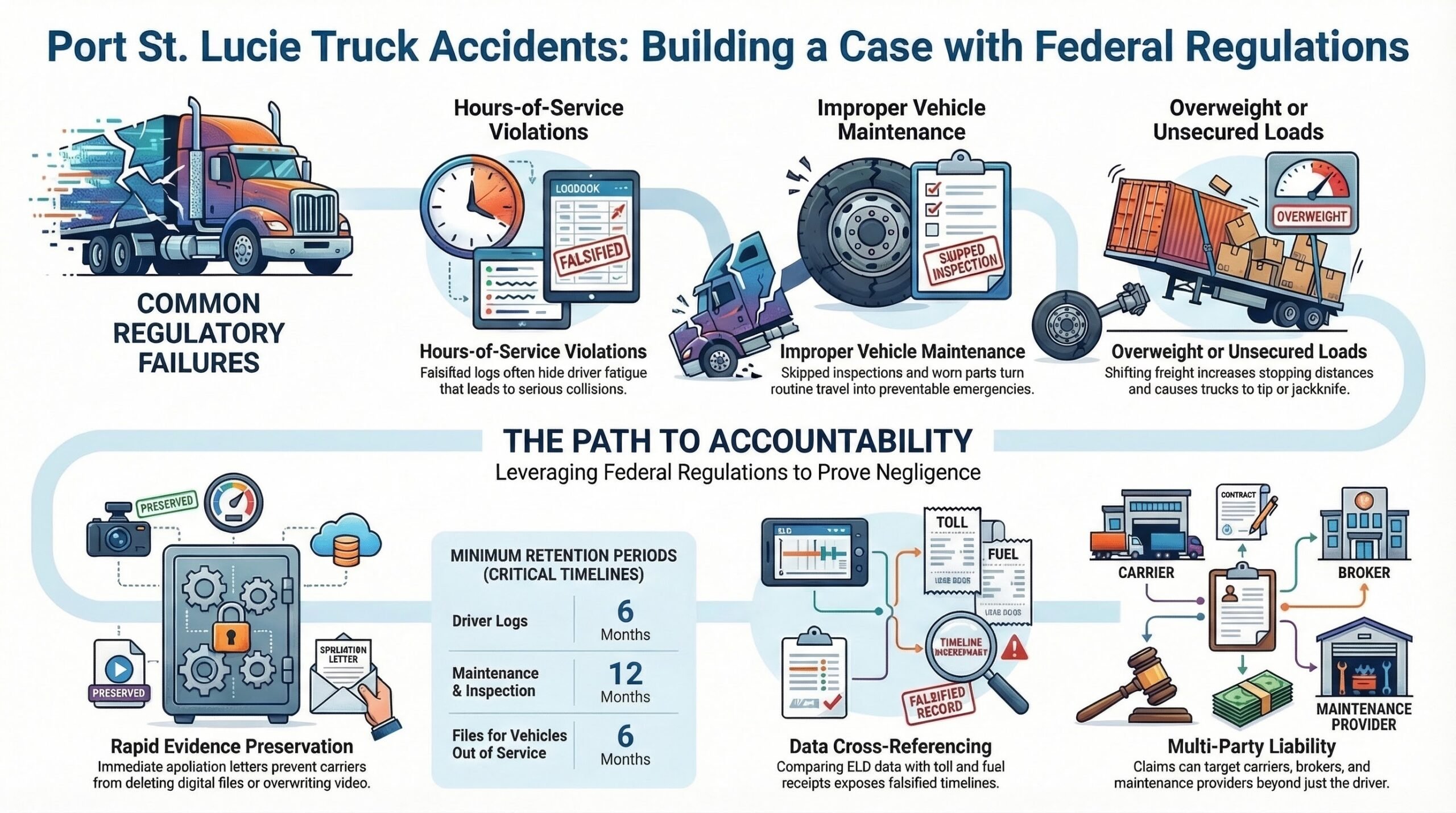
We help you pursue a federal regulations claim by preserving evidence, sending spoliation letters, and securing inspection reports, driver qualification files, and electronic logging data.
Preserve critical evidence fast—spoliation letters, inspection reports, driver qualification files, and electronic logging data to support federal regulations claims.
We coordinate timely medical documentation, calculate wage loss, and present a clear damages narrative that supports fair settlement demands.
If negotiations stall, we prepare the case for litigation, using focused discovery and disciplined case management.
We also keep your goals central, so your recovery supports your family and lets you continue serving your community.
Our multilingual support facilitates clear communication, and our community outreach helps connect you with local resources during recovery.
Throughout the process, we provide structured updates, honest risk assessments, and practical guidance, so you can make informed decisions at each stage.
OUR CONSULTATIONSARE FREE
START YOUR FREE CASE REVIEW

Understanding Port St. Lucie Truck Accident Federal Regulations Cases
Because trucking collisions often involve commercial carriers operating under strict federal oversight, we approach Port St. Lucie truck accident cases involving federal regulations with careful structure and purpose.
These matters often turn on how the Federal Motor Carrier Safety Regulations apply to the driver, carrier, and any entity that controlled dispatch, maintenance, or cargo handling.
We review logbooks, inspection reports, electronic data, and company policies to identify where compliance broke down and how that failure connects to the harm you’re facing.
We also study regulatory history to understand why each rule exists and what conduct it was designed to prevent.
That context helps us explain the standards in plain terms and present them persuasively.
Finally, we rely on case precedents to anticipate defenses, frame admissible evidence, and evaluate settlement value.
When you’re serving your family and community through recovery, we’ll serve you by building a disciplined, regulation-based claim.


Common Causes of Port St. Lucie Truck Accident Federal Regulations
When we assess truck crashes in Port St. Lucie, we often find that breakdowns in federal regulations directly contribute to how and why the collision occurred.
We’ll explain how hours-of-service violations, improper truck maintenance, and overweight or unsecured loads can create predictable, preventable hazards on the road.
We’ll also address distracted or impaired driving, and how these behaviors intersect with compliance duties that carriers and drivers can’t ignore.
Hours-Of-Service Violations
Although federal hours-of-service rules exist to limit fatigue and keep commercial drivers alert, violations remain a frequent factor in serious truck crashes in Port St. Lucie.
When drivers or carriers push beyond legal limits, reaction time slows, judgment narrows, and the risk to families sharing the road rises.
We often see logs that don’t match fuel stops, toll records, dispatch messages, or onboard data, even with Electronic Logging in place.
We also review whether drivers skipped required Rest Breaks, altered duty status, or accepted unrealistic delivery windows.
If you’re hurt, we’ll work to protect the public by identifying scheduling pressure, verifying time records, and showing how fatigue contributed to the collision.
Our goal is accountability and safer roads for everyone.
Improper Truck Maintenance
Even as carriers operate under strict federal maintenance and inspection rules, improper truck maintenance remains a common cause of serious crashes in Port St. Lucie.
When fleets cut corners, worn brakes, failing lights, and handling defects can turn routine travel into a preventable emergency, placing the public at needless risk.
We often see records showing skipped service intervals, incomplete driver vehicleinspection reports, or repairs delayed until after a breakdown.
Brake corrosion can reduce stopping power and increase heat, especially during repeated braking in traffic.
Tire inspection failures also matter because underinflation, tread separation, and sidewall damage can trigger loss of control without warning.
If you’re harmed, we’ll pursue maintenance logs and inspection history to help protect others.
Overweight Or Unsecured Loads
Because cargo weight and securement directly affect braking distance, stability, and handling response, overweight or unsecured loads remain a frequent cause of serious truck crashes in Port St. Lucie.
When a carrier exceeds legal limits or ignores proper Load distribution, the truck can sway, tip, or jackknife, especially during sudden stops or lane changes.
Shifting freight also increases stopping distance and reduces directional control, placing nearby drivers at unnecessary risk.
We focus on service by holding companies to the federal standards that protect the public, including accurate weight documentation and compliant Cargo restraints.
If a load is poorly secured, straps, chains, or blocking may fail, allowing cargo to spill into traffic and trigger multi-vehicle collisions, with catastrophic results.
Distracted Or Impaired Driving
When a truck driver divides attention between the road and a phone, dispatch device, or other in-cab task, a routine traffic situation can turn into a high-impact crash in seconds.
Cellphone distraction often means delayed braking, missed signals, and unsafe lane changes, especially in heavy Port St. Lucie traffic. Federal safety rules limit certain handheld use, yet violations still occur, endangering everyone nearby.
Impairment creates similar risks, even without illegal drugs or alcohol.
Fatigue, over-the-counter medications, and prescription impairment can slow reaction time and distort judgment, making a fully loaded tractor-trailer harder to control. When we investigate, we review logs, camera footage, toxicology reports, and dispatch records, and then we help you pursue accountability to promote safer roads for all.
Legal Rights of Port St. Lucie Truck Accident Federal Regulations Victims
Although Florida traffic laws apply to any collision, truck accident victims in Port St. Lucie often gain additional protections under federal truckingregulations governing drivers, carriers, and maintenance practices.
When you’ve been harmed, we can help you assert rights that honor both accountability and community safety, while safeguarding your privacy rights during investigations and litigation.
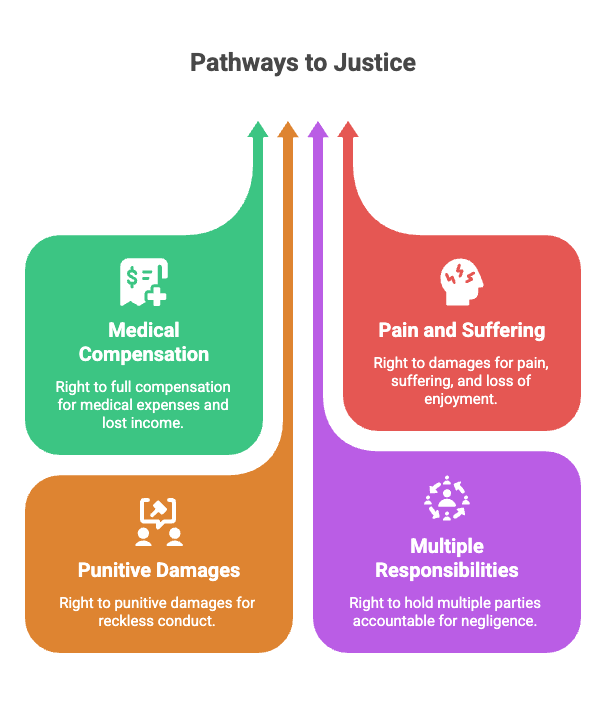
Your legal rights commonly include:
- The right to pursue full compensation for medical costs, lost income, and reduced earning capacity.
- The right to seek damages for pain, suffering, and loss of enjoyment of life.
- The right to request punitive damages when reckless conduct shows conscious disregard for human life.
- The right to hold multiple parties responsible, including the driver, motor carrier, broker, or maintenance provider.
We also work to make certain evidence is preserved, communications stay appropriate, and your claim reflects the real impact on your family and those who rely on you every day.
Steps to Take After a Port St. Lucie Truck Accident: Federal Regulations
After a Port St. Lucie truck accident, we’ll help you prioritize safety and secure critical evidence at the scene, because early steps can shape a federal-regulations claim.
We’ll also urge you to report the crash and any injuries promptly to ensure official records accurately reflect what happened.
Finally, we’ll guide you in preserving federal compliance records, including driver logs, inspection and maintenance reports, and carrier policies that may establish violations.
Secure Evidence And Safety
Act quickly to protect everyone’s safety and preserve proof that may determine liability under federal trucking regulations.
We’ll help you move vehicles out of traffic when possible, set out warning triangles or flares when available, and keep bystanders at a safe distance to prevent further harm.
We should photograph the scene from multiple angles, capturing vehicle positions, skid marks, debris fields, road signs, weather, and any visible cargo issues.
We’ll identify witnesses and record names and contact details while memories remain fresh, and we won’t alter damaged parts or clean debris that may show impact points.
For electronic proof, we’ll request logs and dashcam files, then store copies with digital encryption and strict access control to prevent tampering and support later analysis.
Report Crash And Injuries
Notify the proper authorities and document every reported injury as soon as the scene is stable.
We should call 911, request law enforcement, and make sure emergency medical services evaluate everyone, even when symptoms seem minor.
When you can, we’ll use Mobile Reporting tools to note the time, location, vehicles involved, and visible hazards, because accurate initial details often guide later decisions.
We’ll also encourage you to report any pain, dizziness, or numbness immediately and to seek prompt medical assessment.
If transport is required, we can coordinate with a Hospital Liaison to help communicate your condition, confirm where you’re treated, and ensure family members receive reliable updates.
As we serve you, we’ll keep our focus on clear facts, timely notifications, and consistent injury documentation.
Preserve Federal Compliance Records
Once the scene is documented and medical concerns are addressed, we should move quickly to preserve federal compliance records that can explain why the crash happened and whether the trucking company followed the rules.
We’ll ask for driver qualification files, hours-of-service logs, ELD data, drug and alcohol testing results, maintenance and inspection reports, load manifests, and dispatch communications.
We should send a preservation letter immediately, directing the carrier and its insurers to retain paper and digital files, including telematics and video, before routine deletion cycles.
If needed, we’ll seek court orders to prevent spoliation.
Strong audit readiness often depends on complete, time-stamped records, so we’ll request metadata and chain-of-custody details.
We’ll also secure copies and verify cloud backups to protect the public and future victims, too.
How a Port St. Lucie Truck Accident Federal Regulations Lawyer Can Help You
How do federal trucking regulations shape the outcome of a Port St. Lucie crash claim?
We use those standards to show what a carrier, driver, or broker should’ve done, and to measure where they fell short.
By aligning your facts with FMCSA rules, we build a clear, service-minded case that holds others accountable and protects others on the road.
Here’s how we can help you move forward with purpose and precision:
- Secure logs, inspection reports, ELD data, and maintenance files before they’re altered or lost.
- Analyze hours-of-service, drug and alcohol testing, cargo securement, and training compliance for actionable violations.
- Coordinate Medical navigation so your care stays organized while documentation supports your claim.
- Provide Multilingual support so your family understands every step, deadlines, and settlement terms.
We handle insurer tactics, calculate fair damages, and prepare for trial if needed, while keeping you informed.
Long-Term Effects of Port St. Lucie Truck Accident Federal Regulations Injuries
When a truck crash in Port St. Lucie involves federal regulatory violations, we often see injuries that don’t end with the initial treatment, and we want you to understand what that can mean for your future.
We’ll explain how chronic pain and lasting disability can limit work and daily function, and how traumatic brain injuries may affect memory, focus, and long-term independence.
We’ll also address the emotional and psychological trauma many people experience, including anxiety, sleep disruption, and persistent stress that can complicate recovery.
Chronic Pain And Disability
Living with chronic pain after a Port St. Lucie truck crash can reshape work, sleep, and basic mobility, especially when injuries don’t recover cleanly.
We often see persistent back, neck, and joint pain develop into lasting disability, limiting lifting, driving, and even household tasks.
We encourage early documentation, consistent follow-up care, and a structured Pain Management plan that matches your values and responsibilities to others.
When movement becomes unsafe or exhausting, Adaptive Equipment such as braces, walkers, or modified vehicle controls can preserve independence and reduce flare-ups.
We also help you track how pain affects your daily functioning, because insurers may minimize invisible limitations.
Together, we can pursue compensation to support ongoing treatment, home adjustments, and lost earning capacity over time.
Traumatic Brain Injury Impacts
Uncertainty often follows a traumatic brain injury after a Port St. Lucie truck crash, and long-term effects can disrupt daily routines, work performance, and independent decision-making.
We help you understand how attention, processing speed, memory, and executive function may change over time, even when scans appear normal.
With consistent Cognitive Rehabilitation, many people strengthen skills through structured practice, adaptive strategies, and coordinated therapy goals.
We also encourage practical planning, because safety, medication management, driving readiness, and return-to-work demands often require step-by-step evaluation.
As you serve your family and community, Social Reintegration matters, and we can support planning for communication accommodations, accessible transportation, and reliable caregiving schedules.
Emotional And Psychological Trauma
Although physical injuries often receive the earliest attention after a Port St. Lucie truck crash, emotional and psychological trauma can shape your recovery for months or years.
We often see clients struggling with PTSD symptoms, including intrusive memories, hypervigilance, and persistent avoidance of driving or highways.
These reactions may strain families, disrupt work performance, and reduce a person’s capacity to serve others in their home, faith, or community.
Sleep disturbances are also common, and chronic fatigue can worsen pain, irritability, and concentration problems.
We encourage prompt screening, counseling, and coordinated care because documentation matters and early support can prevent escalation.
When federal regulation violations contribute to a collision, we can pursue accountability while you focus on rebuilding stability, purpose, and daily function.
Proving Liability in Port St. Lucie Truck Accident, Federal Regulations, Injury Cases
When a Port St. Lucie truck collision involves federal trucking regulations, we prove liability by building a clear, service-minded record that protects you and the community.
We identify every responsible party, including the driver, motor carrier, broker, shipper, and maintenance provider, and then link each party’s conduct to the harm caused.
We gather driver logs, ELD data, dispatch messages, inspection reports, weight tickets, and black-box data, and compare them against FMCSA rules on hours of service, maintenance, and driver qualification.
We also secure witness statements, roadway evidence, and expert reconstruction so the timeline can’t be reshaped later.
Venue Selection matters because the chosen court can affect access to witnesses, local rules, and trial logistics.
We address Comparative Fault directly, documenting your safe driving choices and challenging claims that shift blame without proof.
Our goal is accountability that honors those you serve.
Dealing With Insurance Companies After a Port St. Lucie Truck Accident: Federal Regulations
After a Port St. Lucie truck accident, insurance companies often move quickly to control the narrative, and we’ll help you respond with steady, service-minded discipline.
We shouldn’t give recorded statements or sign broad medical authorizations until we’ve reviewed the request, because adjusters may use gaps or imprecise wording to limit payments.
Don’t give recorded statements or sign broad medical authorizations until we review them—adjusters may use gaps to reduce payments.
We’ll document your losses with treatment records, proof of wages, and evidence of repairs, then present a clear demand that reflects federal trucking obligations without overarguing.
If Claim Denials arise, we’ll require written reasons, compare them with the policy terms, and promptly challenge unsupported positions.
We’ll also address Medical Liens early, coordinating with providers and insurers so care continues while the claim remains pending.
Throughout, we’ll keep communications professional, time-stamped, and consistent, protecting your credibility while aiming for a resolution that honors your recovery and your commitment to others.
What to Expect During a Port St. Lucie Truck Accident: Federal Regulations Claim Process
We’ll start with an initial case evaluation to understand what happened, identify liable parties, and outline how federal trucking rules may affect your claim.
Next, we’ll collect critical evidence and records, then conduct a focused federal compliance investigation that reviews driver logs, maintenance files, inspection reports, and carrier safety practices.
With that foundation, we’ll pursue resolution through negotiation when appropriate, or proceed to litigation when the facts and the stakes require it.
Initial Case Evaluation
Understanding what happens in an initial case evaluation helps us move quickly and accurately in a Port St. Lucie truck accident claim guided by federal regulations.
We’ll listen to your account, clarify timelines, and identify the parties involved, so we can assess whether the facts support a viable claim and where accountability may lie.
We’ll also explain our role and yours, establishing clear client expectations about communication, decision points, and realistic outcomes.
Because many people seek justice to protect others on the road, we’ll discuss how your case can promote safer practices while pursuing fair compensation.
Finally, we’ll review fee structures, including contingency arrangements and potential costs, so you can make an informed, service-minded choice without pressure.
If we can’t help, we’ll recommend the next steps.
Evidence And Records Collection
Because trucking cases turn on documentation governed by federal safety rules, we move early to secure the evidence and records that can prove what happened and who was responsible for each safety obligation.
We send preservation letters, request driver logs, dispatch records, bills of lading, maintenance files, and training materials, and we work to obtain onboard data and relevant video before it’s overwritten.
We also gather your medical records, wage information, and photos, so your losses are documented with care and respect.
When digital files matter, we use metadata analysis to trace creation, edits, and device sources, and we seek timestamp authentication to align events across systems.
Throughout this stage, we keep you informed, and we organize the record so your claim advances efficiently and accurately.
Federal Compliance Investigation
After we secure the vital records, we focus on whether the carrier, driver, and any contracting parties complied with the Federal Motor Carrier Safety Regulations and related safety guidance.
We compare logs, inspection reports, maintenance files, drug and alcohol testing, dispatch communications, and training records to federal requirements, looking for patterns that place the public at risk.
When appropriate, we review Agency Audits and safety ratings, then analyze how prior violations, corrective actions, or ignored warnings relate to your crash.
We also evaluate hours-of-service compliance, load securement practices, and qualification standards, because these rules exist to protect others on the road.
If regulators opened a case, we would track the applicable Enforcement Procedures and timelines and document gaps indicating preventable noncompliance.
We keep you informed with clear, mission-focused updates.
Negotiation Or Litigation Steps
Moving from regulatory findings to action, we map out a claim strategy that positions us to negotiate from strength while preparing every case as if it will be tried in court.
We begin by calculating losses, organizing evidence, and drafting a clear Demand Letter that ties the carrier’s violations to your harm and requested relief.
If the insurer responds, we manage deadlines, evaluate offers, and keep you informed so you can choose a path that serves your family and community.
When talks stall, we implement Mediation Strategies, using focused briefs, targeted exhibits, and disciplined communication to narrow issues and test settlement value.
If fair terms remain out of reach, we file suit, conduct discovery, take depositions, and present motions that enforce federal standards.
Throughout, we act with purpose and steadiness.
Compensation for Port St. Lucie Truck Accident Federal Regulations Damages
While truck crash claims often focus on immediate medical bills and vehicle damage, federal trucking regulations can expand the range of compensation we can pursue in Port St. Lucie.
When a carrier violates FMCSA safety rules, we can connect those breaches to the harm you suffered and strengthen the value of your claim.
We gather logbooks, inspection records, driver qualification files, and electronic data to show how preventable conduct caused the collision and worsened its impact.
In severe cases, we may seek punitive damages when the evidence shows reckless disregard for public safety, because accountability protects others on our roads.
We also evaluate structured settlements when long-term care, guardianship, or future support is needed, since predictable payments can reduce risk and preserve eligibility for certain benefits.
Throughout the process, we keep your goals central, pursue fair resolution, and press for full compliance-driven recovery without delay.
Economic vs Non-Economic Damages in Port St. Lucie Truck Accident Federal Regulations Cases
We’ll explain economic damages by focusing on the measurable costs you can document, such as medical bills, lost wages, and future care needs.
We’ll also address non-economic losses, including pain and suffering and reduced quality of life, and how we build a clear, credible value for those harms.
Finally, we’ll show how federal trucking regulations can strengthen your claim by establishing safety standards and supporting liability when violations contribute to the crash.
Economic Damages Explained
Because truck collisions in Port St. Lucie often trigger federal safety rules, we help you identify economic damages that can be measured and documented.
These losses typically include past and future medical bills, rehabilitation, prescription costs, mileage to treatment, and necessary home or vehicle modifications.
We also pursue wage loss, reduced earning capacity, and the value of missed employment benefits, using payroll records and vocational support when needed.
If you own a company, we can document business interruption through invoices, contracts, and profit-and-loss statements, then connect that impact to the crash timeline.
We also evaluate property damage and replacement costs, including specialty equipment.
Finally, we plan for tax implications so any recovery aligns with your financial responsibilities and long-term stability.
Non-Economic Losses Valuation
Economic losses give us a documented baseline for what the crash costs you, yet they don’t capture the human impact that follows a serious truck collision.
When we value non-economic losses, we focus on pain, emotional distress, loss of enjoyment of life, inconvenience, and the strain on family relationships.
We’ll help you describe how daily routines changed, what activities you can’t do, and how sleep, mobility, and independence were affected.
We also gather consistent narratives from medical notes, therapy records, and trusted witnesses, so your experience is presented with dignity and accuracy.
While no formula is perfect, we use recognized evaluation methods informed by international standards and historical trends in comparable cases, aiming for a fair figure that reflects the true cost of harm in Port St. Lucie.
Federal Regulations Impact
Although trucking collisions often look like ordinary negligence cases at first glance, federal safety regulations can reshape how we prove fault and, in turn, how we support both economic and non-economic damages in Port St. Lucie.
When a carrier violates hours-of-service rules, inspection mandates, or maintenance standards, we can connect that breach to crash causation and strengthen liability arguments.
That foundation helps us document medical bills, lost wages, future care, and other Economic Consequences with clearer, verifiable timelines and records.
It also supports non-economic harms, since compliance failures can explain the severity and duration of pain, disruption, and loss of enjoyment.
We serve you best by pursuing Regulatory Enforcement evidence, including logbooks, ELD data, and safety audits, then presenting it in a disciplined damages narrative.
When a Port St. Lucie Truck Accident Federal Regulations Case Goes to Trial vs Settlement
When federal trucking regulations play a central role in a Port St. Lucie case, we usually pursue a settlement first because it can provide timely resources for medical care and family stability.
We present clear proof, such as hours-of-service logs, maintenance records, and hiring files, to show how safety rules were broken and why your losses merit full value.
If the insurer denies responsibility, minimizes harm, or disputes critical regulatory violations, we may recommend a trial to protect the community and deter repeat misconduct.
At that stage, we prepare for juror bias by refining themes, selecting credible experts, and presenting the rulebook in plain language.
We also use venue strategy, evaluating where the crash occurred, where witnesses live, and where a fair, attentive jury is most likely.
Throughout, we stay service-minded, so every decision reflects your needs and long-term recovery goals.
The Statute of Limitations for Port St. Lucie Truck Accident Federal Regulations Case
Settlement or trial strategy won’t matter if we miss the filing deadline, so we address the statute of limitations early in every Port St. Lucie truck accident matter involving federal regulations.
Florida law generally sets strict Filing Deadlines for injury and wrongful death claims, and the clock may start on the crash date or the date of death.
Because evidence can fade quickly, we treat time as a safety issue, protecting your ability to pursue accountability and financial support for those you serve.
We also evaluate whether Tolling Rules apply, such as when the at-fault party can’t be located, a defendant conceals wrongdoing, or a claimant lacks legal capacity.
Even when tolling is available, courts apply these exceptions narrowly, and waiting can still harm leverage and the evidence.
We confirm the correct deadline, identify all responsible parties, and file timely, properly pleaded claims in the appropriate court.
When to Contact a Port St. Lucie Truck Accident Federal Regulations Lawyer After a Port St. Lucie Truck Accident Federal Regulations
How soon should we contact a Port St. Lucie truck accident federal regulations lawyer after a crash?
We should reach out as soon as urgent medical needs are addressed and we’re safe, ideally within the first day or two.
Early contact helps us document injuries, preserve vehicle and roadway evidence, and identify witnesses before memories fade.
It also allows us to direct insurance calls appropriately, so we don’t unintentionally provide statements that later get misunderstood.
If the collision draws attention, we should approach Media Interaction carefully and avoid public comments, including on social platforms, until we understand what facts can be verified.
We should also promptly contact counsel if we receive paperwork, a request for a recorded statement, or a notice from a trucking company representative.
Finally, timely guidance supports Stress Management by reducing decision fatigue and allowing us to focus on recovery and on serving our families and community.
Why You Need an Experienced Port St. Lucie Truck Accident Federal Regulations Lawyer
Although a truck crash may look straightforward at first, federal trucking regulations often determine who bears legal responsibility and what evidence proves it.
What seems like a simple truck crash often turns on federal regulations that define liability and shape the evidence.
We use that framework to identify every liable party, including the carrier, shipper, broker, maintenance vendor, or negligent driver, so you can focus on recovering and caring for others.
We move quickly to secure logbooks, ELD data, inspection reports, dispatch records, and drug and alcohol testing results before they are lost or altered.
We also evaluate hours-of-service compliance, cargo securement, and driver qualification files, because small regulatory breaches can establish negligence and support full compensation.
Throughout the case, we prioritize Client Communication, keeping you informed and prepared for each decision.
We also insist on Fee Transparency, so you understand costs, contingency terms, and what you’ll owe, if anything, at the conclusion.
This clarity helps you serve your family and community while we serve you.
How to Choose the Right Port St. Lucie Truck Accident Federal Regulations Lawyer for Your Case
Where should we begin when the trucking company points to “the rules” and denies responsibility after a crash in Port St. Lucie?
We begin by choosing counsel who can apply federal trucking regulations to real facts, then prove where safety broke down.
We should look for a lawyer who routinely handles commercial vehicle cases, understands driver logs, maintenance duties, and hiring standards, and can move quickly to preserve evidence.
We’ll also want a team that serves with purpose, treating our recovery as a means of protecting others on the road.
Ask how they investigate, whom they consult as experts, and how they handle pressure from insurers.
Next, insist on fee transparency in writing, including costs, percentages, and what happens if we don’t recover.
Finally, prioritize client communication: clear timelines, direct access, and regular updates, so we can make informed decisions and stay focused on recovery.
About The Law Offices of Anidjar & Levine
At The Law Offices of Anidjar & Levine, we handle Port St. Lucie truck accident cases with focused attention to federal safety rules and the real needs of injured people.
We understand you may be seeking not only compensation but also accountability to prevent future harm.
Our team investigates logbooks, inspection records, driver qualification files, and carrier policies, then builds a claim designed to withstand aggressive defenses.
We keep communication direct, return calls promptly, and explain each step so you can make informed decisions.
Our Firm History reflects steady, client-centered advocacy, and we bring that same discipline to every trucking matter we accept.
We also value Community Outreach, because service extends beyond the courtroom and into the neighborhoods where our clients live and work.
If you choose us, we’ll pursue results with professionalism, urgency, and respect for your recovery.
Frequently Asked Questions
What Federal Agencies Regulate Trucking Safety After a Port St. Lucie Crash?
We look first to the Federal Motor Carrier Safety Administration for FMCSA oversight of driver qualifications, hours of service, vehicle maintenance, and carrier compliance.
We also rely on the National Transportation Safety Board when serious crashes trigger NTSB investigations that analyze causes and issue safety recommendations.
We may coordinate with the U.S. Department of Transportation and, where applicable, the Federal Highway Administration.
Collectively, these agencies help us pursue accountability and protect others on our roads.
Do Truck Black Boxes and Electronic Logs Record Data Relevant to My Accident?
Yes, truck black boxes and electronic logs often record vital accident data.
We can use speed, braking, throttle, engine fault codes, and sudden-deceleration metrics to reconstruct events.
Electronic logging devices capture duty status, driving time, location history, and sometimes vehicle movement, which helps confirm fatigue or schedule pressure.
Many systems include tamper-detection features, so we can detect edits, disconnects, or power interruptions.
We’ll act quickly to preserve this evidence for accountability.
Can a Trucking Company Be Liable for Violations Committed by an Independent Contractor Driver?
Yes, a trucking company can be liable for an independent contractor’s violations when the law supports vicarious liability or when the company’s own conduct contributed.
We’ll assess whether the carrier controlled critical aspects of the work, required unsafe schedules, or imposed policies that encouraged noncompliance.
We also examine negligent hiring, including screening, training, supervision, and safety history.
Our goal is accountability that protects others and promotes safer roads for everyone.
What Happens if Hazardous Materials Rules Were Violated in My Truck Accident?
If hazardous materials rules were violated in your truck accident, investigators may cite the carrier and driver, and courts can treat the breach as strong proof of negligence.
We’ll help document spills, secure expert testing, and address Cleanup Liability that may shift to responsible parties.
We can also pursue Victim Compensation for medical care, lost income, and long-term harm, while urging prompt reporting, evidence preservation, and coordinated public safety compliance.
How Long Must Trucking Companies Keep Driver Logs and Maintenance Records?
Trucking companies must generally keep driver logs for at least 6 months; maintenanceand inspection records are commonly retained for 12 months, and some files remain for 6 months after a vehicle leaves service.
These retention periods matter because missing documents can trigger audits and weaken accountability.
We’ll help you promptly request records, preserve evidence, and support fair outcomes that protect others on the road.
—————————
We’ll review logs, maintenance records, electronic data, and company policies to identify breaches and connect them to your injuries.
We can handle insurer communications, calculate full damages, and pursue the responsible parties, whether a driver, carrier, broker, or manufacturer.
If you’ve been hurt in Port St. Lucie, a Port St. Lucie Truck Accident Lawyer is prepared to protect your rights.

