A Jacksonville slip and fall at-risk victims lawyer from The Law Offices of Anidjar and Levine helps older adults, people with disabilities, children, and medically vulnerable individuals pursue claims after unsafe property conditions cause injury. These cases may involve wet floors, poor lighting, uneven pavement, loose mats, cluttered walkways, or neglected maintenance. An attorney can investigate notice, preserve evidence, address comparative negligence arguments, value medical and long-term care losses, and handle insurance communications. For additional guidance, visit our Jacksonville Personal Injury Lawyer page.
Main Takeaways
- A Jacksonville slip and fall lawyer can evaluate unsafe property conditions affecting older adults, children, disabled individuals, and medically vulnerable victims.
- Claims often involve wet floors, poor lighting, uneven pavement, cluttered walkways, loose mats, broken handrails, or neglected maintenance.
- Legal review focuses on duty, breach, causation, damages, notice of the hazard, and whether you used reasonable care.
- Evidence may include incident reports, medical records, photos, video, witness statements, inspection logs, maintenance records, and prior complaints.
- An attorney can handle insurance communications, liability evidence, damage valuation, deadlines, and comparative negligence arguments under Florida law.
How We Can Help With Your Jacksonville Slip & Fall At-Risk Victims Injury Claim
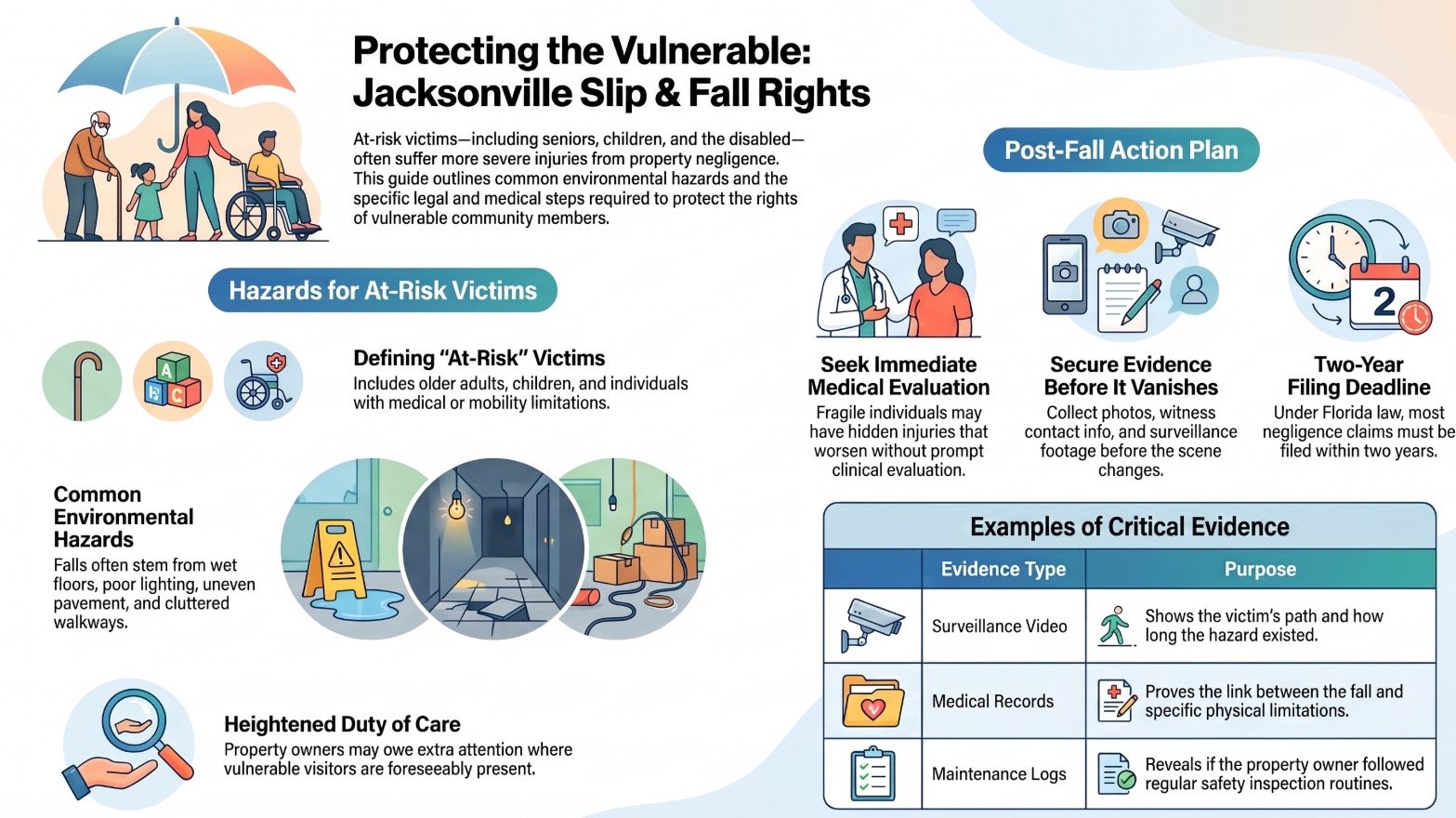
When an at-risk individual suffers injuries in a Jacksonville slip and fall accident, a lawyer can help determine whether unsafe property conditions, negligent maintenance, or inadequate warnings contributed to the incident. Legal support may begin with Document review, including incident reports, medical records, photographs, maintenance logs, witness statements, and prior complaints involving the premises. This careful evaluation helps identify responsible parties and preserves information that may otherwise become difficult to obtain.
A lawyer can also develop a claim strategy tailored to the injured person’s circumstances, including age, disability, medical vulnerability, or dependence on caregivers. This strategy may address insurance communications, damage valuation, liability evidence, and deadlines that affect recovery. By managing these tasks, counsel lets families, advocates, and care providers stay focused on protection, restoration, and practical support. The objective is to present a well-supported claim that reflects the person’s injuries, losses, and need for accountability under Florida law.
Understanding Jacksonville Slip & Fall At-Risk Victims Injury Cases


Understanding how Jacksonville slip and fall injury cases affect at-risk victims requires close attention to both the hazardous condition and the injured person’s specific vulnerabilities. Older adults, people with disabilities, children, and individuals with medical limitations may suffer harm that is more severe than another visitor might experience under similar circumstances.
OUR CONSULTATIONSARE FREE
START YOUR FREE CASE REVIEW

These cases often require a careful Negligence analysis focused on duty, breach, causation, and damages. The inquiry may consider whether a property owner, business, or manager acted reasonably in identifying, addressing, or warning about a dangerous condition. For at-risk victims, timely response and proper premises maintenance can be especially important because reduced mobility, impaired balance, or limited awareness may increase the likelihood of serious injury.
A well-developed claim should connect the unsafe condition to the victim’s losses through medical records, witness accounts, inspection practices, and property evidence. This approach supports accountability while recognizing the dignity and protection owed to vulnerable community members.
Don’t Wait. Call Our Florida Personal Injury Lawyers Now!
Common Causes of Jacksonville Slip & Fall At-Risk Victims
Common causes of Jacksonville slip and fall injuries among at-risk victims often include wet or slippery floors, poor lighting conditions, uneven walking surfaces, and cluttered walkways. These hazards can create dangerous conditions in stores, apartment complexes, medical facilities, and other public or private properties. Careful evaluation of the cause is critical, as liability may depend on whether the hazard was known, foreseeable, or reasonably preventable.
Wet Or Slippery Floors


Wet or slippery floors create a serious fall hazard for at-risk victims in Jacksonville, especially older adults, people with mobility limitations, and those using canes, walkers, or other assistive devices. Spills, tracked-in rain, recently mopped surfaces, leaking refrigeration units, and polished flooring may reduce traction without adequate notice. Property owners, managers, and staff serving the public are expected to respond promptly, remove hazards, and provide clear Floor warning signs when conditions cannot be corrected immediately. Effective slip hazard training helps employees recognize dangerous surfaces, follow cleaning procedures, and protect vulnerable visitors with reasonable care. When a fall occurs, investigators may review maintenance records, inspection routines, witness accounts, and available video to determine whether preventable neglect contributed to the injury and resulting harm.
Poor Lighting Conditions
In poorly lit areas, at-risk victims in Jacksonville may be unable to identify hazards that would otherwise be visible, including uneven flooring, steps, debris, curbs, or changes in surface elevation. Older adults, disabled visitors, and residents with limited mobility may be especially vulnerable when hallways, parking lots, entrances, stairwells, or common areas lack adequate illumination. Property owners, managers, and service providers who value public safety should treat lighting as a core part of Preventive Maintenance, not a secondary concern. Burned-out bulbs, dim fixtures, blocked lighting, and delayed repairs can create foreseeable risks. After an incident, Legal Documentation may include photographs, maintenance records, inspection logs, witness statements, and prior complaints. Such evidence may help establish whether responsible parties failed to correct lighting problems within a reasonable time.
Uneven Walking Surfaces
Poor lighting can make surface defects harder to detect, but uneven walking surfaces present hazards even when visibility is adequate. In Jacksonville, seniors, people with disabilities, and recovering patients may be especially vulnerable when flooring, sidewalks, ramps, or entryways are not properly maintained. Pavement cracks can catch a cane, walker, or shoe, causing a sudden loss of balance. Uneven steps may also create serious danger when height differences are unexpected or lack clear markings. Property owners, managers, and service providers should routinely inspect areas used by visitors, residents, and clients, then correct defects promptly. When vulnerable individuals fall because these conditions were ignored, documentation of the surface, maintenance history, and prior complaints may help determine responsibility and support a careful legal evaluation.
Cluttered Walkways
Across retail aisles, apartment corridors, medical facilities, and business entryways, cluttered walkways can create serious fall risks for at-risk individuals in Jacksonville. Boxes, cords, cleaning equipment, merchandise, mobility aids, and unattended deliveries may obstruct safe passage, especially for seniors, patients, residents with disabilities, and others who require clear routes. Property owners and staff serving these individuals are expected to maintain orderly pathways, inspect high-traffic areas, and correct hazards promptly. Safety signage may help warn visitors temporarily, but it does not replace timely removal of obstructions. Maintenance logs can show whether inspections occurred, who identified the hazard, and how quickly the condition was addressed. When clutter remains despite foreseeable danger, vulnerable visitors may suffer preventable injuries that premises liability principles require careful evaluation. Evidence should be preserved promptly.
Legal Rights of Jacksonville Slip & Fall At-Risk Injury Victims
When a Jacksonville slip and fall involves an at-risk victim, the legal rights at issue may extend beyond ordinary premises liability concerns. Older adults, children, disabled individuals, and medically fragile residents may require careful protection after an injury. Their claims may involve duties of reasonable care, fair insurance handling, and accountability for unsafe property conditions.
- Medical care: Victims may seek necessary treatment, rehabilitation, mobility support, and documentation of long-term limitations.
- Compensation: Recoverable losses may include medical expenses, pain, reduced independence, lost income, and caregiver-related costs.
- Representation: A lawyer may help preserve evidence, conduct witness interviews, gather incident reports and photographs, and communicate with insurers.
- Protection: Families, caregivers, and advocates may help ensure the victim isn’t pressured, ignored, or unfairly blamed.
These rights serve a broader purpose: safeguarding vulnerable people while encouraging safer spaces throughout Jacksonville’s homes, businesses, facilities, and public areas after preventable falls.
Why Do Jacksonville Slip & Fall At-Risk Victims Injuries Happen?
Understanding legal rights also requires examining why these injuries occur in the first place, particularly because at-risk victims may face hazards that others can avoid or withstand. In Jacksonville, falls often result from wet floors, uneven pavement, poor lighting, loose mats, broken handrails, crowded walkways, or neglected property maintenance. Older adults, people with disabilities, children, and individuals with medical vulnerabilities may be less able to detect hazards, regain balance, or prevent serious harm after a fall.
These incidents may also occur when businesses, landlords, care facilities, or public property managers fail to inspect conditions, correct dangers, or provide adequate warnings. Comparative negligence may become an issue if a property owner argues that the injured person should have noticed the hazard. For at-risk victims, that analysis must consider their limitations and the setting. Evidence preservation is consequently important because conditions can change quickly, obscuring whether reasonable care was provided before the injury occurred.
What Should You Do After a Jacksonville Slip & Fall At-Risk Victims Injury?
After a Jacksonville slip and fall injury involving an at-risk victim, prompt action can help protect health, safety, and any potential legal claim. The injured person should seek immediate medical care, report the incident to the property owner or responsible party, and document the event properly. Preserving important evidence, including photographs, witness information, and medical records, may be essential to establishing what happened and who may be responsible.
Seek Immediate Medical Care
Immediate medical care is required for any at-risk victim injured in a Jacksonville slip and fall, even if the harm appears minor at first. Older adults, disabled individuals, children, and medically fragile persons may suffer hidden injuries that worsen without prompt evaluation. A physician can assess head trauma, fractures, spinal strain, internal bleeding, or medication-related complications. Early treatment also supports safer recovery plans, including Broken ankle recovery when mobility, balance, and daily assistance are concerns. Caregivers should document symptoms, pain levels, dizziness, swelling, confusion, and changes in function as treatment continues. Accurate medical records can guide providers, protect vulnerable patients, and clarify the connection between the fall and resulting harm. Compassionate attention, paired with timely clinical care, helps preserve health, dignity, and future recovery options.
Report The Incident
Where should the fall be reported, and how quickly should that report occur? Report a Jacksonville slip and fall involving an at-risk person immediately to the property owner, manager, landlord, or supervising employee. Prompt notice helps protect the injured person and supports accurate review of what occurred.
Caregivers, relatives, or advocates should document details, including the location, time, reported symptoms, and names of those informed. If the injury occurred in a public place, assisted living facility, store, or transportation setting, responsible parties may need to notify authorities according to applicable procedures. They should also report witnesses to management so management can include their observations. Before leaving, the injured person or helper should request incident report documentation to ensure the event is formally recorded reliably.
Preserve Important Evidence
When a Jacksonville slip and fall involves an at-risk person, preserve evidence as soon as the person is safe and medical concerns are being addressed. Caregivers, relatives, or staff should secure details before conditions change or memories fade. Incident reporting should identify the location, time, hazard, and people notified. Photo evidence of wet floors, poor lighting, uneven surfaces, missing mats, or lack of warning signs may help clarify what occurred. Gather witness statements from employees, visitors, or residents promptly, and keep contact information. Medical documentation should record injuries, pain complaints, mobility changes, and treatment recommendations. Those serving vulnerable individuals should also preserve footwear, clothing, surveillance information, and communication records, since each item may help establish responsibility and protect the injured person’s legal interests.
Critical Evidence in a Jacksonville Slip & Fall At-Risk Victims Injury Case
Critical evidence in a Jacksonville slip and fall at-risk victims injury case often determines whether negligence, causation, and damages can be clearly established.
Critical materials may include:
1. Incident scene documentation
2. Surveillance video footage
3. Witness contact information
4. Medical records evidence
Each category can help preserve facts, confirm unsafe conditions, and support the injured person’s claim with objective proof.
Incident Scene Documentation
At the scene of a slip and fall involving an at-risk victim, incident scene documentation often becomes central to proving how the injury occurred and whether the property owner failed to address a dangerous condition. Careful records may include floor conditions, lighting, warning signs, weather, footwear, and the victim’s position after the fall. A Scene photo checklist helps caregivers, relatives, or advocates capture consistent images before hazards are cleaned, repaired, or disputed. Useful evidence preservation tips include noting the time, identifying witnesses, saving incident reports, and preserving clothing or assistive devices affected by the fall. For vulnerable individuals, prompt documentation can protect dignity while supporting accountability. Clear, organized records allow counsel to evaluate notice, causation, and preventable risk more accurately in Jacksonville claims.
Surveillance Video Footage
Although photographs and witness statements are important, surveillance video footage can provide the most direct account of how a Jacksonville slip and fall involving an at-risk victim occurred. Video may show the hazardous condition, the victim’s path, the time the danger remained present, and whether employees had an opportunity to respond. For elderly individuals, disabled visitors, or others requiring added care, this evidence may clarify details that memory or limited mobility can obscure. Cellphone footage may also support the record when store cameras, doorbell systems, or parking lot cameras capture only part of the event. Prompt preservation requests are often necessary because many systems overwrite data quickly. Timestamp verification helps confirm sequence, duration, and accuracy, allowing decision-makers to assess responsibility with greater fairness, discipline, and respect for the injured person.
Witness Contact Information
Witness contact information often determines whether important observations remain available after a Jacksonville slip and fall involving an at-risk victim. Names, phone numbers, addresses, and email details allow responsible parties to preserve neutral accounts from customers, employees, caregivers, or passersby who saw the hazard, the fall, or the immediate response. Timely collection supports Incident witness statements before memories fade, schedules change, or witnesses become difficult to locate. For at-risk victims, such as older adults or persons with disabilities, outside observations may clarify lighting, floor conditions, warnings, assistance offered, and delays in addressing danger. Accurate witness lists also strengthen future claims documentation by connecting facts to identifiable sources. Careful recordkeeping reflects respect for the injured person, promotes accountability, and helps advocates evaluate liability with greater confidence.
Medical Records Evidence
When an at-risk person suffers a slip and fall, medical records provide the clearest foundation for proving injury, treatment, and the event’s physical impact. These records may include emergency evaluations, diagnostic imaging, rehabilitation notes, and expert assessments, each helping clarify how the fall affected mobility, independence, and daily care needs. For vulnerable individuals, accurate documentation can show whether preexisting conditions worsened or whether new injuries created additional limitations. Medication timelines are especially important because changes in prescriptions may reveal pain levels, complications, or recovery challenges after the incident. Doctor follow-ups also demonstrate ongoing medical concern and compliance with treatment recommendations. When preserved and reviewed carefully, these records support a fair evaluation of damages and guide advocates seeking responsible care and accountability for the injured person.
Long-Term Effects of Jacksonville Slip & Fall At-Risk Victims’ Injuries
Long-term injuries from a Jacksonville slip and fall can extend beyond the initial medical treatment, particularly for at-risk victims facing chronic pain complications. These injuries may reduce mobility and independence, creating ongoing limitations in daily activities and personal care. Cognitive changes, anxiety, depression, and other emotional impacts may also affect recovery, requiring careful evaluation in any injury claim.
Chronic Pain Complications
Chronic pain recovery complications after a Jacksonville slip and fall can extend far beyond the initial injury, especially for at-risk victims such as older adults, individuals with disabilities, or those with preexisting medical conditions. Persistent back, neck, hip, or joint pain may require ongoing medical care, medication management, therapy, and close provider monitoring. For those committed to serving vulnerable individuals, these effects show why attentive support and accurate recordkeeping matter. Damages documentation may include treatment notes, diagnostic results, pain journals, prescription histories, and testimony from caregivers or medical professionals. In legal evaluation, Comparative negligence may also affect how responsibility is assessed when property hazards, victim conduct, or prior conditions are disputed. Chronic pain can shape daily routines, emotional health, and care needs long after visible injuries appear resolved.
Mobility And Independence
As recovery progresses after a Jacksonville slip and fall, reduced mobility can become one of the most disruptive long-term effects for at-risk victims. Mobility limitations may affect walking, standing, transferring, bathing, meal preparation, and transportation, requiring steady support from caregivers, medical providers, and community resources. These challenges often create new Accessibility needs that require careful planning, not temporary adjustments.
Home modifications may include ramps, grab bars, widened pathways, improved lighting, stair alternatives, or safer bathroom layouts. When these changes are delayed, the risk of additional injury can increase. Independence planning helps identify necessary assistance while preserving dignity, routine, and personal choice. For vulnerable residents, practical support can promote safer daily living and reduce preventable dependence over time.
Cognitive And Emotional Impacts
Following a Jacksonville slip and fall, at-risk victims may experience cognitive and emotional effects that interfere with recovery, safety, and daily decision-making. Head injuries, pain, medication, or shock can contribute to memory problems, confusion, reduced concentration, and slower processing. These changes may limit the victim’s ability to follow medical instructions, recognize hazards, or manage household responsibilities. Trauma reactions can also develop, including sleep disruption, irritability, anxiety, and heightened distress near the location of the fall. Over time, fear avoidance may cause the individual to restrict movement, decline social contact, or resist necessary activity, increasing isolation and physical decline. Caregivers, advocates, and service providers should watch for these signs, document concerns, and encourage appropriate medical, psychological, and legal support to protect dignity, independence, and long-term wellbeing.
Don’t Wait. Call Our Florida Personal Injury Lawyers Now!
Proving Liability in Jacksonville Slip & Fall At-Risk Victims Injury Cases
In Jacksonville slip and fall cases involving at-risk victims, proving liability requires a careful showing that the property owner, manager, or other responsible party failed to maintain reasonably safe premises. This often involves identifying a dangerous condition, such as wet flooring, uneven pavement, poor lighting, loose mats, or obstructed walkways, and showing that the hazard caused the injury.
Evidence preservation is essential because conditions may change quickly after a fall. Photographs, video footage, incident reports, maintenance records, witness statements, and medical documentation can help establish what occurred and whether reasonable precautions were ignored. For elderly individuals, disabled persons, or others with heightened vulnerability, the analysis may also consider whether the premises presented foreseeable risks.
Comparative negligence may arise if the defense claims the injured person failed to notice the hazard. Liability evidence must consequently address both the unsafe condition and the victim’s conduct with fairness, accuracy, and dignity.
Dealing With Insurance Companies After a Jacksonville Slip & Fall At-Risk Victims Injury
When an at-risk victim suffers injuries in a Jacksonville slip and fall accident, insurance companies often come into play soon after the incident. Adjusters may contact the victim, family members, caregivers, or facility representatives while medical needs remain urgent. Their role is to safeguard the insurer’s financial interests, not to ensure that vulnerable individuals receive full support.
Careful communication is important, especially when injuries affect memory, mobility, or decision-making. Recorded statement risks include misconstrued questions, partial answers, and comments later used to dispute the severity of harm. Written correspondence, medical records, and witness information should be preserved before any detailed response is provided.
Common Claim denial reasons may include alleged lack of notice, comparative fault, preexisting conditions, or insufficient proof of unsafe property conditions. Those assisting an at-risk victim should approach insurer requests with caution, maintain organized documentation, and seek guidance before accepting settlements that may not reflect long-term care needs.
What to Expect During a Jacksonville Slip & Fall At-Risk Victims Injury Claim Process
A Jacksonville slip and fall at-risk victims injury claim typically begins with an initial case evaluation, where we review liability, injuries, and available legal options. The process then moves into evidence collection, insurance claim preparation, and negotiations with the responsible party’s insurer. If a fair settlement cannot be reached, the claim may proceed toward litigation, where a lawsuit can seek compensation through the court system.
Initial Case Evaluation
How does an initial case evaluation shape a Jacksonville slip and fall injury claim involving an at-risk victim? It allows counsel to understand the person’s vulnerabilities, the fall setting, and immediate medical concerns with care and precision. During this review, the lawyer examines available facts, identifies responsible parties, and considers whether the victim’s age, disability, or medical condition increased the risk of serious harm. The lawyer addresses evidence preservation early to protect important records before they are lost or altered. The evaluation also helps organize insurance communications, so statements remain accurate and the victim’s interests are protected. For families, caregivers, and advocates, this first meeting provides structure, guidance, and a practical path for serving the injured person’s safety, dignity, and recovery.
Evidence Collection Steps
After the initial evaluation clarifies the basic facts, evidence collection becomes the foundation of a Jacksonville slip and fall claim involving an at-risk victim. Counsel may seek photographs of the hazard, incident reports, maintenance logs, medical records, footwear details, and lighting or weather information. Spoliation prevention often begins early with written notices requesting that video footage, cleaning schedules, and physical evidence be preserved. A witness statement may also be obtained from employees, visitors, caregivers, or others who observed the fall, the dangerous condition, or the victim’s limitations afterward. For vulnerable individuals, careful documentation helps protect dignity while establishing how the incident affected safety, mobility, and daily care needs. These steps allow the claim to be evaluated through reliable proof rather than assumptions or incomplete recollections.
Insurance Claim Process
Once you gather primary evidence, the insurance claim process generally begins with identifying all available coverage and notifying the appropriate carriers. For at-risk victims, this step should be handled with care, because medical conditions, mobility limits, or cognitive concerns may affect communication and documentation needs. The carrier may request incident reports, medical records, photographs, maintenance information, and witness statements to evaluate responsibility and injury severity. Evidence preservation remains important during this phase, since surveillance footage, cleaning logs, and property records can become unavailable with time. Claim representatives may also seek recorded statements, which they should approach cautiously to prevent confusion or incomplete answers. Throughout the process, organized communication helps ensure the injured person’s needs are respected, deadlines are monitored, and the claim is presented accurately.
Settlement Or Lawsuit
As the insurance claim develops, the matter may move toward either a negotiated settlement or a lawsuit, depending on the strength of the evidence, the severity of the injuries, and the insurer’s position on liability and damages. A careful Negotiation strategy may help secure compensation without placing an at-risk victim under the added strain of litigation. This approach often includes medical documentation, witness statements, hazard evidence, and a clear explanation of how the fall affected daily care needs. If the insurer undervalues the claim or disputes responsibility, trial readiness becomes critical. Preparing for court can encourage fair evaluation while protecting the injured person’s rights. Throughout this stage, the focus remains on service, dignity, and practical recovery for vulnerable individuals and their families after harm.
Compensation for Jacksonville Slip & Fall At-Risk Victims Injury Damages
When an at-risk victim is injured in a Jacksonville slip and fall accident, compensation may depend on the severity of the harm, the circumstances of the fall, and the property owner’s failure to take reasonable safety measures. For older adults, disabled persons, or medically vulnerable individuals, a fall can create serious disruption, requiring careful documentation and timely legal assessment.
Compensation may be pursued through Insurance negotiation or, when necessary, litigation against responsible parties. Evidence such as incident reports, maintenance records, witness statements, photographs, and medical evaluations can help show that a hazardous condition was known or should have been corrected. In Florida, comparative negligence may affect recovery if the injured person is alleged to have contributed to the fall. A lawyer may address these claims by examining lighting, warnings, flooring conditions, accessibility issues, and staff response. This process supports fair accountability while helping protect individuals who require special care.
Economic vs Non-Economic Damages in Jacksonville Slip & Fall At-Risk Victims Cases
In Jacksonville slip and fall cases involving at-risk victims, damages are generally divided into economic losses, such as medical bills and lost income, and non-economic losses, such as pain and emotional harm. Economic damages often require records, invoices, wage documentation, and expert support to establish the injury’s financial impact. Non-economic damages require careful proof of how the fall affected the victim’s daily life, wellness, and overall well-being.
Medical Bills And Lost Income
Because slip and fall injuries can disrupt both health and financial stability, medical bills and lost income often form the core of economic damages in Jacksonville at-risk victim cases. These losses may include emergency care, hospitalization, surgery, rehabilitation, medication, assistive devices, and follow-up treatment. Caregivers, advocates, and legal representatives often help gather invoices, insurance statements, wage records, and physician reports to show the full financial impact.
Lost income may involve missed work, reduced hours, diminished earning capacity, or the need for Workplace accommodation. Accurate disability documentation can support limitations, treatment timelines, and work restrictions. For older adults, disabled individuals, or medically vulnerable residents, careful proof helps ensure compensation reflects actual needs, while preserving resources for recovery, stability, and continued dignified care.
Pain And Emotional Harm
Financial losses often show only part of the harm caused by a serious slip and fall, especially for at-risk victims whose injuries may affect daily comfort, independence, and emotional stability. Non-economic damages address pain, anxiety, humiliation, sleep disruption, loss of mobility, and the reduced ability to enjoy family, faith, or community activities. For older adults, disabled persons, and others needing support, these harms may deepen isolation or increase reliance on caregivers. A Jacksonville claim may consider how suffering changes routines, dignity, and confidence, apart from bills or wages. Negligence proof still matters, because the unsafe condition must be tied to the injury and its effects. Comparative fault factors may also influence recovery, requiring careful attention to the conduct of all parties involved under Florida law.
Proving Damages In Jacksonville
Establishing damages in a Jacksonville slip and fall claim requires evidence that separates measurable financial losses from personal harms that are harder to quantify. Economic damages may include ambulance charges, hospital bills, therapy costs, medication expenses, lost wages, and reduced earning capacity. Non-economic damages address pain, emotional distress, loss of independence, and diminished daily functioning, especially for at-risk victims who need added care.
A careful Evidence preservation checklist may help document medical records, photographs, witness names, incident reports, footwear, and communications with insurers. This record supports the full impact of the injury while protecting the injured person’s dignity. Comparative fault defenses may challenge compensation by arguing the victim failed to notice hazards, making accurate proof necessary for fair evaluation and responsible service.
When a Jacksonville Slip & Fall At-Risk Victims Injury Case Goes to Trial vs Settlement
When a Jacksonville slip and fall case involving an at-risk victim is evaluated for settlement or trial, the decision often turns on liability, injury severity, available evidence, and the property owner’s or insurer’s willingness to offer fair compensation. A settlement may serve the injured person by providing faster support for medical care, mobility needs, and daily assistance. However, when insurance negotiations undervalue the harm or dispute responsibility, litigation may become necessary.
Trial timelines can be longer, and the process may require testimony from caregivers, physicians, safety experts, and family members. Careful Court strategy focuses on presenting the victim’s vulnerabilities, the dangerous condition, and the lasting effect of the fall. Strong documentation may increase settlement leverage before trial, encouraging a fair resolution without unnecessary burden. If trial proceeds, the objective remains clear: seek accountability, protect the dignity of the at-risk victim, and pursue compensation that reflects proven losses.
Florida Laws That May Affect Your Jacksonville Slip & Fall At-Risk Victims Case
Because Florida premises liability law imposes specific duties on property owners and occupiers, a Jacksonville slip and fall case involving an at-risk victim often depends on how those legal standards apply to the facts. Florida premises law may require reasonable inspection, repair, warning, and protective measures when hazards threaten vulnerable guests, patients, residents, or customers.
Florida premises liability standards often determine whether vulnerable visitors received reasonable protection from preventable hazards.
- Duty of care: Owners may owe heightened attention where children, older adults, or disabled individuals are foreseeably present.
- Notice of hazards: Liability may turn on whether the owner knew, or should have known, about a dangerous condition.
- Comparative fault: Damages may be reduced if the injured person is found partly responsible, requiring careful factual analysis.
- Negligent security: Poor lighting, unsafe access, or inadequate supervision may support related claims when preventable harm occurs.
These rules help identify whether the property holder acted responsibly toward those needing protection, dignity, and practical care.
The Statute of Limitations for Jacksonville Slip & Fall At-Risk Victims Injury Cases
For Jacksonville slip and fall cases involving at-risk victims, the statute of limitations can determine whether an injured person retains the right to pursue compensation. In Florida, most negligence-based injury claims must be filed within two years from the date of the fall. When the victim is elderly, disabled, or medically fragile, prompt attention to deadlines is especially important because evidence may disappear, memories may fade, and medical conditions may complicate causation.
Missed filing deadlines can prevent recovery, regardless of injury severity or the property owner’s conduct. Timely action also allows careful review of Comparative negligence factors, including whether the victim’s limitations, footwear, assistance needs, or awareness of the hazard may be raised to reduce damages. Property owners and insurers may also rely on Premises liability defenses, such as lack of notice or an open and obvious condition. Understanding these timing rules helps caregivers, families, and advocates protect vulnerable people.
How a Jacksonville Slip & Fall At-Risk Victims Lawyer Can Help You
After a serious fall involving an elderly, disabled, or medically vulnerable person, a Jacksonville slip and fall at-risk victims lawyer can help identify the legal, medical, and evidentiary issues that may affect the claim. Counsel may evaluate whether unsafe flooring, poor lighting, Pothole liability, or neglected Store maintenance contributed to the injury, while keeping the client’s health limitations central to the case.
- Preserving evidence: The lawyer may secure photographs, incident reports, surveillance footage, and witness statements before conditions change.
- Assessing responsibility: Legal review can determine whether a property owner, business, landlord, or maintenance contractor failed to act reasonably.
- Documenting harm: Medical records, caregiver notes, and rehabilitation needs may show how the fall affected daily function, dignity, and independence.
- Managing communication: Counsel may address insurers and opposing parties, helping protect vulnerable clients from pressure while supporting a careful, service-minded pursuit of accountability and fair compensation.
Don’t Wait. Call Our Florida Personal Injury Lawyers Now!
When to Contact a Jacksonville Slip & Fall At-Risk Victims Lawyer
When should a vulnerable fall victim or family member seek legal guidance? Contact should occur as soon as medical needs are addressed and safety is stabilized. Early consultation helps protect an Evidence timeline, including incident reports, photographs, witness names, surveillance footage, maintenance records, and care facility communications. For older adults, disabled individuals, or residents in supervised settings, delays may make it harder to determine what happened and whether preventable hazards contributed to the fall.
A Jacksonville slip and fall at-risk victims lawyer may also be contacted when injuries worsen, medical bills begin accumulating, mobility declines, or caregivers notice changes in independence. Families serving a vulnerable person often need case valuation guidance before speaking with insurers, property owners, or facility representatives. Timely legal input can clarify reporting duties, preserve important documentation, and support informed decisions. Prompt action is especially important when the victim cannot communicate clearly or advocate effectively after a serious fall.
Why You Need an Experienced Jacksonville Slip & Fall At-Risk Victims Lawyer
Because vulnerable fall victims often face medical, cognitive, and mobility-related challenges, legal representation may be important in identifying risks that are not immediately obvious. An experienced Jacksonville slip and fall at-risk victims lawyer can evaluate how age, disability, medication, or assisted living conditions may have contributed to the incident and resulting harm.
These cases often require careful Evidence Preservation, including maintenance logs, surveillance footage, incident reports, footwear details, witness statements, and medical records. When these materials are lost or delayed, the injured person’s ability to prove unsafe conditions may be weakened.
A lawyer also helps monitor the Claim Timeline, ensuring notice requirements, insurance communications, treatment documentation, and filing deadlines are handled properly. For families, caregivers, and advocates focused on an injured person’s daily needs, legal guidance can provide structure and accountability while pursuing compensation for medical care, rehabilitation, pain, reduced mobility, and other losses tied to the fall.
How to Choose the Right Jacksonville Slip & Fall At-Risk Victims Lawyer for Your Case
The right Jacksonville slip and fall at-risk victims lawyer should have direct experience handling fall claims involving older adults, disabled individuals, assisted living residents, and others with heightened medical or mobility concerns. Selection should begin with careful Client case screening, including a review of the fall location, medical history, witness information, and any prior safety complaints. A qualified attorney should understand how fragile health, limited mobility, cognitive impairment, or reliance on caregivers can affect liability and damages.
The lawyer should also explain an evidence-gathering strategy early in the case. This may include preserving surveillance footage, inspecting flooring or lighting conditions, obtaining incident reports, and consulting medical professionals when necessary. Families and advocates seeking justice for vulnerable people should look for clear communication, organized case management, and a respectful approach. The attorney’s role is to protect the injured person’s dignity while pursuing accountability from negligent property owners or responsible care providers.
About The Law Offices of Anidjar & Levine
For individuals and families seeking guidance after a serious fall, Anidjar & Levine provides legal representation focused on accountability, evidence preservation, and client-centered support. The firm helps injured people understand their rights, document unsafe conditions, and pursue claims against negligent property owners or managers.
In Jacksonville premises cases, the firm evaluates maintenance records, incident reports, witness accounts, and medical documentation to build a clear factual record. Its attorneys also anticipate liability defenses, including arguments about notice, comparative fault, or open-and-obvious hazards, and prepare evidence-based responses.
The Law Offices of Anidjar & Levine emphasizes communication, timely case updates, and practical assistance throughout the legal process. This approach supports clients facing physical limitations, financial pressure, and uncertainty after a fall. By combining careful investigation with steady advocacy, the firm works to protect vulnerable individuals and help them seek fair compensation under Florida law.
Frequently Asked Questions
Can Prior Falls Affect My Jacksonville Slip and Fall Claim?
Yes, prior falls can affect a Jacksonville slip and fall claim. Insurers may use prior incident evidence to argue that injuries were preexisting, or that the person had notice of personal limitations. They may also raise a comparative negligence defense, claiming insufficient caution. However, prior falls do not bar recovery. Careful medical records, witness statements, and service-minded legal advocacy can distinguish past events from the property owner’s negligence.
Are Nursing Home Slip and Fall Cases Handled Differently?
Yes, nursing home slip and fall cases are handled differently because they often involve resident vulnerability, care standards, staffing records, and facility safety policies. Investigators assess whether supervision, mobility assistance, or hazard removal was adequate. Traumatic injuries may indicate neglect or delayed response. Witness statements from staff, residents, and visitors are especially important. These claims require careful review, aiming to protect dignity, accountability, and the welfare of those entrusted to care.
What if Poor Lighting Caused My Slip and Fall Injury?
Poor lighting may support a premises liability claim if it created an unsafe condition and the property owner knew, or should have known, about the danger. Investigators would review maintenance records, witness accounts, prior complaints, evidence photos, and whether adequate warning signs were posted. Those serving injured persons should preserve details quickly, because lighting conditions may change. A claim may seek compensation for medical care, lost income, and related harm.
Can Caregivers Be Liable for an At-Risk Victim’s Fall?
Yes, caregivers can be liable when an at-risk person falls due to caregiver neglect or failure to meet a duty of care. Liability may arise if the caregiver ignored known mobility limits, failed to provide supervision, left hazards unaddressed, or did not follow safety plans. Those serving vulnerable individuals must act with reasonable vigilance. Each case depends on foreseeability, the victim’s needs, and whether proper precautions were taken.
Do Language Barriers Affect Slip and Fall Claims in Jacksonville?
Yes. Language barriers can affect Jacksonville slip and fall claims by influencing reporting, treatment, and testimony. Medical Records may be incomplete if symptoms were misunderstood, while Translated Notices can clarify hazards, policies, or prior complaints. Interpreter Availability supports accurate statements during medical care, insurance communications, and depositions. Courts and insurers may also evaluate Credibility Factors, including consistency, timing, and whether communication barriers reasonably explain confusion or delayed reporting.
—————————
At-risk victims injured in Jacksonville slip and fall incidents may face serious medical, financial, and legal challenges. A knowledgeable lawyer can evaluate liability, preserve evidence, calculate damages, and pursue fair compensation from negligent property owners or insurers. The Law Offices of Anidjar and Levine provide focused legal guidance for injured individuals and their families. Learn more from a Jacksonville Personal Injury Lawyer. Prompt legal review can help protect important rights, strengthen the claim, and support a more informed path toward recovery.