PTSD from a crash can steal your sleep, your confidence behind the wheel, and your ability to show up for the people who need you — we document every loss and fight for your full recovery.
The Law Offices of Anidjar & Levine help Gainesville car accident injured people pursue PTSD compensation by connecting the crash, medical evidence, and daily disruptions to a clear injury claim.
Our Gainesville Car Accident Lawyer team gathers therapy records, physician opinions, witness statements, wage loss proof, and crash evidence, then handles insurer communications and challenges efforts to minimize invisible injuries.
PTSD damages may include counseling, medication, lost income, reduced earning ability, and loss of enjoyment. Below, we explain how these claims work and what steps matter most.
What Is Car Accident PTSD?
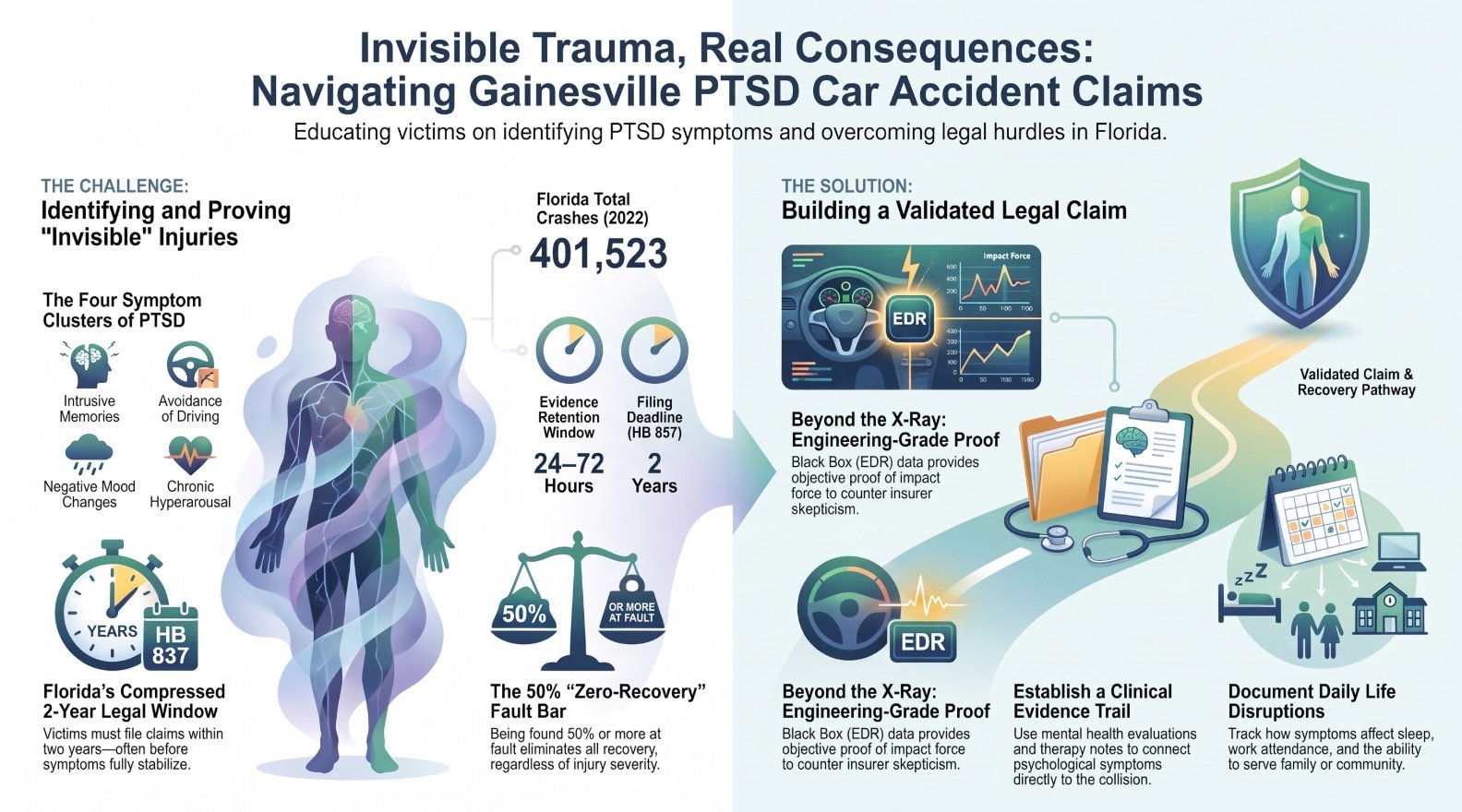
Post-Traumatic Stress Disorder (PTSD) is a clinically recognized mental health condition that can develop after a person is exposed to or witnesses a traumatic event that involves actual or threatened death, serious physical injury, or sudden and violent loss of control. Car accidents — particularly those involving violent impact, entrapment, life-threatening harm, or witnessing another person’s severe injury — can trigger PTSD in drivers, passengers, pedestrians, and bystanders. The condition is characterized by four symptom clusters: intrusive re-experiencing (flashbacks, nightmares), avoidance of crash-related reminders (refusal to drive, avoiding certain roads), negative changes in mood and cognition (emotional numbing, detachment, persistent fear), and hyperarousal (startling easily, sleep disruption, hypervigilance). In Florida, PTSD is documented through licensed mental health evaluations, therapy progress notes, and provider opinions — and qualifies as a serious personal injury when supported by consistent clinical evidence connecting the diagnosis to the collision.
Main Takeaways
- A Gainesville PTSD car accident lawyer can connect psychological trauma to the crash and its impact on daily life, work, and relationships.
- Strong PTSD claims use medical records, mental health evaluations, therapy notes, medication history, and witness statements.
- Compensation may cover therapy, medication, lost wages, reduced earning ability, and loss of enjoyment of life.
- An attorney can handle insurers, challenge unfair denials, and fight efforts to minimize or dismiss invisible psychological injuries.
- Evidence may include police reports, crash details, rescue timelines, provider opinions, and testimony from family, coworkers, or first responders.
How We Can Help With Your Gainesville PTSD Car Accident Injury Claim
After a serious crash, we can help you pursue compensation for PTSD by building a claim that connects your psychological trauma to the collision and its impact on your daily life. We listen carefully, protect your dignity, and gather evidence showing how your condition affects your work, relationships, sleep, and service to others.
We coordinate trauma documentation from medical providers, therapists, and counselors, then organize those records into a clear timeline. We also evaluate witness accounts by reviewing statements from family members, coworkers, first responders, and others who observed meaningful changes after the crash. Our team handles communications with insurers, calculates damages, and challenges attempts to minimize invisible injuries. We prepare every claim with the care it warrants, because your ability to recover and continue supporting your community matters.
For a foundational understanding of Florida’s no-fault PIP system and how it applies to injury claims, read: Florida PIP Insurance Explained.
Understanding Gainesville PTSD Car Accident Injury Cases
When a crash causes lasting psychological harm, a Gainesville PTSD car accident injury case must show more than fear, stress, or general distress. We help you understand how these claims connect documented trauma to the collision, medical treatment, and measurable disruption in daily life. PTSD may affect sleep, work, family care, transportation, and community service, even when visible injuries seem limited. We focus on evidence that supports your experience, including mental health records, physician opinions, medication history, therapy progress, and testimony from people who observe your struggles.
As we review your case, we look for consistent symptoms, timely treatment, and credible proof of impact. Our goal is to present your claim clearly, so insurers and responsible parties recognize the full extent of harm suffered and understand that psychological injury is as real and as serious as any broken bone or visible wound.
Gainesville PTSD Car Accident Injuries: Invisible Trauma, Real Consequences
PTSD following a car accident is among the most legally and medically challenging personal injury claims because the harm is neurological, internal, and often dismissed by insurers who prefer to pay only what they can see on an X-ray. According to the FLHSMV 2022 Florida Traffic Crash Facts, Florida recorded 401,523 total crashes and more than 253,888 injuries statewide — a volume that trains insurers to dispute, minimize, and delay psychological injury claims at scale. NHTSA data shows that distracted driving killed 3,308 people nationally in 2022, and the sudden, unwarned violent impacts characteristic of distraction crashes are among the strongest triggers for acute stress disorder and PTSD — because the brain has no time to prepare, and the sense of helplessness and randomness intensifies the trauma response.
Florida’s 2023 tort reform (HB 837) reduced the filing window to two years and introduced a 50% modified comparative fault bar — a threshold that eliminates all recovery regardless of PTSD severity if reached. Physical crash evidence can disappear within 24 to 72 hours, and connecting PTSD to the crash — which requires proving the event’s traumatic character, the timing of symptom onset, and the absence of prior psychiatric history as the primary cause — is far more difficult without preserved crash scene documentation and early medical records.
Common Causes of Gainesville PTSD Car Accident Injuries
We understand PTSD after a Gainesville car accident can stem from several traumatic experiences, not just the crash itself. You may face lasting psychological effects after a violent collision impact, life-threatening injuries, witnessing serious harm to another person, or being trapped after a crash. We evaluate these causes carefully, because identifying the specific source and character of the trauma strengthens your injury claim and helps connect your symptoms to the collision with clinical precision.
Violent Collision Impact
Because a violent collision can overwhelm the body and mind in seconds, many Gainesville car accident-injured people develop PTSD symptoms long after the physical danger has passed. We understand how sudden force, shattered glass, loud impacts, and loss of control can leave you feeling unsafe during your daily travels. Rear-end collisions, especially at higher speeds, may create intense fear even when visible injuries seem limited. The nervous system’s response to sudden threat does not distinguish between the size of the crash and the psychological impact — a lower-speed crash experienced without warning can produce lasting trauma just as severe as a high-speed impact. We help you connect the collision’s character and force to lasting distress, so your claim reflects the full consequences of what happened and what continues to happen in your daily life.
Life-Threatening Injuries
Violent impact often becomes even more traumatic when a crash causes life-threatening injuries or creates a genuine belief that death is imminent. We understand that severe bleeding, organ damage, spinal trauma, burns, or emergency surgery can leave lasting psychological harm long after the body stabilizes. When you serve others — as a caregiver, parent, professional, or community member — losing independence or confronting mortality can feel especially disruptive, because your role depends on strength, clarity, and steady presence. We help you connect these traumatic experiences to the collision using medical records, provider notes, and personal accounts, and we document how the psychological aftermath continues to limit your capacity for the responsibilities that matter most to you.
Witnessing Serious Harm
After a serious collision, seeing another person suffer catastrophic injuries can create trauma even if your own physical injuries seem less severe. We understand that caregivers, passengers, drivers, and bystanders may feel responsible, helpless, or haunted by what they witnessed. This traumatic witness impact can lead to nightmares, intrusive images, avoidance of roads, guilt, panic, and difficulty serving family, coworkers, or community members with steady focus. We encourage you to seek care early, because prompt evaluation supports recovery and strengthens your legal claim. PTSD symptom documentation may include medical records, counseling notes, medication history, work limitations, and statements from people who observe changes in your daily functioning. With careful evidence, we can show how witnessing serious harm caused lasting psychological injury after a Gainesville crash.
Trapped After Crashes
Being trapped inside a damaged vehicle can turn a Gainesville car accident into a prolonged psychological crisis. When you cannot move, breathe easily, or reach help, fear may intensify with every passing minute. We understand how this confinement can create lasting PTSD symptoms, including panic attacks, nightmares, and persistent avoidance of driving or enclosed spaces. Emergency response limitations — such as blocked roadways, hazardous conditions, or delayed extraction — may heighten feelings of helplessness and prolong the traumatic experience. We look closely at rescue timelines, body camera footage, medical records, and witness accounts. Strong post-crash trauma documentation helps connect your psychological injuries to the collision and the time you remained trapped, giving your claim a factual foundation that no insurer can easily dismiss.
Your Legal Rights After a Gainesville PTSD Car Accident Injury
When a crash causes PTSD, injured people in Gainesville have the right to seek compensation for the full impact of that psychological harm, not just their physical injuries. We help you understand those rights so you can protect your recovery and continue serving the people who depend on you.
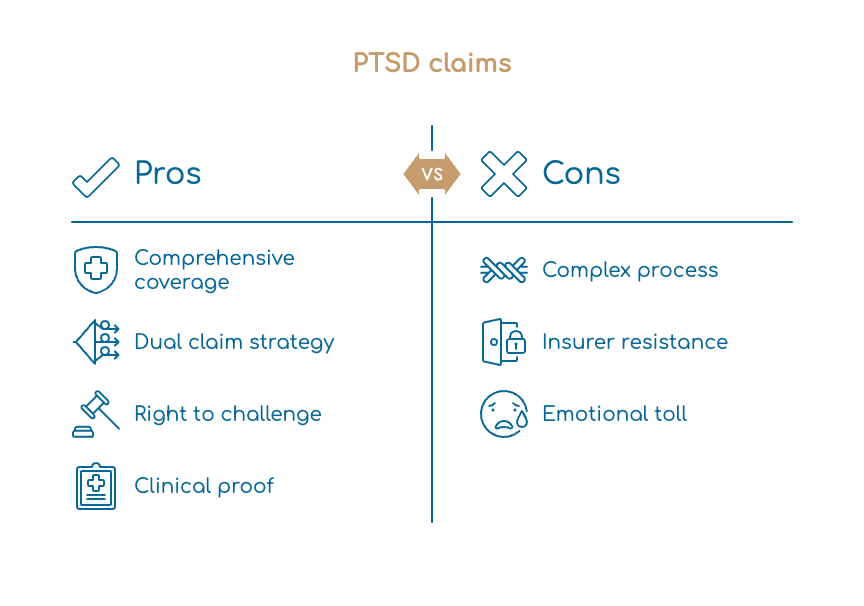
Your legal rights in a PTSD claim may include:
- Damages for therapy, medication, psychiatric care, lost wages, reduced earning ability, and loss of enjoyment of life.
- Access to first-party coverage when available, while also pursuing claims against the responsible at-fault party.
- The right to challenge unfair denials, especially when insurers imply exaggeration or misrepresent the clinical significance of PTSD without evidence.
- The right to present clinical proof from doctors, counselors, and mental health professionals that connects your diagnosis to the crash.
We do not let PTSD get dismissed as invisible or minor. We work to document how symptoms affect your daily duties, relationships, and community responsibilities. Your legal claim should reflect the full and ongoing cost of the trauma you endured.
Why Do Gainesville PTSD Car Accident Injuries Happen?
Although every collision is different, PTSD after a Gainesville car accident often develops because the crash overwhelms the brain’s normal ability to process danger, pain, and loss of control. We see trauma deepen when a person believes death or serious harm is imminent, hears screams or shattering glass, witnesses injuries, or becomes trapped and helpless without access to help. PTSD can also develop when physical pain, medical uncertainty, financial strain, and disrupted family responsibilities continue long after the scene clears. For those who serve others — as caregivers, teachers, responders, or community leaders — the inability to return to trusted roles can intensify distress and create a secondary layer of loss beyond the injury itself.
These injuries happen because the nervous system remains on alert after the threat has passed. Understanding these causes supports recovery planning, validates your experience, and shows why emotional injuries deserve the same careful attention as visible wounds in a legal claim.
What Should You Do After a Gainesville PTSD Car Accident Injury?
After a Gainesville car accident causes PTSD symptoms, we recommend that you seek immediate medical care, even if your physical injuries seem minor. We also urge you to document your symptoms, treatment, missed work, and changes in daily life, because this evidence can support your claim. Finally, contacting a car accident lawyer who understands PTSD injury claims can help protect your rights while you focus on recovery.
Seek Immediate Medical Care
Because PTSD symptoms may not appear immediately, you should seek medical care as soon as possible after a Gainesville car accident, even if you believe your physical injuries are minor. A prompt evaluation helps protect your health, connects you with appropriate providers, and creates a clear treatment path that supports your claim. Speak honestly with doctors about anxiety, sleep disruption, panic, intrusive thoughts, or changes in daily functioning. Early care may include referrals for counseling or treatments tailored to your needs, such as EMDR therapy, cognitive processing therapy, or trauma-focused cognitive behavioral approaches. These services can support recovery and help you continue serving your family, workplace, and community with greater stability.
Follow every medical recommendation, attend appointments consistently, and prioritize care — because timely treatment strengthens both your recovery and any related injury claim.
Document Your PTSD Symptoms
Track your PTSD symptoms as soon as they appear, and keep a consistent record of how they affect your sleep, work, relationships, driving habits, and daily responsibilities. Write dated entries that describe nightmares, panic attacks, avoidance behaviors, irritability, or difficulty concentrating. Trigger documentation matters because it shows what events, sounds, locations, or interactions intensify your distress. If you serve family members, coworkers, patients, students, or community members, note how symptoms limit your ability to remain present, reliable, and attentive. Save therapist notes, medication records, referrals, and follow-up instructions, since they help connect your condition to the crash and show your treatment needs. Preserve messages from supervisors or loved ones describing visible changes in behavior, missed obligations, or reduced performance. Every documented detail strengthens the connection between the collision and the continuing harm you experience.
Contact a Car Accident Lawyer
Your symptom records can support your claim, but you should not have to manage the legal process alone while coping with PTSD. A Gainesville car accident lawyer can review your PTSD documentation, explain liability, identify available insurance coverage, and preserve evidence before it becomes harder to obtain. We can communicate with insurers, request medical and psychological records, evaluate wage losses, and build a claim that reflects both visible and invisible injuries. Prompt action helps protect important deadlines and legal options, so you can focus on treatment while we pursue accountability and fair compensation on your behalf.
Critical Evidence in a Gainesville PTSD Car Accident Injury Case
We build a strong PTSD car accident injury case by gathering evidence that connects the crash, your symptoms, and the losses you have suffered. Key evidence includes police accident reports, medical treatment records, mental health evaluations, and witness statements. We use this evidence to present a clear, well-supported claim and protect your right to fair compensation.
For a detailed explanation of why medical documentation anchors every successful injury claim, read: Why Medical Records Matter in Personal Injury Cases.
Police Accident Reports
Although a police accident report does not prove every element of a Gainesville PTSD car accident injury case, it often provides the factual foundation we need to begin building the claim. We review it carefully because officer observations, witness reliability assessments, traffic citation records, and roadway condition documentation can shape liability from the outset. When you seek accountability after a traumatic crash, the report can help clarify who was present, what each driver said, where vehicles came to rest, and whether roadway or weather conditions contributed to the collision. We also compare officer conclusions against photographs, statements, and physical evidence. If the report contains errors or omissions, we address them promptly and document the discrepancy. By strengthening this foundational record, we help protect your ability to connect the crash to the psychological trauma that followed.
Medical Treatment Records
After a traumatic crash, medical treatment records can become some of the most important evidence in a Gainesville PTSD car accident injury case. We rely on these records to connect your physical injuries, emotional distress, and ongoing care needs to the collision. Emergency room notes, primary care visits, prescriptions, and follow-up appointments help create symptom timelines that show when problems began and how they progressed. We also review therapist referrals, medication changes, work restrictions, and discharge instructions for consistency. Careful evidence preservation helps us protect records before details are lost, altered, or overlooked. These documents can also support negotiations with insurers by demonstrating the seriousness of your condition and the available liability coverage.
Mental Health Evaluations
When PTSD symptoms follow a serious collision, a mental health evaluation can help establish the diagnosis, severity, and connection to the crash. We rely on licensed counselors, psychologists, and psychiatrists to document intrusive memories, avoidance, sleep disruption, irritability, and functional limits that affect your work, family duties, and service to others. Trauma screening may identify acute stress reactions, depression, anxiety, or prior conditions that the crash aggravated. In more complex cases, neuropsychological assessments can measure attention, memory, processing speed, and emotional regulation, especially when head injury concerns exist alongside PTSD. We use these findings to present a clear picture of damages, support the necessary treatment, and counter claims that symptoms are unrelated or exaggerated. A thorough evaluation gives your recovery plan structure and strengthens the evidence behind your claim.
Witness Statements
Because PTSD symptoms often are not visible at the crash scene, witness statements can provide critical context that medical records and police reports may not fully capture. We use these accounts to show how the collision occurred, how you responded afterward, and whether your behavior changed in ways consistent with trauma. Witnesses may describe panic, confusion, disorientation, or fear that appeared immediately after the crash. They may also confirm later changes, including withdrawal, sleep disruption, or difficulty driving past the crash location. Documenting injuries, preserving evidence, and contacting witnesses promptly can strengthen your claim before memories fade. We help gather statements from passengers, bystanders, first responders, coworkers, and family members whose observations can support your diagnosis and connect symptoms to the crash.
Event Data Recorder (EDR) Evidence in PTSD Car Accident Cases
In PTSD car accident claims, Event Data Recorder (EDR) data — the vehicle’s black box — is often critical for proving that the crash was traumatic in character and force. Most passenger vehicles manufactured after 2012 record pre-crash speed, braking force, throttle input, steering angle, and seat-belt status in the seconds before impact. For PTSD claims, this data matters directly: it establishes the severity of the impact (supporting the argument that the crash was objectively traumatic), confirms whether the at-fault driver took no evasive action (reinforcing the element of sudden helplessness), and documents the duration and nature of the event. When insurers argue that the crash was too minor to produce genuine psychological trauma, EDR data — combined with biomechanical analysis — provides engineering-grade proof of impact forces. We send formal spoliation letters immediately upon retention to prevent ignition cycling from overwriting the data.
Learn more: How Black Box Data Can Help Your Car Accident Case. Federal EDR regulation background: NHTSA Event Data Recorders.
Long-Term Effects of Gainesville PTSD Car Accident Injuries
We must also consider how PTSD can affect your life long after the crash, especially when chronic anxiety symptoms continue to disrupt daily routines. We often see PTSD disrupt ordinary life in ways that compound over time — missed work, strained relationships, avoidance of essential activities. We assess your ongoing treatment needs carefully, because future therapy, psychiatric care, and monitoring can significantly affect the value of your claim.
Chronic Anxiety Symptoms
After a serious crash, chronic anxiety can persist long after the physical injuries begin to improve, affecting how a person drives, works, sleeps, and interacts with others. We often see survivors experience racing thoughts, sudden fear responses, muscle tension, irritability, and sleep disruption, especially when reminders of the collision appear — a similar vehicle, a familiar intersection, or the sound of braking. If symptoms escalate into chest pain, disorientation, or thoughts of self-harm, we urge prompt emergency evaluation. For daily support, brief grounding techniques — controlled breathing, naming visible objects, or focusing on steady physical sensations — may help manage acute episodes. We also value documenting symptom timelines, because clear records help medical providers, counselors, and legal advocates understand the condition’s course and connect chronic anxiety to the original trauma of the collision. According to the Mayo Clinic, PTSD symptoms are generally grouped into intrusive memories, avoidance behaviors, negative changes in thinking and mood, and changes in physical and emotional reactions — and all four clusters can contribute to the chronic anxiety and hyperarousal that makes daily life feel unpredictable and unsafe long after the crash.
Disrupted Daily Life
Chronic anxiety often becomes most visible when it disrupts ordinary routines, and PTSD after a Gainesville car accident can make daily life feel unpredictable and difficult to manage. You may struggle with errands, caregiving, work attendance, or volunteer service because ordinary travel now triggers fear. Sleep disruption from nightmares or hyperarousal can leave you exhausted, less patient, and unable to focus on the people who rely on your steadiness. We encourage practical symptom journaling — noting missed tasks, panic triggers, sleep interruptions, and changes in family or community responsibilities — because these records show how PTSD affects your daily functioning, not just your mood on a clinical evaluation form. When we document these disruptions carefully, we help connect your injury to the real losses shaping your life each day.
Ongoing Treatment Needs
As PTSD symptoms continue beyond the initial recovery period, ongoing treatment needs can become a central part of your injury claim. We help you document counseling sessions, medication management, psychiatric evaluations, and follow-up care that may remain necessary for months or years. Therapy continuity planning can show insurers or a court why consistent treatment supports your recovery, stability, and ability to serve your family, workplace, or community over time. We also examine how symptoms affect employment, caregiving duties, transportation, and daily responsibilities.
When PTSD limits your capacity to work or maintain prior roles, we may review disability benefits alongside your injury claim. By presenting clear medical records and future care projections, we work to pursue compensation that reflects your long-term needs, not only your immediate losses after the crash.
Proving Liability in Gainesville PTSD Car Accident Injury Cases
Proving liability in a Gainesville PTSD car accident injury case requires more than showing that a collision occurred; we must connect another party’s negligence to both the crash and the psychological harm that followed. We build that connection through police reports, witness statements, crash evidence, medical records, and mental health evaluations. When we serve you, we look for proof that the at-fault driver breached a duty of care — by speeding, texting, failing to yield, or driving impaired — and we document how that breach caused the traumatic event that triggered your PTSD. We also work to show how the traumatic event caused or worsened your symptoms through consistent treatment records, provider opinions, and testimony from people who know your daily life.
For context on how Florida evaluates the value of injury claims, read: Average Car Accident Settlement in Florida.
Dealing With Insurance Companies After a Gainesville PTSD Car Accident Injury
After a Gainesville car accident causes PTSD, insurance companies often question the seriousness, cause, and value of the psychological injury. We help you respond with organized medical records, trauma documentation, and clear evidence connecting your symptoms to the crash. Insurers may minimize therapy needs, dispute lost income, or pressure you to settle before the full impact is known. We review communications, protect you from statements that can be misused, and evaluate available policy limits through careful coverage analysis. When an insurer issues a wrongful denial, we identify the factual and legal weaknesses in that decision and prepare focused claim appeals. Our role is to serve your recovery by keeping the insurer accountable. You should not have to prove your suffering alone while trying to recover and care for others after a serious collision.
What to Expect During a Gainesville PTSD Car Accident Injury Claim
We guide you through each stage of a Gainesville PTSD car accident injury claim, beginning with an initial case evaluation and a careful review of your medical documentation. We then prepare and present your insurance claim, negotiate with the insurer, and protect your position when the company disputes the severity of your PTSD. If a fair settlement is not available, we assess whether litigation is necessary to pursue the compensation you are owed.
Initial Case Evaluation
During the initial case evaluation, we review the facts of the Gainesville car accident, the nature of your PTSD symptoms, and the available evidence that connects your psychological injury to the crash. We listen carefully to your account, including how traumatic triggers affect daily responsibilities, relationships, work, and community service. We identify who may be liable, what insurance coverage applies, and which deadlines may control the claim. Our goal is to understand how the crash changed your life, protect your legal position, and explain the next steps clearly. We encourage your questions, so you can make informed decisions with confidence while continuing to focus on the people and responsibilities that matter most to you.
Medical Documentation Review
Once we understand the basic facts of your claim, medical documentation review helps us evaluate how your PTSD diagnosis, treatment history, and symptom progression relate to the Gainesville car accident. We examine emergency records, mental health evaluations, therapy progress notes, medication records, and referrals to identify consistent patterns of distress. We also review journal entries when available, because they may show how traumatic symptoms affect sleep, work, caregiving, relationships, and community responsibilities. This process helps us understand the full human impact while respecting your privacy and dignity. By organizing this evidence carefully, we can present a clear picture of your needs, your recovery efforts, and the support required for stability.
Insurance Claim Negotiations
After the medical records establish a documented picture of your PTSD and its connection to the crash, insurance claim negotiations focus on presenting that evidence in a persuasive and organized demand. We explain how symptoms affect your work, caregiving, community service, relationships, and daily responsibilities. We address traumatic memory gaps carefully, showing why incomplete recall can be part of the injury — not a weakness in your claim. We also include long-term therapy plans, medication needs, counseling records, and provider opinions to show future care requirements. During negotiations, we communicate with the insurer, respond to questions, correct unfair assumptions, and protect you from pressure to minimize your suffering or accept an early settlement that does not reflect your full losses.
Settlement or Litigation
If the insurer will not offer a fair settlement, we evaluate whether litigation is the strongest path to protect your PTSD injury claim. We review medical records, accident evidence, and expert opinions to determine whether filing a lawsuit may improve your position. We also prepare for insurer defenses, including arguments that your PTSD came from prior trauma, work stress, or unrelated life events. We address those claims with documentation, testimony, and clear timelines. If litigation becomes necessary, we guide you through pleadings, discovery, mediation, and — when required — trial. Our goal is to serve your recovery by pursuing accountability with discipline, preparation, and steady advocacy throughout the process.
Compensation for Gainesville PTSD Car Accident Injury Damages
When PTSD follows a Gainesville car accident, compensation should reflect the full scope of harm — not just the visible injuries. We help you pursue damages that recognize how trauma disrupts work, relationships, sleep, concentration, and daily responsibilities. Our role is to document the condition clearly, connect it to the crash, and present its impact accurately and with dignity. We approach each claim with service, discipline, and respect for your experience. By building a complete record, we work to secure compensation that addresses the real consequences of trauma and helps you move forward with stability, care, and confidence.
Economic vs. Non-Economic Damages in Gainesville PTSD Car Accident Cases
We separate economic damages from non-economic damages so you can understand how PTSD-related losses may affect your claim. We calculate economic damages by reviewing treatment costs, lost income, medication expenses, and other measurable financial effects. We then assess non-economic damages by valuing the emotional harm, daily disruption, and reduced quality of life caused by PTSD after the crash.
Defining Economic Damages
Although PTSD may feel difficult to measure, economic damages focus on the financial losses that can be documented through records, bills, and expert analysis. We define these damages by identifying the measurable costs tied to your trauma-related care and recovery needs. Medical documentation plays a central role because it connects your PTSD diagnosis, symptoms, and care plan to the crash. Treatment costs may include therapy, psychiatric visits, prescribed medication, and related clinical services. We also consider income lost when symptoms prevent you from working or serving others in the way you once did. By organizing these records carefully, we help show how PTSD has created real, documented financial harm that gives your claim a factual foundation supporting accountability and recovery.
Calculating PTSD Expenses
Because PTSD treatment can continue long after the vehicle damage is repaired, calculating expenses requires a careful review of both current losses and future needs. We help you gather records showing therapy bills, medication costs, missed work, transportation, and related care expenses. Accurate symptom tracking can also support treatment planning by showing how often care is needed and whether symptoms limit daily functioning. When PTSD affects employment, we may review wage records, job restrictions, and possible disability benefits to measure financial impact. We also consider future counseling, psychiatric visits, prescriptions, and supportive services when providers recommend continued care. By organizing these costs, we present a clear economic-damages claim that helps protect your stability as you focus on recovery.
Valuing Emotional Harm
Emotional harm can shape every part of life after a serious car accident, and PTSD damages require more than a simple review of medical bills. Non-economic damages address pain, fear, sleep disruption, isolation, and the loss of normal daily function and quality of life. We document symptoms, treatment history, and emotional recovery needs to build a complete picture of harm. Witnesses — family, coworkers, friends — can describe visible changes in your personality, engagement, and capacity for the relationships and responsibilities that define your daily life. This careful valuation helps ensure your claim reflects the full impact of PTSD, not only the expenses visible on paper.
When a Gainesville PTSD Car Accident Injury Case Goes to Trial vs. Settlement
When a Gainesville PTSD car accident injury case moves forward, we weigh settlement against trial by examining liability, medical evidence, psychiatric evaluations, insurance limits, and the long-term effect of trauma on daily life. Settlement can provide privacy, control, and faster resolution, especially when evidence clearly shows trauma-related harm. Trial may become necessary when an insurer undervalues PTSD, disputes causation, or ignores how symptoms affect work, caregiving, and daily responsibilities. We prepare every claim as if trial is possible, using a focused litigation strategy that presents records, expert opinions, and personal testimony with dignity. Our goal is never conflict for its own sake, but meaningful recovery that supports stability, treatment, and service to your family and community.
Florida Laws That May Affect Your Gainesville PTSD Car Accident Case
As your claim develops, Florida law can shape nearly every part of a Gainesville PTSD car accident case, from insurance benefits and filing deadlines to fault disputes and proof of psychological injury. We help you understand these rules so you can pursue recovery while continuing to care for your family, patients, clients, or community.
- No-fault PIP benefits: We review available personal injury protection coverage and how it may apply to counseling, evaluations, and related care after the crash.
- Florida comparative fault (HB 837): We address any allegations that you share responsibility, because any assigned fault may reduce — or entirely eliminate — your compensation under the modified comparative fault system.
- Insurance coverage limits: We identify all available policies, including bodily injury, uninsured motorist, and umbrella coverage, since limits may affect the practical scope of recovery for psychological injury damages.
- Medical proof standards: We connect PTSD symptoms to the crash through consistent treatment records, expert psychiatric opinions, and documented functional limitations that establish causation with clinical specificity.
When law and evidence align, we position your case for a stronger and more informed resolution.
For an explanation of how Florida PIP applies to injury claims including psychological harm, read: Florida PIP Insurance Explained.
The Statute of Limitations for Gainesville PTSD Car Accident Injury Cases
Protecting your right to compensation starts with understanding the deadline that applies to your Gainesville PTSD car accident injury case. In Florida, most negligence claims arising from car accidents must be filed within two years of the crash under HB 837 (effective March 24, 2023). If that deadline passes, the court may bar the claim, even when PTSD has disrupted your work, caregiving, or daily responsibilities. We must also consider related deadlines, such as insurance notice requirements and claims against government entities. These rules can affect how quickly we must act after the collision. Prompt evidence preservation matters because medical records, witness memories, crash data, and treatment notes can become harder to secure with time. The statute of limitations does not prevent settlement discussions or mediation, but those efforts do not automatically extend the filing deadline. We treat the deadline as firm while pursuing every appropriate path toward accountability.
How a Gainesville PTSD Car Accident Injury Lawyer Can Help You
Meeting the filing deadline is only one part of building a strong PTSD car accident injury claim. We help you present the full impact of trauma with care, accuracy, and purpose, so your recovery needs are not minimized or dismissed.
- Gathering medical records, counseling notes, and trauma therapy plans that connect your symptoms to the crash with clinical precision.
- Providing documentation guidance to help you track sleep disruption, panic episodes, missed work, and changes in daily service or caregiving duties.
- Communicating with insurers, opposing parties, and medical providers to reduce pressure while you focus on recovery and the people who rely on you.
- Calculating damages for treatment, lost income, reduced function, and future care — then advocating for compensation that reflects your lived experience and ongoing needs.
With focused legal support, we turn scattered evidence into a clear claim that honors both your injury and your responsibilities to others after the accident.
For context on how Florida evaluates the full spectrum of injury damages, read: Average Car Accident Settlement in Florida.
When to Contact a Gainesville PTSD Car Accident Injury Lawyer
The right time to contact a Gainesville PTSD car accident injury lawyer is as soon as trauma symptoms begin affecting your health, work, relationships, or daily responsibilities after a crash. You may try to keep serving your family, workplace, or community while minimizing what you are experiencing — but delayed action can make important details harder to preserve and legal options harder to maintain. You should reach out when nightmares, panic, avoidance, irritability, or concentration problems interfere with normal routines. Stress triggers — such as driving near the crash site or hearing sudden impact sounds — may signal that your condition warrants immediate legal and medical attention. Contacting us early does not require that you have every answer. It allows us to review your situation, identify deadlines, and help you take organized steps while you continue focusing on recovery, responsibilities, and the people who depend on you.
Why You Need an Experienced Gainesville PTSD Car Accident Injury Lawyer
Hiring an experienced Gainesville PTSD car accident injury lawyer gives you a stronger path forward when psychological trauma, medical evidence, and insurance pressure intersect after a crash. We understand that PTSD can affect your work, relationships, caregiving duties, and ability to serve others with consistency. PTSD cases require careful trauma documentation, including treatment records, symptom history, provider opinions, and evidence showing how the crash changed daily life. We organize this information so insurers, opposing counsel, and courts can evaluate the seriousness of your condition with clarity.
At Anidjar & Levine, that experience is verifiable and substantial. Glen Levine is Board Certified in Civil Trial — the highest designation the Florida Bar awards — and the firm employs two board-certified civil trial lawyers on staff. Both founding partners hold Martindale-Hubbell’s AV Preeminent rating, the highest peer-recognized designation for legal ability and professional ethics. Mr. Levine also holds an AVVO rating of 10 out of 10 (“Superb”). These credentials matter in PTSD negotiations because psychological injury claims require the same depth of clinical and legal preparation as any serious physical injury — and insurers settle differently when they know a firm with demonstrated trial readiness is presenting the claim. We also build an insurance strategy that addresses common attempts to minimize emotional injuries or blame unrelated stressors. With experienced guidance, you do not have to manage complex evidence, deadlines, and negotiations alone.
How to Choose the Right Gainesville PTSD Car Accident Injury Lawyer for Your Case
When you are choosing a Gainesville PTSD car accident injury lawyer, look for a legal team that understands both the medical complexity of trauma and the legal standards required to prove it. Your advocate should recognize how PTSD affects work, family duties, service to others, and daily stability. During attorney consultations, ask how the firm evaluates mental health records, accident evidence, expert opinions, and insurance disputes. A clear case strategy should explain how the lawyer connects the crash to your emotional injuries and pursues fair compensation with purpose.
Strong client communication also matters, because you should receive updates, direct answers, and guidance when decisions affect your recovery. Ask about Board Certification in Civil Trial and an AV Preeminent rating from Martindale-Hubbell — these are independently verified marks of serious litigation capability that distinguish trial-ready counsel from general practitioners. You deserve fee transparency before you sign any agreement, with clear explanation of costs, contingency terms, and responsibilities without confusion.
Real Reviews From Our Clients!
Anna T. ★★★★★
“After a serious crash, I developed panic attacks so severe I could not drive past the intersection where it happened. I was losing sleep, missing work, and withdrawing from my family. The insurer told me PTSD was not a ‘real’ injury under the policy and refused to engage seriously. Anidjar & Levine gathered my therapy records, documented my missed shifts, and brought in a psychiatric expert who connected my symptoms directly to the crash. The settlement reflected everything I had been through — not just my physical injuries, but the fear and disruption that followed me for months.”
Stephen P. ★★★★★
“I was rear-ended at a stop light by a distracted driver going full speed. I walked away without broken bones, but I could not sleep, I startled at every sound, and I could not get back into a car without hyperventilating for weeks. My insurer kept saying my medical bills were low so my claim had no value. Anidjar & Levine explained that psychological injury is compensable under Florida law, documented my PTSD diagnosis and ongoing therapy, and fought for a result that reflected how completely the crash disrupted my life. I am extremely grateful.”
DY Projects ★★★★★
“The crash left me with PTSD that affected my business, my relationships, and my ability to function normally for months. I could not drive to client sites, I was canceling appointments, and I was losing contracts because I could not be reliable. The insurance company treated my psychological injuries as an afterthought. Anidjar & Levine took my case seriously from the first call — they documented the financial impact on my business, connected my therapy records to the crash timeline, and made sure the settlement reflected both what I had lost and what I would need going forward.”
About The Law Offices of Anidjar & Levine
Founded in 2005 by Marc Anidjar and Glen Levine, the firm began as a two-person operation working out of a construction office conference room. Over the past 20 years, that modest start has grown into one of Florida’s most recognized personal injury practices — with more than $1 billion recovered in settlements for injury clients across the state. We bring that same determination and depth of experience to every PTSD car accident case we handle.
Marc Anidjar — Senior Partner
Marc Anidjar oversees the day-to-day operations of the firm and has settled thousands of cases — including serious psychological injury matters — across nearly two decades of practice. He earned his Bachelor of Science from the University of Florida in 1999 and his Juris Doctor from Nova Southeastern University, Shepard Broad School of Law in 2003. His client-centered approach ensures that every injured person who comes to the firm receives attentive, organized, and results-focused representation regardless of whether the injuries are physical, psychological, or both.


Glen Levine — Senior Partner
Glen Levine is a founding partner who oversees all of the firm’s litigation. In 2019, Mr. Levine became Board Certified in Civil Trial — the highest level of evaluation by the Florida Bar, denoting excellence in civil trial litigation. He is consistently AV Rated by Martindale-Hubbell, the highest preeminence designation the service awards, reflecting top-tier legal ability and professional ethics. AVVO has rated Mr. Levine 10 out of 10 (“Superb”). He received the “Lawyer of Distinction” designation in 2017, 2018, and 2019; was named to Florida Trend Magazine’s “Legal Elite” list in 2017; was recognized by the Miami Herald as a Top Rated Lawyer in South Florida in 2015; and was a finalist in the personal injury category for “South Florida Leaders in the Law” in 2013.
With more than 50,000 clients served and 419 years of combined legal experience across our team, we have the resources and depth to handle even the most complex psychological injury claims. Our results reflect that commitment: we recovered more than $20 million for a single family in Jacksonville and secured more than $6 million for another family in a separate case. We also obtained a recovery for a family in Broward County that was recognized as one of the top ten settlements of the year in Florida.
Our team includes lawyers, investigators, and medical and legal support professionals who thoroughly investigate each case and pursue the full value of every client’s losses. With two board-certified civil trial lawyers on staff, your PTSD injury claim is backed by the highest credentials Florida law allows. We are available 24 hours a day, 7 days a week, with offices in Fort Lauderdale, Miami, West Palm Beach, Fort Myers, Tampa, Orlando, and Jacksonville.
We are also deeply invested in the communities we serve. For 15 years, we have participated in Christmas on Las Olas, and we proudly sponsor the KISS Cares radiothon, raising money for Joe DiMaggio Children’s Hospital. We also support the Scripps Howard Foundation’s “If You Give a Child a Book” campaign, MADD, the Jewish Federation, Special Compass, and dozens of other local causes across Florida. We proudly sponsor the Miami Dolphins, Miami Heat, Florida Panthers, and Tampa Bay Lightning.
Past results do not guarantee a similar outcome in future cases. Each case is evaluated individually based on its unique facts and circumstances.
Frequently Asked Questions
Can PTSD Appear Weeks After a Gainesville Car Accident?
Yes, PTSD can appear weeks after a Gainesville car accident. We often see delayed PTSD onset when the trauma symptom timeline unfolds gradually, especially after the initial shock of the crash fades. You may notice sleep disruption, avoidance of driving, intrusive memories, or heightened vigilance that intensifies days or weeks after the event. A delayed onset does not make your symptoms less real or less compensable. We encourage you to document changes, seek trauma-informed care early, and contact a lawyer before evidence fades or deadlines approach.
Can Children Develop PTSD After a Car Accident?
Yes, children can develop PTSD after a car accident, even if they were not physically injured. Common signs include nightmares, withdrawal from friends and activities, refusal to ride in vehicles, irritability, difficulty concentrating at school, and regression to earlier behaviors. Child safety includes emotional recovery, not only physical protection. We encourage prompt evaluation from a licensed mental health professional, careful documentation of behavioral changes, and steady support so the child can regain stability and confidence.
Will PTSD Affect My Ability to Return to Work?
Yes, PTSD can affect your ability to return to work, especially when symptoms impair focus, sleep, judgment, emotional regulation, or interpersonal interactions. Work environments that trigger reminders of the crash — such as commuting, operating vehicles, or high-pressure settings — can intensify symptoms and make consistent attendance difficult. We encourage you to seek medical guidance, document all limitations in writing, and discuss work restrictions with your provider so that employer accommodations or income loss documentation can support your recovery and your claim.
Can Therapy Records Remain Private During My Injury Claim?
Yes, therapy records can remain partially private, but they must be handled carefully in an injury claim. HIPAA limits disclosure of mental health information, yet insurers may request relevant treatment records when you seek compensation for psychological harm. We help you disclose only what is necessary to support your claim, challenge overbroad document requests, and seek protective orders when sensitive counseling details require firm protection. You should not provide unrestricted access to mental health records without legal guidance, because sensitive details may require careful management.
Do I Need a PTSD Diagnosis Before Calling a Lawyer?
No, you do not need a PTSD diagnosis before contacting us. We can evaluate your situation, explain what mental health documentation may later support your claim, and guide you toward appropriate medical care. Early legal consultation helps preserve evidence, meet important timelines, and provide informed guidance while you focus on recovery. If symptoms are affecting your sleep, driving, work, relationships, or daily responsibilities, we will help you understand next steps with care and precision.
How Long Do I Have to File a PTSD Car Accident Injury Claim in Florida?
Under Florida’s 2023 tort reform (HB 837, effective March 24, 2023), you generally have two years from the date of the crash to file a personal injury lawsuit. This deadline applies even when PTSD symptoms are still emerging, therapy is ongoing, or you are in negotiations with the insurer. Delayed symptom onset does not extend the filing deadline. Separate insurance notice deadlines may apply within days of the crash. Missing any deadline can permanently bar you from compensation. We track every applicable deadline from the day we are retained.
How Does Florida’s Modified Comparative Fault Rule (HB 837) Affect My PTSD Car Accident Settlement?
Florida’s modified comparative fault rule (effective March 24, 2023) directly affects how much you can recover for PTSD following a car accident. Under HB 837, if you are found 50% or more at fault for the crash, you recover nothing — regardless of PTSD severity or therapy costs. If your share of fault is less than 50%, your recovery is reduced proportionally. Insurers now argue fault aggressively to reduce or eliminate payouts, making the fault dispute — backed by crash reports, EDR data, and witness accounts — a central battleground in every serious PTSD car accident claim. We counter fault-shifting arguments with documented evidence and protect the full value of your claim throughout negotiations.
If you are facing PTSD after a Gainesville car accident, we can help protect your rights and pursue the compensation you are owed.
Our team understands how trauma can affect your health, work, and daily life, and we will build a claim that reflects those losses.
At The Law Offices of Anidjar & Levine, our Gainesville Car Accident Lawyer team handles the legal process while you focus on treatment and recovery.
Contact us today for a free consultation about your case.