Delivery drivers juggling apps, deadlines, and stacked orders create real danger. We secure the trip data, GPS records, and delivery logs that prove what happened — before the evidence disappears.
The Law Offices of Anidjar & Levine helps injured people pursue compensation after Gainesville food delivery car accidents involving distracted drivers, speeding, unsafe stops, fatigue, and complex insurance issues.
Our team can gather crash reports, medical records, app data, delivery logs, witness statements, photos, and coverage information to identify every liable party.
We also handle insurer communications, document damages, meet deadlines, and build evidence for medical bills, lost income, pain and suffering, and future care needs.
To learn more about related crash claims, visit our Gainesville Car Accident Lawyer page.
Main Takeaways
- A Gainesville food delivery accident lawyer can investigate driver status, app activity, delivery logs, insurance coverage, and fault.
- Key evidence may include crash reports, medical records, witness statements, dashcam footage, scene photos, and delivery app data.
- Common causes include distracted app use, speeding, unsafe parking stops, sudden stops, fatigue, and failure to yield.
- Injured people may seek compensation for medical bills, lost income, pain, suffering, future care, and other crash-related losses.
- Prompt medical treatment, police reporting, evidence preservation, and careful communication with the insurer support a stronger food delivery accident claim.
How We Can Help With Your Gainesville Food Delivery Car Accident Injury Claim
A food delivery accident can create immediate medical, financial, and legal concerns — especially when multiple insurance policies or companies may share responsibility. We help you protect your health, document losses, and pursue compensation with focused, service-minded advocacy. Our team gathers crash reports, medical records, app data, witness statements, and delivery logs to identify every accountable party.
We also review driver status, company procedures, and negligent training policies that may have contributed to the collision. Because food delivery cases often involve layered coverage, we investigate personal auto policies, commercial coverage, and hidden delivery insurance that may not be apparent at first glance. We communicate with insurers, calculate damages, and handle deadlines so you can focus on recovery and caring for those who depend on you.
When negotiation is appropriate, we present a clear claim supported by evidence. If a fair resolution is refused, we are prepared to litigate with discipline, purpose, and resolve on your behalf.
Understanding Gainesville Food Delivery Car Accident Injury Cases


Food delivery collisions in Gainesville often involve more than a simple driver-versus-driver insurance claim, because the driver’s app status, delivery assignment, vehicle use, and employer relationship can all affect liability. We examine whether the driver was waiting for an order, traveling to a restaurant, carrying food, or completing a delivery — since each stage may trigger different coverage.
OUR CONSULTATIONSARE FREE
START YOUR FREE CASE REVIEW

We also help you protect the record early. Accident report accuracy matters because insurers often rely on the report when evaluating fault, injuries, and available coverage. If details are missing or incorrect, we can pursue clarification before those errors harm your claim. We also encourage prompt preservation of dashcam footage — requesting footage from drivers, businesses, and nearby property owners before it is deleted.
When you come to us after serving your family, workplace, or community, we focus on the facts, preserve vital evidence, and pursue compensation with care, discipline, and purpose.
Gainesville Food Delivery Accident Statistics: Why Distraction Is Especially Dangerous
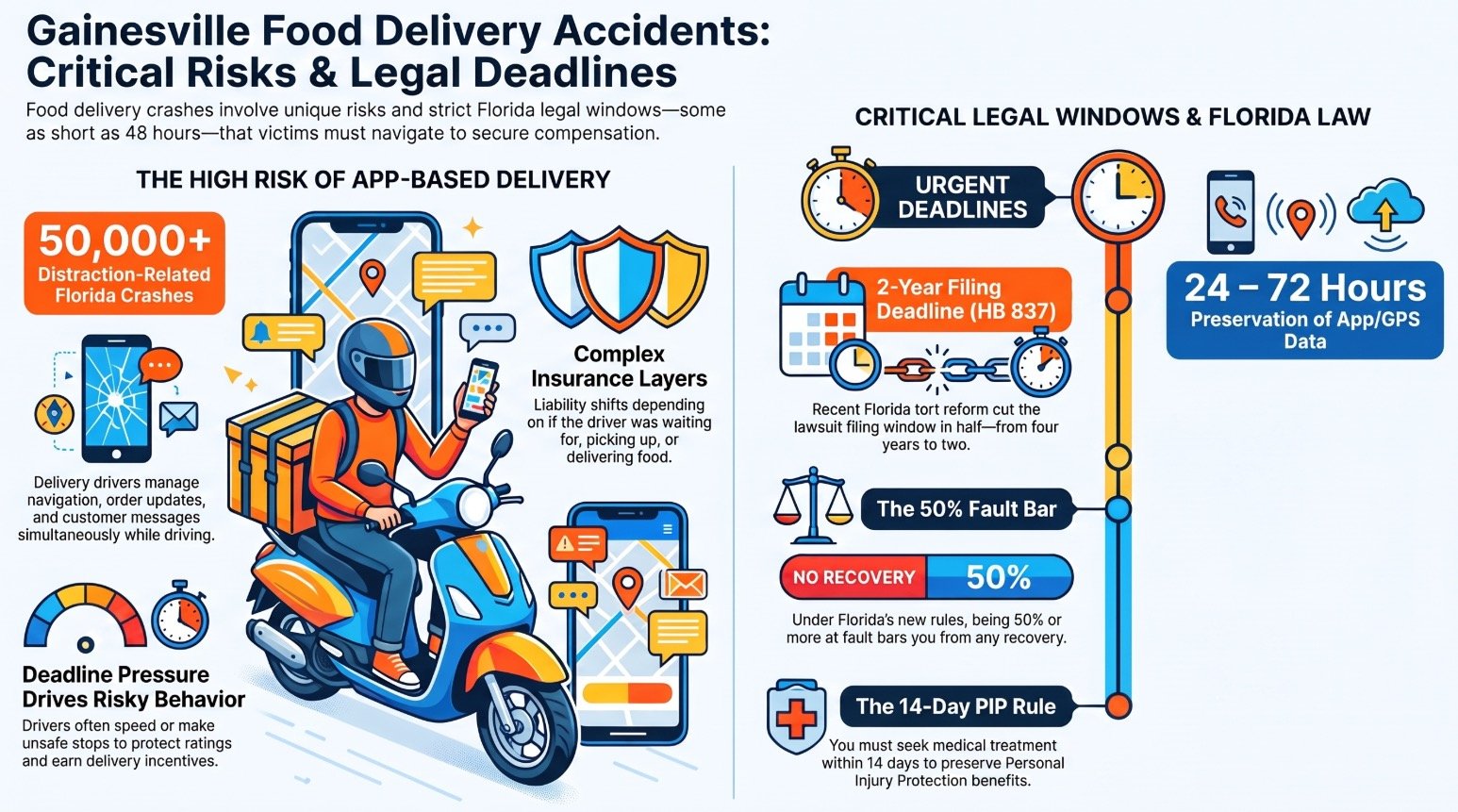
Florida’s crash data makes clear why food delivery accidents carry such a serious risk. According to the FLHSMV 2022 Florida Traffic Crash Facts, Florida recorded 401,523 total crashes in 2022, resulting in 253,888 or more documented injuries. Food delivery drivers face a compounded version of these risks: they navigate unfamiliar streets, manage live app notifications, and race against customer deadlines — all while operating a vehicle. NHTSA data shows 3,308 distracted driving deaths nationally in 2022, driven largely by the same phone-dependent behavior that defines app-based delivery work.


Delivery platforms also create unique evidence challenges — trip logs, GPS routes, and screen interaction records exist only briefly before they are overwritten or restricted. Under Florida HB 837 (2023), the filing deadline is now two years from the crash date, and if you are found 50% or more at fault, you recover nothing. Acting quickly is not just practical — it is legally essential.
Florida PIP and No-Fault Coverage After a Food Delivery Accident
Florida is a no-fault state, which means that after a food delivery crash, your own Personal Injury Protection (PIP) coverage pays first — regardless of which driver was at fault. Florida law requires a minimum of $10,000 in PIP coverage, which covers 80% of reasonable medical bills and 60% of lost wages up to that limit. To preserve access to PIP benefits, you must seek medical treatment within 14 days of the crash. Delaying beyond 14 days can disqualify you from PIP benefits entirely.
For a complete breakdown of how PIP interacts with third-party claims after a crash, read our guide: Florida PIP Insurance Explained.
Food delivery cases add an important layer: the at-fault driver may carry both personal auto coverage and a supplemental commercial policy through their delivery platform, creating a multi-insurer negotiation that requires careful coordination. We identify every active policy, challenge coverage gaps, and ensure you are not left paying expenses that a delivery platform’s insurance should cover.
Common Causes of Gainesville Food Delivery Car Accidents
We often see Gainesville food delivery crashes arise from predictable risks, including distracted app usage, speeding between orders, unsafe parking stops, and driver fatigue. When drivers focus on navigation, delivery updates, or tight deadlines, they can make choices that put you and others on the road in danger. We examine these causes carefully because each factor can affect liability, insurance coverage, and the strength of an injury claim.
Distracted App Usage
Why do app-based distractions cause so many Gainesville food delivery car accidents? We understand drivers want to serve customers quickly, accurately, and safely — yet delivery apps often demand attention at the worst moments. A driver may read order updates, confirm pickups, follow navigation, message customers, or manage stacked deliveries while moving through traffic. These phone-distraction risks reduce reaction time and make it harder to notice pedestrians, cyclists, signals, and sudden stops near restaurants or in neighborhoods. We also examine app policy compliance, because companies may require hands-free use, safe parking before updates, or limits on in-app messaging while driving. When drivers ignore these rules, preventable harm can follow. If you were injured, we can review digital records, trip data, and communications to identify any distractions and assess accountability.
Speeding Between Orders
As delivery deadlines tighten and order volume increases, some drivers speed between pickups and drop-offs to protect ratings, earn incentives, or avoid customer complaints. We understand the desire to serve hungry customers quickly, especially when platforms reward fast completion. However, rushing deadlines can turn routine streets near UF, downtown Gainesville, and residential neighborhoods into dangerous corridors. Speeding reduces reaction time, increases stopping distance, and makes crashes more severe for everyone involved.
We also see how app multitasking can combine with speed to create unsafe decisions. When a driver accepts stacked orders, checks routes, or monitors timers while accelerating, attention narrows, and judgment suffers. If you were injured by a speeding delivery driver, we can examine trip data, witness accounts, and crash evidence to establish liability and pursue the compensation you deserve.
Unsafe Parking Stops
When delivery drivers stop suddenly or park in unsafe locations, they can create immediate hazards for other motorists, cyclists, and pedestrians. We often see risks when drivers block travel lanes, stop near intersections, double-park, or pull into bike lanes while trying to complete an order quickly. These choices can force you or others to swerve, brake hard, or enter opposing traffic. Illegal stopping — including stopping where parking is prohibited — may support a claim when it contributes to a crash. Improper signage can also matter, especially when unclear loading zones, faded curb markings, or missing warnings confuse drivers and increase the risk of accidents. We examine these details carefully because safe streets protect everyone, including those serving meals and those simply trying to travel through Gainesville responsibly.
Driver Fatigue Risks
During long shifts and late-night delivery runs, fatigue can weaken a driver’s attention, reaction time, and judgment. When sleep deprivation affects a delivery driver, we may see lane drifting, missed signals, harsh braking, or delayed responses to hazards involving pedestrians, cyclists, and other motorists. In Gainesville, these risks matter because every delivery trip shares the road with people who rely on reliable service and public safety. We encourage you to recognize fatigue as more than ordinary tiredness — it can create preventable harm. Strong incident prevention requires reasonable schedules, rest breaks, and honest decisions about when a driver should stop. Driver accountability also matters when companies pressure workers to accept too many orders or ignore warning signs. We help examine these facts after a serious crash.
Legal Rights After a Gainesville Food Delivery Car Accident
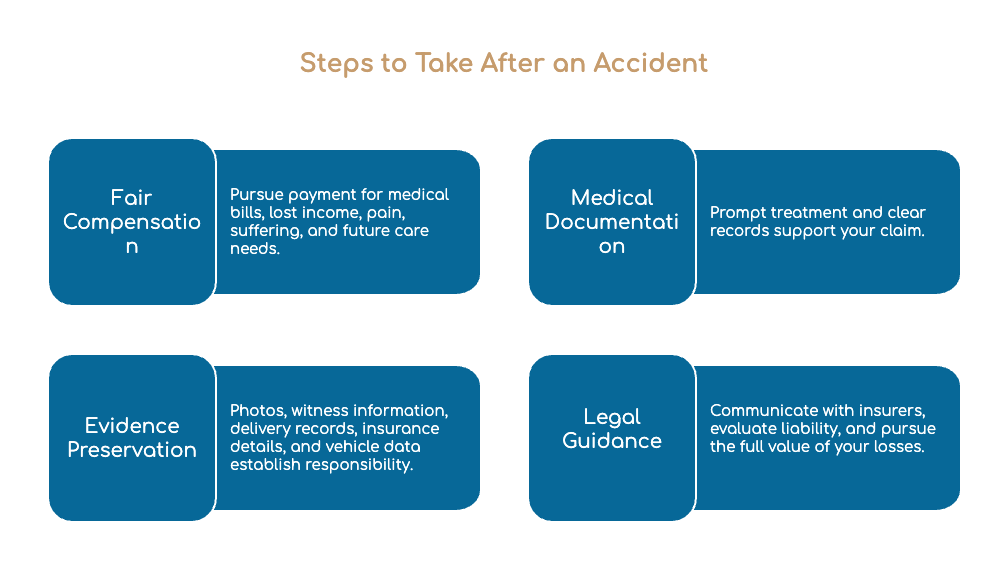
After a food delivery crash in Gainesville, injured people have the right to seek compensation from any party whose negligence contributed to the collision. We help you understand those rights, so you can protect your health, your family, and your ability to serve others.
- Fair compensation: You may pursue payment for medical bills, lost income, pain, suffering, and future care needs.
- Medical documentation: We encourage prompt treatment and clear records because your recovery history supports your claim.
- Evidence preservation: Photos, witness information, delivery records, insurance details, and vehicle data can help establish responsibility.
- Legal guidance: We can communicate with insurers, evaluate liability, and pursue the full value of your losses.
You should not have to carry the financial burden when another party caused your injuries. By acting quickly and carefully, we can help improve your claim, reduce avoidable mistakes, and seek accountability through a structured legal process.
Why Do Gainesville Food Delivery Car Accident Injuries Happen?
Understanding your legal rights also requires identifying why the crash happened and who had the power to prevent it. In Gainesville, food delivery accidents often occur because drivers face tight deadlines, unfamiliar routes, and constant app notifications. We see risks increase when a driver speeds, looks at a phone, stops suddenly, or parks in unsafe locations while trying to complete an order.
Other causes may involve careless motorists who fail to yield, follow too closely, or ignore signals near restaurants, apartments, and campus areas. Weather and road conditions can also make deliveries more dangerous, especially during heavy rain, poor visibility, standing water, or construction zones. In some cases, traffic control failures — such as broken signals, missing signs, or poorly marked intersections — contribute to preventable crashes.
When we examine these factors, we focus on accountability, safety, and the duty each person or entity has to protect others on the road.
What Should You Do After a Gainesville Food Delivery Car Accident?
After a Gainesville food delivery car accident, we recommend that you act quickly to protect your health and your potential injury claim. We start by helping you seek medical care, report the crash, and preserve crucial evidence before it disappears. These steps can strengthen your case, clarify what happened, and support your right to pursue compensation.
Seek Medical Care
Prompt medical care can restore your health and create a clear record of your injuries following a Gainesville food delivery car accident. We encourage you to get evaluated immediately — even if you believe your injuries seem manageable. A minor injury assessment can identify hidden trauma, including soft tissue damage, concussions, or internal concerns that may worsen without care.
We also recommend documenting symptoms from the outset, including pain levels, mobility limitations, dizziness, and emotional distress. Clear notes help medical providers understand your condition and support consistent treatment decisions. Attend all follow-up medical visits, follow prescribed care plans, and keep copies of records, bills, and instructions. Treatment continuity protects your rehabilitation, strengthens accountability, and helps ensure you can continue serving your family, work, and community responsibly.
Report the Crash
When a food delivery crash causes injuries, you should report the collision to law enforcement as soon as it is safe to do so. Call 911 immediately if anyone needs urgent help, traffic is blocked, or a driver seems impaired. While at the scene, protect yourself first and avoid standing in travel lanes. Get details from responding officers, including the agency name, report number, and instructions for obtaining the crash report. We also suggest that you clearly describe pain, visible harm, and medical concerns so officers can document injuries accurately. If broken glass, leaking fluids, poor lighting, or road debris created danger, note those hazards for the report. A prompt, accurate report helps establish what happened and supports your path toward accountability after the crash.
Preserve Key Evidence
Once the scene is secure, preserve evidence that can show how the crash happened, who was working, and what losses you suffered. Photograph vehicle damage, skid marks, traffic signals, delivery bags, app screens, license plates, and visible injuries before conditions change. If you can, gather names, phone numbers, and insurance details from drivers, witnesses, and responding officers. Contact evidence may include delivery app records, dispatch logs, order receipts, GPS data, and texts — request and save them quickly.
We also need to preserve medical records, bills, discharge papers, prescriptions, and therapy notes. These documents connect your injuries to the crash and support fair compensation. Keep damaged property, missed-work notes, and repair estimates in one secure file. Early organization helps us serve your claim with accuracy and purpose.
Critical Evidence in a Gainesville Food Delivery Car Accident Injury Case
We help you identify and preserve the evidence that can prove fault, timing, and delivery status after a Gainesville food delivery crash. Critical evidence may include: 1. delivery app data, 2. driver trip records, 3. crash scene photos, 4. witness statements, and 5. event data recorder (EDR) information. We use these materials to build a clear claim, challenge disputed facts, and pursue the compensation you are entitled to seek.
Delivery App Data
Because delivery app records can show what a driver was doing in the moments before a crash, this data often becomes critical evidence in a Gainesville food-delivery car-accident injury case. We look for order status, route activity, screen interactions, and timestamps for each app that may indicate whether the driver was accepting, reviewing, or managing a delivery while driving. This information can help us serve injured clients by identifying distraction, timing, and potential responsibility more accurately.
We handle geolocation privacy concerns carefully, seeking only data that is relevant to the collision and your claim. Delivery platforms may control this information, so requests to preserve prompts matter. When properly obtained, app data can support witness statements, police findings, and crash reconstruction — helping us protect your rights and pursue a fair outcome.
Driver Trip Records
Driver trip records build on delivery app data by showing the broader history of a driver’s activity before, during, and after a Gainesville food delivery crash. We review these records to understand timing, workload, and service demands that may have affected safe driving. App trip tracking can reveal accepted orders, pickup windows, delivery deadlines, and whether the driver was rushing to serve a customer. GPS route history helps us compare the intended route with the actual path taken, including detours or delays. We also examine driver employment status, because liability may depend on whether the driver acted as an employee or an independent contractor. When available, vehicle maintenance logs may show ignored safety issues. Together, these records help us present your claim with accuracy and purpose.
Crash Scene Photos
At the crash scene, photos can preserve details that later disappear, change, or become disputed. We use clear images to document vehicle positions, skid marks, debris fields, traffic signals, weather conditions, road defects, and delivery items inside or near the vehicle. These images support accident timeline documentation by showing what happened before cleanup, towing, or repairs alter the scene.
We also rely on photos when applying vehicle damage valuation methods, because visible impact points, crushed panels, airbag deployment, and structural damage help connect the force of the collision to your injuries. If you can safely take pictures, capture wide views, close details, license plates, app delivery bags, and surrounding landmarks. We handle this evidence carefully, so your claim can serve truth, accountability, and fair recovery.
Witness Statements
Photos show what the crash scene looked like, but witness statements help explain how the collision unfolded. We speak with nearby drivers, pedestrians, restaurant staff, and first responders to identify what they saw, heard, and did after impact. These accounts can confirm speeding, distraction, unsafe turns, delivery pressure, or whether a driver ignored traffic controls. We also compare each statement with physical evidence, police reports, and delivery platform data. Eyewitness credibility checks help us assess vantage point, timing, consistency, and possible bias. When an app displays route details, pickup times, or delivery status, the app’s recording accuracy becomes crucial. We help you preserve these records before they disappear or change. Strong witness statements can serve your recovery by clarifying fault and supporting a fair claim.
Event Data Recorder (EDR) Evidence in Food Delivery Cases
Most passenger vehicles manufactured after 2012 contain an Event Data Recorder (EDR) — a device that captures speed, braking, throttle position, and steering data in the seconds before and during a crash. According to NHTSA, this data is especially valuable in food delivery cases, where the driver’s speed and braking behavior at the moment of impact can directly contradict insurer claims about fault. EDR data can confirm whether a delivery driver was accelerating, confirm the force of the crash, and even reveal whether a seatbelt was worn at impact.
We send formal spoliation letters — written demands for evidence preservation — to all responsible parties immediately upon retention, because EDR data can be overwritten when the ignition is cycled after the crash.
For more on how black box data helps protect claims like yours, read: How Black Box Data Can Help Your Car Accident Case.
Long-Term Effects of Gainesville Food Delivery Car Accident Injuries
After a Gainesville food delivery crash, we often see injuries that do not resolve quickly — including chronic pain that limits mobility and daily function. We also help you consider how missed work, reduced job options, and lost earning capacity may affect your financial future. Emotional trauma can be just as serious, and we account for anxiety, sleep disruption, and lasting distress when evaluating your claim.
Chronic Pain Complications
Chronic pain can disrupt nearly every part of life after a Gainesville food delivery car accident, especially when injuries to the back, neck, shoulders, joints, or nerves do not recover as expected. We recognize how persistent discomfort can affect your ability to care for family, serve customers, and remain engaged in your community. Chronic pain symptoms may include burning sensations, stiffness, weakness, headaches, limited range of motion, or pain that worsens with routine activities. These complications often require careful documentation, consistent medical evaluation, and a clear plan for future care. We consider long-term treatment options such as physical therapy, pain management, injections, medication, and specialist care when reviewing injury claims. By identifying these needs early, we help restore your health, dignity, and continued ability to serve others with purpose.
Lost Earning Capacity
Persistent pain can also limit the type and amount of work you are able to perform, creating financial harm that extends well beyond immediate medical bills. When injuries reduce your stamina, mobility, or concentration, your ability to earn a living may be permanently affected. We evaluate lost earning capacity by considering your prior wages, career path, education, physical restrictions, and the service-focused duties you can no longer safely perform. For food delivery drivers, this may include reduced driving hours, missed opportunities, or the need to leave work that once supported their families and communities. Medical expenses and future care needs can intensify these losses. We pursue long-term support that reflects your diminished earning future and the real-world impact the crash has had on your livelihood.
Emotional Trauma Effects
When a serious crash interrupts your sense of safety, emotional trauma can affect daily life long after the physical injuries begin to heal. We recognize that anxiety, sleep disruption, irritability, and fear of driving can make it harder for you to work, care for others, and maintain relationships. These effects merit careful documentation, just like medical bills or missed wages.
We help you recognize how post-crash financial pressure, settlement timelines, and insurance paperwork can intensify stress during recovery. By setting communication boundaries with insurers and delivery companies, we protect your focus and reduce unnecessary strain. We also encourage consistent mental health treatment when symptoms persist, because your emotional restoration matters. A complete injury claim should reflect both visible harm and the lasting psychological impact of the collision.
Proving Liability in Gainesville Food Delivery Car Accidents Injury Cases
After a food delivery crash, proving liability requires a careful review of who caused the collision, what each party was doing at the time, and whether any company policies or insurance coverage may apply. We examine police reports, traffic camera footage, app records, delivery timelines, witness statements, and vehicle damage to determine how the crash occurred. You are entitled to a clear explanation of whether the driver, another motorist, a restaurant, or a delivery platform contributed to your injuries.
We also consider whether negligent hiring played a role, such as when a company allowed an unsafe driver to make deliveries despite warning signs. Vendor liability may apply if a restaurant, contractor, or related business created conditions that increased the risk of harm. By carefully building the evidence, we help you pursue accountability while honoring your goal of restoring stability, protecting your family, and serving your community after a serious delivery accident in Gainesville.
Dealing With Insurance Companies After a Gainesville Food Delivery Car Accident
Because food delivery crashes often involve several insurers, we move quickly to identify every policy that may apply and protect you from early tactics that can weaken your claim. We speak with adjusters for you, so you do not have to balance recovery, work, family, and service to others while facing recorded statements or unfair settlement pressure.
We review the driver’s personal coverage, any delivery platform coverage, and other available sources. We also explain how coverage disputes can arise when insurers argue over whether the driver was logged in, waiting for an order, or actively delivering food. Those details matter, and we work to preserve them.
For guidance on your rights as a Florida policyholder or injured claimant, you can also visit the Florida Department of Financial Services.
Your wellness remains central. By carefully documenting your medical records, we connect your injuries to the crash and help demonstrate the full impact on your daily responsibilities. We aim to keep insurers focused on facts — not excuses — while protecting your dignity and financial stability.
What to Expect During a Gainesville Food Delivery Car Accident Injury Claim Process
We will guide you through each stage of a Gainesville food delivery car accident injury claim, beginning with the initial filing and the evidence needed to support it. We will help you understand how medical records, crash reports, witness statements, and app data can affect the insurance negotiation process. If the insurer will not offer fair compensation, we will explain when settlement remains possible and when litigation may become necessary.
Initial Claim Filing
When a food delivery crash occurs in Gainesville, the initial claim filing sets the direction for the entire injury case. We begin by identifying every available insurance path, including the delivery driver’s policy, the company’s coverage, and any personal injury protection benefits. We also determine whether workers’ compensation claims apply, especially when the injured person was delivering orders at the time. If law enforcement cites or arrests a driver, we explain the criminal versus civil considerations, because a criminal case may punish misconduct, while a civil claim seeks financial recovery. We help you notify insurers, avoid harmful statements, and meet filing deadlines. Our goal is to protect your rights while you focus on recovery, family responsibilities, and continuing to serve others with stability and dignity.
Evidence Collection Steps
After the claim is opened, evidence collection becomes the foundation for proving fault, damages, and available insurance coverage. We act quickly because delivery data, witness memories, and video records can disappear. We gather police reports, crash photos, medical records, repair estimates, and statements from witnesses to the collision. We also seek app-based records showing whether the driver was accepting orders, transporting food, or using the vehicle for personal reasons.
Preserving surveillance footage is often urgent, so we send written requests to nearby businesses, homes, and traffic camera sources. Smartphone location tracking may also help confirm routes, speeds, stops, and timing. As we organize this evidence, we help you carefully document losses, protect your role in serving others, and prepare a clear claim record.
Insurance Negotiation Process
Once we have gathered the core evidence, we begin the insurance negotiation process by identifying every available policy and presenting the claim in a structured, evidence-based manner. We communicate with insurers for the delivery driver, company, and any applicable rideshare or commercial carrier — protecting you from statements that could be misused. We explain liability, medical treatment, wage loss, property damage, and emotional impact recovery with clear documentation. We also properly gather witness accounts, using consistent questions, contact details, and written or recorded statements. Throughout this process, we respond to adjuster requests, challenge undervalued assessments, and keep you informed. Our goal is to serve your needs with diligence, preserve leverage, and pursue fair compensation through disciplined negotiation.
Settlement or Litigation
If the insurer will not offer a fair resolution, we evaluate whether settlement remains practical or litigation has become necessary to protect your claim. We explain each option, review the evidence, and prepare you for the next step with care. Settlement can spare time and conflict, but it must reflect your medical needs, lost income, and long-term responsibilities. Litigation may be appropriate when insurers rely on insurance policy exclusions, dispute delivery status, or undervalue your losses. We also perform a comparative negligence analysis to address claims that you, another driver, or the delivery company shared fault. If filing suit serves your interests, we draft the complaint, manage deadlines, and pursue discovery. Throughout the process, we remain focused on accountability, recovery, and helping you move forward with stability.
Compensation for Gainesville Food Delivery Car Accidents Injury Damages
When a food delivery crash in Gainesville causes injuries, the compensation available should reflect the full scope of the harm — not just the first medical bill or repair estimate. We help you pursue recovery that accounts for treatment needs, wage disruption, vehicle damage, and the lasting effect the collision has on daily responsibilities.
Because many injured people still care for families, serve customers, or support their communities, we treat each loss with practical attention. Proving medical harm requires records, physician opinions, imaging, and treatment plans that connect the crash to your injuries and future care. We also review delivery app coverage, driver policies, and other available insurance to identify all responsible sources. To understand how compensation values are typically calculated in Florida crashes, read: Average Car Accident Settlement in Florida.
If insurance underpayment occurs, we challenge low valuations with organized evidence and firm negotiation. Our goal is to present a complete claim, protect your rights, and seek compensation that supports your recovery with dignity and stability.
Economic vs. Non-Economic Damages in Gainesville Food Delivery Car Accidents Cases
We separate your damages into economic and non-economic losses because each category requires different proof and valuation. Economic damages cover measurable costs such as medical bills, lost wages, and vehicle repairs, while non-economic damages address pain, suffering, and reduced quality of life. We help you document these losses clearly, connect them to the crash, and pursue compensation that reflects the full impact of your injuries.
Economic Damages Explained
Although every injury claim depends on its specific facts, economic damages in a Gainesville food delivery car accident case focus on the measurable financial losses caused by the crash. We look closely at medical bills, rehabilitation costs, prescription expenses, transportation to appointments, and property damage. Lost wages also matter, especially when your injuries keep you from serving your family, employer, or community. We gather insurance documentation, employment records, receipts, and provider statements to show what the crash has already cost you. We also consider future expenses, including ongoing treatment, reduced earning capacity, and necessary household support. By organizing these records carefully, we build a clear demand that reflects the practical costs you should not have to carry alone after a collision.
Non-Economic Damages Explained
Non-economic damages address the human cost of a Gainesville food-delivery car accident, including pain, distress, and disruption that do not appear on receipts or invoices. We recognize that your recovery may involve anxiety, sleep loss, physical limitations, embarrassment, or the loss of activities that once supported your family, work, and community service. These harms matter because an injury can change how you care for others and participate in daily life.
We evaluate non-economic damages by considering the severity of injuries, the duration of suffering, and the effects on relationships, independence, and routine responsibilities. Emotional distress documentation may help explain the depth of these losses, while future loss modeling can clarify how lasting impairments may continue affecting your quality of life beyond the immediate recovery period.
Proving Accident Losses
After identifying the personal impact of the injury, the next step is to prove the full value of the losses associated with the Gainesville food delivery car accident. We gather medical bills, wage records, repair estimates, and receipts to document economic damages with precision. We also help you present non-economic harm, including pain, emotional distress, and loss of daily function, through medical notes, testimony, and consistent documentation.
To understand how medical records factor into this calculation, read: Why Medical Records Matter in Personal Injury Cases.
We examine comparative negligence carefully because any assigned fault can reduce recovery under Florida law. If a delivery driver, company, or other party acted with reckless disregard for safety, we may also evaluate whether punitive damages apply. Our goal is to build a clear, service-minded claim that honors your losses and supports your path forward.
When a Gainesville Food Delivery Car Accident Injury Case Goes to Trial vs. Settlement
Most Gainesville food delivery car accident injury cases resolve through settlement, but we prepare every claim as if a jury may ultimately decide it. That preparation helps us serve you with steady judgment, whether negotiations succeed or trial becomes necessary. We evaluate liability, medical proof, lost income, future care needs, and the insurer’s willingness to make a fair offer.
Settlement may protect you from delay, expense, and uncertainty — especially when the evidence supports a reasonable resolution. Trial may become appropriate when the opposing side disputes fault, minimizes injuries, or refuses to account for the full harm caused. Our trial strategy focuses on presenting clear evidence, credible witnesses, and a practical explanation of how the crash changed your daily life.
If a trial is required, jury selection becomes important because jurors bring different life experiences to the courtroom. We work to identify fair decision-makers who can listen carefully and apply the evidence responsibly.
Florida Laws That May Affect Your Gainesville Food Delivery Car Accidents Case
Florida law governs every stage of a Gainesville food-delivery car accident case, from insurance coverage to the deadline to file a lawsuit. We help you understand how these rules apply when service to others turns into serious harm.
- No-fault coverage: Florida PIP benefits may pay initial medical expenses regardless of who caused the crash, but treatment must begin within 14 days of the accident.
- TNC liability: If an app-based courier caused the collision, coverage may depend on whether the driver was logged in, waiting for an order, or actively delivering food at the time of impact.
- Employment status: Some delivery drivers are independent contractors, while others may be covered by workers’ compensation rules, which affects the available claims and benefits for everyone involved.
- Medical lien issues: Hospitals, insurers, or providers may assert a medical lien against your recovery, and we work to protect your compensation from improper reductions.
We review each legal issue carefully, so you can focus on healing, family, and continuing to serve your community.
The Statute of Limitations for Gainesville Food Delivery Car Accidents Injury Cases
When a food delivery crash causes injuries in Gainesville, the statute of limitations can determine whether you still have the right to pursue compensation. In most Florida negligence cases, you must act within two years from the crash date, following the 2023 reform under HB 837. Missing that deadline can bar a claim, even when injuries are serious, and service responsibilities were interrupted.
We also consider how early action supports the preservation of evidence. Delivery app records, GPS data, dashcam footage, witness statements, vehicle damage, and medical documentation can become harder to obtain over time. Prompt attention helps protect the facts that show how the collision occurred and how it affected your ability to care for others.
Florida’s comparative fault rules may also affect recovery if multiple parties share responsibility. Timely investigation helps clarify each party’s role before memories fade or records disappear. By respecting these deadlines, we protect your opportunity to seek full accountability.
How a Gainesville Food Delivery Car Accident Injury Lawyer Can Help You
After the filing deadline and evidence concerns are addressed, we focus on building a claim that reflects the full impact of the crash. We help you organize facts, document losses, and pursue accountability while you continue serving your family, workplace, and community.
- Investigation: We review police reports, delivery app records, witness statements, and vehicle damage to identify liable parties and strengthen causation.
- Evidence preservation: We guide you on safeguarding photos, receipts, medical records, damaged property, and communications before crucial details are lost.
- Medical treatment planning: We coordinate documentation of diagnoses, follow-up care, therapy, and future needs — helping connect your injuries to the collision.
- Claim management: We handle insurer communications, calculate wage loss and non-economic harm, and prepare negotiations with disciplined support.
At each step, we protect your time, reduce confusion, and present a clear account of damages — so your claim is treated with seriousness and respect.
When to Contact a Gainesville Food Delivery Car Accident Injury Lawyer
As soon as a food delivery crash disrupts your health, work, or daily responsibilities, you should consider contacting a Gainesville food delivery car accident injury lawyer. We recommend reaching out before speaking in detail with insurers, signing forms, or accepting payment — because early statements can affect your claim.
You should also call when injuries appear minor, but pain, dizziness, or stiffness develops later. Immediate medical documentation helps connect your condition to the collision and supports responsible care planning. If you serve family members, clients, students, patients, or your community, protecting your recovery also protects those who depend on you.
Contact us promptly if the delivery driver was on an app, multiple vehicles were involved, the fault is disputed, or evidence may disappear. An emergency evidence checklist can help preserve photos, witness names, app information, police reports, medical records, and damaged property before details are lost. Early action keeps important legal options available.
Why You Need an Experienced Gainesville Food Delivery Car Accident Injury Lawyer
Protect your claim by working with a Gainesville food delivery car accident injury lawyer who understands how these cases differ from ordinary collisions. We recognize these crashes often involve delivery apps, personal auto policies, commercial coverage questions, and drivers under pressure to complete orders quickly.
When you are healing and still trying to care for your family, work, or community, we help carry the legal burden. We investigate the fault, preserve app records, review insurance layers, and calculate damages that reflect the full impact of the crash. That includes lost income, pain, property damage, and future medical costs when treatment may continue for months or years.
We also manage communication with insurers, so you do not face tactics designed to reduce payment or delay progress. Because settlement timelines can vary based on liability disputes, medical recovery, and coverage issues, we keep your claim organized and prepared for negotiation or litigation when necessary.
How to Choose the Right Gainesville Food Delivery Car Accidents Injury Lawyer for Your Case
Choosing the right Gainesville food-delivery car-accident injury lawyer starts with finding a firm that understands both injury law and the unique insurance issues associated with app-based delivery work. Look for experience with rideshare, delivery driver, and third-party liability claims, because these cases often involve several insurers and coverage disputes.
We also want a lawyer who respects your role in caring for others while helping you protect your own recovery. Ask how the firm investigates crashes, gathers delivery app records, evaluates medical needs, and communicates with insurance companies. Client communication preferences matter, so confirm whether updates come by phone, email, text, or scheduled meetings.
Fee structure transparency is equally important. Understand whether the lawyer works on a contingency basis, what costs may arise, and when payment is due. The right advocate explains each step clearly, answers questions directly, and helps you make informed decisions with confidence.
Real Reviews From Our Clients!
Stephen P. ★★★★★
“After being injured in a crash caused by a distracted driver, I did not know what to do or who to call. Anidjar & Levine stepped in immediately and took complete control of the situation. They handled all the insurance paperwork, kept me fully informed, and made sure I was treated fairly. I cannot thank them enough.”
Maddie Dalby ★★★★★
“Anidjar & Levine went above and beyond for me. They explained every step of the process, were always available when I had questions, and made sure I received fair compensation. I felt like I was in the best possible hands throughout the entire experience.”
Evan Cadet ★★★★★
“The team at Anidjar & Levine was professional, compassionate, and relentless in fighting for what I deserved. They took over all communication with the insurance company so I could focus on healing. Exceptional firm — I would recommend them to anyone who needs a personal injury attorney in Florida.”
About The Law Offices of Anidjar & Levine
Founded in 2005 by Marc Anidjar and Glen Levine, the firm began as a two-person operation working out of a construction office conference room. Over the past 20 years, that modest start has grown into one of Florida’s most recognized personal injury practices — with more than $1 billion recovered in settlements for injury clients across the state. We bring that same determination and depth of experience to every case we handle.
When a food delivery crash disrupts your health, income, and daily responsibilities, The Law Offices of Anidjar & Levine can help you pursue compensation with focused legal support. We represent injured people in Gainesville with careful attention to evidence, deadlines, insurance tactics, and the practical burdens that follow a serious collision.
We know you may be trying to protect your family, continue serving others, and restore stability after an unexpected injury. Our team handles communication with insurers, gathers records, reviews crash details, and explains the principles of negligence so you understand how fault, damages, and liability may affect your case.
We also address misconceptions about Florida claims that can lead injured people to delay taking action or accept less than they deserve. When you work with us, we keep your case organized, provide direct guidance, and pursue the compensation available under Florida law. Call us for a free consultation today to discuss your next steps.
Past results do not guarantee a similar outcome in future cases. Each case is evaluated individually based on its unique facts and circumstances.
Frequently Asked Questions
Can I Sue a Food Delivery App Company Directly?
Yes, we can pursue a food delivery app company directly when the driver acted within the app work, the company controlled deliveries, or negligent hiring, supervision, or app design contributed to the crash. App company liability often depends on contracts, insurance coverage tiers, and Florida law. We help you identify all responsible parties and pursue full recovery through disciplined, evidence-based action after a crash.
What if the delivery driver were using a Bicycle or a scooter?
Yes, you may have a claim if a delivery driver on a bicycle or scooter caused harm. We examine bicycle liability, including traffic violations, unsafe turns, and failure to yield. We also assess scooter negligence, such as distracted riding, speeding, or improper use of sidewalks. We help you identify all responsible parties, preserve evidence, and pursue compensation — so you can focus on recovery and continue serving others with confidence.
Are Undocumented Immigrants Eligible to File Injury Claims?
Yes, undocumented immigrants can file personal injury claims. Immigration status does not usually control eligibility after an accident. If another party caused harm, you may seek compensation for medical care, lost income, and pain. We protect your dignity and pursue your claim without unnecessary exposure. You deserve clear guidance, respectful advocacy, and equal access to justice under the law.
Can Passengers in a Delivery Vehicle Seek Compensation?
Yes, passengers in a delivery vehicle can seek compensation when another party’s negligence causes injury. We can help you pursue claims against careless drivers, delivery companies, or others responsible for unsafe conduct. Negligent hiring may apply if an employer placed an unsafe driver on the road. Premises liability may also matter when unsafe pickup or drop-off locations contribute. We evaluate losses, protect your rights, and guide your recovery.
Do Food Delivery Accidents Affect Future Insurance Rates?
Yes, food delivery accidents can affect future insurance rates, especially when fault, claim size, or repeated incidents concern insurers. Insurers review driving history, coverage terms, and the claim process before adjusting rates. You should not assume every claim causes an increase, but you should document facts carefully, report accurately, and seek guidance before making statements to any insurance representative.
How Long Do I Have to File a Food Delivery Accident Lawsuit in Florida?
Under Florida’s 2023 tort reform law (HB 837), most personal injury claims must be filed within 2 years of the date of the accident. Missing this deadline can permanently bar your right to compensation, regardless of how serious your injuries are. Delivery app data, GPS records, and surveillance footage can disappear within days — contacting an attorney promptly is essential to protecting your rights and preserving time-sensitive evidence.
How Does Florida’s Modified Comparative Fault Rule Affect My Food Delivery Accident Claim?
Under Florida HB 837 (2023), if you are found 50% or more responsible for the crash, you are completely barred from recovering any compensation — even for serious, documented injuries. If your fault is below 50%, your recovery is reduced by your fault percentage. In food delivery cases, insurers may argue that you contributed to the collision. We challenge those claims aggressively with delivery records, crash reconstruction, traffic evidence, and witness accounts.
If you were injured in a Gainesville food delivery car accident, our Gainesville Car Accident Lawyer can help you pursue compensation and protect your rights. Our team understands the legal, insurance, and liability issues these cases often involve, and we are prepared to handle the details while you focus on recovery.
The Law Offices of Anidjar & Levine is ready to review your case, explain your options, and fight for the financial recovery you are entitled to. Contact us today for a free consultation.