The Law Offices of Anidjar and Levine helps injured people pursue compensation after a Gainesville failure to obey traffic signal accident. We investigate signal timing, right-of-way, driver conduct, video footage, witness accounts, police reports, vehicle damage, and medical records to prove fault and damages.
Our Gainesville Car Accident Lawyer team also handles insurer communications, evaluates settlement offers, and prepares claims for litigation when needed. If shared fault is alleged, we address comparative negligence with evidence, documentation, and legal strategy, as explained further below.
Main Takeaways
- A Gainesville injury lawyer can investigate signal timing, vehicle paths, right of way, and driver conduct after an intersection crash.
- Evidence such as police reports, video footage, photos, witnesses, and medical records helps prove liability and injury damages.
- Common causes include distracted driving, speeding, impairment, fatigue, poor visibility, confusing lanes, or malfunctioning traffic signals.
- Florida comparative negligence rules may reduce compensation if insurers argue you shared fault for the crash.
- A lawyer can handle insurer communications, evaluate quick settlement offers, and pursue compensation for medical bills, lost income, and pain.


How We Can Help With Your Gainesville Failure To Obey Traffic Signal Accident Injury Claim
When a driver fails to obey a traffic signal, the resulting crash can leave you facing medical bills, lost income, and difficult questions about liability. We help you move forward with steady guidance, careful investigation, and focused advocacy. Our role is to protect your claim while you concentrate on recovery, family duties, and serving those who depend on you.
We begin by reviewing police reports, medical records, vehicle damage, and available video. Collecting witness evidence is often crucial, because neutral accounts can clarify signal timing, driver conduct, and the sequence of impact. We also document your injuries, treatment needs, work limitations, and long-term losses.
Insurers may contact you quickly, but early offers often undervalue the severity of the harm. We handle communications, evaluate coverage, and pursue fair compensation through negotiating settlement offers. If negotiations don’t produce a just result, we’re prepared to present your claim with discipline, evidence, and purpose.
OUR CONSULTATIONSARE FREE
START YOUR FREE CASE REVIEW

Understanding Gainesville Failure To Obey Traffic Signal Accident Injury Cases
Although traffic signal violations may seem straightforward, Gainesville failure-to-obey-traffic-signal accident injury cases often require careful analysis of fault, timing, visibility, and driver conduct. We look beyond the citation and examine how the collision affected you, your family, and the broader community you serve.
These cases may involve disputed accounts, incomplete reports, or questions about whether a driver had a lawful opportunity to stop. We evaluate signal cycles, intersection layout, lighting, vehicle positions, and available video to establish what happened. Faulty Signal Malfunctions can also complicate liability, especially when timing records or maintenance histories reveal problems.
We also consider Eyewitness Credibility Issues, because sincere witnesses may remember events differently under stress. Our role is to organize the evidence, identify responsible parties, and present your claim with precision. When we grasp the full context, we can help you pursue accountability while protecting your ability to recover and continue serving others.
Common Causes of Gainesville Failure To Obey Traffic Signal Accident
We often see accidents involving failure to obey traffic signals in Gainesville that arise from preventable conduct, including distracted driving, speeding through intersections, impaired driving, and unsafe decisions during poor weather. When drivers ignore red lights or fail to adjust to conditions, they place you and others at serious risk of injury. We examine these common causes closely because they can help establish fault, liability, and the full impact of your claim.
Distracted Driving
Distracted driving causes many Gainesville failure-to-obey traffic signal accidents because it takes a driver’s attention away from the road at the exact moment they must recognize and respond to a red light, yellow light, or traffic control device. We often see crashes where distracted texting, navigation use, eating, or reaching for an object prevents a driver from noticing stopped traffic, pedestrians, cyclists, or changing signals.
When attention shifts, even briefly, drivers may enter an intersection unlawfully, make unsafe lane change errors, or fail to yield to those already proceeding with the right of way. We appreciate that responsible driving protects neighbors, families, and community members who depend on careful conduct. If you were injured, we can examine phone records, witness accounts, and roadway evidence to identify the cause of the distraction.
Speeding Through Intersections
Speeding through intersections creates serious Gainesville traffic signal accidents because it reduces the time a driver has to observe a red light, react to a yellow light, or stop for vehicles, pedestrians, and cyclists already in the intersection. We understand That Intersection speed limits exist to protect everyone moving through shared spaces, especially people relying on the pedestrian right-of-way.
When drivers rush through lights, they commit common violations that can turn routine travel into life-altering harm. We often see speeding undermine crosswalk safety, leaving walkers, students, cyclists, and other vulnerable road users little chance to avoid a collision. If you were injured because a driver ignored traffic controls while speeding, we can help identify the violation, preserve evidence, and pursue accountability with care.
Impaired Driving
When a driver approaches a signal while impaired by alcohol, drugs, or certain medications, even a routine intersection can become dangerous within seconds. We often see impaired motorists misjudge distance, react too slowly, or ignore a red light entirely, placing you and others at immediate risk. Blood alcohol levels may help prove impairment, but unsafe driving can occur before a driver reaches the legal limit.
Prescription medications and illegal drugs can also reduce attention, coordination, and judgment. When a crash results, DUI penalties may apply, yet criminal consequences don’t fully address your medical bills, lost income, or lasting harm. We work to identify evidence of impairment, including reports, test results, and witness accounts, so we can pursue accountability and help you protect the people who depend on you.
Poor Weather Conditions
Poor weather can make an already dangerous signalized intersection even harder to maneuver, especially after rain reduces visibility and traction on Gainesville roads. We are aware drivers must slow down, increase following distance, and remain alert for changing signals, pedestrians, and vehicles entering the intersection.
When motorists fail to adjust for wet pavement, fog, glare, or standing water, they can slide through red lights or misjudge yellow signals, causing serious harm to people who trusted the roadway to be safe.
We also consider how Nighttime Visibility and Roadside Lighting affect driver perception during storms or low-light conditions. Poor illumination can hide signal heads, lane markings, cyclists, or pedestrians. If you were injured, we can review weather records, lighting conditions, and driver conduct to help identify responsibility.


Legal Rights of Gainesville Failure To Obey Traffic Signal Accident Injury Victims
If another driver ignored a red light, failed to stop at a stop signal, or otherwise violated a traffic control device in Gainesville, the injured victim may have the right to seek compensation through a personal injury claim. We help you understand those rights with care, because recovery supports your ability to serve your family, workplace, and community.
Under Florida law, your claim may involve intersection right-of-way, driver duties, and Comparative negligence rules.
These rules can affect compensation if an insurer argues you shared fault.
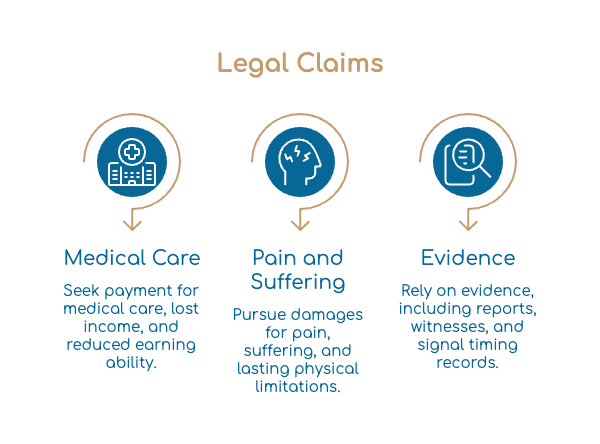
- You may seek payment for medical care, lost income, and reduced earning ability.
- You may pursue damages for pain, suffering, and lasting physical limitations.
- You may rely on evidence, including reports, witnesses, and signal timing records.
We work to protect your claim, present the facts clearly, and hold the negligent driver accountable for the harm caused.
Why Do Gainesville Failure To Obey Traffic Signal Accident Injuries Happen?
Because traffic signals rely on every driver’s attention and compliance, failure to obey them often causes serious Gainesville intersection accidents within seconds. We see these injuries happen when drivers speed through yellow lights, enter intersections after red lights, or turn without yielding. Distraction, impairment, fatigue, and impatience can also cause motorists to ignore clear commands meant to protect everyone.
Intersection safety laws exist because pedestrians, cyclists, passengers, and other drivers depend on predictable conduct. When someone disregards those rules, they can cause widespread harm to people simply traveling to work, school, medical appointments, or community service. Poor visibility, confusing lane design, and malfunctioning signals may also contribute, but drivers still must use reasonable care.
Traffic light liability often centers on who had the right of way, whether a signal was ignored, and how that choice caused injury. We examine these factors carefully because accountability supports safer roads for the Gainesville community.
What Should You Do After a Gainesville Failure To Obey Traffic Signal Accident Injury?
After a Gainesville failure to obey traffic signal accident, we recommend that you seek medical care immediately, even if your injuries seem minor. We also encourage you to document the scene, gather witness information, and preserve any evidence that may support your claim. Once you’ve addressed urgent medical and safety concerns, we advise you to contact an attorney who can protect your rights and guide the next steps.
Seek Medical Care
When a driver fails to obey a traffic signal in Gainesville, we should treat medical care as an immediate priority, even when injuries seem minor at first. We protect ourselves and those who depend on us by calling 911 for serious pain, bleeding, dizziness, confusion, or breathing trouble. While waiting, we can follow First aid steps, including staying still, controlling bleeding, and avoiding movement that may worsen a neck or back injury.
We should also accept evaluation by emergency personnel and seek prompt follow-up care with a physician. Some injuries, including concussions and internal trauma, may appear hours later. By documenting symptoms, medication, diagnoses, and treatment instructions, we create a clear health record that supports recovery, continuity of care, and any future injury claim.
Document The Scene
Prompt medical care protects our health, and careful scene documentation helps preserve the facts surrounding the crash. When it’s safe, we should record the traffic signal, vehicle positions, skid marks, debris, weather, lighting, and any visible injuries. A practical Scene photography checklist helps us capture wide views, close-ups, license plates, road signs, and damage from multiple angles.
We should also gather respectful witness information without interrupting emergency responders. Using basic eyewitness documentation tips, we can ask for names, phone numbers, locations at the time of impact, and brief statements about what they observed. If possible, we should note nearby cameras at businesses or intersections. By documenting carefully, we help protect everyone affected and support an accurate understanding of how the Gainesville signal violation occurred.
Contact An Attorney
Once we’ve addressed medical needs and preserved essential evidence, we should contact a Gainesville traffic signal accident injury lawyer as soon as possible. Early legal guidance helps us protect your claim, communicate with insurers, and avoid statements that may weaken liability. We can review the crash report, Emergency response records, witness information, intersection timing, and available video.
We should also request that dashcam footage be preserved from involved drivers, nearby businesses, rideshare vehicles, or public agencies before footage is erased. When we act promptly, we help secure facts that support accountability and fair compensation. You should focus on recovery and responsibilities to loved ones, while we handle legal deadlines, documentation, and negotiations. Serving your needs with diligence, we work to preserve your rights after a crash caused by failure to obey a traffic signal.
Critical Evidence in a Gainesville Failure To Obey Traffic Signal Accident Injury Case
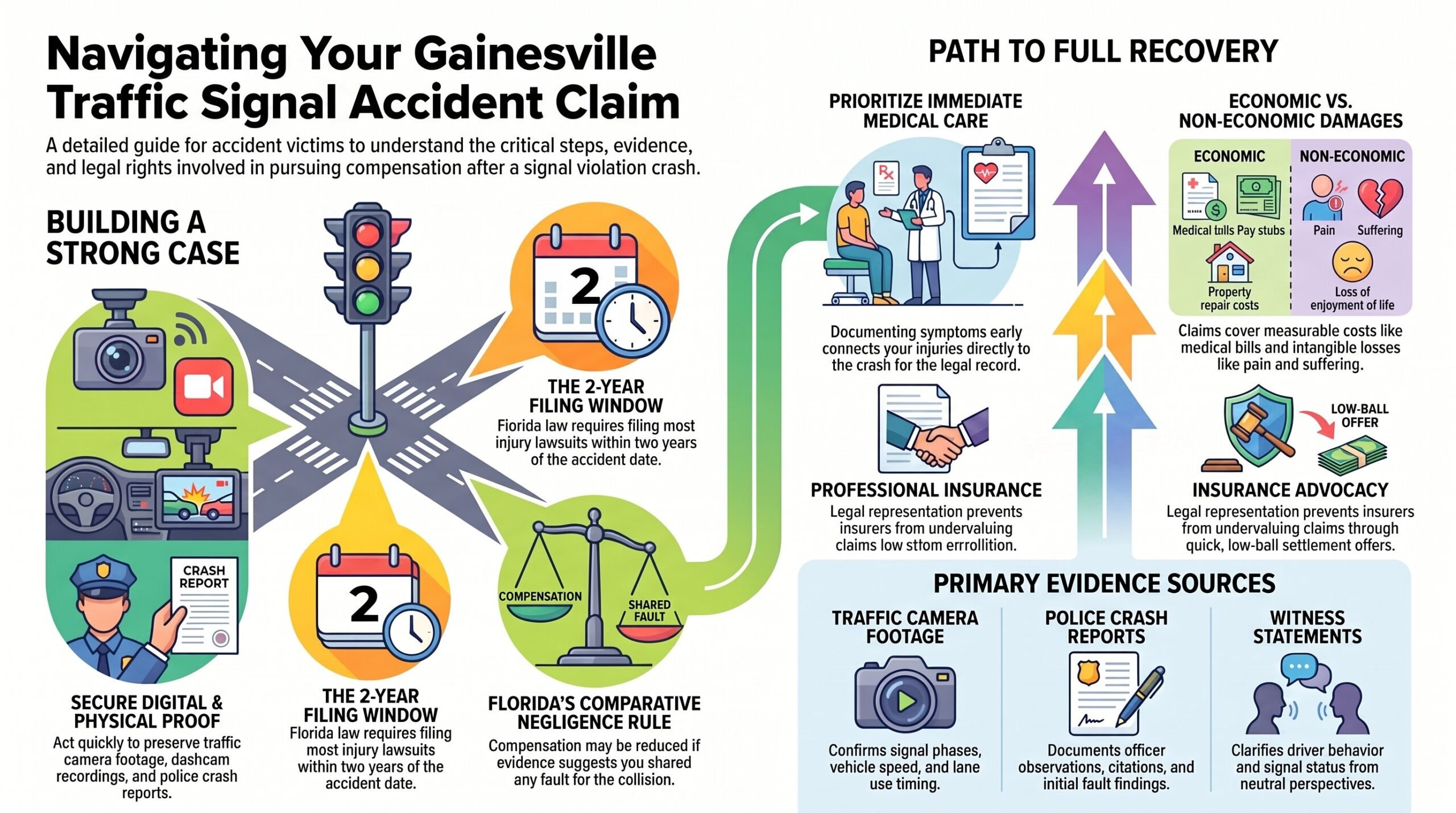
We identify and preserve the evidence that can prove how the signal violation caused your crash, because small details often determine liability. Vital proof may include: 1. traffic camera footage, 2. police crash reports and witness statements, and 3. vehicle damage evidence. We use these materials to build a clear timeline, challenge inaccurate accounts, and connect the at-fault driver’s conduct to your injuries.
Traffic Camera Footage
When a driver fails to obey a traffic signal, traffic camera footage can provide some of the most reliable evidence of what happened in the intersection. We use this footage to identify signal phases, vehicle positions, speed, lane use, and the timing of each movement. This evidence can help confirm whether a driver entered on red, failed to yield, or created a hazard for others.
For clients committed to serving their families and communities, clear proof matters because accountability supports intersection safety and helps prevent future harm. Footage may also reveal Pedestrian impacts, near misses, or evasive actions that witnesses did not fully observe. We act quickly to locate, preserve, and analyze available recordings before systems overwrite them or access becomes limited.
Police Crash Reports
Traffic camera footage can show the collision as it happened, but the police crash report often provides the first organized account of the Gainesville failure-to-obey-traffic-signal accident. We review this report carefully because it may identify drivers, vehicles, insurance details, citations, roadway conditions, and the officer’s initial conclusions. It also helps us understand how police determine fault, including whether a driver ignored a red light, failed to yield, or gave an inconsistent statement.
We also look for diagrams, impact points, skid marks, and references to electronic evidence. The importance of dashcam footage becomes clear when it supports or challenges the officer’s findings. When we serve injured clients, we use the crash report as a foundation, not the final word, while building a stronger claim.
Witness Statements
Because traffic signal violations often happen in seconds, witness statements can provide crucial details that physical evidence and crash reports don’t fully capture. We seek accounts from drivers, passengers, pedestrians, cyclists, and nearby workers who observed the signal phase, vehicle speed, lane position, or driver behavior. These statements can help you serve justice by clarifying what occurred before impact and supporting a truthful claim.
We also use Eyewitness credibility checks to evaluate vantage point, attention, consistency, timing, and possible bias. Prompt contact matters because memories fade and witnesses may become difficult to locate. Through statement preservation tactics, we document names, contact information, recorded summaries, and signed declarations when appropriate. By acting quickly, we protect reliable testimony that may strengthen your Gainesville failure to obey traffic signal injury case.
Vehicle Damage Evidence
Although a crash may last only moments, evidence of vehicle damage can reveal how a Gainesville failure-to-obey-traffic-signal accident occurred. We examine impact points, crush patterns, broken lights, paint transfer, and airbag deployment to understand direction, speed, and timing. When we compare damage with Eyewitness vehicle positioning, we can test whether accounts match the physical record.
This helps protect your claim and supports a fair evaluation of fault. We also act quickly because damaged vehicles may be repaired, sold, or discarded before inspection. Skid mark preservation matters as well, since tire marks can show braking, evasive action, and vehicle path. By securing photographs, repair estimates, and expert inspections, we help present reliable proof that serves accountability, safety, and your recovery.
Long-Term Effects of Gainesville Failure To Obey Traffic Signal Accident Injuries
We recognize that injuries from a Gainesville failure-to-obey-traffic-signal accident can extend far beyond the initial crash. You may face chronic pain, cognitive injury effects, and ongoing financial burdens that disrupt work, treatment, and daily stability. We evaluate these long-term consequences carefully, because they often shape the true value of your injury claim.
Chronic Pain Conditions
After a Gainesville traffic signal accident, chronic pain can become one of the most disruptive long-term effects of the crash. We often see you struggling with back pain, neck pain, nerve irritation, joint damage, or headaches that persist long after visible injuries recover. These conditions can limit work, caregiving, worship, volunteering, and daily service to others.
We help document how pain affects your function, treatment needs, and future stability through medical records, expert opinions, and consistent symptom histories. Strong Settlement negotiation strategies must address ongoing therapy, medication, injections, reduced earning capacity, and diminished quality of life. Under Florida comparative negligence rules, any assigned fault may reduce recovery, so we carefully connect your chronic pain to the signal violation and protect your claim from unfair blame.
Cognitive Injury Effects
When a driver ignores a traffic signal in Gainesville, the force of the collision can cause cognitive injuries that disrupt memory, concentration, processing speed, and emotional control. We acknowledge how these changes affect your ability to serve family, clients, coworkers, and community members with steadiness and care. Traumatic brain injuries may appear mild at first, yet symptoms can deepen as daily responsibilities expose fatigue, confusion, irritability, or difficulty making decisions.
We help you recognize that cognitive harm requires careful documentation, consistent medical attention, and patience during long-term recovery. You may need neurological evaluations, therapy, and structured routines to regain function. We focus on showing how these impairments interfere with communication, judgment, and reliability, so your legal claim reflects the full seriousness of your condition.
Ongoing Financial Burdens
As medical needs continue beyond the initial emergency response, a Gainesville traffic signal accident can place lasting financial pressure on your household. We understand your focus often remains on caring for others, maintaining work, and preserving stability, yet recovery expenses can disrupt every plan. Budgeting for medical appointments, therapy, prescriptions, mobility support, and transportation requires careful review of current income and future needs.
We help you consider how unpaid bills, reduced wages, and family caregiving duties may affect your claim. Negotiating payment plans with providers can offer temporary relief, but it shouldn’t replace the pursuit of full compensation from the responsible party. We evaluate documented losses, anticipated treatment costs, and practical household burdens, so your financial recovery reflects the crash’s long-term impact.
Proving Liability in Gainesville Failure To Obey Traffic Signal Accident Injury Cases
Establishing liability in a Gainesville failure-to-obey-traffic-signal crash requires clear proof that another driver violated a traffic control device and caused the resulting injuries. We begin by identifying the signal sequence, driver positions, vehicle paths, and timing of impact. Evidence preservation is crucial, because camera footage, skid marks, vehicle damage, and witness memories can disappear quickly after a collision.
We also examine intersection causation, meaning how the signal violation directly led to the crash and your losses. A driver may have run a red light, failed to yield on a protected turn, or entered against a steady signal. We gather police reports, scene photographs, crash data, medical records, and witness statements to build a reliable timeline.
When we serve you, we focus on facts that show duty, breach, causation, and damages. This disciplined approach helps present your claim credibly and supports the accountability required after a preventable intersection injury.
Dealing With Insurance Companies After a Gainesville Failure To Obey Traffic Signal Accident Injury
After a Gainesville traffic signal accident, insurance companies often move quickly to limit what they pay. We help you respond with care, accuracy, and a clear focus on protecting your recovery. Adjusters may request recorded statements, broad medical authorizations, or quick settlements before you understand the full impact of your injuries. We review communications, preserve supporting records, and help ensure your words aren’t used unfairly against you.
When an insurer disputes fault, questions treatment, or undervalues damages, we press for accountability through organized documentation and firm negotiation. If the carrier refuses to make proper payment, Insurance denial appeals may be necessary.
We also address coverage dispute resolution when policy limits, exclusions, or multiple insurers create conflict. Our role is to relieve you of unnecessary pressure, so you can focus on repair, serving your family, and continuing the responsibilities that matter most. We pursue fair treatment with diligence and professionalism.
What to Expect During a Gainesville Failure To Obey Traffic Signal Accident Injury Claim Process
We help you understand each stage of a Gainesville failure to obey traffic signal accident injury claim, from the initial evaluation to the decisions that may affect your recovery. We collect and review crucial evidence, including crash reports, witness statements, medical records, and signal timing information, to build a clear account of what happened. We then guide you through insurance negotiations and, when necessary, prepare for settlement discussions or litigation to protect your interests.
Initial Claim Evaluation
Evaluate the claim early to identify the facts, evidence, injuries, and insurance issues that will shape a Gainesville failure to obey traffic signal accident case. We begin by listening to you, understanding how the crash affected your health, work, family, and ability to serve others. We examine the reported sequence of events, traffic signal status, roadway conditions, and any immediate medical concerns.
A review of police reports helps us assess fault findings, citations, officer observations, and documented statements. Witness identification also matters, because independent accounts may clarify whether a driver ignored a red light or otherwise violated traffic control. We review available insurance coverage, potential defenses, and deadlines, then explain the claim’s strengths and concerns. This early evaluation gives you direction before major decisions arise.
Evidence Collection Steps
Once we recognize the basic facts, we move quickly to preserve and collect the evidence that can prove how the traffic signal violation caused the crash. We obtain police reports, witness details, traffic camera footage, signal timing records, and nearby business surveillance when available. We also guide you through a Photography timeline that documents vehicle damage, skid marks, debris fields, injuries, and intersection conditions before key details change.
Medical records, ambulance reports, and repair estimates help connect the collision to your losses with care and accuracy. We may send preservation letters to responsible parties, requesting that they protect relevant data. Social media preservation also matters, because posts, photos, and messages can affect the claim. We help you safeguard truthful information while avoiding statements that create confusion or misinterpretation.
Insurance Negotiation Process
After we’ve gathered the essential evidence, the insurance negotiation process begins with a clear presentation of liability, damages, and the legal basis for compensation. We prepare a demand that explains how the signal violation caused harm, connects your medical records to the crash, and documents lost income, treatment needs, and daily limitations. Insurers often test the claim through Liability defenses, arguing another driver, weather, or unclear signal timing contributed to the collision.
We address these points directly, using evidence to protect your position. Florida’s comparative negligence rules may reduce compensation if blame is assigned to you, so we work to limit unsupported fault claims. Throughout negotiations, we keep you informed, evaluate offers carefully, and pursue a resolution that supports your recovery and service to others.
Settlement Or Litigation
When settlement discussions don’t produce a fair result, we assess whether litigation will better protect your claim and increase pressure on the insurer. We explain each step, from filing the complaint to discovery, mediation, and trial preparation, so you can make informed decisions while focusing on recovery and service to your family. We gather testimony, crash data, medical records, and evidence of signal maintenance, especially when Faulty signal timing may have contributed to the collision.
Insurers may raise Comparative negligence defenses, arguing you share responsibility for entering the intersection or reacting late. We counter those claims with careful evidence and clear legal arguments. If settlement remains unreasonable, we’re prepared to present your damages before a judge or jury with discipline, purpose, and commitment.
Compensation for Gainesville Failure To Obey Traffic Signal Accident Injury Damages
If another driver ignored a traffic signal and caused your crash, compensation may cover the full range of losses tied to your injuries and recovery. We help you pursue a result that reflects what the collision has taken from your daily life, work, responsibilities, and ability to serve those who depend on you.
Our role is to connect your damages to clear proof. We review crash reports, signal timing issues, witness accounts, medical records, and the conduct of every driver involved. When insurers question fault, we apply Liability dispute strategies that address comparative negligence claims, inconsistent statements, and attempts to minimize the violation.
We also share Evidence preservation tips early, because camera footage, vehicle data, intersection debris, and witness memories can disappear quickly. By protecting this information, we strengthen your claim and support a fair demand. We work to secure compensation through settlement, and when necessary, through litigation.
Economic vs Non-Economic Damages in Gainesville Failure To Obey Traffic Signal Accident Cases
We separate your damages into economic losses, such as medical bills and lost wages, and non-economic losses, including pain, suffering, and emotional harm. In failure-to-obey traffic signal cases, we assess how the crash affected both your finances and your daily life. We then gather evidence to prove the value of each loss, so your claim reflects the full impact of your injuries.
Medical Bills And Wages
Documenting medical bills and lost wages is one of the first steps in measuring the financial impact of a Gainesville traffic-signal failure-to-obey accident. We gather emergency records, physician invoices, therapy statements, medication costs, and projected treatment expenses to show what your recovery requires. We also focus on documenting lost income through pay stubs, employer letters, tax records, and missed work schedules, especially when service-focused work depends on physical presence or reliable transportation.
These records help us present economic damages clearly and support our resistance to fault arguments raised by insurers. When another driver ignored a traffic signal, we work to connect your expenses and wage loss to the collision. Careful documentation helps protect your claim, reflects your real financial burden, and supports a fair demand.
Pain And Emotional Losses
Financial records show part of the harm, but they don’t capture the pain, disruption, and emotional strain that often follow a Gainesville failure to obey traffic signal accident. We recognize that your suffering may include daily discomfort, limited mobility, anxiety in traffic, sleep problems, and the loss of activities that gave your life purpose.
These non-economic losses matter because they affect how you serve your family, workplace, and community. We consider how injuries change routines, relationships, independence, and your ability to care for others.
Sound coping strategies, medical treatment, counseling, and support networks can help stabilize your recovery while protecting your dignity. In serious cases, trauma recovery may take time, patience, and consistent care. Your experience merits careful attention beyond bills alone and always.
Proving Damage Value
Proving damage value requires more than listing expenses because a Gainesville failure-to-obey-traffic-signal accident can create both measurable financial losses and deeply personal non-economic harm. We document medical bills, lost income, therapy costs, medication, property damage, and future care needs with records that support your claim.
We also help show how pain, emotional distress, limited mobility, and loss of enjoyment of life affect your daily service to your family, work, and community. Liability defenses may challenge fault, treatment gaps, or injury severity, so we prepare evidence that connects your losses to the crash. Our settlement strategy considers economic damages, non-economic damages, insurance limits, and trial risk. We work to present a clear, credible valuation that reflects the full impact of your injuries.
When a Gainesville Failure To Obey Traffic Signal Accident Injury Case Goes to Trial vs Settlement
Although many Gainesville failure-to-obey-traffic-signal accident injury cases resolve through settlement, we prepare each case as if it may proceed to trial. That approach helps us serve you with diligence, discipline, and care. Settlement may be appropriate when liability, injuries, and damages are well documented, and when the insurer makes a fair offer. Common fault disputes can delay resolution, especially when drivers disagree about signal timing, right-of-way, speed, or visibility.
When negotiating settlement offers, we focus on evidence that shows how the crash affected your health, work, family responsibilities, and ability to support others. If the opposing party refuses to accept responsibility or undervalues your losses, trial may become necessary. In court, we present testimony, records, photographs, video, and expert opinions to support your claim. We guide you through each stage, explain the risks, and pursue the path that best protects your recovery.
Florida Laws That May Affect Your Gainesville Failure To Obey Traffic Signal Accident Case
Whether a case settles or proceeds to trial, Florida law shapes how we evaluate fault, damages, insurance coverage, and filing deadlines after a Gainesville traffic signal crash. We apply these rules carefully, because your recovery may affect medical care, family stability, and your ability to keep serving others.
- Comparative fault rules: Florida may reduce compensation if evidence shows you shared responsibility, such as entering on yellow or failing to react reasonably.
- Right-of-way defenses: The other driver may claim a protected green light, an emergency maneuver, or unclear signal timing. We test those claims against crash reports, camera footage, witness statements, and intersection data.
- Insurance requirements: Personal injury protection may cover initial losses, while liability coverage may address injuries caused by another driver’s violation.
We look beyond the citation itself. By connecting traffic laws, evidence, and damages, we build a clear claim that reflects what happened and why accountability matters.
The Statute of Limitations for Gainesville Failure To Obey Traffic Signal Accident Injury Cases
When a traffic signal crash causes serious injuries, Florida’s statute of limitations sets a strict deadline for filing a lawsuit. In most injury cases, we must file within 2 years of the crash, or you may lose the right to seek compensation. This deadline matters even when treatment continues, bills grow, or the other driver’s insurer remains in contact.
We encourage you to act promptly because evidence can fade, witnesses may become harder to reach, and settlement timelines can shift quickly. Comparative fault may also affect your claim if another party argues you shared responsibility for the collision. Preserving records, medical documentation, and crash details early can help protect the truth.
For people committed to caring for family, coworkers, or community, missed deadlines can create added hardship. Knowing the filing period helps you make informed decisions while keeping your recovery, responsibilities, and long-term stability in focus.
How a Gainesville Failure To Obey Traffic Signal Accident Injury Lawyer Can Help You
After a failure to obey a traffic signal causes a serious crash, we can help you protect your claim by taking control of the legal and evidentiary issues early. We focus on proving fault, documenting harm, and presenting your losses with the care your service-centered life merits.
- We gather Liability evidence, including signal timing records, crash reports, witness statements, photos, video footage, and vehicle damage analysis.
- We communicate with insurers, medical providers, and opposing parties, so you can focus on recovery, family duties, and community responsibilities.
- We build a settlement strategy that reflects medical needs, lost income, pain, future care, and the broader impact on your daily work.
We also identify every available insurance source, challenge unfair blame, and prepare your claim as though trial may become necessary. By managing these details, we help you pursue fair compensation with structure, purpose, and steady advocacy.
When to Contact a Gainesville Failure To Obey Traffic Signal Accident Injury Lawyer
Because evidence can disappear quickly, you should contact a Gainesville failure to obey traffic signal accident injury lawyer as soon as your immediate medical needs are under control. We can review the crash facts, confirm Immediate legal eligibility, and help you understand whether another driver’s traffic signal violation may support a claim.
You should reach out after any crash involving medical treatment, missed work, vehicle damage, unclear fault, or contact from an insurance adjuster. Early guidance helps protect your ability to serve your family, workplace, and community while your claim is properly documented. We can identify urgent evidence-preservation steps, including securing traffic camera footage, witness statements, police reports, vehicle damage records, and medical documentation before they become unavailable.
Do not wait until your pain worsens or an insurer pressures you for a statement. Prompt contact allows us to act with purpose, preserve important facts, and protect your rights from the beginning.
Why You Need an Experienced Gainesville Failure To Obey Traffic Signal Accident Injury Lawyer
Early legal contact matters, but the value of that contact depends on the lawyer’s ability to identify and prove how the traffic signal violation caused your injuries. We help you connect the driver’s conduct to the collision, your medical needs, lost income, and future limitations. In these cases, evidence can include signal timing data, witness accounts, camera footage, crash reports, and expert analysis. We use that evidence to show why you merit full compensation, not a quick payment that overlooks your long-term recovery.
We also focus on Rehabilitation planning, because your claim should reflect the care and support you may need after the initial treatment ends. When insurers dispute fault or minimize damages, we prepare for settlement negotiation with a clear record of liability and loss. Our role is to protect your ability to recover, continue serving your family and community, and move forward with dignity while we handle the legal burden.
How to Choose the Right Gainesville Failure To Obey Traffic Signal Accident Injury Lawyer for Your Case
The right lawyer should understand both the local traffic environment in Gainesville and the legal proof needed to connect a signal violation to your injuries. We should look for counsel who listens carefully, explains options clearly, and treats your recovery as a responsibility, not a transaction. A strong attorney will investigate promptly, identify witnesses, request camera footage, and focus on Evidence preservation before key details disappear.
We also want a lawyer who can manage insurance documentation with accuracy, including medical records, wage information, repair estimates, and correspondence. This helps protect your claim and reduces your burden as you focus on healing and serving those who depend on you.
Ask about experience with intersection crashes, communication practices, case strategy, and trial readiness. We should choose someone who prepares every claim with discipline, answers questions directly, and works to secure fair compensation through organized advocacy and steady professional judgment.
About The Law Offices of Anidjar & Levine
At the Law Offices of Anidjar & Levine, we represent injured people with disciplined preparation, direct communication, and a clear focus on securing fair compensation after serious traffic signal accidents in Gainesville.
We understand that your case may affect your health, family, work, and ability to serve others.
Our team investigates each collision carefully, reviewing police reports, witness accounts, signal timing, roadway conditions, medical records, and available video evidence.
We address Fault Determination with precision, because liability often shapes every stage of recovery.
We also evaluate Comparative Negligence issues, Insurance Coverage, and Policy Limits so you understand the practical value and challenges of your claim.
When insurers dispute responsibility or undervalue your losses, we respond with evidence, organization, and persistence.
You can expect attentive service, clear updates, and a legal strategy built around your needs.
We handle the legal burdens so you can focus on recovery and moving forward with purpose.
Frequently Asked Questions
Can Traffic Camera Footage Be Requested After a Gainesville Signal Violation Crash?
Yes, we can request Traffic Camera footage after a Gainesville signal violation crash, but we must act quickly because agencies may overwrite recordings. We’ll guide you through the Request Process, identify the responsible city, county, or state agency, and preserve evidence that may help establish fault. If footage exists, we’ll seek it formally, support your claim, and help you serve accountability, safety, and justice for those harmed.
Do Red-Light Accident Cases Differ if a Pedestrian Was Involved?
Yes, red-light accident cases differ when a pedestrian is involved because we must assess crosswalk use, signal timing, driver visibility, and right-of-way duties. We examine pedestrian faults carefully, but drivers often bear heightened responsibilities near intersections. You may pursue injury damages for medical care, lost income, pain, and lasting impairment. We help preserve evidence, identify liable parties, and serve your recovery with disciplined, fact-driven advocacy focused on accountability and fair compensation.
Can Tourists File Gainesville Failure to Obey Traffic Signal Injury Claims?
Yes, can tourists file claims in Gainesville after traffic accidents with injured parties? We help you understand that Residency rules don’t usually affect eligibility for compensation after a signal violation. For visitors seeking justice, evidence matters: police reports, photos, witness names, medical records, and travel documents. We guide you through Florida procedures, protect deadlines, and coordinate care, so you can focus on recovery while supporting accountability for unsafe driving.
What if the Malfunctioning Signal Caused the Gainesville Accident?
If a malfunctioning signal caused your accident, we’d investigate Negligent maintenance, signal timing records, repair history, and prior complaints. We must prove fault causation, showing the defect directly contributed to the crash. Because intersection safety often involves public agencies, contractors, and drivers, liability insurance can become complex. We’ll help you preserve evidence, identify responsible parties, and pursue compensation while respecting your purpose of recovering and continuing to serve others.
Are Bicycle Crashes Treated Differently in Traffic Signal Violation Cases?
Yes, bicycle crashes can be evaluated differently because riders face unique visibility, lane-position, and right-of-way issues. We examine Rider Comparative Liability carefully, including whether you obeyed signals, used lights, and acted predictably. We also seek Signal Duration Evidence to determine whether the light provided sufficient time to cross safely. When serving injured cyclists, we focus on fairness, roadway duties, and the facts that show how the violation caused harm.
—————————
If you suffered injuries in a Gainesville failure to obey traffic signal accident, The Law Offices of Anidjar and Levine is ready to help you pursue the compensation you are entitled to.
Our team can investigate the crash, identify liable parties, handle insurers, and protect your rights throughout the legal process.
You don’t have to manage your claim alone.
Contact our Gainesville Car Accident Lawyer today for a free consultation, and let us guide your case with skill, focus, and commitment.