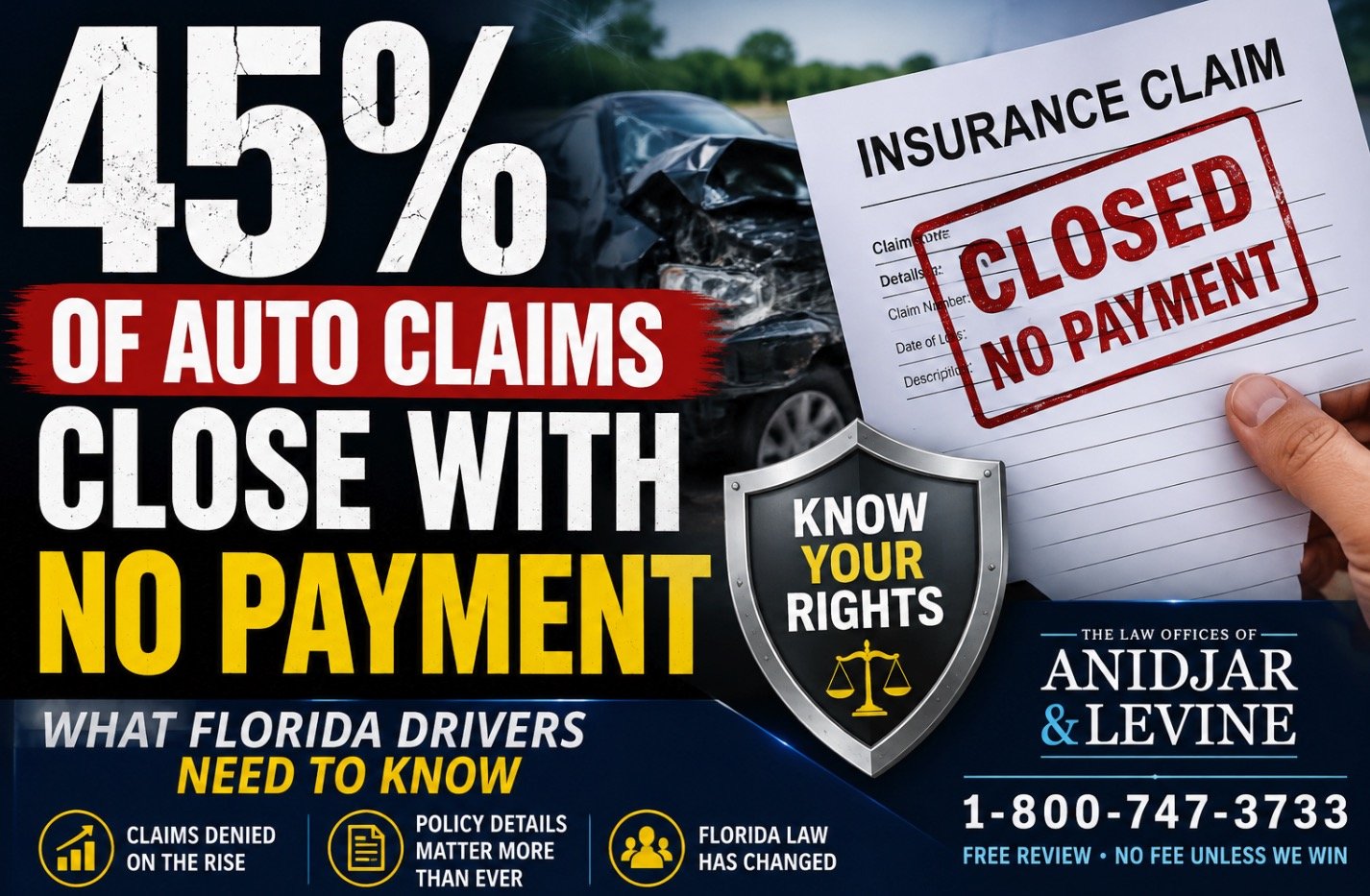
Nearly half of resolved auto liability and medical claims now close with no payment at all. Florida drivers deserve to know what that means for them.
If you are searching for answers about a Florida car insurance claim denial, you are not imagining a trend. New national reporting suggests that the odds of an auto claim closing without any payment have climbed substantially over the past decade — and it is worth asking what that means for Florida drivers who pay premiums every month believing coverage will be there when they need it.
What follows is an attempt to take that reporting seriously without overstating it. The underlying data is genuinely striking. It is also more complicated than either side of Florida’s long-running insurance debate tends to admit, and the honest version of the story requires holding several things in mind at once: that claim payment appears to be tightening nationally, that Florida premiums have recently started falling, that the 2023 tort reform law changed who can afford to challenge a denial, and that none of those facts alone settles the argument.
Call The Law Offices of Anidjar & Levine at 1-800-747-3733 for a free review of your denied claim. There is no fee unless we recover for you.
Main Takeaways
- The Wall Street Journal reports that 45% of resolved U.S. auto liability and medical claims in 2025 ended with no payment, up from about 35% a decade earlier.
- Over the same period, personal auto insurers paid roughly 61 cents in claims for every premium dollar in 2025 — the lowest net loss ratio since 2020, per S&P Global Market Intelligence data cited by the Journal.
- A claim closing without payment is not automatically a denial — the category also captures withdrawn claims, claims paid by another carrier, losses under the deductible, and matters outside policy terms.
- Florida’s HB 837 repealed the one-way attorney fee statutes for insurance cases, which changed the economics of challenging a denial.
- Carrier-specific policy wording — endorsements, exclusions, and new notification duties — increasingly determines whether a claim gets paid.
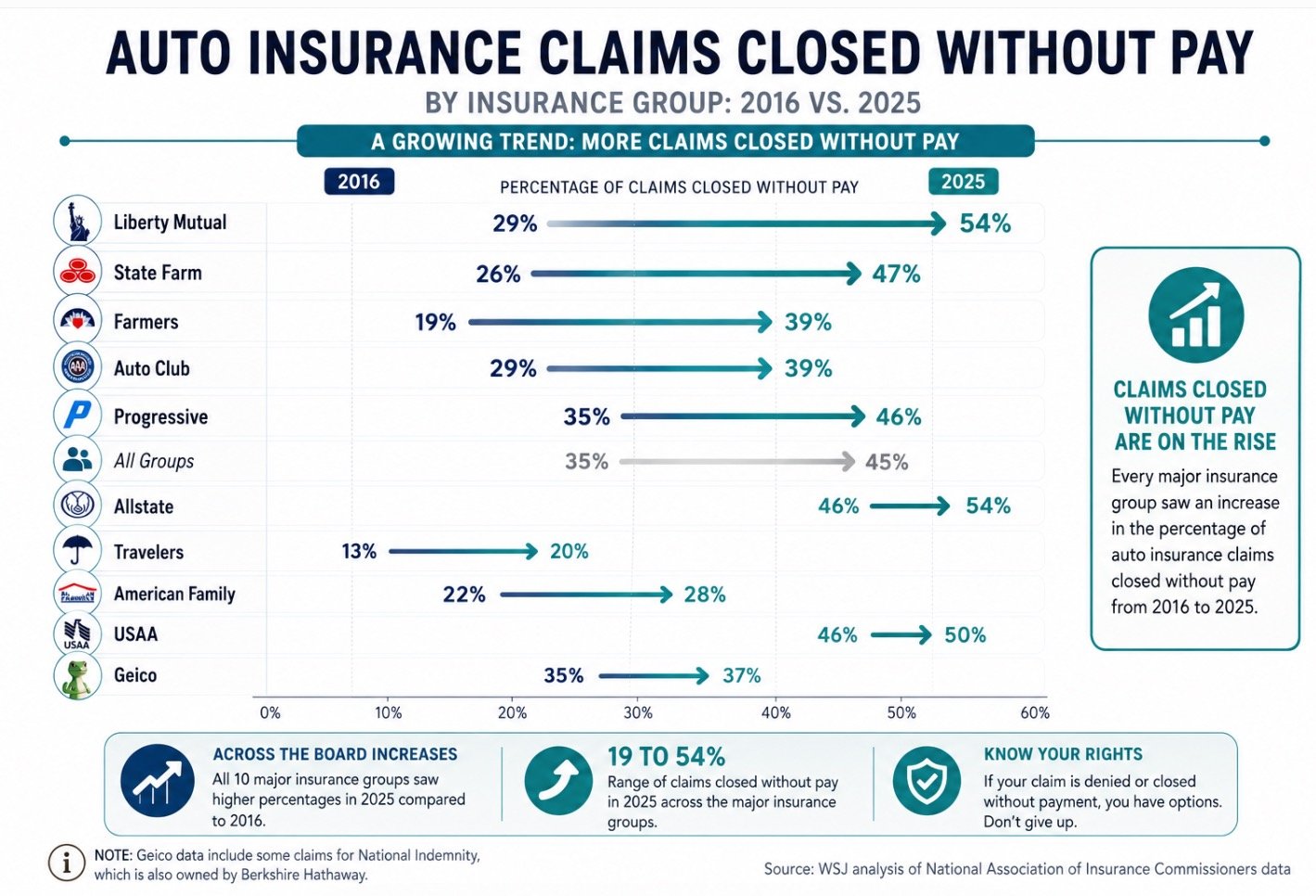
WSJ: 45% of Resolved Liability and Medical Claims Ended With No Payment
On August 9, 2026, The Wall Street Journal reported that 45% of resolved auto liability and medical claims in the United States in 2025 resulted in no payment to the claimant. A decade earlier, that figure was approximately 35%.
That is a meaningful shift, and it deserves to be stated carefully.
A claim that closes without payment has not necessarily been denied. The Journal notes that no-payment closures also include claims the consumer withdrew, claims ultimately paid by a different insurer, losses that fell below the deductible, and matters that genuinely fell outside the policy’s terms. Any honest discussion of this number has to hold that distinction, because collapsing it produces a claim the data cannot support.
It is worth walking through what actually sits inside that 45%, because the categories are not equivalent in what they tell us. Some no-payment closures are entirely unremarkable. A driver reports a cracked bumper, learns the repair costs less than the deductible, and drops the claim — nothing has gone wrong. A claimant pursues two carriers and one of them pays; the other closes its file without payment, correctly. A claim is submitted under a coverage that plainly does not apply to the loss.
Other closures are far less neutral. A claimant gives up after months of document requests and unreturned calls. An adjuster values an injury claim at a fraction of the medical bills and the claimant, without counsel and without the means to litigate, accepts nothing rather than fight. A carrier invokes an exclusion the policyholder never knew existed. Those closures also land in the no-payment column, and from the outside they look identical to the benign ones.
That is precisely why the aggregate number is worth attention rather than dismissal. Nobody outside the carriers can disaggregate it. What can be observed is the direction: whatever mix of causes sits underneath, a materially larger share of people who file an auto liability or medical claim now walk away with nothing than was true ten years ago. A ten-point move in a decade is not noise.
What a loss ratio does and does not measure
Alongside that trend, the Journal reported that personal auto insurers paid about 61 cents in claims for every premium dollar collected in 2025, citing S&P Global Market Intelligence — the lowest net loss ratio since 2020.
This figure gets misused constantly in both directions, so it is worth being precise about what it captures. Loss ratio measures claims incurred against premiums earned. Full stop. It does not include the expense ratio — commissions to agents, adjuster salaries, marketing, technology, general overhead — which routinely runs in the twenties as a percentage of premium. It also excludes investment income, which for insurers holding large reserves can be substantial, particularly in a higher interest rate environment. The combined ratio, which adds losses and expenses together, is the closer proxy for underwriting performance, and even that leaves investment returns out.
So a 61% loss ratio does not translate to a 39% margin, and it should not be described as though it did. What it does tell you, unambiguously, is that a smaller portion of the premium dollar is leaving the building as claim payments than at any point since 2020. That is the industry’s own metric, reported through the industry’s own channels. It moves in the same direction as the no-payment rate, and the two together are what make the pattern worth examining rather than either figure alone.
“The Wall Street Journal reports that 45 percent of resolved auto liability and medical claims in 2025 resulted in no payment. That should concern every driver who pays an insurance premium believing coverage will be there when it is needed.”
— Marc Anidjar, Esq., managing partner of Anidjar & Levine and a Florida Justice Association district director-at-large
The Numbers Behind Florida’s Insurance Debate
Florida sits at the center of the national argument about insurance costs and civil litigation, which makes the state a useful test case — and a complicated one.
The national picture from the Journal’s reporting is that 45% of resolved auto liability and medical claims closed with no payment in 2025, compared with roughly 35% a decade earlier, while personal auto insurers paid approximately 61 cents per premium dollar in claims in 2025. Those are the figures at the heart of the current debate.
The Florida-specific data complicates any simple story, and it would be a disservice to readers to leave it out. Florida personal auto insurers recorded an incurred loss ratio of roughly 57.5% in 2025, down sharply from about 73.2% in 2023 and 89.7% in 2022 — among the lowest in the country. On the premium side, Florida drivers absorbed average increases of roughly 31.7% in 2023 and 4.3% in 2024, and rates have since turned: the Florida Office of Insurance Regulation has approved a series of auto rate decreases for 2026, with the largest carrier groups averaging reductions in the mid-to-high single digits. Florida nonetheless remains among the most expensive states in the country for auto coverage, a function of hurricane exposure, a high uninsured-driver population, and fraud.
Both things can be true at once: premiums have begun to come down, and a growing share of claims nationally are closing without payment. Anyone arguing that the reforms did nothing has to contend with the rate filings. Anyone arguing that the reforms straightforwardly worked has to contend with the fact that a falling loss ratio is, by definition, a measure of money not being paid out on claims.
Reasonable people disagree about how much of the premium movement reflects the 2022 and 2023 reforms versus the ordinary insurance market cycle — rates across the country softened in the same period as pandemic-era loss spikes normalized and used-vehicle values stabilized. Untangling those effects is genuinely difficult and well beyond what any single data point resolves.
What the falling loss ratio does not answer, and what Floridians have a direct stake in, is what is happening to the payment side of the ledger while premiums adjust. Lower premiums financed by broader coverage and efficient claim handling are a good outcome for consumers. Lower premiums financed partly by a higher rate of claims closing unpaid are a different transaction, and one that consumers were never explicitly asked to agree to. That is the question this data invites, and it is not one the industry’s cost narrative addresses on its own.
The Insurance Industry Blamed Litigation — But the Data Raises New Questions
For years, the argument advanced in Tallahassee and in statehouses across the country has run in one direction: lawsuits and trial lawyers drive up the cost of insurance, and restricting litigation will bring costs down. It is a coherent argument; it has been made by serious people, and it is not baseless.
Insurers point to fraud, staged accidents, inflated medical billing, litigation expense, deductibles, and policy exclusions as real contributors to cost. Those factors exist and are documented. Florida in particular developed a well-earned reputation for organized claim fraud and for litigation practices that imposed genuine costs on the system. Anyone who dismisses that entirely is not arguing in good faith.
What the recent claim-closure data does is introduce a second question that the cost narrative does not answer on its own.
“For years, the insurance industry has argued that lawsuits and trial lawyers are driving up the cost of insurance. But when more claims are closing without payment, consumers deserve to ask a different question: Are lawsuits causing the problem, or are people being forced to file lawsuits because legitimate claims are not being paid?”
— Marc Anidjar, Esq., managing partner of Anidjar & Levine and a Florida Justice Association district director-at-large
This is a question about sequence, not a conclusion about causation, and the distinction matters. The reporting presents competing explanations and does not resolve them. Insurers attribute the rise in no-payment closures to fraud detection improving and to litigation pressure forcing more disciplined claim evaluation. Consumer advocates and plaintiff lawyers argue that increasingly restrictive claim handling is itself generating the disputes that later appear in litigation statistics — that the lawsuit is the symptom rather than the disease.
Both positions are arguable on the current record, and the available data does not adjudicate between them. Claim-closure statistics show outcomes, not reasons. A rise in no-payment closures is equally consistent with better fraud screening and with more aggressive denial practices, and distinguishing the two would require access to individual claim files that no researcher has.
What the data does undercut is the presentation of that debate as settled in one direction. For two decades the policy conversation in Florida has proceeded largely on the premise that the litigation side of the ledger was the problem to be solved. The claim-payment side received comparatively little legislative attention. If the share of claims closing unpaid has risen by ten points nationally while insurers retain a larger portion of each premium dollar, that asymmetry in scrutiny is harder to justify.
“Insurance companies often point to litigation as the problem. What gets overlooked is why litigation happens in the first place. When an injured person presents a legitimate claim and the insurance company denies it, delays it or substantially undervalues it, the courthouse may be the consumer’s only meaningful way to enforce the insurance contract.”
— Marc Anidjar, Esq., managing partner of Anidjar & Levine and a Florida Justice Association district director-at-large
What Florida’s 2023 Tort Reform Changed for Injured Consumers
Florida enacted the most sweeping civil justice changes in decades when Governor DeSantis signed CS/CS/HB 837 on March 24, 2023. According to the Florida Senate’s official bill summary, the law reshaped several rules that bear directly on insurance disputes. Three of them matter most to an ordinary policyholder with a denied claim.


The repeal of one-way attorney fees
The most consequential change for insurance disputes was the outright repeal of sections 627.428 and 626.9373 — the one-way fee statutes covering authorized insurers and surplus lines insurers respectively. Under the prior framework, a policyholder who obtained a favorable judgment against an insurer was entitled to recover reasonable attorney fees from that insurer. The insurer, if it won, generally could not recover fees from the policyholder.
That asymmetry was deliberate. It existed to correct a structural imbalance in insurance litigation: the carrier is a repeat player with in-house counsel, actuarial resources, and the ability to absorb litigation costs across thousands of files, while the policyholder is a one-time participant for whom legal fees can quickly exceed the amount in dispute. One-way fees meant a lawyer could take a modest but meritorious coverage case knowing that, if the denial was wrong, fees would be recoverable.
Critics of the statute argued with some force that it invited abuse — that it encouraged litigation over small disputes and generated fee awards disproportionate to the amounts recovered, particularly in property insurance. That criticism was a significant driver of the repeal.
Whatever one makes of that debate, the practical effect on the consumer side is straightforward and easy to underestimate.
What the fee repeal means in practice
Consider a driver with a disputed claim worth $8,000. The carrier denies it, citing an endorsement the driver does not remember receiving. The driver believes the denial is wrong, and let us assume for the sake of the example that it is.
Under the prior framework, a lawyer could evaluate the file and, if the denial appeared indefensible, pursue it — because a favorable judgment would carry a fee award against the insurer. The economics worked even though the disputed amount was modest.
After the repeal, the same driver faces a different calculation. Litigating a coverage dispute through discovery and motion practice can cost more than $8,000. Absent a fee-shifting provision, that cost comes out of the recovery or out of the driver’s pocket. The claim may be entirely valid and still not be economically rational to pursue.
The denial has not become more correct. It has become less reviewable.
HB 837 did preserve one narrow path. The law created a limited ability to recover attorney fees from an insurer following a total coverage denial, pursued through a declaratory judgment action. That route matters and should be evaluated in any case involving a complete denial of coverage — but it does not reach partial denials, undervaluations, or the far more common scenario in which a carrier pays something and disputes the rest.
Contingency fee multipliers and modified comparative fault
The law also narrowed contingency fee multipliers, establishing a rebuttable presumption that the lodestar calculation — reasonable hours multiplied by a reasonable rate — is sufficient, with multipliers reserved for rare and exceptional circumstances under the federal standard. The practical effect compounds the fee repeal: in the residual categories where fees remain recoverable, the amounts are lower and harder to enhance for risk.
Separately, HB 837 replaced Florida’s pure comparative negligence rule with modified comparative fault. A claimant found more than 50% responsible for their own injuries now recovers nothing at all, rather than recovering a proportionally reduced amount. In practice, this converts every liability dispute into a contest over whether the claimant can be pushed across the halfway line, because doing so eliminates the claim entirely rather than merely discounting it. The law additionally shortened the statute of limitations for most negligence-based injury claims from four years to two.
“Florida was told that restricting the rights of injured people and making it harder to hold insurance companies accountable would help control insurance costs. The latest claims data should cause lawmakers and consumers to examine whether those changes are delivering the results Floridians were promised.”
— Marc Anidjar, Esq., managing partner of Anidjar & Levine and a Florida Justice Association district director-at-large
Evaluating that fairly means looking at both sides of the ledger, and the honest answer is mixed. Premiums have started to come down, and approved rate filings for 2026 reflect decreases at most large carriers — that is a real result, and consumers are feeling it. Whether claim payment has held steady alongside those reductions is a separate question that has received far less scrutiny, and it is the question on which the reform’s ultimate verdict should partly turn.
Bad Faith Claims in Florida After HB 837
Beyond the contract itself, Florida law has long recognized that an insurer owes duties in how it handles a claim, not merely whether it ultimately pays. Section 624.155 of the Florida Statutes provides a statutory civil remedy against an insurer that fails to settle in good faith, and it remains available — though HB 837 reshaped it in ways that matter.
The procedural gateway has not changed. Before filing a statutory bad faith action, a claimant must file a civil remedy notice with the Florida Department of Financial Services and serve it on the insurer. The notice must identify the specific statutory provisions violated and the facts supporting the allegation. The carrier then receives a 60-day cure period in which it can investigate, reevaluate, and pay. If the insurer cures within that window, the bad faith action generally does not proceed. This makes the drafting of the notice consequential: a vague or incomplete civil remedy notice can undermine the claim before it begins.
HB 837 layered several new limitations onto that framework. The law codified that mere negligence alone is insufficient to constitute bad faith — a principle already reflected in Florida case law, but now expressly written into the statute. It created a meaningful safe harbor for liability insurers: an insurer is not liable for bad faith if it tenders the lesser of the policy limits or the amount demanded by the claimant within 90 days after receiving actual notice of the claim. And it imposed reciprocal obligations on the other side, requiring claimants, insureds, and their representatives to act in good faith in furnishing claim information, making demands, setting deadlines, and attempting settlement — with a failure to do so potentially reducing damages awarded against the insurer.
The net effect is a narrower but still real avenue. Bad faith exposure remains the principal legal mechanism by which Florida law disciplines claim handling, and the 90-day tender safe harbor cuts in a genuinely consumer-protective direction as well: it gives carriers a strong incentive to evaluate and pay clear claims quickly rather than sit on them. Whether the overall rebalancing has gone too far is contested. What is not contested is that the analysis is now more technical, the deadlines less forgiving, and the drafting more demanding than it was before 2023.
How Carrier-Specific Policy Language Can Create Coverage Disputes
Two Florida drivers can buy what they each describe as “full coverage,” pay similar premiums, and hold materially different contracts. The difference lives in the endorsements — the amendatory pages appended to the base policy form that add, remove, or redefine coverage.
The Wall Street Journal reports that State Farm added a “duty to notify us of changes” provision to renewal policies, and described scenarios in which claims that may previously have been paid could be denied under the new wording. Provisions of this kind impose an affirmative obligation on the policyholder to report changes — a new household driver, a change in how the vehicle is used, a different garaging address — and a failure to report can become the stated basis for a coverage dispute later.
Most people never read a renewal packet. Many would not identify the operative change if they did, because the language rarely announces itself: a new duty may arrive as a single amended paragraph inside a multi-page endorsement, referenced by form number, with no summary of what changed from the prior term.
“Consumers should not need to be insurance lawyers to understand whether the policy they purchased will protect them after a crash. When policies contain layers of exclusions, endorsements and company-specific language, small differences in wording can have enormous consequences after an accident.”
— Marc Anidjar, Esq., managing partner of Anidjar & Levine and a Florida Justice Association district director-at-large
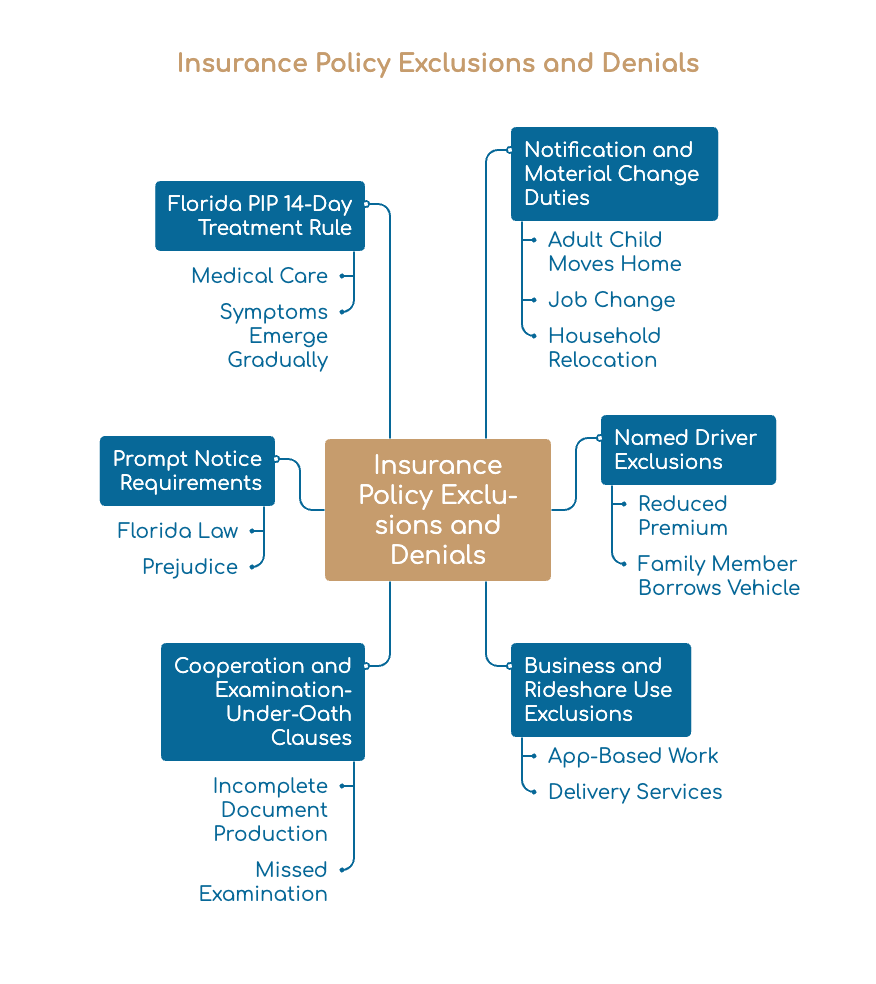
Several categories of provision generate the bulk of Florida coverage disputes, and each operates differently.
- Notification and material change duties are the newest area of concern and the one the Journal’s reporting highlights. These require the insured to tell the carrier when circumstances change. The difficulty is that ordinary life generates such changes constantly — an adult child moves home and occasionally borrows the car, a job change alters the commute, a household relocates across a county line into a different rating territory — and few policyholders understand these as reportable events.
- Named driver exclusions operate more bluntly. When a specific household member is excluded by name, coverage disappears entirely for any loss occurring while that person is driving. These are sometimes added at the policyholder’s request to reduce premiums, and the consequences are frequently not appreciated until a family member borrows the vehicle for an errand.
- Business and rideshare use exclusions have become far more consequential as app-based work has grown. A standard personal auto policy typically excludes coverage while the vehicle is being used to carry passengers or goods for compensation. A driver making deliveries without the correct endorsement may have no coverage at all during that period, and may not learn it until after a crash.
- Cooperation and examination-under-oath clauses convert the claim process itself into a potential ground for denial. Policies require the insured to cooperate with the investigation, and a carrier can take the position that incomplete document production or a missed examination constitutes a material breach. Most such disputes are resolvable, but they can stall a claim for months.
- Prompt notice requirements create an argument for denial when a claim is reported later than the policy contemplates. Florida law generally requires the insurer to show prejudice from late notice, but the provision still furnishes a starting position for the carrier and a delay for the claimant.
- The Florida PIP 14-day treatment rule is not a policy term at all but a statutory one, and it forfeits personal injury protection benefits entirely when medical care does not begin within 14 days of the crash. It is probably the single most common way Florida drivers lose benefits they were entitled to, and it disproportionately affects people whose symptoms emerge gradually or who postpone care out of concern about cost.
Should Florida Consider Greater Standardization of Auto Insurance Policies?
If policy wording is doing this much work in determining outcomes, it is fair to ask whether Florida consumers are well served by the current degree of variation.
“Florida should seriously examine whether greater standardization of automobile insurance policies would better protect consumers. Basic coverage should be clear and predictable, regardless of which carrier sells the policy.”
— Marc Anidjar, Esq., managing partner of Anidjar & Levine and a Florida Justice Association district director-at-large
Massachusetts is a model worth examining — though it should be described accurately, because it is frequently mischaracterized in this debate. Massachusetts does not require every insurer to sell one identical auto policy; the state permits multiple approved forms. What it does provide is a comparatively robust framework of regulatory oversight, standard and advisory forms, and clearly published consumer rights.
The Massachusetts Consumer Bill of Rights for Automobile Insurance illustrates the approach. It states that consumers have the right to prompt and fair handling of claims, and that an insurer denying a claim must provide a written explanation for the denial. It guarantees a right to know the basis for a denial of an application for coverage, a right to obtain insurance through a residual market plan when no carrier will voluntarily write a policy, a right to be notified when the insurer has determined the consumer was more than 50% at fault in an accident, and a right to a written cancellation notice specifying the reason and providing at least 20 days’ warning. Agents and companies must explain coverage options in plain language, both at application and on request thereafter.
None of that dictates the content of the policy. It regulates the transparency of the relationship — what the consumer is told, when, and in what form. That is a narrower intervention than standardizing coverage itself, and correspondingly easier to defend.
Whether Florida should adopt any particular element of that framework is a policy question for the Legislature, not one a law firm can resolve. The narrower and more defensible point is that transparency requirements of that kind are compatible with a competitive market. A written explanation of denial does not tell an insurer what to charge or what to cover.
“Insurance companies can compete on price, service and coverage options without turning basic policy language into a maze. Greater uniformity could make comparison shopping easier and reduce the risk that consumers discover important limitations only after a loss.”
— Marc Anidjar, Esq., managing partner of Anidjar & Levine and a Florida Justice Association district director-at-large
The counterargument deserves a fair hearing. Insurers contend that form flexibility drives product innovation, allows carriers to price risk more precisely, and supports offerings tailored to different customer profiles — a driver who wants a stripped-down policy at a low premium and a driver who wants comprehensive protection are genuinely different customers. Mandated uniformity, on this view, can reduce choice, compress the market toward a single product, and raise costs for consumers who neither need nor want broader coverage. There is also a practical objection: policy forms encode decades of litigated language, and rewriting them wholesale can generate a fresh wave of interpretive disputes before the meaning of new terms settles.
Those are serious points, and any legislative effort in this area would have to answer them. They apply with considerably more force to standardizing coverage than to requiring disclosure.
“Insurance is a promise. The consumer pays premiums before anything goes wrong in exchange for the insurer’s promise to perform when a covered loss occurs. Our laws should make that promise transparent and enforceable.”
— Marc Anidjar, Esq., managing partner of Anidjar & Levine and a Florida Justice Association district director-at-large
What Florida Drivers Can Do Before and After a Crash
Policy debates take years. In the meantime, most of what determines whether a Florida driver gets paid is decided by choices made before a crash ever happens and in the first weeks afterward.
Before anything happens
The single most useful step is also the least common: request a complete certified copy of your policy, including the declarations page and every endorsement, and actually look at what the endorsements say. The declarations page — the summary most people think of as “the policy” — lists coverages and limits but does not tell you what has been carved out. The exclusions live in the forms behind it.
Beyond that, a short checklist covers most of the avoidable problems.
- Read the renewal packet — specifically for new notification duties or added exclusions. Ask your agent to identify in writing what changed from the prior term. That request is reasonable and creates a record.
- Buy uninsured and underinsured motorist coverage, and consider stacking it across household vehicles. In a state with a high uninsured-driver population, UM is frequently the most valuable coverage on the policy — and it is the coverage that responds when the at-fault driver has nothing.
- Report changes promptly and in writing. A new driver in the household, a move, or a change in vehicle use should be documented with your carrier and confirmed back to you.
- Confirm rideshare or delivery endorsements before driving for any app-based platform. Do not rely on the platform’s own coverage without understanding when it attaches and when it does not.


After a crash
The days immediately following a collision carry deadlines that are easy to miss and impossible to undo. The 14-day PIP treatment window is the most unforgiving of them, and it runs regardless of whether anyone has told you it exists.
- Begin medical treatment within 14 days. Florida PIP benefits are forfeited if care does not start inside that window, regardless of how serious the injury later proves to be.
- Report the claim promptly and keep a written record of when and how you did it.
- Get any denial in writing, with the specific policy provision cited. “We are unable to pay this claim” is not an explanation. Ask which paragraph of which endorsement the carrier is relying on, and keep the response.
- Be cautious with recorded statements. You generally owe cooperation to your own insurer, but you are entitled to understand the scope of a request before answering it — and you owe no recorded statement at all to the other driver’s carrier.
- Do not sign a release or accept a first offer before the full extent of your injuries and losses is known. A release signed early cannot be undone when a condition worsens.
- Preserve everything — photos, the crash report, medical records and bills, wage documentation, and every letter, email, and claim note.
- File a complaint if you believe the handling was improper. The Florida Department of Financial Services Division of Consumer Services accepts insurance complaints and can be reached at 1-877-693-5236.
- Mind the two-year deadline. Most Florida negligence claims must now be filed within two years of the crash.
How Anidjar & Levine Helps With Denied and Undervalued Claims
A denial letter is a position, not a verdict.What matters is whether the provision the carrier cites actually applies to your facts — and that question is answerable.
The work usually starts with documents the policyholder does not have. We obtain the complete certified policy, including every endorsement in effect on the date of loss, and read the cited exclusion against the actual circumstances of the claim. Denials are frequently premised on a version of the facts that does not survive contact with the record, or on a provision that does not reach the situation once its defined terms are traced through the policy. We also request the claim file and adjuster notes, which show how the decision was actually reached rather than how it was later explained — the internal chronology is often the most revealing document in a coverage dispute.
From there, the analysis turns to coverage the policyholder may not know exists. Identifying every applicable layer means examining uninsured and underinsured motorist coverage, stacked policies across household vehicles, medical payments coverage, resident-relative policies, and any excess or umbrella coverage. In a state where the at-fault driver frequently carries minimal limits or none at all, these layers regularly determine whether a claim is worth more than a nominal amount.
Where the handling itself appears improper, we evaluate whether the facts support a civil remedy notice and a statutory bad faith claim, keeping the post-HB 837 requirements and the 90-day tender safe harbor firmly in view. Where there has been a total denial of coverage, we assess whether a declaratory judgment action is appropriate — the narrow route through which attorney fees may still be recoverable from the insurer. And in every case, we build the medical and economic record needed to establish what the loss is actually worth, because an undervalued claim and a denied claim are the same problem at different points on a spectrum.
Learn more about our Florida car accident practice, how we handle denied insurance claims, and what to know about uninsured motorist coverage.
You can also browse the communities we serve across Florida.
“Florida spent years debating how litigation affects insurance companies. It is time for an equally serious conversation about how insurance-company claims practices affect Florida consumers.”
— Marc Anidjar, Esq., managing partner of Anidjar & Levine and a Florida Justice Association district director-at-large
Frequently Asked Questions
What does it mean that 45% of auto claims closed with no payment?
The Wall Street Journal reports that 45% of resolved U.S. auto liability and medical claims in 2025 ended with no payment, up from roughly 35% a decade earlier. Importantly, a claim closing without payment is not the same as a denial. That category can also include claims the consumer withdrew, claims paid by a different insurer, losses below the deductible, and matters that fell outside the policy terms.
Does this data prove insurance companies are wrong about litigation driving costs?
No. The reporting presents competing explanations rather than resolving them. Insurers point to fraud, litigation, deductibles, and policy exclusions. Consumer advocates and plaintiff lawyers argue that tougher claim handling is itself generating disputes. The data challenges a one-sided narrative; it does not conclusively establish causation in either direction.
Is a low loss ratio the same as a high profit?
No. Loss ratio measures only claims incurred against premiums earned. It excludes the expense ratio, which covers commissions, salaries, and overhead, and it excludes investment income. The combined ratio adds losses and expenses together and is a closer proxy for underwriting performance. A falling loss ratio tells you less of the premium dollar is leaving as claims; it does not by itself establish what an insurer earned.
What did Florida’s HB 837 change for people with insurance disputes?
HB 837, signed March 24, 2023, repealed Florida’s one-way attorney fee statutes for insurance cases (sections 627.428 and 626.9373), meaning a policyholder who wins against an insurer generally can no longer recover attorney fees from that insurer. It also restricted contingency fee multipliers to rare and exceptional circumstances, shifted Florida to modified comparative fault, and shortened the filing deadline for most negligence claims to two years.
Can I still recover attorney fees from my insurance company in Florida?
Only in narrow circumstances. HB 837 preserved a limited path to recover fees following a total coverage denial through a declaratory judgment action. Outside that route, most policyholders now bear their own legal costs when disputing a claim, which changes the economics of pursuing smaller disputes.
What is a civil remedy notice and how does bad faith work in Florida?
Before filing a statutory bad faith action under section 624.155, a claimant must file a civil remedy notice with the Florida Department of Financial Services and serve it on the insurer, which then has a 60-day cure period to investigate and pay. HB 837 added that mere negligence alone is insufficient to constitute bad faith, created a safe harbor when a liability insurer tenders the lesser of policy limits or the amount demanded within 90 days of actual notice, and obligated claimants to act in good faith as well.
What is the “duty to notify” provision in a renewal policy?
The Wall Street Journal reports that State Farm added a “duty to notify us of changes” provision to renewal policies, and described scenarios in which claims that might previously have been paid could be denied under the new wording. Provisions like this create obligations to report changes in drivers, vehicle use, or garaging address, and failing to report can become a basis for a coverage dispute.
Does Massachusetts require every insurer to sell an identical auto policy?
No. Massachusetts allows multiple approved policy forms. What Massachusetts does provide is extensive regulatory oversight, standard and advisory forms, and a published Consumer Bill of Rights for Automobile Insurance that includes a right to a written explanation when a claim is denied. It is a model worth examining, not an exact one-policy system.
What should I do first if my Florida auto insurance claim is denied?
Request the denial in writing along with the specific policy provision the insurer is relying on. Obtain a complete certified copy of your policy including all endorsements. Preserve every communication, and do not give a recorded statement or sign a release before you understand the basis for the denial. You may also file a complaint with the Florida Department of Financial Services Division of Consumer Services.
Have Florida auto insurance rates gone down since the 2023 reforms?
Recent rate filings approved by the Florida Office of Insurance Regulation show decreases for many carriers heading into 2026, and Florida personal auto loss ratios have fallen substantially since 2022. Reasonable people disagree about how much of that reflects the reforms versus broader market cycles. The open question for consumers is what is happening to claim payment alongside those premium changes.
How much does it cost to have a lawyer review a denied claim?
Anidjar & Levine offers a free consultation and handles injury and claim disputes on a contingency fee basis, meaning there is no attorney fee unless we recover compensation for you.
About The Law Offices of Anidjar & Levine
Founded in 2005 by Marc Anidjar and Glen Levine, the firm began as a two-person operation working out of a construction office conference room. Over the past 20 years, that modest start has grown into one of Florida’s most recognized personal injury practices — with more than $1 billion recovered in settlements on behalf of injury clients across the state. We bring that same determination and depth of experience to every case we handle.
Marc Anidjar, Esq. serves as managing partner of Anidjar & Levine and as a Florida Justice Association district director-at-large. The firm represents drivers and injured people throughout Florida in car accident, insurance claim, and wrongful death matters.
Talk to a Florida Insurance Claim Lawyer
If your auto insurance claim was denied, delayed, or paid at a fraction of what it is worth, you are entitled to understand exactly why — and to have someone read the policy as carefully as the carrier did.
Call The Law Offices of Anidjar & Levine at 1-800-747-3733 for a free case review. We work on contingency: no fee unless we recover for you.
This article is provided for general informational purposes and does not constitute legal advice or create an attorney-client relationship. Statistics attributed to The Wall Street Journal reflect that publication’s August 9, 2026 reporting; loss ratio figures are cited by the Journal to S&P Global Market Intelligence. Loss ratio measures claims incurred relative to premiums earned and is not a measure of insurer profit. Claims closing without payment are not necessarily denied claims. Florida market figures are drawn from publicly available rate filings and industry reporting and may be revised. The hypothetical described in this article is illustrative only and does not reflect any actual case. Every case is different, and past results do not guarantee a similar outcome.