We help Floridians injured in hospital falls secure medical evaluations, preserve evidence, and pursue compensation through disciplined legal advocacy.
At the Law Offices of Anidjar and Levine, we investigate fall-risk assessments, staffing, alarms, maintenance, and medications, obtain surveillance and records, and coordinate experts to prove fault and causation.
We handle insurer communications, protect deadlines, and seek damages for medical care, lost income, and pain and suffering under Florida negligence and premises liability law.
Our experienced team explains options clearly and prepares every case for trial, where strategic steps come next.
Learn more: Medical Malpractice Injury Lawyer
Key Takeaways
- Florida hospital fall cases require immediate medical evaluation, incident documentation, and preservation of photos, witness names, and internal reports.
- A lawyer investigates fall‑risk assessments, staffing logs, call‑light response times, maintenance records, and surveillance footage to prove breach of duty.
- Attorneys send preservation letters, secure medical records and EHR metadata, and maintain chain of custody for physical and digital evidence.
- Experts (nurses, safety consultants, life‑care planners) link policy violations to injuries and quantify damages, future care needs, and lost earnings.
- Florida deadlines and comparative fault rules apply; prompt legal consultation protects claims and improves negotiation or trial outcomes.
How We Can Help With Your Florida Hospital Fall Injury Claim
Guide your claim with a team that knows Florida hospital fall cases inside and out. Dig deeper with our recent Case Study: Securing Justice After a Preventable Hospital Fall in Florida.
We begin by listening, documenting your experience with care, and identifying the points where safety protocols failed. Our focus is patient advocacy, so we gather records, interview witnesses, and coordinate with medical professionals to substantiate injuries, costs, and long-term needs.
We organize evidence with precision, preparing a straightforward narrative that supports liability and damages.


We communicate promptly with insurers, manage deadlines, and protect you from tactics that minimize your recovery. Our settlement negotiation approach is deliberate and data-driven, using comparable outcomes and expert opinions to quantify losses, including future care and lost earning capacity.
If negotiations stall, we’re prepared to litigate, file motions, and present testimony effectively.
Throughout, we keep you informed, explain options, and seek solutions that restore stability. Our role is to shoulder the legal burden, so you can focus on healing and service.
Understanding Florida Hospital Fall Injury Cases
OUR CONSULTATIONSARE FREE
START YOUR FREE CASE REVIEW

With the legal burden on our shoulders, it’s essential to understand how Florida law frames hospital fall injury cases and what facts drive outcomes. We evaluate whether the hospital met its duty to maintain a reasonably safe environment, tailored to each patient’s condition and known risks.
That duty includes appropriate assessments, timely monitoring, and documented fall prevention measures that align with accepted standards.
Liability turns on proving a breach of duty, causation, and damages. We analyze medical records, incident reports, staffing levels, and policy compliance to determine whether the facility’s actions, or omissions, fell below the standard of care.
Our patient advocacy focuses on objective proof, such as risk scores, care plans, and response times, which often determine responsibility.
Florida’s comparative fault rules and statutes of limitation also affect strategy and recovery. We preserve evidence promptly, work with qualified experts, and quantify losses, including medical costs, functional limitations, and future care needs.
Common Causes of Florida Hospital Fall Injuries
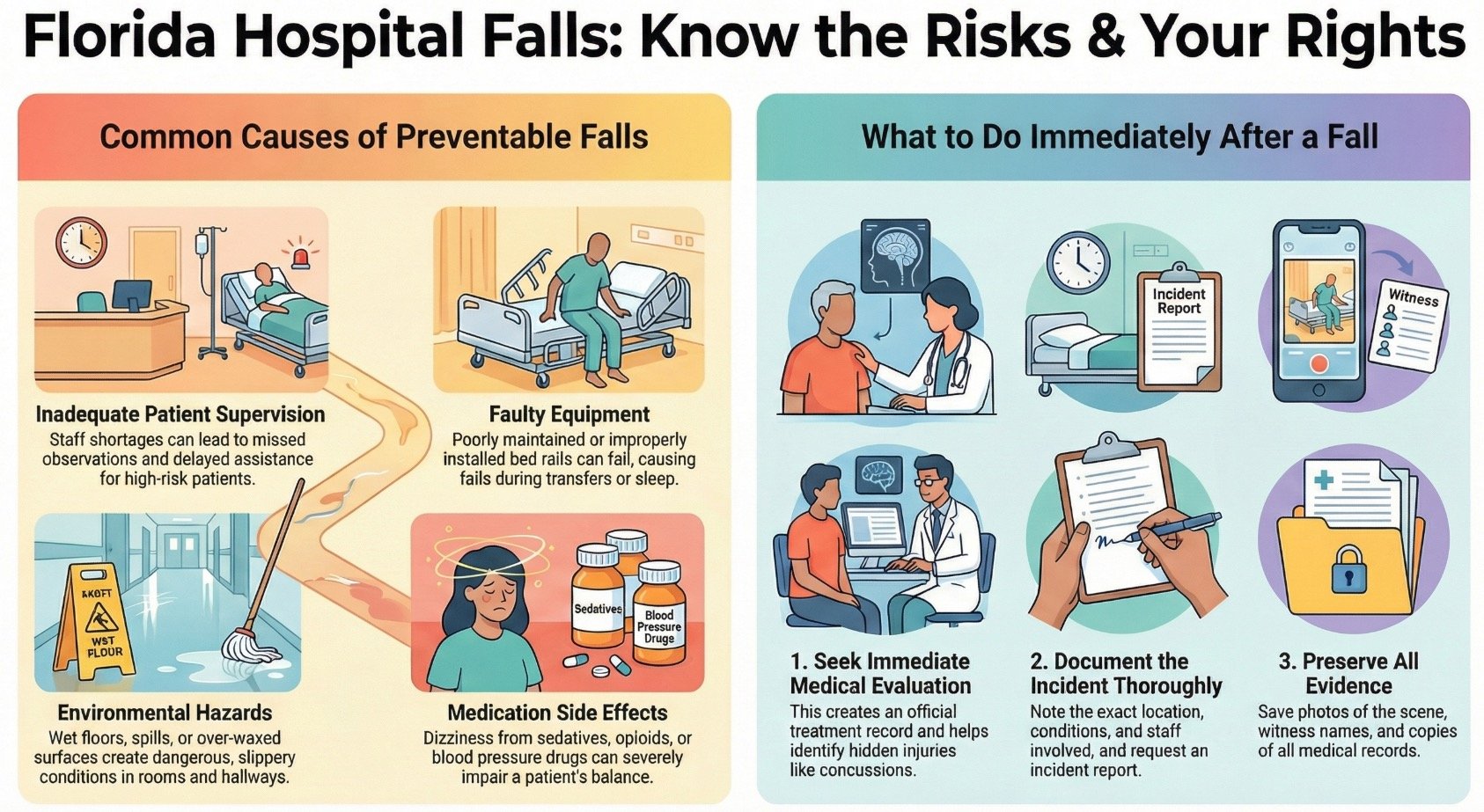
As we assess how hospital falls occur, we often find patterns that point to preventable errors such as inadequate patient supervision and wet or slippery floors.
We also see equipment-related hazards, including faulty bed rails that fail to secure patients during transfers or sleep.
Additionally, medication-related dizziness can impair balance and judgment, increasing the risk of a sudden, dangerous fall.
Inadequate Patient Supervision


Too often, hospital falls trace back to inadequate patient supervision, a preventable lapse in basic safety protocols. When caregivers are spread thin due to staff shortages, essential observations are missed, and patients at high risk don’t receive timely assistance.
We see this most with individuals experiencing confusion, mobility limitations, or vision impairment, who require consistent monitoring, bed-exit alarms, and swift responses to call lights.
We evaluate whether hospitals performed thorough fall-risk assessments, updated care plans, and assigned appropriate sitters or rounding schedules. Supervision also includes safe transfer techniques, prompt toileting assistance, and ensuring assistive devices are within reach.
If staffing levels, training, or communication fell short, accountability follows. We’re committed to holding facilities responsible, securing resources for rehabilitation, and promoting safer supervision practices that prevent future harm.
Wet or Slippery Floors
Supervision failures often intersect with environmental hazards, and wet or slippery floors are among the most dangerous conditions we investigate. We see spills, tracked rain, and over-waxed surfaces turn corridors and patient rooms into hidden risks. Hospitals must implement rigorous cleaning protocols, post clear warnings, and promptly dry high-traffic areas.
They should also inspect mats at entrances, maintain leak-prone equipment, and document response times to reported hazards.
We advocate for patients by examining incident reports, surveillance footage, and staffing logs to confirm whether safety steps were followed. We also evaluate whether non-slip footwear was provided and appropriate for each patient’s mobility level.
When policies fall short, preventable falls occur. Our role is to enforce accountability and secure resources that restore health and dignity.
Faulty Bed Rails
Faulty bed rails can turn a patient’s last line of defense into a serious hazard, particularly when design flaws, improper installation, or poor maintenance go unchecked. When rails wobble, latch improperly, or leave dangerous gaps, patients face entrapment, head injuries, and falls during routine care.
We evaluate whether the model was appropriate for the patient, whether staff followed patient restraint policies, and whether rail maintenance logs show timely inspections and repairs.
Hospitals must match rail configuration to the patient’s condition, mobility, and cognition, then document that choice. Nurses and technicians should test locks, spacing, and height at every shift change, and remove defective parts immediately.
When facilities ignore manufacturer guidelines or skip inspections, they breach their duty of care.
We gather records, expert evaluations, and evidence to prove accountability.
Medication-Related Dizziness
Often overlooked in busy hospital settings, medication-related dizziness is a leading contributor to preventable falls, particularly among older or medically complex patients. When sedatives, antihypertensives, opioids, or polypharmacy interact, medication dizziness can impair balance, slow reaction time, and cause sudden drops in blood pressure.
We work with families and clinicians to guarantee accurate histories, careful titration, and vigilant dosage monitoring, especially during shifts of care.
We advocate for protocols that mandate orthostatic vital checks, clear fall-risk labeling, and timely pharmacist reviews after any medication change. Nurses should conduct assisted ambulation after first doses, remind patients to rise slowly, and document adverse effects promptly.
When hospitals ignore these safeguards, errors become foreseeable harms. If a preventable fall occurs, we investigate orders, MAR entries, and staffing patterns to establish accountability and pursue appropriate recovery.
Legal Rights of Florida Hospital Fall Injury Victims
Clarity matters when we assert the legal rights of Florida hospital fall injury victims. Under Florida law, hospitals must provide reasonable safety, honor patient autonomy, and engage in effective risk communication about fall hazards. When staff fail to assess fall risk, ignore call lights, or omit bed alarms, that negligence can create liability.
We focus on accountability, measurable harm, and fair compensation, while respecting each patient’s dignity and informed choices.
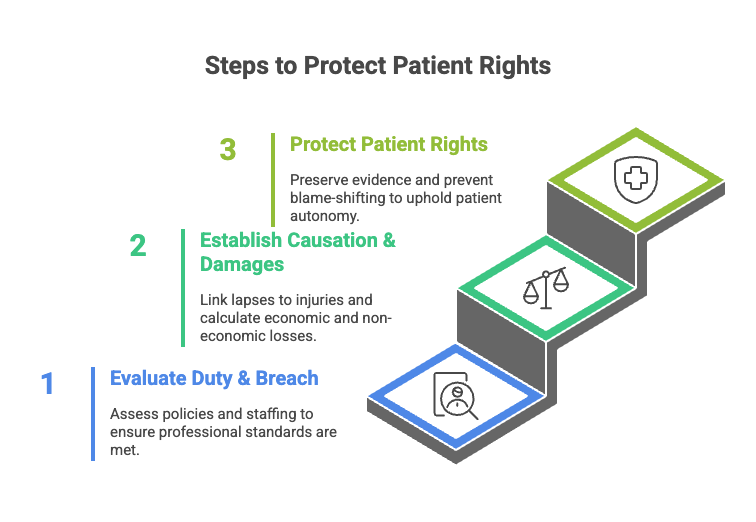
- We evaluate duty and breach, documenting policies, staffing levels, and whether risk communication and fall precautions met professional standards.
- We establish causation and damages, linking lapses to injuries, medical costs, lost earnings, rehabilitation needs, and non-economic losses such as pain and reduced independence.
- We protect rights against insurers and hospital counsel, preserve evidence, enforce privacy, and prevent blame-shifting that undermines patient autonomy.
These rights exist to assure safer care, promote transparency, and provide meaningful remedies when preventable falls occur in Florida hospitals.
Steps to Take After a Florida Hospital Fall Injury
After a hospital fall, we should first make sure you receive an immediate medical evaluation to identify injuries and create a treatment record.
Next, we’ll document the incident thoroughly by noting the location, conditions, staff involved, and obtaining copies of any incident reports.
Finally, we’ll preserve evidence and records, including medical charts, imaging, photos, witness names, and correspondence, to protect your claim and support future legal action.
Seek Immediate Medical Evaluation
Promptly securing a thorough medical evaluation is essential, even if injuries seem minor or symptoms appear delayed. After a hospital fall, we encourage you to request an urgent assessment to identify hidden trauma, internal injuries, or complications that may not be immediately visible.
A timely neurological check helps detect concussion, brain bleed, or nerve damage, conditions that can worsen without prompt care. We also recommend targeted imaging and lab work when indicated, as these tools corroborate clinical findings and guide appropriate treatment.
Early evaluation protects your health and supports a safe recovery plan. Tell clinicians exactly how the fall occurred and describe every symptom, including dizziness, headache, confusion, or new pain. If mobility is affected, ask for assistive measures.
Follow discharge instructions precisely, and schedule follow-up appointments without delay.
Document Incident Thoroughly
With medical needs addressed, we should preserve the facts of the fall with meticulous documentation.
We begin by recording the date, time, exact location, and conditions, noting lighting, floor surface, and any hazards.
We write a clear account of what happened, including our actions before and after the fall.
We request the names and roles of staff present, capturing direct quotes where possible, and we obtain witness statements promptly, while recollections are fresh.
We take incident photos from multiple angles, documenting the scene, footwear, assistive devices, and any visible injuries.
We confirm whether an internal incident report was created, and we request the report number.
We save the names of supervisors notified and the time of notice.
We maintain consistent, accurate details to support accountability and patient safety.
Preserve Evidence and Records
Lock down every piece of evidence that bears on the fall, because gaps now can weaken both care decisions and any legal claim. We secure medical records, incident reports, and witness names immediately, then create a clear inventory so nothing is overlooked.
We send prompt preservation letters to the hospital and contractors, requesting preservation of digital footage from cameras covering hallways, rooms, and nurses’ stations. We document who holds each item and maintain an unbroken chain of custody, ensuring admissibility and authenticity.
We save bed charts, call-light logs, staffing rosters, and maintenance records, then back up files with date-stamped copies. We record injuries through photographs and ongoing treatment notes.
We store everything safely, organize timelines, and verify consistency against official records.
How a Florida Hospital Fall Injury Lawyer Can Help You
Find your way through the aftermath of a hospital fall with a legal advocate who knows how to build a strong claim from the start. We step in quickly, align our strategy with your goals, and protect your rights at every turn. Through disciplined patient advocacy and careful evidence preservation, we position your case for a fair resolution while you focus on healing.
- We investigate thoroughly, securing incident reports, chart notes, surveillance footage, and witness statements, then analyze policies and staffing to identify breaches in safety protocols.
- We coordinate medical evaluations, consult qualified experts, and translate intricate findings into clear, persuasive arguments that demonstrate liability and the full scope of harm.
- We manage insurer and hospital communications, control deadlines, and negotiate from a position of strength, preparing for trial when necessary to protect your interests.
We keep you informed, explain options plainly, and pursue accountable outcomes. Our role is to shoulder the legal burden so that you can restore stability and dignity with confidence.
Long-Term Effects of Florida Hospital Fall Injuries
We need to address how hospital fall injuries can lead to chronic pain and reduced mobility, which may limit independence and require ongoing therapy.
We should also consider the heightened risks of cognitive decline after head trauma, including memory issues and impaired executive function.
Finally, we must prepare for the financial and caregiving burdens that follow, including medical costs and lost income, as well as the strain on family support systems.
Chronic Pain and Mobility
Endurance defines many hospital fall survivors’ daily reality, as chronic pain and reduced mobility linger long after discharge. We see how persistent discomfort reshapes routines, limits independence, and strains the will to stay active. When joints, muscles, or nerves remain inflamed, each step requires planning, and the fear of reinjury grows.
Addressing chronic mobility challenges means coordinating care that blends pain management, targeted therapy, and safe home adjustments.
We help you document symptoms with precision, track functional limits, and secure thorough evaluations from rehabilitation experts. With evidence-based plans, we support incremental gains in strength, balance, and gait.
We also advocate for durable medical equipment, transportation solutions, and adaptive exercises that respect pain thresholds. Our goal is sustained progress, fewer setbacks, and a clear path toward safer movement.
Cognitive Decline Risks
While mobility setbacks shape daily routines, long-term risks also extend to the brain’s function after a hospital fall. We often see declines in attention, memory, and executive function, especially when head trauma, hypoxia, or prolonged sedation occurred.
These changes may appear subtly at first, then interfere with medication management, decision-making, and safety awareness.
We recommend prompt cognitive screening, repeated at defined intervals, to track baseline and progression. Early identification supports targeted rehabilitation, including occupational and speech therapy, which can strengthen problem-solving and daily functioning.
We also encourage caregiver training that emphasizes cueing strategies, structured routines, and risk reduction in the home. When facilities ignore warning signs or delay evaluations, preventable deterioration can follow.
We coordinate evaluations, document deficits, and pursue accountability, while guiding families toward evidence-based supports and safer recovery plans.
Financial and Caregiving Burdens
Burden often begins quietly, then compounds as hospital fall injuries trigger cascading financial and caregiving demands. We see families absorb sudden costs for specialized care, transportation, and adaptive equipment, while daily routines shift to accommodate therapy and follow-up visits.
Lost wages emerge quickly when relatives reduce hours or leave jobs to provide hands-on support, creating immediate pressure on household budgets.
We also plan for Home modifications that guarantee safety, such as ramps, widened doorways, grab bars, and non-slip flooring. These changes protect dignity and reduce the risk of rehospitalization, yet they require resources and coordination.
Coordinating home health, medication management, and respite care becomes a second job. Our role is to document expenses, secure benefits, and pursue liable parties, stabilizing finances while preserving compassionate, sustainable caregiving.
Proving Liability in Florida Hospital Fall Injury Medical Malpractice Injury Cases
Although every fall has unique facts, proving liability in a Florida hospital fall injury case centers on showing that the facility breached a duty of care and that this breach caused the patient’s harm.
We begin by identifying the applicable standard of care, then compare the hospital’s conduct against that benchmark using policies, incident reports, and witness statements.
We examine risk assessments, staffing levels, call-light response times, and whether bed alarms or sitters were warranted but not used.
Documentation is essential. We secure medical records, fall protocols, maintenance logs, and evidence of staff training on fall prevention.
We scrutinize whether the hospital performed regular environmental audits, corrected hazards, and monitored high-risk patients. Expert testimony links deviations to the fall, establishing causation with medical probability.
Surveillance footage, electronic health record metadata, and time-stamped rounding notes often reveal systemic failures. By assembling these components methodically, we present a clear, evidence-driven case that satisfies Florida malpractice standards.
Compensation for Florida Hospital Fall Injury Damages
Having established how liability is proven under Florida malpractice standards, we next focus on what compensation the law allows for hospital fall injuries. We pursue both economic and non-economic damages, aligning recovery with the harm suffered and the care required.
Financial losses include past and future medical expenses, rehabilitation, home health support, and lost income or diminished earning capacity.
Non-economic damages address pain, suffering, loss of enjoyment of life, and loss of consortium, recognizing the human cost of preventable falls.
Our damages valuation begins with thorough documentation, expert cost projections, and a careful review of medical and occupational impacts. We assess whether any alleged patient negligence might trigger comparative fault, then work to minimize its effect through evidence and testimony.
We also account for liens and collateral-source issues to preserve the net recovery. Ultimately, we aim to secure full and fair compensation that supports healing, protects dignity, and sustains long-term independence.
The Statute of Limitations for Florida Hospital Fall Injury Cases
Before we pursue a claim, we must evaluate the statute of limitations that governs Florida hospital fall injury cases, as it can determine whether a lawsuit may proceed at all. Florida imposes strict statute deadlines, and missing them can bar recovery entirely.
In most negligence claims, the filing window is limited, beginning on the date of the fall or when the injury reasonably should have been discovered.
We assess whether the case involves ordinary negligence or medical negligence, because different periods and pre-suit requirements may apply. The discovery rule may extend the timeline in concealed or latent injury scenarios, yet courts apply it narrowly.
We also examine filing exceptions, including tolling for minors, periods of incapacity, and fraudulent concealment. Government-owned hospitals may trigger shorter notice windows and mandatory pre-suit claims.
To honor our duty to serve you, we quickly collect records, identify responsible parties, and calendar every deadline, ensuring timely and compliant filing.
Why You Need an Experienced Florida Hospital Fall Injury Lawyer
Because hospital fall cases straddle medical and premises liability law, you need counsel who understands both frameworks and how Florida courts treat them.
We guide the unique mix of clinical standards, safety protocols, and property duties, and we align the facts with the correct burden of proof. We also preserve evidence quickly, obtain accurate medical timelines, and secure expert testimony that clarifies causation and damages.
We protect patient autonomy, especially where fall-prevention measures intersect with dignity and freedom of movement. When consent disputes arise—such as refusals of restraints, bed alarms, or assisted transfers—we evaluate documentation, informed consent procedures, and policy compliance to determine responsibility.
We anticipate hospital defenses, identify charting inconsistencies, and challenge gaps in surveillance footage and incident reporting. We quantify long-term harm with life care planners and economists to ensure your losses are fully valued.
Our experience positions us to build a disciplined, fact-driven case, pursue accountability, and support your recovery with principled advocacy.
How to Choose the Right Florida Hospital Fall Injury Lawyer for Your Case
Selecting the right attorney builds on the same disciplined approach we use to investigate hospital falls. We start by confirming focused experience with Florida hospital fall cases, including proof of results and references from clients and medical experts.
We evaluate the firm’s investigative resources, such as access to nurses, safety consultants, and life-care planners, because these tools elevate case preparation and settlement value.
We also prioritize client communication. You merit prompt updates, clear explanations of strategy, and direct access to your attorney, not only staff. We ask about response times, reporting schedules, and whether the firm offers multilingual support when needed.
Next, we examine the fee structure. We look for transparent contingency terms, written cost policies, and fair percentages that adjust if the case resolves early.
Finally, we assess courtroom readiness. A lawyer who tries cases commands respect in negotiations, protects your rights under Florida law, and holds hospitals accountable for preventable harm.
About the Law Offices of Anidjar and Levine
Driven by results and client care, the Law Offices of Anidjar and Levine is a Florida-based personal injury firm with a dedicated focus on complex medical negligence and hospital fall cases.
We bring disciplined preparation, attentive communication, and strategic advocacy to every matter because your recovery, dignity, and future merit uncompromising representation.
Our firm’s history reflects steady growth driven by service. We started with a simple mission: deliver responsive counsel, build strong cases, and hold institutions accountable.
Today, we leverage seasoned trial experience, medical experts, and thorough investigations to position claims for full and fair compensation.
We believe trust is earned through performance. Client testimonials consistently highlight our prompt updates, clear explanations, and unwavering availability.
We coordinate medical care, preserve essential evidence, and negotiate from a position of strength, while preparing for trial when necessary.
We’re dedicated to lifting burdens so you can focus on healing, and we measure success by meaningful, lasting outcomes for you and your family.

Frequently Asked Questions
What Evidence Should Families Gather During a Hospital Stay to Prevent Disputes?
We should gather complete medical records, daily care notes, and medication lists, ensuring timestamps and provider names.
We should photograph room conditions, equipment, and any visible injuries, preserving metadata.
We should request and document incident reports immediately.
We should secure witness statements from staff and visitors, including contact information.
We should log conversations with clinicians, noting dates, times, and decisions.
We should save discharge instructions and consent forms and organize all materials chronologically to prevent disputes.
Can I Switch Lawyers Mid-Case Without Delaying My Claim?
Yes, you can change counsel mid-case, and we can help minimize timing concerns. We’ll review your file, coordinate a smooth handoff, and avoid duplicative work.
We’ll confirm lien rights, fee arrangements, and deadlines, then promptly notify the court and opposing parties. If the trial is near, we’ll evaluate feasibility and seek continuances only when necessary.
Our goal is steady momentum, preserved evidence, and uninterrupted advocacy that protects your interests and advances your claim.
Will Pursuing a Claim Affect Ongoing Treatment at the Same Hospital?
No, pursuing a claim shouldn’t affect your ongoing treatment at the same hospital. Your patient rights protect access to care, and treatment continuity is a core clinical duty.
We’ll help you communicate professionally with providers, maintain clear boundaries, and keep medical records organized. If conflicts arise, we’ll coordinate referrals, guarantee uninterrupted care plans, and document any changes.
Your focus remains healing, while we handle the claim with discretion, precision, and unwavering advocacy.
Are Interpreter Services Available for Non-English-Speaking Clients During the Case?
Yes, we arrange interpreter services for non‑English‑speaking clients throughout the case.
We coordinate certified interpreters for meetings, medical reviews, and court appearances, ensuring language access at every stage.
We also provide translated documents when needed, promoting clarity and informed decisions.
We prioritize cultural competency, respecting customs and communication styles, so your voice is accurately represented.
We handle scheduling and costs when possible, reducing burdens on you, and we maintain confidentiality and accuracy in every translation.
How Are Minor Children’s Claims Handled After a Hospital Fall?
We file a claim through the child’s legal guardian, obtain parental consent, and obtain court approval for any settlement.
We document injuries, calculate future care needs, and preserve evidence promptly.
Because the statute of limitations differs for minors, we track deadlines carefully, and tolling rules may apply.
Settlement funds typically go into a restricted account or structured settlement, supervised by the court, to protect the child’s interests until reaching the age of majority.
————————
At Law Offices of Anidjar and Levine, we’re ready to protect your rights and pursue the compensation you deserve after a Florida hospital fall.
Our team investigates thoroughly, preserves essential evidence, and builds a strong, timely claim.
We guide you through every step, from documenting injuries to negotiating with insurers and litigating when necessary.
If you or a loved one suffered a fall in a hospital, contact us today.
We’ll evaluate your case, explain your options, and take decisive action to secure accountability.
Learn more here: Medical Malpractice Injury Lawyer.