The Law Offices of Anidjar and Levine investigates whether defective brakes, tires, steering controls, safety equipment, improper loading, or inadequate maintenance caused an Orlando truck collision. The investigation may involve preserving photographs, electronic data, inspection records, failed components, witness statements, and surveillance footage. Potential claims may target trucking companies, drivers, manufacturers, repair facilities, loaders, or maintenance contractors. An Orlando Personal Injury Lawyer can evaluate comparative fault, insurance coverage, medical expenses, lost income, long-term care needs, and wrongful-death damages.
Main Takeaways
- Investigates whether brake, tire, steering, or safety-equipment failures caused the Orlando truck crash and resulting injuries.
- Preserves photographs, maintenance records, inspection reports, electronic data, and witness statements before evidence disappears.
- Identifies potentially responsible parties, including carriers, drivers, manufacturers, repair facilities, maintenance contractors, loaders, and owners.
- Evaluates negligence, product defects, inadequate inspections, improper loading, notice, causation, insurance coverage, and comparative fault.
- Pursues compensation for medical expenses, lost income, rehabilitation, and wrongful-death losses while complying with Florida deadlines.
How We Can Help With Your Orlando Truck Accident Equipment Failures Injury Claim
When defective or poorly maintained truck equipment contributes to a collision, an Orlando truck accident equipment failures lawyer can examine the circumstances and identify the parties responsible for the resulting injuries. The lawyer can help preserve evidence, including photographs, maintenance records, inspection reports, electronic data, and witness statements, before vital information disappears. A careful review may reveal whether a carrier, driver, manufacturer, repair facility, or other entity failed to meet applicable safety obligations.
The legal team can communicate with insurers, evaluate available Insurance Coverage, and address attempts to minimize the claim. It can also assess medical expenses, lost income, rehabilitation needs, and other documented losses while maintaining organized records for the injured person. If allegations of Comparative Fault arise, counsel can examine the evidence and present a clear response concerning each party’s conduct. Through respectful communication and diligent case preparation, the lawyer can help protect the claimant’s interests and pursue an appropriate resolution while allowing the injured person to focus on recovery and family responsibilities.
Don’t Wait. Call Our Florida Personal Injury Lawyers Now!
Understanding Orlando Truck Accident Equipment Failure Injury Cases


Truck accident equipment failure cases involve collisions in which a defective, damaged, or inadequately maintained component may have contributed to the crash or increased its severity. These injury cases require careful review of medical records, collision evidence, inspection histories, and the link between the equipment’s condition and the resulting harm. The central issues may include responsibility, notice, causation, and the full measure of available damages.
OUR CONSULTATIONSARE FREE
START YOUR FREE CASE REVIEW

A legal review may examine conduct by trucking companies, maintenance providers, manufacturers, leasing entities, or other responsible parties. Passive Negligence Factors, such as failing to monitor inspections or respond to known concerns, can be significant even when no party directly caused the collision. When a death occurs, Wrongful Death Procedures may govern eligible claimants, filing deadlines, recoverable losses, and required documentation. Each case depends on its specific facts, applicable regulations, and reliable evidence. Prompt investigation helps preserve records and supports informed decisions for injured individuals and families seeking accountability and assistance.
Common Causes of Orlando Truck Accident Equipment Failures
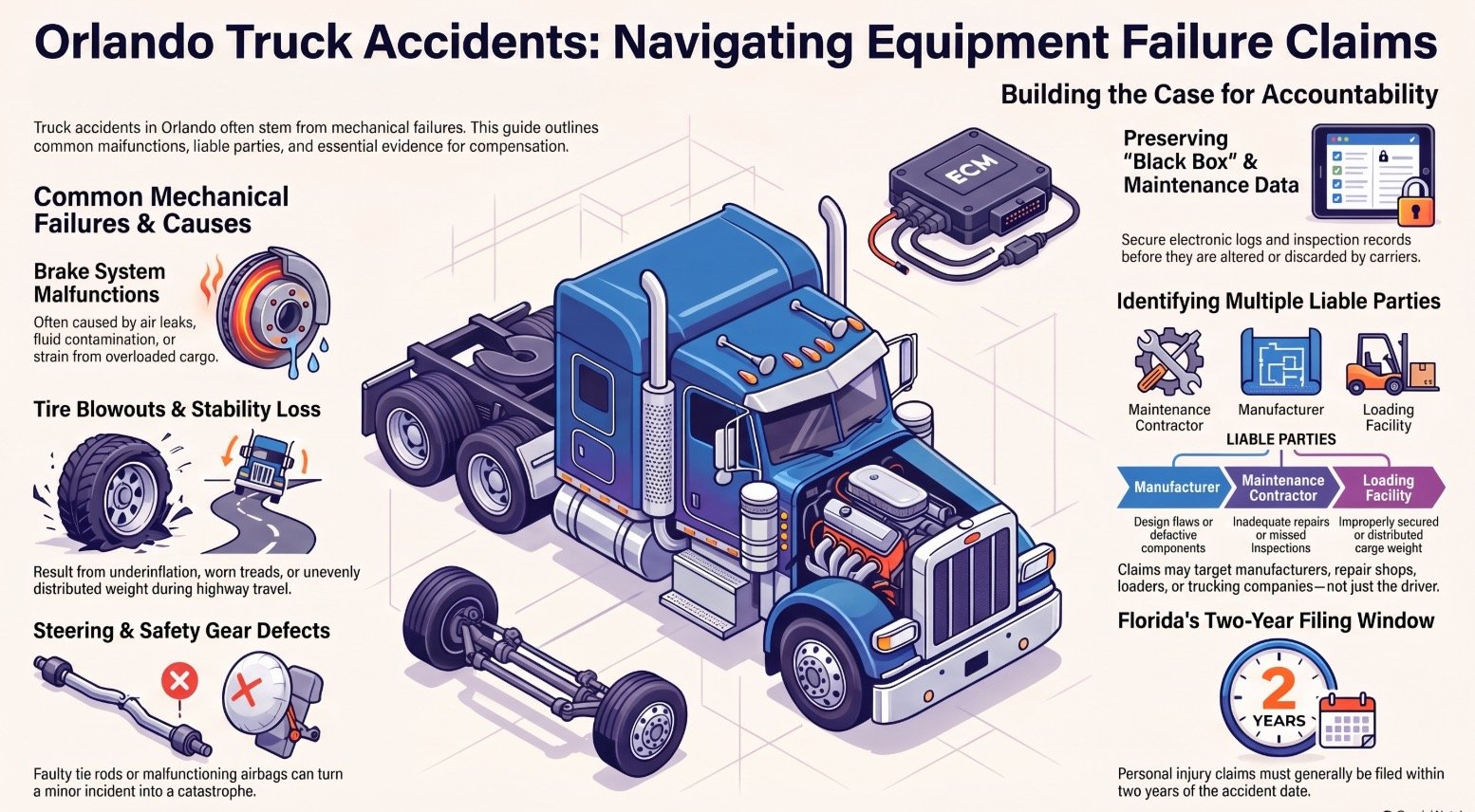
Common equipment failures in Orlando truck accidents may involve brake system failures, tire blowouts, or faulty steering components that undermine vehicle control. Defective safety equipment can further increase the risk or severity of resulting injuries. Identifying the specific failure and its underlying cause is key when evaluating potential liability.
Brake System Failures


Brake system failures are a significant cause of Orlando truck accidents, particularly when large commercial vehicles cannot stop within a safe distance or maintain control during emergency braking. Common causes include worn brake components, inadequate maintenance, improper adjustments, and defects that reduce braking performance. Brake fluid contamination can damage hydraulic components and prevent consistent pressure from reaching the brakes. In vehicles equipped with air brakes, air brake leaks may lower system pressure, delaying engagement or causing partial braking loss. Overloaded cargo can further strain braking systems and increase stopping distances, especially on congested Orlando roads. Commercial carriers and drivers have a responsibility to inspect, maintain, and repair these systems before operation. When failures cause injuries, careful investigation may identify neglected maintenance, defective parts, or regulatory violations that contributed to the collision.
Tire Blowouts
Although tires are designed to withstand substantial weight and highway use, a blowout can cause a commercial truck to lose stability with little warning. Common causes include underinflation, worn tread, heat exposure, manufacturing defects, and inadequate tire maintenance. Operators and carriers should conduct a Safety Inspection before each trip, checking pressure, tread depth, sidewalls, and valve conditions. Compliance with Vehicle Weight Limits also reduces stress on tires and helps prevent load-related tire damage. Unevenly distributed cargo may place excessive pressure on individual tires, increasing the likelihood of failure during highway travel. When a blowout occurs, debris can endanger occupants of nearby vehicles and contribute to rollovers or collisions. Proper inspections, timely replacement, and documented maintenance practices help protect motorists, passengers, and communities from avoidable equipment-related crashes.
Faulty Steering Components
Faulty guidance components can prevent a commercial truck from responding properly to driver input, increasing the risk of lane departures, jackknifing, and collisions. Steering failures may result from worn tie rods, damaged linkages, loose connections, inadequate maintenance, or manufacturing defects. Road debris can strike exposed components, while corrosion and repeated stress may weaken parts over time. Unlike driver distraction, which involves human attention, a guidance defect can remain hidden until the vehicle must turn or avoid an unexpected hazard. Inspection records, repair histories, and maintenance schedules may help identify whether a carrier overlooked warning signs. Witness accounts and vehicle examinations can also clarify how the failure developed. Prompt investigation assists injured individuals and supports accountability when neglected steering maintenance endangers motorists, passengers, and communities throughout Orlando.
Defective Safety Equipment
Defective safety equipment can leave commercial trucks unable to protect occupants and nearby motorists during crashes or emergency operations. Common failures include malfunctioning seat belts, defective airbags, inadequate warning lights, worn fire extinguishers, and missing reflective markings. Brake-related safety devices, emergency exits, and underride guards may also fail because of poor design, improper installation, insufficient inspection, or delayed maintenance. These defects can increase injury severity and complicate post-collision rescue efforts. Responsibility may extend to manufacturers, repair facilities, carriers, or maintenance contractors, depending on the source of the failure. Negligent hiring can contribute when a carrier assigns inspection duties to unqualified personnel. Similarly, driver fatigue may prevent timely recognition of equipment warnings or unsafe conditions. Prompt documentation and qualified evaluation can help clarify how defective equipment contributed to an accident.
Don’t Wait. Call Our Florida Personal Injury Lawyers Now!
Legal Rights of Orlando Truck Accident Equipment Failure Injury Victims
When a truck’s equipment failure contributes to a collision, injured victims may have legal rights to pursue compensation from the parties responsible for the vehicle’s condition, maintenance, loading, or operation. Claims may address medical expenses, lost income, rehabilitation, property damage, pain, and other legally recognized losses. An Orlando attorney can secure evidence, identify responsible entities, and explain applicable deadlines.
Truck equipment failures can cause serious collisions, but victims may pursue compensation from those responsible for maintenance, loading, or operation.
- Victims may seek documents concerning inspections, repairs, recalls, and maintenance.
- Evidence may establish negligent hiring, insufficient workplace training, driver impairment, or failures involving alcohol testing.
- Families may pursue wrongful-death remedies when a collision proves fatal.
Potential defendants can include trucking companies, owners, maintenance contractors, manufacturers, loaders, and individual drivers, depending on the evidence. Florida’s comparative-fault rules and insurance requirements may affect recovery. Prompt legal assistance can support injured people and their families while protecting evidence from alteration or loss. A careful investigation also helps ensure that accountability remains focused on those whose decisions or omissions caused preventable harm.
Why Do Orlando Truck Accident Equipment Failures Injuries Happen?
Truck accident equipment-failure injuries often result from inadequate inspection, poor maintenance, improper loading, or the continued use of worn or damaged components. Negligent vehicle maintenance may allow defective brakes, underinflated tires, gear-control problems, broken lights, or unsecured cargo to remain on a commercial vehicle. These failures can reduce stopping ability, impair control, or cause materials to fall into surrounding traffic.
Some incidents arise when trucking companies prioritize schedules or cost savings over required repairs and safety procedures. In other cases, manufacturers, repair facilities, or loading personnel may contribute by supplying defective parts, performing incomplete work, or distributing weight improperly. Driver distraction can also prevent a driver from recognizing warning signs, responding to equipment problems, or controlling a truck after a component fails. Weather, roadway conditions, and excessive speed may intensify the consequences, but they do not necessarily explain the original defect. Identifying the failure’s source requires careful examination of maintenance records, inspection reports, cargo practices, and vehicle components.
What Should You Do After an Orlando Truck Accident Equipment Failure Injury?
After an Orlando truck accident involving equipment failure, the injured person should seek immediate medical care, even if symptoms initially appear minor. When safe, document the accident scene with photographs, witness information, vehicle details, and relevant road conditions. The person should also contact a truck accident lawyer to protect legal rights and evaluate potential claims.
Seek Immediate Medical Care
Prompt medical evaluation should be a priority for anyone injured in an Orlando truck accident involving equipment failure. A qualified clinician can identify visible and internal injuries, provide necessary treatment, and establish a clear medical baseline. Some conditions, including concussions, spinal trauma, and internal bleeding, may worsen without timely attention, even when symptoms initially appear limited.
The injured person should accurately describe all symptoms, follow prescribed instructions, and attend recommended follow-up appointments. Consistent care supports recovery and creates Emergency medical records documenting the injury, diagnosis, treatment, and prognosis. Those records may also assist representatives serving the injured person by connecting medical conditions to the collision.
When possible, the patient should provide complete information about pain, mobility changes, prior conditions, and medication use. Delayed care or incomplete disclosures can complicate treatment and later evaluation.
Document the Accident Scene
If it is safe to do so, the injured person or a witness should document the accident scene before vehicles, debris, or damaged equipment are moved. Photographs should show vehicle positions, roadway conditions, traffic controls, tire marks, cargo, visible injuries, and broken components from multiple distances. A brief video may capture warning lights, unusual sounds, fluid leaks, or other conditions that photographs cannot fully convey. Names and contact information for everyone who observed the collision should be recorded promptly, supporting reliable Witness statements. Notes should include the time, weather, lighting, and sequence of events as remembered, without speculation. Medical responders or other authorized personnel may later preserve additional evidence, including electronic data and records relevant to driver log extraction. Original files should remain unedited and backed up securely.
Contact a Truck Accident Lawyer
Contact a truck accident lawyer promptly if equipment failure may have caused or contributed to an Orlando collision. Early legal guidance can help protect an injured person’s rights, identify potentially responsible parties, and coordinate communication with insurers. Counsel can review maintenance records, inspection reports, driver logs, recall information, and available electronic data to determine whether defective parts, inadequate repairs, or neglected inspections contributed.
A lawyer can also explain insurance claim deadlines that may affect recovery and recommend evidence preservation steps before records disappear or damaged equipment is altered. Maintain medical documentation, photographs, witness information, and employment records carefully. By seeking representation, an injured individual may avoid statements or settlements that undermine a legitimate claim while allowing counsel to pursue accountability and support fair compensation.
Critical Evidence in an Orlando Truck Accident Equipment Failure Injury Case
Critical evidence may establish whether defective equipment caused the Orlando truck accident and resulting injuries, including:
- Failed equipment records and maintenance or inspection logs.
- Accident scene photographs, measurements, and witness documentation.
- Expert mechanical analysis linking the failure to the collision.
These materials can clarify responsibility and support a legally sound injury claim.
Failed Equipment Records
When a truck’s brakes, tires, control components, or other safety systems fail, equipment records can help establish what happened and whether the failure was preventable. A careful review may reveal a maintenance history showing recurring defects, delayed repairs, or parts that were replaced shortly before the collision. Inspection gaps can indicate missed checks or work performed without adequate attention. When records are incomplete, altered, or withheld, record subpoenas may secure documents from carriers, repair vendors, manufacturers, and other custodians. An electronic log review can also identify service activity, vehicle use, and timing that may clarify whether the equipment was operated despite known concerns. Preserving these materials promptly supports accurate investigation, protects injured individuals’ interests, and helps qualified professionals evaluate responsibility without relying solely on recollections or assumptions.
Maintenance And Inspection Logs
Maintenance and inspection logs can establish whether a commercial truck received timely service and whether identified defects were corrected before the crash. These records may show scheduled inspections, brake and tire evaluations, repair orders, technician observations, and parts replaced. Consistent documentation can help determine whether a carrier followed federal safety requirements and its own maintenance policies. Gaps, altered entries, or repeated warnings may indicate neglectful servicing rather than an isolated mechanical failure. Logs can also reveal overlooked recalls involving handling, braking, lighting, or other safety-critical components. Comparing service dates with driver complaints and dispatch records may clarify whether management knew, or reasonably should have known, about a dangerous condition. Preserving these materials enables qualified investigators to assess responsibility, helps injured individuals pursue accountability, and supports safer practices across the transportation industry.
Accident Scene Documentation
Accident scene documentation provides an independent record of the conditions surrounding a truck crash and can help connect equipment failures to the resulting injuries. Photographs should capture vehicle positions, damaged components, roadway conditions, debris patterns, traffic controls, lighting, and visible hazards before the scene changes. Measurements, diagrams, and time-stamped notes can preserve details that become difficult to verify later. A Witness Statement may clarify what occurred immediately before impact, including unusual braking, guidance, warning signals, or detached parts. Nearby businesses, residences, traffic systems, or dashboard devices may contain Surveillance Footage that records the collision and surrounding events. Prompt collection and preservation of this material can help injured individuals, families, and their representatives present an accurate account. Documentation also helps protect evidence for insurers, investigators, and courts.
Expert Mechanical Analysis
Because equipment failures may not be apparent from photographs alone, expert mechanical analysis can be crucial in determining how a truck crash occurred. A qualified engineer may conduct a mechanical inspection of brakes, tires, steering components, suspension systems, lighting, and safety devices. The evaluation can identify defects, improper maintenance, manufacturing problems, or collision-related damage. Determining the Failure root cause helps distinguish preexisting equipment conditions from consequences of impact. Through expert reconstruction, experts may guide how a malfunction affected vehicle control, stopping distance, or crash severity. Evidence preservation is critical because damaged parts can change during towing, repairs, or storage. Investigators may document, photograph, and securely retain relevant components, maintenance records, and electronic data. This analysis can provide objective findings that support accountability and informed decisions for affected individuals.
Don’t Wait. Call Our Florida Personal Injury Lawyers Now!
Long-Term Effects of Orlando Truck Accident Equipment Failures Injuries
Equipment-failure injuries from Orlando truck accidents may cause chronic pain conditions that persist long after initial treatment ends. Lasting mobility challenges can restrict employment, daily activities, and personal independence. These physical limitations may also create significant emotional and financial strain through ongoing care costs, lost income, and reduced quality of life.
Chronic Pain Conditions
When defective truck equipment causes a collision, injured individuals may develop chronic pain that persists long after visible wounds have recovered. Such pain can arise from nerve damage, spinal trauma, soft-tissue injuries, or complications that remain difficult to diagnose. Symptoms may fluctuate, interfere with sleep, and limit concentration, making ordinary responsibilities more demanding. Medical professionals may recommend medication, injections, counseling, or other continuing care to manage symptoms and preserve quality of life. Documentation of pain levels, treatment responses, and resulting limitations can help establish the condition’s duration and seriousness. Compensation hurdles may arise when insurers question subjective symptoms or argue that unrelated conditions caused them. Legal guidance can help identify responsible parties and pursue damages addressing chronic treatment costs, lost income, and the sustained burden of pain while supporting affected individuals.
Lasting Mobility Challenges
Long-term mobility challenges may develop alongside chronic pain after a truck collision involving defective equipment. Injuries to the spine, hips, knees, or extremities can restrict walking, standing, lifting, and other routine movements. Some individuals may require braces, wheelchairs, walkers, or home modifications to maintain safety and independence. Limited mobility can also affect the ability to attend medical appointments, manage household responsibilities, or return to necessary daily activities. Post-accident transportation issues may arise when driving becomes unsafe, or tailored transit is unavailable. A qualified medical team can document functional limitations through examinations, treatment records, and rehabilitation assessments. Legal professionals may help coordinate disability claim assistance and preserve evidence concerning the equipment failure. Ongoing evaluations are important because mobility needs can change as treatment progresses, symptoms persist, or permanent impairment becomes clearer.
Emotional and Financial Strain
Emotional and financial strain often continues after injuries caused by defective truck equipment, particularly when recovery requires prolonged treatment or prevents a return to work. Medical appointments, rehabilitation, medication, and necessary household assistance can create substantial expenses while lost wages reduce financial stability. Some injured individuals also experience anxiety, depression, sleep disruption, or diminished confidence as daily independence changes. These effects may extend for months or years, especially when permanent limitations affect employment and family responsibilities. Careful documentation can help establish the full impact of these losses. Evidence preservation may be important when equipment defects, maintenance records, or manufacturer conduct must be examined. A wrongful delay in pursuing available benefits or legal remedies can complicate recovery. Prompt guidance may help protect records, identify responsible parties, and support fair compensation for continuing physical, emotional, and financial consequences.
Proving Liability in Orlando Truck Accident Equipment Failure Injury Cases
Establishing liability in an Orlando truck accident involving equipment failure requires evidence connecting the defective, poorly maintained, or improperly inspected component to the collision and resulting injuries. Investigators may examine maintenance records, inspection reports, repair invoices, driver logs, electronic data, and photographs of the truck and roadway. Qualified engineers or mechanics can evaluate whether brakes, tires, steering systems, cargo restraints, or other equipment failed because of a manufacturing defect, inadequate service, or missed inspection.
Trucking negligence may be shown when a carrier ignored safety regulations, postponed necessary repairs, assigned an unqualified driver, or failed to enforce inspection procedures. Employer liability may apply if the company’s conduct, supervision, maintenance practices, or hiring decisions contributed to the crash. Preserving records is essential because evidence can be altered, discarded, or lost after an incident. Witness statements and medical documentation can further establish causation, damages, and the connection between the equipment failure and the injured person’s needs.
Dealing With Insurance Companies After an Orlando Truck Accident Equipment Failure Injury
When an Orlando truck accident involves equipment failure, insurance companies may quickly seek statements, records, and settlement discussions that affect the injured person’s potential claim. An injured individual should provide accurate basic information while avoiding speculation about fault, medical prognosis, or the equipment’s condition. Recorded statements and broad medical authorizations may be used to narrow or challenge the claim.
Insurance representatives may request photographs, employment records, treatment details, or access to social media accounts. Each request warrants careful review because incomplete context can create misleading impressions. A qualified attorney can communicate with adjusters, preserve relevant evidence, and help prevent a wrongful delay in evaluating benefits.
Settlement offers should not be accepted before the injury’s consequences and available insurance coverage are reasonably understood. Counsel may assess policy language, trucking company responsibilities, maintenance records, and damages while protecting the client’s litigation strategy. Prompt, professional communication also helps serve the injured person’s needs without sacrificing legal protections or necessary documentation.
What to Expect During an Orlando Truck Accident Equipment Failures Injury Claim Process
An Orlando truck accident equipment failures injury claim typically begins with an initial evaluation of the facts, injuries, liability, and available insurance coverage. The evidence-gathering process may include obtaining accident records, maintenance documentation, expert assessments, medical records, and witness statements. After reviewing the evidence, the parties may negotiate with insurers toward a settlement, while unresolved disputes can proceed to trial.
Initial Claim Evaluation
During the initial claim evaluation, an Orlando truck accident equipment failures lawyer reviews the collision circumstances, available evidence, and potential sources of liability. The assessment may address defective parts, inadequate maintenance, improper inspections, or operational failures involving the truck, carrier, manufacturer, or maintenance provider. A preliminary failure investigation helps determine whether the facts support a negligence, product liability, or related claim. The lawyer may explain an evidence checklist without conducting the detailed evidence gathering addressed later. This discussion can include medical documentation, injury effects, and applicable filing deadlines. Counsel also evaluates possible insurance denial issues and identifies responses to incomplete or disputed coverage positions. The firm establishes clear timeline expectations, including claim review, communications, negotiations, and potential litigation. The process clarifies options and protects the injured person’s interests.
Evidence Gathering Process
A structured evidence-gathering process establishes how the equipment failure occurred and identifies each party that may bear responsibility. Counsel may inspect the truck, preserve damaged components, and photograph roadway conditions before repairs or disposal alter pivotal evidence. Maintenance histories, inspection reports, electronic logging data, cargo records, and manufacturer notices can reveal whether defective design, inadequate servicing, improper loading, or operational decisions contributed to the collision. Witness interviews may clarify warning signs, timing, and the vehicle’s condition immediately before impact. Driver testimony collection typically addresses pre-trip inspections, observed malfunctions, repair requests, and communications with dispatch or supervisors. Deposition preparation helps organize documents, identify disputed facts, and prepare witnesses to answer accurately without speculation. Investigators may also consult qualified engineers or mechanics to interpret technical findings and connect them to the claimed injuries.
Insurance Company Negotiations
Insurance company negotiations typically begin after the claimant or attorney submits a demand supported by medical records, wage documentation, crash evidence, and proof of the equipment failure. The insurer may request additional information, question the extent of injuries, or investigate maintenance records and driver conduct. Counsel may address spoliation claims when relevant evidence was lost, altered, or discarded after notice of the incident. During the settlement timeline, adjusters typically evaluate liability, damages, policy limits, and available defenses before responding. Claim denials can arise from disputed causation, alleged policy exclusions, or insufficient documentation. Coverage disputes may require careful review of commercial policies, additional insured provisions, and competing insurers’ obligations. Clear, timely communication helps protect the claimant’s interests while preserving supporting evidence and maintaining an accurate record of negotiations.
Settlement Or Trial
Settlement or trial decisions in an Orlando truck accident equipment failure claim depend on the strength of the evidence, the severity of the injuries, available insurance coverage, and the parties’ willingness to resolve disputed issues. Settlement versus litigation timelines can differ substantially, because negotiations may conclude within months while discovery and trial preparation often take longer. An attorney may develop an insurance negotiation strategy based on maintenance records, inspection reports, electronic data, medical documentation, and witness accounts. If negotiations fail, litigation may require depositions, expert testimony, and motions addressing responsibility. Juror selection considerations can influence how counsel presents intricate mechanical evidence and damages. During trial, courtroom evidence presentation must connect the equipment defect to the collision and resulting harm. The process should remain focused on accountability, fair compensation, and protecting injured individuals.
Compensation for Orlando Truck Accident Equipment Failure Injury Damages
Compensation for injuries caused by truck equipment failures may include medical expenses, lost wages, reduced future earning capacity, property damage, and pain and suffering. A careful claim may also address rehabilitation, medication, transportation to treatment, and necessary changes to a home or vehicle. Documenting commercial liability requires identifying responsible parties, such as the carrier, owner, maintenance provider, manufacturer, or parts supplier. Preserving truck maintenance records, inspection reports, repair invoices, electronic data, and damaged components can help establish whether inadequate service or a defective part contributed to the collision. Collect evidence promptly because vehicles may be repaired, sold, or altered. A claim involving loss of earning capacity may require employment records, medical opinions, and vocational analysis to explain how lasting limitations affect future work. Non-economic pain and suffering damages may reflect physical discomfort, disability, emotional distress, and diminished quality of life. Attorneys serving injured individuals may coordinate documentation and negotiations while seeking compensation that supports recovery and household stability.
Economic vs Non-Economic Damages in Orlando Truck Accident Equipment Failures Cases
Economic damages may include medical expenses, lost income, property damage, and other measurable financial losses caused by an equipment failure. Non-economic losses, such as pain, emotional distress, and reduced quality of life, require careful evaluation because they do not have fixed monetary values. Establishing both categories typically requires evidence linking the defective equipment to the crash, injuries, and resulting losses.
Economic Damages Explained
In Orlando truck accident equipment failure cases, critical damages represent measurable financial losses caused by the crash, while non-economic damages address personal consequences without a fixed dollar value. Critical damages may include emergency treatment, hospital care, rehabilitation, prescription medication, and other documented medical costs. They can also cover future healthcare needs when qualified professionals provide medical expense estimates supported by treatment records. You may also recover lost wages, reduced earning capacity, property damage, transportation costs, and necessary household assistance. Attorneys often organize bills, employment records, repair invoices, and expert projections to establish the total financial impact. During insurance negotiations, this documentation helps present a clear demand and challenge incomplete evaluations. Accurate calculations support fair compensation and help injured individuals and their families manage restorative recovery expenses.
Non-Economic Losses Valued
Non-economic losses reflect the personal harm that follows an Orlando truck accident involving equipment failure, even when those losses do not appear on bills or financial records. They may include physical pain, emotional distress, diminished quality of life, disfigurement, and loss of companionship. A pain and suffering calculation considers the injury’s severity, recovery period, lasting limitations, and effect on ordinary activities. The valuation does not follow a fixed price list; it depends on the circumstances and applicable Florida law. When a fatality occurs, wrongful death damages may address survivors’ loss of companionship, protection, guidance, and emotional support. These damages recognize harms that economic figures cannot fully express. An attorney serving injured people may explain how non-economic losses differ from medical expenses, lost income, and other measurable financial consequences.
Proving Equipment Failure Damages
When a truck’s defective brakes, tires, wheel components, or other equipment contributes to a crash, proving damages requires evidence connecting the failure to the resulting losses. Economic damages may include emergency treatment, rehabilitation, medication, lost wages, reduced earning capacity, property damage, and necessary future care. Records, invoices, employment documentation, and medical opinions help establish these amounts. Non-economic damages address pain, emotional distress, disability, disfigurement, and diminished quality of life, which require testimony describing daily limitations and lasting effects. Eyewitness testimony can clarify the collision and visible injuries, while an expert deposition may explain how equipment failure caused the harm and support future-loss calculations. Attorneys also evaluate insurance coverage, comparative fault, and available defendants when developing a settlement strategy that fairly serves the injured person’s long-term needs.
When an Orlando Truck Accident Equipment Failure Injury Case Goes to Trial vs Settlement
The decision to resolve an Orlando truck accident equipment failure injury case through settlement or trial depends on the strength of the evidence, the severity of the injuries, and the parties’ willingness to accept a fair result. Settlement may provide timely compensation, reduce uncertainty, and spare an injured person and family from the demands of courtroom testimony. Negotiations often address medical expenses, lost income, rehabilitation needs, and long-term assistance while allowing all parties to maintain greater control over the outcome.
Trial becomes more likely when insurers dispute responsibility, undervalue damages, or refuse reasonable negotiations. A careful Trial Strategy may include presenting maintenance records, inspection evidence, expert opinions, and testimony describing how the failure affected the injured person’s daily life. Jury Selection is also important because jurors must evaluate technical evidence fairly and understand the lasting consequences of preventable harm. Whether through settlement or trial, the process should protect the injured person’s interests and support meaningful recovery for those affected.
Florida Laws That May Affect Your Orlando Truck Accident Equipment Failures Case
Florida laws may affect nearly every part of an Orlando truck accident equipment failure case, including liability, evidence, filing deadlines, and available compensation.
Important legal considerations may include:
- Comparative negligence rules: If an injured person is found partly responsible, the recoverable award may be reduced by that percentage. Evidence concerning maintenance, inspections, warnings, loading, and driver conduct can influence this analysis.
- Evidence and responsibility: Florida negligence law may allow claims against trucking companies, manufacturers, maintenance providers, or other parties whose conduct contributed to a defective brake, tire, guidance system, or safety device. Records, photographs, electronic data, and qualified testimony can help establish these connections.
- Florida damages caps: Certain claims, particularly those involving governmental entities, may face statutory limits on recoverable damages. The applicable rule depends on the defendant and the type of loss. Document medical expenses, lost income, rehabilitation needs, and non-economic harm carefully so you can evaluate the case accurately and present it in service of the injured person’s recovery.
The Statute of Limitations for Orlando Truck Accident Equipment Failures Injury Cases
A statute of limitations establishes the deadline for filing an Orlando truck accident equipment failures injury claim in court. In Florida, personal injury claims generally must be filed within two years after the accident, although specific facts may alter that period. Claims involving a government vehicle or agency can require shorter notice deadlines and additional procedural steps.
The deadline may also be affected by the injured person’s age, incapacity, delayed discovery of an injury, or the defendant’s absence from Florida. Because equipment failures can involve maintenance records, inspection reports, driver conduct, and federal trucking regulations, early evidence preservation is important. A missed deadline can permanently bar compensation, even when liability appears clear.
Comparative fault rules may reduce an award when the injured person shares responsibility, but they do not ordinarily extend the filing period. Prompt attention helps preserve legal rights and supports fair treatment of everyone affected, including victims, families, drivers, carriers, and other road users.
How an Orlando Truck Accident Equipment Failures Lawyer Can Help You
After an Orlando truck accident involving equipment failure, legal counsel can investigate the cause, identify potentially responsible parties, and protect the injured person’s right to seek compensation.
A lawyer may assist by:
- Examining maintenance records, inspection reports, driver logs, and available video to determine whether defective parts, inadequate repairs, or negligent operation contributed to the collision.
- Preserving physical components and electronic data, reducing the risk of evidence spoliation while coordinating qualified experts to evaluate the truck and its equipment.
- Pursuing appropriate claims against drivers, carriers, manufacturers, maintenance providers, or other responsible entities, including claims involving serious injury or Wrongful death.
Counsel can also address insurance disputes by reviewing coverage, challenging unsupported denials, and communicating with insurers on the affected person’s behalf. Legal representation may help document medical expenses, lost income, long-term care needs, and emotional trauma. By presenting organized evidence and a clearly supported damages analysis, counsel can promote accountability and help families obtain resources needed for recovery, rehabilitation, and continued service to others.
When to Contact an Orlando Truck Accident Equipment Failures Lawyer
Prompt consultation with an Orlando truck accident equipment failures lawyer is generally advisable when a collision causes injury, property damage, or uncertainty about the truck’s condition or maintenance history. Early evidence collection may be crucial because vehicles can be repaired, records can change, and relevant physical conditions may not remain available. A lawyer may be contacted promptly when braking, direction , tires, lighting, cargo securement, or other equipment appears connected to the crash. Obtain immediate medical documentation for anyone reporting pain, limited movement, or other symptoms, even if injuries initially seem minor. Legal guidance can help preserve photographs, witness information, maintenance records, inspection materials, and communications with insurers. Consultation is particularly prudent when injuries require ongoing care, fault is disputed, multiple parties are involved, or an insurer requests a recorded statement or release. Early attention allows affected individuals and families to organize facts responsibly while protecting important deadlines and supporting a clear account of the event.
Why You Need an Experienced Orlando Truck Accident Equipment Failures Lawyer
The need for an experienced Orlando truck accident equipment failures lawyer often becomes apparent when determining how a mechanical defect, inadequate maintenance, or improper inspection contributed to a collision. Such counsel can protect an injured person’s interests while pursuing accountability from responsible parties, including carriers, maintenance providers, manufacturers, or other entities.
An experienced lawyer understands Evidence preservation steps, such as securing vehicle components, inspection histories, electronic data, photographs, and witness statements before essential information disappears or changes. The lawyer can also coordinate a medical records review to connect diagnosed injuries, treatment requirements, and future limitations to the crash. This analysis supports an accurate evaluation of damages and helps prevent disputed claims from overlooking significant losses.
Legal guidance may further address regulatory records, maintenance policies, driver reports, and insurance communications. By organizing technical and medical evidence into a clear case theory, experienced representation lets the injured individual and family focus on recovery while the legal process moves forward responsibly.
How to Choose the Right Orlando Truck Accident Equipment Failures Lawyer for Your Case
Selecting the right Orlando truck accident equipment failures lawyer requires careful consideration of experience, investigative resources, and the ability to identify every potentially responsible party. A qualified attorney should understand commercial transportation regulations, maintenance obligations, inspection records, and the technical issues surrounding defective or improperly repaired equipment.
Prospective clients may evaluate whether the lawyer regularly handles truck collision claims and can explain a clear Liability strategy without making unsupported promises. The attorney should also prioritize evidence preservation, including securing electronic control data, maintenance histories, photographs, damaged components, and witness statements before essential information disappears.
Communication is equally important. A lawyer representing injured individuals should provide clear updates, respond promptly, and explain the claim’s strengths and limitations. It is also appropriate to ask about investigative methods, potential defendants, litigation experience, fee arrangements, and expected case stages. Careful comparison helps a client choose counsel prepared to protect legal rights and pursue a thorough, responsible resolution.
About The Law Offices of Anidjar & Levine
With a focus on personal injury litigation, the Law Offices of Anidjar & Levine represents individuals injured in serious truck collisions, including cases involving equipment failures. The firm examines whether defective brakes, tire failures, inadequate maintenance, or other mechanical problems contributed to a crash. Its attorneys may review inspection records, maintenance histories, driver reports, photographs, and available electronic data to help clarify responsibility.
A client-centered consultation allows the legal team to understand the injured person’s circumstances, medical needs, financial losses, and objectives. From that foundation, attorneys develop case strategy planning tailored to the evidence and applicable Florida law. This process may include identifying potentially responsible parties, consulting qualified experts, preserving important evidence, and pursuing appropriate compensation through negotiation or litigation.
The firm’s work emphasizes communication, careful preparation, and service to individuals and families facing significant disruption. While outcomes depend on each case’s facts, the attorneys guide clients through the legal process and advocate for their rights with disciplined attention to detail.
Frequently Asked Questions
Can Defective Truck Equipment Lead to Criminal Charges Against the Responsible Company?
Defective truck equipment can lead to criminal charges against a responsible company when prosecutors establish knowing violations, reckless conduct, fraud, or deliberate concealment of safety hazards. Equipment liability may arise alongside corporate responsibility, particularly when management ignored inspections, recalls, maintenance duties, or regulatory warnings. Charges depend on jurisdiction, evidence, causation, and the severity of resulting harm. Civil claims may proceed separately, providing compensation to injured individuals and supporting broader public safety.
Who Pays for Vehicle Repairs After an Equipment-Related Truck Accident?
Vehicle repairs are generally paid through the responsible party’s insurance coverage, depending on the policy, liability findings, and applicable coverage limits. The truck owner, carrier, equipment manufacturer, maintenance contractor, or another negligent party may be responsible for repairs when defective components, inadequate maintenance, or improper installation caused the collision. If coverage is disputed, the vehicle owner may initially use personal coverage and pursue reimbursement through claims or litigation.
Can I Recover Damages if I Was Partially at Fault?
A person may recover damages after a truck accident even when partly responsible, depending on the state’s Comparative Fault rules. Compensation is generally reduced by the person’s percentage of responsibility, though some jurisdictions bar recovery when fault reaches a specified threshold. Damage Limits may also restrict available compensation, particularly for certain claims or losses. A careful investigation should identify equipment failures, preserve evidence, and fairly evaluate each party’s conduct before pursuing compensation or serving affected victims.
What Happens if the Truck’s Manufacturer Is Located Outside Florida?
A truck manufacturer located outside Florida may still be held responsible if its equipment contributed to the crash. Jurisdiction issues determine where the claim can proceed and whether Florida courts can exercise authority over the company. Counsel may pursue the manufacturer in Florida or another appropriate forum, depending on contacts and applicable law. Prompt evidence handling is critical, including preserving failed components, maintenance records, testing data, and communications concerning the defect.
Are Equipment Failure Accidents Involving Autonomous Trucks Handled Differently?
Autonomous truck equipment failure accidents may be handled differently because liability can involve the vehicle manufacturer, software developer, maintenance provider, fleet operator, or human safety driver. Investigators typically examine system data, maintenance records, design defects, warnings, and regulatory compliance. Insurance coverage may involve commercial policies, technology-related coverage, or multiple insurers. A careful legal review helps identify responsible parties, preserve electronic evidence, and protect injured individuals seeking fair compensation under applicable state and federal law.
—————————
Equipment failures can make Orlando truck accidents especially complicated, involving maintenance records, inspection duties, defective components, and multiple potentially responsible parties. Injured individuals may face significant medical expenses, lost income, and lasting consequences while critical evidence remains vulnerable to loss. An experienced Orlando truck accident equipment failures lawyer can investigate the cause, identify liable parties, and pursue available compensation. The Law Offices of Anidjar and Levine provide informed guidance and dedicated representation while helping protect victims’ legal rights throughout the claims process. Learn more from an experienced Orlando Personal Injury Lawyer.