The Law Offices of Anidjar and Levine, an Orlando truck accident driver behavior lawyer, investigates whether distraction, fatigue, speeding, impairment, unsafe actions, or inadequate training contributed to a collision. The firm preserves electronic records, driver logs, dashcam footage, witness accounts, and company documents while evaluating medical expenses, lost income, future care, and other damages. Legal counsel may identify responsible parties, communicate with insurers, meet procedural deadlines, and negotiate or litigate claims. For additional information, visit an Orlando Personal Injury Lawyer to learn about evidence, liability, victim rights, and selecting appropriate representation.
Main Takeaways
- Investigate distracted driving, fatigue, speeding, impaired driving, unsafe maneuvers, and inadequate training that may have caused your Orlando truck accident.
- Preserve critical evidence, including electronic logs, phone records, vehicle data, dashcam footage, surveillance video, and witness statements.
- Establish negligence by proving the truck driver’s duty, unsafe conduct, causation, and the resulting injuries and financial losses.
- Identify potentially responsible parties, including trucking companies, employers, maintenance providers, cargo handlers, and insurers.
- Manage insurance communications, medical documentation, deadlines, negotiations, and litigation while pursuing compensation for current and future damages.
How We Can Help With Your Orlando Truck Accident Driver Behavior Injury Claim
When a truck driver’s unsafe behavior contributes to a collision, an experienced Orlando truck accident attorney can investigate the circumstances, identify responsible parties, and pursue compensation for the injured person. The legal team may preserve records, review reports, and organize Insurance claim documentation to present a clear account of the losses sustained.
Assistance can include communicating with insurers, evaluating medical expenses, documenting lost income, and identifying future care needs. Counsel may also coordinate dashcam evidence retrieval, obtain roadway or vehicle data, and interview witnesses whose observations clarify what occurred. These efforts can help prevent important information from being overlooked or mischaracterized during claim review.


An attorney can explain available legal options, manage procedural deadlines, and negotiate with responsible parties on the client’s behalf. If a fair resolution cannot be reached, the attorney may prepare the matter for litigation. This support allows injured individuals and their families to focus on recovery while their interests receive careful, professional attention throughout the claim process.
Understanding Orlando Truck Accident Driver Behavior Injury Cases
OUR CONSULTATIONSARE FREE
START YOUR FREE CASE REVIEW

Understanding an Orlando truck accident driver behavior injury case requires examining how a driver’s conduct contributed to the collision and the resulting harm. The analysis considers whether the driver acted reasonably before, during, and after the event, including compliance with traffic laws, attention to surroundings, and appropriate responses to changing roadway conditions.
Evidence may include crash reports, vehicle data, witness accounts, medical records, and trucking-company documents. Investigators must also distinguish negligent conduct from conditions outside the driver’s control. For example, truck brake failures may affect responsibility differently depending on inspection practices, maintenance records, and the driver’s reaction. Likewise, adverse weather conditions do not automatically excuse unsafe decisions when a careful driver would have reduced speed or increased following distance.
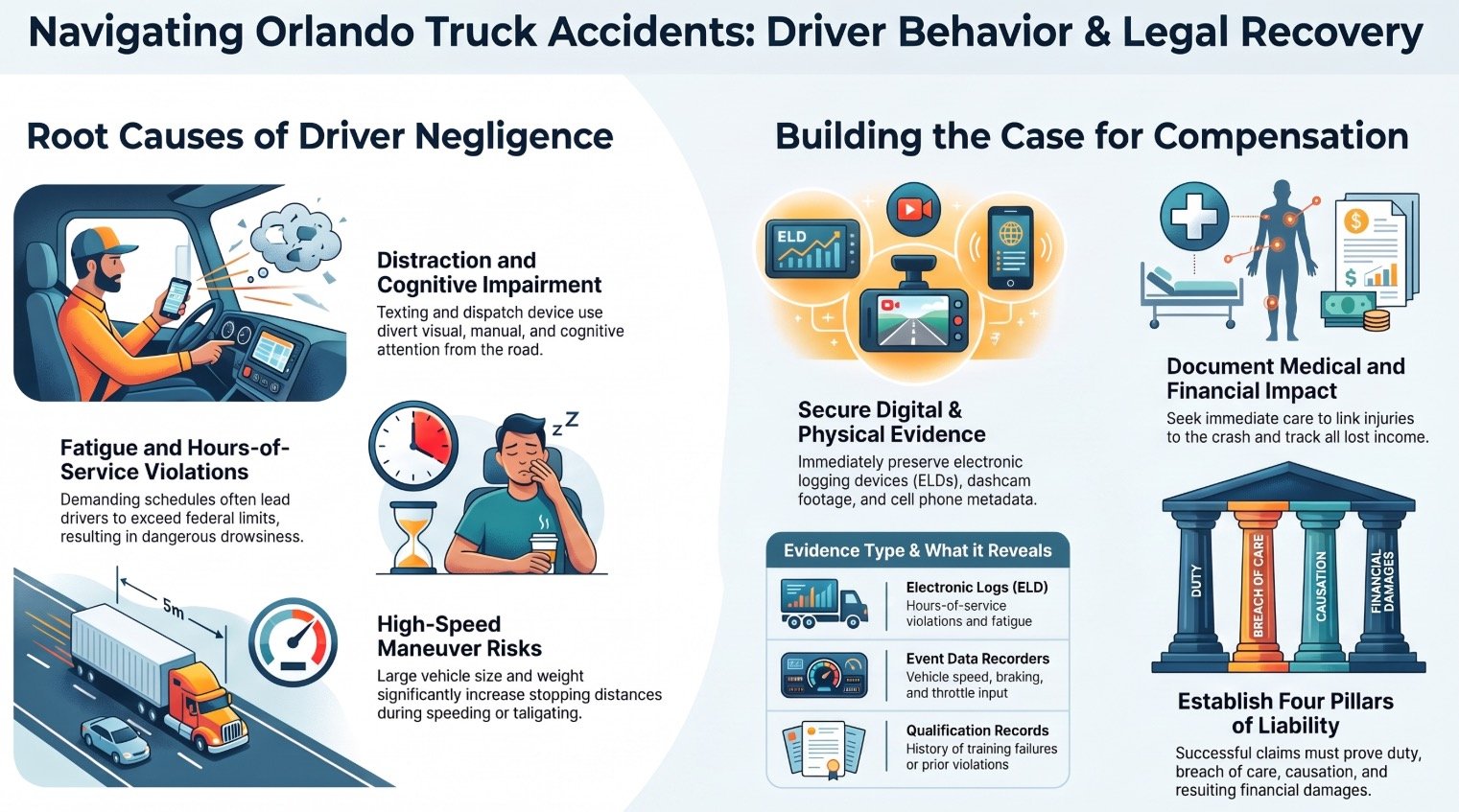
An injury case generally requires proof of duty, breach, causation, and damages. A careful review helps identify responsible parties, preserve reliable evidence, and support injured individuals seeking fair treatment, financial recovery, and continued assistance during rehabilitation and recovery.
Don’t Wait. Call Our Florida Personal Injury Lawyers Now!
Common Causes of Orlando Truck Accident Driver Behavior


Common causes of truck accidents in Orlando include distracted driving, driver fatigue, and drowsiness, each of which can impair attention and reaction time. Speeding and reckless maneuvers can further increase crash risk, especially because large vehicles require longer stopping distances. Impaired or inexperienced drivers can also make unsafe decisions, fail to recognize hazards, or lose control of a truck.
Distracted Truck Driving
Distracted truck driving occurs when a commercial driver diverts attention from the roadway, whether by texting, using a dispatch device, adjusting navigation, eating, or engaging in other non-driving activities. Texting distraction is particularly hazardous because it combines visual, manual, and cognitive impairment. A cellular device may require a driver to look away, remove a hand from the wheel, and process information unrelated to traffic conditions. Even brief interruptions can prevent timely responses to braking vehicles, changing signals, pedestrians, or roadway hazards. Commercial drivers owe heightened duties to protect passengers, motorists, and communities sharing the road. Employers may also have responsibilities concerning communication policies, device use, and safety enforcement. Evidence such as phone records, onboard systems, witness accounts, and surveillance footage may help establish whether distraction contributed to a collision.
Driver Fatigue And Drowsiness
Driver fatigue and drowsiness can significantly impair a commercial truck driver’s ability to operate a vehicle safely, particularly during extended routes, overnight shifts, or demanding delivery schedules. Fatigue may reduce alertness, slow reaction time, and interfere with sound judgment, increasing the likelihood that a driver will miss changing traffic conditions or fail to recognize hazards. Federal hours-of-service requirements are intended to limit excessive driving and encourage adequate rest, yet violations, unrealistic schedules, and insufficient sleep may still occur. Effective truck route planning can help carriers establish reasonable timetables, identify rest locations, and reduce pressure to continue driving while tired. Employers also have a responsibility to monitor fatigue and address vehicle maintenance issues that create additional physical or mental demands. Documentation, electronic logs, and witness accounts may help identify fatigue-related conduct after an Orlando collision.
Speeding And Reckless Maneuvers
When commercial truck operators exceed posted speed limits or make unsafe maneuvers, the vehicle’s size, weight, and limited stopping ability can substantially increase the severity of an Orlando collision. Speeding reduces reaction time and may prevent a loaded truck from stopping before a pedestrian crossing, traffic signal, or slowing vehicle. Abrupt lane changes, unsafe passing, tailgating, and failure to yield can create dangerous conflicts, particularly on congested highways and urban roads. Drivers may also misjudge traffic signal timing, enter an intersection after the light changes, and put others at risk. Aggressive conduct can escalate road rage, encouraging further maneuvers and confrontations. Evidence such as onboard data, surveillance footage, witness accounts, and crash reports may help establish how driver behavior caused harm and support accountability for affected individuals and families.
Impaired Or Inexperienced Drivers
Impaired or inexperienced commercial truck operators may lack the judgment, coordination, and reaction time necessary to manage a large vehicle safely on Orlando roads. Alcohol intoxication can affect perception, decision-making, and motor control, increasing the risk of speeding, improper lane changes, delayed braking, and collisions. Federal and state regulations generally prohibit operating commercial vehicles while impaired, yet violations may still occur when drivers consume alcohol before or during a shift.
Lack of training presents another significant concern. Drivers who have not received adequate instruction in vehicle handling, cargo securement, defensive driving, or emergency procedures may respond improperly to traffic conditions. Employers may also contribute by assigning duties without confirming qualifications or providing sufficient supervision. Identifying these factors can help protect injured individuals, clarify responsibility, and support efforts to promote safer transportation throughout Orlando and surrounding communities.
Legal Rights of Orlando Truck Accident Driver Behavior Injury Victims
Victims injured in Orlando truck crashes caused by negligent or unlawful driver behavior may have the right to pursue compensation through an insurance claim or personal injury lawsuit. Potential recovery may include medical expenses, lost income, reduced earning capacity, property damage, and documented pain-related losses.
Legal counsel can help protect those rights while coordinating with insurers and opposing parties.
- Request prompt medical evaluation and follow prescribed treatment.
- Preserve photographs, records, witness details, and other evidence.
- Avoid recorded statements or settlements before understanding claim value.
- Track expenses, missed work, symptoms, and related limitations.
- Monitor filing deadlines and required insurance notices.
Evidence preservation is crucial because vehicle data, employment records, surveillance footage, and driver logs may become unavailable. A lawyer may investigate responsibility, calculate damages, communicate with insurers, and pursue litigation when negotiations fail. Victims should understand that compensation delays can result from disputed fault, incomplete documentation, serious injuries, or multiple liable parties. Timely guidance helps preserve options and supports fair treatment while victims focus on recovery and serving their families.
Why Do Orlando Truck Accident Driver Behavior Injuries Happen?
Understanding the causes of driver-behavior-related truck injuries helps establish how a crash occurred and which parties may bear responsibility. Common causes include driver distraction, fatigue, speeding, aggressive manœuvres, impaired driving, and failure to follow traffic controls. Commercial truck operators may face demanding schedules that contribute to inadequate rest or pressure to meet delivery deadlines. In other cases, insufficient training, unfamiliarity with routes, or disregard for federal and state safety requirements can increase collision risks.
Driver distraction may involve texting, phone conversations, electronic dispatch systems, eating, or adjusting vehicle controls. Investigators may examine cell phone records, onboard cameras, electronic logging data, inspection reports, and witness accounts to determine whether conduct contributed to the collision. Trucking companies may also bear responsibility when they hire unqualified drivers, encourage unsafe practices, or fail to provide appropriate supervision and maintenance. Understanding these contributing factors supports a careful assessment of how preventable behavior caused injuries and identifies responsible parties for affected individuals and families.
What Should You Do After an Orlando Truck Accident Driver Behavior Injury?
After a truck accident injury, the injured person should seek immediate medical care, even if symptoms seem minor at first. Document the accident scene with photographs, witness information, police reports, and relevant medical records. Consulting an Orlando truck accident lawyer can help preserve evidence, assess liability, and protect the individual’s legal rights.
Seek Immediate Medical Care
Prompt medical evaluation is essential following an Orlando truck accident involving suspected driver negligence, even when injuries initially appear minor. A qualified healthcare professional can identify concussions, internal trauma, spinal injuries, and other conditions that may repair without treatment. The injured person should describe all symptoms accurately and follow recommended testing, treatment, and follow-up instructions. Prompt care supports recovery and creates medical records connecting reported conditions to the collision. Those records may assist with insurance documentation and proving fault when a driver’s conduct is disputed. Consistent treatment also demonstrates a responsible effort to protect personal health and preserve evidence relevant to a claim. If transportation is difficult, a trusted person may help arrange care. Emergency symptoms, including severe pain, confusion, weakness, breathing difficulty, or loss of consciousness, warrant immediate emergency services.
Document The Accident Scene
At the accident scene, the injured person or a reliable witness should document conditions that may show how the Orlando truck collision occurred. If safety permits, photographs should capture vehicle positions, roadway markings, traffic signals, visible injuries, property damage, debris, weather, and lighting. Take images from multiple distances without disturbing evidence or entering hazardous areas. Names, contact information, and brief accounts from bystanders can preserve Witness statements before memories change. The truck’s license plate, company markings, trailer number, and apparent damage may also assist identification. A person should record the time, location, and sequence of events as soon as practical, using objective language rather than assumptions about driver behavior. Store copies of photographs, notes, medical records, and Insurance documentation securely for later reference.
Consult A Truck Accident Lawyer
A truck accident lawyer can evaluate whether driver conduct, such as speeding, distraction, fatigue, impairment, or unsafe lane changes, contributed to the injury. Early consultation helps preserve evidence, identify responsible parties, and protect an injured person from statements that could undermine a claim. Counsel may examine crash reports, electronic logging data, vehicle records, witness accounts, and available surveillance footage. An Insurance coverage review can determine whether the trucking company, driver, carrier, or other entities provide applicable benefits. Legal guidance also helps coordinate medical documentation and assess present and future losses. During discussions with insurers, a lawyer can develop a settlement negotiation strategy based on liability, damages, and supporting evidence rather than pressure to accept an inadequate offer. Professional representation lets the injured individual focus on recovery while meeting family and community responsibilities.
Critical Evidence in an Orlando Truck Accident Driver Behavior Injury Case
Critical evidence can clarify whether a truck driver’s conduct contributed to the Orlando crash and resulting injuries. An attorney may examine qualification records, hours-of-service logs, electronic data, witness statements, and video accounts to establish a reliable factual record.
Relevant materials may include:
- Driver qualification and training records
- Hours-of-service and fatigue-related logs
- Electronic logging device and vehicle data
- Eyewitness statements and accident reports
- Dashcam, traffic-camera, and surveillance video
Driver Qualification Records
When a commercial truck driver’s conduct is disputed, driver qualification records can provide objective evidence of whether the carrier properly evaluated and monitored that driver before the collision. These records may include employment applications, prior driving histories, license verifications, medical certifications, training documentation, and required safety evaluations. They can reveal whether the carrier identified previous crashes, traffic violations, substance-related concerns, or disciplinary issues before assigning the driver to operate a commercial vehicle. A complete file may also show whether the carrier followed consistent hiring and supervision procedures or ignored warning signs. Investigators generally examine hours-of-service logs and Electronic data separately to evaluate operational conduct and vehicle activity. Preserving qualification materials promptly can help clarify responsibility, support injured individuals, and promote accountability among carriers entrusted with protecting the public.
Hours-Of-Service Logs
Beyond the driver’s qualifications, hours-of-service logs can show whether fatigue or scheduling practices contributed to an Orlando truck accident. Hours-of-service log documentation may identify driving periods, required rest breaks, and possible violations of federal limits. These records can help clarify whether a driver exceeded permitted hours, reported insufficient off-duty time, or continued operating despite fatigue-related risks. Investigators may compare the logs with dispatch instructions, delivery deadlines, fuel records, and crash timing to assess whether company practices encouraged noncompliance. Electronic logbook compliance issues, including unexplained edits, missing entries, or inconsistent certifications, may warrant closer review. Careful preservation and analysis of these materials can support a fair determination of responsibility and help protect injured individuals seeking appropriate medical care, financial recovery, and accountability after a preventable collision.
Electronic Data Evidence
Electronic data evidence can help establish how a truck driver operated the vehicle before an Orlando collision. Event data recorders may preserve information about speed, braking, throttle application, control inputs, and seatbelt use. GPS records can help identify vehicle movements, route deviations, extended stops, or speed changes that may support a careful reconstruction of events. Mobile-device records may reveal Cellphone distraction, including calls, texts, application activity, or other usage near the reported crash time, subject to applicable privacy rules. In addition, dashcam footage maintained by the carrier, driver, or vehicle system may capture roadway conditions and driving actions before impact. Investigators and attorneys can request preservation of these records promptly because electronic information may be overwritten, deleted, or altered through routine system operation.
Witness And Video Accounts
Witness statements and video recordings can provide independent evidence of a truck driver’s conduct before and during an Orlando collision. Passengers, pedestrians, nearby motorists, and business employees may describe speeding, distraction, fatigue, aggressive turns, unsafe loading, or failures to yield. Dashcams, traffic cameras, surveillance systems, and cellphone footage can preserve timing, vehicle movement, visibility, and road conditions before memories change. Investigators should promptly identify witnesses, secure original files, and document how recordings were obtained to support reliability and admissibility. These accounts may clarify disputed facts when electronic data is incomplete or unavailable. They can also support damages calculations by linking unsafe conduct to collision severity, injuries, and losses. Medical treatment documentation further helps establish the nature, duration, and consequences of injuries requiring compensation.
Don’t Wait. Call Our Florida Personal Injury Lawyers Now!
Long-Term Effects of Orlando Truck Accident Driver Behavior Injuries
Long-term injuries from truck accidents may cause chronic physical pain, reduced mobility, and ongoing medical needs. Emotional trauma can also result in anxiety, depression, sleep disturbances, or difficulty resuming ordinary activities. These conditions may create substantial financial hardship through medical expenses, lost income, and diminished earning capacity.
Chronic Physical Pain
When truck driver behavior causes a collision, the resulting injuries may produce chronic physical pain that persists long after emergency treatment and initial recovery. Victims may experience lasting back, neck, joint, or nerve pain that limits mobility, employment, and daily responsibilities. Continuing symptoms can require medical evaluations, physical therapy, prescription treatment, injections, or other pain management options. Thorough records of diagnoses, treatment plans, expenses, and functional limitations help establish the injury’s long-term impact. Physicians may also provide opinions about future care and whether symptoms are likely to remain permanent. An Orlando truck accident driver behavior lawyer can use this evidence to develop a settlement negotiation strategy that accounts for past losses, anticipated medical needs, reduced earning capacity, and diminished quality of life. Timely legal guidance may help preserve documentation and protect the injured person’s interests.
Emotional Trauma Effects
Emotional trauma can remain after the immediate danger of a truck collision has passed, affecting a victim’s sense of safety, sleep, concentration, and ability to resume normal activities. Some individuals develop anxiety, depression, panic responses, or post-traumatic stress symptoms after witnessing severe injuries or fearing for their lives. Avoiding driving, experiencing intrusive memories, and reacting strongly to traffic conditions may interfere with family responsibilities and recovery. A qualified professional can evaluate these symptoms and recommend counseling, medical care, and appropriate coping strategies. Documentation from therapists, physicians, and loved ones may help explain how trauma affects daily functioning. These records can matter in insurance claim disputes. Employers and providers may also coordinate workplace injury support, allowing a person to pursue treatment while preserving dignity, stability, and meaningful participation in recovery.
Financial Hardship Consequences
Although medical treatment may address the physical consequences of a truck collision, the resulting financial hardship can continue for months or years. Injured individuals may face reduced earning capacity, recurring medical expenses, and transportation costs while recovering. Lost wages can affect mortgage payments, household necessities, and access to continued care. Medical documentation helps establish the extent of treatment, anticipated recovery, and limitations that may influence future employment. Ongoing pain management can create additional expenses, particularly when injuries require therapy, medication, or expert consultations. Emotional distress may also interfere with concentration, job performance, and the ability to maintain consistent employment. Carefully assessing these consequences can help identify the full scope of recoverable losses and support informed assistance for affected families. Legal guidance may help preserve relevant records and address long-term financial needs.
Proving Liability in Orlando Truck Accident Driver Behavior Injury Cases
Establishing liability in an Orlando truck accident driver behavior injury case requires evidence showing that the driver’s conduct breached a legal duty and directly caused the resulting injuries. Relevant conduct may include speeding, distracted driving, fatigue, impaired driving, unsafe lane changes, or violations of federal and Florida trucking regulations. Gathering eyewitness accounts, traffic-camera footage, electronic logging data, vehicle inspections, and police reports can help establish what occurred. Medical records and qualified testimony may connect the collision to the claimant’s injuries, supporting a careful damages calculation that includes treatment costs, lost income, diminished earning capacity, and non-economic harm. Proving negligence generally requires demonstrating duty, breach, causation, and damages. Evidence concerning the trucking company’s hiring, training, supervision, or maintenance practices may also establish additional responsibility. Because early evidence can disappear or become disputed, a lawyer may promptly preserve records, identify witnesses, and consult accident-reconstruction professionals while protecting the injured person’s interests throughout the legal process.
Dealing With Insurance Companies After an Orlando Truck Accident Driver Behavior Injury
After preserving liability evidence, interactions with insurance companies require careful handling because adjusters may seek statements or records that minimize the value of an Orlando truck accident driver behavior injury claim. Injured individuals should provide accurate, limited information and avoid recorded statements, broad medical authorizations, or settlement discussions before receiving informed legal guidance. Claim documentation mistakes, including inconsistent descriptions, missing bills, or unsupported wage-loss calculations, can create avoidable disputes and weaken otherwise valid requests for compensation. Insurance denial tactics may include attributing symptoms to prior conditions, challenging the necessity of treatment, or asserting that the truck driver’s conduct did not cause the collision. Organized medical records, crash reports, photographs, employment documentation, and witness information can help present a clear account. A lawyer may communicate with insurers on the injured person’s behalf, protect privacy, correct inaccurate assertions, and advocate for fair consideration while preserving the individual’s ability to serve family and community responsibly during recovery.
What to Expect During an Orlando Truck Accident Driver Behavior Injury Claim Process
The claim process generally begins with an initial case evaluation to assess the injuries, available evidence, and potential legal issues. A driver behavior investigation then examines factors such as fatigue, distraction, impairment, training, and regulatory compliance to establish evidence and liability. Depending on the claim’s strength and the parties’ positions, the case may resolve through settlement negotiations or proceed to trial.
Initial Case Evaluation
During an initial case evaluation, an Orlando truck accident driver behavior lawyer examines how the collision occurred, whether the truck driver violated traffic laws or safety regulations, and how those actions contributed to the claimant’s injuries. The lawyer typically reviews available medical records, crash reports, photographs, witness accounts, and insurance communications to determine whether the claim appears viable. The discussion may address treatment status, documented losses, liability concerns, and the claimant’s goals for obtaining appropriate compensation and supporting affected family members. Counsel can explain evidence-preservation steps and recommend practical measures to protect important records without interfering with ongoing care. The evaluation may also outline Insurance negotiation tactics, potential claim deadlines, and expected communication procedures. It generally concludes with guidance on next steps, possible representation, and the cooperation needed to pursue a fair resolution.
Driver Behavior Investigation
A driver behavior investigation examines the truck operator’s actions before, during, and immediately after the collision to determine whether negligence contributed to the claimant’s injuries. The process may involve reviewing driver logs, dispatch communications, inspection records, and available camera footage. Electronic evidence preservation is important because data from event recorders, onboard systems, mobile devices, or surveillance equipment can be overwritten or lost. Investigators may assess speeding, distraction, fatigue, impairment, unsafe lane changes, following distance, and compliance with company procedures. Counsel may also explain the basics of FL trucking regulations, including hours-of-service requirements, inspection duties, and restrictions affecting commercial drivers. The claimant may be asked to provide a detailed account of observed driving behavior, timing, road conditions, and post-crash interactions. Interviews should remain accurate, consistent, and focused on firsthand knowledge.
Evidence And Liability
Establishing evidence and liability in an Orlando truck accident injury claim requires carefully comparing the driver’s conduct, the trucking company’s responsibilities, and the circumstances surrounding the collision. Investigators may review police reports, vehicle data, dispatch records, medical documentation, witness statements, and available video footage. These materials can clarify whether fatigue, distraction, speeding, impairment, inadequate training, or maintenance failures contributed to the injuries. The trucking company may share responsibility when supervision, scheduling, inspection, or hiring practices violated safety obligations. Insurance coverage disputes may arise when multiple policies, exclusions, or commercial entities are involved. Legal representatives often organize the evidence, identify responsible parties, and address disputed facts with insurers. A well-supported settlement negotiation strategy depends on establishing causation, documenting losses, and presenting reliable proof of each party’s liability.
Settlement Or Trial
When credible evidence supports liability and damages, an Orlando truck accident injury claim may resolve through settlement or proceed to trial. During negotiations, the parties evaluate medical records, lost income, vehicle damage, eyewitness accounts, and evidence of unsafe driver behavior. Strong documentation can create negotiation leverage and encourage an agreement that addresses medical treatment, future needs, and other recoverable losses.
If settlement discussions fail, litigation may continue through discovery, depositions, motions, and preparation for a jury hearing. A carefully developed trial strategy may address disputed fault, the truck driver’s conduct, insurance coverage, and the extent of claimed injuries. The injured person generally decides whether to accept a settlement after receiving informed advice about risks, timing, and potential outcomes. Each step should protect the claimant’s interests, support a fair resolution, and preserve resources for recovery.
Don’t Wait. Call Our Florida Personal Injury Lawyers Now!
Compensation for Orlando Truck Accident Driver Behavior Injury Damages
Truck driver behavior that causes an Orlando collision may support compensation for the resulting injury damages, including medical expenses, lost income, reduced earning capacity, and pain and suffering. A claim may address treatment already received and reasonably necessary future care when evidence connects those needs to the crash. It may also account for time missed from work, diminished ability to perform prior duties, and other documented consequences of the injury.
Establishing this compensation requires organized proof of the driver’s conduct and the injury’s effects. An attorney may pursue surveillance footage recovery from nearby businesses, traffic systems, or commercial vehicles before recordings are overwritten. A careful medical records strategy can document diagnoses, treatment progression, restrictions, prognosis, and the relationship between the collision and claimed harm. Witness statements, employer records, and crash reports may further clarify responsibility. Through diligent preparation, legal counsel can help an injured person present a complete claim and pursue appropriate relief while protecting the individual’s ability to recover.
Economic vs Non-Economic Damages in Orlando Truck Accident Driver Behavior Cases
Economic damages may cover medical expenses, lost income, and other measurable financial losses resulting from a truck crash. Non-economic damages address less quantifiable harm, including pain, emotional distress, and diminished quality of life. Establishing these damages generally requires evidence proving the truck driver’s negligence and linking that conduct to the injured party’s losses.
Economic Damages
Damages in Orlando truck accident cases involving driver negligence generally fall into two categories: economic and non-economic losses. Economic damages represent measurable financial harm caused by the collision. They may include emergency treatment, hospitalization, medication, rehabilitation, medical equipment, and anticipated future care. Lost wages, reduced earning capacity, vehicle repairs, transportation expenses, and necessary household assistance may also qualify with reliable evidence. Careful records help establish the amount and connection between each expense and the crash. Injury documentation requirements commonly include medical records, invoices, employment statements, tax documents, and expert assessments addressing future losses. An attorney may evaluate insurance coverage disputes, identify applicable commercial policies, and present organized proof to insurers or a court. Timely documentation can protect a claimant’s ability to seek full reimbursement for documented economic losses.
Non-Economic Damages
When a truck collision causes harm that cannot be measured through bills or financial records, non-economic damages may provide compensation for the injury’s personal impact. These damages can address physical pain, emotional distress, diminished enjoyment of life, disfigurement, inconvenience, and loss of companionship. Unlike medical expenses or lost wages, they have no fixed price, so their value depends on the injury’s severity, duration, and effect on daily living. A person who regularly serves family, coworkers, or the community may experience significant losses when pain or trauma limits those responsibilities. Comparative fault can reduce a recoverable award if Florida law finds the injured person shares responsibility. During settlement negotiations, documentation, testimony, and consistent descriptions of life changes may help present the claim’s full human impact without overstating it.
Proving Driver Negligence
Establishing driver negligence in an Orlando truck accident requires evidence connecting the driver’s conduct to the collision and the resulting losses. Relevant proof may include police reports, vehicle data, surveillance footage, and Witness statements describing speeding, distraction, fatigue, impairment, or unsafe lane changes. Evidence of hours-of-service violations or inadequate training may also support a negligence claim against the driver or trucking company. Medical records and post-accident treatment documentation help connect the crash to economic damages, including emergency care, rehabilitation, lost income, and future medical needs. Non-economic damages, such as pain, emotional distress, and diminished quality of life, require testimony and consistent clinical records. A careful investigation preserves evidence, clarifies responsibility, and supports fair compensation for injured individuals and families seeking meaningful assistance during recovery.
When an Orlando Truck Accident Driver Behavior Injury Case Goes to Trial vs Settlement
Although many Orlando truck accident injury claims are resolved through settlement, some proceed to trial when the parties cannot agree on liability or fair compensation. Settlement may provide a faster, more predictable resolution, allowing injured individuals and families to address medical care, lost income, and ongoing needs without courtroom uncertainty. Insurance negotiations often focus on driver conduct, company records, negligent hiring, training, supervision, and corporate policies that may have influenced the collision.
A trial may become necessary when an insurer disputes responsibility, minimizes injuries, or refuses to offer appropriate compensation. Counsel may present testimony, employment records, electronic data, medical evidence, and other documentation to explain how driver behavior caused harm. The decision between settlement and trial depends on evidence strength, damages, litigation risks, and the client’s priorities. A carefully developed claim strategy should preserve the opportunity to settle while preparing thoroughly for trial. Throughout either process, legal professionals can help injured people pursue accountability and protect their ability to recover.
Florida Laws That May Affect Your Orlando Truck Accident Driver Behavior Case
Florida laws may greatly affect how an Orlando truck accident driver behavior case is investigated, proven, and resolved. Florida negligence principles may require evidence that a driver or trucking company breached a duty of reasonable care and caused the collision. Comparative negligence can reduce recovery when an injured person is found partly responsible.
Key legal considerations may include:
- Commercial driver licensing and safety requirements
- Hours-of-service and electronic logging records
- Distracted, impaired, fatigued, or aggressive driving evidence
- Employer responsibility for negligent hiring or supervision
- Insurance coverage and statutory damage limitations
Federal trucking regulations may also help establish the applicable standard of care. Wrongful death claims can involve different damages and legally authorized survivors when dangerous conduct causes a fatality. Florida premises liability may become relevant if a hazardous loading area, poorly maintained facility, or property condition contributed to the crash. Accurate preservation of records, witness accounts, vehicle data, and medical documentation supports fair evaluation. Legal professionals serving affected families can help identify responsible parties and pursue accountability under applicable Florida law.
The Statute of Limitations for Orlando Truck Accident Driver Behavior Injury Cases
Timely filing is important in an Orlando truck accident driver behavior injury case because Florida law imposes deadlines for commencing a personal injury lawsuit. In many Florida negligence cases, the limitations period is generally two years from the accident, although exceptions may shorten or extend that deadline. Claims involving governmental entities, wrongful death, minors, or delayed discovery can follow different rules. Because the correct deadline depends on the facts and parties involved, prompt attention protects a potential claimant’s rights.
Early action also helps preserve evidence, including driver logs, electronic data, maintenance records, surveillance footage, and vehicle inspection materials. Witness statements may become less reliable as memories fade, particularly when unsafe lane changes, distraction, fatigue, or speeding are disputed. Timely review can also identify insurance bad faith concerns if an insurer unreasonably delays or rejects a valid claim. Accurate damages calculation requires medical documentation, wage records, and evidence of future needs, all of which should be organized before key deadlines expire.
How an Orlando Truck Accident Driver Behavior Lawyer Can Help You
An Orlando truck accident driver behavior lawyer can investigate the collision, identify the conduct that caused it, and pursue compensation on the injured person’s behalf. Counsel may examine driving records, electronic logging data, dispatch communications, vehicle maintenance files, and available video evidence to determine whether distraction, fatigue, speeding, impairment, or other misconduct contributed to the crash.
A lawyer can also:
- Interview witnesses and consult qualified accident reconstruction professionals.
- Evaluate medical records, lost income, property damage, and future needs.
- Identify potentially responsible parties, including carriers, employers, or contractors.
- Handle communications with insurers and protect the client’s legal position.
- Develop Trial preparation and deposition strategy based on the evidence.
Through organized case management, counsel can present the injured person’s experience accurately and persuasively. This support allows families and advocates to focus on recovery and service while the legal team addresses investigations, negotiations, evidence preservation, and courtroom requirements. The lawyer’s work also promotes accountability by examining whether safety policies, supervision, or commercial driving practices failed to protect others.
When to Contact an Orlando Truck Accident Driver Behavior Lawyer
Prompt legal attention can help preserve evidence and clarify responsibility after a truck collision in Orlando. Schedule a consultation promptly if injuries, property damage, disputed facts, or possible driver misconduct are involved. Early guidance may help identify relevant records, including electronic logging data, dispatch communications, maintenance documents, vehicle inspections, and available surveillance footage.
Evidence preservation tips include photographing the scene, obtaining witness contact information, keeping medical records, saving damaged property, and avoiding statements that speculate about fault. A lawyer may also advise on communications with insurers while the investigation develops. Contact becomes especially important when an insurer delays evaluation, requests a recorded statement, offers an inadequate settlement, or denies the claim. Families supporting an injured person may seek assistance when medical treatment, lost income, or caregiving needs create significant financial pressure. Prompt contact does not require certainty about liability; it lets you review concerns while evidence remains available and deadlines can be identified.
Why You Need an Experienced Orlando Truck Accident Driver Behavior Lawyer
Because truck collisions often involve multiple sources of evidence and overlapping responsibilities, experienced legal counsel can provide a structured analysis of driver behavior and potential liability. A qualified Orlando attorney can examine hours-of-service records, dispatch communications, cellphone data, training materials, vehicle inspections, and available video to determine whether fatigue, distraction, speeding, or inadequate supervision contributed to the crash. Prompt Evidence preservation is important because electronic logs, onboard systems, and surveillance recordings may be overwritten or altered through routine operations. Counsel can also identify responsible parties, including drivers, motor carriers, maintenance providers, and other entities whose conduct may warrant review. Experienced representation is particularly valuable during insurance disputes, when insurers may minimize injuries, challenge causation, or assign undue responsibility to an injured person. By organizing facts and communicating with involved parties, legal counsel helps protect survivors’ and families’ interests while supporting a fair, orderly resolution grounded in evidence and applicable law.
How to Choose the Right Orlando Truck Accident Driver Behavior Lawyer for Your Case
Choosing the right Orlando truck accident driver behavior lawyer requires careful consideration of the attorney’s experience, investigative resources, and record handling complex commercial vehicle claims. A qualified lawyer should understand federal and Florida trucking regulations, driver qualification requirements, logbook practices, fatigue evidence, and electronic vehicle data. Experience with similar collisions can help counsel determine whether speeding, distraction, impairment, inadequate training, or carrier pressure contributed to the incident.
Potential clients should evaluate case results carefully, while recognizing that every claim depends on its own evidence and circumstances. They should also evaluate lawyer communication by asking how updates are provided, who will answer questions, and whether the legal team explains developments clearly. It is equally important to review fee structure, including contingency percentages, litigation expenses, and responsibility for case-related costs. Professionalism, accessibility, investigative preparation, and a demonstrated commitment to protecting injured people can help families select counsel capable of pursuing accountability and meaningful compensation.
About The Law Offices of Anidjar & Levine
The Law Offices of Anidjar & Levine represents individuals and families affected by serious truck collisions throughout Florida, including claims involving driver behavior and commercial carrier negligence. The firm examines evidence such as driver records, electronic logging data, maintenance documents, dispatch communications, and crash reports to identify contributing violations or unsafe practices.
Its attorneys provide client-focused legal advocacy for people seeking accountability, financial recovery, and guidance after a devastating collision. Representation may address medical expenses, lost income, property damage, long-term care needs, and how permanent injuries affect family life. The firm also evaluates whether trucking companies, insurers, contractors, or other parties share responsibility.
Free case evaluations allow prospective clients to discuss their circumstances, understand potential legal options, and learn how a claim may proceed without an immediate financial commitment. By investigating claims promptly and communicating clearly, the firm works to protect evidence and support informed decisions. Its approach emphasizes service, preparation, and diligent pursuit of each client’s lawful interests.

Frequently Asked Questions
Can I Sue a Truck Driver’s Employer for Negligent Hiring or Supervision?
Yes, an injured person may sue a truck driver’s employer for negligent hiring or supervision when evidence shows the company failed to investigate qualifications, ignored warning signs, or inadequately monitored unsafe conduct. Employer Liability generally depends on proving the company knew, or reasonably should have known, about the risk and that its conduct contributed to the collision. Negligent Policies, including deficient training or unrealistic scheduling, may also support a claim, subject to applicable law.
What Happens if the Truck Driver Was Working Across State Lines?
A truck driver working across state lines may be subject to cross-state licensing requirements and federal trucking rules, including hours-of-service, vehicle inspection, and qualification standards. Investigators may examine whether the driver and carrier complied with those obligations, and violations can support a negligence claim. The employer may also face responsibility for negligent hiring, supervision, or training. Jurisdiction, insurance coverage, and applicable state laws can materially affect available legal remedies.
Can Dashcam Footage or Cellphone Records Reveal Unsafe Driver Behavior?
Dashcam footage and cellphone records can reveal unsafe truck-driver behavior, including speeding, abrupt lane changes, distraction, or texting before a collision. Dashcam limitations may include missing recording periods, poor camera angles, unclear images, or disputed authenticity. Cellphone metadata can establish calls, messages, application use, and device activity by time, although it may not prove who operated the phone. Investigators typically compare these records with vehicle data, witness accounts, and company logs.
Are Punitive Damages Available in Cases Involving Reckless Truck Driving?
Punitive damages may be available when truck driving reflects intentional misconduct, gross negligence, or a conscious disregard for public safety, rather than ordinary carelessness. The injured party generally must present clear, convincing evidence of especially reckless conduct, such as impaired driving, falsified logs, or knowingly dangerous operation of a vehicle. Promptly preserving evidence, including dashcam files, electronic logs, and cellphone records, is critical. Counsel should also examine insurance coverage details and applicable corporate responsibility before evaluating potential recovery.
Can Family Members Pursue Claims After a Fatal Truck Accident?
Yes. Eligible family members may pursue a wrongful death claim after a fatal truck accident, depending on state law and their relationship to the deceased. Wrongful death survivors may seek compensation for funeral expenses, lost financial support, and other legally recognized damages. Prompt evidence preservation is vital, including vehicle data, driver records, maintenance documents, and witness accounts. A qualified attorney can identify proper claimants, protect their interests, and meet filing deadlines.
—————————
Truck accidents caused by negligent driver behavior can lead to severe injuries, significant financial losses, and complex liability disputes. Orlando victims may benefit from prompt legal guidance to preserve evidence, identify responsible parties, and pursue available compensation. An experienced Orlando Personal Injury Lawyer can evaluate the circumstances, address insurance challenges, and protect a victim’s legal rights throughout the claims process. The Law Offices of Anidjar and Levine can help injured individuals understand their options and determine an appropriate course of action.