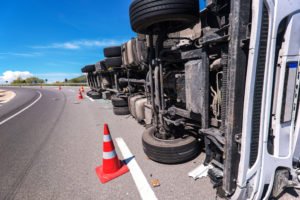
The Law Offices of Anidjar and Levine investigates whether driver fatigue, speeding, distraction, impaired operation, improper cargo securement, mechanical defects, or trucking violations caused an Orlando truck accident. An investigation may include electronic logs, inspection records, maintenance files, cargo documentation, surveillance footage, witness accounts, and medical evidence. Potentially responsible parties may include drivers, trucking companies, maintenance providers, and cargo handlers. An Orlando Personal Injury Lawyer can help preserve evidence, challenge insurer denials, calculate damages, and pursue timely claims.
Main Takeaways
- An Orlando truck accident lawyer investigates driver negligence, including speeding, fatigue, distraction, impairment, and unsafe lane changes.
- Attorneys examine trucking violations involving hours-of-service rules, driver qualifications, training, inspections, and electronic logging records.
- Liability may involve trucking companies, drivers, maintenance providers, cargo loaders, manufacturers, or other responsible parties.
- Improperly secured cargo, overloaded trailers, defective tires, worn brakes, and inadequate maintenance can cause serious truck crashes.
- Preserving photographs, medical records, vehicle evidence, witness information, and electronic data strengthens injury claims and settlement negotiations.
How We Can Help With Your Orlando Truck Accident Causes & Trucking Violations Injury Claim
When a truck accident results from driver negligence, mechanical defects, improper loading, or violations of federal and state trucking regulations, the injured party may face complicated legal and insurance issues. An Orlando truck accident lawyer can provide focused guidance throughout the claim process while protecting the claimant’s right to pursue appropriate compensation.
Legal counsel can manage communications with insurers, identify responsible parties, and explain available legal options. Early preserving evidence may include securing photographs, medical records, vehicle damage documentation, witness information, electronic logs, inspection records, and relevant company materials before they are lost or altered. A thorough liability investigation can examine the driver’s conduct, carrier policies, maintenance practices, ownership arrangements, and other factors affecting responsibility.


The legal team may also coordinate with qualified professionals to evaluate injuries, future care needs, lost income, and other recoverable losses. By handling procedural requirements and settlement discussions, counsel lets the injured person and family focus on recovery while making informed decisions to pursue a fair resolution.
Understanding Orlando Truck Accident Causes & Trucking Violations Injury Cases
OUR CONSULTATIONSARE FREE
START YOUR FREE CASE REVIEW

Understanding the causes of a truck accident and the trucking violations involved is important to evaluating an injury claim in Orlando. Each case requires careful attention to the relationship between the driver, trucking company, maintenance providers, and other responsible parties. Legal analysis may address whether conduct breached a safety duty, caused the collision, and contributed to physical, financial, or emotional harm.
Liability for negligence generally depends on credible evidence connecting a legal violation or unreasonable conduct to the injured person’s losses. Relevant records can include crash reports, inspection documents, driver qualification materials, electronic logging data, dispatch communications, medical records, and witness statements. An organized evidentiary proof checklist can help identify missing information, preserve important materials, and support a complete review of the claim.


A careful evaluation also considers applicable federal and Florida requirements, insurance coverage, and the timing of notice or litigation. Counsel can help injured individuals pursue accountability while treating all involved people with professionalism, clarity, and respect throughout the process.
Don’t Wait. Call Our Florida Personal Injury Lawyers Now!
Common Causes of Orlando Truck Accident Causes & Trucking Violations
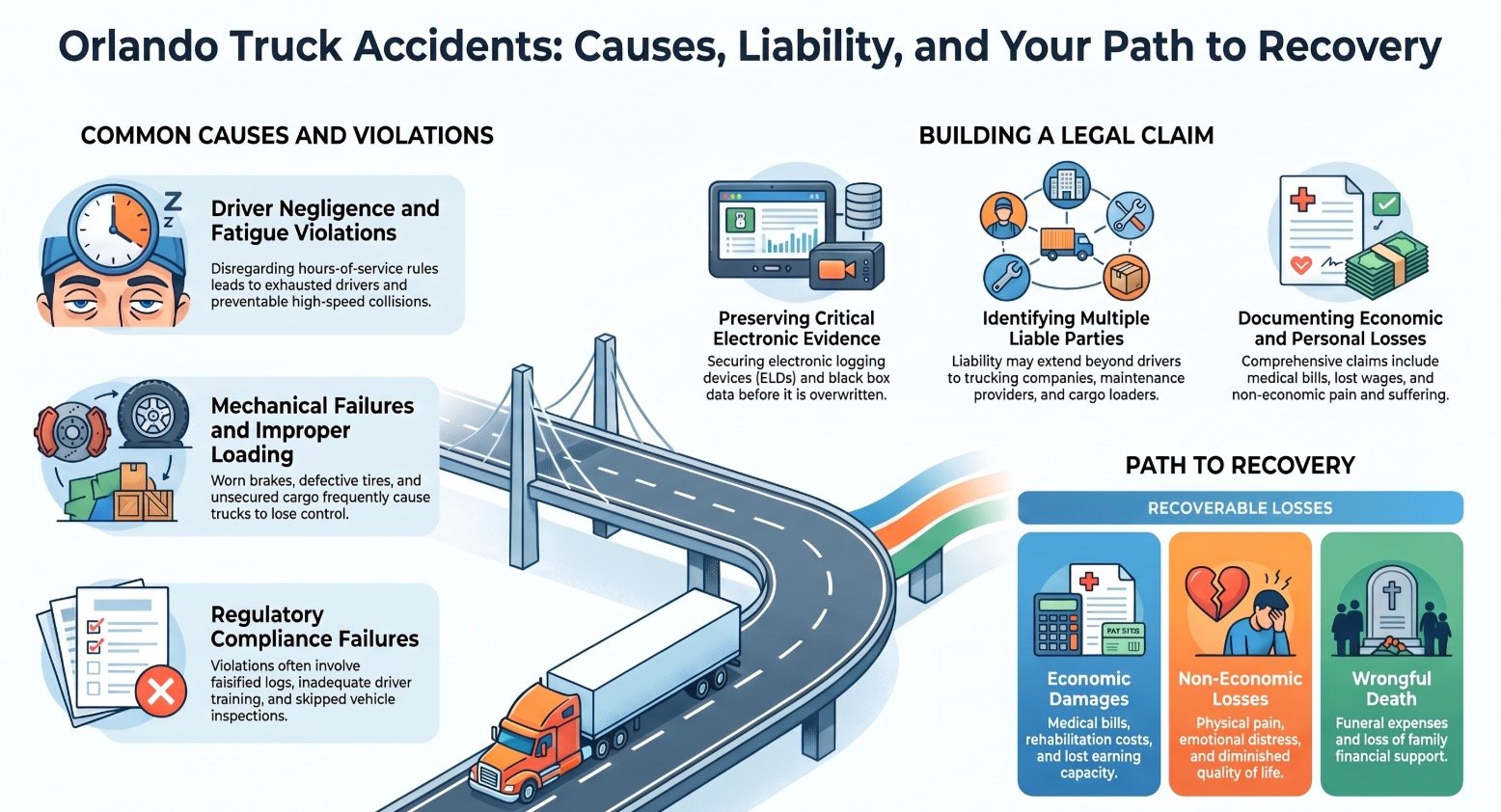
Common causes of Orlando truck accidents include driver fatigue violations, speeding, reckless driving, improper cargo loading, and vehicle maintenance failures. Each issue can impair vehicle control, increase stopping distances, or create dangerous roadway conditions. Identifying these factors is crucial when evaluating potential trucking violations and liability.
Driver Fatigue Violations
Driver fatigue violations occur when commercial truck drivers or motor carriers disregard federal hours-of-service requirements designed to prevent unsafe driving caused by insufficient rest. These rules limit driving and on-duty periods while requiring qualifying off-duty and sleeper-berth intervals. Falsified, incomplete, or inconsistent records may indicate failures in duty-hours compliance. Fatigue can also result when carriers pressure drivers to continue working despite warning signs, medical concerns, or inadequate recovery time. Sleep apnea treatment may be necessary when a diagnosed breathing disorder interferes with restorative sleep and alertness. Employers that ignore required evaluations or allow medically impaired drivers to operate vehicles may increase crash risks for motorists and communities. An attorney can examine logs, dispatch communications, medical records, and carrier policies to identify violations and support affected individuals seeking accountability.
Speeding And Reckless Driving
When a commercial truck travels too fast or is operated recklessly, its size, weight, and limited maneuverability can substantially increase the severity of an Orlando collision. Speeding reduces the time available to recognize hazards, brake, or navigate around vehicles, pedestrians, and roadway obstructions. Excessive speed also increases stopping distance and impact force, potentially causing devastating injuries. Reckless conduct may include aggressive lane changes, tailgating, running red lights, or ignoring traffic controls. Investigators may examine electronic records, surveillance footage, witness accounts, and driver statements to determine whether unsafe conduct contributed to the crash. Hidden driving techniques or undocumented habits may also reveal dangerous behavior. Although distracted driving can involve a phone or in-cab activity, it can be equally hazardous when combined with speeding. Responsible enforcement and accountability help protect Orlando motorists from preventable truck collisions.
Improper Cargo Loading
Improper cargo loading can destabilize a commercial truck and create serious hazards for Orlando motorists. When freight is unevenly distributed, unsecured, or heavier than permitted, the truck may sway, roll over, or require greater stopping distance. Shifting cargo can also obstruct handling and cause debris to fall into traffic, creating immediate risks for surrounding drivers, passengers, and pedestrians. Federal regulations establish Cargo securement standards requiring carriers and drivers to select suitable restraints, inspect loads, and prevent movement during transportation. Failure to follow these requirements may demonstrate a violation of federal loading compliance and contribute to a preventable collision. After an accident, investigators may review shipping records, loading procedures, weight documentation, and photographs. Identifying these failures can help injured individuals and their families seek accountability and informed legal assistance.
Vehicle Maintenance Failures
Vehicle maintenance failures can compromise a commercial truck’s braking, handling, tires, and other critical systems, increasing the likelihood of a serious collision in Orlando. Brake system failures may result from worn pads, leaking hydraulic lines, damaged rotors, or neglected inspections, preventing a driver from stopping in time. Similarly, tire tread defects, improper inflation, sidewall damage, and uneven wear can reduce traction, increase stopping distances, or cause a sudden blowout. Federal and state regulations require motor carriers to conduct regular inspections, maintenance, and repairs, while drivers must identify and report unsafe conditions. When a company delays necessary service or ignores documented defects, it may place motorists, passengers, and pedestrians at unreasonable risk. Maintenance records, inspection reports, and repair histories can help establish whether preventable equipment failures contributed to an Orlando truck accident.
Legal Rights of Orlando Truck Accident Causes & Trucking Violations Injury Victims
Truck accident victims in Orlando may have legal rights to pursue compensation when a carrier, driver, maintenance provider, or other responsible party violates safety regulations or acts negligently. Potential claims may address medical expenses, lost income, property damage, rehabilitation, pain, and future care needs. Families may also pursue wrongful-death damages when a crash causes a fatality.
Victims and their representatives may have the right to:
- Request crash records, inspection documents, electronic logging data, and insurance information.
- Consult counsel before providing recorded statements or accepting a settlement.
- Challenge a wrongful denial through an insurance appeal or civil claim.
A lawyer can identify responsible parties, preserve evidence, calculate damages, and communicate with insurers while protecting the client’s interests. Filing deadlines and procedural requirements may limit recovery if you delay. Legal guidance can also help injured individuals understand whether federal trucking rules, state regulations, or contractual relationships affect liability. Prompt documentation and informed decisions support fair treatment for victims and their families.
Why Do Orlando Truck Accident Causes & Trucking Violations Injuries Happen?
Understanding why these injuries occur can help establish whether negligence or a trucking violation contributed to the collision. Large trucks may cause severe harm when drivers speed, follow too closely, drive while distracted, or operate while fatigued. Impairment, inadequate training, and unfamiliarity with Orlando roads can further reduce reaction time and judgment.
Mechanical failures also contribute to crashes. Inadequate inspections, maintenance, or compliance monitoring can lead to worn brakes, defective tires, overloaded trailers, and improperly secured cargo. Trucking companies can contribute through unrealistic delivery schedules, negligent hiring, or pressure to violate hours-of-service limits. Weather, roadway conditions, and blind spots may increase danger, but they do not eliminate responsibility when reasonable precautions were available.
A careful evaluation may identify which conduct caused the collision and whose duty was breached. Evidence Preservation, including driver logs, inspection records, electronic data, and surveillance footage, can clarify disputed facts. Such information also supports informed liability assessments and Negotiation Tactics while protecting injured individuals’ interests.
What Should You Do After an Orlando Truck Accident Causes Injury & Trucking Violations?
After a truck accident, the injured party should seek immediate medical care, even when symptoms initially appear minor. When possible, document the accident scene with photographs, witness information, and official reports. Contacting an experienced truck accident lawyer promptly can help preserve evidence and evaluate potential trucking violations.
Seek Immediate Medical Care
Because some serious injuries may not produce immediate symptoms, anyone involved in an Orlando truck accident should seek prompt medical care, even when the condition initially appears minor. A qualified medical professional can identify internal trauma, head injuries, spinal damage, and other conditions that may worsen without treatment. Accident victims should accurately describe all symptoms, disclose relevant medical history, and follow prescribed instructions. They should retain discharge papers, diagnostic results, prescriptions, bills, and records of follow-up appointments. These materials may help establish the timing, severity, and continuity of treatment. Medical personnel can also document reported symptoms and clinical findings under Florida medical reporting requirements. A Crash scene documentation checklist should not replace medical attention; protecting health must remain the immediate priority before addressing insurance, legal, or administrative concerns.
Document the Accident Scene
A person involved in an Orlando truck accident should document the scene when it is safe to do so, since accurate evidence may clarify how the collision occurred and whether trucking violations contributed to the injuries. If medical conditions permit, the person should photograph vehicle positions, road conditions, traffic signals, visible injuries, license plates, and relevant truck markings. Scene photo notes should include the date, time, location, weather, lighting, and direction of travel to preserve context that images alone may not establish. Gather names and phone numbers from observers, along with brief descriptions of what each witness saw. Record witness contact info carefully and store it securely. Avoid moving evidence, arguing about fault, or interfering with emergency personnel. A calm, organized record can assist those evaluating the incident and supporting injured individuals.
Contact a Truck Accident Lawyer
When should an injured person contact a truck accident lawyer? Ideally, the injured person should seek legal guidance promptly, after receiving necessary medical care. Early consultation can protect important evidence, clarify legal rights, and prevent statements that might undermine a potential claim. A lawyer can review Crash scene documentation, including photographs, witness information, vehicle damage, and available surveillance footage. Counsel may also investigate driver qualifications, maintenance records, hours-of-service compliance, cargo loading, and other trucking violations that contributed to the collision. An attorney can develop an Insurance claim strategy suited to the injuries, financial losses, and responsible parties involved. This process may include communicating with insurers, preserving electronic data, identifying witnesses, and evaluating settlement offers. Prompt representation helps injured individuals pursue accountability while allowing them to focus on recovery and serving their families.
Critical Evidence in an Orlando Truck Accident Causes & Trucking Violations Injury Case
Establishing liability in a truck accident case requires preserving evidence that may reveal driver conduct, trucking violations, and the extent of resulting injuries. Critical sources include driver logs, electronic data records, accident scene evidence, and medical treatment documentation. An attorney may evaluate each category to identify inconsistencies and connect the evidence to the claimed harm.
- Driver logs and electronic records may show hours of service, speed, braking, and vehicle operation.
- Scene evidence can include photographs, vehicle damage, road conditions, witness accounts, and surveillance footage.
- Medical records document diagnoses, treatment, prognosis, expenses, and the injury’s impact on daily activities.
Truck Driver Logs
Reviewing truck driver logs can reveal whether a commercial driver complied with federal hours-of-service requirements before an Orlando truck accident. These records may show driving time, off-duty periods, rest breaks, and duty changes relevant to fatigue-related collisions. Federal logbook requirements generally require accurate documentation of a driver’s activities and prohibit falsification. Reviewing the entries may identify excessive driving, insufficient rest, or unexplained gaps that support an injured person’s account. Records can also help establish whether a carrier properly monitored compliance and responded to apparent violations. The phrase electronic hours of service may describe digitally maintained compliance information used by drivers and carriers. Careful preservation and review of available logs can help attorneys present reliable evidence for individuals and families seeking accountability after a serious crash.
Electronic Data Records
Electronic data records can provide critical evidence in an Orlando truck accident involving suspected trucking violations. Electronic logging devices may show driving hours, rest periods, vehicle movement, and possible violations of federal hours-of-service requirements. Engine control modules can preserve information about speed, braking, throttle activity, and mechanical conditions immediately before an impact. Dispatch messages, GPS histories, and onboard camera files may further clarify whether scheduling pressures or unsafe instructions contributed to the collision. Preserving electronic records is vital because data may be overwritten, altered, or lost through routine system updates. A qualified attorney may seek prompt preservation requests and appropriate legal orders. Digital log authentication helps establish that records are complete, reliable, and connected to the involved vehicle and driver, supporting an accurate evaluation of responsibility and damages.
Accident Scene Evidence
Photographs, measurements, debris patterns, skid marks, vehicle positions, and roadway conditions can provide direct evidence of how an Orlando truck accident occurred and whether trucking violations contributed to the injury case. Investigators may document traffic signals, visibility, lane markings, warning signs, and damage patterns before conditions change or investigators remove vehicles. Preserving witness testimony is also important because recollections may become less precise over time. Record names, contact information, statements, and observations about speed, driving movements, driver conduct, and surrounding conditions promptly. Dashcam footage retrieval from nearby vehicles, businesses, traffic systems, or the truck itself may reveal events that physical evidence cannot establish. Proper collection and secure preservation of this evidence can help clarify responsibility, support affected individuals, and promote fair accountability for preventable trucking violations.
Medical Treatment Documentation
Medical treatment documentation can establish the nature, severity, and progression of injuries after an Orlando truck accident. Emergency department records, diagnostic images, physician assessments, prescriptions, and rehabilitation notes may connect specific conditions to the collision and demonstrate the care required. Consistent documentation also helps clarify whether symptoms were immediate, developed later, or resulted in permanent limitations. Patients should follow prescribed treatment and retain appointment summaries, billing records, work restrictions, and communications with providers. Gaps in care or unexplained inconsistencies may create questions about causation and damages, although practical barriers should be documented and explained. In fatal cases, medical records can support Wrongful death claims by showing the victim’s final treatment and associated expenses. When appropriate, counsel may coordinate witness statement collection with medical evidence to present a complete account.
Don’t Wait. Call Our Florida Personal Injury Lawyers Now!
Long-Term Effects of Orlando Truck Accident Causes & Trucking Violations Injuries
Long-term injuries from truck accident causes and trucking violations may produce chronic pain, permanent disability, and reduced physical independence. Survivors may also experience emotional and psychological trauma, including anxiety, depression, or post-traumatic stress. These effects can create lasting financial and lifestyle challenges through medical expenses, lost income, and changes in daily activities.
Chronic Pain and Disability
Chronic pain and disability can develop when Orlando truck accident injuries damage the spine, joints, nerves, or other crucial structures. Symptoms may persist for months or become permanent, limiting mobility, strength, coordination, or the ability to perform ordinary tasks. Affected individuals may require ongoing medical evaluations, prescription management, physical therapy, assistive devices, or long-term rehab to preserve function and independence. Severe injuries can also prevent a person from returning to the same occupation, reduce earning capacity, and create continuing costs for treatment, transportation, and personal assistance. Workplace accommodations may include modified duties, flexible schedules, ergonomic equipment, or reassignment when employment remains possible. Careful documentation of limitations, treatment, prognosis, and related expenses helps establish the scope of long-term needs. Legal guidance can help families pursue resources that support sustained care and stability.
Emotional and Psychological Trauma
Emotional and psychological trauma may accompany the physical consequences of Orlando truck accident injuries, particularly when a collision involves severe harm, sudden loss, or prolonged recovery. Affected individuals may experience anxiety, depression, sleep disruption, irritability, or recurring memories of the crash. Some develop post-traumatic symptoms consistent with acute stress or post-traumatic stress disorder, including avoidance of driving, heightened vigilance, and distress when encountering reminders. These effects can interfere with relationships, concentration, and confidence in ordinary activities. Professional evaluation may help identify trauma-related conditions and guide appropriate counseling, medication, or trauma-informed care. Family members and caregivers can support survivor coping by listening without judgment, encouraging treatment, and recognizing that recovery may not follow a predictable timetable. Documentation of psychological symptoms can also clarify the injury’s continuing impact for legal review.
Financial and Lifestyle Challenges
When Orlando truck accident injuries persist, financial and lifestyle challenges may extend well beyond the initial medical treatment. Ongoing rehabilitation, medication, transportation, and adaptive equipment can create significant Budget impacts, particularly when an injured person cannot return to work. Reduced earnings may coincide with mounting household expenses, insurance disputes, and future care needs. Household disruption can affect childcare, transportation, meal preparation, and other responsibilities that previously supported family stability. Some individuals may need help with daily activities or home modifications, while caregivers may reduce their working hours to provide support. These changes can limit education, recreation, and community involvement. Careful documentation of losses, medical recommendations, and functional limitations may help clarify the injury’s long-term consequences for families, service providers, and legal professionals evaluating available compensation.
Proving Liability in Orlando Truck Accident Causes & Trucking Violations Injury Cases
Proving liability in an Orlando truck accident requires showing that a driver, trucking company, maintenance provider, cargo loader, or other responsible party caused the collision through negligence or a safety-regulation violation. Evidence may include police reports, electronic logging data, inspection records, vehicle maintenance histories, dispatch communications, and cargo documentation. Investigators may evaluate whether fatigue, speeding, distracted driving, defective equipment, inadequate training, or improper loading contributed to the event. Witness statement accuracy is important because consistent descriptions can clarify vehicle movements, traffic conditions, and driver conduct. Preserving surveillance footage from nearby businesses, traffic cameras, dashcams, and residential systems may also reveal essential moments before impact. Accident reconstruction professionals can analyze skid marks, debris patterns, vehicle damage, and available data to explain how the crash occurred. Medical records and employment documentation can connect the collision to reported injuries and functional limitations. A careful investigation identifies each contributing party and supports accountability for preventable harm.
Dealing With Insurance Companies After an Orlando Truck Accident Causes & Trucking Violations Injury
Insurance companies often respond quickly after an Orlando truck accident, but their early involvement does not necessarily guarantee the injured party’s interests. Adjusters may request recorded statements, medical authorizations, or access to employment information while evaluating liability and damages. Understanding the way insurance adjusters work helps injured individuals recognize that these requests can serve the carrier’s financial interests, not necessarily the claimant’s recovery.
A careful response requires preserving photographs, medical records, wage documentation, repair estimates, and collision-related communications. Injured parties should avoid speculating about fault, minimize statements about pain, and avoid accepting an early settlement before the full impact becomes clear. Consistent documentation of claim timelines can establish when symptoms appeared, how treatment progressed, and whether insurers slowed down or limited assistance. A truck accident lawyer may communicate with adjusters, protect relevant evidence, and help ensure that requests remain appropriate. This support allows families and caregivers to focus on medical needs while pursuing fair treatment through informed, orderly communication with insurers.
What to Expect During an Orlando Truck Accident Causes & Trucking Violations Injury Claim Process
A truck accident injury claim generally begins with an initial case evaluation to assess liability, damages, and potential trucking violations. The process may include collecting evidence, communicating with insurers, and negotiating based on documented facts and applicable law. If the parties cannot reach a fair resolution, litigation may follow, or they may pursue another formal resolution method.
Initial Case Evaluation
During an initial case evaluation, an Orlando truck accident lawyer reviews the collision circumstances, identifies potential causes and trucking violations, and determines whether the evidence supports an injury claim. The discussion typically covers the client’s injuries, medical treatment, lost income, insurance communications, and the incident’s effect on daily responsibilities. Counsel may ask about collecting witness statements, including who observed the crash and what each person can reliably recall. The lawyer may also explain evidence preservation steps, such as retaining relevant records and avoiding statements that could compromise the claim. This meeting allows the legal team to assess potential liability, applicable filing deadlines, and practical objectives. It also gives the prospective client an opportunity to understand legal options, expected responsibilities, and how counsel can support a fair resolution.
Evidence Collection Process
When an Orlando truck accident injury claim begins, counsel typically organizes a structured evidence collection process to determine how the collision occurred and which parties may be responsible. Investigators may inspect the crash scene, photograph vehicle damage, document road conditions, and obtain available traffic-camera or surveillance footage. Evidence preservation helps prevent the loss or alteration of electronic records, vehicle components, inspection materials, and other relevant information. Counsel may request driver logs, maintenance records, cargo documentation, training files, and data from onboard systems. Witness statements can clarify traffic movements, driver conduct, weather conditions, and events immediately before impact. Medical records and employment documentation may also establish the injury’s effects and necessary support. This process seeks reliable facts that can serve the injured person’s interests and promote accountability among responsible parties.
Insurance Claim Negotiations
Although insurers may begin evaluating a truck accident claim soon after receiving notice, settlement negotiations should proceed only after the available evidence and damages have been reasonably documented. An adjuster may request medical records, wage information, photographs, witness statements, and police report details. The insurer may also review maintenance files, driver logs, cargo records, and evidence of a faulty inspection when determining responsibility. Representatives commonly assess liability, treatment needs, anticipated care, property damage, and applicable policy limits before presenting or responding to an offer. A claimant should avoid minimizing injuries or providing speculative statements, because inaccurate information can affect claim evaluation. Careful communication helps preserve credibility and supports a fair, evidence-based discussion. A legal professional may organize documentation, address disputed facts, and communicate with insurers on the claimant’s behalf.
Litigation And Resolution
Litigation may become necessary if liability, damages, or insurance coverage remains disputed after claim negotiations. The injured person’s attorney may file a complaint, identify responsible parties, and present allegations supported by medical records, crash reports, employment information, and trucking-regulation evidence. Each party typically exchanges documents, answers written questions, and participates in depositions. An evidence preservation checklist can help secure photographs, electronic logging data, vehicle inspections, maintenance records, surveillance footage, and witness statements before information disappears. Throughout the case, counsel may develop a Settlement negotiations strategy based on documented losses, future medical needs, liability evidence, and available insurance. Many claims resolve through mediation or private negotiations, but trial preparation strengthens the client’s position. Resolution may include compensation for medical expenses, lost income, rehabilitation, pain, and other legally recognized damages.
Compensation for Orlando Truck Accident Causes & Trucking Violations Injury Damages
Victims of truck crashes in Orlando may pursue compensation when negligent driving, unsafe trucking practices, or violations of federal and state regulations contribute to their injuries. Recoverable damages may address medical treatment, rehabilitation, prescribed care, and other losses resulting from the collision. Claims may also account for reduced ability to work, diminished earning capacity, and necessary changes to daily living when supported by evidence.
Compensation can extend to physical discomfort, emotional distress, disfigurement, and loss of enjoyment of life. These forms of pain and suffering require careful documentation and a clear connection between the injuries and the truck operator’s or company’s conduct. Families may bring wrongful death claims when a crash causes a loved one’s death. Such claims may seek damages for funeral expenses, lost financial support, and the family’s resulting losses. Insurance coverage, trucking records, witness accounts, and expert testimony may affect case value. Prompt legal guidance can help preserve evidence, identify responsible parties, and pursue a resolution that supports affected individuals and families.
Economic vs Non-Economic Damages in Orlando Truck Accident Causes & Trucking Violations Cases
Truck accident claims may include economic damages such as medical expenses, lost wages, property damage, and future financial losses. Non-economic losses, including pain, emotional distress, and diminished quality of life, address the personal impact of injuries and may require careful evaluation. Calculating total compensation involves evaluating both damage categories, along with the accident’s causes and any proven trucking violations.
Economic Damage Categories
When a commercial truck collision results from driver negligence, improper maintenance, or a trucking regulation violation, the injured party may pursue economic damages for measurable financial losses. Recoverable categories commonly include emergency transportation, hospital services, physician visits, medication, rehabilitation, medical equipment, and other reasonable treatment expenses. Records such as invoices, receipts, health insurance statements, and provider estimates can help establish the amount and necessity of care. Lost income may include missed shifts, reduced hours, diminished work capacity, and employment benefits that were not received. Pay stubs, tax returns, employer statements, and other lost wages proof can support this claim. If the injury affects long-term employment, vocational evidence and future earnings calculations may help evaluate projected losses. Careful documentation enables a claim to present a complete, reliable financial accounting.
Non-Economic Losses
Non-economic losses address the personal effects of a truck collision that do not have a fixed price, including physical pain, emotional distress, disfigurement, and diminished enjoyment of life. These losses may reflect ongoing pain and suffering, sleep disruption, anxiety, loss of companionship, and reduced ability to participate in meaningful activities. A serious injury can also affect personal independence, family relationships, and confidence in daily life. In fatal cases, surviving relatives may pursue wrongful death damages for the relationship, guidance, and emotional support the deceased provided. Because these harms lack invoices or receipts, documentation often includes medical observations, personal testimony, family accounts, and evidence describing changes in routine. An Orlando truck accident lawyer may present these effects clearly while treating injured individuals and grieving families with dignity, care, and respect.
Calculating Total Compensation
Although each claim depends on its specific facts, total compensation in an Orlando truck accident case generally combines economic and non-economic damages arising from the collision or related trucking violations. Economic damages may include medical treatment, rehabilitation, property damage, lost wages, reduced earning capacity, and necessary future care. Accurate calculation requires medical records, employment information, repair estimates, and insurance documentation showing expenses and payments. Loss valuation methods may compare past earnings, projected income, life-care needs, and inflation to estimate long-term financial harm. Non-economic damages address pain, emotional distress, disability, disfigurement, loss of companionship, and reduced enjoyment of life. Their value depends on the injury’s severity, duration, and effect on daily activities. A careful evaluation helps claimants pursue compensation that supports recovery and protects household stability.
When an Orlando Truck Accident Causes & Trucking Violations Injury Case Goes to Trial vs Settlement
An Orlando truck accident injury case may proceed to trial or resolve through a negotiated settlement, depending on the evidence, the parties’ willingness to compromise, and the disputed value of the claim. Settlement can provide a predictable resolution, reduce litigation costs, and deliver compensation without requiring an injured person to testify. Negotiations may address medical expenses, lost income, future needs, and other documented losses while preserving privacy.
Trial becomes more likely when liability, damages, or the adequacy of an offer remains contested. Counsel may present testimony from medical professionals, accident investigators, economists, and witnesses to help jurors evaluate the claim. Jury verdict preparation includes organizing exhibits, preparing witnesses, developing opening and closing arguments, and clearly explaining complex evidence.
Before choosing either path, the injured person may consider risk, timing, financial pressures, and personal preferences. Trial versus appeal timelines can extend resolution substantially, whereas settlement generally concludes the dispute once agreements are signed and required payments are made.
Florida Laws That May Affect Your Orlando Truck Accident Causes & Trucking Violations Case
Florida laws governing negligence, trucking regulations, insurance coverage, and statutory deadlines may importantly affect an Orlando truck accident case involving alleged causes or trucking violations. Florida traffic rules establish duties for drivers, including speed control, lane management, signaling, and safe following distances. Violations may provide evidence of negligence, although liability generally depends on the complete circumstances.
Federal trucking standards may regulate driver qualifications, hours of service, vehicle maintenance, cargo securement, inspections, and required records. State and federal requirements can help identify whether a carrier, driver, broker, or maintenance provider failed to meet applicable obligations.
- Comparative negligence may reduce a recovery when an injured person shares responsibility for the collision.
- Commercial insurance policies and statutory minimums can affect available compensation and coverage disputes.
- Evidence such as electronic logging data, inspection reports, black-box information, and witness accounts may clarify compliance and causation.
A careful review can support fair treatment, accountability, and informed assistance for individuals and families affected by serious truck crashes.
The Statute of Limitations for Orlando Truck Accident Causes & Trucking Violations Injury Cases
Deadlines can determine whether an Orlando truck accident injury claim can proceed, even if evidence shows driver negligence or trucking violations. Florida law generally imposes a limited period to file a personal injury lawsuit, and the deadline may vary by accident date, injury circumstances, defendant, or claim type. Missing that period can result in dismissal, even when medical records and witness accounts support the injured person’s position.
Certain exceptions may pause, extend, or alter the filing period, but courts apply them narrowly and on a case-by-case basis. Government defendants, wrongful-death claims, and unresolved injury conditions may involve distinct requirements. Prompt Evidence preservation remains important because electronic logs, vehicle data, maintenance records, and surveillance footage can disappear before litigation begins.
A careful documentation timeline should record the collision, symptoms, treatment, work limitations, communications, and expenses. Delayed insurer responses or suspected insurance bad faith do not automatically extend the statute of limitations. Timely legal evaluation helps protect accountability and preserves the opportunity to seek compensation for injured individuals and their families.
Don’t Wait. Call Our Florida Personal Injury Lawyers Now!
How an Orlando Truck Accident Causes & Trucking Violations Lawyer Can Help You
When a commercial truck collision involves driver negligence or trucking violations, legal counsel can help identify responsible parties, preserve important evidence, and pursue an appropriate injury claim. An Orlando truck accident lawyer can examine driver logs, inspection records, maintenance files, loading practices, and company policies to determine whether safety rules were disregarded. Counsel can also coordinate with investigators and qualified experts while promoting evidence preservation before crucial information disappears.
Key services may include:
- Establishing liability among the driver, carrier, maintenance provider, shipper, or manufacturer
- Conducting a careful damages calculation for medical care, lost income, disability, and other documented losses
- Handling communications with insurers and presenting a claim supported by organized records and persuasive legal analysis
When to Contact an Orlando Truck Accident Causes & Trucking Violations Lawyer
After a truck collision, contact an Orlando truck accident causes and trucking violations lawyer as soon as possible, especially if injuries, disputed fault, or potential regulatory violations are involved. Early legal attention can help identify urgent Evidence preservation steps, including securing photographs, witness information, vehicle data, medical records, and applicable driver logs before materials disappear or become difficult to obtain.
Consult a lawyer when a trucking company, insurer, or representative requests a recorded statement, settlement, vehicle inspection, or medical authorization. These requests may affect the claim’s development and should be evaluated carefully. Warning signs include delayed responses, unexplained denials, pressure to accept inadequate compensation, or efforts to shift responsibility without reviewing available evidence. Such conduct may indicate insurance bad faith and should be documented and reviewed promptly.
Contact is especially important when symptoms emerge after the crash, treatment continues, employment is affected, or multiple parties may share responsibility. Timely guidance helps protect communication, deadlines, and the interests of injured individuals and their families.
Why You Need an Experienced Orlando Truck Accident Causes & Trucking Violations Lawyer
An experienced Orlando truck accident causes and trucking violations lawyer can examine the collision beyond the initial account and determine how driver conduct, vehicle conditions, company practices, or regulatory violations may have contributed to the injuries. This investigation may involve reviewing electronic logging data, maintenance records, inspection reports, dispatch communications, and available video evidence. Experienced counsel can also identify Potential Negligence Defenses and address arguments concerning comparative fault, sudden emergencies, or unavoidable accidents. Witness Credibility Assessments may clarify conflicting descriptions of traffic conditions, speed, fatigue, and warning signals. By coordinating qualified investigators and subject-matter professionals, the lawyer can connect evidence to applicable safety requirements and explain its significance to insurers, opposing counsel, or a court. Such preparation helps protect an injured person’s interests while supporting a fair process for families seeking accountability and assistance. It also reduces the risk that important records, testimony, or regulatory evidence will be overlooked before liability and damages are evaluated.
How to Choose the Right Orlando Truck Accident Causes & Trucking Violations Lawyer for Your Case
Selecting the right Orlando truck accident causes and trucking violations lawyer requires careful evaluation of the attorney’s experience, investigative resources, and record handling complex commercial vehicle cases. A qualified lawyer should understand federal and state trucking regulations, including driver qualification, vehicle maintenance, hours-of-service, loading, and electronic logging requirements. The attorney should also have access to experts who can examine crash evidence, identify violations, preserve records, and explain how negligence contributed to injuries.
Potential clients should review the lawyer’s history with comparable collisions, courtroom preparedness, and approach to dealing with insurers and trucking companies. Clear Client communication updates can help injured individuals and families understand case progress, deadlines, evidence, and available decisions. During an initial consultation, the lawyer should explain likely challenges without promising a specific result.
Fee arrangements also merit careful attention. Contingency fee options may allow representation without upfront legal fees, while the agreement should clearly identify percentages, litigation expenses, and responsibility for case costs. A careful selection process supports informed, service-focused advocacy.
About The Law Offices of Anidjar & Levine
The Law Offices of Anidjar & Levine represents individuals and families pursuing compensation after serious truck collisions in Orlando and throughout Florida. The firm’s attorneys investigate crash circumstances, identify potentially responsible parties, and explain legal options in terms clients can understand. Their work may include reviewing driver records, maintenance documentation, electronic logging data, inspection reports, and available roadway evidence.
A careful Truck accident timeline can help clarify how events unfolded and whether safety rules, inadequate training, fatigue, improper loading, or mechanical failures contributed to the collision. The firm also helps clients document medical treatment, lost income, property damage, and the ongoing effects of an injury.
When insurers present settlement offers, attorneys assess the available evidence and damages before recommending a settlement negotiation strategy. They may pursue discussions with insurers or prepare the matter for litigation when a fair resolution is not offered. The firm’s approach emphasizes preparation, communication, and service to injured people and their families.

Frequently Asked Questions
Can Truck Accident Victims Pursue Punitive Damages for Intentional Trucking Violations?
Truck accident victims may pursue punitive damages when evidence shows intentional misconduct, fraud, or conduct so reckless that it reflects conscious disregard for safety. Negligent scheduling, knowingly permitting an unqualified driver to operate, or transporting reckless cargo may support punitive liability, depending on applicable state law. Driver intent and company knowledge are often central. Compensatory damages address losses, while punitive awards punish and deter especially egregious trucking violations when clear evidence proves them.
What Happens if a Truck Driver Lacks Proper Commercial Licensing or Endorsements?
A truck driver lacking proper commercial licensing or required endorsements may be barred from legally operating certain vehicles, potentially triggering employer penalties, regulatory investigations, and civil liability after a collision. Driver licensing issues can indicate inadequate training, negligent hiring, or safety-regulation violations. CDL endorsement gaps may also demonstrate that the carrier permitted unauthorized operations. Victims should preserve records, report concerns, and seek qualified assistance to clarify responsibility and available remedies.
Are Trucking Companies Responsible for Accidents Involving Independent Contractor Drivers?
Trucking companies may bear responsibility for accidents involving an Independent Contractor, depending on the working relationship and applicable law. Courts examine control over routes, schedules, safety practices, equipment, and driver selection when evaluating Accident Liability. Even without direct employment, Employer Oversight may support claims based on negligent hiring, training, supervision, or maintenance. Vicarious Negligence can apply when the company’s conduct materially contributed to the collision, while contract labels alone rarely determine responsibility.
How Do Federal Trucking Regulations Differ From Florida Trucking Requirements?
Federal trucking regulations establish nationwide requirements for driver qualifications, hours of service, vehicle maintenance, cargo securement, and commercial insurance. Florida requirements generally operate through FMCSA overlap, adopting many federal safety standards while adding state-specific rules and state enforcement. Differences may involve Florida registration procedures, enforcement priorities, road restrictions, and weight limits tailored to local infrastructure. Carriers and drivers must comply with whichever applicable requirement imposes the stricter obligation to promote public safety.
Can Undocumented Passengers or Workers File Orlando Truck Accident Injury Claims?
Undocumented passengers or workers may generally file Orlando truck accident injury claims, because Immigration status does not automatically bar eligibility for claims for medical expenses, lost wages, or other damages. Liability depends on evidence establishing negligence, causation, and injury. Legal representatives should protect clients from discrimination, explain risks clearly, and arrange written consent when necessary. Qualified counsel can provide language access, preserve confidentiality, and evaluate federal, Florida, and employment-related issues affecting recovery.
—————————
Truck accidents may result from driver negligence, unsafe trucking practices, equipment failures, or violations of federal and state regulations. Identifying the cause requires prompt investigation, preservation of evidence, and careful evaluation of medical and financial losses. Orlando victims may have legal options for pursuing compensation from responsible parties. An experienced Orlando Personal Injury Lawyer can assess the claim, address insurers, and protect the victim’s interests throughout the legal process. The Law Offices of Anidjar and Levine provide informed guidance tailored to each case.