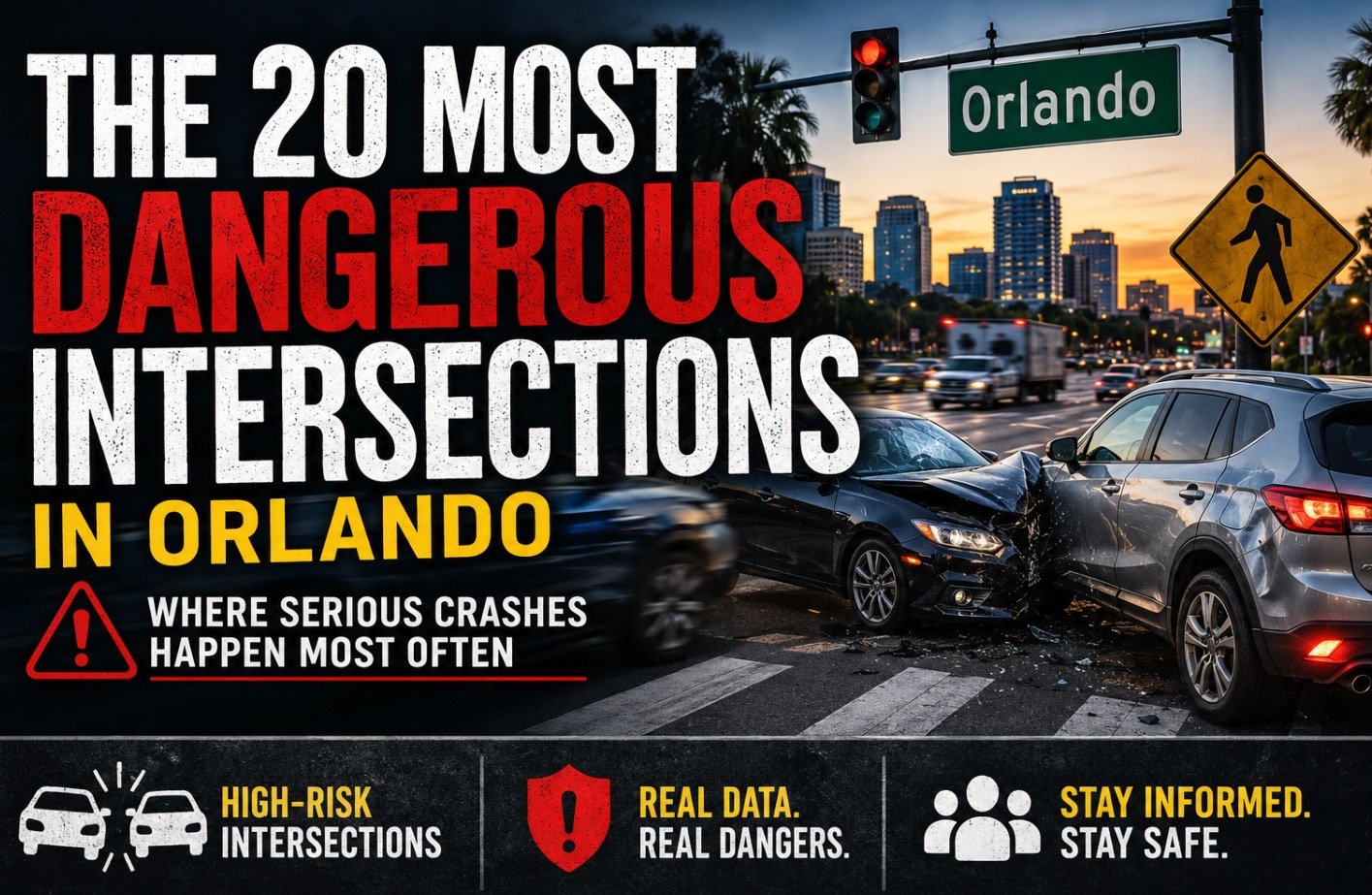
Every year, millions of residents and tourists flock to Central Florida, drawn by world-class theme parks, a thriving economy, and beautiful sunny weather. However, Orlando’s rapid expansion has come with a steep and dangerous price: increasingly hazardous road conditions. For drivers, cyclists, and pedestrians alike, navigating the city’s street grid can feel like running a gauntlet. According to data from the Florida Highway Patrol (FHP) and the Florida Department of Highway Safety and Motor Vehicles (FLHSMV), intersection-related collisions account for a disproportionate percentage of severe injuries and fatalities in Orange County.
As an established Orlando personal injury law firm, we see the devastating aftermath of these accidents daily. Intersection collisions are rarely simple fender-benders; they frequently involve high-speed T-bone impacts, failure-to-yield head-on crashes, and tragic pedestrian strikes. To help protect our community, we have compiled an in-depth analysis of the 20 deadliest intersections in Orlando based on historical crash data, traffic volume metrics, and recurring accident patterns.
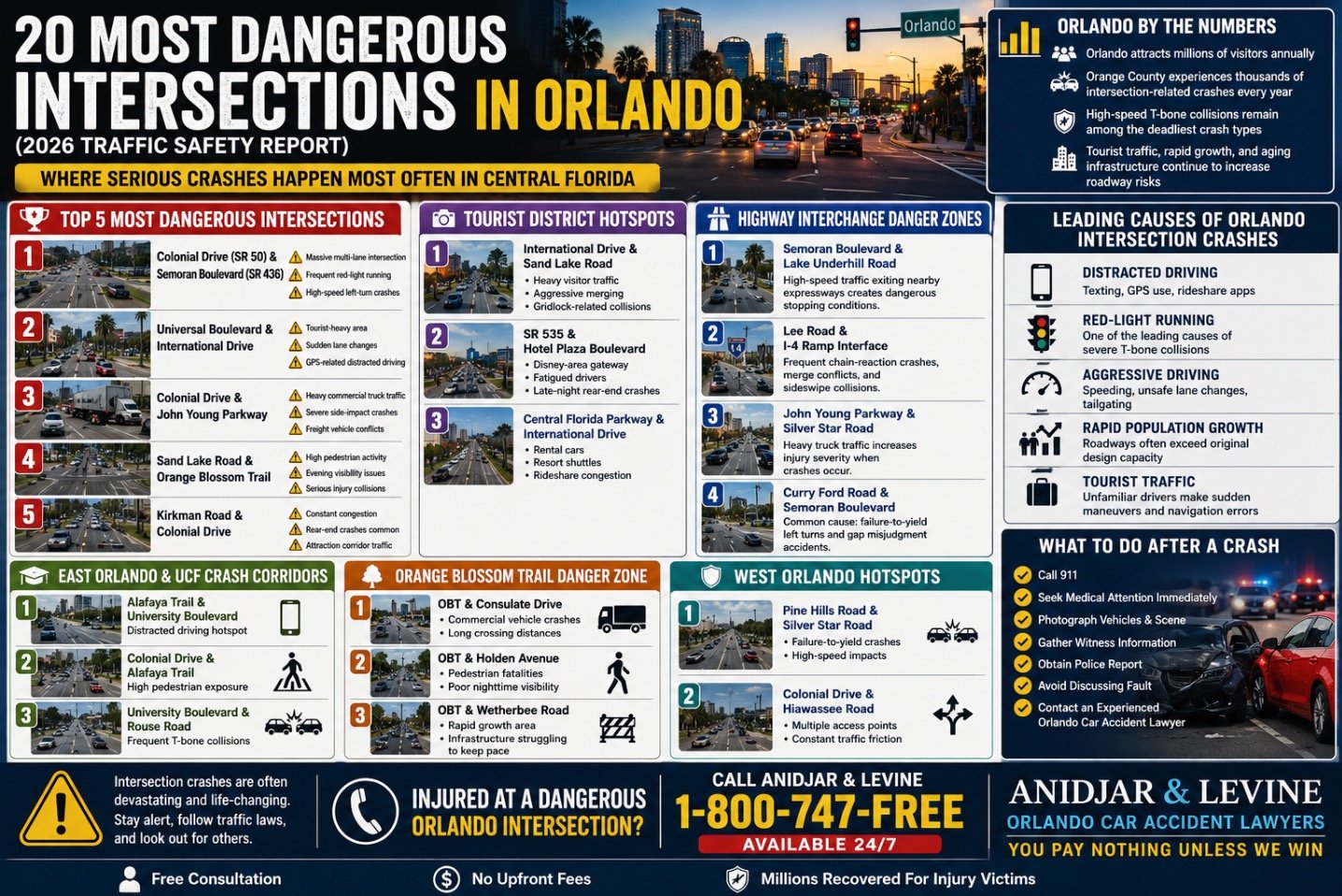
1. The Core Anchors of Congestion: Orlando’s Top 5 Most Dangerous Intersections
The highest concentrations of severe and fatal collisions occur where massive multi-lane arterial roads intersect highway exit ramps or high-density commercial strips. These five intersections consistently rank at the top of local law enforcement watchlists due to their overwhelming accident volume.
State Road 50 (Colonial Drive) and North Semoran Boulevard (SR 436)
This massive crossroads sits at the intersection of two of Orlando’s busiest transit corridors. With up to eight lanes of traffic meeting at complex angles, drivers frequently misjudge the speed of oncoming vehicles when attempting left turns. The high volume of commuter traffic combined with retail shoppers creates a chaotic environment where red-light running is an hourly occurrence.
Universal Boulevard and International Drive
Located in the heart of Orlando’s tourist district, this intersection is a hotbed for confusing lane configurations and distracted driving. Out-of-state visitors relying heavily on GPS navigation systems often make sudden, unpredictable lane changes, cutting across multiple paths of travel to reach theme parks, hotels, or convention centers.
West Colonial Drive (SR 50) and North John Young Parkway
This commercial and industrial hub suffers from severe mixing of freight and passenger vehicles. Heavy semi-trucks, which require longer braking distances, frequently collide with smaller passenger cars that cut them off or stop abruptly as traffic lights transition from yellow to red.
Sand Lake Road (SR 482) and South Orange Blossom Trail (OBT)
Historically known as one of the most perilous corridors in Orange County, this intersection suffers from an aggressive mix of high-speed through-traffic, heavy pedestrian presence, and frequent transit bus stops. Poor visibility during evening hours contributes significantly to a high rate of severe pedestrian impacts.
Kirkman Road (SR 435) and West Colonial Drive
Kirkman Road serves as a primary pipeline to major attractions, meaning it is constantly operating at or near peak capacity. When combined with West Colonial Drive’s aggressive traffic flow, this spot generates a high volume of high-velocity rear-end and side-impact collisions.
2. The Perils of the Tourist District: International Drive Corridors
Orlando’s tourism industry is the lifeblood of our economy, but it also creates a distinct set of roadway hazards. In the tourist district, local commuters share the pavement with millions of drivers who are entirely unfamiliar with Florida’s traffic laws, U-turn allowances, and specific signage.
International Drive and Sand Lake Road
Known locally as a premier retail and dining crossroads, this intersection experiences extreme gridlock during tourist seasons. The danger rises exponentially when frustrated drivers attempt to “force” their way through turning lanes or block the box, leading to aggressive angling maneuvers and side-impact crashes.
SR 535 (Apopka-Vineland Road) and Hotel Plaza Boulevard
As a primary gateway to Walt Disney World resort properties, this intersection experiences extreme traffic surges coinciding with park opening and closing times. Fatigued drivers heading back to off-site hotels late at night often experience delayed reaction times, leading to severe rear-end collisions.
Central Florida Parkway and International Drive
This location sees an intricate blend of resort shuttles, rideshare vehicles, and rental cars. The widespread, improper use of rideshare drop-offs along the shoulder frequently forces trailing traffic to swerve unexpectedly into adjacent lanes, causing high-speed sideswipes.
3. High-Speed Arterials and Highway Interchanges
When traffic exits an interstate or expressway, drivers are often still accustomed to highway speeds (60–70+ mph). When these drivers suddenly encounter stoplights and intersecting local traffic, the disparity in speed frequently results in catastrophic impact forces.
South Semoran Boulevard (SR 436) and Lake Underhill Road
Positioned immediately adjacent to major expressway on-ramps, this intersection sees vehicles transitioning rapidly from high-speed highway driving to urban arterial stopping patterns. Drivers failing to adjust their speed quickly enough routinely slam into vehicles queued at the traffic signal.
Lee Road and Interstate 4 (I-4) Ramp Interface
The ongoing reconfigurations of I-4 have done little to tame the volatility of the Lee Road exchange. Merging bottlenecks, short exit ramps, and sudden lane reductions force drivers into high-stress decision-making scenarios, spiking the rate of sideswipes and multi-vehicle chain-reaction pileups.
North John Young Parkway and Silver Star Road
This intersection serves as a primary industrial transport route. The sheer volume of dump trucks, tractor-trailers, and commercial delivery vans means that when a crash does occur, the physical forces involved almost guarantee severe bodily injury or wrongful death.
Curry Ford Road and South Semoran Boulevard
A dense residential commuter hub, this intersection becomes an absolute bottleneck during morning and evening rush hours. The primary catalyst for severe accidents here is “gap-forcing”—where drivers attempting to turn left across multiple lanes of oncoming traffic miscalculate the closing speed of approaching vehicles.
4. University and East Orlando Bottlenecks
Home to the University of Central Florida (UCF), East Orlando boasts one of the largest student populations in the United States. This demographic mix introduces a high concentration of younger, less experienced drivers onto roads that are already structurally overburdened.
Alafaya Trail (SR 434) and University Boulevard
Serving as the primary entrance to the UCF area, this intersection handles an incredible volume of student drivers, cyclists, and pedestrians. Distracted driving—often involving smartphones or navigation apps—runs rampant here, leading to frequent daytime collisions.
East Colonial Drive and Alafaya Trail
This intersection represents the collision of a major commercial shopping district with a high-volume commuter highway. The roadway’s width makes it incredibly difficult for pedestrians to cross safely within a single signal cycle, leading to high-risk mid-crossing strandings.
University Boulevard and Rouse Road
Rouse Road connects vast residential suburbs to the corporate and academic centers along University Boulevard. Sudden lane changes to access turning bays and a general disregard for yellow-light cycles make this intersection a frequent site of devastating T-bone collisions.
5. The Dangerous Intersections of South Orange Blossom Trail (US 441)
South Orange Blossom Trail is notorious across Central Florida for its structural design flaws and elevated crash rates. Characterized by wide lanes, high speed limits, and dense commercial access points, this corridor presents a continuous threat to motorist safety.
South Orange Blossom Trail and Consulate Drive
Positioned near major logistics hubs and freeway connectors, this intersection experiences severe commercial vehicle conflicts. The long length of the intersection means that turning vehicles are exposed to oncoming traffic for an extended period, increasing the likelihood of a collision.
Orange Blossom Trail and Holden Avenue
This intersection suffers from an infrastructure deficit regarding pedestrian safety. Despite high foot traffic from local residential neighborhoods accessing commercial centers, crosswalk configurations and lighting are subpar, contributing to several fatal nighttime pedestrian accidents over the last few years.
South Orange Blossom Trail and Wetherbee Road
Located further south toward the Osceola County line, this intersection has seen a surge in traffic volume due to recent residential developments. The infrastructure has struggled to keep pace with this growth, leading to aggressive driving behaviors as motorists experience unprecedented delays.
6. The West Orlando and Pine Hills Hotspots
West Orlando and the Pine Hills area feature older roadway designs that have not been adequately modernized to handle modern traffic volumes. In conjunction with densely populated centers, these crossroads consistently experience severe traffic incidents.
Pine Hills Road and Silver Star Road
This intersection handles a complex blend of local traffic, public transit buses, and regional commuters. High speeds combined with failure-to-yield violations during left-turn maneuvers make this one of the most hazardous zones in West Orlando.
West Colonial Drive and Hiawassee Road
A sprawling commercial hub, this intersection features multiple driveways and access points immediately preceding and following the main crossroad. This design flaw creates a phenomenon known as “friction,” where vehicles slowing down to enter private businesses unexpectedly disrupt the flow of high-speed through-traffic.
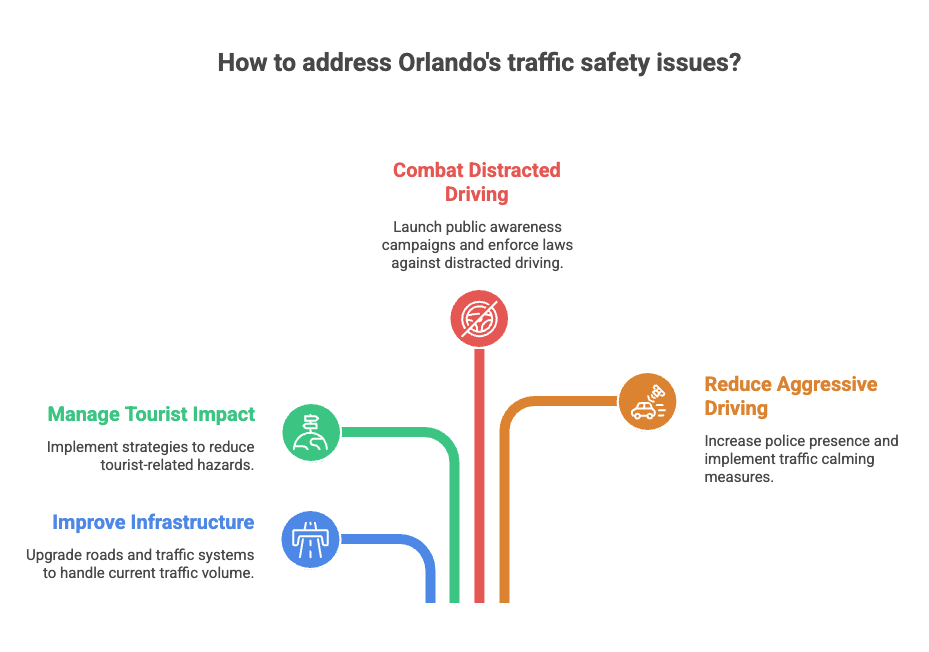
7. Understanding the Underlying Causes of Orlando’s High Fatality Rates
To effectively protect yourself on Orlando roads, it is vital to understand why these specific intersections are so deadly. \
Our legal team’s analysis of accident reports reveals several recurring, systemic catalysts:
-
Inadequate Infrastructure for Rapid Growth: Many of Orlando’s roads were originally engineered decades ago for a fraction of the current population. Despite widening projects, the pure volume of vehicles routinely exceeds design limits.
-
The Tourist Disconnect: Orlando attracts tens of millions of visitors annually. Drivers who are lost, distracted by passengers, or searching for landmarks behave unpredictably, presenting an ongoing hazard to defensive local drivers.
-
Widespread Distracted Driving: From texting and adjusting GPS units to managing rideshare apps, digital distractions mean drivers are frequently blind to changing traffic signals or pedestrians stepping off curbs.
-
Aggressive Driving and Red-Light Running: As gridlock increases, so does driver frustration. Attempting to “beat the light” or speeding through a yellow signal is a primary cause of high-velocity T-bone collisions at major crossroads.
8. What to Do Immediately After an Intersection Accident in Orlando
If you or a loved one is involved in a severe collision at one of these intersections, the steps you take in the immediate aftermath are absolutely critical to preserving your physical health and your subsequent legal claims.
-
Prioritize Safety and Call 911: Move your vehicle out of the direct line of traffic if possible, turn on your hazard lights, and call emergency services immediately. Ensure that an official police report is generated by the responding officer.
-
Seek Immediate Medical Attention: Even if you believe your injuries are minor, adrenaline can mask severe trauma such as internal bleeding, whiplash, or traumatic brain injury (TBI). Furthermore, Florida law requires you to seek medical treatment within 14 days to preserve your Personal Injury Protection (PIP) insurance benefits.
-
Document the Scene Explicitly: If you are physically able, use your smartphone to take comprehensive photos and videos of the accident scene. Capture vehicle damage from multiple angles, skid marks, traffic signal configurations, road conditions, and any visible injuries.
-
Gather Witness Contact Information: Independent witnesses who saw the crash unfold can provide invaluable, unbiased statements that prevent the insurance company from shifting blame onto you. Gather their names, phone numbers, and email addresses.
-
Never Admit Fault or Make Concessions: Avoid apologizing or saying “I didn’t see you.” These casual remarks can be twisted by insurance adjusters to systematically deny or devalue your claim.
9. How an Orlando Personal Injury Lawyer Maximizes Your Financial Recovery
Navigating the aftermath of a catastrophic car accident while dealing with painful injuries, mounting medical bills, and missed time from work can be completely overwhelming. Insurance companies are corporations designed to minimize payouts and maximize their own profits. They often employ aggressive tactics, offering quick, lowball settlements before the true extent of your medical needs is even fully diagnosed.
Retaining a dedicated Orlando car accident attorney levels the playing field completely. An experienced legal team will thoroughly investigate your crash by securing intersection traffic camera footage, obtaining event data recorder (black box) metrics, interviewing witnesses, and employing accident reconstruction specialists if liability is disputed.
Your attorney will accurately calculate the full scope of your damages—including past and future medical expenses, lost wages, diminished earning capacity, rehabilitation costs, and non-economic damages such as pain and suffering. By letting a professional handle the complex insurance negotiations and litigation, you can focus entirely on what matters most: your physical and emotional recovery.
Speak With an Experienced Orlando Car Accident Lawyer Today
If you or a loved one has been injured at a dangerous Orlando intersection, do not face the insurance corporations alone. Contact our office today for a 100% free, no-obligation case evaluation. We work on a contingency fee basis, meaning you pay absolutely nothing unless we successfully recover compensation for you.
For more information about an Orlando Car Accident Lawyer, click this link.