
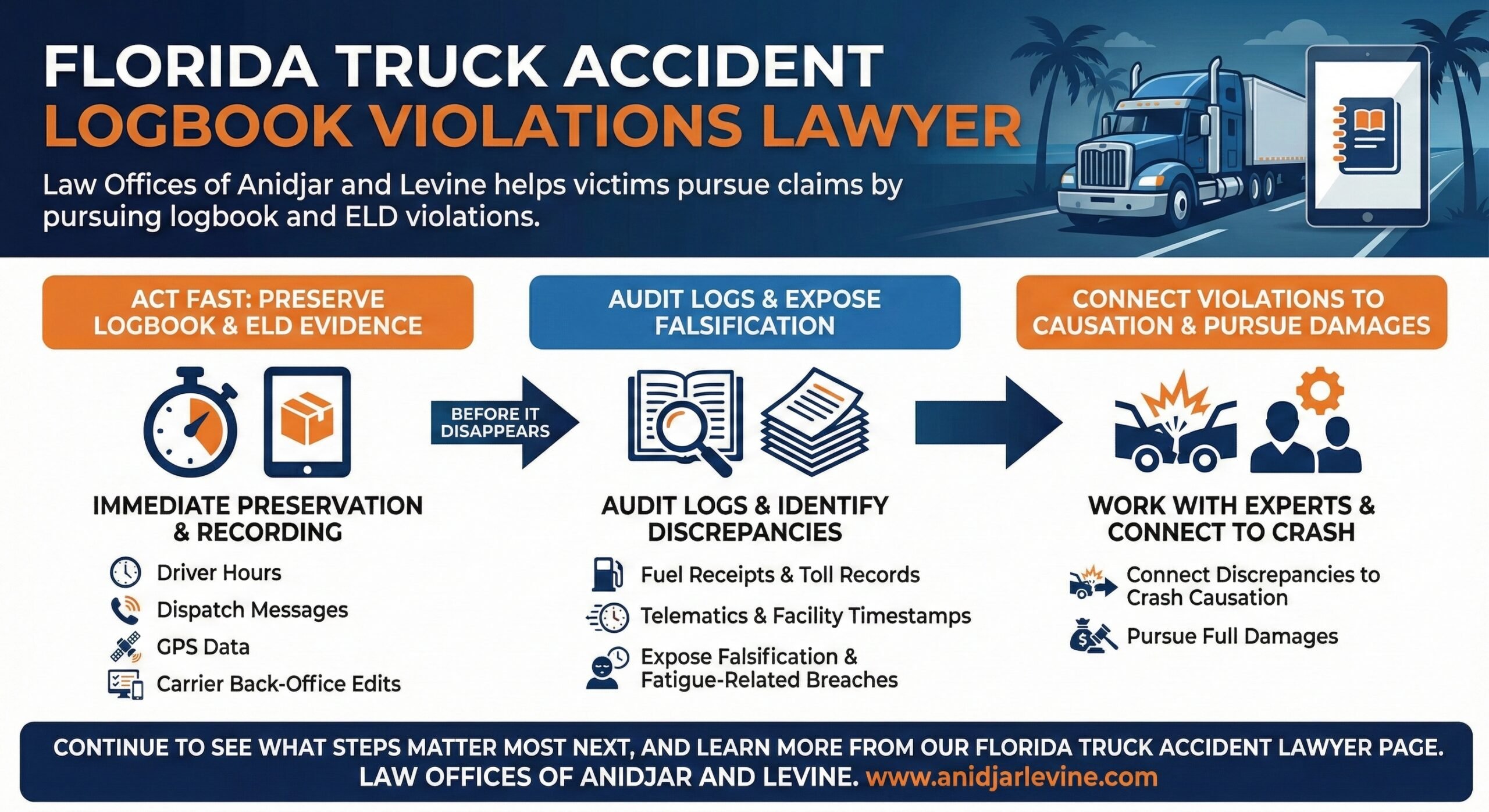
At the Law Offices of Anidjar and Levine, we help Florida truck accident victims pursue claims involving logbook and ELD violations by acting fast to preserve essential evidence, including driver hours, dispatch messages, GPS data, and carrier back-office edits.
We audit logs against fuel receipts, toll records, telematics data, and facility timestamps to identify falsification and fatigue-related breaches of hours-of-service rules.
We also work with qualified experts to connect these discrepancies to crash causation and damages.
Continue to see what steps matter most next, and learn more from our Florida Truck Accident Lawyer page.
Key Takeaways
- A Florida truck accident lawyer can preserve ELD/logbook data fast with preservation letters and court orders to prevent deletion or spoliation.
- Attorneys audit hours-of-service logs against GPS, dispatch records, fuel receipts, toll data, and telematics to reconstruct the driver’s true timeline.
- They identify falsification red flags like back-office edits, missing duty statuses, sudden status changes, or mismatched supporting documents.
- Lawyers use safety and crash-reconstruction experts to connect logbook violations and fatigue to crash causation and damages.
- Counsel handles insurers, proves carrier negligence and scheduling pressure, and pursues full compensation through settlement or litigation.
How We Can Help With Your Florida Truck Accident Logbook Violations Claim
When a truck crash raises concerns about falsified or incomplete driver logs, we can step in quickly to preserve evidence and build a focused claim. We act with urgency and respect, because serving your recovery requires careful attention from the start.
Our team sends preservation notices, secures electronic data, and identifies the records that may reveal fatigue, missed breaks, or improper reporting.
Through disciplined Claim investigation, we organize timelines, obtain supporting documents, and work with qualified professionals to confirm how the log issues connect to the collision. We also handle communication with insurers and opposing counsel, so you’re not pressured into an unfair statement or quick settlement.
With steady Client counseling, we explain your options, set realistic expectations, and help you make informed decisions at each stage. Our goal is clear: present a well-supported claim that reflects your losses and protects your future.
Understanding Florida Truck Accident Logbook Violations Cases
Logbook violations often provide the missing link between a truck driver’s on-paper compliance and the real-world choices that lead to a serious crash. When hours-of-service records don’t match the route, fuel stops, toll data, or electronic tracking, we can uncover patterns that point to driver fatigue and unsafe decision-making.
These cases often hinge on whether the driver and carrier met their duties under state and federal regulations and whether regulatory noncompliance contributed to the collision.
We work with you to frame the facts in a clear timeline and connect them to the harm you experienced. We also evaluate how the company supervised its drivers, maintained records, and responded to warnings that a schedule was unrealistic.
By presenting reliable documentation and consistent testimony, we strengthen your claim and keep the focus on accountability, safety, and serving the broader public interest.
Common Causes of Florida Truck Accident Logbook Violations
When we investigate Florida truck crash claims, we often find that logbook violations stem from patterns that compromise safety and compliance.
We’ll explain how falsified Hours of Service, missing duty status entries, and manipulated electronic logs can conceal fatigue and disrupt accountability.
We’ll also address how pressure from dispatchers can push drivers to cut corners, creating records that don’t match the reality of the road.
Falsified Hours Of Service
Falsified hours of service can slip into a driver’s records in ways that aren’t obvious at first glance, yet the impact on safety is immediate.


When a carrier pressures a driver to “make the load,” logs may be altered to show compliant rest that never occurred. This kind of Record tampering hides extended driving time and accelerates Driver fatigue, raising the risk of delayed reactions, lane departures, and high-speed rear-end crashes on Florida highways.
We often see falsification through edited electronic log entries, overwritten paper logs, or mismatched supporting documents like fuel, toll, and dispatch records.
If we serve you after a wreck, we’ll compare these data points, identify patterns of overwork, and demonstrate how the false hours contributed to the collision. Accountability protects everyone on the road.
Missing Duty Status Entries
Missing duty status entries often appear as small gaps in a driver’s record, yet they can conceal pivotal periods of work or driving that should be documented under federal hours-of-service rules.
When we review crash cases, we often find logbook gaps tied to hurried shift changes, incomplete paperwork, or a lack of training on required entries.
These duty omissions may hide on-duty tasks such as loading, inspections, refueling, or waiting time at a shipper, each of which can affect fatigue and compliance.
We help you focus on service by identifying where the record stops matching the day’s reality.
We compare dispatch notes, fuel receipts, toll data, and facility timestamps to reconstruct the missing timeline.
Clear documentation supports accountability and promotes safer roads for everyone in Florida communities.
Manipulated Electronic Logs
Logbook gaps don’t always come from oversight; some stem from electronic logging devices that have been altered to show a cleaner hours-of-service picture than the driver actually worked.
When data is edited, deleted, or reassigned, the record may falsely indicate lawful rest while the driver remained on duty.
We often see signs such as repeated “system errors,” identical time blocks across trips, or sudden status changes that don’t match fuel, toll, GPS, or receipt records.
These red flags can point to tampered devices or deliberate logbook hacking.
When we investigate, we compare ELD exports, carrier back-office edits, and supporting documents to reconstruct the true timeline.
You earn accountability that protects the public and honors safe service on Florida roads.
Pressure From Dispatchers
Dispatch pressure can creep in quietly, then build into an unspoken expectation that a driver will “find a way” to make an unrealistic schedule work.
When Dispatcher pressure mixes with tight delivery windows, drivers may feel they must choose between service and safety.
We see how this dynamic encourages skipped breaks, late edits, or “creative” entries that mask hours-of-service violations.
Scheduling conflicts often start with a minor delay, then cascade through multiple loads, leaving no lawful time to recover.
If you’re committed to serving customers and protecting the public, you shouldn’t be pushed into falsifying records to preserve a relationship or paycheck.
We help you document calls, messages, and route demands, then connect that pressure to the logbook violations that precede a crash.
Legal Rights of Florida Truck Accident Logbook Violations Victims
Although trucking companies often treat hours-of-service records as routine paperwork, Florida law gives injured people meaningful rights when falsified or incomplete driver records contribute to a crash.
OUR CONSULTATIONSARE FREE
START YOUR FREE CASE REVIEW

We can pursue accountability not only for the driver, but also for carriers, brokers, and supervisors who tolerated unsafe scheduling or ignored fatigue warnings. Through Victim advocacy, we help you seek fair compensation while keeping the focus on safety for everyone who shares the road, including the vulnerable and the overlooked.
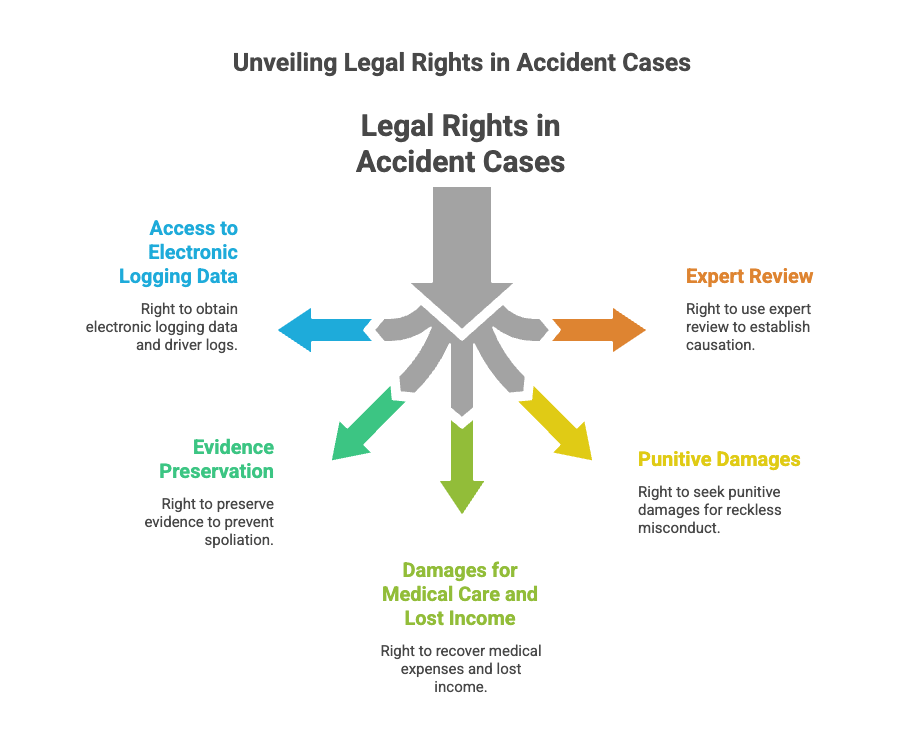
- We can demand access to electronic logging data, driver logs, and supporting documents.
- We can use Evidence preservation to prevent spoliation of records and device downloads.
- We can pursue damages for medical care, lost income, pain, and future needs.
- We can request punitive damages when misconduct shows reckless disregard for safety.
- We can rely on expert review to connect logbook irregularities to causation.
Steps to Take After a Florida Truck Accident Logbook Violations
After a Florida truck crash involving suspected logbook violations, we’ll first focus on immediate safety to help you secure medical care and preserve the scene.
Next, we’ll explain how to document logbook-related evidence, including electronic logging data, driver statements, and time-stamped records that may reveal hours-of-service breaches.
Finally, we’ll outline when to contact a Florida truck accident lawyer, because early legal guidance can protect your claim and prevent crucial evidence from being lost.
Ensure Immediate Safety
When a truck crash in Florida may involve logbook violations, we need to prioritize immediate safety before focusing on evidence or liability.
We should begin with seatbelt checks for everyone involved, then conduct a quick hazard assessment to identify traffic exposure, leaking fuel, fire risk, and unstable cargo.
If it’s safe, we’ll guide passengers to a protected area away from lanes, and we won’t stand between vehicles or near blind spots.
We should call 911 promptly, request medical assistance, and provide clear location details, including nearby mile markers.
If someone is injured, we’ll avoid moving them unless there’s immediate danger, and we’ll offer calm support until help arrives.
We also should follow the officers’ directions and keep the scene orderly.
Document Logbook Evidence
Because logbook violations can disappear quickly, we should start documenting evidence as soon as the scene is stable and emergency care is underway.
We can photograph the cab, any paper logs, and the electronic logging device screen, capturing dates, duty status changes, and unidentified edits.
We should note the truck number, USDOT information, trailer ID, and any visible dispatch documents that may show delivery pressures.
If you can do so safely, we should preserve driver statements by writing exact quotes, recording the time, and identifying witnesses who heard them.
We can also request that responders note fatigue indicators and collect inspection findings.
As part of later logbook audits, these early details help compare logs against fuel receipts, tolls, GPS pings, and weigh-station records, revealing inconsistencies.
Contact Florida Truck Lawyer
Although the crash scene may feel chaotic, we should contact a Florida truck accident lawyer as soon as we’re safe and medical care is in motion, since logbook and electronic logging data can change quickly, and essential records often sit in the carrier’s control.
When we reach out early, we can preserve driver hours, dispatch messages, GPS traces, maintenance files, and prior inspection history before they’re lost or altered.
We should request a Free consultation and a prompt case evaluation to determine liability, insurance deadlines, and the value of our losses.
If we’re serving a family member or a community member, timely legal guidance helps us protect their recovery and dignity.
United, we can pursue accountability with care and resolve.
How a Florida Truck Accident Logbook Violations Lawyer Can Help You


Build your case with a Florida truck accident logbook violations lawyer who knows how to turn driver-hour records into clear proof of negligence. We help you protect your family and community by holding unsafe carriers accountable, while keeping your focus on healing and service to others. Through Record audits, we compare logs to electronic data, fuel receipts, dispatch notes, and toll or GPS trails, then show where rules were ignored and Driver fatigue became foreseeable.
Build your case by turning driver-hour records into clear proof, exposing ignored rules and foreseeable fatigue through precise record audits.
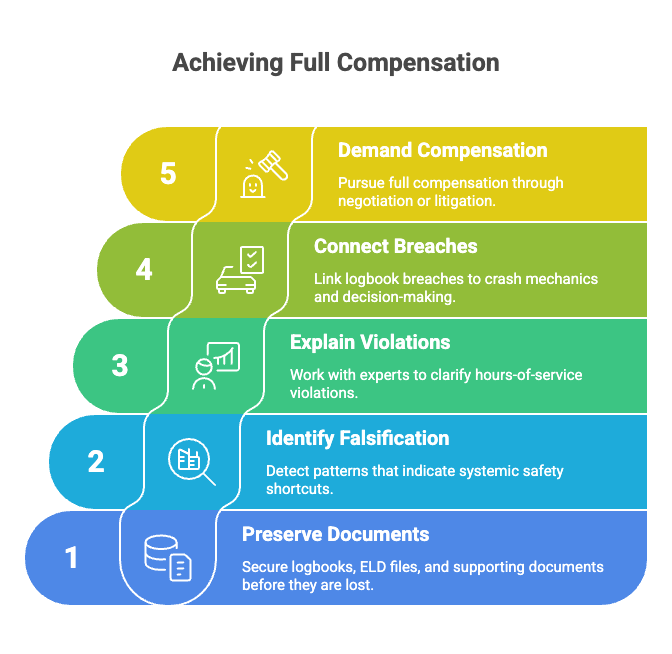
- Preserve logbooks, ELD files, and supporting documents before they disappear
- Identify falsification patterns that reveal systemic safety shortcuts
- Work with experts who explain hours-of-service violations with clarity
- Connect logbook breaches to crash mechanics, timing, and decision-making
- Demand full compensation through disciplined negotiation or firm litigation
We also manage insurer communications, calculate losses with care, and present a respectful, evidence-led narrative that supports a fair resolution without unnecessary conflict.
Long-Term Effects of Florida Truck Accident Logbook Violations Injuries
When logbook violations contribute to a Florida truck crash, we often see injuries that don’t end when the initial treatment does, and you may face lasting consequences in daily life.
We’ll explain how chronic physical limitations, along with cognitive and emotional impacts, can reduce your ability to work, manage routine tasks, and maintain independence.
We’ll also address the ongoing medical and financial needs that frequently follow, including continued care, rehabilitation, and long-term income disruption.
Chronic Physical Limitations
If a truck crash stems from logbook violations and fatigued driving, the injuries often don’t end with initial treatment; they can evolve into chronic physical limitations that reshape daily life.
We often see clients face chronic pain that flares with routine tasks, from lifting groceries to standing through a work shift.
Reduced range of motion, nerve damage, and joint instability can limit safe movement, forcing changes to jobs, caregiving duties, and volunteer commitments.
When walking or balance becomes unreliable, mobility aids may be necessary, and learning to use them can require therapy, home adjustments, and consistent follow-up care.
We help you document these lasting restrictions through medical records and functional assessments, so the full impact on independence and service to others is clearly presented.
Cognitive And Emotional Impacts
Lasting limitations after a truck crash don’t stop at the body; they often extend to the mind and emotional well-being. When logbook violations lead to exhausted driving and a violent impact, we often see attention, memory, and processing speed change in ways you can’t simply push through.
Cognitive fatigue may appear as slower decision-making, difficulty following conversations, or reduced focus during routine tasks, which can strain your sense of reliability and purpose.
Emotional trauma can surface as persistent anxiety, irritability, intrusive memories, or a heightened startle response, especially around traffic or loud noise. We encourage you to treat these effects as real injuries, speak about them without shame, and accept support so you can remain present for the people who depend on you.
Ongoing Medical And Financial Needs
Managing long-term medical care after a truck crash tied to logbook violations often becomes a second full-time job, and it rarely ends with the first round of treatment. We help you anticipate follow-up surgeries, pain management, mobility aids, and mental health support, so your recovery remains steady and dignified.
These needs can expand without warning, and families who serve others often feel pressure to minimize their own struggles. We encourage you to document every appointment and prescription, because accurate records clarify ongoing expenses and protect your stability.
Effective rehabilitation planning also requires coordination with medical consultants, therapists, and vocational experts, especially when work duties change. We pursue compensation that reflects future care, lost earning capacity, and home modifications, so you can keep contributing to your community while healing.
Proving Liability in Florida Truck Accident Logbook Violations Cases
Because logbooks are designed to document compliance with federal hours-of-service rules, they often become the central evidence in proving liability after a Florida truck crash. We help you connect entries, driver fatigue indicators, and crash timelines, so responsibility is established with clarity rather than speculation.
We compare paper logs and ELD data to fuel receipts, toll records, GPS pings, and load documents, then identify gaps that suggest falsification. When we uncover electronic tampering, we preserve device metadata and obtain vendor records to show who altered duty status and when.
We also investigate dispatcher coercion, including texts, call logs, and route demands that pushed a driver past lawful limits. We work with qualified experts to interpret safety rules and reconstruct the sequence of events, and we promptly seek court orders to prevent spoliation.
Compensation for Florida Truck Accident Logbook Violations Damages
When a truck crash in Florida involves logbook or ELD violations, we pursue compensation that accounts for the full scope of harm, not just the initial hospital bill.
We build your claim around medical treatment, rehabilitation, lost income, reduced earning capacity, property damage, and the daily limitations that follow serious injuries.
We also address pain, suffering, and the strain on family life, because accountability should reflect what you endure, not only what you paid.
We use careful injury valuation, supported by records, expert opinions, and clear timelines that connect fatigue-related misconduct to your losses.
Our settlement strategies focus on presenting a complete, organized demand, anticipating insurer arguments, and documenting future costs before negotiations begin.
When needed, we pursue additional responsible parties, including carriers and maintenance contractors, to protect the people you serve and to secure resources for long-term recovery and stability.
The Statute of Limitations for Florida Truck Accident Logbook Violations Cases
Although strong evidence of logbook or ELD violations can support liability, Florida’s statute of limitations still controls how long we’ve got to file a truck accident lawsuit, and missing that deadline can bar recovery entirely.
In most Florida negligence cases arising from truck crashes, we generally have two years from the date of the collision to file suit, but the specific facts matter, and related claims may carry different time limits.
Because service to others starts with protecting your options, we should treat filing deadlines as urgent, even as we gather records, preserve ELD data, and identify responsible parties.
Limited tolling exceptions may pause the clock, such as when a defendant can’t be located for service, a plaintiff is a minor, or fraud conceals a cause of action, yet courts apply these rules narrowly.
If we act promptly, we can preserve evidence and file on time, without sacrificing accuracy or fairness.
Why You Need an Experienced Florida Truck Accident Logbook Violations Lawyer
Even with clear signs of falsified logs or manipulated ELD data, we still need an experienced Florida truck accident logbook violations lawyer to build a case that stands up to aggressive defenses and strict procedural rules.
We recognize that carriers and insurers often argue that the records are harmless errors, or they shift blame to the injured person. We counter by securing time-sensitive evidence, demanding complete driver qualification and hours-of-service files, and comparing dispatch records, fuel receipts, toll data, and onboard telematics for inconsistencies.
Carriers call discrepancies harmless or blame victims; we secure records fast and cross-check dispatch, receipts, tolls, and telematics.
When Driver fatigue is a factor, we connect the paper trail to real-world risk and explain why the violations matter.
We also evaluate Regulatory compliance obligations across drivers, safety directors, and brokers, then identify where the system failed.
How to Choose the Right Florida Truck Accident Logbook Violations Lawyer for Your Case
Because logbook and ELD violations often determine whether a trucking case settles fairly or turns into a prolonged dispute, we should choose counsel based on demonstrated command of FMCSA hours-of-service rules, evidence preservation, and high-stakes litigation.
We can start by asking how the lawyer secures ELD data, paper logs, dispatch records, fuel receipts, and driver messages before they disappear.
We should also confirm they know how to work with accident reconstruction and safety experts, and can challenge carrier compliance programs with precision.
Next, we should evaluate communication and client selection, as a lawyer who screens cases carefully can serve each family with diligence and respect.
We should review fee structures in writing, including contingency percentages, litigation costs, and who advances expenses.
Finally, we should look for a record of verdicts and settlements in trucking cases, and for readiness to proceed to trial when negotiations fail to secure justice.
About the Law Offices of Anidjar and Levine
Turn to the Law Offices of Anidjar and Levine for a focused approach to Florida truck accident cases involving logbook or ELD violations.
We serve people who want accountability on the road, and we keep our work centered on protecting families, coworkers, and communities after preventable harm.
Our team reviews driving-hour records, dispatch notes, and ELD data with care, then acts promptly to preserve evidence and identify responsible parties.
We’re guided by our firm history of advocating for injured Floridians, and we apply that experience to each case’s specific facts.
We communicate clearly, return calls, and prepare every claim as if it will be tried, because thorough preparation supports fair results.
We also value client testimonials as a measure of whether we’ve met our duties with respect and diligence.
If we work jointly, we’ll pursue compensation while honoring your goal of safer roads for others, too.
Frequently Asked Questions
Do Electronic Logging Device Malfunctions Excuse Logbook Noncompliance After a Crash?
ELD malfunctions usually don’t excuse logbook noncompliance after a crash, and you’re still expected to maintain accurate records.
We’ll urge you to document device troubleshooting steps, keep repair tickets, and use compliant paper logs during outages, because regulators look for continuity and honesty.
Limited electronic exemptions may apply in narrow operations, but they rarely cover post-crash gaps.
We can help you preserve evidence, serve your team, and respond responsibly.
Can My Immigration Status Affect My Ability to File a Truck Accident Claim?
In most situations, your immigration status won’t prevent you from filing a truck accident claim. We focus on claim eligibility under Florida law, including liability, damages, and deadlines, not on where you were born.
Still, we guide you carefully because some steps may raise immigration consequences, especially when records or interviews are involved. We’ll protect your privacy, gather documentation, and pursue fair recovery while serving your family.
How Are Punitive Damages Determined in Logbook Falsification Accident Cases?
We determine punitive damages in logbook falsification cases by proving, with clear evidence, that misconduct was intentional or showed reckless disregard for safety.
We present patterns of falsified hours, pressure to violate rules, and resulting harm, and then the court applies jury instructions to guide what punishment fits.
We also address statutory caps, which may limit amounts unless exceptions apply.
We’ll frame your claim to promote accountability and protect others.
Will My Health Insurance Claim Reduce My Truck Accident Settlement in Florida?
Your health insurance claim won’t automatically reduce your Florida truck accident settlement, but it can affect what you ultimately keep.
We review your policy’s subrogation rights, since insurers may seek reimbursement from settlement funds.
We also address coordination-of-benefits issues when multiple coverages apply.
Through lien negotiation, we often work to lower repayment demands, helping you preserve compensation while honoring obligations and supporting responsible recovery for others.
Can I Sue a Logbook Software Provider for Inaccurate Hours-Of-Service Records?
Yes, we can sue a logbook software provider, but only when evidence shows the inaccuracy caused harm and the provider owed a duty under contracts, warranties, or negligence standards.
We’ll evaluate software liability by documenting defects, update failures, user warnings, and reliance by carriers or drivers.
We’ll also pursue consumer recourse through complaints, refunds, or state deceptive-practices claims, while preserving ELD data, audit trails, and communications for proof.
——————————-
When logbook violations contribute to a Florida truck crash, the Law Offices of Anidjar and Levine understands how quickly evidence can disappear and how insurers may try to shift blame.
We act quickly to secure driver logs, electronic data, and maintenance records, then build a clear liability case that reflects the full impact of your injuries and losses.
If you’re facing medical bills, missed work, or long-term limitations, our team is prepared to guide you through each step and pursue the recovery you deserve with help from an experienced Florida Truck Accident Lawyer.