The Law Offices of Anidjar and Levine, a Tallahassee road and highway conditions car accident lawyer, examines whether potholes, poor drainage, missing signage, malfunctioning signals, weather hazards, or construction defects contributed to a crash. Such cases often require prompt preservation of evidence, witness statements, and maintenance records, as well as careful review of notice and liability issues involving drivers, contractors, or public agencies. Legal counsel also assists with medical documentation and insurance disputes, and evaluates compensation options. Learn more from a Tallahassee Personal Injury Lawyer about the process and potential legal remedies.
Main Takeaways
- A Tallahassee road-condition accident lawyer investigates whether potholes, poor drainage, missing signs, bad lighting, or construction hazards helped cause the crash.
- Early evidence matters because roadway conditions change quickly, so photographs, witness statements, reports, and maintenance records should be preserved immediately.
- Liability may involve multiple parties, including another driver, a contractor, or a city, county, or state agency responsible for road maintenance.
- Government roadway claims often require proof the agency knew or should have known about the danger and failed to fix it reasonably.
- A lawyer can help document injuries, handle insurance disputes, and pursue compensation for medical bills, lost income, pain, and property damage.


How We Can Help With Your Tallahassee Road & Highway Conditions Car Accident Injury Claim
When a crash is linked to dangerous road or highway conditions in Tallahassee, effective legal representation can help establish how those hazards contributed to the collision and the resulting injuries. Counsel can support injured people and their families by organizing Evidence preservation early, identifying photographs, maintenance records, and scene details before they are lost or altered.
A careful legal team can also gather witness statements, review official reports, and connect clients with providers who create thorough medical documentation. These steps help present a clear account of harm and the care required for recovery. Attorneys may further manage insurance negotiation, respond to claim disputes, and advocate for compensation that reflects medical costs, lost income, and other damages. Throughout the process, representation remains focused on service, accountability, and practical guidance. This approach allows those affected to concentrate on recovery while their claim is prepared with diligence, accuracy, and respect for every fact involved.
OUR CONSULTATIONSARE FREE
START YOUR FREE CASE REVIEW

Understanding Tallahassee Road & Highway Conditions Car Accident Injury Cases
Because liability can become more complex where roadway defects, poor drainage, missing signage, inadequate lighting, or neglected highway maintenance contribute to a collision, Tallahassee road and highway conditions car accident injury cases often require a broader factual and legal analysis than ordinary crash claims. These matters may involve multiple responsible parties, including drivers, contractors, or public entities, and each role must be evaluated carefully.
A proper assessment usually turns on timing, notice, and documentation. Preservation of evidence is often critical, since road conditions can change quickly after repairs, weather events, or traffic activity. Photographs, maintenance records, incident reports, and witness accounts may help clarify how the environment affected the crash. Comparative negligence basics may also influence recovery when insurers argue that a driver should have responded differently to visible hazards. A service-minded legal approach therefore centers on careful investigation, accurate case valuation, and principled advocacy designed to protect injured people and support community safety.
Common Causes of Tallahassee Road & Highway Conditions Car Accident
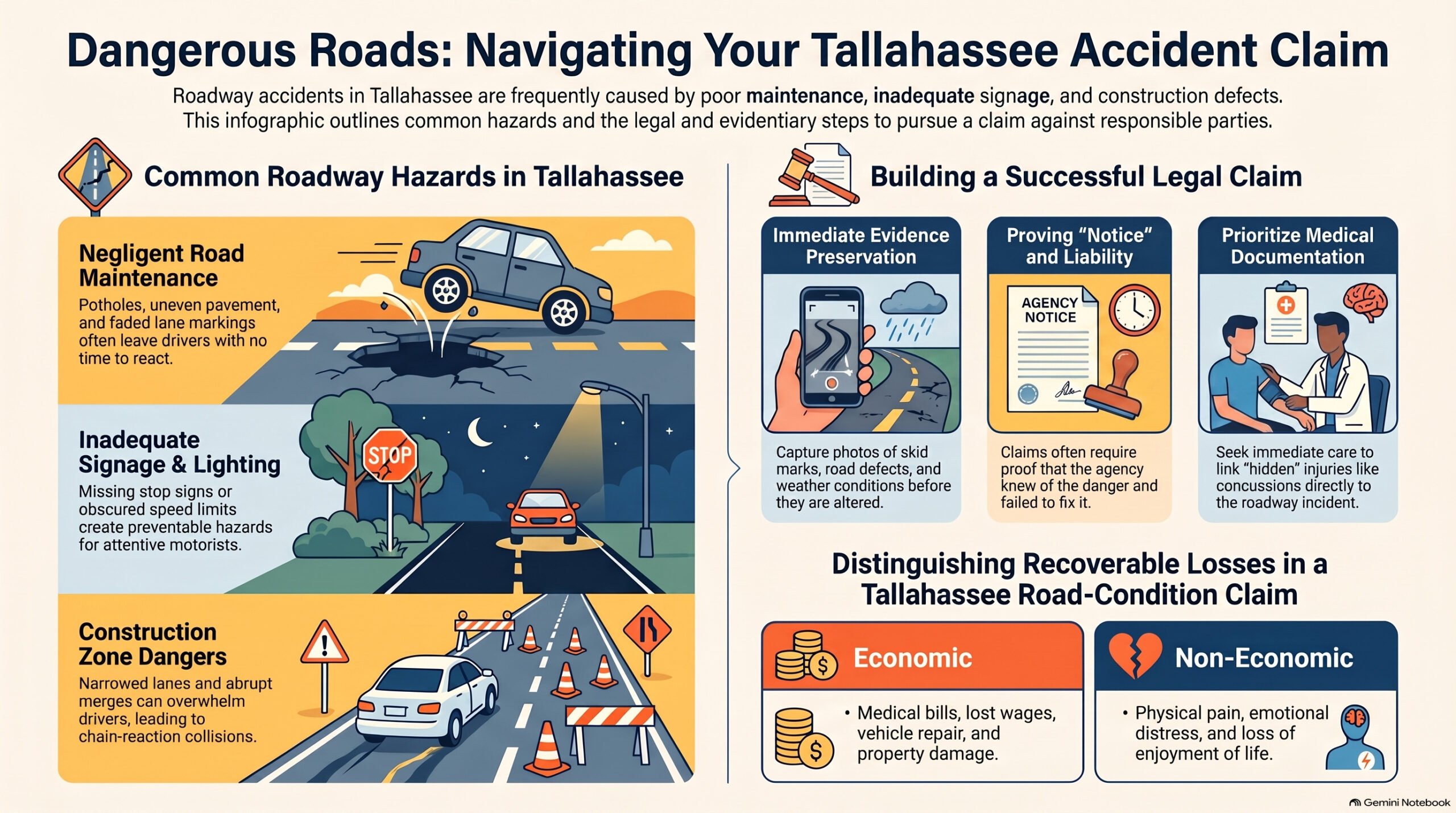
Several roadway factors commonly contribute to car accidents on Tallahassee roads and highways, often creating hazards that drivers cannot reasonably avoid. These incidents frequently arise from poor road maintenance, weather-related hazards, construction zone dangers, and inadequate road signage, each of which can markedly increase the risk of a collision. A clear understanding of these causes helps frame the evaluation of liability and safety concerns in such cases.
Poor Road Maintenance
Although drivers are expected to operate with reasonable care, poor road maintenance can create hazards that significantly increase the risk of crashes on Tallahassee roads and highways. Potholes, uneven pavement, missing guardrails, faded lane markings, and malfunctioning traffic signals may leave motorists with little time to respond safely. These conditions can worsen Driver distraction, as attention shifts from surrounding traffic to sudden roadway defects. When public agencies or contractors fail to inspect, repair, or warn of known dangers, preventable collisions may follow, harming families and disrupting lives. Poor maintenance can also complicate insurance disputes, especially when responsibility is divided among drivers, municipalities, and private entities. Careful investigation is often necessary to identify the contributing roadway failures and to support accountability for those affected by serious crashes and their resulting losses.
Weather-Related Hazards
During periods of heavy rain, dense fog, or sudden thunderstorms, Tallahassee roads and highways can become significantly more dangerous for motorists. Reduced visibility, longer stopping distances, and standing water often increase the risk of hydroplaning, rear-end collisions, and loss of vehicle control. Drivers who seek to protect others on the road are often encouraged to slow down, increase following distance, and use headlights appropriately.
Weather may also worsen Road debris hazards by washing limbs, loose materials, or disabled vehicles into travel lanes with little warning. Strong heat and abrupt temperature changes can contribute to tire failure, making tire blowout prevention an important part of safe travel. Routine inspections, proper tire pressure, and careful attention to changing forecasts help support safer driving conditions for everyone in the Tallahassee area.
Construction Zone Dangers
When roadway construction alters normal traffic patterns, even attentive drivers may face sudden hazards that increase the likelihood of a collision. Narrow lanes, uneven pavement, abrupt merges, and shifting traffic flow can overwhelm motorists already navigating busy Tallahassee roads. In these environments, distracted driving often leads to delayed reactions, while a brief misjudgment may cause a lane departure or chain-reaction crash.
Construction activity may also raise questions of Work zone liability when contractors, agencies, or third parties fail to maintain reasonably safe conditions. In some cases, worker negligence contributes to harm through unsafe equipment placement, debris left in travel lanes, or poorly timed traffic control actions. Careful investigation helps injured individuals understand responsibility and pursue recovery that supports families, promotes accountability, and advances safer roads for everyone.
Inadequate Road Signage
Because motorists rely on clear warnings to anticipate hazards and make safe driving decisions, inadequate road signage can become a significant cause of serious crashes on Tallahassee roads and highways. Missing stop signs, obscured speed limit postings, poorly marked detours, and inadequate merge warnings may leave drivers with too little time to react responsibly. In these conditions, Driver distraction becomes even more dangerous, since a moment of diverted attention can prevent a motorist from seeing crucial information. Confusing or absent lane guidance also increases the risk of lane departure, sideswipe collisions, and sudden braking. Public agencies and contractors who maintain roadways are expected to provide visible, accurate, and timely signs that protect everyone traveling through the area. When they fail to do so, preventable injuries and community harm may result for many families.
Don’t Wait. Call Our Florida Personal Injury Lawyers Now!


Legal Rights of Tallahassee Road & Highway Conditions Car Accident Injury Victims
Faced with injuries caused by unsafe road or highway conditions in Tallahassee, an accident victim may have important legal rights beyond a standard claim against another driver. Florida law may allow recovery when a dangerous roadway, poor design, or Negligent Maintenance contributed to the collision and resulting harm.
Potential rights may include pursuing compensation for losses such as medical costs, lost income, pain and suffering, disability, and property damage.
In the most serious cases, surviving family members may have a Wrongful Death claim when a fatal crash results from a hazardous public roadway.
- Claims may involve a city, a county, a state agency, or a private contractor.
- Strict notice rules and filing deadlines often apply to government-related cases.
- Evidence may include photographs, maintenance records, witness statements, and expert review.
Because these cases can affect a victim’s future and ability to care for others, prompt legal evaluation is often crucial to protecting rights and preserving important evidence.
Why Do Tallahassee Road & Highway Conditions Car Accident Injuries Happen?
Although driver error is often part of a crash, road and highway condition accident injuries in Tallahassee frequently occur where the travel surface or surrounding roadway creates an unreasonable risk that drivers cannot safely avoid. Hazardous pavement, potholes, loose gravel, flooding, debris, broken shoulders, and poorly timed signals can quickly turn ordinary travel into a severe collision.
In many cases, faded Lane markings, poor nighttime visibility, obstructed signage, and unsafe construction zones reduce the time available to make safe decisions. Driver distraction may worsen the danger, but unsafe road design or maintenance often leaves little margin for correction. High speeds on interstates and connector roads increase impact forces, especially when curves, standing water, or abrupt drop-offs are present. Limited lighting and blocked sightlines also delay hazard recognition and emergency response. When these conditions exist, preventable injuries may affect drivers, passengers, pedestrians, and families who depend on safe infrastructure and responsible public stewardship every day.
What Should You Do After a Tallahassee Road & Highway Conditions Car Accident Injury?
After a car accident injury on a Tallahassee road or highway, prompt medical evaluation should be a top priority to recover health and create a clear record of the harm involved. The crash scene should also be documented carefully, including vehicle damage, roadway conditions, and any visible injuries, because this information may later support an insurance claim or legal case. A lawyer should then be contacted to assess liability, preserve evidence, and guide the injured person through the next steps.
Seek Immediate Medical Care
Why does immediate medical care matter so much after a Tallahassee road or highway accident? Prompt evaluation protects health, supports informed treatment, and helps injured people continue serving their families and communities. Some injuries, including concussions, internal bleeding, and soft tissue damage, may not appear serious at first. A physician can identify hidden trauma, stabilize symptoms, and recommend follow-up care before complications worsen.
Immediate treatment also creates a clear medical record that connects symptoms to the collision. That record may influence access to Rehabilitation options, consultant referrals, and necessary therapy. It can also affect benefit questions involving long term insurance and other coverage issues. By seeking care without delay, an injured person demonstrates responsibility, promotes recovery, and strengthens the foundation for future medical decisions with confidence, consistency, and compassion.
Document Crash Scene
Prompt medical attention helps protect both health and the factual record, and the next practical step is to document the crash scene as thoroughly as conditions safely allow. If movement is possible, photographs should capture vehicle damage, skid marks, weather conditions, traffic signals, road debris, and any lane closures affecting traffic flow. Wide and close images can preserve context and detail.
Effective accident documentation also includes noting the time, location, roadway conditions, and visible injuries, while calmly gathering names and contact information from witnesses. If public safety personnel respond, their names, badge numbers, and agency details should be recorded when available. A concise written account, prepared as soon as practical, can help preserve memory and support accurate reporting. Careful documentation serves everyone involved by promoting clarity, accountability, and informed assistance afterward.
Contact A Lawyer
In the days following a Tallahassee car accident involving hazardous road or highway conditions, contacting a lawyer can help protect legal rights and preserve important evidence before it is lost or disputed. Counsel can review police reports, roadway maintenance records, weather data, and witness statements to assess potential liability. Early legal guidance also helps injured people avoid mistakes when speaking with insurers or signing releases. Through careful Negligence proof strategies, an attorney may identify whether a government entity, contractor, or another driver contributed to the collision. Legal counsel can also calculate losses, organize medical documentation, and monitor deadlines that affect a claim. When appropriate, representation supports fair resolutions through informed Settlement negotiation tactics, while allowing injured individuals and their families to focus on recovery and continued service to others.
Critical Evidence in a Tallahassee Road & Highway Conditions Car Accident Injury Case
Establishing liability in a Tallahassee road or highway conditions car accident injury case often depends on timely, well-preserved evidence that shows how the roadway contributed to the collision and whether responsible parties had notice of the hazard.
Key categories of proof often include:
- scene documentation and roadway defect evidence
- witness and expert testimony
- maintenance and inspection records
Scene Documentation
After a Tallahassee road or highway collision, thorough scene documentation often becomes a central form of evidence when hazardous roadway conditions may have contributed to the crash. Photographs, video, and contemporaneous notes can preserve lane positions, sight lines, weather, lighting, traffic control devices, debris patterns, and temporary warnings before conditions change. Reliable dashcam footage may clarify vehicle movement, driver responses, and surrounding traffic in the moments before impact.
Prompt collection also supports witness recall and helps professionals reconstruct events more accurately. Time-stamped images, measurements, and vehicle tracking data may reveal travel paths, speeds, stopping distances, and whether drivers had adequate opportunity to react. When gathered carefully and respectfully, this documentation can assist injured people, support accountability, and promote safer travel for everyone using Tallahassee roads and highways.
Roadway Defect Evidence
When hazardous road conditions are suspected, evidence of roadway defects often becomes a key component of a Tallahassee car accident injury case. This evidence may include photographs of potholes, faded lane markings, missing signs, standing water, broken guardrails, or obstructed sightlines. Maintenance records, repair requests, and prior complaint histories can further show whether a dangerous condition existed and how long it remained unaddressed.
Careful review of roadway defect evidence may support Driver negligence proof when a motorist failed to respond reasonably to visible hazards. It may also help identify whether a public entity or contractor shares responsibility for unsafe conditions. In addition, this evidence can be important during insurance coverage disputes, where parties may challenge causation, liability, or the extent to which road conditions contributed to the collision and injuries.
Witness And Expert Testimony
Witness and expert testimony often builds on roadway defect evidence by explaining how dangerous road or highway conditions affected the events leading to a Tallahassee collision. Eyewitnesses may describe standing water, faded markings, blocked sightlines, missing signs, or poor lighting, helping to clarify what drivers encountered and how conditions limited safe responses.
Professional analysis can strengthen those accounts. Road engineering experts may evaluate design features, traffic control devices, drainage patterns, and visibility concerns, then connect those factors to vehicle movement and driver decision-making. Their opinions can help a court understand whether a hazardous condition contributed to the crash and resulting injuries. Careful Deposition preparation also supports clear, consistent testimony from witnesses and professionals. When presented effectively, this evidence can assist fact finders in reaching informed conclusions that support accountability and community safety.
Maintenance And Inspection Records
In many Tallahassee road and highway condition cases, maintenance and inspection records provide a direct account of what public entities or contractors knew, or reasonably should have known, about a hazardous condition before a collision occurred. These documents may include repair logs, inspection schedules, work orders, complaint histories, and prior incident reports. When reviewed carefully, they can show whether a dangerous shoulder, pothole, drainage failure, or missing sign existed long enough to require corrective action. They also help establish timelines, identify responsible parties, and support the preservation of evidence before records are altered or lost. In service to injured people and their families, these materials are often compared with photographs, witness statements, and expert analysis to present a clear, fact-based explanation of how negligent roadway maintenance may have contributed to serious harm.
Long-Term Effects of Tallahassee Road & Highway Conditions Car Accident Injuries
Injuries caused by poor road and highway conditions in Tallahassee may produce consequences that continue well beyond the initial collision. Many individuals face chronic pain challenges, emotional trauma, and lasting mobility limitations that affect employment, daily routines, and overall independence. These continuing effects often play a significant role in evaluating the full extent of damages in a car accident injury claim.
Chronic Pain Challenges
A collision caused by hazardous road or highway conditions in Tallahassee can leave more than immediate physical damage, as chronic pain often persists long after fractures, soft tissue trauma, or spinal injuries appear to have recovered. Victims harmed after a tire blowout or crashes linked to work zone fatigue may face ongoing back pain, nerve irritation, joint stiffness, and recurring headaches that interfere with daily responsibilities.
Such pain can limit mobility, disrupt sleep, reduce concentration, and make routine service to family, work, and community far more difficult. Continued medical care, physical therapy, pain management, and careful documentation often become necessary to support recovery and demonstrate the lasting burden of these injuries. When symptoms remain unresolved, long-term treatment needs may greatly affect a person’s financial stability and overall quality of life.
Emotional Trauma Impact
Often, the psychological consequences of a crash tied to dangerous Tallahassee road or highway conditions continue long after visible wounds begin to recover. Survivors may experience fear, hypervigilance, disrupted sleep, and persistent anxiety when traveling, especially where hazards resemble the original scene.
In many cases, post-accident PTSD interferes with employment, community involvement, and the ability to provide steady care for loved ones. Emotional distress can also produce withdrawal, irritability, and difficulty concentrating, which may contribute to family relationship strain over time. Children, spouses, and caregivers often absorb these changes, creating added pressure within the household. Compassionate legal advocates recognize that emotional injuries merit careful documentation, respectful attention, and meaningful consideration when evaluating the full human cost of a roadway collision caused by unsafe conditions and negligence.
Lasting Mobility Limitations
When collisions on poorly maintained Tallahassee roads or hazardous stretches of highway cause serious physical harm, the effects may extend far beyond the initial recovery period. Victims may face lasting mobility limitations that alter how they walk, drive, work, and care for family members. Reduced strength, chronic pain, joint instability, and impaired coordination can restrict independence and require ongoing assistance from compassionate support networks.
These limitations often demand careful Rehabilitation planning to address daily needs, transportation barriers, home modifications, and future medical care. In many cases, vocational retraining becomes necessary when previous job duties are no longer possible because of physical restrictions. A thorough legal claim may account for these enduring losses, helping injured individuals secure resources that support dignity, stability, and their continued ability to serve others meaningfully in their communities.
Don’t Wait. Call Our Florida Personal Injury Lawyers Now!
Proving Liability in Tallahassee Road & Highway Conditions Car Accident Injury Cases
Because road and highway condition cases frequently involve multiple contributing factors, proving liability in a Tallahassee car accident injury claim requires careful analysis of both driver conduct and the condition of the roadway itself. Evidence often includes photographs, maintenance records, witness accounts, and proof of driver negligence, such as speeding, distraction, or unsafe responses to visible hazards.
Liability may also depend on whether a public agency or contractor failed to correct a dangerous defect within a reasonable time. Traffic control failure, poor drainage, missing signage, potholes, or inadequate lighting can each strengthen a claim when linked directly to the crash. Accident reconstruction experts may help explain how roadway design, weather, and vehicle movement combined to cause injury. Prompt investigation is important because physical evidence can disappear quickly. Clear documentation also helps injured people respond effectively if Insurance delay tactics create obstacles during the claims process. A thorough case evaluation supports accountability and helps families pursue the recovery they need.
Dealing With Insurance Companies After a Tallahassee Road & Highway Conditions Car Accident Injury
A road or highway condition accident claim in Tallahassee can become more difficult once insurance companies begin evaluating fault, injury severity, and the role of roadway defects. Adjusters may question whether poor maintenance, weather, speed, or distraction contributed to the crash, and their assessments can affect compensation.
Careful communication often protects injured people and the families who support them. Statements should remain accurate, limited to verified facts, and consistent with medical records, photographs, and repair estimates. Thorough documentation strengthens credibility when insurers minimize injuries or shift blame to preexisting conditions. Attention to Insurance claim timelines also matters, because missed deadlines can create avoidable barriers to recovery. When a policyholder faces partial denials or exclusions related to roadway hazards, a prompt review of the policy language is important. Organized records of letters, calls, and submitted evidence can support denied coverage appeals and help guarantee that insurers address claims fairly, responsibly, and in a manner that respects the claimant’s long-term well-being.
What to Expect During a Tallahassee Road & Highway Conditions Car Accident Injury Claim Process
The claim process typically begins with an initial evaluation of the accident, during which available facts, roadway conditions, and potential damages are reviewed. It then turns to evidence and liability, with attention given to police reports, witness statements, photographs, and medical treatment documentation that may support the injured party’s position. From there, the matter may proceed through settlement negotiations, or, if a fair resolution is not reached, into litigation.
Initial Claim Evaluation
When a claim arises from a crash allegedly caused or worsened by unsafe road or highway conditions in Tallahassee, the initial evaluation typically focuses on whether the available facts support liability, causation, and damages. During this early stage, counsel often reviews crash details, injury reports, insurance information, and timelines to determine whether the matter warrants further action. Liability Investigation and Evidence Collection may begin in a preliminary, high-level manner, aimed at identifying responsible parties and preserving vital information without reaching final conclusions. Attention is also given to medical treatment, lost income, and practical needs affecting the injured person and household. This evaluation helps families understand options, deadlines, and likely challenges, while promoting informed decisions that protect resources, encourage accountability, and support a path toward recovery and continued service to others.
Evidence And Liability
Because roadway defect claims often depend on facts that are not immediately obvious at the crash scene, the evidence and liability stage usually centers on proving what hazardous condition existed, how long it was present, whether a public agency or other responsible party knew or should have known about it, and how that condition contributed to the collision and resulting injuries. Attorneys commonly review photographs, maintenance logs, repair requests, prior complaints, weather reports, traffic camera footage, and witness statements. They may also consult engineers or reconstruction experts to clarify causation and identify code violations. Florida comparative negligence rules can affect recovery if a driver’s conduct is alleged to have contributed. Strong liability proof also supports a fair damages calculation by linking property loss, lost income, and other compensable harm directly to the dangerous roadway condition.
Medical Treatment Documentation
Although roadway defect claims often focus first on liability, medical treatment documentation becomes equally important once an injured person begins care, as insurers and opposing parties routinely examine whether the reported injuries are consistent with the collision and whether treatment was timely, necessary, and related to the crash. Clear records of emergency care, diagnostic imaging, prescriptions, and physician notes help show the progression of symptoms and the practical impact on daily life. Consistent hospital follow-ups also demonstrate that the injured person acted responsibly by seeking appropriate care and following medical advice. In service-minded claims, careful Insurance documentation supports accuracy, accountability, and protection for all involved. Providers, caregivers, and advocates often encourage the organization of records, including appointment dates, work restrictions, therapy attendance, and out-of-pocket costs, so the medical picture remains complete, credible, and easier to review.
Settlement And Litigation
While many claims arising from dangerous road or highway conditions in Tallahassee resolve through insurance negotiations, the settlement and litigation process typically begins with a detailed investigation of the crash, the roadway defect, and the resulting damages. Attorneys often gather maintenance records, witness statements, photographs, and expert opinions to support liability and value.
A thoughtful negotiation strategy may then be used to pursue fair compensation for medical costs, lost income, pain, and future needs. If insurers or public entities dispute responsibility, formal litigation may follow, including pleadings, discovery, depositions, and motions. Trial preparation becomes crucial when settlement efforts do not produce a just outcome. Throughout the process, careful documentation and timely filings help protect the injured person’s interests, while also promoting accountability and safer roads for everyone in the community.
Compensation for Tallahassee Road & Highway Conditions Car Accident Injury Damages
Road-condition collisions can produce substantial losses, and compensation in Tallahassee may include recovery for medical expenses, lost income, diminished earning capacity, property damage, and pain and suffering when hazardous highway or roadway conditions contribute to a crash.
A careful claim often depends on prompt investigation, reliable evidence, and complete medical billing documentation that links treatment to the incident. Photographs, repair estimates, witness statements, and roadway maintenance records may help establish how potholes, poor drainage, missing signage, debris, or defective design affected the event. Insurance coverage disputes can arise when drivers, contractors, or public entities each deny responsibility, making thorough documentation especially important. In matters involving public agencies, notice requirements and filing deadlines may affect the ability to pursue compensation. A lawyer serving injured people in Tallahassee may evaluate available insurance, identify potentially liable parties, and present a supported demand that reflects the full scope of losses caused by dangerous road or highway conditions.
Economic vs Non-Economic Damages in Tallahassee Road & Highway Conditions Car Accident Cases
In Tallahassee road and highway condition car accident cases, damages are generally divided into economic losses, such as medical bills, lost wages, and future treatment costs, and non-economic losses, including pain and suffering, emotional distress, and loss of enjoyment of life. This distinction is important because each category is measured differently and may require separate forms of proof to support a claim. Establishing the value of these damages often depends on records, expert opinions, and clear evidence showing how the crash affected the injured person’s finances and daily life.
Economic Damage Examples
Consider economic damages to be the measurable financial losses that often follow a Tallahassee car accident involving unsafe road or highway conditions. These damages often include emergency transportation, hospital bills, diagnostic testing, rehabilitation costs, prescription expenses, and future medical care tied to crash-related injuries.
They may also include Property damage estimates for vehicle repair or replacement, towing charges, storage fees, and the cost of replacing damaged personal items inside the vehicle. When injuries interrupt employment, wage-loss recovery may address missed paychecks, reduced hours, lost benefits, and diminished earning capacity, supported by employment and medical records. In service-minded communities, understanding these concrete losses helps families pursue fair accountability and preserve financial stability while focusing attention on recovery, transportation needs, and day-to-day obligations after a serious roadway incident.
Non-Economic Loss Categories
Beyond medical bills and lost income, Tallahassee car accident claims involving unsafe road or highway conditions may also include non-economic damages, which address the human impact of an injury that does not appear on receipts or invoices. These losses often include physical pain, emotional distress, anxiety, depression, inconvenience, and diminished enjoyment of daily life. In serious cases, they may also involve loss of companionship, strain on family relationships, or the inability to participate in meaningful service, work, or community activities. Such categories recognize that harmful roadway defects can alter a person’s sense of independence and well-being. Attention to Road safety education and driver distraction prevention also reflects a broader commitment to protecting others, reducing preventable harm, and supporting safer travel conditions for individuals, families, and the Tallahassee community as a whole.
Proving Damage Value
Establishing the value of damages in Tallahassee car accident cases involving unsafe road or highway conditions requires clear proof of both financial loss and personal harm. Economic damages are commonly supported through bills, wage records, repair invoices, and medical expense estimates that reflect present and future needs. Non-economic damages, including pain, disability, and reduced quality of life, are often shown through treatment history, testimony, and evidence of daily limitations.
Crash severity can influence both categories, especially when long-term care or permanent impairment is involved. Accurate records are crucial because documentation errors can undermine credibility or delay recovery. Insurance valuation frequently understates losses, particularly when road hazards contributed to the collision. Careful presentation of evidence helps ensure compensation reflects the full impact on the injured person and family.
When a Tallahassee Road & Highway Conditions Car Accident Injury Case Goes to Trial vs Settlement
Although many Tallahassee road and highway accident injury claims resolve through negotiated settlement, some proceed to trial when liability, causation, or the full extent of damages remain genuinely disputed. Settlement is often favored when evidence is clear, losses are documented, and the parties wish to conserve resources while still pursuing a fair outcome that supports recovery and future care.
When disputes persist, counsel may rely on Pretrial negotiation strategies to test positions, exchange evidence, and evaluate risk. If meaningful resolution remains out of reach, Jury trial preparation becomes critical. This process commonly includes witness organization, expert review, exhibit development, and careful presentation of roadway defects, notice issues, and medical harm. A trial may offer an injured person the opportunity for a full public evaluation of contested facts, while settlement may provide faster closure and reduced uncertainty. The appropriate path depends on evidence strength, damage intricacy, and each side’s willingness to act reasonably.
Don’t Wait. Call Our Florida Personal Injury Lawyers Now!
Florida Laws That May Affect Your Tallahassee Road & Highway Conditions Car Accident Case
Because liability in roadway-condition collisions often involves both traffic rules and procedural deadlines, Florida law can materially influence how a Tallahassee car accident claim is investigated, valued, and pursued. In many cases, recovery depends on proving dangerous pavement, signage, drainage, lighting, or maintenance failures while also addressing each driver’s conduct under Florida comparative negligence. That rule can reduce compensation when an injured person shares fault, even if poor roadway conditions substantially contributed to the crash.
Several legal principles often shape these claims:
- Duties may differ for cities, counties, contractors, and private property owners.
- Notice of a dangerous condition can affect whether neglect is established.
- Government sovereign immunity, may limit claims against public entities and cap certain damages.
Careful evaluation of records, maintenance logs, crash reports, and witness accounts may help clarify responsibility. A service-minded legal approach often focuses on accountability, practical guidance, and the protection of the resources that injured people and families need for recovery and stability.
The Statute of Limitations for Tallahassee Road & Highway Conditions Car Accident Injury Cases
Time limits also shape Tallahassee road and highway condition car accident cases, since even a well-supported claim may be barred if it is not filed within the period allowed by Florida law. In many injury matters, filing deadlines determine whether an injured person can seek accountability for losses arising from dangerous pavement, poor drainage, missing signs, or other roadway defects.
These deadlines can vary depending on the parties involved and the legal theory asserted. Claims against government entities may require earlier notice and compliance with additional procedural rules, which makes careful attention critical. Courts generally expect claimants to act diligently, preserve evidence, and document how the hazardous condition contributed to the collision under applicable Negligence standards. Missing a deadline can prevent recovery even when medical records, witness statements, and crash reports strongly support the facts. For communities focused on protecting others, understanding these timing rules promotes responsible action and helps preserve the opportunity to pursue justice lawfully.
How a Tallahassee Road & Highway Conditions Car Accident Lawyer Can Help You
Evaluate the roadway, preserve critical evidence, and identify every potentially responsible party, as these are central ways a Tallahassee road and highway conditions car accident lawyer can assist after a crash linked to unsafe travel conditions. Counsel may examine potholes, faulty signage, poor drainage, debris, or dangerous design features, then connect those conditions to the collision through focused investigation and proof of liability.
A Tallahassee road and highway conditions car accident lawyer investigates unsafe roadway hazards, preserves key evidence, and traces liability after serious crashes.
A careful legal approach often includes:
- Reviewing crash reports, photographs, and roadway maintenance records
- Coordinating Car accident witness interviews and witness statement collection
- Maintaining evidence integrity for vehicles, scene data, and repair documentation
This work helps establish whether a government entity, contractor, property owner, or another party failed to protect the traveling public. By organizing evidence clearly and responsibly, counsel supports injured people and families seeking accountability, while also advancing safer roads for others. Strong preparation can also improve negotiations with insurers and other opposing parties after serious collisions.
When to Contact a Tallahassee Road & Highway Conditions Car Accident Lawyer
When a crash may have been caused or worsened by unsafe road or highway conditions, prompt contact with a Tallahassee road and highway conditions car accident lawyer is often advisable. Early action can help identify whether Road design, poor maintenance, missing signage, or roadway debris contributed to the event and endangered others in the community.
Contact is especially important when there are serious injuries, fault is disputed, government entities may be involved, or conditions change quickly after the collision. An attorney can begin an accident investigation while facts remain fresh and witnesses are available. Prompt outreach also supports the preservation of evidence, including photographs, vehicle damage, skid marks, maintenance records, and weather reports. Because claims involving public roads may be subject to strict notice rules and distinct liability standards, delay can create avoidable obstacles. Reaching out soon after medical needs are addressed may help protect the injured person’s interests and encourage accountability and safer travel conditions for all road users.
Why You Need an Experienced Tallahassee Road & Highway Conditions Car Accident Lawyer
Because roadway-condition collisions often involve overlapping issues of driver conduct, public maintenance duties, and defective design, an experienced Tallahassee road and highway conditions car accident lawyer can provide analysis that goes well beyond an ordinary crash review. Such counsel can identify whether poor drainage, missing signage, worn pavement markings, or hazardous shoulders contributed to the event and resulting injuries.
Experienced representation also helps preserve evidence before conditions change or repairs occur. A lawyer may coordinate investigators, engineers, and medical professionals to link roadway hazards to the full extent of harm, including issues involving Vehicle safety equipment and occupant protection. This work can also separate environmental factors from alleged causes of distraction, preventing unfair blame from narrowing recovery. In matters affecting families and the wider community, informed legal advocacy supports accountability, promotes safer public infrastructure, and helps injured people access the resources needed for treatment, stability, and continued service to others after a serious roadway-related collision.
How to Choose the Right Tallahassee Road & Highway Conditions Car Accident Lawyer for Your Case
For claims involving unsafe roadway or highway conditions, selecting the right Tallahassee car accident lawyer requires close attention to both legal experience and case-specific resources. A suitable attorney should understand roadway defect claims, government liability issues, and the practical demands of investigating hazardous conditions before they change or disappear.
Those evaluating counsel should review the lawyer’s record with similar accident matters, communication practices, and ability to explain a realistic Case timeline. Strong representation often depends on the prompt preservation of evidence, including photographs, maintenance records, witness statements, and roadway design information. It is also important to assess whether the firm has access to investigators, engineers, or reconstruction professionals who can clarify how poor conditions contributed to harm. Clear fee explanations and consistent updates may help clients make informed decisions while focusing on recovery and service to their families and communities. Careful selection can strengthen accountability efforts and support a more effective claim overall.
About The Law Offices of Anidjar & Levine
The Law Offices of Anidjar & Levine represents injured clients in Tallahassee car accident matters involving dangerous road and highway conditions, with attention to the factual and legal issues these claims often present.
The firm approaches each case with disciplined analysis and a service-centered commitment to helping people pursue accountability after preventable harm.
Its work may include reviewing Road maintenance evidence, evaluating whether poor design, neglect, or inadequate warnings contributed to a collision, and identifying responsible parties.
The attorneys coordinate the investigation, documentation, and communication in a manner intended to reduce the burden on injured individuals and their families.
When technical issues arise, the firm may address expert witness preparation to support clear, reliable opinions on roadway safety, causation, and damages.
Through organized case development and steady client support, The Law Offices of Anidjar & Levine provides representation designed to protect legal rights while advancing informed, responsible claims under Florida law for those in need.
Frequently Asked Questions
Can Weather Reports Help Document Dangerous Road Conditions After a Crash?
Yes, weather reports can help document dangerous road conditions after a crash. They provide Weather documentation that may confirm rain, fog, ice, or high winds affecting the road surface at the relevant time and location. This information can support post-crash evidence by strengthening incident verification and clarifying contributing hazards. When combined with photographs, witness statements, and official records, such reports may assist those seeking an accurate, service-oriented assessment of responsibility.
Who Is Responsible for Accidents Caused by Malfunctioning Traffic Signals?
Responsibility for accidents caused by malfunctioning traffic signals often rests with the public agency or contractor responsible for maintaining the signal, though liability depends on notice, response time, and the specific equipment failure involved. A negligent driver may still share fault if unsafe conduct contributed to the crash. Careful investigation, witness statements, maintenance records, and incident reports help determine who failed in the duty to protect others traveling through the intersection.
Can Poor Road Lighting Contribute to Highway Accident Claims?
Yes, poor road lighting can contribute to highway accident claims by reducing visibility and increasing foreseeable driving hazards. An objective review typically considers whether inadequate lighting obscured signs, pedestrians, lane markings, or disabled vehicles. Such conditions may affect crash liability by showing that a roadway defect, negligent maintenance, or another party’s conduct played a substantial role. Careful investigation helps injured people pursue accountability and support safer public travel.
Are Construction Zone Accidents Handled Differently From Other Car Accident Cases?
Yes, construction zone accidents are often handled differently from other car accident cases. A careful negligence analysis may examine driver conduct, contractor duties, signage, and the impacts of lane closures. Liability allocation can involve multiple parties, including motorists, construction companies, or public entities. Because a construction zone presents altered traffic patterns and heightened hazards, these claims usually require more detailed investigation to support fair recovery and protect those affected.
What if Multiple Road Hazards Contributed to the Same Accident?
When multiple road hazards contribute to a single accident, liability is often evaluated under Multiple Causation principles. An investigator may assess how each hazard and each party’s conduct combined to produce the harm. Comparative Negligence can then reduce or apportion recovery if a driver also shared fault. Careful documentation, prompt reporting, and thorough expert analysis help identify responsible parties. This process supports fair outcomes and helps affected individuals pursue appropriate compensation.
—————————
Road and highway condition accidents in Tallahassee can involve complex facts, disputed liability, and serious injuries.
A knowledgeable attorney can investigate the cause of the crash, identify potentially responsible parties, and pursue compensation for medical expenses, lost income, and other damages.
Tallahassee Personal Injury Lawyer services from The Law Offices of Anidjar and Levine can provide focused support tailored to these claims.
Prompt legal guidance may help preserve critical evidence and strengthen an injured person’s pursuit of fair financial recovery.