A head injury can take your memory, your focus, and your ability to care for the people who need you — we preserve evidence fast and pursue full accountability.
The Law Offices of Anidjar & Levine help Gainesville car accident injured people with head injuriesprotect their claims while they focus on treatment. Our team gathers medical records, crash reports, witness statements, video, and imaging evidence to connect the collision to symptoms, lost income, future care, and personal losses. We also handle insurer communications, challenge denial tactics, and build demands against negligent drivers. You can learn how these claims work, when to call, and what evidence may strengthen your case by speaking with a Gainesville Car Accident Lawyer.
Legal Term Defined
What Is a Car Accident Head Injury?
A car accident head injury is damage to the brain, skull, or surrounding neurological tissue caused by crash forces. Common forms include concussions (mild traumatic brain injuries), contusions, intracranial hemorrhage, skull fractures, and diffuse axonal injury from violent shaking without direct impact. These injuries can affect memory, concentration, balance, mood, speech, and the ability to manage daily responsibilities. Symptoms may not appear for hours or days after the crash, making early medical evaluation critical for both treatment and documentation. In Florida, the serious injury threshold under the PIP no-fault system determines whether additional claims against the at-fault driver can proceed beyond basic no-fault benefits.
Main Takeaways
- A Gainesville car accident head injury lawyer can protect your claim while you focus on medical treatment.
- Legal support includes gathering crash evidence, medical records, witness statements, and available video.
- A lawyer can help link symptoms to the crash using records, imaging, and provider opinions.
- Compensation may include medical costs, lost income, reduced earning ability, future care, pain, and suffering.
- An attorney can handle insurers and challenge tactics that minimize symptoms, shift blame, or pressure unfair settlements.
How We Can Help With Your Gainesville Car Accident Head Injury Claim
After a crash causes a head injury, we can step in quickly to protect your claim and manage the legal work while you focus on treatment. We gather records, secure crash evidence, communicate with insurers, and document how the injury affects your work, family duties, and service to others. We also guard against insurance denial tactics that may minimize symptoms, question medical care, or shift blame without evidence. When adjusters request statements or broad releases, we handle those communications and preserve your rights.
Our role is to build a clear, supported demand for compensation, including medical costs, lost income, future care, and personal losses. We prepare every claim as if litigation may become necessary, so you have steady advocacy from the start.
For a foundational understanding of Florida’s no-fault PIP system and where it applies to crash injury claims, read: Florida PIP Insurance Explained.
Understanding Gainesville Car Accident Head Injury Cases
In Gainesville car accident cases, head injuries often involve more than the initial impact, because symptoms can develop, worsen, or change over time. We help you understand how medical records, witness accounts, imaging studies, and provider opinions connect the crash to your condition. When you are focused on recovering and caring for others, we focus on preserving the evidence needed to support your claim.
These cases require careful attention to negligence standards, including whether another driver failed to act with reasonable care under the circumstances. We evaluate the facts, identify responsible parties, and explain how fault affects recovery. Proving damages also requires more than stating that you were hurt. We document treatment costs, lost income, pain, cognitive changes, and the effect on daily responsibilities. By building a clear, organized case, we work to protect your rights while helping you pursue accountability with purpose and dignity after a serious head injury.
Gainesville Car Accident Head Injuries: The Neurological Stakes
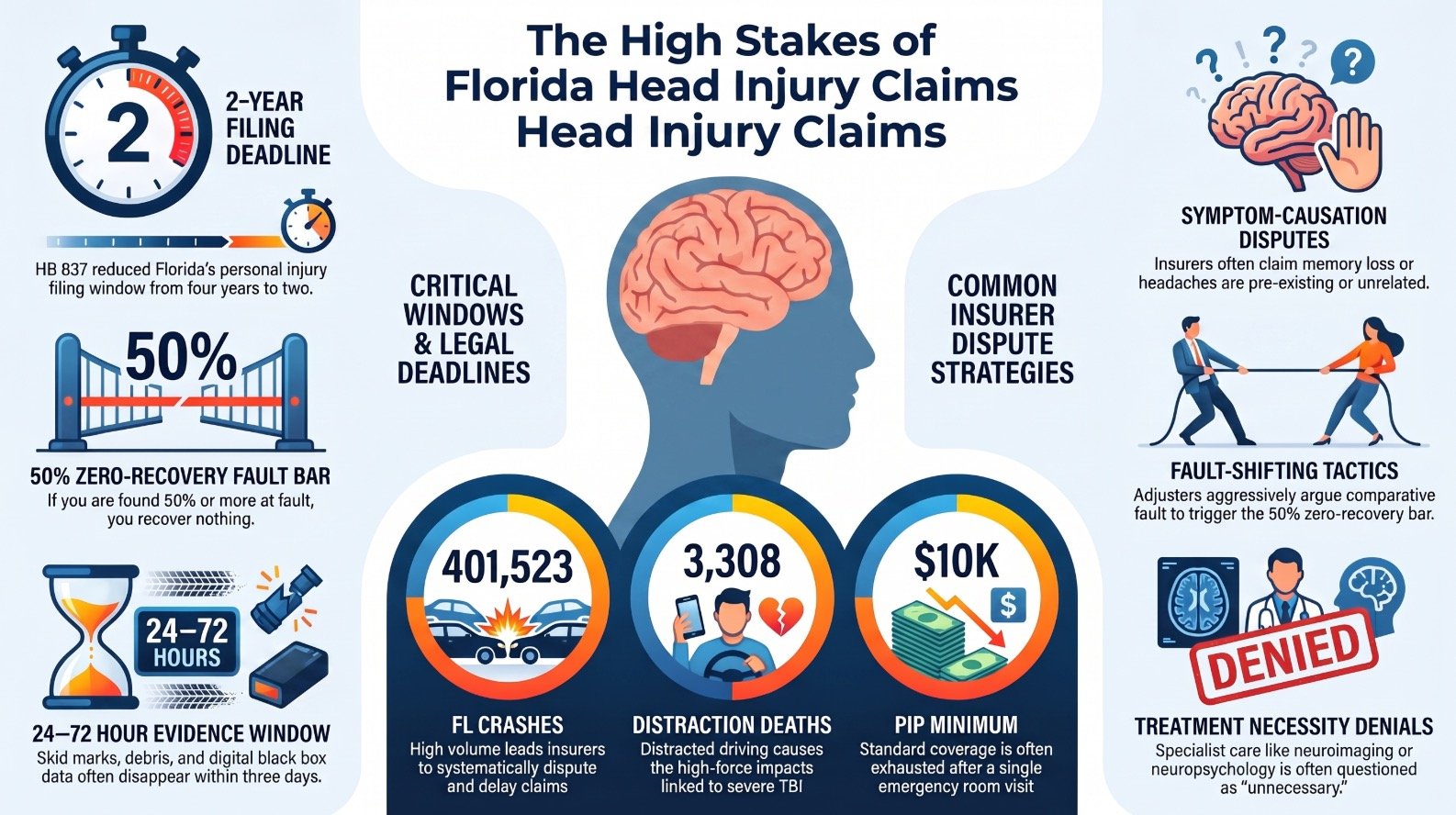
Head injuries are among the most consequential crash injuries because their full impact can be invisible to insurers and delayed in clinical presentation — yet devastating in long-term effect on work, cognition, and daily life. According to the FLHSMV 2022 Florida Traffic Crash Facts, Florida recorded 401,523 crashes and more than 253,888 injuries statewide — a volume that trains insurers to systematically minimize, delay, and dispute claims. NHTSA data shows distracted driving caused 3,308 deaths nationally in 2022, and distraction crashes frequently produce the sudden, unbraked impacts that generate the highest head-impact forces.
Florida’s 2023 tort reform (HB 837) reduced the personal injury filing window to two years and introduced a 50% modified comparative fault bar — meaning an insurer that successfully pushes a claimant’s assigned fault to 50% or above eliminates all recovery, regardless of injury severity. Physical crash evidence — including skid marks, vehicle positions, and EDR data — can disappear within 24 to 72 hours. Because head injury causation and severity are the most frequently disputed elements in neurological injury claims, the evidentiary window after a crash is narrow, consequential, and non-recoverable.
Common Causes of Gainesville Car Accident Head Injuries
We often see head injuries arise from rear-end collisions, distracted driving, drunk driving crashes, and high-speed impacts. When another driver’s negligence causes your head to strike a window, steering wheel, headrest, or other surface, the consequences can be severe. We help you identify how the crash happened, preserve crucial evidence, and pursue accountability for the harm you have suffered.
Rear-End Collisions
Rear-end collisions often cause head injuries because the sudden force can snap the head and neck forward and backward, even at lower speeds. We help you recognize how concussions, whiplash-related trauma, and delayed symptoms may affect daily responsibilities, including caring for family, serving coworkers, or supporting the community. Prompt evaluation protects your health and creates head injury documentation through careful medical evidence collection. We review crash details, treatment records, imaging, and symptom changes to connect the impact to your condition. When insurers minimize injuries, we explain insurance settlement options and pursue negotiated compensation that reflects medical care, lost income, and future needs. Together, we focus on accountability, practical recovery, and the resources you need to continue serving others with stability and confidence after a collision.
Distracted Driving
When a driver looks at a phone, adjusts navigation, or loses focus in traffic, a brief distraction can cause a violent crash that results in a serious head injury. We see how distracted driving turns ordinary travel into danger for everyone nearby, including passengers, pedestrians, cyclists, and families serving their communities. Texting behavior is especially hazardous because it takes a driver’s eyes, hands, and attention away from the road. In Gainesville, congested intersections, campus traffic, and sudden stops can make even seconds of inattention devastating. We help you understand how distraction may have caused the collision, identify phone records or witness evidence, and pursue accountability. When someone’s lack of focus harms you, we work to protect your recovery and support your future.
Drunk Driving Crashes
Because impaired drivers make poor decisions before they ever enter traffic, drunk driving crashes often involve severe impacts that cause traumatic head injuries. We recognize how these cases affect families, caregivers, and communities committed to protecting others. Alcohol can create impaired perception, delayed reactions, and unsafe judgment, leaving injured people with concussions, brain bleeding, or lasting cognitive changes. We review DUI enforcement records, officer observations, toxicology results, and witness statements to identify how intoxication contributed to the collision. A thorough crash investigation may show when the driver drank, how impairment affected conduct, and whether prior warning signs were ignored. When we serve injured clients, we focus on accountability, medical proof, and fair recovery, so your needs and future care remain central.
High-Speed Impacts
At higher speeds, a collision transfers far greater force to the head, neck, and brain, even when a vehicle’s safety systems work as designed. We often see severe injuries when rapid deceleration causes the brain to move inside the skull, leading to bleeding, swelling, or diffuse trauma. Vehicle deformation can also reduce survival space, increasing the chance that your head strikes glass, metal, or interior structures. Side-impact mechanisms are especially dangerous because doors and pillars provide less distance to absorb energy before the force reaches occupants. When we evaluate these crashes, we look closely at speed, roadway evidence, impact angles, and medical findings. By understanding how high-speed impacts harm you, we can pursue accountability through clear, evidence-based legal action after serious collisions in Gainesville.
Your Legal Rights After a Gainesville Car Accident Head Injury
After a serious crash, injured people in Gainesville have the right to seek compensation from the party whose negligence caused their harm. We help you understand those rights so you can protect your health, family, and future while serving the people who depend on you.
After a head injury in Gainesville, understanding your rights can help protect your recovery, your family, and your future.
Your claim may include medical costs, lost income, reduced earning ability, pain, suffering, and long-term care needs. Comparative fault rules may reduce compensation if an insurer claims you share responsibility, so we focus on evidence preservation from the beginning.
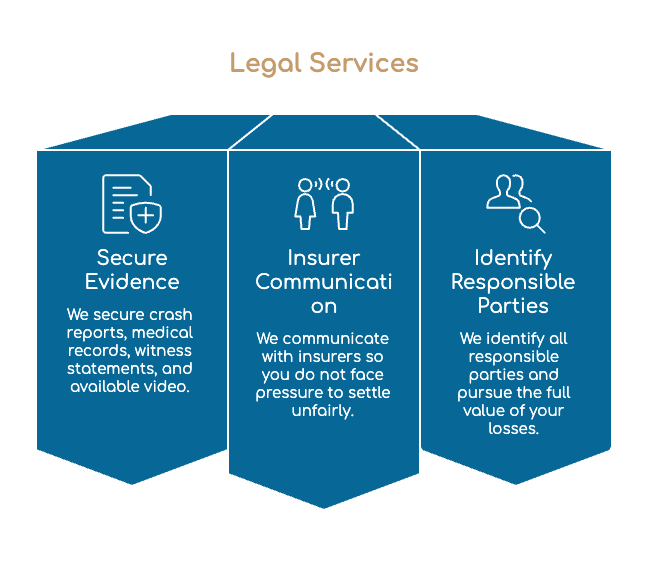
- We help secure crash reports, medical records, witness statements, and available video.
- We communicate with insurers so you do not face pressure to settle unfairly.
- We identify all responsible parties and pursue the full value of your losses.
You should not have to carry these burdens alone. We stand with you, protect your rights, and work to secure fair accountability after a Gainesville head injury.
Why Do Gainesville Car Accident Head Injuries Happen?
Head injuries happen so often in Gainesville car accidents because the head remains vulnerable whenever force, speed, and sudden movement combine. A collision can drive your skull into a window, steering wheel, headrest, or airbag, while violent shaking can injure the brain without direct impact.
Many crashes arise from preventable conduct. A truck driver, experiencing fatigue during long shifts, may miss slowing traffic or drift across lanes. Distracted drivers may overlook signals, cyclists, or stopped vehicles. Speeding reduces reaction time and increases the force transferred to your head and neck. Impaired driving, unsafe turns, and following too closely also create serious risks. Pedestrian impacts, crosswalk safety failures, and poor visibility can cause severe head trauma, especially near campuses, hospitals, and busy intersections. When drivers ignore their duty to protect others, we help you understand how those choices may have caused your injury.
What Should You Do After a Gainesville Car Accident Head Injury?
After a Gainesville car accident head injury, you should act quickly to protect your health and preserve your legal options. Below, we explain why you need immediate medical care, how to document the accident, and when to contact a lawyer. These steps can help you build a stronger claim while focusing on your recovery.
Seek Immediate Medical Care
If you suspect a head injury following a Gainesville car accident, seek medical care right away, even if your symptoms seem mild or delayed. Treat dizziness, confusion, nausea, headache, vision changes, or unusual fatigue as warning signs, not inconveniences. A prompt evaluation helps identify concussion risk, brain bleeding, or other trauma that may worsen without treatment. It also creates medical records that help physicians monitor progress and document recovery, which can protect your health and support any later claim. Follow all discharge instructions, attend recommended follow-up visits, and report any new symptoms promptly. When you prioritize care, you protect your ability to serve family, work, and community while reducing the chance that an untreated head injury causes lasting harm.
Document the Accident
Preserve every available detail as soon as your condition allows, because accident documentation can strengthen both your medical care and any later injury claim. Gather facts carefully, without placing yourself or others at risk. Document vehicle damage, road conditions, traffic signs, skid marks, debris, visible injuries, and the surrounding intersection or roadway. If you cannot take photographs, ask a trusted person to help.
You should also complete witness contact logging by recording names, phone numbers, addresses, and brief statements from anyone who saw the crash. Save the police report number, insurance details, medical discharge papers, and all follow-up instructions. Clear records help caregivers, insurers, and investigators understand what happened and support responsible recovery.
Contact a Lawyer
Contact a lawyer after a Gainesville car accident head injury as soon as your immediate medical needs are addressed. Early legal guidance helps protect your ability to recover costs while you focus on restoring health and caring for those who depend on you. We can begin a legal intake review quickly, review the crash details, identify insurance issues, and explain the next steps with clarity. Prompt action also supports the preservation of evidence, including vehicle damage, witness statements, surveillance footage, medical records, and police reports. Delays may allow evidence to disappear or insurers to shape the record against you.
Critical Evidence in a Gainesville Car Accident Head Injury Case
We build a strong Gainesville car accident head injury case by gathering evidence that links the crash to your injury, supports liability, and documents the full extent of your damages. Key materials include police accident reports, medical imaging records, witness statements, vehicle damage evidence, and police reports. When preserved and organized early, this evidence can build a clearer claim and protect your right to fair compensation.
For a detailed explanation of why medical documentation anchors every successful injury claim, read: Why Medical Records Matter in Personal Injury Cases.
Police Accident Reports
Because head injury claims often turn on disputed facts, the police accident report can become one of the first crucial records we examine after a Gainesville car crash. We review it for officer observations, driver statements, witness names, roadway conditions, citations, and diagrams that may help establish fault evidence. When you are focused on recovery and caring for your family, we work to preserve these details before memories fade or records become harder to obtain. A report is not always final proof of liability, but it often shapes insurance disputes from the beginning. We compare the report with photographs, vehicle damage, and witness accounts to identify errors or missing information. If an insurer relies on an incomplete narrative, we challenge that position with organized, credible evidence.
Medical Imaging Records
After a Gainesville car accident, medical imaging records can provide critical evidence of a head injury that may not be visible during a routine examination. We review CT scans, MRIs, and related radiology reports to connect symptoms with objective findings. These records can reveal bleeding, swelling, fractures, or traumatic brain changes that affect daily service, caregiving, and work responsibilities. We use medical imaging to clarify the severity of harm, support treatment needs, and challenge claims that injuries are minor or unrelated. Emerging trial strategies often rely on clear imaging timelines to explain how trauma progressed after impact. When insurers evaluate responsibility, these records can strengthen negotiating leverage by grounding your claim in documented medical proof. We help preserve, interpret, and present this evidence with care and precision.
Witness Statements
When a head injury affects memory, awareness, or communication, witness statements can fill important gaps in the evidence. We look for people who saw the crash, heard key remarks, or observed your condition afterward, because their accounts may help protect your recovery and serve the truth. Witness credibility matters, so we review each person’s location, attention, consistency, and possible bias. Statement timelines also matter; prompt accounts often preserve details before stress, media, or outside influence changes recollection. When needed, we compare statements with 911 calls, police notes, medical observations, and corroborating footage from nearby cameras. We may also prepare witnesses for legal depositions, where careful questioning can clarify what happened. Strong witness evidence helps us present your head injury claim with accuracy, dignity, and purpose.
Vehicle Damage Evidence
Although vehicle damage does not always reveal the full extent of a head injury, it can provide important information about the force, direction, and mechanics of a Gainesville car accident. We examine photographs, impact points, airbag deployment, broken glass, seat damage, and frame distortion to understand how your head may have moved during the collision. This evidence can support medical findings and help explain why symptoms appeared after the crash. We may review vehicle repair estimates to identify structural damage, collision severity, and repair patterns that insurers might overlook. By presenting this evidence carefully, we help protect your claim while serving your need for accountability and fair recovery.
Event Data Recorder (EDR) Evidence in Head Injury Cases
In car accident head injury claims, Event Data Recorder (EDR) data — the vehicle’s black box — is often the most objective tool for establishing the crash forces that caused neurological trauma. Most passenger vehicles manufactured after 2012 record pre-crash speed, braking force, throttle input, steering angle, and seat-belt status in the seconds before impact. For head injury claims, this data matters directly: it quantifies the impact speed and deceleration forces (allowing biomechanical analysis of the forces applied to the head and brain), confirms whether the at-fault driver attempted to brake, and documents occupant restraint status at the moment of impact. When insurers dispute whether the crash was severe enough to cause a TBI or concussion, EDR data provides engineering-grade proof that no adjuster can credibly contradict. We send formal spoliation letters immediately upon retention to prevent ignition cycling from overwriting the data.
Learn more: How Black Box Data Can Help Your Car Accident Case. Federal EDR regulation background: NHTSA Event Data Recorders.
Long-Term Effects of Gainesville Car Accident Head Injuries
We understand that head injuries from Gainesville car accidents can affect you long after the crash, especially when chronic cognitive impairment disrupts memory, focus, and daily decision-making. We also recognize that emotional and behavioral changes can strain your work, relationships, and independence. As we assess your claim, we consider ongoing physical symptoms, including headaches, dizziness, and fatigue, to show the full impact of your injury.
Chronic Cognitive Impairment
After a serious crash, chronic cognitive impairment can affect a person’s memory, attention, reasoning, processing speed, and ability to manage daily responsibilities. We often see these limitations disrupt medical care, household duties, finances, school, and community service commitments. When you are trying to serve others, cognitive setbacks can make even familiar tasks difficult to complete accurately and on time. We help document how these impairments affect your life, using medical records, neuropsychological testing, and evidence of daily functioning. According to the Mayo Clinic, traumatic brain injury can produce a wide range of long-term effects on thinking, memory, movement, and personality — many of which require coordinated specialist care and structured rehabilitation. Rehabilitation planning may include cognitive therapy, structured routines, assistive technology, and caregiver support. If you return to work, workplace accommodations such as reduced distractions, written instructions, modified schedules, or task adjustments may be necessary. We pursue compensation that reflects these long-term needs and protects your ability to rebuild with dignity.
Emotional and Behavioral Changes
When a head injury alters emotional regulation, a person may experience irritability, anxiety, depression, mood swings, impulsive behavior, or personality changes that strain daily life and relationships. We recognize that these changes can affect judgment, communication, patience, and trust, making ordinary responsibilities more difficult for you and those who depend on you. In a service-centered household or workplace, these effects may disrupt caregiving, employment, and community involvement. Therapy and support can help you recover coping skills, identify triggers, and restore healthier patterns of interaction. Family adjustment also matters, because loved ones often need guidance as they respond with firmness, patience, and compassion. We help document these emotional and behavioral consequences so any claim reflects the full human impact of the injury.
Ongoing Physical Symptoms
Even as visible injuries begin to recover, a head injury can leave persistent physical symptoms that disrupt work, driving, sleep, and daily responsibilities. We often see clients struggle with headaches, dizziness, blurred vision, nausea, light sensitivity, balance problems, fatigue, and coordination changes that make ordinary service to family, employers, and community harder to sustain. These symptoms may appear inconsistent, but they can signal serious neurological disruption requiring careful medical review. We encourage you to document every symptom, appointment, missed shift, and limitation because this record supports rehabilitation planning and future care decisions. When doctors recommend therapy, medication, imaging, or specialist referrals, we evaluate how long-term treatment may affect your health, income, and responsibilities. This evidence helps us pursue compensation that reflects the continuing burden of your injury.
Proving Liability in Gainesville Car Accident Head Injury Cases
Because a head injury can involve complicated medical evidence, proving liability in a Gainesville car accident case requires a careful review of how the crash happened, who had a duty to act safely, and how that breach caused your injuries. We examine police reports, witness statements, roadway conditions, vehicle damage, traffic laws, and available video to identify negligent conduct, such as speeding, distracted driving, impaired driving, or failing to yield. We also connect the crash to your diagnosed head injury through medical records, provider opinions, and evidence that shows how symptoms affected your daily responsibilities, work, and service to others. This proof matters because liability alone is not enough; we must show causation and the full harm that followed.
For context on how Florida courts evaluate the value of injury claims, read: Average Car Accident Settlement in Florida.
Dealing With Insurance Companies After a Gainesville Car Accident Head Injury
After we establish liability and document the medical impact of a head injury, the insurance process often becomes the next major challenge. We understand insurers may question symptoms, downplay cognitive changes, or suggest that headaches, dizziness, and memory problems came from something else. We protect you by organizing your records, communicating carefully, and refusing to let adjusters determine the value of your recovery without the full context. Independent medical evidence can become crucial when an insurer disputes the seriousness of your condition. We use that evidence to show how the injury affects your work, family responsibilities, and your ability to serve others consistently and with care. We also address emotional distress damages when anxiety, mood changes, sleep disruption, or fear of driving follow the crash. You should not have to manage pressure tactics alone. We stand between you and the insurer, pursue fair compensation, and keep the focus on truth, dignity, and your long-term recovery.
What to Expect During a Gainesville Car Accident Head Injury Claim Process
We guide you through each stage of a Gainesville car accident head injury claim, beginning with an initial medical evaluation and careful evidence gathering. We then address insurance claim negotiations, using medical records, accident documentation, and liability evidence to support your position. If the insurer will not offer fair compensation, we help you evaluate whether settlement or litigation best protects your claim.
Initial Medical Evaluation
When a head injury follows a Gainesville car accident, the initial medical evaluation becomes the foundation for both treatment and any future injury claim. We encourage you to seek prompt care, even if symptoms seem mild, because traumatic symptoms can appear gradually. A physician may assess consciousness, memory, balance, vision, nausea, headaches, and neck pain, then order imaging or specialist follow-up when appropriate. Report every symptom clearly, without minimizing pain or confusion, so providers can connect the injury to the crash. Note when symptoms began, how they affect daily service, work, family responsibilities, and whether they worsen over time. This medical record helps guide recovery, supports accurate diagnosis, and preserves the integrity of the claim process.
Evidence Gathering
As the claim begins to take shape, evidence gathering helps us prove what happened, how the crash caused the head injury, and how the injury has affected your life. We begin with a scene investigation, reviewing vehicle damage, roadway conditions, traffic controls, photographs, video, and witness statements. We move quickly because evidence preservation protects details that may disappear, including skid marks, damaged vehicles, electronic data, and surveillance footage. We also collect medical records, employment records, and insurance documentation to show the full scope of your losses. Each item supports liability proof by connecting careless conduct to the collision and your diagnosis.
Insurance Claim Negotiations
After we have gathered the essential evidence, insurance claim negotiations become the stage where we present the facts, document your losses, and push back against efforts to minimize the head injury. We prepare a demand that explains how the crash occurred, how the injury affects your daily life, and why fair compensation must include current care, lost income, and future medical costs. Insurers often question symptoms, treatment choices, or recovery timelines, so we address those issues with records, expert opinions, and consistent communication. Liability disputes can also arise, especially when the insurer tries to shift blame onto you or another driver. We respond with clear evidence and focused advocacy, helping protect your claim while you concentrate on recovery, stability, and your responsibilities to those who depend on you.
Settlement or Litigation
Although many Gainesville car accident head injury claims resolve through settlement, we prepare each case as though litigation may become necessary. We focus on evaluating fault, gathering evidence, and documenting how the injury affects your health, work, and ability to serve those who depend on you. Settlement discussions can provide a timely resolution, but we do not accept inadequate offers that ignore long-term care needs. If negotiations fail, we are ready to file a lawsuit and present your claim in court. Litigation may involve pleadings, discovery, medical testimony, depositions, and hearings. Throughout the process, we keep you informed, protect your dignity, and pursue accountability with disciplined advocacy.
Compensation for Gainesville Car Accident Head Injury Damages
When a head injury disrupts your health, work, and daily life, a Gainesville car accident claim can seek compensation for both immediate losses and long-term consequences. We help you identify every harm connected to the crash, including medical treatment, rehabilitation, reduced earning ability, home support, and the effect on your capacity to care for others. We also evaluate future needs, because brain injuries can change over time. Ongoing therapy, specialist visits, mobility assistance, and cognitive support may become necessary after the initial claim begins. If the injury causes a fatal outcome, wrongful death claims may help surviving family members pursue accountability and financial stability. We deal directly with insurers, document losses, and challenge tactics that undervalue your claim.
Economic vs. Non-Economic Damages in Gainesville Car Accident Head Injury Cases
We separate economic damages, such as medical bills and lost wages, from non-economic damages, including pain and emotional trauma. We help you understand how each category affects the value of a Gainesville head injury claim and focus on proving these damages with clear evidence.
Medical Bills and Lost Wages
After a head injury from a Gainesville car accident, medical bills and lost wages often form the foundation of the financial recovery claim. We help you identify every measurable loss, from ambulance charges and emergency care to rehabilitation, prescriptions, and follow-up visits. Lost wages also matter, especially when recovery keeps you from serving your family, workplace, or community. We gather employer records, tax documents, medical restrictions, and treatment plans to build strong claim documentation. If your injury limits future earning capacity, we work to show how that loss affects long-term stability. By documenting economic damages carefully, we protect your ability to recover the financial support needed after a serious head injury.
Pain and Emotional Trauma
Although medical bills and wage losses are easier to measure, pain and emotional trauma often show the deeper impact of a head injury after a Gainesville car accident. We acknowledge that headaches, dizziness, memory problems, and disrupted sleep can change how you work, serve, and care for others. Non-economic damages address these human losses, including anxiety, fear of another collision, and the frustration of relying on pain management just to complete daily tasks. We also consider how strained relationships, reduced independence, and loss of confidence affect your life beyond receipts and pay records. While insurance coverage may focus on numbers, we know that true recovery includes dignity, stability, and peace.
Proving Head Injury Damages
In a Gainesville car accident head injury case, proving damages requires more than stating what the injury has taken from your life. We help you document economic damages, such as emergency care, rehabilitation, medication, lost wages, and future medical needs. We also present non-economic damages, including pain, cognitive changes, emotional distress, and reduced ability to serve family, work, and community. Insurance adjusters often minimize symptoms, question treatment gaps, or argue that headaches and memory problems are unrelated. We respond with records, witness statements, employment evidence, and expert testimony options from neurologists, life-care planners, economists, and mental health professionals. By connecting medical proof to daily consequences, we build a damages claim that reflects your losses and supports fair compensation.
When a Gainesville Car Accident Head Injury Case Goes to Trial vs. Settlement
When a Gainesville car accident head injury claim reaches a decision point, we evaluate whether settlement or trial offers the stronger path to full compensation. We weigh medical proof, long-term care needs, lost earning capacity, and the insurer’s willingness to value your harm fairly. Settlement can spare you delay and reduce stress, especially when liability and damages are well supported. Still, we do not recommend accepting less than your recovery requires. If negotiations fail, we prepare to serve your interests before a jury. Our trial strategy focuses on clear themes, credible witnesses, and courtroom evidence that explains how the injury affects daily function, work, and family responsibilities. Whether we resolve your claim privately or present it in court, we keep your goals central and pursue accountability with disciplined advocacy at every stage.
Florida Laws That May Affect Your Gainesville Car Accident Head Injury Case
Several Florida laws can directly shape the value, timing, and strategy of your Gainesville car accident head injury case. We help you understand these rules so you can recover from your injuries, support your family, and continue serving those who depend on you.
- Comparative fault: May reduce compensation if an insurer claims you shared responsibility for the crash.
- Pain management records: Can show the severity, duration, and daily impact of headaches, cognitive issues, and neurological symptoms.
- Insurance deadlines: Affect notice requirements, benefits access, and the orderly presentation of your claim.
We examine police reports, medical documentation, and insurer communications to identify legal issues early. Florida’s no-fault system may require you to first seek certain benefits through your own policy, while serious injury evidence may support a claim against the at-fault driver. We coordinate documentation carefully because clear evidence helps link the collision to your head injury and strengthens your position during negotiations.
For an explanation of how Florida PIP applies in these situations, read: Florida PIP Insurance Explained.
The Statute of Limitations for Gainesville Car Accident Head Injury Cases
Because strict filing deadlines can control your right to recover compensation, we evaluate the statute of limitations early in every Gainesville car accident head injury case. In Florida, most negligence claims arising from a motor vehicle crash must be filed within two years of the collision date under HB 837 (effective March 24, 2023). If that deadline expires, a court may bar the claim, regardless of the injury’s severity. Head injuries can create delayed symptoms, including cognitive changes, dizziness, and memory problems. Even when you are focused on treatment, family duties, and serving others in your community, time continues to run. Certain circumstances can affect the filing period, including claims involving government vehicles or a person who later dies from crash-related injuries. We treat every deadline as critical from the outset.
How a Gainesville Car Accident Head Injury Lawyer Can Help You
After a serious crash, we help you protect your claim while you focus on medical care and recovery. We investigate the collision, preserve evidence, and work with medical professionals to show how the head injury affects your daily life, service, and responsibilities to others.
- We identify every liable party, including negligent drivers, vehicle owners, employers, or insurers.
- We calculate medical costs, lost income, future care needs, emotional distress damages, and reduced quality of life.
- We evaluate wrongful death eligibility when a traumatic brain injury leads to a loved one’s death.
We also manage insurer communications, challenge unfair blame, and prepare a claim that reflects the full extent of the harm caused. You should not carry the burden of legal deadlines, records requests, and settlement pressure alone. We stand beside you with careful advocacy, so your family can seek stability and continue supporting the people who depend on you.
When to Contact a Gainesville Car Accident Head Injury Lawyer
If you or a loved one suffers a head injury in a Gainesville car accident, you should contact a lawyer as soon as your immediate medical needs are addressed. Your first priority is care, safety, and supporting those who depend on you. Once treatment begins, prompt legal contact helps protect your ability to act with clarity.
Early communication matters because filing deadlines can limit the time available to pursue a claim. Waiting may also make evidence preservation harder, especially when vehicles are repaired, roadway conditions change, witnesses move, or digital records are lost. You should also reach out if symptoms develop later, such as headaches, confusion, dizziness, memory issues, or mood changes. Head injuries may not be obvious at first. By contacting us early, you take a responsible step toward supporting your health, your family, and your future.
Why You Need an Experienced Gainesville Car Accident Head Injury Lawyer
Once you have taken steps to protect your claim, the experience of the lawyer you choose can strongly affect how your case develops. We recognize that head injuries often change lives quietly at first, then more severely as symptoms progress. An experienced Gainesville car accident head injury lawyer can connect medical evidence, witness accounts, and the TBI symptom timeline to show how the crash affected your work, service, family duties, and future needs.
At Anidjar & Levine, that experience is verifiable and substantial. Glen Levine is Board Certified in Civil Trial — the highest designation the Florida Bar awards, recognizing excellence in courtroom litigation — and the firm employs two board-certified civil trial lawyers on staff. Both founding partners hold Martindale-Hubbell’s AV Preeminent rating, the highest peer-recognized designation for legal ability and professional ethics. Mr. Levine also holds an AVVO rating of 10 out of 10 (“Superb”). These credentials matter in head injury negotiations because insurers know that a firm with demonstrated trial readiness commands a different settlement conversation than a firm that settles every case regardless of value.
We also know that early action matters. Crash scene preservation can help secure photographs, evidence of vehicle damage, traffic camera footage, and roadway details before they disappear. We use that information to address fault, challenge incomplete insurance conclusions, and present the full scope of your losses. When you are focused on restoration and continuing to support others, we help carry the legal burden.
How to Choose the Right Gainesville Car Accident Head Injury Lawyer for Your Case
In a serious head injury case, the right lawyer should bring more than general car accident experience. Look for counsel who understands traumatic brain injuries, long-term medical needs, lost earning capacity, and the evidence required to connect those losses to the crash. Consider their record with neurological injury claims, their ability to work with medical experts, and their willingness to prepare every case as if trial may become necessary. Ask about Board Certification in Civil Trial and an AV Preeminent rating from Martindale-Hubbell — these are independently verified marks of serious litigation capability. You are entitled to clear updates, timely answers, and guidance that helps you make informed decisions while you focus on recovery and the people depending on you. You also deserve fee transparency before representation starts. By choosing carefully, you protect your claim and position your case for a fair and accountable result.
Real Reviews From Our Clients!
DY Projects ★★★★★
“I suffered a head injury in a car accident and had no idea how to build a case while managing my recovery. The symptoms were subtle at first — headaches, memory gaps — but Anidjar & Levine understood immediately what needed to be documented and when. They gathered imaging records, organized my medical timeline, and went back and forth with the insurer so I did not have to. The result reflected the real long-term impact of my injury. I am grateful for how seriously they took my situation.”
Evan Cadet ★★★★★
“After a rear-end collision left me with a concussion and months of cognitive symptoms, I was not sure a lawyer could even help. Anidjar & Levine explained every step clearly, communicated with me consistently throughout recovery, and built a claim that covered both my current treatment and my future care needs. The insurer initially disputed the severity of my symptoms, and the team pushed back with documentation I never could have organized on my own. Outstanding experience.”
Christopher Kull ★★★★★
“The insurance company tried to argue that my headaches and memory issues were pre-existing. Anidjar & Levine countered with my full medical history, imaging reports, and expert opinions that made the connection to the crash undeniable. They never let the insurer control the narrative. I felt protected throughout the entire process and received a settlement that truly reflected what I had been through. I would recommend them without hesitation.”
About The Law Offices of Anidjar & Levine
Founded in 2005 by Marc Anidjar and Glen Levine, the firm began as a two-person operation working out of a construction office conference room. Over the past 20 years, that modest start has grown into one of Florida’s most recognized personal injury practices — with more than $1 billion recovered in settlements for injury clients across the state. We bring that same determination and depth of experience to every head injury case we handle.
Marc Anidjar — Senior Partner
Marc Anidjar oversees the day-to-day operations of the firm and has settled thousands of cases — including serious neurological and head-injury matters — over nearly two decades of practice. He earned his Bachelor of Science from the University of Florida in 1999 and his Juris Doctor from Nova Southeastern University, Shepard Broad School of Law in 2003. His client-centered approach ensures that every injured person who comes to the firm receives attentive, organized, and results-focused representation.


Glen Levine — Senior Partner
Glen Levine is a founding partner who oversees all of the firm’s litigation. In 2019, Mr. Levine became Board Certified in Civil Trial — the highest level of evaluation by the Florida Bar, denoting excellence in civil trial litigation. He is consistently AV Rated by Martindale-Hubbell, the highest preeminence designation the service awards, reflecting top-tier legal ability and professional ethics. AVVO has rated Mr. Levine 10 out of 10 (“Superb”). He received the “Lawyer of Distinction” designation in 2017, 2018, and 2019; was named to Florida Trend Magazine’s “Legal Elite” list in 2017; was recognized by the Miami Herald as a Top Rated Lawyer in South Florida in 2015; and was a finalist in the personal injury category for “South Florida Leaders in the Law” in 2013.
With more than 50,000 clients served and 419 years of combined legal experience across our team, we have the resources and depth to handle even the most complex head injury claims. Our results reflect that commitment: we recovered more than $20 million for a single family in Jacksonville and secured more than $6 million for another family in a separate case. We also obtained a recovery for a family in Broward County that was recognized as one of the top ten settlements of the year in Florida.
Our team includes lawyers, investigators, and medical and legal support professionals who thoroughly investigate each case and pursue the full value of every client’s losses. With two board-certified civil trial lawyers on staff, your head injury claim is backed by the highest credentials Florida law allows. We are available 24 hours a day, 7 days a week, with offices in Fort Lauderdale, Miami, West Palm Beach, Fort Myers, Tampa, Orlando, and Jacksonville.
We are also deeply invested in the communities we serve. For 15 years, we have participated in Christmas on Las Olas, and we proudly sponsor the KISS Cares radiothon, raising money for Joe DiMaggio Children’s Hospital. We also support the Scripps Howard Foundation’s “If You Give a Child a Book” campaign, MADD, the Jewish Federation, Special Compass, and dozens of other local causes across Florida. We proudly sponsor the Miami Dolphins, Miami Heat, Florida Panthers, and Tampa Bay Lightning.
Past results do not guarantee a similar outcome in future cases. Each case is evaluated individually based on its unique facts and circumstances.
Frequently Asked Questions
How Much Does Hiring a Gainesville Head Injury Lawyer Cost?
Hiring a Gainesville head injury lawyer usually costs nothing upfront, because we work on a contingency fee basis. We collect attorney fees only if we recover compensation for you, allowing your resources to support recovery, family duties, and service to others. We explain fee percentages, case expenses, and payment timing before representation begins. You should expect transparent terms, no hourly billing in most injury cases, and clear guidance throughout your claim.
Can I Switch Lawyers During My Head Injury Case?
Yes, you can switch lawyers during your head injury case if it serves your best interests. Your right to choose counsel generally allows you to change attorneys at any stage. We review your existing agreement, protect deadlines, and coordinate the transfer of records so your claim continues without unnecessary disruption. You should not feel trapped by poor communication or inadequate advocacy. We guide you carefully through the transition.
Will My Injury Case Affect My Immigration Status?
Usually, your injury case will not affect your immigration status, but we review any pending immigration court matters, visa conditions, or public benefit concerns before proceeding. We help you understand how the legal timeline for your claim may interact with interviews, hearings, or documentation needs. You deserve guidance that protects your recovery and your ability to serve your family and community, while we coordinate carefully with qualified immigration counsel when needed.
Can I Claim Compensation if I Was Not Wearing a Seatbelt?
Yes, you can still claim compensation if you were not wearing a seatbelt. We evaluate comparative negligence, because Florida may reduce damages if the lack of restraint worsened your head injuries. You do not lose your claim automatically, especially when another driver caused the crash. We help you document medical evidence, address fault arguments, and protect recovery for treatment, lost income, and service to your family, community, and responsibilities.
Do Gainesville Head Injury Lawyers Offer Free Consultations?
Yes, we offer free consultations for head injury cases. You can use this meeting to explain the injury, your treatment history, and how the crash affected your ability to serve your family, work, or community. We review accident details, available medical records, insurance information, and any documentation you gathered at the scene. We then discuss potential next steps and the legal options available to you.
How Long Do I Have to File a Car Accident Head Injury Claim in Florida?
Under Florida’s 2023 tort reform (HB 837, effective March 24, 2023), you generally have two years from the date of the crash to file a personal injury lawsuit. This two-year deadline applies even when head injury symptoms are still developing, treatment is ongoing, or you are in negotiations with an insurer. Insurance policies may also impose separate notice deadlines, sometimes requiring notification within days of the crash. If a government entity contributed to the accident, even shorter notice deadlines may apply. Missing any of these deadlines can permanently bar you from compensation. We track every applicable deadline from the day we are retained.
How Does Florida’s Modified Comparative Fault Rule (HB 837) Affect My Head Injury Claim?
Florida’s modified comparative fault rule (effective March 24, 2023) directly affects how much you can recover for a head injury. Under HB 837, if you are found 50% or more at fault for the crash, you recover nothing — regardless of how severe the TBI or concussion is. If your share of fault is less than 50%, your recovery is reduced proportionally. Insurers now have a powerful incentive to argue that injured claimants contributed to their own crashes, making the fault dispute — backed by crash reports, EDR data, and witness accounts — one of the most critical aspects of any head injury claim. We counter fault-shifting arguments with documented evidence and protect the full value of your claim throughout negotiations.
If you suffered a head injury in a Gainesville car accident, we are ready to protect your rights and pursue the compensation you are owed.
At The Law Offices of Anidjar & Levine, our Gainesville Car Accident Lawyer team can handle the legal process while you focus on treatment and recovery.
We will investigate your crash, document your losses, and deal with insurers on your behalf.
Contact us today for a free consultation.