Broken bones and torn ligaments can take you off the job and out of your daily life — we connect crash evidence to your losses and fight for full recovery.
The Law Offices of Anidjar & Levine help Gainesville car accident injured people with arm and leg injuries pursue compensation for medical care, lost income, pain, and long-term trauma to bones, nerves, and soft tissue. Our Gainesville Car Accident Lawyer team gathers records, consults medical and financial experts, identifies all coverage, and challenges insurers that delay, deny, or undervalue valid claims. We prepare every case for negotiation or trial, linking crash evidence to your injuries. Below, we explain your rights, options, and next steps.
Legal Term Defined
What Is a Car Accident Arm or Leg Injury?
A car accident arm or leg injury is damage to the bones, joints, ligaments, tendons, nerves, or soft tissue of the upper or lower limbs caused by the forces of a vehicle collision. Common injury types include fractures of the femur, tibia, fibula, humerus, radius, or ulna; ligament tears including ACL, MCL, and rotator cuff damage; nerve injuries including radial and sciatic nerve trauma; and crush injuries from direct impact or intrusion of vehicle structures. These injuries frequently result from direct impact against the door, dashboard, steering wheel, or seat structure, or from the torsional forces of a side or rear-end collision. Symptoms including pain, swelling, limited mobility, and chronic aching can persist for months or years and affect work capacity, caregiving duties, and personal independence. In Florida, the serious injury threshold under the PIP no-fault system determines whether additional claims against the at-fault driver can proceed beyond basic no-fault benefits.
Main Takeaways
- A Gainesville car accident arm and leg injury lawyer can pursue compensation for medical care, lost income, pain, suffering, and long-term recovery needs.
- Arm and leg injuries may involve fractures, nerve damage, ligament tears, mobility loss, and long-term work or daily-life restrictions.
- Common causes include intersection collisions, distracted driving, rear-end crashes, motorcycle accidents, and pedestrian impacts.
- Strong claims use police reports, medical records, imaging, witness statements, vehicle damage, and expert evaluations to prove liability and damages.
- A lawyer can handle insurer tactics, identify PIP, liability, and uninsured motorist coverage, negotiate settlement, and prepare for trial.
How We Can Help With Your Gainesville Car Accident Arm and Leg Injury Claim
After a car accident causes an arm or leg injury, we can help you pursue the compensation needed to address medical care, lost income, and the long-term effects of your condition. We take on the legal burden so you can focus on recovering, supporting your family, and continuing the work that matters to you. Our team gathers records, consults medical and financial experts, and performs a careful calculation of damages that reflects both current losses and future needs. We identify all available coverage, examine policy limits, and challenge attempts to undervalue your claim.
During settlement negotiation, we present clear evidence, respond to insurer tactics, and protect your interests at every stage. If an insurer delays, misrepresents coverage, or refuses to act fairly, we can address insurance bad faith and pursue appropriate remedies. We prepare each claim as though trial may be necessary, giving you a stronger position from the start.
For a foundational understanding of Florida’s no-fault PIP system and how it applies to crash injury claims, read: Florida PIP Insurance Explained.
Understanding Gainesville Car Accident Arm and Leg Injury Cases
Arm and leg injury car accident cases in Gainesville often involve more than the immediate break or tear, because damage to the bones, nerves, joints, and soft tissue of the limbs can affect mobility, work capacity, and long-term daily function. We understand that when you are trying to care for your family, return to work, or support your community, these injuries can disrupt your ability to fulfill every responsibility. We evaluate each case by looking at medical findings, imaging results, and the practical limits the injury places on daily life. Limb fractures and soft-tissue damage may require surgery, immobilization, physical therapy, and careful monitoring before the full picture of recovery becomes clear. We also consider how pain, limited range of motion, and restricted movement affect work duties, caregiving, transportation, and personal independence.
By documenting these issues clearly, we help present your claim with accuracy, purpose, and respect for the responsibilities you carry.
Gainesville Car Accident Arm and Leg Injuries: Impact Forces and Legal Stakes
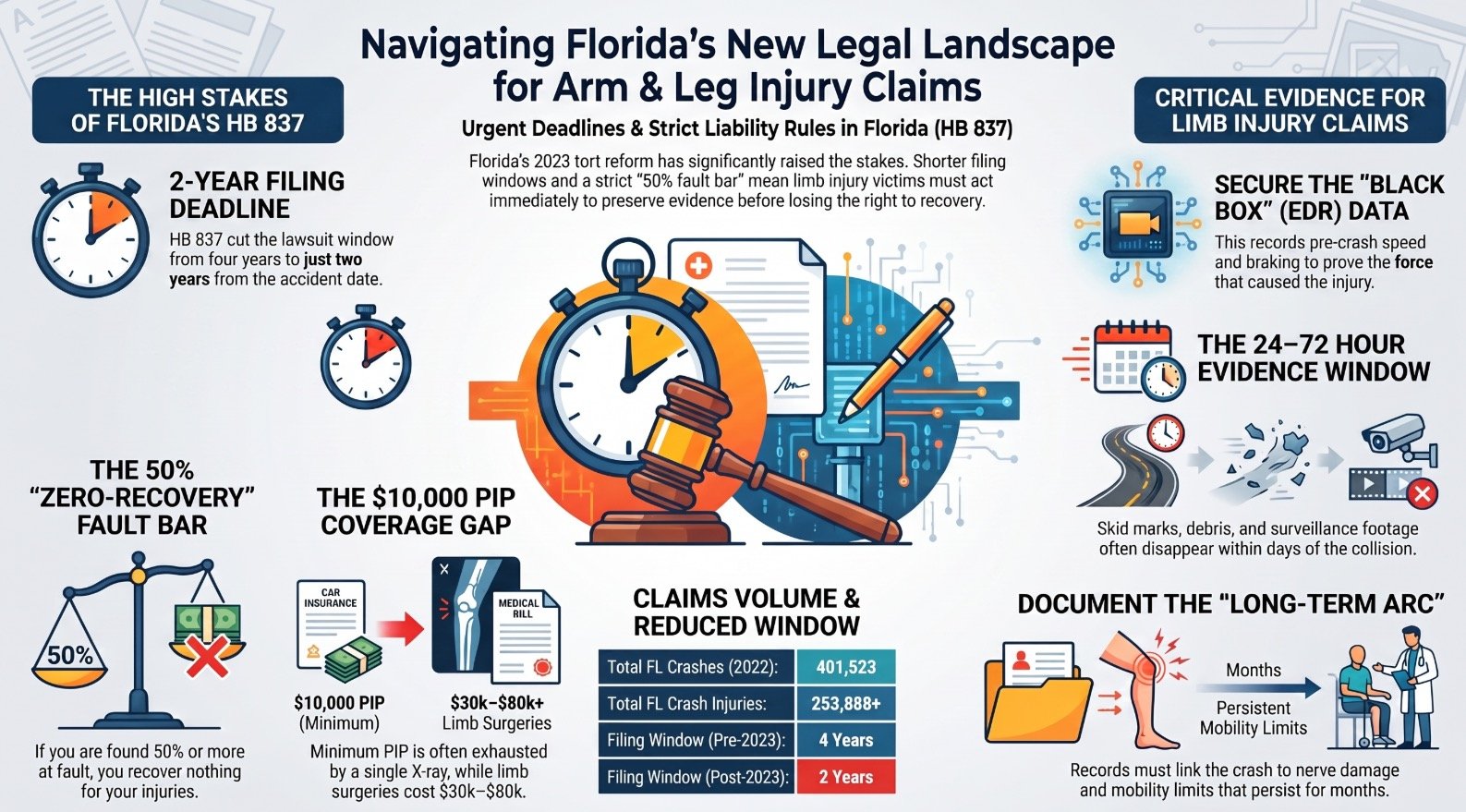
Arm and leg injuries from car crashes are among the most disruptive personal injury claims because they involve the limbs people rely on for work, caregiving, transportation, and every dimension of daily life. According to the FLHSMV 2022 Florida Traffic Crash Facts, Florida recorded 401,523 total crashes and more than 253,888 injuries statewide — generating a claims environment where insurers are financially motivated to dispute medical necessity, invoke pre-existing orthopedic conditions, and challenge causation on every serious fracture and nerve injury.
NHTSA data shows that distracted driving killed 3,308 people nationally in 2022, and the sudden unbraked impacts typical of distraction crashes generate the highest lateral and torsional forces — the primary mechanism behind femur fractures, tibial injuries, and limb crush damage in survivable collisions. Florida’s 2023 tort reform (HB 837) reduced the filing window to two years and introduced a 50% modified comparative fault bar — a threshold that, if reached, eliminates all recovery regardless of fracture severity or nerve damage extent. Physical crash evidence can disappear within 24 to 72 hours, and limb injury causation — which depends on proving impact angle, crash forces, and vehicle intrusion dynamics — is far harder to establish after evidence is gone.
Common Causes of Gainesville Car Accident Arm and Leg Injuries
We often see Gainesville car accident arm and leg injury cases arise from specific crash types and driver behaviors that generate the forces needed to fracture bones, tear ligaments, or compress nerves. You may suffer limb trauma from direct impact against vehicle structures, lateral loading during a side collision, or the torsional forces of a spinning or rolling crash. We evaluate these causes carefully, because identifying how the injury occurred can help establish liability and support your claim.
Intersection Collisions
Intersection crashes are among the most common causes of serious arm and leg injuries in Gainesville, because the lateral forces of a T-bone or angle collision can directly load the lower limbs against the door panel, seat structure, or dashboard. We often see femur fractures, tibial injuries, knee ligament tears, and foot or ankle damage when a driver fails to yield, runs a red light, or enters an intersection without a clear path. Intersection injuries frequently affect pedestrians and cyclists as well, generating limb crush damage from vehicle contact with little protective structure. The angle of impact, intersection geometry, traffic signal timing, and driver behavior all become important parts of the liability analysis. We examine crash reports, surveillance footage, witness accounts, and EDR data to establish who failed to exercise reasonable care at the intersection and how that failure caused your limb injury.
Distracted Driving
Distracted driving generates some of the most severe arm and leg injuries in Gainesville crashes, because inattentive drivers fail to brake before impact — delivering unabsorbed collision forces directly into the vehicle structure and the occupant’s limbs. We often see broken arms from bracing impact, femur and tibial fractures from dashboard and console loading, and leg injuries from door intrusion when distracted drivers strike at full speed. Phone records, witness accounts, traffic camera footage, and EDR data can help establish that the at-fault driver was not focused on the road at the moment of impact.
We gather this evidence promptly because phone records require a formal legal process to obtain, and cell carriers’ data retention periods vary. Connecting inattention to the crash sequence and the crash sequence to your limb injury requires structured, timely evidence development.
Rear-End Crashes
Although rear-end crashes are often viewed as minor, a high-speed rear impact can generate significant forces on the lower body — especially when the occupant’s foot is on the brake pedal or when the seat shifts during impact. We often see leg, ankle, and knee injuries in rear-end crashes where the vehicle’s floorboard or pedal assembly transmits forces directly to the lower limbs. Forward whip motion during a rear-end crash can also extend the arm beyond its normal range, causing shoulder, elbow, and wrist injuries. Insurers frequently minimize rear-end injury claims by arguing that the damage was too minor to cause serious harm, but medical records, imaging, and biomechanical analysis can counter this argument with documented evidence of limb-specific trauma.
Motorcycle Accidents
Motorcycle crashes produce some of the most severe arm and leg injuries in Gainesville because riders have no protective enclosure and absorb direct impact forces with their limbs during falls, collisions, or ejections. We often see complex fractures, degloving injuries, nerve damage, and road rash combined with deep orthopedic trauma when a motorcycle occupant contacts the roadway, another vehicle, or a barrier. Road rash combined with fractures or joint injuries can require multiple surgeries, extended wound care, and long-term rehabilitation. Motorcycle riders also face bias in insurance negotiations — some adjusters assume rider fault without analysis. We document the crash sequence, rider behavior, vehicle positions, and roadway conditions carefully to counter unsupported assumptions and build a claim based on evidence rather than presumption.
Your Legal Rights After a Gainesville Car Accident Arm and Leg Injury
After a serious crash, injured people in Gainesville have the right to pursue compensation when another driver’s negligence caused or contributed to their harm. We help you understand those rights, protect your claim, and seek resources that support recovery, stability, and service to those who depend on you.
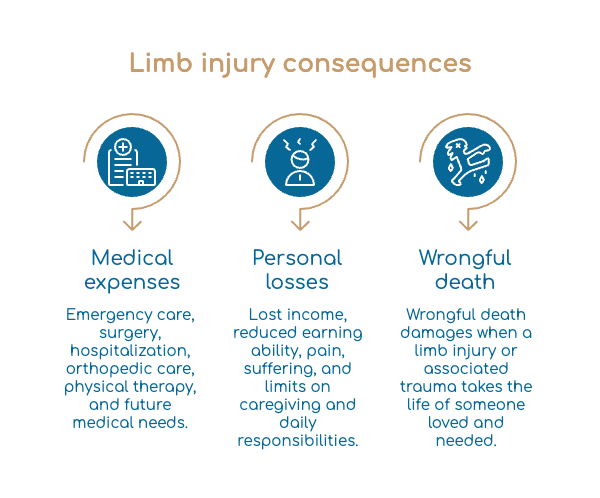
Your legal rights may include recovery for:
- Emergency care, surgery, hospitalization, orthopedic care, physical therapy, and future medical needs.
- Lost income, reduced earning ability, pain, suffering, and limits on caregiving and daily responsibilities.
- Wrongful death damages when a limb injury or associated trauma takes the life of someone loved and needed.
We also address insurance bad faith when an insurer delays, denies, or undervalues a valid claim without proper cause. You should not have to carry that burden alone while trying to recover. We gather records, document losses, communicate with insurers, and pursue accountability through negotiation or litigation. By acting promptly, we preserve evidence and protect your ability to seek full compensation.
Why Do Gainesville Car Accident Arm and Leg Injuries Happen?
Arm and leg injuries often happen because a crash forces the body into violent contact with a door panel, dashboard, seat structure, steering wheel, or roadway. We see these injuries when sudden deceleration or lateral loading compresses the limbs, fractures bones, tears ligaments, or damages nerves. Driver behavior patterns often play a central role, including speeding, distracted driving, tailgating, unsafe lane changes, impaired driving, and failure to yield. When drivers disregard the safety of others, they increase the force and angle of impact, placing occupants at serious risk of orthopedic harm. Vehicle safety defects can also contribute to limb trauma. Faulty door structures, collapsing seat systems, poor crash energy management, or inadequate intrusion protection may turn a survivable collision into a severe injury event.
Understanding why these injuries happen helps us identify responsibility and protect those who dedicate themselves to helping others.
What Should You Do After a Gainesville Car Accident Arm and Leg Injury?
After a Gainesville arm or leg injury car accident, we recommend that you seek immediate medical care, even if fractures or soft-tissue damage are not yet confirmed. We also encourage you to document the accident carefully, including photos, witness information, and medical records. Once your health is stabilized, we can help you contact a lawyer to protect your rights and assess your potential claim.
Seek Immediate Medical Care
When a collision causes pain, swelling, limited movement, or visible deformity in any limb, you should seek immediate medical care and let a doctor evaluate whether a fracture, nerve injury, or ligament damage is present. Even when symptoms seem manageable, limb injuries can be more extensive than they appear at the scene. Warning signs may include numbness or tingling, bone protrusion, inability to bear weight, severe bruising, significant swelling, or cold or pale skin in the affected limb. Explain each concern clearly to medical staff, and accept imaging, splinting, immobilization, and specialist referral when recommended. Prompt care protects both your health and your ability to document the injury accurately from the earliest point in the recovery process.
Document the Accident
Medical care should come first, but documentation should begin as soon as you can safely do so. Preserve details that help explain what happened, especially when limb pain, swelling, or functional loss may worsen over time. If you are able, take photographs of vehicle damage, skid marks, intersection geometry, traffic signals, weather conditions, and visible injuries. Gather names, phone numbers, insurance details, and witness statements, while avoiding arguments or blame. Emergency scene notes can include the time, location, responding agencies, and anything the other driver said. We also recommend logging medical symptoms each day, including pain levels, mobility limitations, swelling, missed work, and activities you cannot perform for those who rely on you. Careful record-keeping supports accurate treatment and protects the truth when others depend on your stability.
Contact a Lawyer
Because arm and leg injuries can involve delayed complications, multiple surgical stages, and disputed fault, you should contact a lawyer as soon as your immediate medical needs are under control. We can help protect your rights while you focus on recovery, family responsibilities, and returning to the people who depend on you. During a free consultation, we review the crash facts, medical records, insurance communications, and any documentation you gathered at the scene. This evaluation helps us identify liable parties, available coverage, and deadlines that may affect your claim. We also handle insurer contact, preserve evidence, and work to present the full impact of your injuries. By involving counsel early, you avoid missteps that can weaken your position and gain informed guidance after serious harm.
Critical Evidence in a Gainesville Car Accident Arm and Leg Injury Case
We use major evidence to connect your arm or leg injury to the crash, prove the severity of your losses, and challenge any unfair defense arguments. Key evidence includes accident-scene evidence, medical records, witness statements, and vehicle-damage documentation. We evaluate each item carefully because strong documentation can significantly affect the value and direction of your Gainesville car accident arm-and-leg injury case.
For a detailed explanation of why medical documentation anchors every successful injury claim, read: Why Medical Records Matter in Personal Injury Cases.
Accident Scene Evidence
Crash scene evidence can preserve details that police reports and medical records do not fully capture, especially when an arm or leg injury results from a high-impact collision. We use scene photographs to understand vehicle positions, roadway geometry, point of impact, debris fields, and damage patterns that explain how your limbs absorbed crash forces. When we review photographs, we look for traffic signal documentation, skid marks, roadway defects, weather conditions, and visibility factors that may clarify fault. Images may also reveal evidence of driver distraction, such as a phone, food container, or an open screen inside a vehicle. If you are able, photograph wide views and close details before conditions change. By preserving visual evidence immediately, we help protect your claim and support a fair recovery for the harm you have endured.
Medical Records
After a crash involving arm or leg trauma, the treatment record often becomes the foundation of the injury claim. We rely on emergency reports, imaging results, physician notes, operative reports, prescriptions, and discharge instructions to show what happened to your body and why consistent care mattered. These records help with diagnosing limb injuries, including fractures, ligament tears, nerve damage, and soft tissue trauma that may worsen without proper care. We also review follow-up appointments, physical therapy records, and specialist notes because consistent care shows the injury’s course, your limitations, and the efforts made to recover. When you attend visits, follow restrictions, and report symptoms clearly, we can present a stronger, more complete claim that connects the crash to the harm you continue to face.
Witness Statements
Photographs show what the scene looked like, but witness statements can explain what happened in the moments before, during, and after the collision. We use independent testimony collection to identify drivers, passengers, pedestrians, first responders, and nearby workers who observed important events affecting your arm or leg injury claim. Their accounts may clarify speed, lane position, traffic signals, braking, distraction, impact sequence, and your visible distress after the crash. We also conduct witness credibility assessment, because reliable statements carry more weight when insurers or juries review the evidence. We compare accounts with reports, medical findings, and scene details to address inconsistencies before they are used against you. When we gather statements promptly, we help preserve truth, support accountability, and serve your recovery with disciplined advocacy.
Vehicle Damage Photos
Vehicle damage evidence can reveal how force moved through the vehicles and into your arms and legs during a Gainesville car accident. We examine crush patterns, door intrusion, footwell deformation, dashboard displacement, and seat structure damage. These details help us connect the mechanics of the crash to limb injuries, including bone fractures, ligament tears, and nerve compression. We also use vehicle photographs, repair estimates, event data, and inspection findings to support driver fault analysis. When damage aligns with roadway evidence and witness accounts, it can help clarify speed, angle of impact, and whether a failure to yield or stop occurred. By preserving and presenting this proof, we serve your claim with accuracy and purpose.
Event Data Recorder (EDR) Evidence in Arm and Leg Injury Cases
In car accident arm and leg injury claims, Event Data Recorder (EDR) data — the vehicle’s black box — is often the most objective tool for proving the crash forces that caused orthopedic and nerve trauma. Most passenger vehicles manufactured after 2012 record pre-crash speed, braking force, throttle input, steering angle, and seat-belt status in the seconds before impact. For limb injury claims, this data matters directly: it establishes the deceleration rate and impact velocity (which biomechanical engineers use to calculate the forces transmitted to legs and arms through vehicle structures), confirms whether the at-fault driver attempted to brake, and documents the occupant’s restraint status. When insurers dispute whether the crash was severe enough to fracture a femur or tear a ligament, EDR data provides engineering-grade proof. We send formal spoliation letters immediately upon retention to prevent ignition cycling from overwriting the data.
Learn more: How Black Box Data Can Help Your Car Accident Case. Federal EDR regulation background: NHTSA Event Data Recorders.
Long-Term Effects of Gainesville Car Accident Arm and Leg Injuries
We must also consider how arm and leg injuries can affect your life long after the crash, especially when chronic pain limits daily activity. We often see nerve damage create persistent complications, work restrictions, and ongoing medical needs. We assess your long-term medical requirements carefully, because future treatment, therapy, and monitoring can significantly affect the value of your claim.
Chronic Pain and Mobility
Although some arm and leg injuries appear to improve after a Gainesville car accident, chronic pain can develop when damaged bones, ligaments, muscles, nerves, or connective tissue do not heal as expected. We often see pain persist during walking, climbing, lifting, gripping, or caring for others, which can limit daily service and responsibility. Effective pain management may require coordinated medical care, diagnostic follow-up, therapy, and consistent medication use to reduce setbacks. Post-accident rehabilitation can help restore range of motion, rebuild strength, and prevent guarded movement patterns from creating additional musculoskeletal strain. We encourage you to document symptoms, appointments, work limitations, and treatment responses, because these records may support your injury claim and protect your right to future care.
Nerve Damage Complications
When a crash injures the nerves in your arm or leg, the effects can persist long after the bone heals. We often see clients experience numbness, tingling, weakness, burning sensations, or loss of fine motor control that affects how they perform work tasks, drive, care for family, or engage in community service. According to the Mayo Clinic, broken leg injuries can involve nerve or blood vessel damage at the time of fracture, and nerve recovery — when it occurs — can take months to years and may be incomplete. We help review medical records, nerve conduction studies, specialist evaluations, and symptom history to show how the crash injury has affected your neurological function and what ongoing or future care is required.
Work and Lifestyle Limits
After a serious arm or leg injury, work and lifestyle limits can continue for months or years after the Gainesville crash. We help you consider how these restrictions affect your income, responsibilities, and ability to serve your family or community. Activity limits may include restrictions on lifting, standing, walking, gripping, climbing, or operating equipment or vehicles. We also look ahead to costs that insurers may overlook, including future disability evaluations, adaptive equipment, vocational retraining, and long-term home health or rehabilitation services. By identifying these needs early, we can present a claim that reflects your medical and functional reality, not only your immediate bills. Careful planning helps protect your future stability and independence.
Proving Liability in Gainesville Car Accident Arm and Leg Injury Cases
Because arm and leg injuries can involve serious orthopedic trauma, proving liability in a Gainesville car accident case requires a careful review of how the crash occurred and who failed to act with reasonable care. We look at police reports, scene evidence, vehicle damage, witness statements, traffic laws, and medical records to connect the collision to your injuries. These fault investigation methods help us identify careless driving, such as speeding, distracted driving, unsafe turns, or failure to yield. We also assess comparative negligence, because Florida law may reduce compensation if you share responsibility for the crash. Our role is to protect your position with clear evidence, careful documentation, and a service-focused commitment to your recovery.
For context on how Florida courts evaluate the value of injury claims, read: Average Car Accident Settlement in Florida.
Dealing With Insurance Companies After a Gainesville Car Accident Arm and Leg Injury
Insurance companies often move quickly after a Gainesville arm or leg injury car accident, and they do not always protect your best interests. We help you respond with care, purpose, and a clear commitment to your recovery and your family’s stability. Adjusters may request statements, medical authorizations, or quick settlement discussions before the full impact of your injury is known. We guide you in avoiding common claim denial strategies, including arguments that your fracture or nerve injury predated the crash, that treatment was excessive, or that you contributed to the collision. We also emphasize documentation best practices, such as saving medical bills, imaging results, discharge instructions, prescription records, wage information, and written notes about daily mobility limitations. When we communicate with insurers, we protect your right to fair treatment and ensure that no statement or submission undermines the value of your claim.
What to Expect During a Gainesville Car Accident Arm and Leg Injury Claim
We guide you through each stage of a Gainesville arm and leg injury car accident claim, beginning with an immediate medical evaluation and careful documentation of injury evidence. We then help you manage the insurance claim steps, including notices, records, and communications that can affect your recovery. As the case progresses, we prepare for settlement negotiations, working to present your losses clearly and protect your rights.
Immediate Medical Evaluation
After a Gainesville car accident, an immediate medical evaluation creates the foundation for both your recovery and your arm or leg injury claim. We encourage you to seek care promptly, even when pain seems manageable, because fractures and nerve injuries can worsen without timely treatment. Physicians assess warning signs including inability to bear weight, severe swelling, deformity, numbness, or pale or cold skin in the injured limb. Diagnostic imaging benefits — including X-rays, CT scans, and MRI — help identify fractures, ligament tears, joint displacement, or nerve compression that might not be apparent on physical examination alone. Early medical attention supports safer recovery and shows responsible action after the collision, protecting your health and your claim simultaneously.
Documenting Injury Evidence
As your treatment begins, documenting injury evidence helps connect your arm or leg trauma to the Gainesville car accident and supports the value of your claim. We gather medical records, imaging results, operative reports, prescriptions, and therapy notes so your recovery is shown clearly over time. We also encourage you to keep a daily pain journal describing mobility limits, sleep problems, missed work, and activities you cannot perform for those who rely on you. Causation proof depends on timely records and consistent details. Incident documentation — including crash photos, vehicle damage, witness names, and first responder reports — helps show how the impact generated the forces that caused your injuries. We organize this evidence with care and precision.
Insurance Claim Steps
When you start a Gainesville arm and leg injury car accident claim, the insurance process usually begins with identifying every available coverage source. We review your personal injury protection, liability coverage, uninsured motorist benefits, and any health insurance that may apply. We notify insurers, submit the required forms, and track deadlines to ensure your right to recover remains protected. We also help you respond to adjuster requests without giving statements that could weaken your claim. Medical records, wage information, and crash documentation support each submission. If insurers issue claim denials, we review the stated reasons, correct any missing information, and, when appropriate, preserve your rights through the appeal process.
Settlement Negotiation Process
Once the insurance claim materials are organized and the insurer has reviewed the documented losses, settlement negotiations may begin. We present the claim’s medical evidence, wage losses, and long-term functional limits with clear support, then respond to the insurer’s evaluation. You can expect offers, counteroffers, and focused discussion about liability, treatment needs, and fair compensation. Comparative fault determination often shapes the negotiation range, especially when the insurer argues that you shared responsibility for the crash. We address those arguments with records, witness statements, and crash facts. Settlement timeline delays may occur if medical treatment continues, records remain incomplete, or the insurer requests additional review. We keep the process organized and protect your position throughout.
Compensation for Gainesville Car Accident Arm and Leg Injury Damages
Because arm and leg injuries can affect mobility, employment, and long-term health, compensation after a Gainesville car accident must account for both immediate losses and future consequences. We work to identify every responsible party, document the full impact of the trauma, and pursue recovery that accurately reflects your needs with care. We also consider whether the facts support punitive damages, which may apply when reckless conduct placed others at serious risk. When a limb injury leads to wrongful death, we help families seek compensation that honors the life lost and supports those left behind.
Economic vs. Non-Economic Damages in Gainesville Car Accident Arm and Leg Injury Cases
We separate economic damages from non-economic damages so you can understand how each category affects your Gainesville arm and leg injury car accident claim. Economic damages often include medical bills and costs, along with lost income claims tied to missed work or reduced earning capacity. Non-economic damages address pain and emotional impact, including the physical discomfort and personal limitations that do not appear on standard invoices or wage records.
Medical Bills and Lost Wages
After a Gainesville car accident causes an arm or leg injury, medical bills and lost wages often become the two clearest measures of financial harm. We look at emergency transport, hospital care, imaging, surgery, medication, follow-up visits, rehabilitation, and future treatment needs to establish economic damages. We also help you document missed wages, reduced hours, lost overtime, and diminished earning capacity through payroll records, tax returns, employer statements, and medical restrictions. When mobility limits prevent lifting, walking, driving, or performing physically demanding duties, we connect those restrictions to your income losses so the claim reflects your actual financial harm and the responsibilities you were unable to meet during recovery.
Pain and Emotional Impact
Pain and emotional distress can affect every part of daily life, and Florida law allows people injured in arm and leg injuries to seek non-economic damages for that harm in addition to measurable financial losses. We help you show how mobility limits, sleep disruption, anxiety, frustration, and reduced participation in family and community life changed your experience after the crash. We use evidence preservation strategies — including medical records, symptom journals, photographs, witness statements, and provider opinions — to support the claim. When we present pain and emotional impact clearly, we help insurers and juries understand the full human cost of a crash that took you off the job, out of your daily life, and away from the people who depend on you.
Proving Damage Value
Proving the full value of arm and leg injury damages requires organizing medical costs, wage losses, and future care projections into a documented claim that withstands insurer scrutiny. We work with medical specialists, life-care planners, rehabilitation counselors, and economic experts to build a complete picture of damages. The medical complexity of a serious orthopedic injury — which may involve multiple surgeries, physical therapy over months or years, nerve recovery monitoring, and adaptive equipment — must be translated into specific, defensible dollar figures. We present these calculations with supporting records so that no component of your loss is left unexplained or undercounted during negotiations or at trial.
When a Gainesville Car Accident Arm and Leg Injury Case Goes to Trial vs. Settlement
Although many Gainesville arm and leg injury car accident claims resolve through settlement, we prepare every case as if a jury may need to decide it. Settlement may serve you well when the evidence is clear, medical needs are understood, and the insurer offers fair compensation without delay. We assess your diagnosis, treatment, lost income, long-term functional limits, and the human impact on your ability to care for yourself and others. Trial becomes necessary when the defense disputes fault, minimizes orthopedic trauma, challenges future care, or refuses a reasonable offer. We organize medical testimony, crash evidence, and witness accounts so your claim reaches the court with clarity and purpose.
Florida Laws That May Affect Your Gainesville Car Accident Arm and Leg Injury Case
A strong trial strategy also requires a clear understanding of the Florida laws that shape your Gainesville arm and leg injury car accident case from the first claim filing through any courtroom proceeding. We evaluate these rules early, so we can protect your recovery and serve your needs with disciplined advocacy.
- No-fault coverage: May require your own insurer to address initial medical expenses regardless of fault, but serious arm and leg trauma can support claims beyond those benefits.
- Injury reporting laws: Affect how medical records, crash reports, and insurance notices support the facts, so we help you document symptoms promptly and accurately.
- Comparative negligence rules: Can influence liability, especially when insurers argue that you shared responsibility for the crash.
We apply these laws to build evidence, challenge unfair blame, and present the full impact of broken bones, nerve injuries, mobility loss, and lasting pain.
For an explanation of how Florida PIP applies to arm and leg injury claims, read: Florida PIP Insurance Explained.
The Statute of Limitations for Gainesville Car Accident Arm and Leg Injury Cases
When an arm or leg injury follows a Gainesville car accident, Florida’s statute of limitations can determine how long you have to file a lawsuit and preserve your right to compensation. In most Florida negligence cases, claims must be filed within a 2-year deadline under HB 837 (effective March 24, 2023), measured from the date of the accident. Missing the deadline can bar your claim, even when your injuries, medical bills, and caregiving responsibilities are substantial. We also consider how time limits interact with issues that often arise before suit. Comparative fault disputes may require careful review of reports, witness accounts, and medical evidence while the filing period continues to run. A policy limits investigation can also matter early, because available insurance may shape decisions about pursuing damages. You need to act quickly to protect evidence, maintain legal options, and avoid preventable barriers to financial accountability after a serious limb injury.
How a Gainesville Car Accident Arm and Leg Injury Lawyer Can Help You
After a Gainesville car accident causes an arm or leg injury, we can help you build a claim that connects the crash, the medical diagnosis, and the full effect on your life. We gather evidence with care, because your recovery, responsibilities, and ability to serve others deserve accurate representation.
- Medical documentation review, including imaging, surgical reports, rehabilitation records, and physician opinions.
- Liability investigation, including crash reports, witness accounts, vehicle damage, and available video evidence.
- Insurance denial response, with organized proof, legal arguments, and direct communication with adjusters.
We also calculate damages tied to hospital bills, lost income, reduced mobility, pain, and future medical needs. If the insurer minimizes your injury, we challenge that position with facts rather than assumptions. Our role is to protect your claim, reduce your burden, and help you pursue compensation that reflects what the collision has cost you and those who depend on your steady presence.
When to Contact a Gainesville Car Accident Arm and Leg Injury Lawyer
Because arm and leg injuries can worsen quickly and insurers often question their severity, you should contact a Gainesville car accident arm and leg injury lawyer as soon as your immediate medical needs are addressed. We can begin preserving facts while you focus on recovering and caring for those who depend on you. Reach out after any emergency visit, hospital admission, diagnosis of fractures, nerve damage, ligament tears, or mobility limitations. You should also call if symptoms appear days later, since delayed complications may still relate to the crash. Early contact helps us review medical records, document missed work, and identify treatment gaps before they create confusion. You should seek guidance before giving recorded statements or accepting post-accident insurance offers. Insurers may request information that seems routine, yet incomplete answers can affect your claim.
Why You Need an Experienced Gainesville Car Accident Arm and Leg Injury Lawyer
Choose experienced legal counsel so your arm-and-leg injury claim is handled with the medical, financial, and legal attention it requires. We recognize that fractures and nerve injuries can affect mobility, employment, and daily service to family and community. We gather records, consult medical professionals, and clearly link symptoms to the collision.
At Anidjar & Levine, that experience is verifiable and substantial. Glen Levine is Board Certified in Civil Trial — the highest designation the Florida Bar awards — and the firm employs two board-certified civil trial lawyers on staff. Both founding partners hold Martindale-Hubbell’s AV Preeminent rating, the highest peer-recognized designation for legal ability and professional ethics. Mr. Levine also holds an AVVO rating of 10 out of 10 (“Superb”). These credentials matter in orthopedic injury negotiations because insurers know that a firm with demonstrated trial readiness commands a different settlement conversation than a firm that settles every case regardless of value.
Insurers often minimize limb injuries, dispute causation, or pressure injured people into quick settlements. We understand what you are going through, identify insurance denial strategies early, respond with documentation, and challenge unsupported conclusions. With experienced representation, you can focus on recovering and caring for those who depend on you, while we protect your claim with diligence, structure, and purpose throughout the process.
How to Choose the Right Gainesville Car Accident Arm and Leg Injury Lawyer for Your Case
How can you identify the right Gainesville car accident arm and leg injury lawyer when your health, income, and future mobility may depend on the strength of your claim? Begin by looking for proven experience with serious crash injuries, including fractured bones, nerve damage, ligament tears, and long-term mobility loss. You deserve a free consultation where you can ask direct questions about liability, medical evidence, insurance tactics, and potential damages. Also ask how the lawyer develops a case strategy, preserves evidence, consults experts, and values future treatment needs. Ask about Board Certification in Civil Trial and an AV Preeminent rating from Martindale-Hubbell — these are independently verified marks of serious litigation capability. You deserve clear updates, prompt answers, and guidance that helps you make informed decisions while serving your family and community. You also deserve to understand contingency fees so you know payment depends on recovery, not upfront costs.
Real Reviews From Our Clients!
Richard Powers ★★★★★
“A rear-end crash left me with a femur fracture that required surgery, months of physical therapy, and weeks away from work. The at-fault driver’s insurer immediately tried to shift blame and minimize the injury. Anidjar & Levine gathered every piece of evidence — the EDR data, the crash report, the surgical records, and my physical therapy notes — and built an airtight case. The settlement covered my surgery, my lost income, and my ongoing rehabilitation. I am grateful for their professionalism and persistence.”
Jackie Sheen ★★★★★
“I broke my arm bracing for the impact and ended up needing surgery and months of physical therapy. My insurance company kept saying the treatment was excessive, and the other driver’s insurer argued I caused the crash. Anidjar & Levine countered every one of those arguments with documentation, expert input, and clear legal advocacy. They handled everything so I could focus on getting my range of motion back and returning to work. Outstanding team — I would recommend them without hesitation.”
Evan Cadet ★★★★★
“I was hit by a distracted driver and ended up with a tibial fracture and nerve damage in my leg that affected my ability to walk normally for months. The insurance company offered a settlement that did not come close to covering my surgical bills, let alone my future rehabilitation costs. Anidjar & Levine documented my complete recovery arc, retained a medical expert who explained the long-term nerve damage prognosis, and negotiated a result that actually reflected what I had been through. I cannot thank them enough.”
About The Law Offices of Anidjar & Levine
Founded in 2005 by Marc Anidjar and Glen Levine, the firm began as a two-person operation working out of a construction office conference room. Over the past 20 years, that modest start has grown into one of Florida’s most recognized personal injury practices — with more than $1 billion recovered in settlements for injury clients across the state. We bring the same determination and depth of experience to every arm-and-leg injury case we handle.
Marc Anidjar — Senior Partner
Marc Anidjar oversees the day-to-day operations of the firm and has settled thousands of cases — including serious orthopedic and limb-injury matters — over nearly two decades of practice. He earned his Bachelor of Science from the University of Florida in 1999 and his Juris Doctor from Nova Southeastern University, Shepard Broad School of Law in 2003. His client-centered approach ensures that every injured person who comes to the firm receives attentive, organized, and results-focused representation.


Glen Levine — Senior Partner
Glen Levine is a founding partner who oversees all of the firm’s litigation. In 2019, Mr. Levine became Board Certified in Civil Trial — the highest level of evaluation by the Florida Bar, denoting excellence in civil trial litigation. He is consistently AV Rated by Martindale-Hubbell, the highest preeminence designation the service awards, reflecting top-tier legal ability and professional ethics. AVVO has rated Mr. Levine 10 out of 10 (“Superb”). He received the “Lawyer of Distinction” designation in 2017, 2018, and 2019; was named to Florida Trend Magazine’s “Legal Elite” list in 2017; was recognized by the Miami Herald as a Top Rated Lawyer in South Florida in 2015; and was a finalist in the personal injury category for “South Florida Leaders in the Law” in 2013.
With more than 50,000 clients served and 419 years of combined legal experience across our team, we have the resources and depth to handle even the most complex arm and leg injury claims. Our results reflect that commitment: we recovered more than $20 million for a single family in Jacksonville and secured more than $6 million for another family in a separate case. We also obtained a recovery for a family in Broward County that was recognized as one of the top ten settlements of the year in Florida.
Our team includes lawyers, investigators, and medical and legal support professionals who thoroughly investigate each case and pursue the full value of every client’s losses. With two board-certified civil trial lawyers on staff, your arm and leg injury claim is backed by the highest credentials Florida law allows. We are available 24 hours a day, 7 days a week, with offices in Fort Lauderdale, Miami, West Palm Beach, Fort Myers, Tampa, Orlando, and Jacksonville.
We are also deeply invested in the communities we serve. For 15 years, we have participated in Christmas on Las Olas, and we proudly sponsor the KISS Cares radiothon, raising money for Joe DiMaggio Children’s Hospital. We also support the Scripps Howard Foundation’s “If You Give a Child a Book” campaign, MADD, the Jewish Federation, Special Compass, and dozens of other local causes across Florida. We proudly sponsor the Miami Dolphins, Miami Heat, Florida Panthers, and Tampa Bay Lightning.
Past results do not guarantee a similar outcome in future cases. Each case is evaluated individually based on its unique facts and circumstances.
Frequently Asked Questions
Can I Switch Lawyers After Starting My Arm or Leg Injury Claim?
Yes, you can switch lawyers at any time during your arm or leg injury claim. If you feel your current attorney is not communicating, moving your case forward, or serving your needs, you have the right to seek new representation. In most personal injury cases, attorney fees are handled on a contingency basis, and the transition process can be managed without interrupting your recovery. We offer free consultations and can review your case to help you decide whether a change in representation makes sense for your situation.
Can Social Media Posts Hurt My Arm or Leg Injury Claim?
Yes, social media posts can significantly hurt your arm or leg injury claim. Insurers and defense attorneys routinely monitor social platforms for photos, check-ins, or activity updates that appear inconsistent with the injuries you report. A photo showing physical activity during your recovery, even if it misrepresents the context, may be used to dispute the severity of your fracture, nerve damage, or mobility limitations. We recommend limiting social media use after a crash, adjusting privacy settings, and refraining from posting about the accident, your injuries, or your daily activities until your case is resolved.
When Are Specialist Witnesses Used in Arm or Leg Injury Cases?
Specialist witnesses are used in arm or leg injury cases when standard medical records are not sufficient to prove the severity of injuries, the causal link to the crash, the extent of future care needs, or the economic value of long-term mobility loss. We work with orthopedic specialists, neurologists, biomechanical engineers, rehabilitation counselors, and life-care planners to present a complete picture of how the injury changed your life. These professionals provide written reports and testimony that can significantly strengthen your claim during negotiations or at trial.
Can Undocumented Immigrants File Arm or Leg Injury Claims in Florida?
Yes, undocumented immigrants can file personal injury claims in Florida. Florida law does not require legal immigration status to pursue compensation for injuries caused by another person’s negligence. You have the same right to medical care, legal representation, and a fair recovery as any other injured person in the state. We handle all client information with the same confidentiality and professionalism we apply to every case, and your immigration status does not affect our ability to pursue compensation for your arm or leg injury.
Can Pedestrians File Arm or Leg Injury Claims After a Car Accident?
Yes, pedestrians can file claims for arm or leg injuries after a car accident. When a driver’s negligence causes fractures, nerve damage, or mobility loss to a pedestrian, the injured person has the right to pursue compensation for medical care, lost income, pain, suffering, and long-term needs. Pedestrian injury claims often involve serious orthopedic damage because the body absorbs crash forces without any vehicle structure for protection. We help pedestrians gather medical records, crash evidence, witness accounts, and traffic data to build a complete and supported claim.
How Long Do I Have to File an Arm or Leg Injury Car Accident Claim in Florida?
Under Florida’s 2023 tort reform (HB 837, effective March 24, 2023), you generally have two years from the date of the crash to file a personal injury lawsuit. This deadline applies even when arm or leg injury symptoms are still evolving, treatment is ongoing, or you are in negotiations with the insurer. Separate insurance notice deadlines may apply within days of the crash. Missing any deadline can permanently bar you from compensation. We track every applicable deadline from the day we are retained.
How Does Florida’s Modified Comparative Fault Rule (HB 837) Affect My Arm or Leg Injury Settlement?
Florida’s modified comparative fault rule (effective March 24, 2023) directly affects how much you can recover for an arm or leg injury. Under HB 837, if you are found 50% or more at fault for the crash, you recover nothing — regardless of fracture severity, nerve damage, or mobility loss. If your share of fault is less than 50%, your recovery is reduced proportionally. Insurers now aggressively contest fault to reduce or eliminate payouts, making the fault dispute — backed by crash reports, EDR data, and witness accounts — a central battleground in every serious limb-injury claim. We counter fault-shifting arguments with documented evidence and protect the full value of your claim throughout negotiations.
If you suffered an arm or leg injury in a Gainesville car accident, The Law Offices of Anidjar & Levine is ready to protect your rights and pursue the compensation you are owed.
Our team can investigate the crash, gather medical evidence, handle insurers, and build a claim that reflects your losses.
You should not face this process alone while recovering.
Contact our Gainesville Car Accident Lawyer today for a free consultation, and let us help you move forward with confidence.