Law Offices of Anidjar and Levine acts fast to preserve crucial trucking evidence in Florida before it’s overwritten or lost, treating your case like immediate litigation from day one.
We send spoliation and preservation letters to the carrier, driver, broker, insurers, and vendors, demanding ELD and GPS data, dashcam video, driver logs, maintenance and hiring records, phone records, and black box downloads.
When needed, we seek court orders and forensic imaging to protect the chain of custody. Keep going to see the pivotal steps and deadlines, and learn more from our Florida Truck Accident Lawyer page.
Key Takeaways
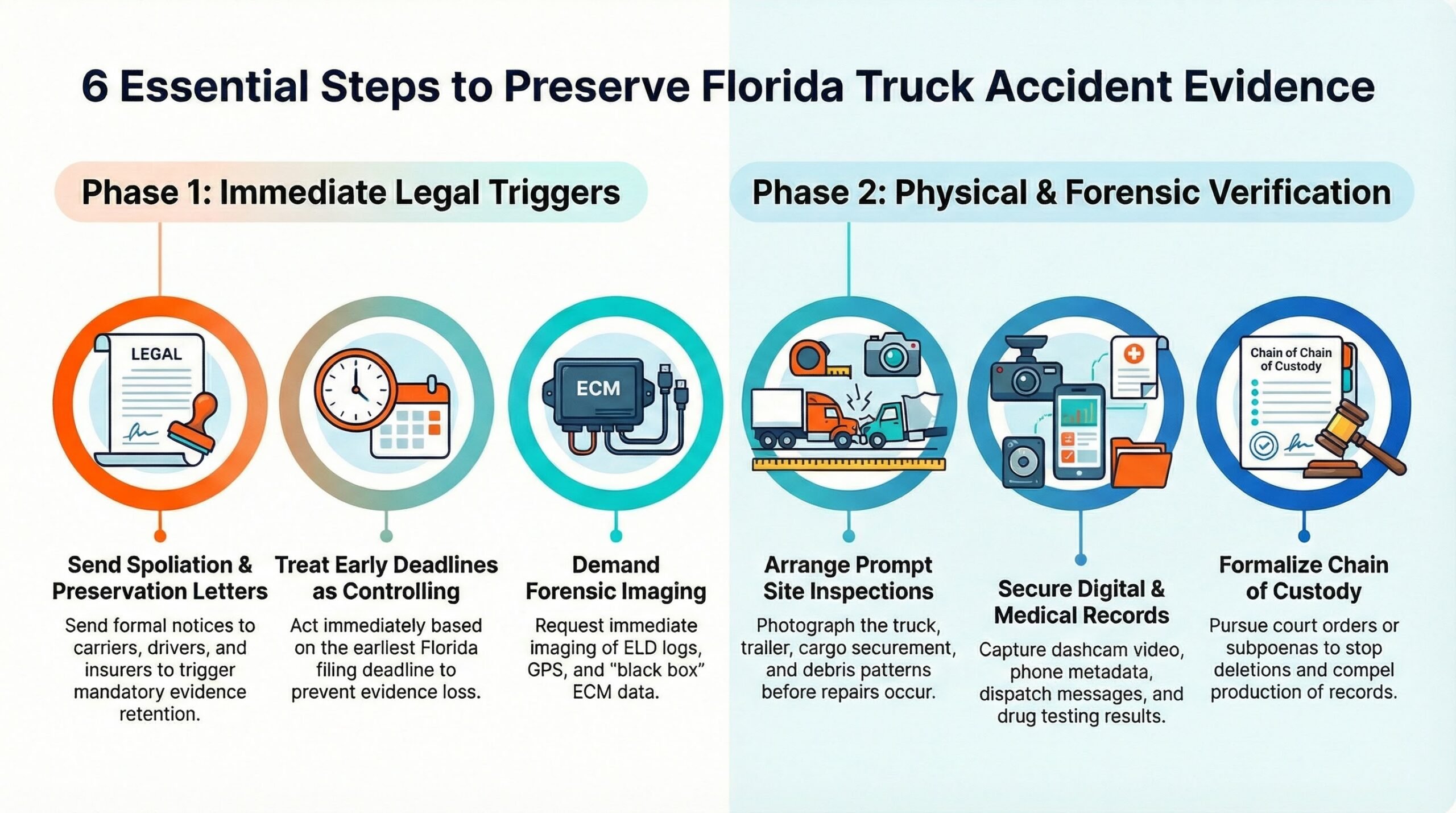
- Act immediately to preserve time‑sensitive trucking evidence and treat the earliest Florida filing deadline as controlling.
- Send spoliation and preservation letters to the carrier, driver, broker, insurer, and maintenance/dispatch vendors to trigger formal preservation duties.
- Demand retention and forensic imaging of ELD logs, GPS, ECM “black box” data, dashcam video, phone metadata, dispatch messages, and drug/alcohol testing results.
- Arrange prompt inspections and forensic photography of the truck, trailer, cargo securement, roadway, debris patterns, and visible injuries before repairs or salvage.
- Track chain of custody and, if needed, pursue court orders or subpoenas to stop deletions and compel production of critical records.


How We Can Help With Your Florida Truck Accident Evidence Preservation Claim
Because critical evidence can disappear within days of a Florida truck crash, we act quickly to preserve what insurers and carriers may not volunteer.
We serve you by moving with urgency, then documenting each step with discipline and care.
We help by identifying the central sources of proof and coordinating immediate collection through trusted professionals.
We arrange forensic photography of vehicles, roadway conditions, cargo areas, and visible injuries, creating a reliable record before repairs, weather, or routine cleanup change the scene.
We also send prompt preservation demands, track preservation timelines, and follow up until we confirm materials are secured and not overwritten or discarded.
When you’re focused on recovery and supporting your family, we handle communications, scheduling, and requests so you don’t carry that burden alone.
Throughout the process, we keep you informed in plain language, explain what we’re doing and why, and align each action with your claim’s goals.
OUR CONSULTATIONSARE FREE
START YOUR FREE CASE REVIEW

Understanding Florida Truck Accident Evidence Preservation Cases
Although a truck crash may appear straightforward at first, evidence-preservation cases in Florida often turn on what we can secure before routine business practices, repairs, and data-retention limits obscure the facts. In these matters, we focus on identifying what records and physical items exist, who controls them, and how quickly they may change.
We often coordinate early documentation of vehicle conditions, scene measurements, and post-crash forensics, so later arguments rest on verified observations rather than assumptions.
We also evaluate whether the trucking company’s actions align with regulatory compliance duties, including required inspections, maintenance records, and retention of electronic information.
When we act promptly, we can request that crucial materials be preserved, track the chain of custody, and reduce the risk of loss or alteration.
Common Causes of Florida Truck Accident Evidence Preservations
When we work to preserve truck accident evidence in Florida, we often confront preventable losses that can shape the outcome of your claim.
We commonly see driver logbook alterations, ELD and GPS data overwrites, and vehicles repaired, salvaged, or destroyed before proper inspections occur.
We also regularly address missing dashcam footage, which can disappear quickly unless we act promptly and implement the right preservation steps.
Driver Logbook Alterations
Logbook alterations can slip under the radar at first, yet they often become the decisive issue in Florida truck accident evidence preservation.
When a driver’s hours appear “too perfect,” we look for logbook tampering and falsified entries that hide fatigue, missed breaks, or unauthorized routes.
We compare handwritten pages to dispatch records, fuel and toll receipts, scale tickets, delivery windows, and maintenance notes to identify inconsistencies.
To serve you well, we act quickly and methodically, because carriers may “correct” logs after a crash and claim the changes were routine.
We request complete driver qualification and hours-of-service files, preserve originals, and document the chain of custody.
When alterations surface, they can clarify liability, support safety violations, and protect the truth for everyone affected.
ELD And GPS Overwrites
In the hours immediately after a Florida truck crash, electronic logging device (ELD) and GPS data can start disappearing through routine overwrites and carrier-side “sync” processes.
When systems roll over, key details, such as speed, hard braking, location pings, and hours-of-service status, may be lost before anyone realizes they exist.
We act quickly to help you serve the truth by sending preservation letters, requesting downloads, and insisting that the carrier suspend automatic deletions.
ELD Overwrites can mask fatigue, route changes, or unreported driving time, while GPS Tampering can distort timelines by disabling units, editing breadcrumbs, or swapping devices between trucks.
We coordinate with qualified experts, document the chain of custody, and pursue court orders when needed, so essential electronic evidence remains intact for your case.
Vehicle Repair Or Salvage
Electronic data can vanish through overwrites, and physical evidence can disappear just as fast once the tractor or trailer goes to a repair bay or salvage yard.
When a carrier authorizes repairs, parts are replaced, welds are redone, and impact points may be ground down, which can erase evidence of a defect, speed, or direction of force.
If the vehicle is declared a total loss, it may move quickly through salvage auctions, where storage lots release it, and components are stripped or sold.
We act early by sending preservation demands, requesting an immediate hold, and arranging inspections before any work begins.
We also secure repair estimates, parts orders, and photographs, because these records can show pre-repair damage and the timing of alterations.
Your prompt action helps us serve others with integrity.
Missing Dashcam Footage
Dashcam footage can slip away without warning after a Florida truck crash, and we often see it missing long before a claim gets filed.
Many systems overwrite video within days, especially when the truck returns to service, gets powered down, or the storage card fails.
In other cases, the device is removed during repairs, and the chain of custody breaks before anyone requests preservation.
We also confront camera tampering, whether intentional deletion, disconnected power, or a “lost” memory card, which can hide crucial seconds before impact.
To serve you well, we act quickly with preservation letters, inspections, and targeted subpoenas, and we coordinate with digital experts to support timely footage recovery.
Early action protects the record and strengthens accountability for everyone involved.


Legal Rights of Florida Truck Accident Evidence Preservation Victims
Although trucking companies and their insurers often control pivotal records from the moment a crash occurs, Florida law gives victims clear rights to pursue and preserve evidence needed to prove fault and damages.
We can assert these rights promptly because evidentiary timelines are tight, and lost data can permanently undermine a well-founded claim.
Truck insurers may control key records early, but Florida law protects your right to preserve evidence before it disappears.
Florida courts recognize a duty to preserve relevant materials once litigation is reasonably anticipated, and preservation noticesformalize that duty and deter spoliation.
When we stand beside you, we do so in service of accountability and community safety, not conflict.
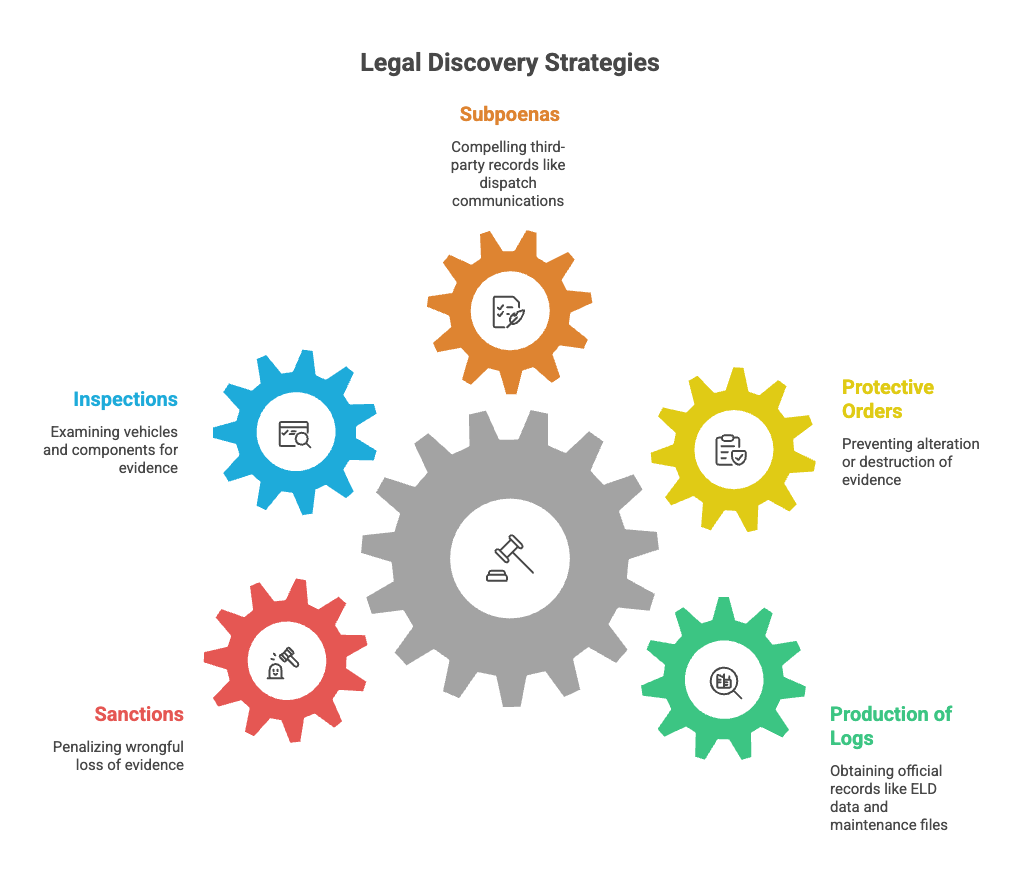
Crucial rights often include:
- Requesting court-ordered production of logs, ELD data, and maintenance files
- Seeking protective orders to prevent alteration or destruction of records
- Pursuing subpoenas for third-party records, including dispatch and shipper communications
- Asking for inspections of the tractor, trailer, and retained components
- Seeking sanctions or adverse inferences when evidence is wrongfully lost
Steps to Take After a Florida Truck Accident: Evidence Preservation
After a Florida truck accident, we need to act quickly to protect evidence before it’s lost or altered.
We’ll send a spoliation letter immediately, and we’ll help you document the scene and your injuries with clear photos, notes, and medical records.
We’ll also move fast to secure crucial trucking company records, including driver logs, electronic data, maintenance files, and dispatch communications.
Send Spoliation Letter Immediately
Time and routine record‑retention practices can erase essential trucking evidence within days, so we should send a spoliation letter immediately to the carrier, driver, and any third‑party maintenance or dispatch vendors.
This notice provides clear instructions to preserve logs, ELD data, onboard video, GPS, ECM “black box” downloads, inspection files, maintenance records, dispatch messages, and drug and alcohol testing materials.
We’ll request forensic preservation, including secure imaging of electronic systems and retention of original hardware, so no data gets overwritten or “cycled out.”
When we frame the matter as potential immediate litigation, we increase accountability and reduce excuses later.
Document Scene And Injuries
Act quickly to document the crash scene and your injuries, because early records often become the most persuasive evidence when accounts change, and physical conditions fade.
If you’re able, we’ll help you capture wide and close photographs of vehicle positions, skid marks, debris patterns, road signage, traffic signals, weather, and lighting.
We should also record time, location, and contact details for witnesses, and note any statements you hear before memories shift.
This photographic documentation can clarify angles, distances, and visibility in ways later descriptions cannot.
For injuries, we’ll encourage prompt evaluation and consistent follow-up, and we’ll maintain careful notes on pain, limitations, and daily impacts.
With your consent, medical photography of bruising, swelling, lacerations, and healing stages can corroborate treatment records and support a clear timeline of harm.
Secure Trucking Company Records
Photographs and medical records can explain what happened and how you were hurt, but trucking company documents often show why the crash occurred and whether safety rules were followed.
We act quickly to secure driver logs, dispatch notes, ELD data, GPS pings, maintenance files, inspection reports, cargo records, and personnel training materials before they are routinely deleted.
We send a preservation letter to the carrier, broker, and insurer, demanding that all paper and electronic records remain intact.
We also request camera footage, drug and alcohol testing results, and post-crash repair invoices that may reveal rushed fixes.
To protect the chain of custody, we coordinate direct collection, imaging, and secure storage, then document every transfer.
When irregularities arise, we conduct a targeted forensic audit to verify authenticity and accountability.
How a Florida Truck Accident Evidence Preservation Lawyer Can Help You
Because critical truck-crash evidence can vanish quickly under routine business practices, we don’t leave preservation to chance.
We act early, align chain preservation with litigation timing, and guide you with steady purpose so your claim reflects the truth and serves everyone impacted.
We preserve truck-crash evidence early, align timing with litigation, and guide you steadily so your claim reflects the truth.
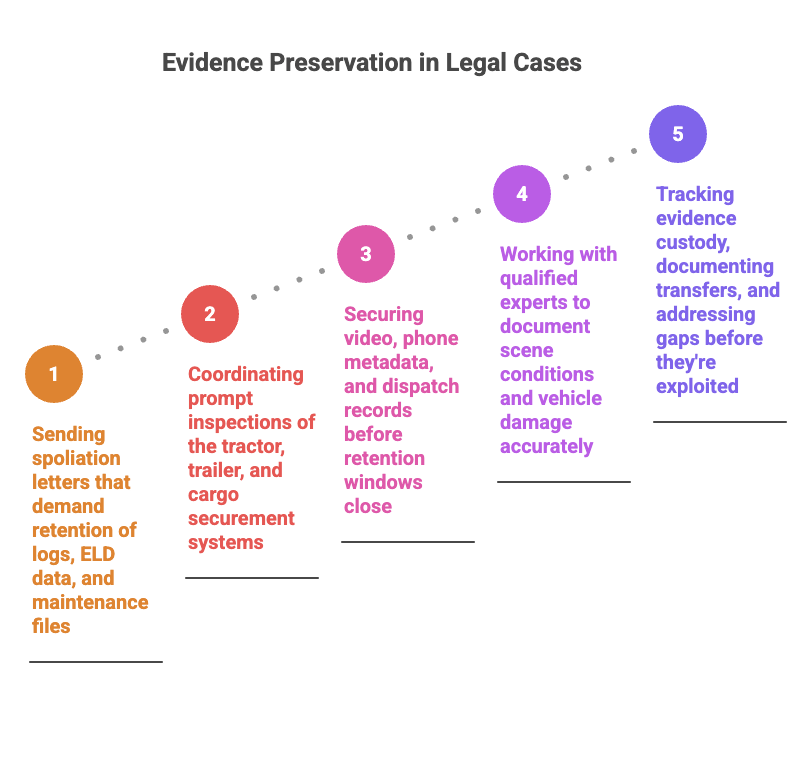
We help you by taking immediate, structured steps such as:
- Sending spoliation letters that demand retention of logs, ELD data, and maintenance files
- Coordinating prompt inspections of the tractor, trailer, and cargo securement systems
- Securing video, phone metadata, and dispatch records before retention windows close
- Working with qualified experts to document scene conditions and vehicle damage accurately
- Tracking evidence custody, documenting transfers, and addressing gaps before they’re exploited
We also handle communications with insurers and opposing counsel, reducing pressure on you and protecting the integrity of the record.
Throughout, we keep you informed, so your decisions reflect both accountability and care for others.
Long-Term Effects of Florida Truck Accident Evidence Preservation Injuries
We recognize that truck accident injuries can create long-term harm that doesn’t end when the initial treatment does, and we want you to understand what that can mean for your future.
We’ll address chronic physical impairments that limit mobility and independence, along with psychological and emotional trauma that can affect sleep, focus, and daily stability.
We’ll also explain the financial and lifestyle consequences, including ongoing medical costs, lost earning capacity, and the lasting adjustments many people must make at home and at work.
Chronic Physical Impairments
Living with a serious truck-crash injury often means managing chronic physical impairments that don’t resolve after the initial treatment ends.
You may face chronic pain that limits concentration, interrupts sleep, and requires ongoing medication, therapy, or procedures.
Many survivors also develop mobility limitations, including reduced range of motion, weakness, or balance problems that make driving, lifting, or even standing difficult.
When these issues persist, we must plan for long-term care, assistive devices, home modifications, and reliable transportation, so you can keep serving your family and community.
We also encourage you to document symptoms, appointments, and functional setbacks, because consistent records help show the true scope of impairment.
Preserving this evidence supports fair compensation for future medical needs and lost earning capacity.
Psychological And Emotional Trauma
After a violent truck crash, the most persistent injuries aren’t always visible, as many survivors develop psychological and emotional trauma that reshapes daily functioning long after the physical wounds stabilize.
We often see post traumatic stress emerge through intrusive memories, hypervigilance, disrupted sleep, and avoidance of driving routes, which can strain relationships and community involvement.
You may also experience depression, irritability, or loss of confidence, especially when recovery feels uncertain.
Because many of us serve others in demanding roles, these symptoms can quietly erode patience, focus, and empathy if left unaddressed.
We encourage early screening by qualified clinicians, consistent therapy, and, when appropriate, structured grief counseling to address loss, guilt, or fear.
With informed support, you can rebuild stability and regain a sense of purpose.
Financial And Lifestyle Consequences
Although the immediate medical crisis may pass, a serious truck collision often triggers long-term financial pressure and lifestyle disruption that can persist for years.
Medical expenses can continue well beyond discharge, including therapy, prescriptions, and follow-up evaluations, and they may coincide with reduced income or an inability to return to prior work.
When mobility or cognition changes, families often face added costs for Home modifications, adaptive equipment, transportation, and in-home assistance, all while routine bills remain due.
We encourage you to document every invoice, mileage log, and employment record, because preserved proof helps us press insurers and defendants for full compensation.
Proving Liability in Florida Truck Accident Evidence Preservation Cases
Because trucking collisions often involve multiple companies, layers of insurance, and rapidly disappearing records, we must prove liability with evidence preserved early and presented in a clear chain of responsibility.
We help you serve your family and community by focusing on facts, not speculation, and by identifying every party that owed a duty of care.
We start by securing electronic logging data, onboard camera footage, dispatch communications, and cargo documents, then we compare them against scene measurements and police findings.
We request maintenance records to test whether poor inspections, worn brakes, or ignored recalls contributed to the crash.
We also conduct timely witness interviews to confirm who saw what, when, and from where, while memories are still reliable.
Next, we trace the control of the driver, tractor, trailer, and load to determine whether negligent hiring, supervision, training, or unsafe scheduling occurred.
Finally, we present these links in a coherent timeline that supports responsibility under Florida law.
Compensation for Florida Truck Accident Evidence Preservation Damages
Damages drive the compensation analysis in Florida truck accident evidence-preservation cases, and we build that analysis around the records we secure before they disappear.
We use medical bills, wage statements, repair estimates, and diagnostic imaging to document economic loss, and we pair them with provider notes and pain journals to support non-economic harms.
When service to others guides your recovery, we also show how injuries limit your ability to care for your family, work safely, and fulfill community obligations.
Because trucking claims involve jurisdictional nuances, we confirm which venues, insurance layers, and responsible entities affect the available recovery, then align evidence requests accordingly.
We focus on claim valuation early, using black-box data, maintenance logs, and hiring files to assess causation, duration, and future costs.
With clear documentation, we negotiate from a position of strength and prepare the file as if it will be tried.
The Statute of Limitations for Florida Truck Accident Evidence Preservation Cases
Tracking the statute of limitations is vital in Florida truck accident evidence preservation cases, since the filing deadline controls whether we can bring the claim at all and, in turn, whether pivotal evidence ever gets enforced through the court process.
When we miss that window, courts may refuse to consider the request, and the practical ability to compel records, downloads, and documents can fade quickly.
Florida’s statute limits can vary by claim type, so we should treat the earliest plausible deadline as controlling and act promptly.
We also need to account for potential exceptions, including discovery tolling, which may pause or extend time when essential facts couldn’t reasonably be known.
Still, tolling arguments are narrow and fact-driven, and we shouldn’t rely on them as a plan.
Why You Need an Experienced Florida Truck Accident Evidence Preservation Lawyer
Even when we act quickly after a Florida truck crash, vital evidence can disappear within days through routine overwriting, document retention cycles, or informal repairs, and we can’t rely on the trucking company to preserve what helps our case.
That’s why we need experienced counsel who can issue prompt spoliation notices, demand a clear preservation protocol, and secure court orders when cooperation is limited.
We coordinate forensic photography of vehicle damage, roadway conditions, and cargo securement before changes occur, and we obtain electronic data, driver logs, maintenance files, and dispatch communications while they still exist.
Just as important, we safeguard the chain of evidence so the evidence remains credible, traceable, and admissible.
We also work with qualified experts who can interpret technical records and provide expert testimony that connects the preserved evidence to liability and damages.
Through disciplined preservation, we protect your claim and hold the responsible parties accountable for the harm caused.
How to Choose the Right Florida Truck Accident Evidence Preservation Lawyer for Your Case
Because truck-crash evidence can vanish quickly, we should choose counsel based on proven preservation skill rather than a generic injury track record.
Truck-crash evidence disappears fast, so choose counsel for proven preservation skill—not just a generic injury track record.
We’ll want a lawyer who can act immediately, send preservation letters, and seek court orders when carriers delay or deny access. Ask how they protect the evidence chain, from electronic logging data to maintenance files, so nothing gets lost or challenged later.
We should review their preservation tactics in prior trucking cases, including rapid scene documentation, coordination with qualified experts, and secure handling of digital records.
We can request clear timelines, staffing plans, and communication practices, as speed and consistency serve the people who depend on us.
Confirm they understand Florida trucking regulations and can identify every party that holds crucial materials, such as brokers, shippers, and third-party maintenance vendors.
Finally, we should choose counsel who explains risks plainly, sets measurable next steps, and treats our case as a responsibility to the community we serve.
About the Law Offices of Anidjar and Levine
Selecting counsel based on preservation capability leads us to contemplate the Law Offices of Anidjar and Levine, a Florida firm that focuses on acting quickly to secure truck-accident evidence before it disappears.
We approach each matter with a service mindset, because your recovery can support medical care, family stability, and safer roads for others.
We begin by sending preservation letters, coordinating prompt inspections, and pursuing records that may include electronic data, maintenance files, and dispatch communications.
We also work with qualified professionals when reconstruction or downloading onboard systems is necessary, and we do so without delay.
Our firm’s history reflects a consistent commitment to responsive advocacy, clear communication, and disciplined preparation.
We keep you informed, return calls, and explain next steps so you can make confident decisions.
When reviewing client testimonials, you’ll see emphasis on respect, diligence, and follow-through, traits that align with evidence-driven truck litigation.
Frequently Asked Questions
Will the Trucking Company Destroy Evidence if I Wait to Contact a Lawyer?
Yes, it’s possible, and waiting can increase spoliation risks.
We can’t assume bad faith, but routine record overwrites, vehicle repairs, and document retention policies may remove crucial data.
We should act promptly because the notification timeline matters, and early written preservation requests can secure logs, GPS data, ECM data, dash video, maintenance records, and driver records.
Can I Still Preserve Evidence if My Truck Was Repaired or Scrapped?
Yes, we can still preserve valuable evidence even if your truck was repaired or scrapped.
We’ll gather post-repair documentation, including invoices, photos, and diagnostic reports, to reconstruct the condition and damage.
If it was scrapped, we’ll request salvage yard receipts, inventory logs, and parts disposition records, and we’ll secure any remaining components for inspection.
We also obtain repair shop statements and digital data backups to support accountability.
How Do I Obtain Dashcam Footage From Another Vehicle or Nearby Business?
We obtain dashcam footage by quickly identifying the vehicle owner or business, then sending request letters that specify the date, exact time range, location, and camera type.
We ask them to preserve originals and provide an unedited copy, since overwriting can occur within days.
We also document the footage timeline, including when we asked, who received notice, and any responses.
If they refuse, we pursue subpoenas through proper channels.
Do I Need a Court Order to Access the Truck’s Black Box Data?
You don’t always need a court order to compel access, but we often do. We can request the truck’s event data from the carrier or insurer, yet they may refuse or delay.
When cooperation fails, we’ll seek a subpoena or preservation order and coordinate expert retrieval. We must protect the legal chain of custody so that the data remains reliable and usable.
Act quickly because systems can overwrite information.
What Evidence Should I Personally Photograph or Save at the Crash Scene?
We recommend photographing the vehicle positions, all damage, and debris fields before any movement.
Capture roadway markings, traffic signals, signage, lighting, weather, and any obstructions.
Take clear injury closeups only if safe and respectful, and note when symptoms began.
Record the truck’s DOT numbers, license plates, company name, and trailer identifiers.
Save witness names, numbers, and brief statements, and preserve dashcam files, texts, and call logs.
————————
When a truck crash occurs, crucial evidence can disappear quickly, and the Law Offices of Anidjar and Levine acts promptly to preserve it.
We’ll send preservation letters, pursue inspection orders when needed, and secure electronic data, maintenance records, and witness accounts before they’re lost.
We also handle insurer communications and build a clear liability narrative supported by documented proof.
If you’re facing injuries and uncertainty, we’re prepared to protect your rights and position your claim for fair compensation with help from a Florida Truck Accident Lawyer.