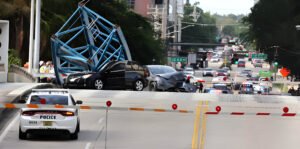
A construction crane collapsed Monday morning on Brickell Bay Drive, crushing a vehicle and sending at least four people to the hospital. If you or a loved one was hurt, evidence is disappearing by the hour — and Florida’s 2-year filing deadline is already running.
Published September 14, 2026 · The Law Offices of Anidjar & Levine
What Happened: Crane Collapses at Brickell Bay Drive and SE 12th Street
On the morning of Monday, September 14, 2026, a construction crane collapsed in the heart of Miami’s Brickell neighborhood near the intersection of Southeast 12th Street and Brickell Bay Drive. According to NBC 6 South Florida, Miami Police confirmed the collapse and shut down Brickell Bay Drive between Southeast 12th Street and Southeast 13th Street while emergency crews worked to secure the scene, extinguish an active vehicle fire, and search for anyone trapped in or beneath the debris. Because of the density of pedestrian and vehicular traffic in Brickell during the morning commute, the closure disrupted access throughout the surrounding blocks and forced rerouting well into the afternoon.
Video and still images show the crane lying across the roadway, with a white vehicle crushed underneath and engulfed in flames as dark smoke rose above the high-rises. CBS 12 (WPEC), citing CBS Miami, reports that at least four people were injured and transported to area hospitals. Additional coverage from Local 10 News confirms four people were transported to the hospital following the collapse. Whether the occupants of the burning vehicle survived, and how badly they were hurt if they did, has not been publicly reported at the time of this writing.


As of publication, city officials have not released the cause of the collapse. Miami Police and the responding agencies were scheduled to hold a news conference to provide updates. Investigators from the U.S. Occupational Safety and Health Administration are almost certainly on scene or on their way, because federal law requires OSHA to open an inspection whenever a workplace incident results in a fatality or the hospitalization of one or more workers. Brickell is one of the most densely developed neighborhoods in the country, with active high-rise construction sites, tower cranes, and dozens of new residential and commercial projects underway at any given moment, and any one of the neighborhood’s many active job sites could be the source of the collapsed rig.
Brickell Crane Collapse Claims — Key Data Every Injured Person Should Know
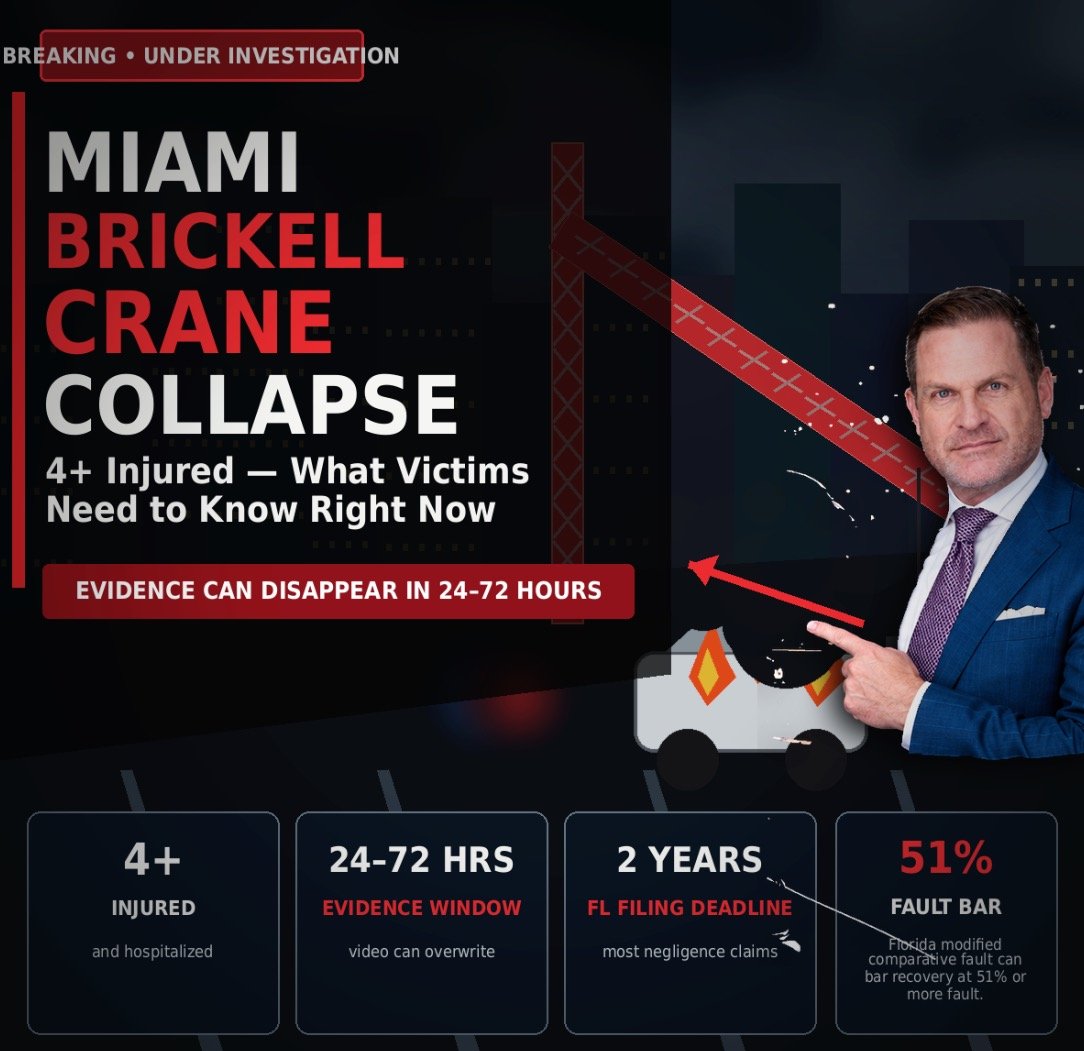
The three paragraphs that follow set the framework for why a Miami crane collapse case is legally distinct from an ordinary injury claim, why the timeline is compressed, and why insurers and construction defendants move quickly to lock in an unfavorable narrative. The editorial infographic below summarizes the same data points at a glance.
Cranes are among the most heavily regulated pieces of construction equipment in the United States. OSHA 29 CFR §1926.1412 requires daily pre-shift inspections, monthly “frequent” inspections, and annual comprehensive inspections of every crane used in construction. Certified operators must hold credentials under 29 CFR §1926.1427, and dedicated signal persons and rigging teams must be trained under §1926.1428 and §1926.1425. Bureau of Labor Statistics fatal injury data shows that fall, struck-by, and equipment-collapse events account for a large share of construction fatalities every year, and cranes appear disproportionately in the “struck by” and “caught in or between” categories that BLS tracks for construction.


Florida’s 2023 tort reform statute, HB 837, made every serious injury claim in this state more time-sensitive than it used to be. The statute of limitations for most negligence claims dropped from four years to two years, effective March 24, 2023, and Florida moved from pure comparative fault to a modified system that bars recovery entirely if the injured person is found 51% or more at fault. In a crane collapse case, defense teams will look for any argument to place a share of fault on drivers, cyclists, or workers near the scene, so preserving evidence that shows who was actually responsible must begin immediately.
Finally, the physical and documentary evidence that decides a crane collapse case begins to degrade or disappear within 24 to 72 hours. The crane itself is disassembled, hauled off, and often shipped back to a leasing company. Load logs and inspection records get amended. Surveillance and traffic-camera footage from surrounding high-rises overwrites on a 24- to 72-hour cycle. Witness memory fades. Formal spoliation letters must reach every party in interest — the developer, the general contractor, the crane subcontractor, the equipment manufacturer, and neighboring building owners with cameras — before the physical and digital record is gone.
Why Crane Collapse Cases Are Different From an Ordinary Accident Claim
A crane collapse is not a routine injury case. It is a mass-casualty construction event that can involve many potentially responsible parties, sophisticated defense teams, layered insurance policies, and highly technical questions about equipment inspection, load calculations, ground and wind conditions, operator certification, and site supervision. Anyone hurt in the Brickell incident, whether a driver in the crushed vehicle, a pedestrian on the sidewalk, a cyclist in the bike lane, a delivery worker, or a construction employee on the job site itself, is up against a defense apparatus that will begin working within hours to shift blame and limit exposure.
Under Florida’s general contractor and OSHA framework, a tower crane on a high-rise construction site typically involves several distinct commercial actors, each with its own contract, insurance policy, and defense counsel. The property owner or developer commissioned the project and set the schedule. The general contractor oversees the site and coordinates safety across every subcontractor. A specialized crane subcontractor supplies, erects, and often operates the crane, while the certified crane operator holds federally required credentials and reports up through that subcontractor’s chain of command. The equipment manufacturer or leasing company that provided the crane may bear product-liability responsibility if a component failed, and a third-party inspection or engineering firm may have certified the erection or the tower’s tie-in to the building. Rounding out the picture, a separate rigging or signal-person subcontractor is often responsible for the load itself and for communicating with the operator during the lift.
Each of these parties typically carries its own liability insurance, indemnity and additional-insured agreements, and defense counsel. Without an experienced legal team pursuing every angle, injured people are frequently pushed toward the smallest available policy while the deeper coverage sources go untouched. A well-built case identifies every responsible party, quantifies every applicable policy, and forces meaningful contributions from the parties whose negligence actually caused the collapse.
Florida Law and the Deadlines That Are Already Running
Florida’s 2023 tort reform law, HB 837, made several sweeping changes that apply directly to crane collapse victims and that are worth understanding in full. First, the statute of limitations for most negligence-based claims dropped from four years to two years, effective March 24, 2023. That deadline sounds distant when the injured person is still in the hospital, but between multiple surgeries, months of physical therapy, disputes with insurance carriers, and the sheer disorientation of a catastrophic injury, two years can slip away quickly. Missing the deadline is fatal to the case, no matter how strong the underlying facts.
Second, Florida shifted from pure comparative fault to a modified comparative fault regime with a 51% bar. If a defendant convinces the jury that the injured person was 51% or more at fault, recovery is barred entirely. In a crane collapse case, construction defendants will argue that drivers should have avoided the block, that pedestrians should have crossed elsewhere, or that workers on the site should have known better than to be in the fall zone. Those arguments do not have to succeed for the defense to gain leverage in settlement negotiations, and you can neutralize them only with strong evidence developed early.
Third, HB 837 tightened the rules around bad-faith insurance claims, changed how medical bills are proved at trial, and adjusted how letters of protection are treated. These changes affect how compensation is calculated at settlement or verdict, and a lawyer familiar with the reformed rules is essential. In addition to the state statute, an OSHA investigation almost always opens within hours of a serious construction incident. OSHA reports, witness interviews, and equipment inspection findings can be powerful evidence in a civil case, but only if an attorney preserves, obtains, and uses them properly and knows how to synchronize the federal record with the state-court claim.
Workers’ Compensation vs. a Third-Party Injury Claim
If someone hurt in the Brickell collapse was working on the construction project when the crane fell, Florida workers’ compensation may cover a portion of their medical bills and lost wages. Workers’ comp is a no-fault system: it does not require the injured worker to prove anyone was negligent. But that convenience comes at a cost. Workers’ comp benefits almost never cover the full measure of damages after a catastrophic injury. It does not pay for pain and suffering. It does not pay for the full value of future lost earning capacity. And it does not hold third parties — equipment manufacturers, subcontractors, engineering firms, leasing companies — accountable when their negligence caused the collapse.
A qualified crane accident attorney can pursue workers’ compensation benefits in parallel with a separate third-party liability claim against every non-employer party whose negligence contributed to the incident. That is the path to full recovery, and it is legally distinct from the workers’ comp exclusive remedy rule. The two claims move on separate tracks, but a coordinated legal team ensures they do not undercut one another, that liens and offsets are handled correctly, and that the injured worker keeps as much of the recovery as the law allows.
If the injured person was not a construction employee—a driver, a pedestrian, a cyclist, a delivery worker, or anyone else simply passing through Brickell that morning—workers’ comp does not apply at all. In that case, every dollar of medical costs, lost income, pain and suffering, permanent disability, and future care must come from a civil claim against the parties responsible for the collapse. That claim is exactly the kind of complex, multi-defendant construction case that requires a firm with the resources and experience to see it through.
Why Evidence in a Crane Collapse Case Disappears Within Hours or Days
The single biggest reason injured people should contact a lawyer immediately after a crane collapse is that the evidence needed to prove the case starts disappearing within hours. In a construction incident of this scale, the evidence at risk falls into several overlapping categories, and each demands attention within its own preservation window.
The crane and rigging itself are the most important physical evidence in the entire case. Once the incident scene is cleared, the crane will be dismantled, removed, and often shipped back to a leasing company or to the manufacturer. Physical inspection of the load lines, jib welds, slew rings, counterweights, hydraulic systems, and structural members becomes exponentially harder after the equipment is disassembled and shipped, and once the individual pieces are separated it may be impossible to reconstruct the failure sequence. A prompt court order or preservation demand can freeze that process while a qualified engineering expert examines the components.
Beyond the crane itself, an enormous volume of documentary evidence lives in the general contractor’s and subcontractor’s offices. Every daily pre-lift inspection, monthly inspection, and annual comprehensive inspection required under OSHA 29 CFR §1926.1412 generates paperwork that establishes the crane’s condition and the diligence of the operator’s employer. Lift plans, load charts, wind-speed monitoring logs, ground-condition assessments, operator certifications, and rigging documentation can prove that the collapse was foreseeable and avoidable — but only if the plaintiff’s team demands them before they are lost, misfiled, or amended after the fact.
Downtown Miami is saturated with private security cameras, traffic cameras, and building lobby cameras, and Brickell in particular has one of the highest concentrations of surveillance systems in the state. The problem is that most of those systems overwrite footage on a 24- to 72-hour cycle. Once the video of the fall and the minutes leading up to it is overwritten, the single most powerful piece of evidence in the case is gone forever. Formal preservation letters must reach neighboring building owners and businesses within hours of the incident.
Witness statements, cell phone records, and radio communications also decay quickly. Nearby workers, doormen, pedestrians, and drivers remember what they saw most accurately in the hours right after the collapse. Rigging teams typically communicate by radio during a lift, and the crane operator, foreman, and signal person may have exchanged text messages or app messages in the minutes leading up to the fall. Those communications can prove whether the operator ignored a warning, whether the signal person waved off the load, or whether a supervisor overrode a safety concern — but only if the records are subpoenaed before carrier retention windows close.
Finally, weather data is often central to a crane collapse case. Wind speed and direction in the hours leading up to the collapse can be the difference between a defensible operation and one that should have been shut down. NOAA and airport records are permanent, but linking them to the specific site conditions requires expert reconstruction and a fast-moving legal team. An experienced law firm sends formal spoliation letters to every party in interest within hours of being retained — the general contractor, the crane subcontractor, the property owner, the equipment manufacturer, and neighboring building owners with surveillance systems — demanding preservation of every category of evidence and notifying them that destruction may result in court sanctions or an adverse inference at trial.
Common Injuries in a Miami Crane Collapse
Crane collapses at the scale of the Brickell incident cause severe, life-changing injuries. The kinetic energy involved when a tower crane falls onto a roadway is enormous, and secondary hazards like the vehicle fire visible in early Brickell scene photos add another layer of harm. Injured people commonly present with traumatic brain injury (TBI) from crushing impact or blunt-force trauma, spinal cord injuries ranging from herniated discs to complete paralysis, multiple bone fractures including crush fractures of the pelvis, chest, and extremities, and severe burns from post-collision vehicle or fuel fires. Internal organ damage, internal bleeding, and traumatic amputations are all common in this pattern of injury, and long-term outcomes frequently include permanent disability requiring lifelong care.
Beyond the physical trauma, survivors of catastrophic construction incidents often develop post-traumatic stress disorder, acute anxiety, and complex psychological injury that may not be diagnosed for weeks or months after the initial event. Documenting the full arc of these injuries, from the emergency department visit through months of physical and mental health treatment, is essential to any recovery. These injuries require months or years of medical care, extensive rehabilitation, and often permanent lifestyle adaptation. The compensation ceiling in a well-prepared crane collapse case can reach into the millions of dollars, but the case must be built correctly from day one, with the right experts, evidence, and legal strategy.
What to Do Right Now if You or a Loved One Was Hurt
In the first hours and days after a crane collapse, injured people and their families face a series of decisions that will shape the case for years to come. The single most important priority is medical care: follow every discharge instruction, attend every follow-up appointment, photograph visible injuries as they heal, and keep every receipt for out-of-pocket expenses, prescription costs, medical devices, transportation to appointments, and any other injury-related spending. Missed appointments and gaps in treatment are the two arguments defense adjusters use most often to minimize a claim, so continuity of care is not just a health issue — it is a legal one.
Second, do not give a recorded statement to any insurance carrier, whether it is your own, the construction company’s, or anyone else’s. Adjusters are trained to elicit statements that will later be used against the injured person on issues of fault and injury severity. Similarly, do not sign any release, waiver, or settlement offer in the early days of the case. Construction defendants and their insurers know that a serious injury victim in the first weeks after a collapse is under maximum emotional and financial pressure, and their earliest offers are usually a fraction of the true case value. Signing a release ends the case permanently, and no amount of later work can undo it.
Third, preserve everything. Save the clothing you were wearing, protect the vehicle (do not let it be totaled and hauled off without an attorney’s inspection), keep your phone with any photos or videos of the scene, and save every text message or email exchanged about the incident. Even mundane messages to family members describing what happened can become important evidence. Finally, and most importantly, contact an experienced Florida personal injury lawyer immediately. The sooner counsel is engaged, the more evidence can be preserved, the more parties can be identified, and the stronger the resulting case will be. Nearly every crane collapse case that recovers a full measure of damages starts with counsel retained within days of the incident.
About The Law Offices of Anidjar & Levine
Founded in 2005 by Marc Anidjar and Glen Levine, The Law Offices of Anidjar & Levine began as a two-person operation working out of a construction office conference room. Over the past 20 years, that modest start has grown into one of Florida’s most recognized personal injury practices, with more than $1 billion recovered in settlements for injury clients across the state. Marc Anidjar is Board Certified in Civil Trial Law by The Florida Bar, a distinction held by fewer than 3 percent of Florida attorneys, and holds an AV Preeminent rating from Martindale-Hubbell, the legal industry’s highest peer-review recognition for professional excellence and ethical standards. Glen Levine also holds an AV Preeminent rating and has represented seriously injured clients across Florida for more than two decades.
Our firm handles serious construction and crane accident cases across Miami-Dade, Broward, and Palm Beach counties, and we work directly with certified accident reconstructionists, structural engineers, and OSHA-experienced experts to build the strongest possible case for every injured person and every grieving family. If you or someone you love was hurt in the September 14, 2026 Brickell crane collapse, or in any construction incident in Miami, we are available 24 hours a day for a free, confidential consultation. We don’t charge a fee unless we win your case.
Sources
• NBC 6 South Florida — “Crane collapse in Brickell causes road closures, police say” (Julian Quintana, September 14, 2026)
• CBS 12 (WPEC) — “At least 4 injured after crane collapses in Miami’s Brickell neighborhood” (Gershon Harrell, September 14, 2026)
• Local 10 News — “4 transported to hospital after crane collapse in Miami” (September 14, 2026)
• OSHA 29 CFR §1926.1412 — Inspections of Cranes and Derricks in Construction
• U.S. Bureau of Labor Statistics — Census of Fatal Occupational Injuries
Disclaimer: This blog post is for general informational purposes only and does not constitute legal advice. Reading it does not create an attorney-client relationship with The Law Offices of Anidjar & Levine. Facts about the September 14, 2026 Brickell crane collapse are based on early news reports and may be updated as the official investigation proceeds. Past results do not guarantee future outcomes.