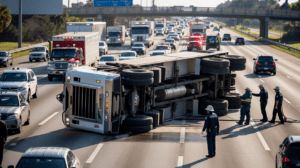
Introduction: The Complexities of Corporate Fleet Accidents
Litigation involving commercial truck accidents against corporate fleets like Coca-Cola is a high-stakes legal environment where simple driver error is merely the final link in a chain of systemic failures. These cases are won or lost not on the facts of the collision alone, but on the ability to dissect complex issues of corporate policy, supply chain pressures, and vicarious liability.
Learn More: Miami Coca-Cola Truck Accident Lawyer
The actions of a driver are often a symptom of decisions made in boardrooms, dispatch centers, and maintenance bays. This case study provides a playbook for establishing corporate culpability, using Florida law as a framework to illuminate the disciplined investigative and legal processes required to prove liability and secure just compensation.
——————————————————————————–


1.0 Initial Incident Response and Preservation of Rights
The actions taken in the immediate aftermath of a commercial vehicle collision are of paramount strategic importance. This initial phase is not merely about managing a crisis; it is a critical window for both ensuring safety and preserving the integrity of a future legal claim. The evidence is perishable, corporate data destruction policies are unforgiving, and a failure here can become a case-ending error before the case even begins.
1.1 Foundational Steps: Scene Management and Evidence Documentation A disciplined response at the accident scene provides the factual foundation upon which a successful liability claim is built. The following procedural steps are essential:
- Ensure Safety First The immediate priority is to prevent further harm. This involves moving to a safe location away from traffic if possible, activating hazard lights, and calling 911 to request police and medical assistance. First responders should be allowed to manage the scene, and their instructions must be followed to maintain order and safety.
- Document Evidence Thoroughly While waiting for authorities, systematic documentation of the scene is crucial. This includes photographing vehicle positions, skid marks, roadway conditions, and visible injuries. Collecting contact and insurance information from all parties and contact information from any witnesses provides invaluable third-party perspectives. All records generated from the incident, including medical reports and vehicle repair estimates, must be meticulously preserved.
- Notify Insurer Promptly A timely report to the appropriate insurance carrier is necessary to comply with policy requirements. The report must be strictly factual, avoiding speculation or admissions of fault. A recorded statement should never be given until the full scope of the claim and legal strategy have been reviewed, as insurers are trained to elicit responses that can be used to undermine a claim’s value.
1.2 Asserting Core Legal Rights Under Florida Law Victims of a commercial truck accident possess fundamental legal rights that must be asserted early to establish a strong legal position. Under Florida law, these rights form the basis for holding negligent corporate entities accountable.
- The right to pursue compensation from all responsible parties, not just the driver. This is grounded in legal principles of negligence and vicarious liability, which hold an employer responsible for the actions of its employees.
- The right to pursue claims against multiple defendants within the corporate and maintenance supply chain. This can include the fleet operator, loading contractors, third-party maintenance providers, and even parts manufacturers if a defect contributed to the crash.
- The right to control evidence by issuing formal preservation notices. This legal demand is a critical first strike, compelling the corporation to safeguard data like black box logs and internal records that would otherwise be destroyed under routine data retention policies. It is a race against the clock.
- The right to a fair process, which includes assertive negotiation backed by a willingness to litigate. This ensures that procedural rights are protected, strict filing deadlines are met, and the victim’s claim is valued based on its true merits.
This initial response phase sets the stage for the deeper investigative work required to deconstruct the incident and build an undeniable case for liability.
——————————————————————————–
2.0 The Investigative Framework for Proving Negligence
Proving negligence in a commercial trucking case demands a disciplined, multi-faceted investigation that moves beyond the surface facts of the collision. The objective is to uncover systemic failures in corporate operations, maintenance protocols, and driver oversight that created the conditions for the accident to occur. This process transforms a collection of facts into a clear narrative of legal responsibility.
2.1 Analysis of Common Causal Factors Investigations frequently reveal that commercial truck accidents stem from one or more of the following systemic failures, each often linked to corporate-level decisions:
- Driver Fatigue and Hours-of-Service (HOS) Violations: Federal regulations strictly limit driving hours, yet long shifts, irregular routes, and night driving create Circadian disruption that degrades judgment and reaction times. These violations are rarely isolated incidents; they are often the result of systemic pressure from dispatchers to meet unrealistic delivery schedules—a common indicator of a corporate culture that prioritizes profit over safety.
- Improper Loading Practices: Incorrect weight distribution or inadequately braced cargo can shift in transit, destabilizing a trailer and turning a routine delivery into a rollover or jackknife on Miami’s crowded streets. This points to failures in training, supervision, or protocols at the loading dock, which are the responsibility of the carrier or its contractors.
- Vehicle Maintenance Failures: Neglecting fleet upkeep on critical systems directly contributes to collision risk. This is not random chance but the result of corporate decisions to extend service intervals or use non-OEM parts like mismatched tires and overdue brake components to cut costs, creating a discoverable pattern of systemic neglect.
- Adverse Weather Conditions: While weather is uncontrollable, the response to it is a corporate duty. Factors like heavy rain magnify risks, imposing a heightened duty of care on employers to train drivers, adjust schedules, and ensure vehicle systems are optimized for the environment, rather than leaving drivers to make critical safety decisions under pressure.
2.2 Building the Evidentiary Trail A powerful liability claim is built upon a foundation of credible, verifiable evidence. Each piece of information plays a specific role in reconstructing the event and establishing an irrefutable chain of causation.
| Evidence Category | Analytical Significance |
| Scene and Vehicle Data | Documents physical conditions, vehicle positions, and skid marks. Event data recorder (EDR) metrics reveal speed, braking, and driver inputs immediately preceding the crash. |
| Witness Statements | Corroborates timelines, driver conduct, and environmental conditions, providing third-party accounts of the event sequence. |
| Electronic Forensics | Extracts telematics, GPS logs, and phone records to identify distraction, speeding, or other policy violations. |
| Corporate Records | Uncovers systemic negligence through review of driver qualification files, HOS logs, and company safety policies. |
| Maintenance and Inspection Histories | Links mechanical failures to the collision by revealing gaps in service, use of improper parts, or ignored repair mandates. |
| Expert Testimony | Synthesizes all factual evidence through accident reconstruction, human factors analysis, and fleet safety standards to create a clear, credible liability narrative. |
By meticulously assembling this evidentiary trail, the investigation moves beyond attributing blame to proving legal negligence and identifying every responsible party.
——————————————————————————–
3.0 Deconstructing Corporate Liability: The Chain of Responsibility
Successfully litigating a commercial trucking case requires an offensive strategy that moves beyond the driver to dismantle the defendant’s corporate structure and expose every negligent actor in the supply chain. In commercial transportation, liability is rarely confined to the individual behind the wheel; it extends up the corporate ladder and across the intricate network of contractors and service providers.
3.1 The Principle of Vicarious Liability A cornerstone of this strategy is the principle of vicarious liability. This doctrine holds that an employer, such as Coca-Cola, is legally responsible for the negligent acts of its employees when those acts occur within the scope of their employment. This doctrine is the primary legal mechanism for accessing the corporate defendant’s deeper pockets, as a driver’s personal insurance is often insufficient to cover the catastrophic damages resulting from a commercial truck accident.
3.2 The Independent Contractor Complication Corporations frequently attempt to shield themselves from liability by classifying drivers as independent contractors. This defense, however, is not absolute and can be defeated by demonstrating the company’s actual control over the driver’s work. Factors that point toward an employment relationship include the company’s control over:
- Routes and schedules
- Branding and vehicle appearance
- Vehicle maintenance standards
- Safety protocols
Even if a driver is a legitimate contractor, the company may still be held liable for its own direct negligence, such as negligent hiring of an unqualified driver or failure to provide proper supervision.
3.3 Liability Within the Broader Supply Chain The complex logistics of moving goods involves multiple entities, any of which can bear responsibility if their negligence was a contributing factor. Potentially liable parties include:
- Loading Contractors: A third-party company can be held liable if its employees improperly distribute weight or fail to secure cargo, leading to vehicle instability.
- Maintenance Providers: Repair shops that perform negligent service, use improper parts, or fail to identify critical defects share liability for a resulting mechanical failure.
- Fleet Operators & Franchisees: In franchise models, the local operator can be held responsible for failures in its own supervision, training, or policy enforcement.
- Product Distributors: Liability may extend to distributors whose operational demands, such as unrealistic delivery schedules, create pressures that promote unsafe driving practices.
Identifying these various parties is a critical step before quantifying the full extent of the harm they caused.
——————————————————————————–


4.0 A Framework for Comprehensive Damage Assessment
A comprehensive damage assessment demands a meticulous and forward-looking approach. Full compensation must account not only for immediate expenses but also for the profound and lasting physical, emotional, and financial consequences of a serious accident. This process ensures the recovery reflects the true, long-term scope of the victim’s losses.
4.1 The Spectrum of Long-Term Injuries The impact of a commercial truck accident often extends far beyond the injuries diagnosed in the emergency room.
- Chronic Pain Syndromes: These conditions can develop months after the incident and involve complex biological changes, such as central sensitization, where the nervous system becomes hypersensitive and amplifies pain signals. Documenting these syndromes is critical because defense counsel often attempts to dismiss them as subjective or unrelated to the initial trauma. Expert medical testimony linking them to biological changes is therefore non-negotiable for proving the full extent of damages.
- Cognitive and Emotional Impacts: The trauma of the accident and the strain of chronic pain can have significant cognitive consequences, including “brain fog,” memory issues, and difficulty with concentration. Anxiety, depression, and Post-Traumatic Stress Disorder (PTSD) are also common, requiring neuropsychological evaluations and trauma-informed therapy to address and quantify.
4.2 Translating Harm into Financial Compensation Under Florida law, victims are entitled to seek compensation for a wide range of damages. A thorough claim quantifies each category of loss with clear, documented evidence.
- Economic Damages: These are the verifiable financial losses, including all past and projected future medical care, lost wages, diminished future earning capacity, and costs for vocational retraining or in-home assistance.
- Non-Economic Damages: This category provides compensation for the intangible, human costs of the accident, including physical pain and suffering, emotional distress, loss of enjoyment of life, and the negative impact on family relationships.
- Property Damages: This covers the cost to repair or replace the victim’s vehicle and any other personal property damaged in the collision.
- Punitive Damages: In cases where the defendant’s conduct demonstrated a reckless disregard for safety, punitive damages may be awarded. These are intended not to compensate the victim but to punish the wrongdoer and deter similar dangerous conduct in the future.
4.3 Special Considerations: Liens and Self-Employment Calculating damages can be complicated by financial factors unique to the victim’s circumstances.
| Issue | Resolution Strategy |
| Health Insurance Reimbursement | Insurers often require reimbursement via subrogation or liens. The legal strategy involves reviewing policies, challenging unrelated charges, and negotiating reductions to maximize the client’s net recovery. |
| Lost Income for Self-Employed/Gig Workers | Proving lost income requires meticulous documentation, including tax returns, 1099s, invoices, and client contracts to establish a credible history and projection of earnings. |
After a complete assessment of damages, the final step is to navigate the procedural rules that govern the timeline for filing and resolving a claim.
——————————————————————————–
5.0 Procedural Law and Strategic Case Management
A factually strong and well-documented case can be defeated by procedural errors. Successfully navigating a claim against a well-resourced corporate defendant requires an unwavering command of critical rules, such as filing deadlines, and strategic imperatives like evidence preservation. This final phase ensures the case is managed with the same discipline used to build it.
5.1 Florida’s Statute of Limitations: A Critical Deadline Florida law imposes a strict deadline, known as the statute of limitations, for filing a lawsuit. This rule is unforgiving.
- For most personal injury claims, a lawsuit must be filed within two years of the date of the accident.
- For wrongful death claims, the lawsuit must be filed within two years of the date of death.
Missing this deadline is an absolute and permanent bar to recovery, regardless of the merits of the case. It is a jurisdictional “kill switch” for the entire claim. While narrow exceptions exist, and shorter timelines can apply to claims involving government entities, prompt action is non-negotiable.
5.2 The Role of Corporate Policies in Evidence Discovery A corporation’s internal data policies directly threaten the availability of crucial evidence. To combat routine deletion of electronic data, a formal preservation letter is sent, creating a “litigation hold.” This letter puts the corporation on formal notice; any subsequent destruction of relevant data can be considered spoliation of evidence, leading to severe court sanctions. Verifying compliance through the discovery process is essential.
5.3 Mitigating External Risks: Social Media’s Impact A client’s social media activity can become a significant liability. Opposing counsel systematically scrutinizes these accounts to challenge credibility and damages. The following recommendations are strategic imperatives:
- Pause all posting about the case, injuries, or daily activities.
- Tighten account privacy settings to the highest level.
- Avoid discussing the case, as any content can be misinterpreted to undermine the claim.
Expert navigation through these complex procedural and strategic waters is essential to protecting the value and viability of a claim.
——————————————————————————–
Conclusion: Synthesizing the Path to Accountability
As this analysis demonstrates, liability in commercial truck accidents is a multi-layered construct, rooted in driver conduct, corporate oversight, and supply chain integrity. A successful outcome for the injured depends on a strategic and disciplined approach that begins the moment a collision occurs. It demands a swift response to preserve evidence, a thorough investigation grounded in forensic and documentary proof, and a comprehensive legal strategy designed to dismantle complex corporate structures and adhere to strict procedural deadlines. This unwavering approach is the key to untangling the chain of responsibility, achieving corporate accountability, and securing the full and fair compensation victims deserve.