After a Jacksonville car accident, every hour matters — evidence disappears, insurers move fast, and your rights depend on what we do right now.
The Law Offices of Anidjar & Levine helps injured people manage insurance claims, document losses, and prove liability after a collision.
Legal support may involve reviewing crash reports, medical records, photographs, witness statements, vehicle damage, and coverage issues.
Counsel can address disputed fault, delayed claims, low settlement offers, and comparative negligence defenses under Florida law.
Early guidance also helps connect injuries to treatment and preserve essential evidence.
The sections below explain major issues that may affect a claim.
Learn more from a Jacksonville Personal Injury Lawyer.
Main Takeaways
- A Jacksonville car accident lawyer can manage insurers, evidence, deadlines, and negotiations while you focus on medical recovery.
- Prompt medical care and thorough documentation help connect injuries to the crash and support your claim.
- Important evidence includes police reports, photos, witness statements, medical records, vehicle damage, and camera footage.
- Common crash causes include distracted driving, speeding, impaired driving, unsafe lane changes, poor roads, and failure to yield.
- Legal guidance may help address delayed claims, low settlement offers, disputed liability, and long-term injury losses.
How We Can Help With Your Jacksonville Car Accident Injury Claim
After a serious collision, a Jacksonville car accident lawyer can help an injured person understand their rights, protect their claim, and pursue compensation from the responsible parties. Legal support often begins with careful guidance, steady communication, and organized case management, allowing the injured person and family to focus on recovery. Counsel may assist with evidence preservation, including photographs, repair records, witness information, medical documentation, and available video, to ensure important evidence is not lost or overlooked.
A lawyer may also handle insurance disputes professionally, responding to claim delays, low settlement offers, or requests that could weaken the claim. Through direct communication with insurers and opposing parties, legal counsel helps reduce confusion and unnecessary pressure. This support can also include documenting losses, coordinating necessary records, and preparing the claim for negotiation or litigation when required, while maintaining a clear focus on accountability, fairness, and responsible advocacy.
What Is a Car Accident Injury Claim?


A car accident injury claim is a formal legal process in which an injured person seeks compensation from the at-fault driver or their insurer for losses resulting from a collision. In Florida, this process begins with the state’s no-fault PIP coverage, which provides initial medical and wage benefits regardless of who caused the crash. When injuries meet Florida’s serious injury threshold — meaning permanent impairment, significant disfigurement, or death — the injured person may pursue direct claims against the at-fault driver for the full range of economic and non-economic damages, including pain and suffering, lost earning capacity, and future medical care.
Understanding Jacksonville Car Accident Injury Cases
OUR CONSULTATIONSARE FREE
START YOUR FREE CASE REVIEW

When a collision causes injury in Jacksonville, the legal and medical issues often develop simultaneously, making early understanding of the claim especially important. An injury case generally requires careful attention to treatment, recovery, insurance communication, and evidence preservation. This process can support fairness, accountability, and practical care for those harmed.
Medical documentation is central because it connects the injury to the incident, records symptoms, and tracks the course of treatment. These records may include emergency evaluations, physician notes, imaging results, prescriptions, therapy plans, and work restrictions. Consistent care also helps show the seriousness of the injury.


Liability proof is equally important, as it helps establish who was responsible under Florida law. Such proof may include reports, photographs, witness accounts, vehicle damage records, and expert evaluations. Together, medical and liability evidence enables a claim to be reviewed accurately and with respect for the injured person’s needs.
Jacksonville Car Accident Statistics: What the Numbers Mean for Your Claim
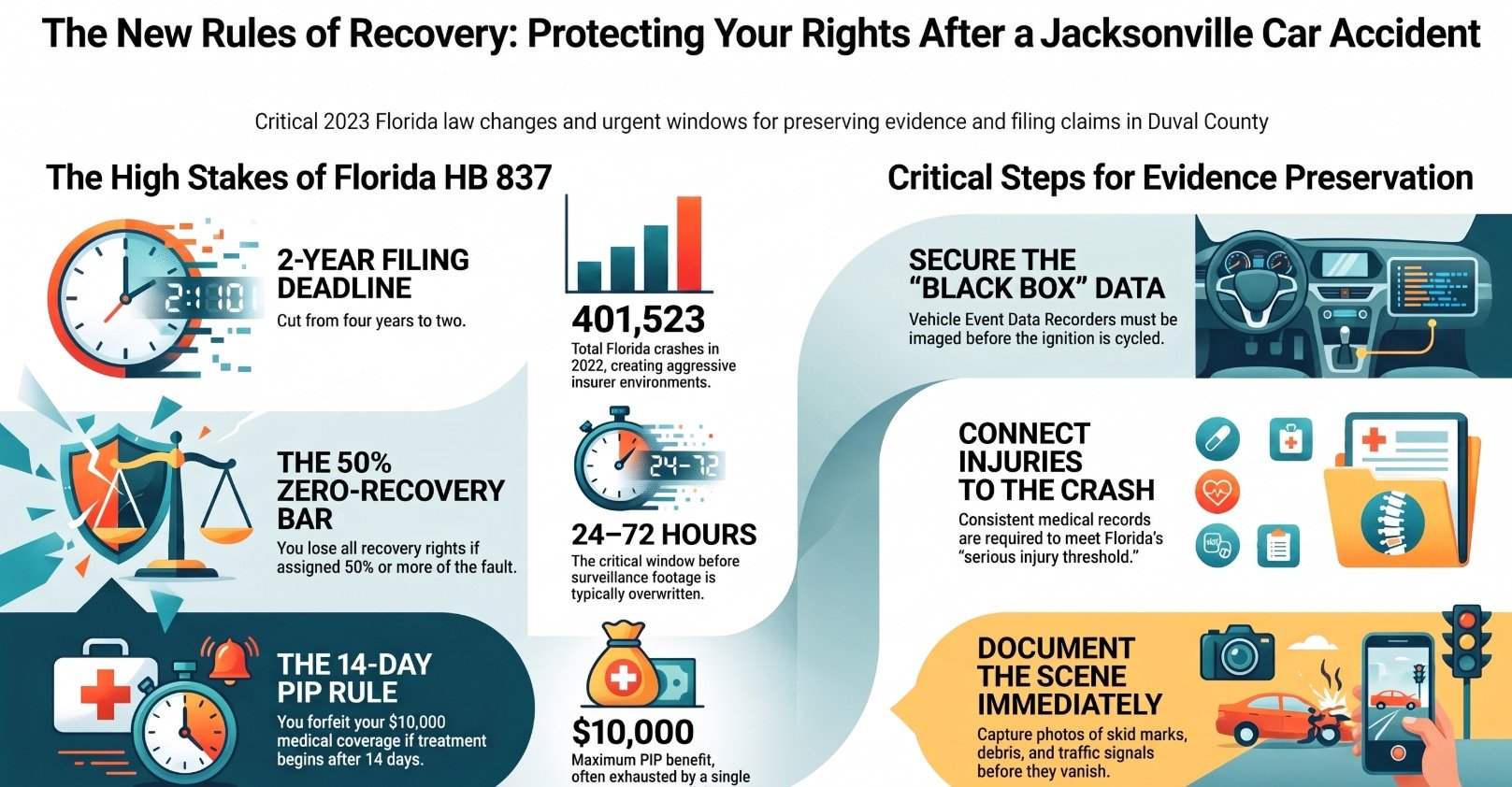
Florida’s crash data helps explain why car accident claims in Jacksonville are so aggressively contested by insurers — and why evidence gathered in the first hours after a crash matters so much. According to the FLHSMV 2022 Florida Traffic Crash Facts, Florida recorded 401,523 total crashes in 2022, resulting in more than 253,888 injuries and 3,535 fatalities statewide. Jacksonville’s position at the convergence of I-95, I-10, and I-295, combined with one of the East Coast’s busiest commercial seaports, creates consistent, high-volume collision patterns across Duval County.
Nationally, 3,208 people died in distracted driving crashes in 2024 according to NHTSA distracted driving data, underscoring how frequently phone records, vehicle data, and witness accounts become central to proving a Jacksonville claim. Surveillance systems typically overwrite on a 24–72 hour cycle, making same-day evidence requests critical. Understanding these figures helps injured people recognize that insurers manage volume and that claims without organized, preserved evidence are far more likely to be undervalued or denied.
Common Causes of Jacksonville Car Accident Injuries
Car accidents in Jacksonville often arise from preventable conduct, hazardous conditions, or a combination of both. Common causes include distracted driving, speeding and reckless driving, drunk or drugged driving, and poor road conditions. Identifying the cause of a crash is critical, as it can affect liability, evidence collection, and the direction of an injury claim.
Distracted Driving
Although many crashes appear sudden, distracted driving often develops from small lapses in attention that considerably reduce a driver’s ability to react. In Jacksonville, common distractions include mobile devices, navigation systems, eating, grooming, and conversations with passengers. Texting while driving is especially dangerous because it diverts the eyes, hands, and mind from the road simultaneously. Even brief inattention can prevent a driver from noticing pedestrians, stopped traffic, cyclists, or changing signals. Hands-free violations may also arise when drivers rely on devices in restricted areas or use technology in ways that still impair awareness. Phone records, witness statements, vehicle data, and camera footage may help clarify how attention was diverted.
According to NHTSA distracted driving data, 3,208 people died in distraction-related crashes in 2024 alone — underscoring how aggressively this cause of injury must be documented and proved.
Speeding and Reckless Driving
Speeding and reckless driving often compound the dangers of inattention because higher speeds reduce reaction time and increase the force of impact. In Jacksonville, excessive speed, unsafe lane changes, tailgating, and aggressive maneuvers can turn ordinary traffic conflicts into severe collisions. These behaviors place families, pedestrians, cyclists, and community members at unnecessary risk. At the scene, shock, chest pain, dizziness, or confusion can affect decisions before the full extent of injuries becomes clear. Vehicle safety technology — including automatic braking, lane warnings, and stability control — may reduce harm, but it cannot overcome deliberate disregard for traffic laws. Careful investigation helps determine speed, roadway conditions, driver conduct, and whether reckless choices directly caused preventable injuries or losses.
Drunk or Drugged Driving
When a driver is impaired by alcohol, illegal drugs, or certain prescription medications, the risk of a serious Jacksonville collision increases sharply. Impairment can reduce judgment, slow reaction time, blur vision, and encourage unsafe choices that endanger passengers, pedestrians, cyclists, and other motorists. In injury claims, evidence may include police observations, field sobriety testing, toxicology results, witness accounts, and crash reconstruction. A Jacksonville car accident lawyer may review these materials to determine how impairment contributed to harm and whether additional parties share responsibility, such as negligent alcohol providers.
Impaired driving defenses and challenges to BAC evidence can affect liability disputes, especially when testing procedures, timing, or calibration records are questioned. Careful legal review helps injured people pursue accountability while supporting broader community safety.
Poor Road Conditions
Poor road conditions can contribute to serious Jacksonville car accidents, particularly on busy corridors where drivers have limited time to react. Potholes, uneven pavement, missing signs, poor lighting, and inadequate drainage may cause drivers to swerve, brake suddenly, or lose control. These hazards can be especially dangerous for elderly motorists, families, cyclists, and pedestrians who depend on safer travel routes. Proper vehicle maintenance — including tire care and brake inspections — may reduce some risks, but it cannot fully offset the effects of neglected infrastructure. When drivers encounter repeated delays or hazards, frustration may escalate into dangerous conduct, creating additional danger for everyone nearby. In some cases, government agencies, contractors, or other responsible parties may be examined to determine whether preventable roadway defects contributed to the crash and resulting injuries or losses.
Your Legal Rights After a Jacksonville Car Accident Injury
A person injured in a Jacksonville car accident may have the right to seek compensation when another driver, company, or other party caused the crash through negligence. These rights may include recovery for medical expenses, lost income, property damage, and pain that affects daily life, work, or family.
Injured people are expected to act carefully after a collision, since legal rights can depend on timely action and accurate documentation. Insurance claim timelines may limit the time within which notice must be given, while evidence of fault can support a fair request for compensation.
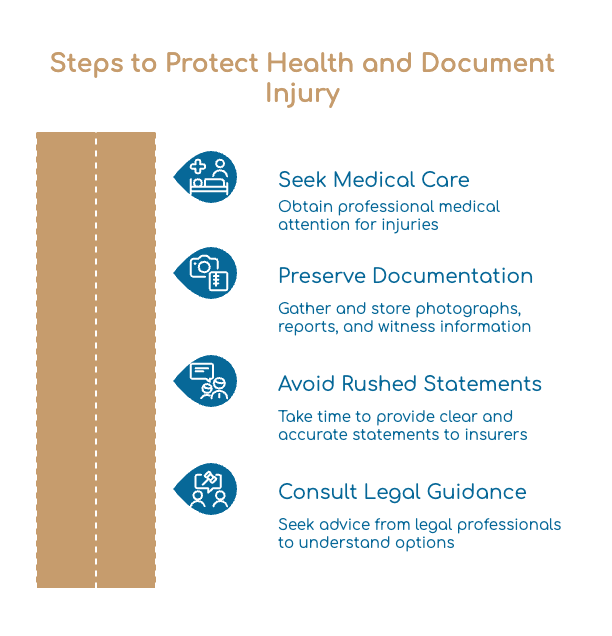
Timely action and clear documentation can help injured people protect their rights after a collision.
- Seeking medical care helps protect health and documents injury severity.
- Preserving photographs, reports, and witness information strengthens accountability.
- Avoiding rushed statements may prevent misunderstandings with insurers.
- Consulting legal guidance can clarify options and reduce procedural errors.
A careful approach allows injured people to protect their claims while focusing on recovery and responsibilities to others after a serious crash.
Why Do Car Accident Injuries Happen in Jacksonville?
Understanding legal rights after a collision also requires examining why car accident injuries occur in the first place in Jacksonville. Many crashes result from preventable conduct, including speeding, impaired driving, distracted driving, unsafe lane changes, and failure to yield. Road design, heavy commuter traffic, commercial vehicles, poor visibility, and sudden weather changes may increase the risk of harm. Injuries can also result from defective vehicle parts, inadequate maintenance, or unsecured cargo that increase the force of impact.
Identifying the cause of a crash supports fair evaluation of responsibility and damages. Insurance issues may also influence the outcome. Available coverage may apply to certain vehicle losses, but it does not replace the need to examine liability, medical causation, and available policy benefits. Common reasons for claim denial include disputed fault, gaps in treatment, excluded losses, late reporting, or insufficient documentation linking the injury to the collision.
What Should You Do After a Jacksonville Car Accident Injury?
After a Jacksonville car accident injury, the injured person should take prompt, organized steps to protect health, evidence, and potential legal rights. Seeking medical care, documenting the accident scene, and preserving relevant records can help establish the extent of injuries and the circumstances of the crash. Contacting an attorney early may also provide guidance on insurance communications, liability issues, and the pursuit of compensation.
Seek Medical Care
When injuries occur in a Jacksonville car accident, prompt medical evaluation is essential, even if symptoms initially appear minor. A physician can identify hidden trauma — including concussions, internal injuries, or soft tissue damage — before complications worsen. Early treatment also supports responsible care for family, coworkers, and others who may depend on the injured person’s recovery. Follow-up appointments should be kept, and prescribed treatment should be completed as directed. Second opinions may be appropriate when symptoms persist, diagnoses remain unclear, or surgical recommendations require careful review. Medical providers can explain the long-term prognosis, helping the injured person understand expected limitations and future needs. Proper rehabilitation planning may include physical therapy, specialist care, pain management, and work restrictions — all focused on restoring function safely and effectively.
Document the Accident
At the scene and in the days that follow, careful documentation can preserve crucial details that may later affect an injury claim. Scene safety should come first, with those involved moving to a secure location when possible and avoiding further harm. Photographs should capture vehicle damage, road conditions, traffic signals, skid marks, debris, license plates, and visible hazards. A person may also document injuries through dated photographs, medical notes, and written descriptions of pain, limitations, or worsening symptoms. Names, phone numbers, and brief witness statements can help clarify how the collision occurred. Records of police reports, insurance information, towing receipts, and repair estimates should be kept in one organized file. This disciplined approach supports accuracy, accountability, and full representation of the harm suffered.
Contact an Attorney
Thorough documentation can help preserve the facts of a collision, but legal guidance may be necessary to protect an injured person’s rights as the claim develops. An attorney can explain the legal consultation process, review available records, and identify urgent deadlines that may affect recovery. A free case review may help families understand whether negligence, insurance coverage, or disputed liability could shape the next steps.
Counsel may also support claim strategy planning by evaluating medical needs, wage loss, property damage, and future care concerns. When a crash causes a fatal injury, wrongful death guidance can help surviving relatives consider their responsibilities with dignity and care. Early contact with counsel may allow injured people and families to focus on recuperation while informed advocacy addresses insurers, evidence, and procedural requirements.
Critical Evidence in a Jacksonville Car Accident Injury Case
The evidence gathered in the hours and days after a Jacksonville car accident often determines the entire outcome of an injury claim. Important materials often include:
- Police crash reports
- Photos and video of the scene, vehicles, and injuries
- Witness contact information
- Medical treatment records
Each item may help establish what happened, who was involved, and how the collision affected the injured person. Understanding which medical records matter most in a Florida injury claim is critical to building a strong case from the start.
Police Crash Reports
When a collision occurs in Jacksonville, the police crash report often becomes one of the first formal records of how the accident happened and who may be responsible. It may identify drivers, passengers, witnesses, road conditions, citations, and the officer’s preliminary assessment. For injured individuals and those assisting them, this report can support evidence preservation by creating an official record before memories fade or information becomes harder to confirm. A Jacksonville car accident lawyer may review the report for accuracy, compare it with medical records, and address any omissions or disputed details. Because insurance claim timelines can move quickly, obtaining the report promptly helps protect the injured person’s ability to present a complete claim, respond to insurer questions, and pursue fair compensation under Florida law.
Photos and Video
Photos and video can fundamentally change the direction of a Jacksonville car accident injury claim. They document vehicle positions, roadway conditions, traffic signals, skid marks, debris, lighting, weather, and visible injuries before these details disappear. A careful record may support fault analysis, medical causation, and the true scale of losses, helping advocates serve an injured person with accuracy and diligence. Images should be taken from multiple angles when safe, and stored without edits or filters. Preserve digital evidence by saving original files, backing them up, and noting who captured them. Nearby dashcams, business cameras, and home security systems may also contain important footage. Because systems overwrite data quickly, prompt requests matter. Video timestamp settings should be reviewed, since time configurations may affect how events are interpreted.
Witness Contact Information
Independent witnesses can greatly affect a Jacksonville car accident injury claim because their accounts may confirm what happened before drivers begin revising their stories. Names, phone numbers, email addresses, and brief location notes should be gathered promptly, when safe and respectful. Proper witness statements may clarify traffic signals, lane changes, speed, weather, or visible impairment. Helpful documentation includes recording where each witness stood, what the person observed, and whether any business cameras or nearby residents may corroborate the account. Phone records may later help verify contact attempts or timelines, but collection and use must comply with privacy laws. A careful legal team preserves this information without pressuring witnesses, recognizing that community cooperation serves injured people and supports an accurate, fair resolution.
Medical Treatment Records
After witness information helps establish how a collision occurred, medical treatment records help prove the physical harm that followed. These records may include emergency room notes, diagnostic imaging, physician evaluations, prescriptions, therapy plans, and specialist referrals. In a Jacksonville car accident injury case, they connect the crash to specific injuries and show the care required for recovery. Accurate records also help measure damages, including future treatment needs and limitations on daily life, work, or family responsibilities. Although sometimes overlooked, consistent medical documentation can strengthen liability proof by showing timing, severity, and medical causation. When records are organized and complete, attorneys, insurers, and courts can better understand the true impact of the collision, allowing injured people to pursue fair compensation with dignity and purpose.
How Event Data Recorders Can Help Your Jacksonville Car Accident Case
Most passenger vehicles manufactured after 2012 contain an Event Data Recorder (EDR) — commonly called a black box — that captures critical vehicle data in the seconds before, during, and after a crash. This data typically includes speed, braking force, throttle position, steering input, and whether seat belts were engaged at the moment of impact. In a Jacksonville car accident claim, EDR data can independently confirm or contradict drivers’ accounts, establish how fast a vehicle was traveling, and provide objective evidence to counter an insurer’s comparative-fault arguments.
The most important fact about EDR data is that it can be overwritten the next time the vehicle’s ignition is cycled after the crash. Once overwritten, that data is typically unrecoverable. Our firm sends spoliation letters immediately after being retained, demanding preservation of the vehicle and its EDR data before insurers or repair shops have any opportunity to destroy critical evidence. We work with certified EDR specialists to retrieve and analyze recordings using manufacturer-compliant software.
Learn more about how black box data can make or break your case, and review the federal standards governing these devices in the NHTSA Event Data Recorders rule documentation.
Understanding Florida’s No-Fault PIP System and When It Is Not Enough
Florida operates under a no-fault insurance system, which means that after a car accident, each driver’s Personal Injury Protection (PIP) coverage pays for initial medical care and wage loss — regardless of who caused the crash. The Florida minimum PIP requirement is $10,000, which covers 80% of medical bills and 60% of lost wages. However, this coverage only applies if the injured person begins medical treatment within 14 days of the accident. Missing that window forfeits PIP coverage entirely.
The $10,000 PIP limit is often exhausted after a single emergency room visit. For injuries that require surgery, rehabilitation, specialist care, or long-term treatment, PIP alone is not enough. To recover the full value of losses — including pain and suffering, full medical costs, and total lost wages — an injured person must prove the at-fault driver’s negligence and meet Florida’s serious injury threshold: permanent injury, significant and permanent disfigurement, or death.
Our Florida PIP insurance guide explains exactly how no-fault coverage works and when you can step outside the PIP system to pursue full compensation from the at-fault driver.
Long-Term Effects of Jacksonville Car Accident Injuries
Jacksonville car accident injuries may produce long-term consequences, including chronic pain conditions that interfere with work, mobility, and daily routines. Emotional trauma effects — such as anxiety, sleep disruption, or fear of driving — can also complicate recovery and reduce quality of life. Ongoing medical costs, including follow-up care, therapy, medication, and future treatment, often become central issues in evaluating the full value of an injury claim.
Chronic Pain Conditions
When a car accident causes lasting injury, chronic pain can become one of the most disruptive long-term consequences. Injured people may struggle with persistent back, neck, joint, or nerve pain that limits work, caregiving, and daily responsibilities. Pain flare-ups can occur without warning, making consistent routines difficult and increasing dependence on medical care. Medication compliance is often important, since missed doses or improper use may affect recovery, symptom control, and claim evaluation. Careful medical documentation helps show how pain affects mobility, employment, and household responsibilities over time. Physicians may recommend therapy, injections, imaging, or ongoing medical care to manage symptoms. In severe cases, chronic pain may support a long-term disability claim when functional limitations prevent reliable employment or sustained daily activity.
Emotional Trauma Effects
Although physical injuries often receive immediate attention, emotional trauma can become a serious long-term effect of a Jacksonville car accident. Survivors may experience anxiety, sleep disruption, irritability, panic while driving, or symptoms linked to post-traumatic stress. These conditions can affect work, family responsibilities, and the ability to be present and engaged with the people who depend on you. Careful post-accident documentation helps show how emotional changes developed after the collision, especially when symptoms are reported consistently. Evidence may include photographs, treatment notes, journals, and communication records. A clear explanation of legal rights can help injured people understand how emotional harm may be considered in a broader claim. Accounts from relatives, coworkers, or caregivers may describe behavioral changes that are not obvious in medical records alone.
Ongoing Medical Costs
Long-term medical care can become one of the most significant financial consequences after a car accident. Injured people may require follow-up visits, surgeries, medication, rehabilitation, assistive devices, or in-home support for months or years. These needs can place serious pressure on families and caregivers who are trying to help the injured person regain stability. Future care planning helps identify anticipated treatment, projected expenses, and the support required to preserve dignity and daily function. In Jacksonville claims, medical documentation often becomes central to accurately valuing these losses. Settlement timelines may be affected when physicians need time to assess recovery, permanent limitations, or future treatment needs. Careful evaluation of ongoing costs helps ensure that compensation reflects both present obligations and long-term responsibilities.
Proving Liability in Jacksonville Car Accident Injury Cases
Proving liability in a Jacksonville car accident injury case requires evidence identifying the at-fault party and linking that party’s conduct to the injured person’s losses. This process may include reviewing crash reports, photographs, witness statements, vehicle damage, medical records, and available video footage. Careful investigation helps determine whether speeding, distracted driving, impaired driving, unsafe lane changes, or traffic signal violations caused the collision.
Liability analysis also requires attention to comparative negligence defenses, because an opposing party may claim the injured person shared fault. In cases involving delivery vehicles, buses, or freight carriers, commercial vehicle negligence may require review of driver logs, maintenance records, and employer practices. When several parties contributed to the crash, each role must be evaluated with discipline and fairness. Insurance coverage gaps can affect recovery planning, but they do not replace the need to prove fault. Strong evidence supports accountability and helps protect injured people in Jacksonville and across Duval County.
Dealing With Insurance Companies After a Jacksonville Car Accident Injury
After a Jacksonville car accident injury, communication with insurance companies can affect the value and direction of a claim. Adjusters may request recorded statements, medical authorizations, or quick settlement discussions before the full impact of the injury is understood. Careful responses help protect the injured person’s interests, while also promoting fair and responsible resolution.
A Jacksonville car accident lawyer may assist by reviewing policy coverage to identify available liability, uninsured motorist, medical payments, or other applicable benefits. This review can clarify which insurers may owe payment and whether coverage limits are adequate for documented losses. Legal guidance also supports claim denial handling when an insurer disputes fault, questions treatment, or relies on incomplete records. By organizing medical evidence, wage documentation, and repair information, counsel can present the claim accurately and professionally. This approach helps reduce confusion, encourages accountability, and supports an injured person’s ability to seek recovery with dignity and appropriate care.
What to Expect During a Jacksonville Car Accident Injury Claim Process
A Jacksonville car accident injury claim typically begins with an initial case evaluation, where the facts, injuries, liability issues, and potential damages are assessed. The process then moves into evidence collection and insurance claim negotiations, which may involve medical records, crash reports, witness statements, and insurer communications. Depending on the strength of the claim and the insurer’s response, the matter may be resolved through settlement or proceed to litigation.
Initial Case Evaluation
During an initial case evaluation, a Jacksonville car accident lawyer reviews the facts of the collision, the available evidence, the injured person’s medical condition, and the potential sources of insurance coverage. This discussion helps determine whether the claim may support compensation for medical expenses, lost income, pain, and related losses. The lawyer may ask about the crash timeline, treatment history, work limitations, prior injuries, and communications with insurers. Careful attention is given to medical documentation because accurate records help link injuries to the collision and inform valuation. A preliminary liability analysis also identifies who may be legally responsible, including drivers, employers, or other parties. This early review allows the lawyer to explain possible next steps, protect the claimant’s interests, and promote informed decisions.
Evidence Collection Process
In the evidence collection process, a Jacksonville car accident lawyer gathers and organizes information that may establish fault, document injuries, and support the value of the claim. This stage may include obtaining police reports, medical records, photographs, witness statements, vehicle damage documentation, traffic camera footage, and expert opinions when needed. Careful collection helps create a clear record that serves the injured person, the family, and others affected by the crash with accuracy and respect.
The lawyer may also review treatment progress, lost income records, and the circumstances surrounding the collision to identify responsible parties. Well-organized evidence strengthens negotiation and supports trial preparation if formal litigation becomes necessary. This methodical approach helps ensure that decisions are grounded in verified facts rather than assumptions.
Insurance Claim Negotiations
Once the evidence has been gathered and reviewed, insurance claim negotiations often become the next major stage in a Jacksonville car accident injury claim. During this phase, the insurer evaluates liability, medical treatment, lost income, property damage, and the long-term impact on the injured person’s life. A lawyer may prepare a demand that carefully presents the facts, emphasizing accountability while protecting the claimant’s dignity. A focused settlement strategy directs the discussion toward the strongest proof of loss and responsibility. Negotiation leverage can include organized medical records, clear witness statements, expert opinions, and documented financial hardship. This process reflects disciplined advocacy, patience, and fairness while seeking appropriate compensation through careful communication with the insurance adjuster.
Settlement or Lawsuit
If negotiations do not resolve the claim, the injured person may need to decide whether to accept a settlement or file a lawsuit. This decision often depends on the strength of liability evidence, the extent of medical losses, and whether the insurer offers fair compensation. A careful negotiation strategy can encourage resolution while preserving the option to proceed further. When litigation becomes necessary, the attorney may file a complaint, manage deadlines, request records, and question witnesses through discovery. Trial preparation also helps clarify the value of the claim, because both sides must evaluate risks and evidence more closely. Each step should support accountability, informed choices, and a resolution that serves legitimate needs.
Compensation for Jacksonville Car Accident Injury Damages
After a serious crash, compensation for Jacksonville car accident injury damages may include both financial losses and the personal impact of the injuries. A careful presentation of claims helps connect medical treatment, missed work, property damage, and ongoing limitations to the harm caused by the collision. For people whose lives have been upended by someone else’s negligence, fair compensation is not just about money — it is about restoring the stability that was taken from you.
A Jacksonville car accident lawyer may begin with an insurance coverage review to identify available benefits, policy limits, exclusions, and potential sources of recovery. This review can include the injured person’s policy, the at-fault driver’s policy, and any additional coverage that may apply. Counsel may then develop a settlement negotiation strategy supported by medical records, expert opinions, wage documentation, and evidence from the crash scene.
Understanding average personal injury settlements in Florida by case type can help injured people set realistic expectations going into negotiations. The goal is to pursue fair compensation through organized advocacy, while protecting the injured person from unnecessary delay, undervaluation, or pressure from insurers during the claims process.
Economic vs. Non-Economic Damages in Jacksonville Car Accident Cases
In Jacksonville car accident cases, damages are generally divided into economic losses and non-economic losses, each serving a distinct role in measuring the harm caused by a collision. Economic damages address financial costs such as medical bills, lost income, and property damage, while non-economic damages account for pain, suffering, emotional distress, and reduced quality of life. Proving these losses requires organized evidence, credible documentation, and a clear connection between the crash and the claimed injuries.
Economic Damages Explained
In a Jacksonville car accident claim, economic damages are the measurable financial losses resulting from the crash. These losses may include emergency treatment, hospital bills, rehabilitation costs, medication expenses, property damage, and transportation needs related to care. They also include wage loss when an injured person cannot work, as well as reduced earning capacity if injuries limit future employment. Proper claim documentation is crucial — receipts, invoices, medical records, pay statements, and repair estimates help establish the amount owed. Insurance coverage may affect how these losses are paid, including personal injury protection, liability coverage, or other available policies. When recovery requires ongoing treatment, future medical expenses should be carefully projected. Accurate economic damage analysis helps protect injured people and supports fair resolution.
Non-Economic Damages Explained
Economic damages address the financial side of a Jacksonville car accident claim, but many serious injuries also cause harm that cannot be measured through bills or pay records alone. Non-economic damages recognize pain, suffering, emotional trauma, loss of enjoyment, disfigurement, and the strain injuries place on family relationships. These losses may affect a person’s ability to participate in daily responsibilities or maintain dignity after a life-changing crash. In wrongful death claims, non-economic damages may also address survivors’ grief, loss of companionship, and the guidance once provided by the deceased. Florida law and available insurance coverage limits can influence recovery, making careful evaluation important. These damages provide formal recognition of human harm — not merely financial disruption — when negligence causes lasting injury or loss in Jacksonville.
Proving Accident Losses
Proving accident losses requires clear evidence that connects the crash to both measurable financial harm and personal, non-financial consequences. In Jacksonville car accident cases, economic damages may be supported through medical bills, repair estimates, wage records, receipts, and insurance documentation. These materials help show the direct cost of treatment, property damage, lost income, and future care needs. Non-economic damages require a different form of proof, including medical evaluations, pain journals, witness statements, and testimony describing reduced mobility, emotional distress, or loss of daily function. Injury causation proof is critical, because insurers often question whether the collision caused the claimed harm. A well-prepared claim presents organized records, consistent medical history, and credible evidence — helping responsible parties and insurers understand the full impact on the injured person’s life.
When a Jacksonville Car Accident Injury Case Goes to Trial vs. Settlement
After a serious collision, a Jacksonville car accident injury case may resolve through settlement negotiations or proceed to trial if the parties cannot agree on liability, damages, or the value of the claim. Settlement often allows injured people to receive compensation sooner, reduce uncertainty, and preserve energy for recovery and for their families. A trial may become necessary when an insurer undervalues medical needs, disputes responsibility, or refuses to recognize lasting harm.
Attorneys assess liability strategies, trial timelines, evidence preservation, and insurance leverage when advising whether to negotiate further or prepare for court. Strong documentation, credible witnesses, expert opinions, and consistent medical records can improve settlement discussions while also supporting presentation before a judge or jury. Trial preparation may involve depositions, motions, exhibits, and careful witness planning. Each path requires discipline, patience, and a clear focus on pursuing fair accountability while protecting the injured person’s dignity and future stability.
Florida Laws That May Affect Your Jacksonville Car Accident Case
Because Florida law directly shapes fault, insurance benefits, filing deadlines, and available compensation, a Jacksonville car accident case must be evaluated within the state’s specific legal framework. These rules influence how injured people seek support, how families remain stable, and how responsible parties are held accountable.
Florida law guides how Jacksonville car accident claims protect recovery, accountability, and long-term stability.
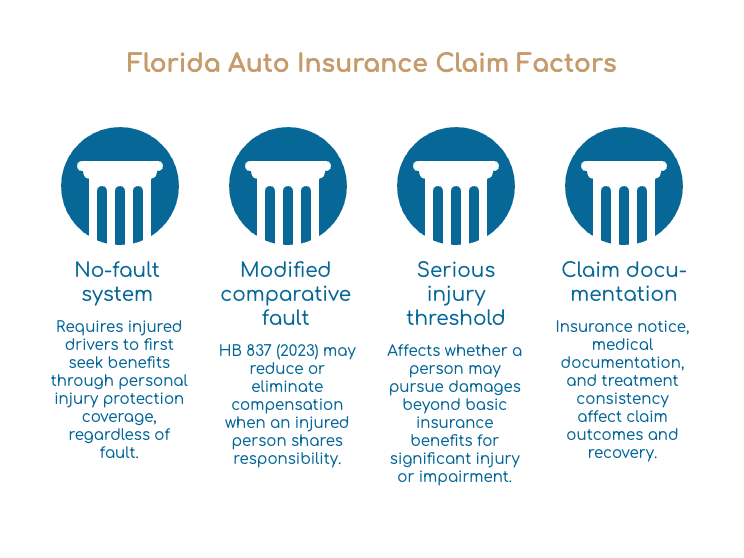
- Florida’s no-fault system generally requires injured drivers to first seek benefits through personal injury protection coverage, regardless of who caused the crash.
- Modified comparative fault under HB 837 (2023) may reduce or eliminate compensation when an injured person shares responsibility — making careful evidence review essential.
- Florida’s serious injury threshold affects whether a person may pursue damages beyond basic insurance benefits, including claims involving significant injury or lasting impairment.
- Insurance notice, medical documentation, and treatment consistency can strongly affect whether a claim serves the injured person’s needs and long-term recovery.
A Jacksonville car accident lawyer reviews these laws in light of the person’s injuries, responsibilities, and long-term care needs, helping ensure the claim is presented with accuracy, dignity, and purpose.
The Statute of Limitations for Jacksonville Car Accident Injury Cases
Florida’s legal framework places strict time limits on when an injured person may file a car accident lawsuit in Jacksonville. Under Florida HB 837 (2023), most personal injury cases must be filed within 2 years of the crash. Missing this deadline can bar recovery entirely, even when injuries are serious and another driver appears responsible. This rule encourages timely action, preserves evidence, and promotes fairness for all parties involved.
Certain circumstances may affect how the deadline is evaluated, including claims involving minors, government vehicles, or injuries discovered after initial treatment. If medical negligence worsened crash-related harm, a separate limitations period may apply to that portion of the claim. Comparative fault may also influence the value of a case, but it does not extend the filing deadline. Prompt attention to these limits is crucial to preserving legal rights after any serious Jacksonville car accident.
How a Jacksonville Car Accident Lawyer Can Help You
When an injured person faces medical treatment, vehicle damage, lost income, and insurance pressure, a Jacksonville car accident lawyer can provide structured guidance from the earliest stages of the claim. Counsel may review evidence, communicate with insurers, and protect the claimant from statements that could weaken recovery. This support allows the injured person and family members to focus on care, stability, and daily responsibilities.
A lawyer may assist by:
- Investigating the crash, including reports, photographs, witnesses, and available video.
- Documenting medical expenses, wage loss, pain, and future care needs with organized proof.
- Responding to insurance claim denials by identifying errors, missing records, or disputed liability.
- Developing settlement strategies that reflect damages, insurance limits, and the strength of the evidence.
Through disciplined case preparation, legal counsel helps present a clear demand for compensation. This service promotes fairness, accountability, and practical relief after a harmful collision.
When to Contact a Jacksonville Car Accident Lawyer
Ideally, contact with a lawyer should occur as soon as urgent medical needs are addressed, and before detailed statements are given to insurers. Early communication allows counsel to help protect timelines, identify responsible parties, and encourage careful recordkeeping. Prompt emergency medical documentation is especially important because treatment notes, diagnostic results, and discharge instructions may connect injuries to the crash.
Delays can create avoidable difficulties, including lost witness information, repaired vehicles, erased video footage, or fading memories. Florida evidence preservation often depends on quick action, including requesting surveillance recordings, securing photographs, and documenting roadway conditions. A person focused on recovery and daily obligations may not realize how quickly useful information can disappear. Timely legal contact helps ensure that essential facts are preserved while the injured person continues appropriate care and supports those who depend on them.
Why You Need an Experienced Jacksonville Car Accident Lawyer
An experienced Jacksonville car accident lawyer can provide essential guidance in a case involving disputed fault, serious injuries, insurance pressure, or complex damages. Legal counsel helps protect an injured person’s rights while allowing the person and family to focus on recovery.
Car accident claims often require careful investigation, organized evidence, and clear communication with insurers. A lawyer can evaluate police reports, medical records, witness statements, and accident details to build a well-supported claim. In matters involving the proof of damages, counsel may document medical expenses, lost income, pain, disability, and future care needs with accuracy and purpose.
Insurance companies may seek quick resolutions that do not reflect the full harm caused. Through negotiating settlements, an experienced lawyer can respond to low offers, present evidence of liability, and pursue compensation aligned with the losses suffered. This support can bring structure, fairness, and accountability to a difficult process for injured people.
How to Choose the Right Jacksonville Car Accident Lawyer for Your Case
Selecting the right Jacksonville car accident lawyer requires careful attention to experience, case strategy, communication practices, and familiarity with Florida injury law. A qualified attorney should demonstrate a record of handling collision claims, evaluating medical evidence, negotiating with insurers, and preparing cases for trial when necessary. This helps injured people receive guidance grounded in both legal knowledge and practical judgment.
Client communication is also important. A dependable lawyer should explain the claims process clearly, provide timely updates, and respond to concerns with patience and respect. This approach supports clients who may be focused on recovery, family responsibilities, and daily life.
The fee structure should be reviewed before representation begins. Many injury lawyers use contingency fees, meaning payment depends on a successful recovery. Clients should also consider availability, local courtroom experience, and the attorney’s willingness to pursue fair compensation through disciplined advocacy and careful case preparation — from the first consultation forward.
About The Law Offices of Anidjar & Levine
Founded in 2005 by Marc Anidjar and Glen Levine, the firm began as a two-person operation working out of a construction office conference room. Over the past 20 years, that modest start has grown into one of Florida’s most recognized personal injury practices — with more than $1 billion recovered in settlements for injury clients across the state. We bring that same determination and depth of experience to every case we handle.
For individuals seeking legal guidance after a collision, The Law Offices of Anidjar & Levine represents injured people in Jacksonville and throughout Florida with a focus on personal injury claims, including motor vehicle crashes. The firm’s work reflects a service-centered approach, supporting injured people as they seek medical care, financial stability, and accountability after harmful conduct.
Its attorney experience includes handling negligence claims involving drivers, insurers, medical records, and accident-related losses. The firm develops each case strategy by reviewing liability, damages, insurance coverage, and the long-term effects of injury on daily life. Prompt evidence preservation may include securing crash reports, photographs, witness statements, surveillance footage, and vehicle damage documentation before important details are lost.
The office also emphasizes client communication, providing updates and explanations to help clients make informed decisions. Through organized preparation and attentive service, the firm works to advance claims with diligence, professionalism, and respect.
Real Reviews From Our Clients!
★★★★★
“After a rear-end collision on I-95 left me with a herniated disc and mounting medical bills, Anidjar & Levine stepped in and handled everything. They preserved the vehicle data before it could be lost, fought the insurer’s comparative fault argument, and secured a settlement that covered all my treatment and lost time from work. I could not have navigated this without them.”
— Richard Powers, Jacksonville, FL (Verified Google Review)
★★★★★
“The other driver’s insurance company tried to deny my claim entirely, arguing I had contributed to the crash. Anidjar & Levine gathered the dashcam footage, traffic camera video, and witness accounts that proved what actually happened. They never backed down, and the final settlement reflected the full impact the accident had on my life.”
— Christopher Kull, Jacksonville, FL (Verified Google Review)
★★★★★
“I was hit at a red light near the I-295 interchange and the insurer’s initial offer was insultingly low. Anidjar & Levine documented every injury, every medical visit, and every day of work I missed, then negotiated a settlement that actually reflected what I went through. They treat you like a person, not a case number.”
— Anna T., Jacksonville, FL (Verified Google Review)
Frequently Asked Questions
Can I Switch Lawyers During My Jacksonville Car Accident Case?
Yes, a person may switch lawyers during an active car accident case, provided the change protects the case and respects existing obligations. The current lawyer should be notified, and any fee agreement, lien, or case file transfer should be reviewed carefully. New representation typically requires client consent and may involve contract reassignment if permitted. A careful change helps preserve deadlines, evidence, and service to the injured person’s interests.
How Are Car Accident Lawyer Fees Structured in Jacksonville?
Fees are typically arranged through a contingency fee, meaning the attorney is paid only if compensation is recovered. This structure helps injured people preserve resources while pursuing rightful support for medical care, lost income, and family responsibilities. The consultation cost is often free, allowing a person to evaluate representation without immediate expense. Case costs, percentage terms, and repayment obligations should be reviewed carefully in a written agreement before representation begins.
Will My Jacksonville Car Accident Case Affect My Immigration Status?
A car accident case generally does not affect immigration status, but related facts may create visa consequences if criminal charges, fraud, or public charge concerns arise. Evidence and documentation should be preserved carefully, including police reports, medical records, insurance communications, and identification materials. Those in the community should seek coordinated legal guidance, ensuring injury claims, court filings, and immigration obligations remain accurate, consistent, and responsibly managed.
Can I Recover Damages if the At-Fault Driver Was Uninsured?
Yes, damages may be recoverable when the at-fault driver lacks insurance. An injured person may seek uninsured motorist coverage through their own policy, if available, and may also use Florida PIP benefits for medical expenses and lost wages regardless of fault. Careful documentation, timely notice, and policy review are vital. Prompt legal guidance helps protect claims, benefits, and recovery options when the at-fault driver carries no insurance.
Do I Need a Lawyer for a Minor Jacksonville Car Accident?
A lawyer may be helpful after a minor accident when fault, injuries, or insurance issues are unclear. Even modest collisions can require evidence gathering, careful medical documentation, and timely communication with insurers. A professional can protect the injured person’s interests while allowing them to focus on recovery and family responsibilities. If damages are minimal and undisputed, representation may be unnecessary, but consultation remains prudent given Florida’s 2-year filing deadline and the insurer’s strong financial incentive to minimize any payment.
How Long Do I Have to File a Jacksonville Car Accident Lawsuit?
Florida’s HB 837 (2023) reduced the personal injury statute of limitations to two years from the date of the crash. Missing this deadline typically bars recovery entirely, regardless of how serious the injuries are or how clear the other driver’s fault may be. Certain exceptions may apply for claims involving minors, government vehicles, or injuries not immediately discovered, but these are narrow. Prompt legal consultation is essential to protect your rights — especially when medical treatment is ongoing and the full extent of injuries has not yet been determined.
How Does HB 837’s Modified Comparative Fault Rule Affect My Jacksonville Car Accident Claim?
Under Florida HB 837 (effective March 24, 2023), if you are found to be 50% or more at fault for the accident, you are completely barred from recovering any compensation — even if your injuries are severe and your medical costs are significant. This is a significant change from the prior pure comparative fault system, under which a partially at-fault person could still recover a reduced amount.
Insurance companies now have a direct financial incentive to build fault arguments against injured claimants, making early evidence preservation and experienced legal representation critical to protecting your recovery in any Jacksonville car accident claim.
A Jacksonville car accident claim requires careful attention to liability, medical evidence, insurance practices, and filing deadlines. An experienced lawyer can evaluate the case, protect the injured person’s rights, and pursue compensation for losses caused by another party’s negligence.
The Law Offices of Anidjar & Levine provides guidance throughout this process from investigation through resolution and can also connect injured clients with a Jacksonville Personal Injury Lawyer when broader personal injury issues are involved.
Prompt legal support can help preserve vital evidence and position the claim for the strongest possible outcome.