A cargo jet came down on a public Miami road in seconds. We move fast to help protect the evidence — and the rights — of everyone affected.
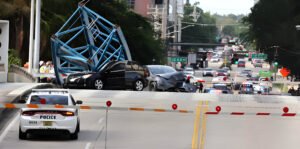
On the afternoon of September 6, 2026, an Amazon Prime Air cargo jet overran a runway while landing at Miami International Airport, crossed onto a nearby road, struck several vehicles, and caught fire. Five people on the ground lost their lives, and several others were injured. Our thoughts are with everyone affected by this tragedy, including the families still waiting for answers.
As Miami personal injury and wrongful death attorneys, we know that in the days after an event like this, victims and grieving families are often left with more questions than answers — and with insurance adjusters and corporate lawyers who move quickly to protect their own companies. This article summarizes what has been publicly reported so far, what remains under investigation, and what Florida law says about the rights of people injured or killed by an aircraft on the ground.
If you or a loved one was affected by this crash, you can speak with our Miami team in a free, no-obligation consultation right now: (305) 384-6882. There is no fee unless we recover compensation for you.
Main Takeaways
- A 32-year-old Boeing 767 cargo jet, operated by 21 Air for Amazon Prime Air, overran a runway at Miami International Airport (MIA) on September 6, 2026, and struck vehicles on a public road before catching fire.
- Both pilots survived. Five people on the ground died, and additional people, including some in vehicles struck by the aircraft, were injured, several critically.
- The National Transportation Safety Board (NTSB) is investigating, alongside the FAA. No cause has been determined yet, and a full report can take about a year.
- Because the victims were on the ground rather than passengers, this is a personal injury and wrongful death matter, not an airline-passenger case — with its own set of potentially responsible parties.
- Florida generally allows 2 years to file a negligence or wrongful death claim, but aviation cases involve federal rules, multiple corporate defendants, and evidence that needs to be preserved quickly.
What Happened at Miami International Airport
According to public reporting from multiple news outlets, Amazon Prime Air Flight 7598, a Boeing 767-300 freighter operated by 21 Air, was arriving from Luis Muñoz Marín International Airport in San Juan, Puerto Rico, when it overran the runway at MIA around 2:00 p.m. local time. The aircraft, registration N1997A, was reportedly about 32 years old, originally built as a passenger jet in 1994 and later converted to a cargo freighter. It continued off airport property, crossed a nearby road, struck multiple vehicles, and came to rest engulfed in flames.
Miami-Dade Fire Rescue sent a large response, including crews who extricated a person trapped under a vehicle. The FAA issued a ground stop that halted arrivals and departures at MIA for several hours, with two of the airport’s four runways reopening once the scene was secured. Weather at the time reportedly included thunderstorms and gusty winds, a factor investigators are expected to examine along with the aircraft’s approach and touchdown point.
The National Transportation Safety Board has sent an investigative team to Miami. NTSB investigations of major accidents typically unfold in stages: an initial on-scene phase, a preliminary report within weeks, and a final report with a probable-cause determination that can take around a year. The FAA is also participating in the investigation and oversees the airline’s and airport’s regulatory compliance. As of this writing, no official cause has been announced, and any theories about what went wrong remain preliminary.
Amazon issued a statement saying its “deepest sympathies go out to the families, loved ones, and all those affected” by what it called a “devastating loss.” 21 Air’s chief executive said the company is cooperating fully with the NTSB, FAA, and local authorities.
A note on accuracy: This article reflects information reported by news organizations and public officials in the first day after the crash. Details such as the cause, the full number of people affected, and the identities of victims may change as the investigation continues. Nothing in this article should be read as a conclusion about who, if anyone, was at fault.
Who May Be Responsible
Because this crash involved a cargo plane rather than a passenger flight, and because the people killed and injured were on the ground, the legal questions here are different from a typical airline-accident case. Depending on what investigators find, several parties could potentially share responsibility:
- 21 Air – The certificated airline that operated the flight and employed the crew, including its training, staffing, and maintenance decisions.
- The aircraft’s owner or lessor – who may bear responsibility for the plane’s maintenance history and airworthiness, particularly given its age and its conversion from a passenger jet to a freighter.
- Amazon – as the company whose branding the aircraft carried and whose logistics network the flight served, depending on its degree of operational control.
- The airport authority or air traffic control, if runway conditions, safety-area design, or the information given to the flight crew played a role.
Identifying every responsible party in a case like this usually requires access to information that is not yet public, including maintenance logs, air traffic control recordings, and the aircraft’s flight data and cockpit voice recorders, which the NTSB controls during its investigation. This is one of the main reasons victims and families benefit from having their own legal representation early, even while the federal investigation is ongoing.
The Scope of What Happened
A few figures help put the scale of this crash in context. The FAA’s ground stop affected arrivals and departures at one of the country’s busiest international airports for several hours, with only two of MIA’s four runways reopened once the scene was cleared. Reported winds at the time of landing were gusting to roughly 26 knots amid nearby thunderstorm activity, a condition the NTSB is expected to examine as part of its review of the landing.
Nationally, the FAA tracks runway safety data every year because excursions like this one, though uncommon, can have severe consequences when an aircraft leaves airport property and enters an area used by the public. The NTSB’s published investigative process shows how a case like this one moves from the accident scene to a final, public report over the following months.
Those numbers cannot capture what the five families who lost someone on September 6 are going through, or what the injured survivors now face in recovery. That human toll is why a careful, independent investigation into fault, separate from the federal safety investigation, matters so much for the people affected.
Florida Wrongful Death and Injury Claims: What the Law Says
Victims and families affected by this crash are not limited to whatever the NTSB ultimately concludes about aviation safety. Florida law gives injured people, and the families of people who are killed, an independent right to seek compensation through a civil claim.
| Florida Legal Fact | What It Means |
|---|---|
| Wrongful Death Act | Fla. Stat. §§ 768.16–768.26 allow a personal representative to bring a claim on behalf of a deceased person’s estate and surviving family members. |
| Who can recover | Surviving spouses, children, and parents may recover damages for loss of support, companionship, and mental anguish; the estate may recover funeral costs and lost earnings. |
| Statute of limitations | Generally 2 years from the date of the incident for most negligence and wrongful death claims under Florida’s 2023 tort reform law. |
| Comparative fault | Florida uses a modified comparative fault system; if multiple parties share fault, recovery can be apportioned among them. |
| Multiple defendants | Aviation cases often name several corporate defendants (airline, owner/lessor, and others), which can involve different insurance carriers and, in some cases, different court systems. |
You can review the text of Florida’s wrongful death damages statute directly on the Florida Senate’s official statutes website. Because this incident may also implicate federal aviation law and parties located outside Florida, the specific deadlines and venue for a claim arising from this crash should be confirmed with an attorney rather than assumed. Our wrongful death attorneys handle these claims throughout South Florida and, together with our statewide wrongful death team, can help families understand which deadlines and courts apply to their specific situation.
Evidence That Matters Right Now
The aircraft’s flight data recorder and cockpit voice recorder are in NTSB custody and will inform the federal safety investigation, but a civil claim on behalf of injured victims or grieving families depends on additional evidence that is not automatically preserved by that process.
- Photos and video taken by bystanders, nearby businesses, and dashcams before that footage is deleted or overwritten, which can happen within 24 to 72 hours on many private surveillance systems.
- Vehicle and property damage documentation for anyone whose car, truck, or business was struck or damaged.
- Medical records and bills documenting injuries, treatment, and prognosis for survivors.
- Maintenance, staffing, and training records that may need to be requested by subpoena before they are lost or routinely purged.
- Contact information for witnesses who saw the crash or its aftermath, whose memories are freshest in the days immediately after the event.
A formal spoliation letter, a written notice demanding that a business, insurer, or company preserve relevant evidence, can help ensure this information is not lost while the NTSB’s process runs its independent course.
How The Law Offices of Anidjar & Levine Can Help
- We can begin an independent investigation into the crash on your behalf, separate from the NTSB’s federal safety review, and send preservation letters to protect evidence before it disappears.
- We can help identify every potentially responsible party, from the airline to the aircraft’s owner, so families are not left dealing with only one insurance company’s version of events.
- We work on a contingency basis, meaning you pay nothing unless we recover compensation for you.
- Our Miami office is available to meet with victims and families affected by this crash, in person or remotely, whenever you are ready to talk.
Miami Office
The Law Offices of Anidjar & Levine
75 Valencia Ave, Suite 100
Coral Gables, FL 33134
Phone: (305) 384-6882
If you or a loved one was affected by the Miami airport plane crash, you do not have to face the insurance companies alone.
Call (800) 747-3733 for a free, no-obligation consultation with our Miami personal injury team.
About The Law Offices of Anidjar & Levine
Founded in 2005 by Marc Anidjar and Glen Levine, the firm began as a two-person operation working out of a construction office conference room. Over the past 20 years, that modest start has grown into one of Florida’s most recognized personal injury practices — with more than $1 billion recovered in settlements on behalf of injury clients across the state. We bring that same determination and depth of experience to every case we handle.
Our attorneys have represented Florida families in complex cases involving multiple corporate defendants, out-of-state companies, and ongoing regulatory investigations. We understand that a case like the MIA cargo plane crash unfolds on two tracks at once: the federal safety investigation, and the separate legal process that determines compensation for the people harmed.
Frequently Asked Questions
What happened in the Amazon cargo plane crash at Miami International Airport?
On September 6, 2026, Amazon Prime Air Flight 7598, a Boeing 767 cargo jet operated by 21 Air on a route from San Juan, Puerto Rico, overran the runway while landing at Miami International Airport. The aircraft continued off airport property, struck multiple vehicles on a nearby road, and caught fire. Both pilots survived. Five people on the ground died and several others were injured, some critically. The FAA issued a ground stop at MIA that lasted several hours.
Who is investigating the Miami airport plane crash, and how long will it take?
The National Transportation Safety Board has sent a team to Miami to lead the investigation, with the FAA also involved. NTSB investigations of this kind typically take around a year to reach a final probable-cause report, although preliminary findings are sometimes released sooner. No cause has been officially determined yet.
I was hurt, or lost a family member, on the ground when the plane crashed. Do I have a legal claim even though I was not a passenger?
Potentially, yes. This crash did not injure airline passengers; it involved a cargo aircraft that left the airport and struck people and vehicles on a public road. Anyone injured on the ground, and the families of anyone killed, may have claims against the airline operator, the aircraft’s owner, Amazon’s logistics arrangement, or other responsible parties, separate from any workers’ compensation issues involving the flight crew.
Who could be held responsible for the Miami plane crash?
That depends on what the NTSB investigation finds. Potentially responsible parties in a runway overrun involving a leased cargo aircraft can include the airline that operated the flight, the company that owns or leases the aircraft, the logistics company whose cargo was being flown, and, in some circumstances, the airport authority. Multiple parties are often involved, each with separate insurance coverage.
What is Florida’s Wrongful Death Act, and who can recover compensation?
Florida’s Wrongful Death Act, sections 768.16 through 768.26 of the Florida Statutes, allows a deceased person’s estate to bring a claim when a death is caused by another’s negligence or wrongdoing. Surviving spouses, children, and parents may recover damages such as loss of support, companionship, and mental anguish, and the estate may recover funeral expenses and lost earnings.
How long do I have to file a claim after the Miami plane crash?
Florida generally requires most negligence-based injury and wrongful death claims to be filed within 2 years under the state’s 2023 tort reform law. Aviation cases can also involve federal aviation regulations, multiple corporate defendants in different states, and specialized evidence, so it is important to speak with an attorney as soon as possible rather than wait.
What should I do right now to protect my rights if I was affected by this crash?
Seek medical care, keep records of any treatment, and preserve anything that documents what you saw or experienced, including photos, videos, and contact information for witnesses. Avoid giving recorded statements to insurance companies before speaking with an attorney. A free consultation can help you understand your options while the facts are still being gathered.
Disclaimer: This article is based on public reporting and official statements available as of September 7, 2026, about an incident that remains under active investigation by the NTSB and FAA. Facts, figures, and the identities of those affected may change as more information becomes available. Nothing in this article is a determination of fault by any party, and nothing here constitutes legal advice. If you have information correcting anything in this article, please contact us. Our sympathies remain with everyone affected by this event.