The Law Offices of Anidjar and Levine helps injured people protect evidence, identify responsible parties, and pursue compensation after a commercial truck collision. A Jacksonville truck accident claims and liability lawyer may investigate potential responsibility involving drivers, carriers, insurers, employers, maintenance contractors, or cargo loaders. Core evidence can include driver logs, black box data, inspection records, photos, witness statements, and medical documentation. Legal support also addresses insurance defenses involving fault, injury severity, and damages. For related legal guidance, visit our Jacksonville Personal Injury Lawyer page.
Main Takeaways
- A Jacksonville truck accident lawyer manages insurers, evidence, liability disputes, and settlement pressure after serious commercial vehicle collisions.
- Liability may involve the driver, trucking company, dispatcher, employer, maintenance provider, loader, or other responsible parties.
- Critical evidence includes driver logs, black box data, maintenance records, dispatch communications, photos, witness details, and medical documentation.
- Common truck crash causes include fatigue, distracted driving, speeding, unsafe lane changes, poor maintenance, overloaded cargo, and brake or tire failures.
- Strong claims connect injuries, wage loss, property damage, and long-term impacts to the crash through organized documentation.
How We Can Help With Your Jacksonville Truck Accident Claims & Liability Injury Claim
After a serious truck collision, an injured person may face complex insurance disputes, questions about fault, and pressure to settle before the full extent of the harm is known. Legal assistance can provide organized guidance, allowing the injured person and family to focus on recovery, service, and daily responsibilities.
A Jacksonville truck accident claims and liability lawyer can manage communication with insurers, coordinate Evidence preservation, and gather records that support the claim. This work may include securing photographs, medical documentation, repair estimates, witness information, and available trucking records before important details are lost.


Counsel may also help negotiate insurance by presenting damages clearly and responding to tactics that undervalue the claim. During settlement negotiation, the lawyer can evaluate offers against medical needs, wage loss, and long-term effects. If a resolution isn’t reasonable, trial preparation helps position the case for formal litigation with discipline and purpose.
Understanding Jacksonville Truck Accident Claims & Liability Injury Cases
OUR CONSULTATIONSARE FREE
START YOUR FREE CASE REVIEW

Understanding how these cases develop helps explain why early investigation and careful claim management can affect the outcome. A Jacksonville truck accident claim often involves injured individuals, commercial carriers, insurers, employers, and sometimes maintenance or loading entities. Each party may hold records that clarify responsibility, damages, and available insurance coverage.
Evidence preservation is especially important because driver logs, onboard data, dispatch records, inspection reports, and scene documentation can be lost or altered if not requested promptly. A well-managed claim also considers medical documentation, wage loss proof, and the long-term impact of injuries on daily service, family duties, and work.


Insurance companies may raise liability defenses, including disputes over fault, injury severity, or whether losses relate to the collision. Injured people sometimes compare counsel when selecting a lawyer, which can be prudent. The central concern remains whether the legal representative can organize evidence, address defenses, and pursue fair compensation.
Common Causes of Jacksonville Truck Accident Claims & Liability
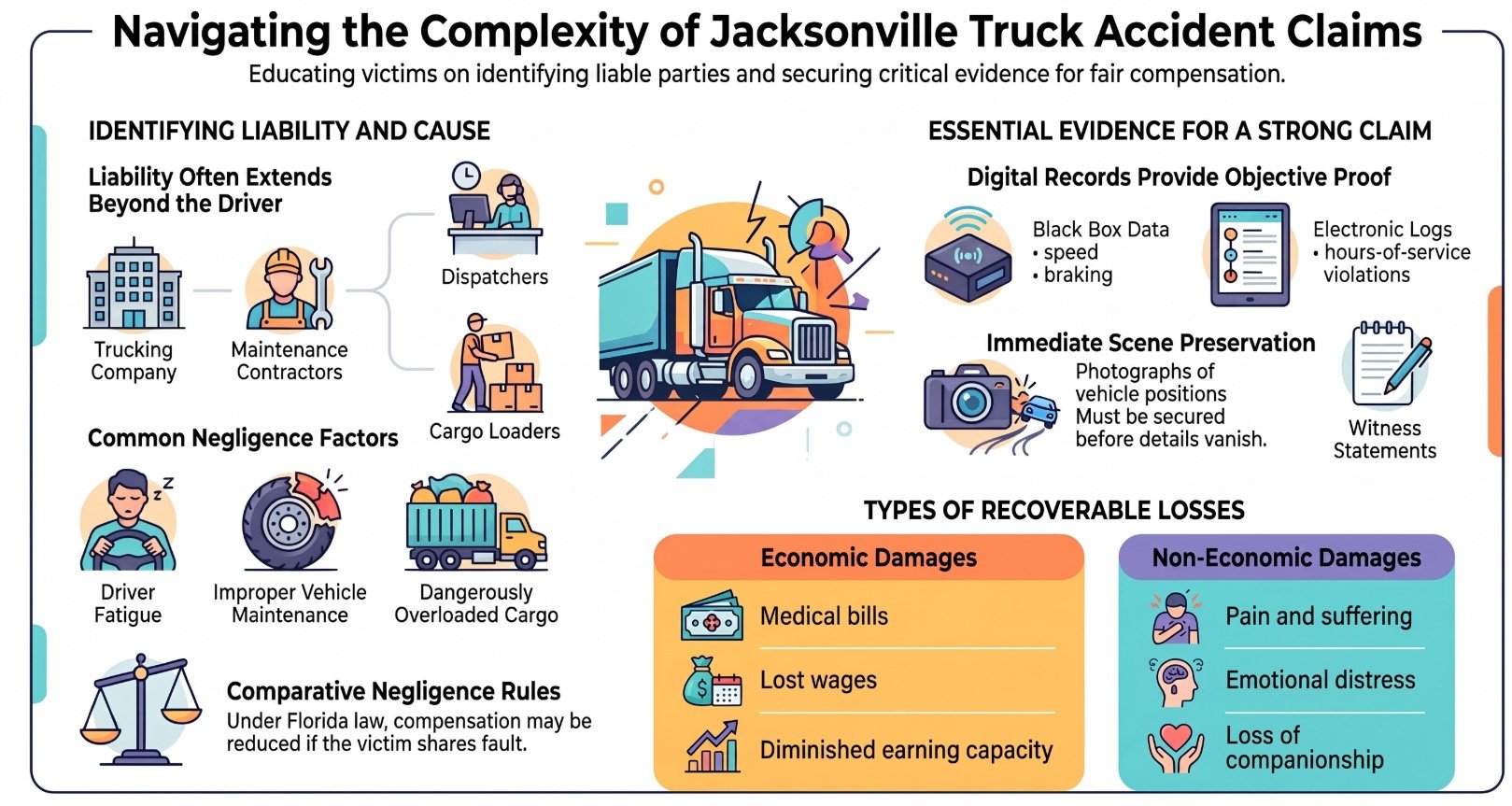
Common causes of Jacksonville truck accident claims often involve driver fatigue, distracted driving, improper truck maintenance, and overloaded cargo. Each factor can create serious safety risks, especially when commercial vehicles operate in dense traffic or on high-speed roadways. Identifying the cause of a crash is pivotal because liability may extend to drivers, trucking companies, maintenance providers, or cargo-loading parties.
Driver Fatigue
When a commercial truck driver remains on the road beyond safe physical limits, fatigue can impair judgment, slow reaction time, and increase the risk of a severe collision. In Jacksonville truck accident claims, driver fatigue may arise from sleep deprivation, demanding delivery schedules, overnight routes, or inadequate rest between shifts. Federal hours-of-service rules limit excessive driving and protect the public, but violations can occur through falsified logs, poor supervision, or pressure to meet deadlines. When fatigue contributes to a crash, liability may extend beyond the driver to the trucking company, dispatcher, or other responsible parties. Careful review of records, electronic logging data, and trip history can help identify failures that placed motorists, passengers, and families in preventable danger.
Distracted Driving
Distracted driving can turn a fully loaded commercial truck into an immediate hazard on Jacksonville roads, especially in dense traffic, construction zones, and high-speed corridors such as I-95, I-10, and I-295. A brief lapse in attention may prevent a driver from seeing slowed traffic, changing signals, or a nearby vehicle entering a blind spot. Cellphone distraction remains a common concern, whether it involves texting, navigation, calls, or dispatch messages. Other distractions may include eating, adjusting controls, or focusing on paperwork instead of the road. When a truck drifts, brakes late, or makes an unsafe lane change, investigators may review electronic data, witness accounts, and company policies. Lane departure prevention systems may reduce risk, but they do not excuse inattentive driving or inadequate supervision. Liability may extend beyond the driver.
Improper Truck Maintenance
Beyond driver inattention, unsafe truck conditions can create severe hazards on Jacksonville roadways, particularly when carriers fail to inspect, repair, or remove defective vehicles from service. Worn brakes, bald tires, faulty lights, steering problems, and neglected trailer components may turn an ordinary trip into a preventable collision. Maintenance records can show whether a company followed federal safety duties or placed convenience above public protection. Driver Logbooks may also reveal whether operators reported defects during required inspections, while Black Box Data can help identify mechanical failure, speed changes, braking activity, and vehicle performance before impact. When maintenance failures harm motorists, passengers, or roadside workers, liability may extend to trucking companies, maintenance contractors, inspectors, or parts providers. Careful review helps protect injured people and promotes safer commercial practices.
Overloaded Cargo
Although commercial trucks are designed to carry substantial weight, overloaded cargo can make a tractor-trailer unstable, harder to stop, and more difficult to operate on Jacksonville highways and surface roads. Excess weight may strain brakes, tires, suspension systems, and steering components, increasing the risk of rollovers, jackknife crashes, and rear-end collisions. Cargo Weight Limits exist to protect motorists, passengers, pedestrians, and workers who share the road. When carriers, loaders, or drivers ignore Federal Trucking Rules, they may place convenience or profit above public safety. Liability may involve shipping companies, freight brokers, trucking companies, or others responsible for loading and verification. Careful investigation of weigh station records, bills of lading, and maintenance evidence can help identify violations and support injured people seeking fair accountability after a serious truck crash.
Don’t Wait. Call Our Florida Personal Injury Lawyers Now!
Legal Rights of Jacksonville Truck Accident Claims & Liability Injury Victims
After a serious truck collision in Jacksonville, injured victims may have the right to seek compensation from every party whose negligence contributed to the crash. These rights can include recovery for medical care, lost income, diminished earning capacity, pain and suffering, and long-term support needs. Under Florida’s Comparative Negligence rules, compensation may be reduced if the injured person shares fault, making careful evaluation critical.
Victims and their advocates can protect a claim by focusing on:
- Prompt medical treatment and accurate documentation.
- Evidence Preservation, including records, vehicle data, photographs, and witness details.
- Notifying insurers promptly without making unnecessary admissions.
- Legal review before accepting any settlement offer.
A Jacksonville truck accident claim may involve multiple defendants, complicated insurance layers, and strict deadlines. Those serving injured individuals should encourage early guidance, organized records, and informed decisions, so the victim’s rights remain protected while physical, financial, and family needs are addressed.
Why Do Jacksonville Truck Accident Claims & Liability Injuries Happen?
Why do serious truck accidents happen on Jacksonville roads, highways, and port routes? They often result from a combination of human decisions, vehicle conditions, commercial pressures, and unsafe conditions around active freight corridors. Large trucks require greater stopping distance, careful lane control, and properly secured loads. When drivers speed, follow too closely, operate while fatigued, or misjudge traffic near exits and bridges, the risk to surrounding motorists increases.
Other causes may involve poor maintenance, defective brakes, worn tires, or inadequate inspection practices. Cargo shift can destabilize a trailer, especially during turns, sudden braking, or high-speed operations. Overturning crashes may occur when a truck enters a curve too fast, encounters uneven pavement, or carries an imbalanced load. Roadway hazards, including construction zones, debris, standing water, and limited visibility, can further contribute to collisions. Understanding these causes helps communities, safety professionals, and legal advocates promote accountability and prevent future harm.
What Should You Do After a Jacksonville Truck Accident Claims & Liability Injury?
After a Jacksonville truck accident injury, the injured person’s first steps can materially affect both medical recovery and any later liability claim. Prompt medical attention, a timely crash report, and careful evidence preservation help establish injury severity and the facts surrounding the collision. These actions create a stronger foundation for determining responsibility and pursuing appropriate compensation.
Seek Medical Attention
Seek immediate medical evaluation following a Jacksonville truck accident, even when injuries appear minor or symptoms seem delayed. Prompt care protects the injured person’s well-being and supports those who may later assist with recovery, caregiving, or legal review. Emergency documentation can identify trauma, establish timing, and preserve observations made before conditions worsen. A careful pain assessment helps providers recognize soft-tissue injuries, head trauma, spinal concerns, or internal complications that may not be obvious at the scene. Follow-up appointments should be kept because consistent medical records show the injury course and response to care. If physicians recommend imaging, therapy, medication, or expert review, the patient should follow the treatment plan closely. This responsible approach promotes recovery, reduces uncertainty, and creates a reliable record of medical needs.
Report The Crash
When a truck crash occurs in Jacksonville, report the collision to law enforcement as soon as it is safe to do so. Officers can secure the scene, assist injured people, and prepare an official crash report that may support later claims. A responsible person may call 911, provide the location, describe apparent injuries, and identify whether a commercial truck is involved. Cooperation should remain calm, truthful, and limited to known facts. Responding officers may note witness statements, which can help clarify how the crash happened. Prompt reporting also supports compliance with insurance timelines, which can affect notice requirements and claim processing. For those committed to serving injured families, timely reporting helps create order, accountability, and a reliable record after a serious Jacksonville truck accident.
Preserve Key Evidence
Because crucial proof can disappear quickly, begin preserving evidence as soon as the injured person is safe and emergency needs are addressed. A careful helper may collect driver, carrier, insurance, and license plate information, while avoiding confrontation or admissions. Photographs and video should capture vehicle positions, road markings, debris, cargo, weather, injuries, and traffic controls to create a reliable photo documentation timeline. If possible, names and contact details for bystanders, passengers, and first responders should be recorded for witness statement preservation. Keep damaged personal property, medical discharge papers, and repair estimates in organized files. The truck’s electronic data, maintenance records, logs, and dispatch communications may require prompt legal preservation notices, because companies may retain some materials only briefly after a serious Jacksonville collision.
Critical Evidence in a Jacksonville Truck Accident Claims & Liability Injury Case
Critical evidence in a Jacksonville truck accident claims and liability injury case can establish how the collision occurred, who may be responsible, and whether safety rules were violated. Key materials often include: 1. driver logbooks, 2. black box data, 3. maintenance records, and 4. crash scene evidence. Each category may help clarify issues such as driver fatigue, vehicle condition, speed, braking, and the actions of all parties involved.
Driver Logbooks
Although often treated as routine paperwork, driver logbooks can become central evidence in a Jacksonville truck accident claim because they may reveal whether a truck driver complied with federal hours-of-service rules before the collision. These records may show driving time, rest breaks, off-duty periods, and possible violations that contributed to fatigue. When reviewed carefully, logbooks can clarify whether the driver, carrier, or another responsible party put efficiency above public safety. In service to injured individuals and the community, this evidence supports a fair investigation focused on accountability, prevention, and lawful conduct. You can also compare paper logs and electronic driving records with fuel receipts, delivery schedules, and dispatch communications to identify inconsistencies. Accurate preservation and analysis can strengthen a claim and protect necessary rights.
Black Box Data
What can a truck’s black box reveal after a serious collision in Jacksonville? Event data recorders may preserve speed, braking, throttle use, directional controls, engine status, and seat belt information from moments before impact. This data can help clarify whether a driver reacted appropriately, followed traffic conditions, or contributed to the crash through unsafe conduct. When reviewed with driver logbooks, it may also expose conflicts between recorded driving activity and reported hours. Because this information can be overwritten or lost, timely preservation requests are often crucial. Compare black box data with crash scene evidence, witness accounts, photographs, and police findings to build a reliable picture of fault. For injured people and families seeking accountability, this evidence may provide objective support in a liability claim.
Maintenance Records
When a commercial truck is involved in a serious collision, its maintenance history may reveal whether mechanical neglect contributed to the crash. Inspection logs, repair invoices, brake service records, tire replacement reports, and federal compliance documents can show whether the carrier met its safety duties. These materials may also identify overdue repairs, repeated mechanical complaints, or improper work performed before the collision. For injured people and those assisting them, this evidence helps clarify how we can prove liability against a driver, trucking company, maintenance contractor, or parts provider. Prompt preservation requests are often necessary because records may be incomplete, altered, or discarded. Strong maintenance evidence can also influence the settlement negotiation timeline, especially when it establishes preventable safety failures and reduces disputes over responsibility.
Crash Scene Evidence
Because the physical scene can change within hours, crash scene evidence often becomes one of the most time-sensitive sources of proof in a Jacksonville truck accident claim. Skid marks, vehicle resting positions, debris fields, roadway defects, lighting, weather, and traffic control devices may help explain how the collision occurred. Prompt photographs, measurements, and preservation requests can support a careful insurance investigation and reduce the risk of lost facts. Witness statements gathered near the time of impact may clarify speed, lane use, braking, or driver conduct. Medical records can connect observed injuries to the force and timing of the crash. Cargo receipts may also show load weight, contents, or delivery pressures. When collected responsibly, this evidence helps injured people, families, and advocates pursue accountability accurately and with care.
Long-Term Effects of Jacksonville Truck Accident Claims & Liability Injuries
Truck accident injuries in Jacksonville may lead to chronic pain conditions that interfere with mobility, sleep, and daily function long after the initial collision. Many claimants require ongoing medical treatment, including expert care, rehabilitation, medication, or future procedures. These long-term limitations may also reduce earning capacity, particularly when injuries prevent a return to the same occupation or work schedule.
Chronic Pain Conditions
After a serious collision involving a commercial vehicle, chronic pain may become one of the most disruptive long-term consequences for an injured person. Pain involving the back, neck, joints, or nerves can limit mobility, reduce concentration, and interfere with basic responsibilities. For individuals who serve families, workplaces, faith communities, or the public, these limitations may affect both personal dignity and daily contribution. In a Jacksonville truck accident claim, chronic pain must be presented with care, because its effects are often difficult to observe directly. Thorough medical documentation can link ongoing symptoms to the crash, describe functional limits, and support a credible valuation. When negotiating an insurance settlement, this evidence may help ensure the injured person’s suffering and reduced quality of life are fairly considered.
Ongoing Medical Treatment
Ongoing medical treatment often becomes necessary when injuries from a Jacksonville truck accident require monitoring, rehabilitation, medication management, or expert care beyond the initial emergency response. Consistent care may involve orthopedic visits, neurological evaluations, physical therapy, pain management, or follow-up imaging to assess healing and complications. Tracking the treatment timeline helps organize appointments, procedures, referrals, and physician recommendations, creating a clear record of medical progress and ongoing needs. For those serving injured individuals, careful attention to these records supports informed decisions and responsible advocacy. Documenting functional limitations is also important, as treatment providers may note restrictions involving mobility, lifting, concentration, sleep, or daily self-care. These details can clarify the injury’s lasting impact, guide future care planning, and support a more complete evaluation of damages in the claim.
Reduced Earning Capacity
When injuries from a Jacksonville truck accident affect a person’s ability to work over time, reduced earning capacity may become a significant part of the claim. This loss may involve fewer hours, lower wages, missed promotions, or a permanent shift to less demanding employment. Medical records, vocational assessments, work history, and expert opinions often help show how the injury limits future income. Future career planning may also be necessary when an injured person can no longer perform prior duties and must retrain or seek modified work. A careful compensation strategy considers age, education, job skills, physical restrictions, and expected career growth. By documenting these factors, a claim can more accurately reflect the accident’s long-term financial harm and support fair recovery for the injured person.
Proving Liability in Jacksonville Truck Accident Claims & Liability Injury Cases
Because truck accident cases often involve multiple parties and complex regulations, proving liability in a Jacksonville injury claim requires a careful review of the facts, evidence, and applicable legal duties. Liability may rest with a driver, trucking company, maintenance provider, cargo loader, or another responsible entity, depending on how the crash occurred.
Evidence may include police reports, driver logs, electronic control data, inspection records, witness statements, and surveillance footage from nearby businesses or traffic systems. These materials can show speeding, fatigue, improper maintenance, unsafe loading, or violations of federal and Florida trucking rules. Comparative negligence may also affect the claim if the injured person or another party contributed to the collision.
A thorough liability investigation supports fair accountability and helps injured individuals, families, and caregivers understand what occurred. By identifying each responsible party, the legal process can promote safety, responsibility, and service to those harmed by preventable truck accidents.
Dealing With Insurance Companies After a Jacksonville Truck Accident Claims & Liability Injury
After liability evidence is gathered, insurance companies often play a central role in how a Jacksonville truck accident claim is evaluated, disputed, and resolved. Adjusters may review medical records, repair estimates, driver logs, policy limits, and recorded communications to determine payment exposure. Their role is not to serve the injured person, but to protect the insurer’s financial interests while complying with applicable duties.
Careful communication can help prevent misstatements that later affect compensation. Evidence preservation remains important when insurers request documents, photographs, vehicle data, or access for inspection. Although witness statements not relevant to dealing with insurance companies may seem separate, statements tied to fault, injuries, or damages can influence valuation. Common claim denial reasons include disputed liability, alleged preexisting conditions, delayed medical treatment, policy exclusions, incomplete documentation, or arguments that damages are unsupported. A lawyer can manage insurer contact, respond to coverage positions, and help protect the injured person’s claim with disciplined advocacy.
What to Expect During a Jacksonville Truck Accident Claims & Liability Injury Claim Process
A Jacksonville truck accident claim typically begins with an initial evaluation of injuries, damages, insurance coverage, and the facts surrounding the crash. The evidence collection process may include police reports, medical records, driver logs, vehicle data, witness statements, and trucking company documents, which support the steps used to determine liability. Once responsibility and damages are assessed, the claim usually proceeds into settlement negotiations, where the timeline depends on the strength of the evidence, the severity of injuries, and the insurer’s response.
Initial Claim Evaluation
Typically, the initial evaluation of a Jacksonville truck accident claim focuses on identifying how the crash occurred, who may be legally responsible, and what evidence is needed to support the injury claim. During this stage, a lawyer reviews the reported facts, the parties involved, injury details, insurance coverage, and any early indications of negligence. The lawyer pays close attention to police report accuracy, since errors in names, vehicle descriptions, roadway conditions, or stated violations can affect later claim decisions. We may also assess witness statements to see whether independent accounts could clarify disputed facts. This evaluation helps injured individuals, caregivers, and advocates understand potential claim strength, anticipated challenges, and available legal paths. It also supports timely decisions made with care, order, and responsibility.
Evidence Collection Process
During evidence collection, a Jacksonville truck accident claim moves from preliminary review toward documented proof of fault, injury, and loss. Counsel may gather crash reports, photographs, electronic data, repair estimates, employment information, and medical records to preserve a clear factual foundation. Witness interviews can help clarify road conditions, vehicle movement, driver behavior, and immediate observations after impact. Organized teams also document timelines, tracking treatment dates, communication with insurers, missed work, and service-related responsibilities affected by the collision. This careful recordkeeping supports claim valuation by connecting injuries, expenses, and daily limitations to reliable evidence. For individuals committed to serving family, community, or workplace duties, thorough documentation helps present the claim with accuracy, dignity, and accountability, while avoiding unnecessary disputes over basic facts.
Liability Determination Steps
Once the evidence has been organized, liability determination focuses on identifying every person or company whose conduct may have contributed to the Jacksonville truck accident. Investigators may review driver logs, maintenance records, dispatch instructions, black box data, police reports, and witness statements to assess whether the truck driver, motor carrier, cargo loader, maintenance provider, or another motorist breached a duty of care. This step often involves comparing federal trucking rules, Florida traffic laws, and industry safety practices against the facts. Comparative negligence may also be evaluated, especially if allegations arise that the injured person shared some fault. A careful liability analysis helps protect the injured party’s interests, supports accurate responsibility findings, and promotes a fair claims process that serves the broader goal of roadway safety.
Settlement Negotiation Timeline
After liability has been evaluated and the injured person’s damages are reasonably documented, settlement negotiations may begin with a demand package submitted to the responsible insurer or corporate representative. This package often includes medical records, wage loss proof, crash reports, expert opinions, and Evidence preservation materials that clarify fault and loss. The insurer then reviews the claim, may request additional information, and usually responds with acceptance, denial, or a counteroffer.
In Jacksonville truck accident claims, the timeline may range from several weeks to months, depending on injury severity, disputed liability, and insurance strategy. Counsel may negotiate through written exchanges, phone conferences, or mediation. Each offer should be measured against future care needs, unpaid expenses, and the client’s long-term stability before any release is signed.
Don’t Wait. Call Our Florida Personal Injury Lawyers Now!
Compensation for Jacksonville Truck Accident Claims & Liability Injury Damages
Pursue full compensation in a Jacksonville truck accident claim requires a careful evaluation of both immediate losses and long-term consequences. Injured individuals may face medical expenses, reduced work capacity, rehabilitation needs, and practical burdens that affect family stability. A focused claim helps identify every responsible party, including drivers, carriers, maintenance providers, or loading companies.
Evidence preservation is central to protecting the claim. Truck data, inspection records, driver logs, photographs, and witness accounts may show how the crash occurred and who contributed to it. A thorough liability investigation allows counsel to connect unsafe conduct with the harm suffered, while damages documentation supports a clear presentation of the injured person’s needs.
For those committed to serving others, fair compensation can restore the resources needed to mend, support dependents, and continue meaningful responsibilities. Careful legal guidance helps prevent insurers from undervaluing the claim or overlooking future care demands.
Economic vs Non-Economic Damages in Jacksonville Truck Accident Claims & Liability Cases
In Jacksonville truck accident claims, damages are generally divided into economic and non-economic categories, each addressing different losses caused by the collision. Economic damages reflect measurable financial harm, while non-economic damages address personal consequences such as pain, suffering, and diminished quality of life. Establishing the value of both categories requires evidence, documentation, and a clear connection between the accident and the claimant’s losses.
Economic Damages Explained
Economic damages define the measurable financial losses that follow a Jacksonville truck accident, including medical expenses, lost income, reduced earning capacity, rehabilitation costs, property damage, and other out-of-pocket expenses tied to the collision. These losses help identify what resources an injured person needs to regain stability and continue meeting family, work, and service responsibilities. Documentation is central because bills, wage records, repair estimates, and expert evaluations connect each loss to the crash. Careful insurance communication also helps prevent undervaluation, incomplete claim review, or statements that may weaken recovery. Evidence preservation supports this process by protecting invoices, employment records, diagnostic reports, vehicle photographs, and truck data. In liability cases, clear proof of economic damages helps a claim reflect the real financial burden caused by negligent conduct.
Non-Economic Damages Explained
While economic damages measure financial loss, non-economic damages address the personal harm that cannot be proven through invoices or wage records alone. In Jacksonville truck accident cases, these losses may include pain, emotional distress, humiliation, loss of companionship, disfigurement, and reduced enjoyment of daily life. Such harm can deeply affect a person’s ability to serve family, workplace, faith community, or neighbors with the same steadiness as before the crash. Comparative Fault may reduce recovery when an injured person shares responsibility, making careful evaluation critical. Insurance Denials often target these damages because they are less tangible than medical bills or repair costs. A liability lawyer may identify how the collision changed the injured person’s dignity, relationships, routines, and independence while maintaining a respectful, evidence-focused approach to the claim.
Proving Damage Value
To prove damage value after a Jacksonville truck accident, a claimant must connect each claimed loss to reliable evidence, the severity of the injuries, and the legal responsibility of the trucking company, driver, or another at-fault party. Economic damages often require Insurance documentation, wage records, repair estimates, and a medical expenses appraisal that reflects past and future care. Non-economic damages require thoughtful proof of pain, limitations, emotional distress, and reduced daily function. Strong evidence preservation supports both categories, especially when records may show preventable harm. Driver logbooks analysis may reveal fatigue or hours violations, while maintenance record review may identify unsafe equipment. These findings can strengthen settlement negotiation by showing the full human and financial impact, helping injured people pursue fair recovery with dignity.
When a Jacksonville Truck Accident Claims & Liability Injury Case Goes to Trial vs Settlement
After a serious truck accident in Jacksonville, the decision to settle or go to trial often depends on liability disputes, injury severity, insurance coverage, and the strength of the available evidence. Settlement may serve an injured person by providing timely compensation, reducing uncertainty, and avoiding the burden of courtroom proceedings. It can be appropriate when fault is well documented, and the insurer makes a fair offer.
Trial may become necessary when trucking companies, insurers, or other parties deny responsibility, undervalue losses, or rely on Negligence defenses to shift blame. In those cases, expert testimony may help explain crash mechanics, commercial driving standards, medical needs, and future financial harm. A trial allows a judge or jury to evaluate credibility and assign accountability. Counsel typically weighs risks, costs, delay, and the client’s long-term welfare. The goal is not escalation for its own sake, but a just outcome.
Florida Laws That May Affect Your Jacksonville Truck Accident Claims & Liability Case
Because truck accident claims often involve severe injuries and multiple responsible parties, Florida law can significantly influence how liability is proven and how compensation is recovered. A careful legal review may help injured people, families, and caregivers pursue accountability while protecting needed support.
Key laws and doctrines may include:
- Comparative Negligence: Fault may be divided among the truck driver, carrier, maintenance company, cargo loader, or injured party.
- Florida No-Fault: Personal injury protection benefits may apply first, though serious injuries can support claims beyond no-fault limits.
- Trucking Federal Preemption: Federal motor carrier rules may affect safety duties, insurance issues, and whether state claims can proceed.
- Dram Shop Liability: Alcohol service may create limited liability if unlawful service contributed to an impaired driver’s conduct.
These rules can impact investigation strategy, evidence preservation, settlement valuation, and trial preparation. Sound guidance helps ensure the claim is developed accurately, fairly, and with respect for those harmed.
The Statute of Limitations for Jacksonville Truck Accident Claims & Liability Injury Cases
When a commercial truck crash causes serious injury in Jacksonville, the statute of limitations sets the legal deadline for filing a claim in court. Under Florida law, injured parties generally have two years from the date of the crash to bring a negligence action, although specific facts may affect timing. Legal deadlines matter because missed limits can prevent recovery, regardless of the severity of harm or the strength of liability evidence.
Timely claim filing also helps preserve evidence. Trucking records, driver logs, maintenance documents, electronic control module data, and witness memories may become harder to secure over time. Prompt action helps maintain an accurate record for those seeking accountability and fair compensation, while also supporting the broader goal of safer roads.
The limitations period can also influence settlement strategy. Insurers often evaluate risk, documentation, and timing before resolving claims. Awareness of deadlines encourages orderly preparation and protects the injured person’s ability to pursue relief if settlement discussions fail.
How a Jacksonville Truck Accident Claims & Liability Lawyer Can Help You
A Jacksonville truck accident claims and liability lawyer can help protect an injured person’s rights by managing the legal process within the required deadlines and preserving evidence before it is lost. This support lets the injured person and family members focus on recovery, caregiving, and daily responsibilities while the claim is handled with care.
Key forms of support may include:
- Investigating crash causes, driver conduct, carrier practices, and vehicle maintenance issues.
- Coordinating evidence preservation, including logs, electronic data, inspection records, and witness information.
- Performing compensation calculations for medical costs, lost income, reduced earning ability, pain, and future care.
- Communicating with insurers, defense representatives, and involved parties to reduce confusion and protect the claim’s value.
Through organized case management, the lawyer helps present facts clearly, identify responsible parties, and pursue fair financial recovery. This service supports accountability while respecting the practical burdens placed on injured people and their families.
When to Contact a Jacksonville Truck Accident Claims & Liability Lawyer
After a serious truck crash in Jacksonville, legal guidance should be taken into account as soon as the injured person’s immediate medical needs are addressed. Early contact allows counsel to help preserve important records, identify involved parties, and reduce preventable confusion during a difficult recovery period. Families, caregivers, and community members assisting the injured person often serve best by encouraging timely organization rather than delay.
Gather emergency medical documentation promptly, including ambulance records, hospital discharge papers, diagnostic results, and follow-up instructions. These records may help show the nature of injuries and the timeline of care. A lawyer may also help with an insurance communications strategy, ensuring necessary notices are handled carefully and statements are not made without proper context.
Contact is especially important when injuries are serious, liability is unclear, a commercial carrier is involved, or insurers begin requesting recorded statements, authorizations, or quick settlement discussions.
Don’t Wait. Call Our Florida Personal Injury Lawyers Now!
Why You Need an Experienced Jacksonville Truck Accident Claims & Liability Lawyer
Timely legal contact matters, but the value of that contact depends heavily on the lawyer’s experience with commercial truck accident claims and liability disputes. These cases often involve layered responsibility among drivers, carriers, maintenance contractors, brokers, and insurers. An experienced Jacksonville lawyer understands how federal safety rules, company records, electronic data, and medical proof must work jointly to support a harmed person’s claim.
Skill also matters when protecting the client’s ability to serve family, work, and community after a serious collision. A lawyer familiar with trucking litigation can build an Insurance documentation strategy that presents losses clearly and resists attempts to minimize responsibility. Effective deposition preparation tactics also help injured clients, witnesses, and professionals provide accurate testimony under pressure. Through disciplined investigation and careful claim development, experienced counsel can identify liable parties, preserve critical evidence, and pursue fair compensation with the seriousness these life-altering cases require after devastating commercial truck collisions.
How to Choose the Right Jacksonville Truck Accident Claims & Liability Lawyer for Your Case
Choosing the right Jacksonville truck accident claims and liability lawyer requires careful attention to the attorney’s experience, resources, and approach to complex commercial vehicle cases. A suitable lawyer should understand federal trucking regulations, insurance practices, crash reconstruction, and the role of multiple potentially liable parties. This knowledge allows the lawyer to identify evidence that may help injured people pursue support for medical care, lost income, and long-term needs.
Prospective clients should evaluate Client communication, including how promptly questions are answered and whether legal options are explained with care and respect. A clear case strategy is also critical, as truck accident claims often require early evidence preservation, detailed investigation, and firm negotiation with insurers. The right lawyer should show compassion while remaining prepared to prove liability and damages. By selecting counsel with discipline, responsiveness, and a service-focused mindset, injured individuals can move forward with greater confidence and direction after a serious truck collision.
About The Law Offices of Anidjar & Levine
For injured people seeking guidance after a commercial truck collision, The Law Offices of Anidjar & Levine provides legal representation focused on personal injury claims, liability analysis, and client support throughout the claims process. The firm helps clients understand their rights, identify responsible parties, and pursue compensation for losses caused by negligence.
Its legal team reviews crash reports, trucking records, insurance communications, and medical documentation to build organized claims. Clients receive practical guidance on Medical treatment timelines, documentation needs, and evidence preservation tips, including the importance of securing photographs, witness information, vehicle data, and repair records.
The firm’s approach reflects a service-centered commitment to reducing burdens for injured individuals and families. By handling negotiations, deadlines, and case preparation, the attorneys help clients remain focused on recovery. In Jacksonville truck accident matters, The Law Offices of Anidjar & Levine provides steady advocacy, careful case evaluation, and informed direction.

Frequently Asked Questions
Can I Sue if the Truck Driver Was an Independent Contractor?
Yes, you may sue even if the truck driver was an independent contractor, but liability depends on the specific facts. Independent Contractor Liability often turns on whether the trucking company, broker, or other party retained authority over safety practices, routes, schedules, or equipment. Proving a control relationship can establish responsibility beyond the driver. Careful evidence review helps injured people identify accountable parties and support a fair, disciplined claim for recovery.
Do Truck Accident Claims Differ From Car Accident Claims?
Yes, truck accident claims often differ from car accident claims because they involve larger vehicles, more severe harm, and multiple responsible parties. Evidence preservation is essential, including driver logs, inspection records, cargo documents, and electronic data. Claimants may need to seek medical care promptly, report the accident accurately, and cooperate with reasonable information requests. Those assisting injured people should recognize that trucking cases often require faster action and careful review of federal and state safety rules.
Can a Trucking Company Destroy Evidence After a Crash?
No. A trucking company generally may not destroy relevant evidence after a crash. Once litigation is reasonably anticipated, spoliation laws require evidence preservation, including driver logs, inspection records, electronic control module data, and maintenance files. Destruction or alteration can lead to sanctions, adverse jury instructions, or liability consequences. Proper preservation supports truth, accountability, and fair service to injured persons, insurers, courts, and others relying on accurate crash information.
What if Hazardous Cargo Caused or Worsened My Injuries?
If hazardous cargo caused or worsened injuries, the claimant should seek immediate care and preserve medical documentation linking exposure, burns, inhalation, or trauma to the crash. A liability investigation may examine shipping papers, placards, driver training, containment methods, and emergency response conduct. Spill contamination can expand responsibility to carriers, loaders, shippers, or maintenance providers. Careful evidence collection helps protect the injured person and supports service-focused accountability.
Are Jacksonville Truck Accident Claims Affected by Federal Trucking Regulations?
Yes, federal trucking regulations often affect these claims. These rules set federal standards for driver hours, vehicle maintenance, cargo securement, inspections, and training. When a carrier or driver violates them, those violations may support findings of negligence and influence liability compliance analysis. For those representing injured individuals, carefully reviewing logs, records, and safety practices helps determine whether regulatory failures contributed to the crash and resulting harm.
—————————
Truck accident claims in Jacksonville often involve complex liability issues, serious injuries, and aggressive insurance defense tactics. An experienced lawyer can investigate the crash, identify responsible parties, preserve vital evidence, and pursue compensation for medical expenses, lost income, and other damages. The Law Offices of Anidjar and Levine offer legal guidance to injured victims and their families. Prompt legal action may help protect important rights and strengthen a claim for financial recovery. Learn more from a Jacksonville Personal Injury Lawyer.