
The Law Offices of Anidjar and Levine can help after a crash caused by an impaired or distracted driver by investigating the driver’s conduct, preserving phone, vehicle, toxicology, and surveillance evidence, and evaluating how negligence caused the collision and the resulting injuries.
A West Palm Beach Personal Injury Lawyer can manage insurer communications, assess medical expenses, lost income, property damage, pain, and future needs, while addressing comparative fault and available coverage.
Prompt legal representation may protect crucial evidence and strengthen negotiations or litigation.
Main Takeaways
- A West Palm Beach impaired or distracted driving lawyer investigates fault using crash reports, witness statements, phone records, video, and vehicle data.
- Legal counsel can protect your rights when insurers request recorded statements, medical authorizations, photographs, or employment information.
- Evidence may establish negligence involving texting, alcohol, drugs, fatigue, eating, speeding, following too closely, or failing to yield.
- Attorneys evaluate compensation for medical expenses, lost income, property damage, pain, suffering, and continuing care under Florida law.
- Prompt medical treatment and preservation of electronic, photographic, physical, and witness evidence can strengthen your accident claim.
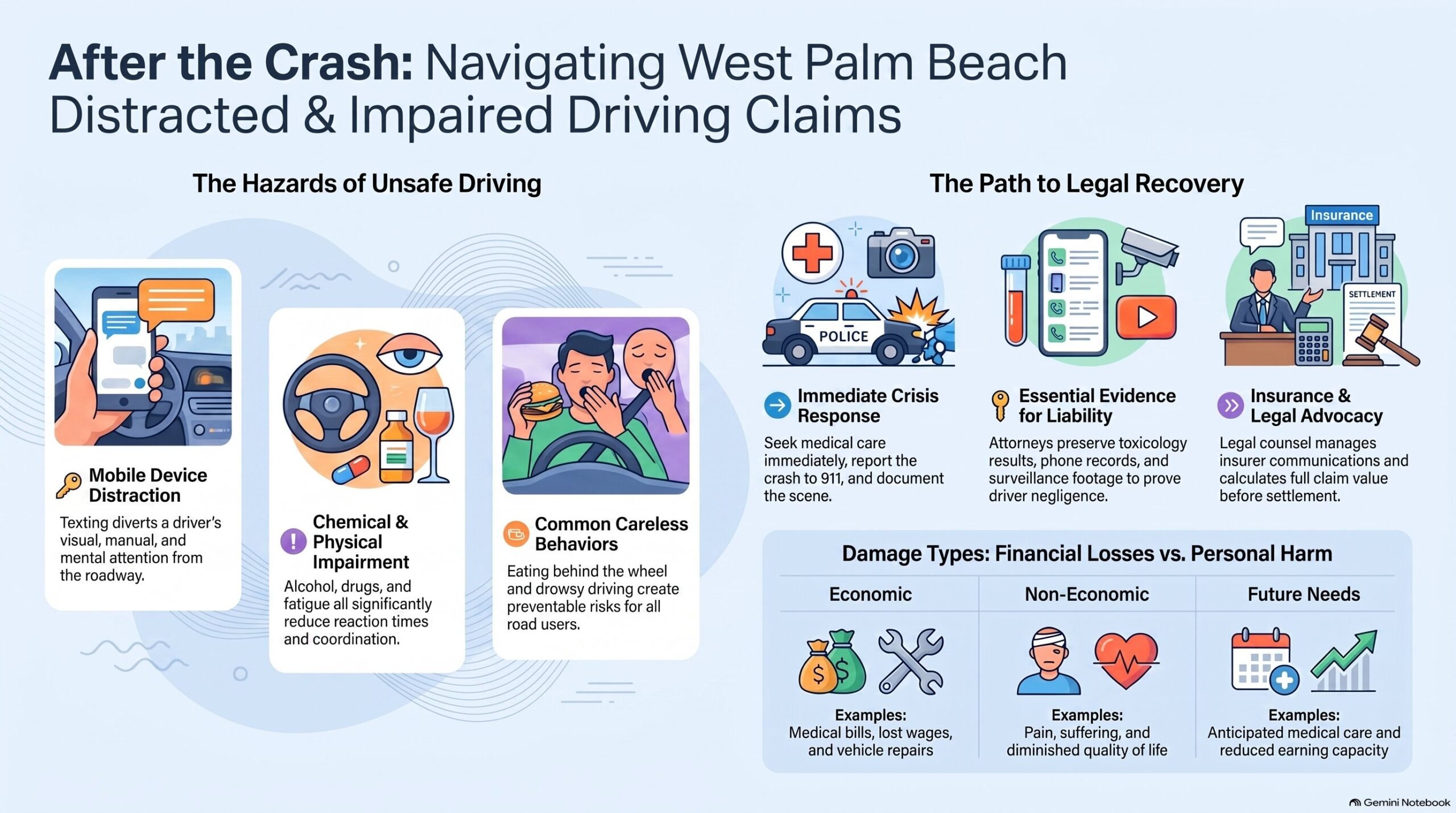


How We Can Help With Your West Palm Beach Car Accident Impaired & Distracted Driving Injury Claim
When a West Palm Beach car accident involves impaired or distracted driving, an attorney can investigate the circumstances, identify the responsible parties, and pursue compensation for the injured person’s losses. Legal counsel can organize police reports, medical records, witness accounts, photographs, and available electronic evidence to develop a clear claim. The attorney may communicate with insurers, protect the client from making premature statements, and assess damages for treatment, lost income, property damage, and ongoing needs.
Through focused Negotiation tactics, counsel can challenge incomplete evaluations, document liability, and present evidence supporting a fair resolution. A thoughtful settlement strategy considers the claim’s strengths, potential disputes, applicable coverage, and the client’s recovery priorities before any agreement is accepted. If negotiations do not produce adequate compensation, the attorney can prepare the matter for litigation and advocate for the injured person in court. This assistance allows clients and their families to focus on medical care while a legal professional diligently handles communications, deadlines, and claim development.
OUR CONSULTATIONSARE FREE
START YOUR FREE CASE REVIEW

Understanding West Palm Beach Car Accident Impaired & Distracted Driving Injury Cases
Impaired and distracted driving injury cases in West Palm Beach require an examination of both the driver’s conduct and its connection to the resulting harm. A case generally considers whether the evidence establishes negligence, including a failure to operate safely, and whether that conduct legally caused the collision and injuries. Medical records, employment documentation, photographs, witness accounts, and official reports may help clarify the severity and financial impact of the loss.
Florida’s Comparative fault analysis can affect recovery when more than one party contributed to the incident. Insurance coverage, available assets, and the nature of each injury also influence case evaluation. Damages may include medical expenses, lost income, rehabilitation, property damage, and non-economic losses recognized by law.
A careful investigation supports informed decisions while protecting the injured person’s interests. Resolution may occur through negotiation, litigation, or mediation. Mediation outcomes depend on evidence, liability assessments, damages, and the parties’ willingness to reach a fair agreement without sacrificing necessary care or accountability.
Common Causes of West Palm Beach Car Accident Impaired & Distracted Driving
Common causes of impaired and distracted driving accidents include texting while driving, driving under the influence, eating behind the wheel, and drowsy driving habits. Each behavior can reduce attention, impair judgment, or delay a driver’s response to changing traffic conditions. Identifying the contributing conduct may help clarify how a collision occurred and who may be legally responsible.
Texting While Driving
Texting while driving is a significant form of distracted driving that diverts a motorist’s visual, manual, and mental attention from the roadway. Cellphone distraction can occur when a driver reads, sends, or searches for messages, even during brief traffic pauses. Looking away for several seconds may prevent you from recognizing stopped vehicles, pedestrians, traffic signals, or changing road conditions. Manual distraction also reduces directional control and delays braking responses, increasing the likelihood of a collision. The consequences of texting may include property damage, physical injuries, emotional distress, and financial losses for affected individuals and families. After a crash, evidence such as phone records, witness statements, and surveillance footage may help establish whether texting contributed to the incident. Legal guidance can help injured parties pursue accountability and available compensation.
Driving Under the Influence
Driving under the influence of alcohol, prescription medication, or illegal substances is a serious cause of West Palm Beach car accidents because it can impair judgment, coordination, vision, and reaction time. Impaired drivers may drift across lanes, disregard traffic signals, misjudge distances, or fail to respond to changing roadway conditions. Prescription medications can create drowsiness or confusion even when taken as directed, particularly when combined with alcohol or other drugs. These risks affect private motorists and individuals involved in commercial trucking, where vehicle size and cargo can increase collision severity. Law enforcement officers may identify suspected impairment through roadside investigations, field sobriety assessments, and chemical testing. Victims may require immediate medical attention, documentation of injuries, and assistance preserving evidence while pursuing accountability through appropriate legal channels.
Eating Behind the Wheel
Eating behind the wheel can be a significant distraction, diverting a driver’s hands, eyes, and attention from the road. Distracted eating may involve opening containers, reaching for food, handling utensils, or responding to spills while traffic conditions change. These actions can delay braking, interfere with guidance, and reduce awareness of pedestrians, cyclists, and nearby vehicles. Hot drinks and loose items may also cause sudden reactions that compromise vehicle control. Drivers who choose to eat while moving increase risks for passengers and others sharing West Palm Beach roads. Vehicle safety requires keeping both hands and visual attention on the road as consistently as possible. Pulling into a safe location before eating allows a driver to address hunger without placing others in avoidable danger. Responsible driving practices help protect the broader community from preventable collisions and injuries.
Drowsy Driving Habits
Fatigue behind the wheel can impair judgment, reaction time, and vehicle control in ways similar to alcohol-related impairment. Drowsy driving habits often develop when motorists dismiss sleep deprivation, work extended hours, or continue driving despite repeated yawning and difficulty focusing. Reduced reaction time may prevent a driver from recognizing hazards, yielding safely, or maintaining a consistent lane position. Medication side effects can intensify drowsiness, particularly when prescriptions or over-the-counter products cause sedation, dizziness, or impaired concentration.
Effective fatigue management requires adequate sleep, planned breaks, alternate transportation, and honest recognition of declining alertness. Drivers serving family members, coworkers, passengers, and other road users have a responsibility to avoid operating a vehicle when exhausted. Addressing these habits can reduce preventable collisions and protect individuals who depend on safe, attentive transportation.


Legal Rights of West Palm Beach Car Accident Impaired & Distracted Driving Injury Victims
When impaired or distracted driving causes a West Palm Beach collision, injured victims may have legal rights to pursue compensation from the responsible driver. These rights can include recovery for medical expenses, lost income, property damage, and pain and suffering, depending on the evidence and applicable Florida law.
A careful legal review may help preserve those rights while supporting a fair resolution.
- Victims may document injuries, treatment, financial losses, and accident-related limitations to establish the full scope of damages.
- Attorneys can manage Insurance claim timelines, communicate with insurers, and evaluate settlement proposals before rights are compromised.
- Case preparation may include police reports, medical records, electronic evidence, and witness credibility checks to clarify responsibility.
Victims should avoid making recorded statements or entering into settlement agreements without understanding their consequences. Prompt consultation with a qualified West Palm Beach car accident attorney may help families protect evidence, meet procedural requirements, and pursue accountability with dignity. Legal guidance also allows injured individuals to focus on recovery while their interests are diligently represented.
Why Do West Palm Beach Car Accident Impaired & Distracted Driving Injuries Happen?
Impaired and distracted driving injuries in West Palm Beach commonly result from unsafe decisions that reduce a driver’s attention, judgment, or physical control. Alcohol, prescription medication, illegal substances, fatigue, mobile-phone use, eating, navigation, and conversations can interfere with a driver’s ability to perceive hazards and respond safely. Speeding, following too closely, ignoring traffic signals, and failing to yield may intensify the consequences of that impairment or distraction. Common negligence often involves conduct that a reasonably careful driver would recognize as dangerous, particularly near busy intersections, schools, and pedestrian areas.
Crashes may produce traumatic brain injuries, spinal damage, fractures, or other conditions requiring extensive medical care and support. Fault determinations can depend on police reports, toxicology results, electronic records, vehicle data, and surveillance footage. Evidence preservation and witness credibility may, in turn, influence whether an injured person receives a fair insurance settlement. Understanding these contributing factors helps families and service professionals recognize preventable risks and advocate for accountability without assigning conclusions unsupported by reliable evidence.
What Should You Do After a West Palm Beach Car Accident Impaired & Distracted Driving Injury?
After an impaired or distracted driving injury, the injured person should seek immediate medical care, even when symptoms initially appear minor. The crash should be reported to law enforcement, and medical records should clearly document the diagnosed injuries. Photographs, witness information, vehicle damage, and other evidence should also be preserved promptly to support the resulting claim.
Seek Immediate Medical Care
Prompt medical treatment should be a priority for anyone injured in a West Palm Beach car accident involving suspected impaired or distracted driving. Immediate symptoms may include pain, dizziness, confusion, weakness, or difficulty breathing, but serious conditions can develop without obvious warning. A qualified healthcare professional can assess hidden injuries, stabilize urgent conditions, and explain appropriate follow-up care. Particular attention is warranted because concussion risk may exist even when a person did not lose consciousness or sustain a visible head wound.
Medical evaluation also creates injury documentation, including examination findings, diagnostic results, treatment recommendations, and prescribed limitations. These records can help establish the nature and progression of harm while supporting continuity of care. Individuals should follow medical instructions, monitor changes, and promptly seek additional treatment if symptoms worsen or new concerns arise.
Report the Crash
A crash involving suspected impaired or distracted driving should be reported to law enforcement as soon as it is safe to do so. Calling 911 allows officers and emergency personnel to assess injuries, address hazards, and establish an official report. Scene safety remains the first priority; individuals should move away from traffic only when it is reasonably safe to do so and should avoid confronting another driver who may be impaired. Witness capture can assist investigators, so names and contact information may be provided to responding officers when available. The involved person should accurately describe the location, apparent injuries, and immediate dangers, without speculating about fault or impairment. Cooperation with officers supports public safety and preserves reliable information for those who may need assistance afterward. Emergency instructions should be followed until responders assume control.
Document Evidence and Injuries
When safety permits, the injured person should document the crash scene and any apparent injuries before evidence changes or conditions deteriorate. Photographs should capture vehicle positions, roadway conditions, traffic signs, visible damage, skid marks, debris, and surrounding businesses or residences that may have surveillance footage. Witnesses’ names and contact information should be preserved, along with insurance details and the responding officer’s report information. Any available Dashcam video should be saved promptly in its original format, since recordings may be overwritten automatically.
Medical evaluation should occur as soon as reasonably possible, even when symptoms initially appear minor. The injured person should describe every symptom accurately and follow recommended treatment. Complete medical documentation can link injuries to the collision and establish their progression, treatment needs, and impact on daily activities. Records, receipts, photographs, and communications should be organized securely.
Don’t Wait. Call Our Florida Personal Injury Lawyers Now!
Critical Evidence in a West Palm Beach Car Accident Impaired & Distracted Driving Injury Case
Critical evidence can establish whether impaired or distracted driving caused the West Palm Beach collision and support an injured party’s claim.
Key sources commonly include:
- Police reports and toxicology test results
- Phone records documenting potential device use
- Witness statements describing the driver’s conduct and the crash circumstances
Police Reports
Although police reports are not conclusive proof of liability, they often provide a key initial record of an impaired or distracted driving collision in West Palm Beach. Officers may document statements, roadway conditions, vehicle positions, visible damage, citations, and observations suggesting mobile-phone use or driver inattention. These details can help establish a timeline and identify witnesses whose recollections may otherwise fade. Reports may also note nearby businesses, traffic cameras, or other sources requiring prompt footage preservation. A careful review can reveal inconsistencies, omitted facts, or investigative steps that warrant follow-up. Because negligence standards require evidence connecting a driver’s conduct to the resulting injuries, the report serves as an essential starting point rather than a final determination. Preserving the report and related records helps attorneys and families pursue an accurate, fair evaluation of the claim.
Toxicology Test Results
Toxicology test results can provide objective evidence of alcohol, prescription medication, or illicit substances in a driver’s system after a West Palm Beach collision. Blood, urine, or breath testing may help establish impairment and clarify whether substance use contributed to unsafe driving. However, interpretation requires careful attention to testing methods, timing, dosage, and applicable legal limits. Reagent accuracy can affect screening reliability, making confirmatory laboratory analysis important when results are disputed. The chain of custody must also be documented from collection through storage, transportation, and testing.
Any unexplained gap may provide grounds to question authenticity or contamination. Attorneys evaluating an injury claim may obtain medical records, laboratory documentation, and deposition testimony concerning these procedures. Properly authenticated results can support accountability while helping injured individuals pursue fair treatment and necessary compensation.
Phone Records
Phone records can provide important evidence of distracted driving in a West Palm Beach car accident involving suspected impairment. Call logs, application activity, and data usage may help establish whether a driver was communicating or accessing online content shortly before the collision. Prompt preservation of phone data can prevent relevant information from being deleted, overwritten, or altered. Investigators may review timestamps and device records alongside crash reports, vehicle damage, and toxicology findings to develop a reliable timeline. Text message analysis may reveal messages sent, received, or drafted near the time of impact, although privacy laws and evidentiary rules govern access and use. A qualified legal professional can seek appropriate records through formal requests or court procedures while protecting the injured person’s interests and presenting reliable evidence to support accountability and fair compensation.
Witness Statements
Witness statements can provide important evidence in a West Palm Beach car accident involving suspected impaired or distracted driving. Independent observers may describe the driver’s conduct before impact, including weaving, speeding, delayed reactions, phone use, or visible signs of intoxication. Their accounts can help establish how the collision occurred and whether the driver breached a duty of care. Eyewitness credibility depends on factors such as viewing distance, lighting, attention, consistency, and the time between the event and the interview. Investigators may compare statements with police reports, vehicle data, and Surveillance footage from nearby businesses or traffic cameras. Promptly identifying witnesses is important because memories can change, and contact information may become unavailable. Careful documentation allows attorneys and support professionals to present reliable evidence while serving injured individuals and their families.
Long-Term Effects of West Palm Beach Car Accident Impaired & Distracted Driving Injuries
Impaired and distracted driving injuries may produce long-term effects that extend well beyond initial medical treatment and recovery. Chronic pain or disability can limit mobility and independence, while emotional and psychological trauma may affect relationships, work, and daily functioning. These injuries can also lead to substantial financial and lifestyle consequences, including ongoing medical expenses, lost income, and reduced quality of life.
Chronic Pain and Disability
Chronic pain and disability may develop after a West Palm Beach car accident caused by impaired or distracted driving, even when the initial injuries appear manageable. Damage to the spine, joints, nerves, or soft tissue can produce persistent pain, restricted movement, weakness, and reduced endurance. These limitations may interfere with employment, household responsibilities, transportation, and other daily activities. Medical evaluations can identify conditions requiring therapy, injections, surgery, assistive devices, or long-term rehabilitation. Consistent pain documentation helps establish how symptoms began, changed, and affected functional capacity over time. Treatment records should also address Medication effects, including drowsiness or impaired concentration that may limit work and routine activities. A careful record of diagnoses, prescriptions, therapy attendance, and physician restrictions can help clarify future care needs and disability-related losses.
Emotional and Psychological Trauma
Emotional and psychological trauma can persist alongside the physical limitations caused by a West Palm Beach car accident involving impaired or distracted driving. Survivors may experience anxiety, depression, irritability, or intrusive memories long after visible injuries improve. Some develop fear of driving, heightened alertness near traffic, or difficulty trusting other motorists. Nightmares and sleep deprivation can impair concentration, emotional regulation, and recovery, creating additional challenges in daily functioning. Family members may also observe withdrawal or behavioral changes that the survivor does not recognize.
Prompt evaluation by qualified mental health professionals can help identify trauma-related conditions and establish appropriate treatment. Trauma counseling, cognitive behavioral therapy, and supportive care may reduce symptoms and promote stability. Documentation of psychological effects can also assist legal professionals in presenting the full scope of accident-related harm.
Financial and Lifestyle Consequences
When injuries from a West Palm Beach car accident caused by impaired or distracted driving persist, their financial and lifestyle consequences may extend well beyond initial medical treatment. Loss of earnings can arise when victims cannot return to prior employment, reduce their hours, or require vocational retraining. Ongoing medical care, rehabilitation, medication, transportation, and household assistance may create substantial financial hardship, particularly when insurance coverage is limited or disputed. Physical limitations can also alter a person’s daily routine, affecting family responsibilities, education, social activities, and independence. These long-term effects may continue for years and require careful assessment of projected expenses and reduced earning capacity. Families and caregivers may provide vital support while experiencing their own financial and emotional strain. Legal guidance can help identify recoverable damages and promote fair accountability.
Proving Liability in West Palm Beach Car Accident Impaired & Distracted Driving Injury Cases
Proving liability in a West Palm Beach car accident involving impaired or distracted driving requires evidence establishing that the driver breached a legal duty of care and caused the resulting injuries. Relevant proof may include police reports, citations, toxicology results, phone records, surveillance footage, vehicle data, and photographs from the crash scene. Evidence preservation is vital because digital records, video, and physical conditions can disappear or change quickly. Investigators may examine whether the driver was texting, using an application, operating under the influence, or otherwise failed to maintain proper attention and control.
Witness corroboration can clarify driving behavior, traffic conditions, timing, and the events immediately before impact. Medical documentation must connect the collision to diagnosed injuries, treatment, and functional limitations. A qualified expert may help explain speed, positioning, visibility, and causation when disputed. Careful documentation allows an injured person’s legal team to present facts that support accountability and protect the person’s ability to recover.
Dealing With Insurance Companies After a West Palm Beach Car Accident Impaired & Distracted Driving Injury
Insurance companies often evaluate impaired or distracted driving claims with a focus on liability, injury documentation, and potential coverage defenses. After a West Palm Beach collision, an injured person may receive requests for recorded statements, medical authorizations, photographs, employment information, or other records. Such requests should be reviewed carefully because incomplete explanations or broad disclosures can affect claim evaluation.
Evidence preservation remains important. Police reports, toxicology information, witness contacts, vehicle images, phone records, medical bills, treatment notes, and proof of lost income may help establish the extent and cause of harm. Photographs should be retained in their original form whenever possible.
Claim timelines also require attention. Insurers may impose reporting requirements, investigate promptly, or present settlement offers before the full medical prognosis is known. A careful review of coverage, damages, and applicable deadlines can help protect the injured person’s interests. Legal guidance may assist with communications while supporting a fair, informed resolution for affected families.
What to Expect During a West Palm Beach Car Accident Impaired & Distracted Driving Injury Claim Process
An impaired or distracted driving injury claim typically begins with an initial case evaluation to assess liability, injuries, and available legal remedies. Evidence is then gathered, including crash reports, medical records, witness accounts, and digital or surveillance evidence, before negotiations with insurers begin. The claim may be resolved through a settlement or, when necessary, through further legal proceedings to pursue appropriate compensation.
Initial Case Evaluation
When a potential client seeks a West Palm Beach car accident lawyer after an impaired or distracted driving collision, the initial case evaluation establishes whether the circumstances support a viable injury claim. The attorney typically discusses the collision’s date, location, injuries, medical treatment, and financial effects while allowing the client to explain personal concerns and goals. This discussion helps identify potential negligence, applicable deadlines, insurance coverage, and significant legal barriers. Fault-proofing begins conceptually by determining whether impairment, distraction, or another unsafe driving act may be connected to the injuries. The lawyer may also outline an insurance strategy, including communication boundaries and potential sources of compensation. Clients should receive a candid assessment of strengths, risks, and next steps to enable informed decisions while protecting their interests throughout the claim process.
Gathering Evidence
Following the initial evaluation, the attorney begins gathering evidence to establish how impaired or distracted driving caused the collision and resulting injuries. Investigators may obtain crash reports, medical records, toxicology information, and vehicle data while preserving photographs of the scene and damage. Digital forensics can examine relevant phone records, application activity, or electronic vehicle information, subject to applicable legal requirements. A dashboard camera, business surveillance system, or nearby traffic camera may provide an objective account of the moments before impact. Attorneys also identify witnesses, document their observations, and assess witness credibility by comparing statements with physical evidence and official records. Reviewing the driver’s traffic violation history may reveal prior conduct relevant to the investigation. This organized process helps clarify responsibility and protects the injured person’s interests throughout the claim.
Negotiating With Insurers
Once the available evidence clarifies liability and the extent of the injuries, negotiations with the insurers generally begin. The injured person’s representative typically submits a demand supported by medical records, wage documentation, crash reports, and evidence of impaired or distracted driving. An effective Insurance negotiation strategy addresses both economic losses and the physical, emotional, and practical effects of the collision. Insurers may question treatment, dispute responsibility, or propose less than the claim warrants.
Counsel evaluates those positions using established claim valuation methods, considering medical expenses, anticipated care, lost income, reduced earning capacity, pain, and functional limitations. Clear communication helps protect the claimant from rushed decisions and preserves accurate information for the insurer’s review. Throughout discussions, careful documentation and measured responses can support a fair assessment while respecting the claimant’s recovery and responsibilities.
Resolving Your Claim
Resolving an impaired or distracted driving injury claim generally involves reaching a settlement, proceeding to trial, or closing the matter after evaluating the available legal and financial options. Counsel typically reviews medical records, crash reports, insurance coverage, lost-income documentation, and evidence of long-term needs. Liability proof may include witness accounts, phone records, surveillance footage, toxicology results, and vehicle data. Early evidence preservation can protect information that might otherwise disappear, including digital communications and roadway video.
During negotiations, the injured person may receive a settlement proposal and should understand how medical liens, expenses, and future damages affect the net recovery. If negotiations fail, litigation may require discovery, depositions, expert testimony, and trial preparation. A representative can explain each stage, communicate with insurers, and pursue a resolution that supports the injured person’s recovery and responsibilities.
Compensation for West Palm Beach Car Accident Impaired & Distracted Driving Injury Damages
When an impaired or distracted driver causes a crash, injured individuals may pursue compensation for the full range of losses supported by the evidence. A claim may address treatment received immediately after the collision, continuing medical care, prescription costs, rehabilitation, and recommended future services. Medical bills documentation, including itemized invoices, payment records, and provider statements, can help establish the necessity and connection of those expenses.
An injured person may also seek recovery of lost wages when the collision prevents work or reduces earning capacity. Pay statements, employer records, tax documents, and medical work restrictions may help demonstrate the financial impact. Documentation should be preserved promptly because insurers may question treatment, time missed, or the relationship between the crash and claimed losses.
Other recoverable amounts may arise from property damage, transportation needs, household assistance, or anticipated care. A careful review of police reports, medical records, witness accounts, and available video can support a complete claim and promote fair treatment for those affected.
Economic vs Non-Economic Damages in West Palm Beach Car Accident Impaired & Distracted Driving Cases
In impaired or distracted driving cases, economic damages may cover quantifiable losses such as medical expenses, lost wages, and vehicle repairs. Non-economic damages address less tangible harm, including pain and suffering, emotional distress, and diminished quality of life. Establishing financial losses generally requires organized records, expert documentation, and evidence connecting each expense to the collision.
Economic Damages
Economic damages compensate an injured person for measurable financial losses caused by an impaired or distracted driver’s negligence. These damages may include emergency transportation, hospital services, physician visits, prescription medication, rehabilitation, medical equipment, and other accident-related treatment expenses. They can also cover lost wages while the injured person recovers, reduced earning capacity when lasting limitations affect employment, and property damage to the vehicle or personal belongings. Documentation is central to accurate Damage Calculations.
Relevant records may include invoices, receipts, pay statements, employer information, repair estimates, and medical opinions describing anticipated care. Future Evidence, including treatment projections and vocational assessments, may help establish continuing expenses or income losses. A lawyer can organize this information, identify overlooked costs, and present a clear claim that supports fair financial recovery for the injured person.
Non-Economic Damages
Non-economic damages address the physical pain, emotional distress, inconvenience, and diminished quality of life caused by an impaired or distracted driver’s negligence. Unlike medical bills or lost wages, these damages reflect personal harm that may not have a precise market value. A claim may consider ongoing discomfort, limitations on daily activities, sleep disruption, anxiety, and reduced participation in family or community life. The impact of pain can vary depending on injury severity, recovery duration, and medical prognosis. Liability evidence, including crash reports, witness accounts, toxicology results, and cellphone records, may help establish that the defendant caused the collision and resulting suffering. Courts may also consider testimony from the injured person, relatives, and treating professionals. Careful documentation enables a fair evaluation while recognizing the individual’s dignity and circumstances.
Proving Financial Losses
When an impaired or distracted driver causes a collision, proving financial losses requires organized evidence that separates measurable expenses from non-economic harm. Economic damages may include emergency care, medical treatment, prescriptions, rehabilitation, property repairs, lost wages, and reduced future earning capacity. Receipts, invoices, pay records, employer statements, tax documents, and professional opinions can be used to establish these amounts. Evidence preservation should begin promptly, including photographs, collision reports, medical records, electronic communications, and witness information.
Non-economic damages, such as pain, emotional distress, inconvenience, and diminished quality of life, generally require consistent medical documentation and testimony describing daily limitations. Accurate records help attorneys evaluate the claim and support settlement negotiations. When liability is disputed, financial documentation combined with evidence of impairment or distraction can provide a clearer basis for fair compensation and responsible advocacy.
When a West Palm Beach Car Accident Impaired & Distracted Driving Injury Case Goes to Trial vs Settlement
Although many impaired or distracted driving injury claims resolve through negotiation, some West Palm Beach car accident cases proceed to trial when the parties cannot agree on liability or the value of the damages. Settlement may provide a faster, more predictable resolution, helping an injured person address medical needs, lost income, and household responsibilities without the delays of prolonged litigation. Damages negotiation typically relies on organized records, treatment information, wage documentation, and evidence describing the injury’s continuing effects.
When an insurer disputes fault, minimizes harm, or refuses a reasonable offer, trial readiness becomes important. Counsel may prepare witnesses, exhibits, expert testimony, and a clear presentation of the evidence. A thoughtful jury strategy focuses on credibility, causation, and the practical consequences faced by the injured person and family. Even after filing suit, settlement discussions can continue. Strong preparation may create leverage for settlement, while a fair agreement can serve the client’s interests more efficiently than a trial. Each decision should reflect informed objectives, available evidence, and the need for dependable support.
Florida Laws That May Affect Your West Palm Beach Car Accident Impaired & Distracted Driving Case
Florida law can affect both the strength and value of an impaired or distracted driving claim in West Palm Beach. Several rules may guide evidence, responsibility, and available compensation. Understanding them helps injured people and their families make informed decisions while protecting others on the road.
- DUI standards: Florida DUI thresholds generally include a blood or breath alcohol level of 0.08 percent for most drivers. Proof of impairment, drug use, or unlawful operation may support negligence claims even when a criminal conviction does not result.
- Distracted driving restrictions: Florida law prohibits texting while driving and may affect how investigators evaluate cellphone records, witness accounts, and roadway conduct. Other distractions can also support allegations of careless driving.
- Shared responsibility: Florida’s comparative fault rules may reduce compensation when an injured person contributed to the crash. Insurance coverage, medical documentation, police findings, and witness testimony can influence fault allocation. Legal professionals serving the community can help clarify these issues and pursue accountability through appropriate channels.
Don’t Wait. Call Our Florida Personal Injury Lawyers Now!
The Statute of Limitations for West Palm Beach Car Accident Impaired & Distracted Driving Injury Cases
The statute of limitations sets a strict deadline for filing a civil claim after an impaired or distracted driving crash in West Palm Beach. Under Florida law, the period may depend on the injury, the type of claim, and the parties involved. Personal injury actions generally must be filed within two years of the accident, although exceptions can alter that timeframe. Wrongful death claims and cases involving government entities may carry different deadlines and notice requirements. Missing the applicable deadline can prevent recovery, regardless of the seriousness of the injuries or the strength of the evidence.
Prompt attention supports Evidence preservation, including securing medical records, crash reports, photographs, witness information, and communications that may establish impairment or distraction. Early awareness also allows sufficient time for negotiations with the insurer without jeopardizing the filing deadline. Settlement discussions typically do not extend statutory periods. Because calculating deadlines can involve complicated facts, injured individuals and families should promptly obtain reliable legal information and identify the governing limitation period before taking steps that could affect their rights.
How a West Palm Beach Car Accident Impaired & Distracted Driving Lawyer Can Help You
A West Palm Beach car accident impaired and distracted driving lawyer can help protect an injured person’s legal rights from the initial investigation through resolution of the claim.
The lawyer serves the client by organizing facts, communicating with involved parties, and pursuing accountability through appropriate legal channels.
- Evidence preservation: Counsel can secure photographs, vehicle data, surveillance footage, medical records, and other materials that may clarify impairment, distraction, fault, and the causation of injury.
- Witness interviews: A lawyer can identify and interview witnesses while recollections are still reliable, documenting observations of traffic conditions, driver conduct, statements, and the collision’s immediate aftermath.
- Insurance claim and damages calculation: Counsel can manage communications with insurers, evaluate coverage issues, and prepare a supported demand. A careful damages calculation may include medical expenses, lost income, rehabilitation, property damage, pain, and future needs.
When to Contact a West Palm Beach Car Accident Impaired & Distracted Driving Lawyer
After a car accident involving suspected impairment or distraction, contacting a West Palm Beach lawyer promptly can help preserve crucial evidence and protect potential legal claims. Early guidance may be appropriate when injuries require medical treatment, vehicle damage is substantial, or responsibility remains disputed. A lawyer can help document the post-accident timeline, including statements, photographs, surveillance footage, and police records before relevant information disappears.
Contact should also occur before giving a recorded statement, signing a release, or accepting an insurer’s settlement offer. Understanding the steps of an insurance claim early may help an injured person organize medical documentation, accurately report the collision, and recognize deadlines that could affect recovery. Legal contact is especially important when the suspected driver was arrested, cited, uninsured, or represented by counsel. Families may also seek assistance when an injured person cannot manage communications independently. Prompt consultation does not require a lawsuit; it provides a structured opportunity to evaluate available information and preserve the interests of those affected.
Why You Need an Experienced West Palm Beach Car Accident Impaired & Distracted Driving Lawyer
Because impaired and distracted driving cases often involve disputed facts, an experienced West Palm Beach car accident lawyer can provide focused guidance from the initial investigation through insurance negotiations or litigation. Counsel can preserve surveillance footage, obtain phone records when legally available, interview witnesses, and examine crash data before evidence disappears. This work may clarify whether impairment, texting, fatigue, or another distraction contributed to the collision.
An experienced attorney also evaluates medical documentation, vehicle damage, lost income, and long-term care needs to present a complete claim. Seatbelt evidence, vehicle positioning, and injury patterns may affect how insurers interpret responsibility and damages. If negotiations fail, counsel can develop a Jury trial strategy supported by admissible evidence, credible witnesses, and clear explanations of the law. Skilled representation also helps protect an injured person from premature statements or pressure to settle unfairly. By handling intricate proceedings carefully, the lawyer allows the client to focus on recovery and continuing to serve family, coworkers, and the broader community.
How to Choose the Right West Palm Beach Car Accident Impaired & Distracted Driving Lawyer for Your Case
Selecting the right West Palm Beach car accident impaired and distracted driving lawyer requires careful evaluation of the attorney’s experience, investigative resources, communication practices, and record handling comparable claims. A qualified attorney should understand how impairment, phone use, fatigue, or other distractions may affect liability and should know how to preserve relevant evidence. This may include crash reports, vehicle data, surveillance footage, witness accounts, and medical records.
Prospective clients should ask how the lawyer evaluates claims, identifies responsible parties, and develops a practical case strategy. Experience with similar collisions can help counsel recognize evidentiary challenges and anticipate defenses without promising a particular outcome. Client communication also warrants attention. The attorney should explain legal options clearly, provide reasonable updates, and respond respectfully to questions.
Fee arrangements, expected expenses, and decision-making responsibilities should be discussed before representation begins. A careful comparison of qualifications, resources, communication standards, and professional judgment can help an injured person select counsel prepared to pursue accountability and protect the interests of affected families.
Don’t Wait. Call Our Florida Personal Injury Lawyers Now!
About The Law Offices of Anidjar & Levine
The Law Offices of Anidjar & Levine represents individuals and families pursuing compensation after serious car accidents in West Palm Beach and throughout Florida.
The firm handles claims involving impaired driving, distracted driving, severe injuries, wrongful death, and related losses.
Its Local legal team overview reflects experience with Florida traffic laws, insurance practices, and the challenges that can follow a collision.
Attorneys assess available evidence, including crash reports, medical records, witness accounts, and potential cellphone or impairment evidence.
They may communicate with insurers, identify responsible parties, and pursue compensation for medical treatment, lost income, property damage, pain, and future needs.
Each matter requires careful evaluation because liability and damages depend on specific facts.
The firm emphasizes client-first communication by keeping individuals informed about case developments, legal options, and significant decisions.
This approach supports clients who seek guidance while serving family members, employees, or community members affected by preventable crashes.
Consultations provide an opportunity to discuss circumstances and determine appropriate next steps without assuming that every claim will proceed in the same way.
Frequently Asked Questions
Can I Recover Damages if I Was Partially Distracted During the Crash?
Yes, an injured person may recover damages even if partial distraction contributed to the crash. Under comparative negligence, compensation is generally reduced according to that person’s assigned percentage of fault. The outcome depends on evidence, including phone records, witness accounts, vehicle damage, surveillance footage, and medical documentation. Because fault rules vary by jurisdiction, a careful investigation is important. A qualified attorney can help protect the injured person’s rights, assess liability, and pursue fair compensation.
Will a DUI Conviction Automatically Prove Liability in My Injury Claim?
A DUI conviction does not automatically prove crash liability in a personal injury claim. It may provide persuasive DUI evidence of improper conduct, but the injured person must still establish that the impaired driver caused the collision and resulting damages. Courts may consider police reports, toxicology results, witness accounts, and roadway evidence. Comparative fault, including the claimant’s distraction, can affect recovery and the DUI’s auto claim impact, depending on applicable law.
Can Passengers File Separate Claims After an Impaired Driving Accident?
Yes. Passengers may file separate injury claims after an impaired-driving accident because each person can sustain distinct injuries, losses, and medical needs. Claims may target the impaired driver, an insurer, or other responsible parties. Evidence can also support allegations of Negligent Supervision when an employer or vehicle owner contributed to the risk. Shared Negligence may reduce recovery if a passenger knowingly accepted unreasonable danger, although it does not automatically bar compensation.
What Happens if the At-Fault Driver Has No Insurance or Insufficient Coverage?
If the at-fault driver has no insurance, an injured passenger may pursue uninsured motorist benefits through applicable household or vehicle policies. Insufficient coverage limits may require combining available policies, subject to Florida law and policy terms. A claim can also be pursued directly against the responsible driver, although collectability may be limited. Prompt investigation, preservation of evidence, and careful review of all insurance policies help identify recovery options and protect each passenger’s separate interests.
Can I Pursue Compensation for a Loved One Killed by an Impaired Driver?
A surviving family member may pursue a wrongful death claim when an impaired driver’s negligence caused a loved one’s death. Potential recovery can include funeral expenses, medical costs, lost income, loss of companionship, and emotional suffering, depending on applicable law. Damages limits may affect the amount available, particularly when insurance coverage is inadequate or multiple claims exist. Prompt legal review helps preserve evidence, identify responsible parties, and protect the family’s rights.
—————————
Victims of impaired or distracted driving crashes in West Palm Beach may face serious injuries, financial losses, and difficult legal decisions.
Prompt guidance can help preserve evidence, identify responsible parties, and pursue compensation for medical expenses, lost income, and other damages.
The Law Offices of Anidjar and Levine carefully evaluate each claim and advocate for victims throughout the process.
Consulting a West Palm Beach Personal Injury Lawyer can help injured individuals understand their rights and make informed decisions about available legal remedies.