
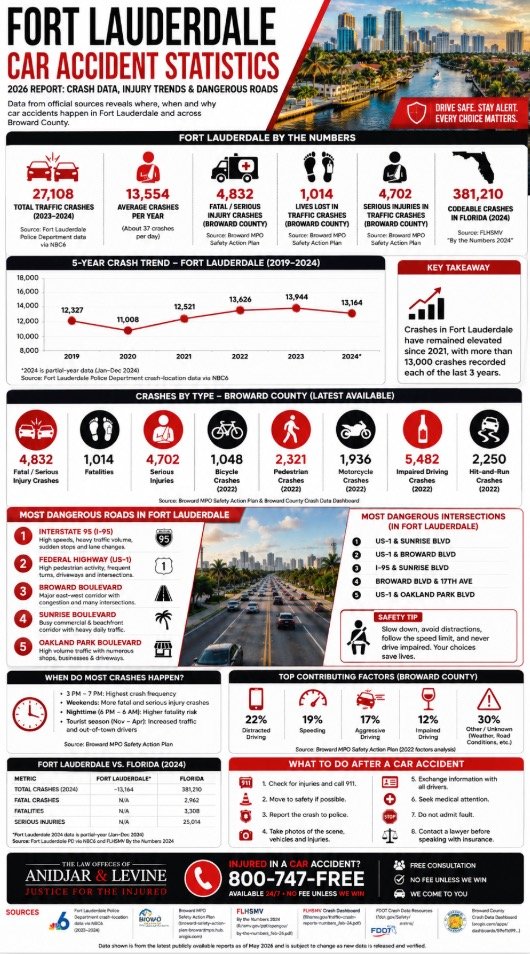
Fort Lauderdale is one of South Florida’s busiest driving environments, with local commuters, beach traffic, tourists, commercial vehicles, pedestrians, cyclists, rideshare drivers, and interstate travelers all sharing the same roadways. According to NBC6, which reported crash-location data provided by the Fort Lauderdale Police Department, 27,108 traffic crashes occurred in Fort Lauderdale during 2023 and 2024. That amounts to an average of roughly 13,554 crashes per year within the city.
This report uses only public crash and safety sources, including FLHSMV, FDOT, Broward MPO, Broward County safety resources, and local police-reported data. FDOT states that FLHSMV is the official custodian of Florida crash reports and statewide crash data.
Fort Lauderdale Car Accident Statistics at a Glance
Key available crash indicators include:
| Statistic | Data Point |
|---|---|
| Fort Lauderdale crashes, 2023–2024 | 27,108 |
| Average Fort Lauderdale crashes per year | ~13,554 |
| Broward fatal/serious injury crashes | 4,832 |
| Broward traffic deaths | 1,014 |
| Broward serious injuries | 4,702 |
| Florida codeable crashes, 2024 | 381,210 |
| Florida fatal crashes, 2024 | 2,962 |
Broward MPO’s Safety Action Plan reports 4,832 fatal/killed and serious injury crashes, including 1,014 lives lost and 4,702 serious injuries in Broward County. FLHSMV’s 2024 “By the Numbers” report listed 381,210 codeable crashes and 2,962 fatal crashes statewide.
Why Fort Lauderdale Roads See So Many Crashes
Fort Lauderdale has several crash-producing conditions at once: dense urban traffic, high-speed corridors, beach access roads, tourists unfamiliar with local traffic patterns, pedestrians near entertainment districts, and heavy congestion near I-95, US-1, Broward Boulevard, Sunrise Boulevard, Oakland Park Boulevard, and A1A.
The Most Dangerous Roads in Fort Lauderdale
The corridors most commonly associated with elevated crash risk include:
I-95 Through Fort Lauderdale
I-95 carries fast-moving commuter, commercial, and regional traffic. Sudden braking, lane changes, speeding, and merge conflicts can create serious rear-end, sideswipe, and multi-vehicle crashes.
Federal Highway / US-1
US-1 combines through traffic with local access points, shopping centers, restaurants, turns, pedestrians, and cyclists. That mix increases the risk of intersection and turning crashes.
Broward Boulevard
Broward Boulevard is a major east-west route with congestion, signalized intersections, and commercial activity. It is a strong candidate for local crash-risk discussion because it connects downtown Fort Lauderdale with major commuter routes.
Sunrise Boulevard
Sunrise Boulevard carries beach, retail, neighborhood, and commuter traffic. High vehicle volume and frequent turning movements can increase crash exposure.
Oakland Park Boulevard
Oakland Park Boulevard is another heavily traveled east-west corridor where congestion, lane changes, and intersection activity can contribute to collisions.
Pedestrian and Bicycle Crash Risks in Fort Lauderdale
Fort Lauderdale’s risk profile extends beyond vehicle occupants. Broward MPO’s Bicycle and Pedestrian Safety Action Plan was developed to analyze historical bicycle and pedestrian crash data, identify crash patterns, and recommend countermeasures to improve safety.
Pedestrian and cyclist crashes are especially important for Fort Lauderdale because of beach traffic, nightlife districts, crosswalk activity, tourists, and mixed-use corridors where people walk, bike, park, ride scooters, and drive in the same spaces.
How Fort Lauderdale Car Accident Trends Have Changed Over Time
Traffic patterns in Fort Lauderdale have shifted considerably over the past several years due to population growth, tourism, rideshare usage, construction, and increased roadway congestion. While traffic volume temporarily declined during the pandemic years, recent crash reporting shows that activity has rebounded significantly as residents, commuters, and visitors have returned to South Florida’s roads. According to crash-location data reported by Fort Lauderdale Police and shared publicly by NBC6, the city recorded 27,108 crashes in 2023 and 2024, underscoring that vehicle collisions remain a persistent public safety concern in the area.
Several factors may explain why crash numbers remain elevated. Fort Lauderdale continues to experience residential growth, increased downtown density, major commercial development, and tourism-related traffic near Las Olas Boulevard, Fort Lauderdale Beach, Port Everglades, and Fort Lauderdale-Hollywood International Airport. The city’s role as a transportation hub means local drivers often share roads with unfamiliar tourists, rental cars, delivery vehicles, rideshare drivers, and interstate travelers.
Population Growth and Traffic Congestion
Broward County’s expanding population has placed increasing pressure on already congested roadways. Higher vehicle volume generally increases crash exposure, particularly along high-capacity corridors such as I-95, Federal Highway (US-1), Broward Boulevard, Sunrise Boulevard, and Oakland Park Boulevard. More vehicles on the road mean more opportunities for rear-end crashes, unsafe lane changes, intersection conflicts, and distracted driving incidents.
Tourism and Seasonal Driving Risks
Unlike many cities, Fort Lauderdale experiences major seasonal fluctuations in traffic volume. Winter tourism, spring break travel, cruise passengers, and beach-related traffic can all contribute to congestion and elevated accident risk. Drivers unfamiliar with local roads may brake unexpectedly, miss turns, or make sudden lane changes—behavior that can increase the risk of collisions in busy tourist corridors.
Why Trend Analysis Matters
Looking at annual crash trends helps identify whether safety initiatives, road redesigns, and enforcement measures are making a difference. Transportation planners and safety agencies frequently analyze multi-year crash data to determine where infrastructure improvements and targeted enforcement are most needed.
Sources: Florida Highway Safety and Motor Vehicles (FLHSMV), Broward MPO Safety Action Plan, Fort Lauderdale Police Department crash-location reporting.
FLHSMV Crash Dashboard
Which Types of Car Accidents Are Most Common in Fort Lauderdale?
Not all crashes happen the same way. Understanding the most common types of Fort Lauderdale car accidents can help drivers better understand risk factors and recognize dangerous roadway situations before a collision occurs.
Rear-End Collisions
Rear-end crashes are among the most common accidents in urban areas like Fort Lauderdale. These crashes frequently occur in heavy traffic, near intersections, and during rush hour. Congestion on I-95, Broward Boulevard, and Sunrise Boulevard can increase the likelihood of sudden braking and chain-reaction collisions.
Common causes include:
- Distracted driving
- Following too closely
- Speeding in congestion
- Sudden stops in heavy traffic
Intersection Accidents
Intersections are frequent crash hotspots due to turning movements, signal timing, driver confusion, and failures to yield. Busy intersections involving US-1, Sunrise Boulevard, and Broward Boulevard often experience elevated crash activity due to high traffic volumes and complex turning patterns.
Side-Impact (T-Bone) Crashes
T-bone collisions commonly happen when one driver runs a red light, fails to stop, or turns improperly across traffic. These crashes can be particularly dangerous because vehicle sides generally provide less protection than front or rear impact zones.
Hit-and-Run Crashes
Florida consistently ranks among states with high numbers of hit-and-run crashes. In densely populated urban environments like Fort Lauderdale, drivers involved in collisions sometimes leave the scene before authorities arrive. Hit-and-run incidents can involve parked vehicles, pedestrians, cyclists, and occupied passenger cars.
Pedestrian and Bicycle Accidents
Because Fort Lauderdale has walkable entertainment districts and heavy beach traffic, pedestrian and bicycle crashes remain an important safety issue. Areas with mixed vehicle and pedestrian activity may experience increased collision risk, especially near crosswalks, downtown areas, nightlife districts, and beachfront roads.
Why Fort Lauderdale Drivers Face Unique Accident Risks
Fort Lauderdale offers a driving environment that differs from that of many other cities in Florida. Local motorists face a combination of urban congestion, tourist traffic, high-speed interstate travel, and dense pedestrian activity, which can increase crash risk.
A Mix of Local and Tourist Drivers
Fort Lauderdale roads are used by year-round residents, snowbirds, cruise travelers, airport visitors, and vacationers. Drivers unfamiliar with the city may rely heavily on GPS systems, hesitate at intersections, or make sudden last-minute lane changes.
Congested Multi-Lane Roadways
Roads like Federal Highway and Sunrise Boulevard require drivers to constantly navigate turning vehicles, pedestrians, cyclists, rideshare pickups, buses, and commercial traffic. High lane counts and frequent merging can increase the risk of sideswipe and lane-change accidents.
Heavy Commercial and Delivery Traffic
Commercial delivery vehicles, service trucks, rideshare drivers, and tourism-related transportation contribute to daily congestion. Increased delivery demand and rideshare activity can lead to more stopping, pulling over, and lane-shifting in already-busy traffic environments.
Weather and Visibility Challenges
South Florida weather can create hazardous driving conditions. Sudden downpours, flooding, glare from afternoon sun, and poor nighttime visibility may all contribute to elevated crash risks. Wet roads can increase stopping distances and make it harder for drivers to maintain control.
Why Defensive Driving Matters in Fort Lauderdale
Because of the unique traffic environment, drivers may benefit from maintaining extra following distance, reducing speed in poor weather, limiting distractions, and remaining especially alert in tourist-heavy areas.
These factors collectively help explain why crash activity remains a significant concern throughout Fort Lauderdale and Broward County.
Why Crash Data Can Change Over Time
Crash statistics are not always final immediately. FDOT guidance explains that crash data can take time to collect and verify, especially for fatal and serious-injury crashes. It notes that fatal and serious injury crashes can take up to 100 days from the crash date to become available in the database, with additional time for location verification.
That is why the safest wording for a 2026 post is:
“Latest available public crash data shows…”
rather than:
“Final 2026 crash totals show…”
What Causes Many Fort Lauderdale Car Accidents?
Common crash factors include distracted driving, speeding, impaired driving, aggressive driving, unsafe lane changes, tailgating, failure to yield, red-light violations, poor visibility, heavy tourist traffic, and congestion around major corridors.
FLHSMV’s crash dashboard tracks crash categories such as total crashes, fatal crashes, injury crashes, bicycle crashes, motorcycle crashes, pedestrian crashes, hit-and-run crashes, and impaired-driving-related crashes.
What To Do After a Fort Lauderdale Car Accident
After a crash, drivers should:
- Call 911 if anyone is hurt.
- Move to safety if possible.
- Request a police report.
- Take photos of vehicles, injuries, road conditions, signs, and traffic signals.
- Exchange information with all drivers.
- Get medical attention.
- Avoid admitting fault.
- Speak with a lawyer before giving recorded insurance statements.
Why Call The Law Offices of Anidjar & Levine
If you were injured in a Fort Lauderdale car accident, The Law Offices of Anidjar & Levine can help you understand your rights, deal with the insurance company, investigate the crash, gather evidence, and pursue compensation for medical bills, lost income, pain and suffering, and other damages.
Call 800-747-FREE. Available 24/7.