

The Law Offices of Anidjar and Levine handles Port St. Lucie truck crash claims involving hours-of-service violations by acting fast to preserve ELD data, dispatch communications, GPS pings, and maintenance records before they’re lost or altered.
We align these logs with scene photos, witness timelines, and driver statements to expose fatigue, coercive scheduling, or falsified entries, then manage insurer contact while you focus on treatment.
We build a disciplined demand package and prepare every case for trial if needed.
Learn more from our Port St. Lucie Truck Accident Lawyer page, and continue for critical steps and timelines.
Main Takeaways
- A Port St. Lucie hours-of-service lawyer investigates fatigue-related crashes by comparing ELD logs, dispatch messages, and GPS/toll data for violations.
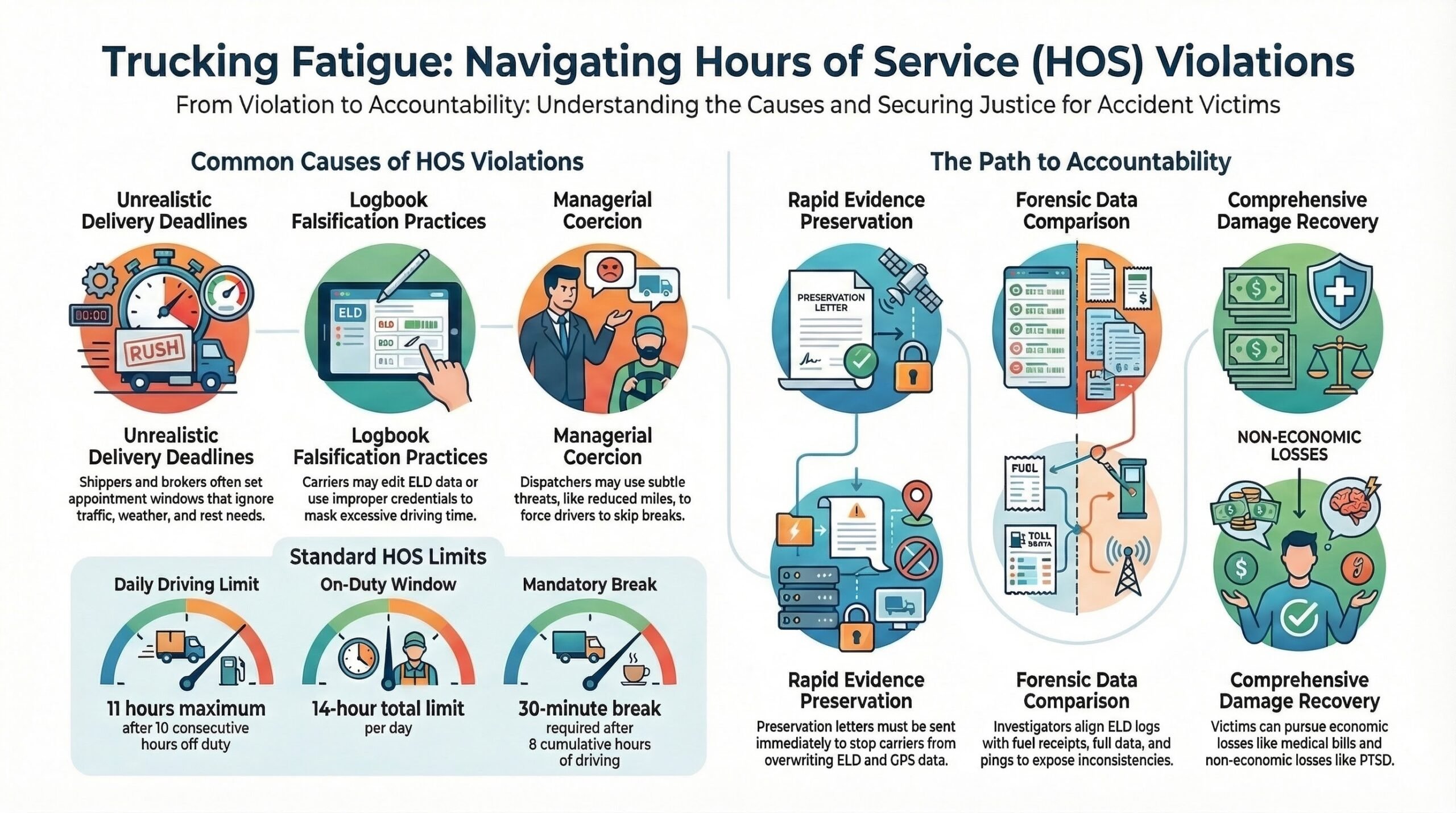
- They send rapid preservation letters to stop carriers from overwriting ELD data, edits, cloud backups, and dispatch records.
- They coordinate evidence collection: crash-scene photos, witness contacts, road conditions, and timelines to test speed, lane position, and visibility.
- They pursue liability beyond the driver, including the motor carrier for scheduling pressure, supervision failures, and compliance breakdowns under federal safety rules.
- They handle insurer communications and build a trial-ready demand package with organized logs, expert support, and documented medical and financial losses.


OUR CONSULTATIONSARE FREE
START YOUR FREE CASE REVIEW

How We Can Help With Your Port St. Lucie Truck Driver Hours of Service Violation Claim
How do you turn a suspected hours-of-service violation into a strong claim in Port St. Lucie?
We start by listening to your concerns, then we move quickly to preserve vital evidence and build a clear narrative of what happened and why it matters.
We listen first, then act fast to preserve key evidence and explain what happened—and why it matters.
We obtain and review records, communications, and related materials, and we coordinate with qualified professionals when expert insight is necessary.
We also handle insurer contact, so you can focus on healing and serving your family and community.
We keep your case organized and transparent through secure case tracking, with timely updates and clear next steps.
If travel or health limits make meetings difficult, we offer virtual consultations that protect your time while maintaining focused preparation.
Throughout the process, we present your losses with careful documentation, pursue fair resolution with disciplined negotiation, and prepare every claim as if it will be tried.
Understanding Port St. Lucie Truck Driver Hours of Service Violation Cases
Once we’ve preserved critical records and organized the facts, we can focus on what makes a Port St. Lucie hours-of-service violation case distinct.
These matters often turn on whether driving time, on-duty time, and required breaks were properly documented and followed, and whether any lapse contributed to a preventable crash.
We help you understand how federal safety rules interact with Florida negligence standards, and how liability may extend beyond the driver to a motor carrier responsible for supervision and compliance.
We also consider the Historical Context of hours-of-service limits, which were created to reduce fatigue-related harm and protect the public.
That purpose guides how investigators, insurers, and courts view compliance.
When questions arise, we compare how Comparative Jurisdictions interpret similar records, enforcement practices, and safety expectations.
This broader lens strengthens our evaluation and supports a clear, service-centered plan aimed at accountability and safer roads for everyone.


Common Causes of Port St. Lucie Truck Driver Hours of Service Violations
When we evaluate common causes of Port St. Lucie truck driver hours of service violations, we often see unrealistic delivery deadlines that push drivers past lawful limits.
We also encounter logbook falsification practices, sometimes used to mask excessive driving time, and inadequate rest opportunities that make compliance difficult even for careful operators.
In many cases, pressure from dispatchers compounds these risks, and we’ll explain how these factors can shape liability and your legal options.
Unrealistic Delivery Deadlines
Although federal Hours of Service rules set clear limits on driving time and required rest, unrealistic delivery deadlines still push many Port St. Lucie drivers into impossible choices.
When shippers and brokers set appointment windows that ignore traffic, detention, and weather, you may feel pressured to extend a run instead of stopping, even when fatigue rises.
These deadlines often stem from poor Inventory Management, where freight is released late but the delivery time remains fixed, shifting the burden onto the driver.
Packaging Constraints can add further delay at the dock, requiring rework, additional securement, or pallet changes that consume precious on-duty hours.
We believe safe service to others starts with realistic planning, and we help you document scheduling failures that contribute to alleged violations.
Logbook Falsification Practices
Unrealistic delivery deadlines often create the pressure that leads to a second, more direct problem: logbook falsification practices.
When drivers or carriers alter hours to appear compliant, they place the public at risk and undermine the spirit of safety rules meant to protect everyone.
We often see paper logs “cleaned up,” time entries shifted, or off-duty periods inserted to hide extended driving, and electronic records can be manipulated through digital tampering.
These actions may involve editing ELD data, using improper login credentials, or disconnecting devices to mask true activity.
To serve injured families and accountable operators alike, we compare dispatch records, fuel receipts, toll data, GPS pings, and phone metadata.
Our forensic analysis helps reveal patterns, establish intent, and document violations clearly.
Inadequate Rest Opportunities
Because rest is a scheduled requirement, not a convenience, inadequate rest opportunities remain a common and preventable cause of truck driver hours of service violations in Port St. Lucie.
When safe parking is scarce, appointments run late, or detention time consumes off-duty hours, we can’t recover as planned, and your driver may start a shift already depleted.
A poor sleep environment, including noise, heat, lighting, or security concerns, further reduces restorative sleep even when time is available.
We focus on the practical conditions that made compliance rest unrealistic, and we document how those conditions contributed to fatigue and recordkeeping errors.
We also encourage lawful fatigue countermeasures, such as structured breaks, hydration, nutrition, and realistic trip planning, to protect the public and support compliant operations.
Pressure From Dispatchers
When dispatch timelines ignore real-world conditions, pressure from dispatchers can quickly push Port St. Lucie drivers toward Hours of Service violations.
We often see tight pickup windows, last-minute route changes, and unrealistic delivery promises that leave no safe margin for traffic, weather, or loading delays.
When you’re committed to serving customers and protecting the public, that pressure can feel like a moral conflict.
We also recognize that managerial coercion may appear subtle, such as repeated calls, threats of reduced miles, or hints that “everyone makes it work.”
Those tactics can lead to safety compromises, including skipped breaks, falsified logs, or driving while fatigued.
We can help you document communications, preserve ELD data, and show how coercion influenced the schedule and decision-making.
Legal Rights of Port St. Lucie Truck Driver Hours of Service Violation Victims
Although hours-of-service rules may seem like internal trucking regulations, Port St. Lucie victims often have enforceable legal rights when fatigue contributes to a crash or a harmful near-miss.
Even if hours-of-service rules seem internal, Port St. Lucie victims may have enforceable rights when fatigue causes harm.
We can help you pursue accountability from the driver, carrier, broker, or dispatcher when logbooks, ELD data, and delivery schedules show unsafe pressure and preventable risk.
You are also entitled to respect throughout the process, including careful handling of sensitive records and your Privacy Rights.
If you were hurt while working, we’ll evaluate whether Workers’ Compensation applies, and whether a separate third-party claim can provide fuller recovery for long-term needs.
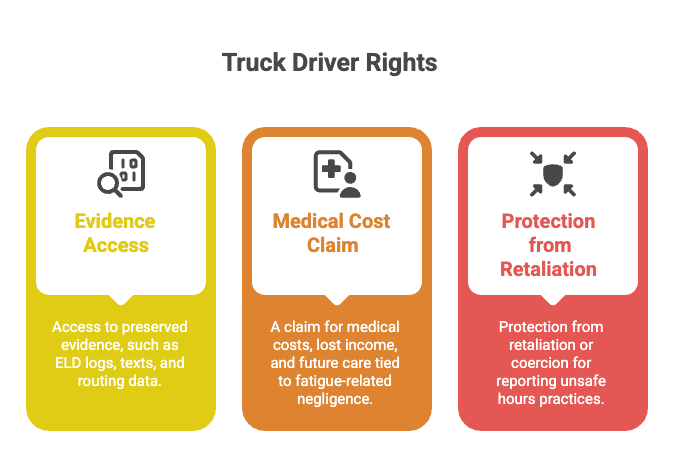
Your rights may include:
- Access to preserved evidence, such as ELD logs, texts, and routing data
- A claim for medical costs, lost income, and future care tied to fatigue-related negligence
- Protection from retaliation or coercion for reporting unsafe hours practices
Steps to Take After a Port St. Lucie Truck Driver’s Hours of Service Violation
After a Port St. Lucie truck driver’s hours of service violation, we’ll start by helping you confirm immediate safety, secure medical care if needed, and report the incident as appropriate.
Next, we’ll guide you in documenting evidence and preserving driver logs, including electronic logging device records, photos, witness details, and any communications tied to scheduling or dispatch.
Finally, we’ll urge you to notify counsel promptly, so we can protect your rights, manage insurer contact, and move quickly to secure vital records before they’re altered or lost.
Ensure Immediate Safety
In the moments immediately following a suspected hours of service violation in Port St. Lucie, we should focus on protecting lives before anything else.
We’ll begin with a careful Scene Assessment, checking traffic flow, hazards, fuel leaks, and unstable cargo, and we’ll keep ourselves and others out of danger.
If vehicles can’t be moved safely, we’ll activate hazard lights, set warning triangles if available, and guide bystanders to a secure location.
Next, we’ll call 911 promptly and provide clear, calm directions so responders arrive without delay.
If someone is injured, we can offer Emergency Aid within our training, control bleeding, support breathing, and avoid moving anyone with possible spinal injuries.
We’ll stay present, reassure others, and follow dispatcher instructions until help arrives.
Document Evidence And Logs
Once the scene is stable and medical help is on the way, we should begin preserving evidence that may prove an hours of service violation and explain how fatigue affected the crash.
We’ll photograph vehicle positions, skid marks, road conditions, and any visible damage, then record names and contact details for witnesses who may have observed erratic driving.
We should request the driver’s electronic logging device data, paper logs, fuel receipts, dispatch messages, GPS records, and weigh-station tickets, because these documents can reveal time gaps and falsified entries.
To protect chain integrity, we’ll store copies securely, note who handled each item, and keep originals unchanged.
If digital files are available, we’ll preserve them in native format and support metadata analysis to confirm creation times, edits, and device sources.
Notify Counsel Promptly
Although the situation may still feel unsettled, we should notify counsel promptly so we can protect our claim before vital hours-of-service evidence disappears.
When we contact a lawyer early, we give them time to issue preservation letters, request electronic logging device data, and identify dispatch records, GPS pings, toll histories, and maintenance entries that may prove fatigue or scheduling pressure.
We can serve the community best by acting responsibly, not letting avoidable delays undermine accountability and safety.
We should use secure messaging to share documents, photos, and timelines, and to avoid public posts that can be misread.
Counsel will also set clear response expectations, including what information to gather, who should speak with insurers, and when to seek follow-up medical care.
Prompt notice supports efficient, ethical advocacy for everyone.
How a Port St. Lucie Truck Driver Hours of Service Violation Lawyer Can Help You
Protect your case from avoidable setbacks by involving a Port St. Lucie truck driver hours of service violation lawyer early, so we can secure records and guide you with steady, service-minded counsel.
We’ll act quickly to preserve logbooks, ELD data, dispatch messages, GPS pings, and maintenance files, then compare them to federal regulations to identify inconsistencies and responsible parties.
We’ll also coordinate communication with insurers and investigators, so you can focus on recovery and supporting others who rely on you.
- We gather and analyze evidence to show fatigue-related rule breaches and causation.
- We challenge inaccurate narratives, negotiate firmly, and prepare the case for trial when needed.
- We pursue broader accountability through policy advocacy and safety training commitments that protect the community.
Throughout the process, we explain options in plain terms, set realistic expectations, and pursue outcomes that reflect both fairness and public safety for all road users.
Long-Term Effects of Port St. Lucie Truck Driver Hours of Service Violation Injuries
When a truck driver violates hours-of-service rules, we often see injuries that don’t end when the crash scene clears, and you may face lasting consequences.
We’ll explain how chronic pain and reduced mobility can limit work and daily activities.
We’ll also explain how neurological and cognitive impairments may affect memory, focus, and coordination.
We’ll also address the emotional trauma and PTSD that can follow, and why documenting these long-term effects matters for your recovery and your claim.
Chronic Pain And Mobility
Because hours-of-service violations often lead to high-impact truck crashes, many Port St. Lucie victims face chronic pain that lingers long after fractures mend and bruises fade.
Pain can radiate through the back, neck, hips, and knees, limiting sleep, work, and the ability to serve family and community.
Mobility losses may follow surgeries, prolonged immobilization, or scar tissue, and even routine tasks can become exhausting.
We encourage careful documentation of flare-ups, missed activities, and treatment progress, because consistency strengthens both medical care and legal claims.
Clinically guided Adaptive Exercise may restore strength and range of motion without aggravating injured tissue.
When needed, Assistive Devices like braces, canes, or walkers can improve safety, independence, and dignity while recovery continues.
Neurological And Cognitive Impairments
Chronic pain and reduced mobility often capture the most attention after a high-impact truck crash, yet many Port St. Lucie victims also face subtle brain-related harm that affects daily functioning.
When a driver violates hours-of-service rules, fatigue-driven impacts can cause concussions or diffuse injury, leaving you with slowed processing, headaches, dizziness, and disrupted sleep.
These changes may stem from neuroinflammation mechanisms that interfere with normal signaling, especially during recovery.
We often see problems with attention, decision-making, and language, along with lapses in short-term recall.
Even routine tasks can become harder when memory consolidation is impaired, making work, caregiving, and community service more demanding.
We’ll help document these deficits through medical records, testing, and credible timelines, so your long-term needs are fully recognized.
Emotional Trauma And PTSD
Although many injuries from an hours-of-service violation show up on scans and in physical therapy notes, the emotional trauma often persists longer and disrupts daily life in quieter ways.
After a serious truck crash, you may relive the impact, avoid certain roads, or feel constantly on guard, which are common markers of PTSD.
Trauma Triggers can arise without warning, such as air brakes, headlights at night, or the scent of diesel, and they can derail work, parenting, and community service.
Many people also experience Sleep Disturbances, including nightmares, insomnia, and sudden waking that leaves them exhausted and less resilient.
We can help you document these harms through counseling records and careful timelines, so your claim reflects the full cost of recovery.
Proving Liability in Port St. Lucie Truck Driver Hours of Service Violation Car Accident Cases
When a truck driver exceeds federal hours-of-service limits, and a crash follows in Port St. Lucie, we focus on proving liability with disciplined, service-minded advocacy.
We start by securing electronic logging device data, dispatch records, fuel receipts, tolls, and GPS pings, then we align them with driver statements and eyewitness timelines.
We also examine inspection reports, maintenance files, and prior citations to show a pattern of unsafe scheduling.
If the carrier pressured the driver, we pursue negligent supervision and policy failures, not just individual fault.
We anticipate comparative negligence arguments by testing speed, lane position, and visibility with scene measurements and event data.
We also address jurisdictional challenges when the truck, company, or records sit outside Florida, using timely preservation letters and coordinated subpoenas.
Dealing With Insurance Companies After a Port St. Lucie Truck Driver’s Hours of Service Violation
After a Port St. Lucie truck crash tied to hours-of-service violations, insurance companies often move quickly to limit their exposure.
We’ll help you protect your statement, preserve essential documents, and avoid signing broad medical releases that invite unnecessary scrutiny.
When adjusters request recorded interviews, we can step in, keep the focus on verifiable facts, and prevent questions designed to shift blame to you.
We also watch for delay tactics and low offers that may signal bad faith, then we respond with firm, documented demands supported by the evidence.
We’ll coordinate communications with all carriers involved, including the trucking insurer, any broker or shipper coverage, and your own policy, so messages stay consistent and accurate.
If health insurers or PIP carriers assert liens, we address subrogation issues early, reducing repayment exposure and protecting your recovery for ongoing care.
What to Expect During a Port St. Lucie Truck Driver Hours of Service Violation Claim Process
We’ll start with an initial case evaluation, where we listen to your account, identify potential violations, and outline the claim’s likely path.
Next, we’ll review crucial evidence and the driver’s logs, then we’ll manage negotiation and settlement steps with the insurers and opposing parties.
If a fair resolution doesn’t materialize, we’ll explain the litigation timeline, prepare the case for court, and guide you through trial expectations.
Initial Case Evaluation
Although every trucking collision has its own set of facts, the initial case evaluation for a Port St. Lucie hours-of-service claim follows a disciplined structure.
We begin by listening to your account and confirming immediate needs, so we can serve you and your family with care and purpose.
Next, we run conflict screening to verify we can advocate for you with complete loyalty.
We then use an intake checklist to capture core details, including essential dates, involved parties, injuries, medical treatment status, and any communications you’ve received.
We’ll explain how a claim typically progresses, identify early legal issues, and outline deadlines that may affect your options.
Before we proceed, we’ll discuss goals, expectations, and fee arrangements in plain terms.
Evidence And Log Review
A strong hours-of-service claim in Port St. Lucie depends on careful evidence and log review, and we’ll guide you through that process with discipline and respect for everyone involved.
We obtain ELD data, paper logs, dispatch records, fuel receipts, GPS pings, toll records, and gate entries, then compare them line by line for consistency.
We also request supporting documents from carriers and third parties, preserving the chain of custody so the record remains reliable.
When electronic logs are involved, we examine device settings, edits, and annotations, and we perform software validation to confirm that the system recorded duty status accurately.
We also secure cloud backups and metadata to prevent loss, overwriting, or selective production, and we document any gaps that require clarification.
Negotiation And Settlement Steps
Guiding negotiation and settlement steps in a Port St. Lucie hours-of-service claim starts after we’ve organized your logs, dispatch records, and supporting evidence into a clear demand package.
We explain your goals, including how a fair result can help protect others on the road, then we present Opening Offers grounded in documented losses and accountability.
We anticipate the insurer’s response, correct misstatements, and keep discussions focused on provable facts.
Next, we lead Concession Planning, deciding in advance what we won’t compromise, what we can trade, and what terms matter most, such as payment timing or corrective safety commitments.
We communicate promptly, document every proposal, and advise you on risks and value, so you can choose a resolution with confidence.
Litigation Timeline And Trial
Settlement talks don’t always produce terms that match the harm caused by an hours-of-service violation, and when that happens, we’re prepared to file suit and move your Port St. Lucie claim into litigation.
We draft the complaint, serve the defendants, and demand critical records like logs, ELD data, dispatch messages, and safety policies.
During discovery, we take depositions, consult qualified experts, and address motions that may limit improper defenses.
As trial approaches, we attend pretrial conferences to narrow issues, exchange witness lists, and confirm exhibits.
We also prepare you to testify with clarity and calm, because service-minded jurors value honest, disciplined answers.
At trial, jury selection sets the tone, then we present evidence, cross-examine witnesses, and request a verdict that reflects your losses.
Compensation for Port St. Lucie Truck Driver Hours of Service Violation Damages
When a truck driver violates hours-of-service rules and a crash follows, we can pursue compensation that reflects the full scope of harm you’ve suffered in Port St. Lucie.
We gather medical records, employment documentation, and expert opinions to present a clear, service-minded case for accountability, so your recovery can support your family and community.
We also identify every responsible party, including carriers and insurers, then document how fatigue-related conduct led to preventable losses.
We’ll evaluate settlement options with care, including structured settlements that can provide stable, long-term support and reduce financial stress.
We’ll also discuss tax implications early, so you aren’t surprised by how a recovery may interact with reporting obligations or benefit eligibility.
If the insurer resists fair terms, we’re prepared to demand full payment through negotiation or litigation, always keeping your goals, dignity, and future security central to the strategy.
Economic vs Non-Economic Damages in Port St. Lucie Truck Driver Hours of Service Violation Cases
We’ll start by separating economic damages, such as medical bills, lost wages, and future care costs, from non-economic damages that address pain, suffering, and loss of enjoyment of life after a Port St. Lucie truck crash tied to hours-of-service violations.
We’ll also explain how we can prove non-economic losses with credible, case-specific evidence, even when they don’t come with receipts or invoices.
Finally, we’ll outline how Florida’s damage caps and other legal limits may apply, so you can assess both the value of your claim and the risks that can reduce recovery.
Defining Economic Damages
How do courts and insurers in Port St. Lucie define economic damages after a truck driver hours-of-service violation causes a crash?
We focus on measurable financial losses tied to the injury and supported by reliable records.
These damages commonly include past and future medical bills, rehabilitation and medication costs, lost wages, reduced earning capacity, and necessary out-of-pocket expenses such as transportation for treatment or home assistance.
When property is damaged, repair or replacement costs may also apply.
To serve you well, we use disciplined Valuation Methods, connecting each claimed amount to invoices, pay stubs, tax returns, and employer statements.
In complicated cases, Forensic Accounting helps trace income trends, quantify business losses, and project future shortfalls with defensible assumptions for negotiations.
Proving Non-Economic Losses
Economic damages put a number on your financial losses, but they don’t capture the human impact a Port St. Lucie hours-of-service crash can cause.
When we prove non-economic losses, we focus on what changed for you day-to-day, including pain, emotional distress, loss of enjoyment, and strain on family relationships.
We’ll help you document the Life Impact through journals, photos, therapy records, and statements from people who’ve seen your limitations firsthand.
We also use Expert Testimony, such as physicians, mental health providers, and vocational professionals, to connect the collision to your symptoms and explain how those symptoms affect function and independence.
Damage Caps And Limits
Although the full cost of a Port St. Lucie truck crash may be obvious in medical bills and lost wages, damage caps and legal limits can restrict what you recover.
We help you distinguish economic damages, such as treatment, rehabilitation, and future earnings, from non-economic damages, such as pain, suffering, disability, and loss of enjoyment of life.
In hours-of-service violation cases, insurers often argue to narrow non-economic compensation, even when fatigue-related harm is profound.
We build clean documentation for economic losses and present credible, human evidence for non-economic losses, so the claim reflects real impact.
When unfair limits arise, we support Legislative reform and Public advocacy, because safer roads and fair compensation serve the entire community.
When a Port St. Lucie Truck Driver’s Hours of Service Violation Case Goes to Trial vs Settlement
When a Port St. Lucie truck driver’s hours of service violation case moves forward, we help you decide whether a settlement or a trial best serves your recovery and the wider community.
We start with a careful cost analysis, weighing litigation expenses, time demands, and the value of certainty against the possibility of a higher verdict.
We also assess media impact, since public attention can influence reputational risks, corporate behavior, and sometimes the willingness to negotiate responsibly.
We pursue settlement when liability is clear, damages are well documented, and the insurer offers terms that reflect the harm and support future care.
We recommend trial when the defense denies fatigue evidence, attacks your credibility, or refuses fair compensation despite strong logbook, ELD, dispatch, and witness proof.
Throughout, we prepare every case as if it will be tried, so you’re protected and positioned for a just outcome.
The Statute of Limitations for Port St. Lucie Truck Driver Hours of Service Violation Case
Because deadlines can decide a case before liability ever gets tested, we treat the statute of limitations as an immediate priority in every Port St. Lucie truck driver hours of service violation matter.
Florida sets strict filing windows for injury and wrongful death claims, and missing them can end a worthy case regardless of how clear the logbook or ELD evidence may be.
We also evaluate when the clock starts. Accrual rules can turn on the date of the crash, the date an injury becomes apparent, or other legally significant events, depending on the claim.
In limited situations, Discovery tolling may pause or extend the time to file when crucial facts couldn’t reasonably be known earlier, such as concealed recordkeeping misconduct.
We gather timelines, preserve documentation, and align your service-focused goals with a filing strategy that protects the people you’re trying to help, without risking dismissal.
When to Contact a Port St. Lucie Truck Driver Hours of Service Violation Lawyer After a Port St. Lucie Truck Driver Hours of Service Violation
How soon should you contact a Port St. Lucie truck driver hours of service violation lawyer after a violation occurs?
We recommend reaching out as soon as you receive a citation, an audit notice, or any request for logs, ELD data, or supporting documents.
Early contact helps us guide you on what to preserve, what to avoid saying, and how to respond in a timely, respectful way that supports public safety and your professional responsibilities.
Early contact lets us advise what to preserve, what not to say, and how to respond promptly, respectfully, and responsibly.
You should also contact us immediately if an employer pressures you to alter records, exceed limits, or accept blame for dispatch decisions.
Prompt advice helps you understand retaliation protections and document concerns without escalating conflict.
If you’re worried about cost, ask about fee structures during the first call so you can plan responsibly and continue serving customers and the community without unnecessary disruption.
Why You Need an Experienced Port St. Lucie Truck Driver Hours of Service Violation Lawyer
Early contact protects you from missteps, but experience is what turns that early start into a focused defense.
When you’re cited for hours of service violations, the stakes can reach beyond a ticket, affecting your livelihood and the people who rely on you to keep goods moving safely.
We help you respond with accuracy, preserve critical records, and avoid statements that can be misread by enforcement or insurers.
An experienced Port St. Lucie lawyer brings disciplined Regulatory Navigation, so we can evaluate logbook and ELD data, identify procedural gaps, and address whether an alleged violation reflects fatigue risk or a documentation error.
We also pursue Reputation Protection, because a preventable mark on your record can follow you into hiring decisions and contract opportunities.
Our role is to shoulder the legal burden, so you can keep serving your team, your employer, and the community with integrity and steady judgment.
How to Choose the Right Port St. Lucie Truck Driver Hours of Service Violation Lawyer for Your Case
Where do you start when one hours of service citation can affect your CDL status, your insurance profile, and your future dispatch opportunities?
We start by choosing counsel who treats your case with the same care you bring to the road and to the people who depend on you.
We should look for a lawyer who focuses on trucking violations in Port St. Lucie, understands logbook and ELD issues, and can quickly assess exposure, deadlines, and likely outcomes.
Look for a Port St. Lucie trucking-violations lawyer who knows logbooks and ELDs and can quickly assess deadlines and risk.
We’ll also evaluate communication style, because you need clear updates, timely callbacks, and advice you can act on between loads.
Ask how they’ll gather evidence, speak with enforcement, and present mitigating facts without creating new risks.
Finally, insist on fee transparency: we should know what’s included, what may cost extra, and how billing works before we commit.
A disciplined selection protects your record and your livelihood.
About The Law Offices of Anidjar & Levine
The Law Offices of Anidjar & Levine represents Port St. Lucie clients who want accountability after serious truck crashes linked to hours of service violations.
We approach each case with disciplined preparation, clear communication, and a steady focus on protecting the people you serve, your family, and your future.
When you work with us, you’ll see that we don’t chase quick resolutions; we build persuasive claims that reflect the full impact of fatigue-related harm.
Our Firm History reflects consistent advocacy for injured Floridians, backed by thorough investigation and strategic negotiation.
We review logs, electronic data, dispatch records, and safety policies to identify where compliance failed and why it mattered.
We also value Community Outreach because service should extend beyond the courtroom.
Frequently Asked Questions
What FMCSA Hours-Of-Service Limits Apply to Florida Truck Drivers?
Florida truck drivers operating in interstate commerce must follow FMCSA hours-of-service rules, not separate state standards.
We advise you to track daily limits: 11 hours driving after 10 off, within a 14-hour on-duty window, plus a 30-minute break after 8 hours.
Weekly caps are 60 hours in 7 days or 70 in 8. Restart provisions allow a 34-hour off-duty reset to serve safely.
Can I Access the Truck’s ELD Records Without Filing a Lawsuit?
Yes, we can often access ELD records without filing a lawsuit, but it usually depends on driver consent and carrier cooperation.
We’ll request the data through a preservation and production letter, and we can propose a limited, confidential review to support a fair resolution.
If the carrier refuses or delays, we can pursue a subpoena through a pre-suit petition or related administrative process, depending on the circumstances.
Are Dashcam or Telematics Records Useful in Hours-Of-Service Violation Cases?
Yes, dashcam and telematics records can be highly useful in hours-of-service violation cases, because they corroborate driving time, stops, and duty status patterns.
We use them to compare ELD entries with real-world movement, then flag gaps, edits, or implausible sequences that raise data integrity issues.
We also address privacy concerns by seeking only relevant segments and securing protective terms, so we can serve others while respecting lawful boundaries.
Do Hours-Of-Service Violations Affect Punitive Damages in Florida?
Yes, hours-of-service violations can support punitive damages in Florida when they show reckless disregard for safety.
We’d focus on proving the conduct was more than mere negligence, using logs, dispatch pressure, and telematics to show conscious risk-taking.
Jury instructions guide how jurors evaluate clear and convincing evidence, while statutory caps may limit the award even if punitive damages are allowed.
We’ll help you pursue accountability that protects others.
Can a Violation Claim Involve Multiple Trucks in a Chain-Reaction Crash?
Yes, a violation claim can involve multiple trucks in a chain-reaction crash, and we’ll often examine each driver’s conduct and records.
We can allege Shared Fault when several carriers or drivers contribute to the sequence, and we can pursue Sequential Liability when one breach triggers later collisions.
To serve others well, we’ll gather logs, ELD data, dispatch messages, and witness accounts to map causation and responsibility accurately.
—————————
If a truck driver’s hours of service violation caused your crash in Port St. Lucie, the Law Offices of Anidjar and Levine can help you pursue accountability and full compensation.
We’ll secure logbooks, ELD data, dispatch records, and crash evidence, then build a clear liability case against the driver and carrier.
We’ll manage insurer communications, meet filing deadlines, and position your claim for maximum recovery.
Learn more by speaking with a Port St. Lucie Truck Accident Lawyer, and contact us promptly so we can protect your rights and preserve crucial evidence.

