When a commercial truck on I-4 or SR 408 leaves you seriously hurt, the carrier’s defense team is already working — we act immediately to secure the black box data, driver logs, and inspection records before they disappear.
The Law Offices of Anidjar & Levine helps injured people preserve critical evidence, identify all responsible commercial parties, document the full scope of their losses, and manage every stage of the claims process.
These claims may involve disputed fault across multiple defendants, federal safety regulation violations, coverage limits across carrier and cargo policies, and long-term losses such as reduced earning capacity, chronic pain, or permanent disability.
A thoughtful legal strategy begins with the evidence, which is why we act before it is lost.
For more on pursuing the full value of a Florida injury claim, see our Orlando Personal Injury Lawyer page for additional context on how these cases are built and valued.
What Are the Federal Motor Carrier Safety Regulations (FMCSRs) and Why Do They Matter in an Orlando Truck Accident Case?
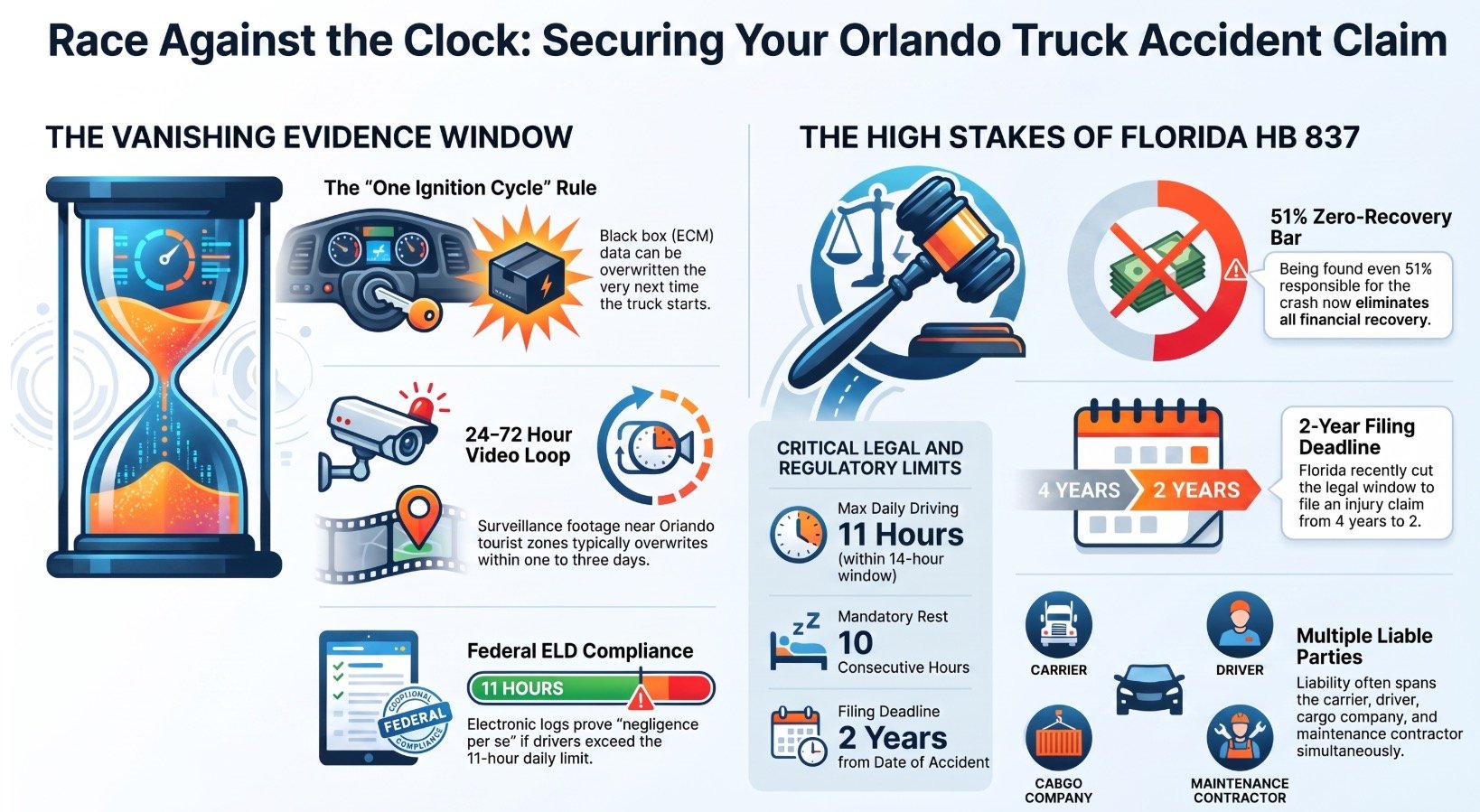
The Federal Motor Carrier Safety Regulations (FMCSRs), issued by the Federal Motor Carrier Safety Administration (FMCSA) under Title 49 of the Code of Federal Regulations, are binding federal rules governing all commercial truck operations on U.S. roads. They set specific requirements for hours of service (a maximum 11-hour driving limit in a 14-hour window, with mandatory 10-hour rest periods), driver qualification standards, pre-trip and post-trip vehicle inspections, cargo securing requirements, and electronic logging device (ELD) mandates that require real-time recording of driving hours.
When a truck driver, carrier, or shipper violates an FMCSR, that violation can establish negligence per se in a Florida personal injury claim — meaning the violation itself proves a breach of the legal duty of care, without requiring additional proof that the conduct was unreasonable. In Orlando, where commercial trucks operate around the clock on I-4, SR 408, and US 441, FMCSA violation evidence from ELD records, driver logs, and maintenance files often becomes the most powerful evidence in a serious truck accident case.
Main Takeaways
- An Orlando truck accident lawyer can preserve critical evidence, including black box data, ELD records, driver logs, and maintenance files, before carriers or their insurers gain control of the narrative.
- Commercial truck cases may involve multiple liable parties — the driver, the carrier, the cargo loading company, and the maintenance contractor — each with separate insurance policies.
- Federal FMCSA regulations govern driver hours, vehicle inspection, and cargo securing — violations of these rules can establish negligence per se and significantly strengthen an injury claim.
- Damages may include medical expenses, lost income, reduced earning capacity, permanent disability, pain, and long-term care needs requiring expert assessment.
- Under Florida’s HB 837 (2023), a 2-year filing deadline and a 51% fault bar apply — making early legal action essential to protecting every injured person’s right to full recovery.
How We Can Help With Your Orlando Truck Accident Injury Claim
After a commercial truck crash, an Orlando truck accident lawyer can help protect the claim from the start by addressing the legal, evidentiary, and regulatory issues that are unique to commercial vehicle collisions. Counsel may immediately send spoliation letters to the carrier and its insurer, coordinate the preservation of evidence from the truck’s ECM and ELD data, identify all potentially liable parties, and manage all communications so that the injured person can focus on recovery and family responsibilities. In the most catastrophic cases, representation may also support surviving family members through wrongful death claims, ensuring deadlines, documentation, and required notices are handled with care and compassion throughout the process.
A structured damages evaluation can assess medical expenses, lost income, reduced earning capacity, pain, and long-term care needs across all liable policies. This careful review helps prevent early settlements that fail to reflect the full impact of the injuries — a particular risk in truck cases where carrier insurers sometimes deploy rapid-response teams and make low offers before the injured person has seen a specialist.
For more on how Florida personal injury settlements are valued, see our guide on Average Personal Injury Settlements in Florida by Case Type.
Understanding Orlando Truck Accident Injury Cases
When a commercial truck collision occurs in Orlando, the resulting injury case often involves more complex questions than a standard car accident claim. Multiple parties — the driver, the carrier, the cargo loading company, and the maintenance contractor — may each bear responsibility, and each may carry separate insurance coverage with separate policy limits. A legal professional must evaluate the crash from multiple angles, including FMCSA compliance, the carrier’s safety history, the truck’s inspection records, and the driver’s qualification and service hours. These matters require careful review because an injured person may face surgery, rehabilitation, lost income, reduced mobility, and lasting pain that extends well beyond the initial emergency treatment.
Evidence preservation is central to understanding the truck accident case from the beginning. Black box data, ELD logs, driver qualification files, pre-trip inspection reports, cargo manifests, and maintenance records may all provide critical information about what occurred and why. Proper documentation also supports compensation evaluation, which considers medical expenses, future care, wage loss, diminished earning capacity, and non-economic harm. By organizing these complex issues with discipline and compassion, a lawyer can help present a clear claim focused on accountability, recovery, and the injured person’s long-term well-being throughout Orange County.
Orlando Truck Accident Statistics: Understanding the Risk on I-4 and Orange County Roads
Commercial truck crashes on Orlando’s roadways cause disproportionately severe injuries compared to collisions between passenger vehicles. According to the FLHSMV 2022 Florida Traffic Crash Facts, Florida recorded 401,523 crashes, 3,535 fatalities, and an estimated $19.4 billion in economic losses statewide. According to the National Highway Traffic Safety Administration, 3,208 distracted driving deaths occurred nationally in 2024, and commercial driver distraction is among the most frequently cited contributing factors in large-truck fatal crashes investigated by the FMCSA.
The I-4 corridor through Orlando connects the Disney/Universal tourist zone with downtown and the airport, generating one of the highest volumes of commercial truck traffic in the state. FMCSA data consistently identifies driver fatigue as a leading cause of serious truck crashes — with federal rules permitting up to 11 hours of driving in a 14-hour window before a mandatory 10-hour rest period. When those rules are violated, the results on high-speed corridors like I-4 and SR 408 can be catastrophic. Florida’s HB 837 (2023) introduced a 51% fault bar that eliminates all recovery and a 2-year filing deadline that applies from the moment of the crash.
Black box data from the truck’s engine control module (ECM) can be overwritten after a single ignition cycle, and surveillance footage near Orlando crash scenes typically overwrites within 24 to 72 hours — making immediate legal action the most important step any injured person can take after a serious commercial truck collision in Orange County.
Common Causes of Orlando Truck Accidents
Commercial truck accidents in Orlando often arise from driver fatigue, distracted driving, poor vehicle maintenance, and improper cargo loading. Identifying these causes helps establish liability across the multiple commercial parties who may share responsibility for serious crashes on I-4, SR 408, and US 441 throughout Orange County.
Driver Fatigue
Driver fatigue is one of the most serious causes of commercial truck accidents in Orlando. Federal regulations limit truck drivers to 11 hours of driving within a 14-hour on-duty window, with mandatory 10-hour rest periods between shifts. When carriers pressure drivers to meet delivery schedules, or when drivers falsify their logs to hide excess hours, the result can be dangerously impaired judgment, slowed reaction time, and microsleep events behind the wheel of a vehicle weighing up to 80,000 pounds. ELD records and driver qualification files can reveal whether hours-of-service rules were followed before the crash. An FMCSA violation established through ELD data provides powerful evidence of negligence per se in an Orange County injury claim.
Distracted Driving
Distracted driving is a significant and preventable cause of truck crashes on Orlando’s busy commercial corridors. Despite federal restrictions on handheld phone use for commercial drivers, attention lapses involving navigation systems, dispatch communications, in-cab electronics, and personal devices remain a contributing factor in serious truck collisions throughout Orange County. Because commercial trucks require greater stopping distances and have larger blind spots than passenger vehicles, even a brief distraction at highway speed can make a crash unavoidable. Phone records, app activity logs, ECM timing data, and dashcam footage from the cab can help establish whether driver distraction contributed to the collision, supporting full accountability for the injuries caused on I-4 and surrounding roads.
Poor Vehicle Maintenance
Federal and state regulations require carriers to conduct pre-trip and post-trip vehicle inspections and to maintain accurate maintenance records for every commercial truck in their fleet. When brake failures, tire blowouts, coupling defects, or lighting failures contribute to a serious crash in Orlando, those maintenance records become critical evidence. Carriers who allow trucks to operate with known defects or fail to document and address inspection findings may face liability not only for the driver’s conduct but also for the carrier’s own negligent maintenance practices. Reviewing maintenance logs, inspection reports, and the carrier’s internal communications about the vehicle’s condition before the crash can reveal patterns of neglect that support a comprehensive injury claim in Orange County.
Improper Cargo Loading
FMCSA regulations impose specific standards for securing cargo loads on commercial trucks, including weight distribution, tie-down requirements, and documentation procedures. When cargo is improperly loaded, overweight, or inadequately secured, the resulting instability can cause jackknife incidents, rollovers, or cargo spills that endanger everyone on Orlando’s roadways. The loading company, shipper, or freight broker may share liability alongside the carrier and driver when improper cargo contributed to the crash. Evidence such as cargo manifests, weight tickets, loading facility records, and the cargo’s physical condition at the scene helps establish whether a loading violation caused or contributed to the collision and the injuries that followed.
Why Do Orlando Truck Accident Injuries Happen?
In Orlando, truck accident injuries often result from the physical reality of commercial vehicle collisions: when an 80,000-pound truck strikes a passenger vehicle, the force of that impact far exceeds what the smaller vehicle’s safety systems are designed to absorb. Common causes include driver fatigue, distracted driving, unsafe lane changes on crowded interchange ramps, improper braking, and load-related instability. Road conditions on the I-4 corridor and in construction zones around downtown Orlando and the airport district add additional risk factors, particularly during heavy seasonal traffic periods when tourist drivers and unfamiliar trucking routes converge.
When negligent conduct causes a fatal truck crash, the harm extends to spouses, children, parents, and others who depended on the deceased person’s care, income, and presence in the family. Even in non-fatal crashes, the injuries sustained in a truck collision — spinal damage, traumatic brain injuries, multiple fractures, internal organ trauma — often require extended specialist care, long-term rehabilitation, and permanent accommodation of disability. Understanding these causes helps communities and legal professionals better protect the most vulnerable people on Orlando’s roads and better hold every commercial party whose negligence contributed to serious harm accountable.
Your Legal Rights After an Orlando Truck Accident
After a serious truck collision in Orlando, an injured person may have the right to pursue compensation from every party whose negligence contributed to the crash. These rights may include recovery for medical treatment, lost income, reduced earning capacity, pain, suffering, and vehicle property damage. When a crash results in loss of life, surviving relatives may have grounds to bring wrongful death claims. Carrier insurance policies typically carry much higher limits than standard auto policies, and identifying all applicable coverage sources is one of the most important steps in building a comprehensive truck accident claim.
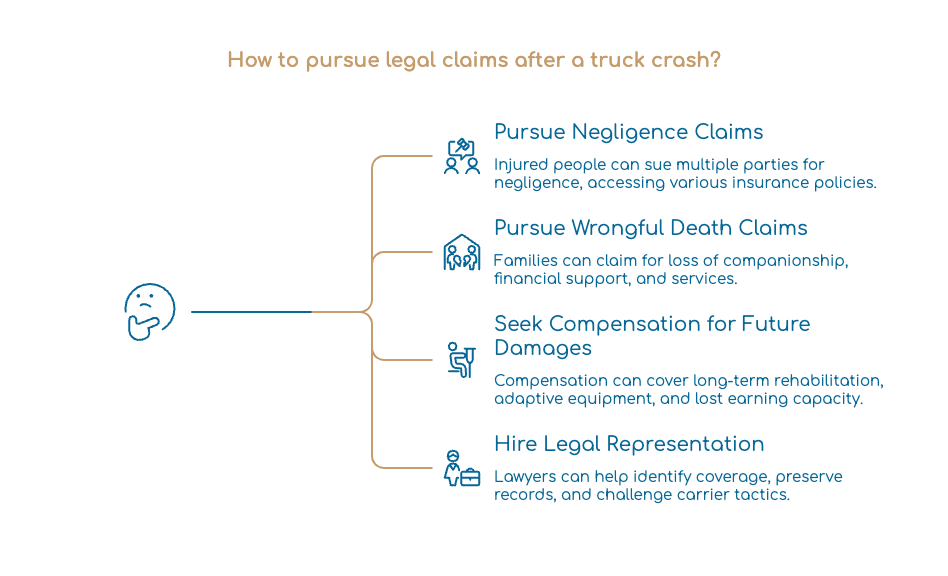
- Injured people may pursue negligence and FMCSA violation claims against the carrier, driver’s employer, cargo company, and maintenance contractor simultaneously, accessing all available insurance policies.
- A family member who loses a loved one in a fatal truck crash may pursue wrongful death claims for loss of companionship, financial support, medical expenses, and services provided to the family.
- Compensation may address both current losses and reasonably expected future damages, including long-term rehabilitation, adaptive equipment, home modification, and lost earning capacity.
- Legal representation can help identify all available coverage sources, preserve federal compliance records, and challenge carrier tactics designed to minimize or deny fair recovery.
What Should You Do After an Orlando Truck Accident?
After a commercial truck accident injury in Orlando, an injured person should prioritize immediate medical care, even when symptoms appear minor or are delayed. The crash should be carefully documented through photographs, witness information, and police reports before evidence is lost or conditions change. Once urgent needs are addressed, contacting an Orlando truck accident attorney can help protect legal rights, preserve time-sensitive evidence, and guide the injured person through the complex claims process required for commercial vehicle crashes.
Seek Immediate Medical Care
The first priority following an Orlando truck accident is prompt medical evaluation, even when symptoms appear minor, delayed, or managed with adrenaline in the immediate aftermath of the crash. A medical professional can identify internal injuries, traumatic brain injuries, spinal damage, fractures, and soft tissue trauma that may worsen significantly without timely care. Continued treatment, specialist follow-up, and adherence to medical instructions support recovery and create a reliable record of the injury over time. Delays in seeking care may complicate recovery and raise questions about causation of injury during insurance evaluations, even when the need for care is entirely genuine. Because injuries from truck crashes are often more severe than those in standard car accidents, emergency evaluation is especially important, regardless of how you feel at the scene.
Document the Accident Scene
Once medical needs are addressed, careful documentation of the Orlando truck accident scene can preserve an accurate, contemporaneous account of the crash. A responsible person may photograph vehicle positions, cargo debris, roadway conditions, traffic signals, skid marks, tire marks from brake application, visible injuries, and any regulatory markings or placard information on the truck. Names, phone numbers, insurance details, CDL numbers, and license plates for all drivers should be collected when it is safe to do so. Witnesses may provide brief written or recorded observations, including where they stood and what they saw before impact.
A dated written summary should note weather, lighting, time, location, and statements made at the scene. All photographs, receipts, medical instructions, and insurer correspondence should be preserved in an organized format from the first day forward.
Contact a Truck Attorney
When an Orlando commercial truck crash results in serious injuries, contacting a truck accident attorney immediately — ideally within hours of the crash — can be one of the most important steps an injured person takes. An attorney can send a spoliation letter to the carrier and its insurer demanding immediate preservation of the truck’s ECM black box data, ELD logs, driver qualification files, pre-trip inspection reports, maintenance records, and dashcam footage. These materials are in the carrier’s possession, and without formal legal demand, they may be overwritten, reset, or handed to the carrier’s own defense team without the injured person’s knowledge.
Early legal involvement also allows counsel to identify all potentially liable parties, review available insurance coverage across the carrier, cargo, and maintenance policies, and guide the injured person through each stage of the complex claims process with discipline and care.
Critical Evidence in an Orlando Truck Accident Case
Critical evidence shapes the outcome of an Orlando commercial truck accident injury case, particularly when liability, regulatory violations, and fault percentage are disputed across multiple parties. A lawyer may evaluate key materials to establish what occurred, whether federal safety regulations were violated, how injuries developed, and how the crash affected the injured person’s life. Important evidence includes driver logbooks, ECM black box data, maintenance records, and witness statements.
Driver Logbooks
Driver logbooks — and their modern electronic equivalent, the ELD records required since December 2017 under FMCSA regulations — document the hours a commercial driver has been operating, resting, and on-duty. These records are critical in any Orlando truck accident case where driver fatigue may be a contributing factor. When logbooks show a driver exceeded the 11-hour driving limit, skipped a mandatory 10-hour rest period, or engaged in on-duty activities that reduced available driving hours, those entries support an FMCSA hours-of-service violation claim. Carriers are required to retain driver logs for at least six months, but early legal action through a spoliation letter helps ensure this evidence is preserved and cannot be altered or destroyed before it is reviewed by the injured person’s legal team.
Black Box Data
The engine control module (ECM) — often called the black box — in a commercial truck records detailed operational data in the seconds and minutes before a crash, including vehicle speed, throttle position, brake application, engine RPM, hard braking events, and cruise control status. Unlike passenger vehicle EDRs, commercial truck ECMs typically store a more extensive historical record of the vehicle’s performance over time. This data can directly contradict insurer claims that the truck was traveling within speed limits, braking properly, or not in violation of operational standards before the impact. Because ECM data can be overwritten after a single ignition cycle or during routine diagnostic procedures, demanding its preservation through immediate legal action is one of the most critical first steps in any serious Orlando truck accident case.
Maintenance Records
Federal regulations require commercial carriers to maintain detailed records of all vehicle inspections, repairs, and maintenance activities. When brake failures, tire blowouts, suspension defects, or lighting violations contributed to a crash in Orlando, maintenance records establish what the carrier knew — or should have known — about the truck’s condition before putting it on the road. These records may reveal prior inspection findings that were not addressed, patterns of delayed maintenance, or outright failures to conduct required inspections. When a carrier’s maintenance negligence contributed to the crash, those records support liability claims directly against the carrier, not just the driver. Expert review of technical maintenance standards and FMCSA inspection requirements may be needed to fully evaluate whether the records reveal actionable negligence.
For more on how medical records and evidence documents matter in an injury claim: “What Medical Records Matter Most in a Florida Injury Claim.”
Witness Statements
When a commercial truck crash occurs in Orlando, witness statements may provide an independent account of events that technical data and physical evidence cannot fully explain on their own. A careful witness statement can describe the truck’s lane position, speed, braking behavior, and any observable driver distraction before impact. These accounts help corroborate or challenge the carrier’s version of events and support a fair evaluation of fault across all involved parties. Investigators often compare witness accounts with ECM data and vehicle damage patterns to identify consistency between what was seen and what the vehicle systems recorded. Prompt collection is important because memories fade, contact information changes, and commercial truck crash scenes are typically cleared quickly, reducing the opportunity for later on-site investigation by the injured person’s legal team.
Event Data Recorders and Black Box Evidence in Orlando Truck Accident Cases
Commercial trucks contain multiple sources of electronic data that are unavailable in most standard passenger vehicle crashes, and this data is often the single most powerful evidence in an Orlando truck accident case. The engine control module (ECM), also called the black box, records the vehicle’s speed, throttle position, brake engagement, engine load, hard braking events, and cruise control status in the seconds and minutes before impact. Unlike the event data recorders (EDRs) found in passenger vehicles, commercial truck ECMs typically store a much longer operational history — often weeks of driving data — that can reveal patterns of speeding, hard braking, and fatigue-related driving behavior that predate the crash itself.
Beyond the ECM, commercial trucks subject to FMCSA electronic logging device (ELD) mandates — which have covered most interstate carriers since December 2017 — carry real-time hours-of-service records that document exactly how many hours the driver operated and when mandatory rest periods were taken. ELD data cannot be falsified as easily as paper logs, making it a highly reliable source for identifying hours-of-service violations. Many carriers also install forward-facing and inward-facing dashcam systems that record video of the roadway and cab, and these recordings can show whether the driver was distracted, drowsy, or looking away from the road at the moment of impact.
All of this evidence belongs to the carrier — which is why a formal spoliation letter demanding preservation of the ECM data, ELD records, dashcam footage, pre-trip inspection reports, and driver qualification files must be sent to the carrier and its insurer within hours of a serious crash. Once the truck is returned to service and the ignition is cycled, ECM overwrite can occur. A strong, immediate legal response is the only reliable way to preserve this evidence for the injured person’s benefit in any Orange County truck accident claim.
How an Orlando Truck Accident Lawyer Can Help You
After filing deadlines and evidence preservation are addressed, the next concern is how legal representation affects the course and value of a complex commercial truck injury claim. An Orlando truck accident lawyer may organize medical records, investigate liability across multiple commercial parties, consult federal trucking regulations experts, and communicate with carrier insurers to reduce pressure on an injured person and their family. Through careful case evaluation, counsel can identify damages involving treatment costs, lost income, permanent disability, pain, and future care needs.
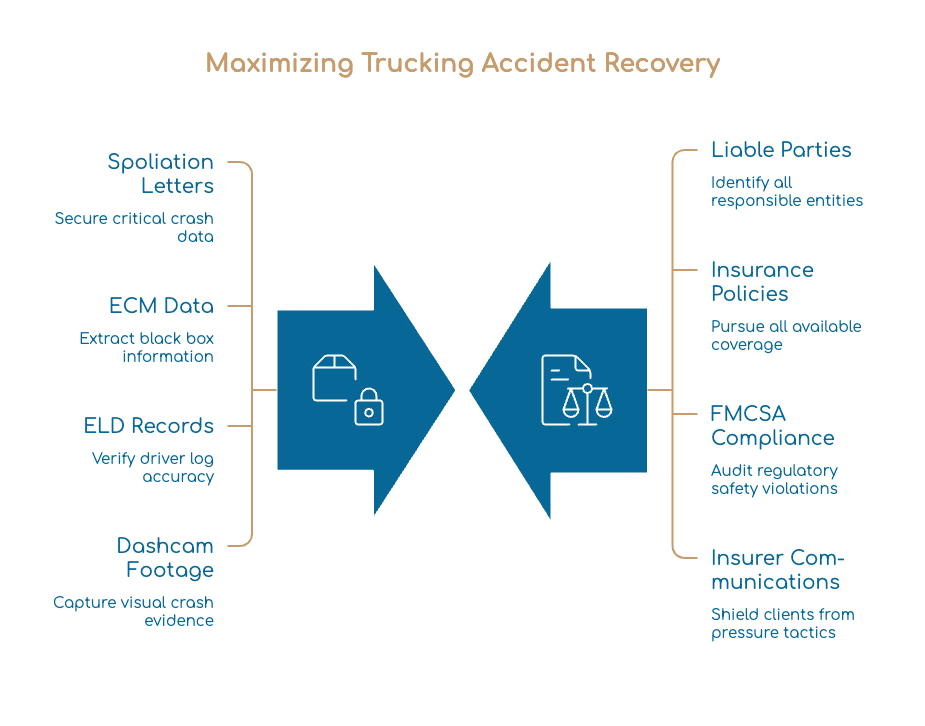
- Immediate evidence preservation — sending spoliation letters to the carrier, its insurer, and any cargo or maintenance company within hours of the crash to secure ECM black box data, ELD records, and dashcam footage before overwrite occurs.
- Identifying all liable parties across the driver, carrier, driver’s employer, cargo loading company, freight broker, and maintenance contractor — ensuring all available insurance policies are pursued simultaneously.
- Evaluating FMCSA compliance across driver qualification files, hours-of-service records, pre-trip inspection reports, and maintenance logs to identify regulatory violations that support negligence per se claims.
- Managing all carrier insurer communications to protect the injured person from pressure tactics, recorded statements, and early settlement offers designed to minimize recovery before the full scope of the injuries is known.
Long-Term Effects of Orlando Truck Accident Injuries
Truck accident injuries in Orlando may lead to long-term consequences that extend well beyond initial emergency treatment. Chronic pain conditions, reduced mobility, and emotional trauma can fundamentally alter an injured person’s ability to work, maintain independence, and fulfill family responsibilities. These lasting effects often become central issues in evaluating damages, future care needs, and the overall value of the injury claim — particularly in cases involving spinal injuries, traumatic brain injuries, or severe orthopedic trauma from a high-force commercial vehicle collision.
Chronic Pain Conditions
After a serious truck crash, chronic pain can become one of the most persistent and disruptive long-term consequences. Persistent pain may arise from nerve damage, spinal compression injuries, fractures, burns, or soft tissue trauma, affecting sleep quality, concentration, work capacity, and family responsibilities over months and years. Treatment often requires specialist care, pain management programs, injections, or surgical intervention, each creating ongoing costs and difficult medical decisions. Insurance claim delays can worsen the burden by postponing needed care and financial support. Careful medical documentation that connects continuing pain to the crash supports a fair injury claim that accounts for the full duration and cost of treatment, rather than only the acute phase of recovery.
Reduced Mobility
When severe injuries affect the spine, pelvis, lower extremities, or neurological function, mobility limitations may become a lasting consequence of an Orlando truck accident. Such limitations can interfere with employment, caregiving, transportation, and participation in community and family life. Some injured people require assistive devices, home modification, adaptive vehicle equipment, or long-term physical therapy. These needs create substantial costs beyond immediate medical treatment, including ongoing rehabilitation, medical transportation, and potential retrofitting of living and working spaces. A careful legal evaluation addresses how reduced mobility affects future earnings, independence, and daily activities, ensuring practical long-term needs are recognized in the valuation of the claim rather than minimized during settlement negotiations with carrier insurers.
Emotional Trauma
Although physical injuries receive immediate medical attention, emotional trauma can become a significant and lasting consequence of an Orlando commercial truck accident. Survivors may experience post-traumatic stress, anxiety about driving, sleep disruption, depression, or persistent difficulty returning to normal daily routines. These conditions can affect family relationships, employment stability, medication adherence, and the person’s overall quality of life for years after the crash. When emotional harm is documented carefully through mental health provider records, personal account evidence, and family observations, it may become an important component of the long-term damages evaluation in an Orange County truck accident claim. Early mental health support and consistent documentation of emotional symptoms serve both recovery and the legal case simultaneously.
Proving Liability in Orlando Truck Accident Cases
Because commercial truck crashes often involve multiple defendants and aggressive defense from carrier insurers, proving liability requires a careful review of the collision from every angle — the driver’s conduct, the carrier’s maintenance and supervision practices, the cargo loading process, and compliance with federal FMCSA safety regulations. Liability may turn on whether a driver violated hours-of-service rules, whether a carrier sent out a truck with known defects, whether cargo was improperly secured, or whether a combination of negligence across multiple parties caused the crash and the resulting injuries.
A thorough investigation may include ECM black box data, ELD records, police reports, scene photographs, traffic camera footage, cargo manifests, maintenance logs, driver qualification files, witness statements, and expert accident reconstruction. These materials help establish how the crash occurred and whether the injured person’s harm was caused by negligent or unlawful conduct. In most serious truck cases, multiple parties share fault, and identifying all of them — and all of their insurance coverage — is the most important function of an experienced Orlando truck accident lawyer in the weeks immediately following the crash.
Dealing With Insurance Companies After an Orlando Truck Accident
After liability evidence begins to take shape, insurance negotiations often become the next major concern in an Orlando truck accident injury claim. Commercial carrier insurers are not like standard auto insurers — they carry much higher policy limits, employ specialized defense teams, and often deploy adjusters to the crash scene within hours. For injured people, careful communication is critical, because recorded statements, signed authorizations, or incomplete claims forms may limit claim value before the full extent of injuries and losses is understood. Commercial truck coverage may involve the carrier’s primary liability policy, a separate excess or umbrella policy, the cargo company’s coverage, and any maintenance contractor’s general liability — all of which may be available depending on the facts of the crash.
Adjusters may challenge fault, dispute treatment necessity, question causation, or make early settlement offers before specialist evaluations and surgery are complete. When benefits are refused or undervalued, the appeal process requires organized evidence, timely responses, and legal analysis of all applicable policies. A measured, disciplined approach to insurer communication — one that protects the injured person’s interests while preserving the evidentiary record — is the most important practical step after the initial evidence preservation phase in any serious Orlando commercial truck accident claim.
What to Expect During an Orlando Truck Accident Injury Claim
An Orlando truck accident injury claim typically begins with an initial case evaluation, followed by a structured evidence collection phase that addresses both the crash itself and the full scope of the injured person’s losses. The process involves insurance negotiations with carrier adjusters and may proceed to litigation if a fair resolution cannot be reached. Each stage carries specific strategic decisions about evidence, expert witnesses, and claim valuation that differ from standard car accident claims.
Initial Case Evaluation
The initial case evaluation in an Orlando truck accident claim differs from a standard car accident consultation because of the complexity of the commercial vehicle landscape. During this review, the lawyer assesses the circumstances of the crash, the identities of all commercial parties involved, the available insurance coverage for all potentially liable parties, and the federal regulations that apply to the carrier’s and driver’s operations. An evidence checklist for truck cases typically includes ECM data, ELD logs, driver qualification files, maintenance records, cargo manifests, dashcam footage, police reports, witness statements, and any communications from the carrier’s insurers. By organizing these facts early, the legal team can evaluate liability across multiple defendants, anticipate fault defenses, and guide the injured person with discipline and care through each subsequent stage of the process.
Evidence Collection Process
When evidence collection begins in an Orlando truck accident case, the focus shifts from the physical crash evidence to the regulatory and operational records unique to commercial vehicle claims. Attorneys review ECM black box data for speed and braking, ELD records for hours-of-service compliance, maintenance logs for vehicle defects, cargo manifests for loading violations, and driver qualification files for licensing and medical certification compliance. Medical records, imaging studies, surgical notes, therapy plans, and expert projections establish injury severity and future care needs. Vocational expert analysis may assess how orthopedic or neurological injuries affect the injured person’s earning capacity across the remainder of their working life. These materials collectively build the foundation of a comprehensive claim against all responsible commercial parties.
Insurance Negotiation Steps
Once evidence collection is organized, insurance negotiations in an Orlando truck accident case typically involve multiple insurers simultaneously — the carrier’s primary liability insurer, any excess or umbrella policy, the cargo company’s insurer, and potentially the maintenance contractor’s general liability coverage. A careful claim strategy for truck cases includes presenting ECM data, ELD violations, maintenance failures, and witness accounts alongside medical documentation, wage loss evidence, and expert opinions on long-term care needs. Negotiations require organized evidence, because carrier insurers routinely challenge causation, injury severity, and the injured person’s fault percentage. A measured, disciplined approach helps prevent undervaluation while maintaining the evidentiary record needed for litigation if negotiations fail to produce a fair result.
Settlement or Litigation
After negotiations clarify the disputed issues, an Orlando truck accident injury claim may move toward settlement or litigation depending on liability strength, damages documentation, the number of liable parties, and the carrier insurer’s offer. Settlement in multi-party truck cases can be more complex than standard car accident resolutions, because multiple insurers may need to coordinate on coverage contributions before a single settlement figure can be finalized. If the carrier or its insurer denies responsibility, minimizes injuries, or refuses a fair amount, litigation may be filed in Orange County Circuit Court. During litigation, attorneys exchange evidence, depose witnesses and corporate representatives, consult federal regulation experts, and prepare for trial while continuing to explore settlement.
Whether resolved by agreement or verdict, the goal remains the same: pursue full accountability for every party whose negligence contributed to the crash, and seek compensation that supports recovery and long-term stability for the injured person and their family.
Compensation for Orlando Truck Accident Damages
Because commercial truck crashes often result in severe physical and financial harm, compensation in an Orlando truck accident claim may address a comprehensive range of injury-related damages across multiple liable parties. An attorney may evaluate how the collision affected the injured person’s health, mobility, career, and daily responsibilities, while considering the long-term needs created by serious orthopedic, neurological, or traumatic injury. This assessment supports a demand that reflects medical treatment across all specialties, long-term rehabilitation, assistive care, lost earning capacity, and other consequences tied to the crash. Compensation evaluation also depends on evidence connecting each category of loss to the negligent conduct, including violations of federal regulations, which carry evidentiary weight beyond standard negligence arguments in Florida courts.
Economic vs. Non-Economic Damages in Orlando Truck Accident Cases
In Orlando commercial truck accident cases, damages are divided into economic losses, such as medical bills, lost wages, and future care costs, and non-economic losses, such as pain, suffering, and loss of enjoyment of life. Each category requires careful evaluation and credible documentation, because economic expenses may be more straightforward to calculate while personal impact requires thoughtful expert opinion and account evidence. Proving the full value of both categories depends on medical records, employment documentation, vocational expert analysis, and a clear connection between the crash and each claimed harm across all liable parties.
Economic Damages Explained
Calculating economic damages is central to valuing an Orlando truck accident claim, since these losses form the measurable financial foundation of the case. Medical expenses may include emergency transport, surgery, hospitalization, specialist care, physical and occupational therapy, prescription medication, long-term rehabilitation, and projected future care costs for permanent injuries. Wage losses may reflect missed work time, reduced hours, diminished earning capacity, or the complete inability to return to prior employment after spinal, neurological, or orthopedic trauma. Records such as itemized medical invoices, employment pay statements, tax returns, and physician work restrictions clarify the full scope of measurable loss.
When coverage disputes arise across multiple carrier and cargo policies, organized economic documentation helps resolve disagreements over payment responsibility, policy limits, and the necessity of each claimed treatment category.
Non-Economic Damages Explained
Non-economic damages represent the personal and deeply human impact of a serious Orlando truck accident — the losses that cannot be captured in an invoice or a pay stub. These may include chronic pain, loss of enjoyment of activities that once defined the injured person’s daily life, anxiety about transportation, sleep disruption, relationship strain, and the burden of depending on family members for care that the injured person previously provided independently. For families who lost a loved one in a fatal truck crash, non-economic losses include grief, loss of companionship, and the permanent absence of a parent, spouse, or caregiver. While insurance coverage may address these damages, they are not reducible to simple arithmetic. They reflect the full human cost of negligent commercial truck operations and deserve to be presented with care, credibility, and the dignity every injured person deserves throughout the claims process in Orange County.
Proving Accident Losses
After a serious commercial truck crash, proving the full value of accident losses requires a disciplined and layered approach to both economic and non-economic damages. Economic losses are supported through itemized records, invoices, expert medical projections, employment documentation, and vocational analysis. Non-economic damages require personal account evidence, consistent medical documentation of pain and emotional symptoms, and expert testimony connecting the crash to ongoing limitations. Careful documentation helps present all losses with accuracy and dignity. In rare cases involving extreme misconduct or deliberate regulatory violations, punitive damages may also be considered. A well-prepared Orlando truck accident claim connects each category of loss to credible evidence, allowing decision-makers to assess fair compensation with accountability and respect for the injured person’s full experience of the harm they suffered.
When an Orlando Truck Accident Case Goes to Trial vs. Settlement
When an Orlando commercial truck accident injury case cannot be resolved through negotiations across all liable carriers, the claim may proceed toward trial in Orange County Circuit Court, where a judge or jury evaluates liability, regulatory violations, damages, and the credibility of the evidence. Settlement often offers faster resolution, reduced uncertainty, and privacy for the injured person and their family, and multi-party truck cases are frequently resolved through structured negotiations that allocate responsibility across carrier, cargo, and maintenance policies. Trial, however, may become necessary when insurers undervalue harm, deny evidence of FMCSA violations, dispute liability among multiple commercial parties, or refuse to account for the long-term consequences of catastrophic injuries. Whether resolved by settlement or verdict, the goal remains full accountability for every party whose negligence contributed to the crash and fair compensation that supports the injured person’s recovery, stability, and long-term well-being throughout Orange County.
Florida Laws That May Affect Your Orlando Truck Accident Case
Florida law, combined with federal FMCSA regulations, shapes every aspect of how an Orlando commercial truck accident claim is assessed, negotiated, and resolved. These rules influence fault allocation, compensation available to injured people, insurance recovery, and the evidentiary standards applied to carrier safety records and driver conduct.
- Modified comparative fault (HB 837, 2023) eliminates all recovery when the injured person is found 51% or more at fault — a standard that carrier insurers use aggressively to challenge injured drivers, making black box data and witness evidence essential to every Orlando truck claim.
- FMCSA regulations under Title 49 of the Code of Federal Regulations govern commercial truck operations in Florida — including hours of service, vehicle inspection, cargo securing, and electronic logging — and violations of these federal rules can establish negligence per se against the carrier or driver.
- Florida’s two-year statute of limitations (effective March 24, 2023) applies to most commercial truck accident injury claims — and carriers begin their defense immediately, making early legal action essential for protecting evidentiary rights in Orange County.
- Florida’s vicarious liability and negligent entrustment doctrines may impose responsibility on carriers and employers for the negligent conduct of their drivers, creating pathways to higher-limit commercial policies beyond the driver’s personal coverage.
The Statute of Limitations for Orlando Truck Accident Cases
Because filing deadlines can determine whether an injured person may pursue compensation at all, the statute of limitations is a central consideration in any Orlando commercial truck accident case. In Florida, most negligence-based injury claims must be filed within two years from the date of the crash, under HB 837 (effective March 24, 2023). Wrongful death claims following a fatal truck crash also generally follow a two-year period from the date of death. Missing the applicable deadline may permanently bar recovery, regardless of the severity of the injuries or the strength of the available evidence.
Commercial truck carriers typically deploy specialized defense teams within hours of a serious crash, and their goal is to control the narrative, preserve evidence favorable to their client, and position the claim for the best possible outcome from the carrier’s perspective. The injured person who waits to consult an attorney is at a structural disadvantage. Early legal action allows counsel to send spoliation letters immediately, identify all liable parties and their coverage, organize injury documentation from the first days of treatment, and develop a clear strategy before the comparative fault arguments are entrenched in the insurer’s claim file. Every day matters in the first weeks after a serious truck accident in Orlando.
When to Contact an Orlando Truck Accident Lawyer
When injuries, insurance questions, carrier insurer contact, or uncertainty about fault arise after a commercial truck crash, contacting an Orlando truck accident lawyer as soon as possible — ideally within the first 24 hours — may be the single most important step an injured person can take. This is especially true in truck cases because black box data from the truck’s ECM can be overwritten after a single ignition cycle, ELD records may be subject to alteration if not immediately preserved, and carrier insurance adjusters often contact injured people quickly to gather recorded statements and gauge the strength of the claim. A lawyer may send spoliation letters immediately, review insurer communications, and guide the injured person through the initial stages of the process while protecting their rights from the very first contact with the commercial carrier’s defense team.
Why You Need an Experienced Orlando Truck Accident Lawyer
An experienced Orlando truck accident lawyer can provide essential guidance in cases involving serious injuries, federal regulatory violations, multiple liable commercial parties, and carrier insurers who specialize in defending these claims. After a truck crash, injured people often face pain, financial strain, and immediate contact from carrier adjusters while also trying to support families and manage medical care. Skilled legal representation helps protect the claimant’s interests by acting immediately to preserve electronic evidence, identify all applicable insurance policies, and build a comprehensive case that carrier insurers cannot easily dismiss with speed or early settlement pressure.
Experience is especially valuable in commercial truck cases because the evidence is time-sensitive, the regulatory framework is specialized, and the liable parties often include corporate entities with significant resources to devote to their defense. A lawyer who understands FMCSA compliance, ECM data preservation, ELD hours-of-service analysis, and multi-party insurer negotiations brings a level of preparation that can directly affect the outcome of a serious Orange County truck accident claim.
At Anidjar & Levine, that experience is anchored by Glen Levine’s Board Certification in Civil Trial, the highest credential awarded by the Florida Bar, and the firm’s AV Preeminent rating from Martindale-Hubbell, independently confirmed designations that reflect the highest standards of legal excellence and courtroom readiness.
How to Choose the Right Orlando Truck Accident Lawyer for Your Case
Choosing the right Orlando truck accident lawyer requires careful attention to experience with commercial vehicle claims, understanding of FMCSA regulations, and the attorney’s approach to evidence preservation in the critical first hours after a serious crash. A qualified attorney should recognize the specific burdens that truck accident injuries place on injured people and their families — the severity of trauma, the complexity of multiple liable parties, and the urgency of black box preservation — while approaching each case with discipline, compassion, and respect for the client’s dignity and autonomy throughout the process.
Ask specifically about how the attorney handles ECM data preservation, ELD hours-of-service analysis, multi-party insurer negotiations, and FMCSA violation evidence in commercial truck cases. Also ask about Board Certification in Civil Trial and an AV Preeminent rating from Martindale-Hubbell — independent credentials that confirm the highest levels of professional excellence and courtroom readiness. These designations are not marketing — they are the Florida Bar’s and Martindale-Hubbell’s formal recognition that the attorneys have met rigorous standards of peer evaluation, legal knowledge, and ethical practice.
Careful selection of legal counsel helps ensure reliable guidance, responsible advocacy, and a focused path toward fair recovery after a serious commercial truck collision in Orlando and throughout Orange County.
Real Reviews From Our Clients!
Patricia N. ★★★★★
“A fatigued semi driver rear-ended me on I-4 near the International Drive interchange and I suffered a herniated disc that required surgery. The firm immediately sent a spoliation letter to the carrier and obtained the driver’s ELD logs, which showed he had been driving for 13 hours straight in violation of federal hours-of-service rules. That evidence changed everything. I am so grateful to the team at Anidjar & Levine for acting so quickly and fighting so hard for me.”
Robert W. ★★★★★
“An improperly loaded cargo truck spilled debris on SR 408 and I lost control of my car trying to avoid it. My attorney at Anidjar & Levine identified both the carrier and the loading company as liable parties and pursued both insurance policies at the same time. I never would have known I had a claim against the loading company on my own. The firm handled every communication while I focused on my recovery. Outstanding work from start to finish.”
Marcus E. ★★★★★
“A commercial truck ran a red light on US 441 and hit my car at high speed. The trucking company’s insurer immediately claimed I had entered the intersection when the light changed. Glen Levine’s team pulled the truck’s black box data within 24 hours and it showed the truck was traveling at 58 mph in a 45 mph zone with no braking before impact. The insurer’s version of events fell apart completely. I cannot recommend this firm highly enough.”
About The Law Offices of Anidjar & Levine
Founded in 2005 by Marc Anidjar and Glen Levine, the firm began as a two-person operation working out of a construction office conference room. Over the past 20 years, that modest start has grown into one of Florida’s most recognized personal injury practices, with more than $1 billion recovered in settlements on behalf of injury clients across the state. We bring that same determination and depth of experience to every commercial truck accident case we handle in Orlando and throughout Orange County.
For injured people in Orlando, The Law Offices of Anidjar & Levine provides legal representation focused on accountability, client service, and the pursuit of fair compensation after serious commercial truck crashes. The firm serves clients by managing the legal and investigative burden in complex multi-party claims, allowing injured people and their families to focus on medical treatment, recovery, and stability. Its team handles truck accident claims involving federal FMCSA violations, multiple liable commercial parties, carrier insurance disputes, and catastrophic injuries. Through immediate evidence preservation, careful investigation, regulatory analysis, and strategic negotiation, the firm works to protect clients from unfair treatment while keeping them informed throughout every stage of the process.
Marc Anidjar — Senior Partner
Marc Anidjar oversees the day-to-day operations of the firm and has settled thousands of cases, including truck accident matters, catastrophic injury cases, and complex multi-party claims, across nearly two decades of practice. He earned his Bachelor of Science from the University of Florida in 1999 and his Juris Doctor from Nova Southeastern University, Shepard Broad School of Law in 2003. His client-centered approach ensures that every injured person receives attentive, organized, and results-focused representation from the first consultation through final resolution.


Glen Levine — Senior Partner
Glen Levine is a founding partner who oversees all of the firm’s litigation, including truck accident cases where insurers dispute liability across multiple commercial parties — the carrier, the driver’s employer, and cargo and maintenance companies — while simultaneously using HB 837’s modified comparative fault rule to push fault onto the injured person and minimize recovery. In 2019, Mr. Levine became Board Certified in Civil Trial, the highest level of evaluation by the Florida Bar. He is consistently AV Rated by Martindale-Hubbell, the highest preeminence designation the service awards. AVVO has rated Mr. Levine 10 out of 10 (“Superb”). He received the “Lawyer of Distinction” designation in 2017, 2018, and 2019; was named to Florida Trend Magazine’s “Legal Elite” list in 2017; was recognized by the Miami Herald as a Top Rated Lawyer in South Florida in 2015; and was a finalist in the personal injury category for “South Florida Leaders in the Law” in 2013.
With more than 50,000 clients served and 419 years of combined legal experience across our team, we have the resources and depth to handle truck accident cases of any complexity in Orlando and throughout Orange County. Our results reflect that commitment: we recovered more than $20 million for a single Jacksonville family and secured more than $6 million for another family in a separate case. We also obtained a recovery for a family in Broward County that was recognized as one of the top ten settlements of the year in Florida.
Our team includes lawyers, investigators, and medical and legal support professionals who thoroughly investigate each case and pursue the full value of every client’s losses. With two board-certified civil trial lawyers on staff, your Orlando truck accident claim is backed by the highest credentials available under Florida law. We are available 24 hours a day, 7 days a week, with offices in Fort Lauderdale, Miami, West Palm Beach, Fort Myers, Tampa, Orlando, and Jacksonville.
We are also deeply invested in the communities we serve. For 15 years, we have participated in Christmas on Las Olas, and we proudly sponsor the KISS Cares radiothon, raising money for Joe DiMaggio Children’s Hospital. We also support the Scripps Howard Foundation’s “If You Give a Child a Book” campaign, MADD, the Jewish Federation, Special Compass, and dozens of other local causes across Florida. We proudly sponsor the Miami Dolphins, Miami Heat, Florida Panthers, and Tampa Bay Lightning.
Past results do not guarantee a similar outcome in future cases. Each case is evaluated individually based on its unique facts and circumstances.
Frequently Asked Questions
What Are the Federal Motor Carrier Safety Regulations (FMCSRs) and Why Do They Matter in an Orlando Truck Accident Case?
The FMCSRs, issued by the FMCSA under Title 49 of the Code of Federal Regulations, are binding federal rules governing hours of service, driver qualifications, vehicle inspection, cargo securing, and electronic logging for all commercial truck operations. When a truck driver, carrier, or shipper violates an FMCSR, that violation can establish negligence per se in a Florida personal injury claim — meaning the violation itself proves a breach of the legal duty of care. On Orlando’s I-4 corridor and US 441 commercial routes, FMCSA violation evidence from ELD records, driver logs, and maintenance files often becomes the most powerful proof in any serious Orange County truck accident case.
Can Truck Accident Claims Involve Federal Safety Regulations?
Yes. Commercial truck accident claims in Orlando frequently involve FMCSA regulations governing driver hours, vehicle maintenance, cargo loading, and electronic logging. When a carrier, driver, or shipper violates these rules, that violation may support negligence and significantly strengthen an injury claim. Reviewing driver logbooks, inspection records, and ELD data helps identify whether federal safety rules were followed before the crash and provides a powerful evidentiary foundation for holding all responsible commercial parties accountable in Orange County.
What Makes Commercial Truck Crashes Different From Car Accidents?
Commercial truck crashes differ from car accidents in several critical ways: the vehicles are significantly larger and heavier, increasing injury severity dramatically; multiple parties may be liable simultaneously, including the carrier, driver’s employer, cargo loading company, and maintenance contractor; and federal FMCSA regulations add a layer of evidence unique to commercial claims. Truck insurers typically carry much higher policy limits and deploy specialized defense teams within hours of serious crashes, making early legal representation and rapid evidence preservation especially important for injured people pursuing claims in Orange County after a truck collision.
Do Truck Accident Cases Require Expert Witnesses?
Yes, truck accident cases in Orlando frequently require expert witnesses to establish liability and quantify damages. Accident reconstruction specialists analyze crash dynamics, vehicle positions, and speed. Trucking industry experts evaluate driver logs, carrier safety compliance, and FMCSA violations. Medical experts project future care costs, treatment needs, and long-term disability impact. Vocational experts assess reduced earning capacity. When insurance disputes arise, expert analysis provides the credible professional foundation needed to challenge insurer valuations and present the full scope of an injured person’s losses in Orange County proceedings.
Can Cargo Loading Companies Be Liable for a Truck Crash?
Yes. When improper cargo loading or unsecured freight contributed to a truck crash in Orlando, the loading company, shipper, or freight broker may share liability alongside the carrier and driver. FMCSA regulations impose specific cargo securing standards, and violations of those standards support negligence claims against multiple parties simultaneously. Evidence such as cargo manifests, loading facility records, weight tickets, and post-crash cargo condition helps establish whether an improper load contributed to the jackknife, rollover, or loss of control that caused the crash and the resulting injuries in Orange County.
Are Truck Accident Settlements Taxable in Florida?
In most Florida truck accident cases, compensation received for physical injuries and related medical expenses is generally not considered taxable income under federal tax law. However, portions attributable to lost wages, punitive damages, or interest may be treated differently depending on the settlement structure and individual tax circumstances. Tax treatment varies, and consulting a qualified tax professional about any specific settlement is always recommended, as tax laws change and no two situations are identical.
What Is the Statute of Limitations for an Orlando Truck Accident Claim?
Under Florida’s 2023 tort reform (HB 837, effective March 24, 2023), most negligence-based truck accident injury claims must be filed within two years from the date of the crash. Missing this deadline bars recovery entirely, regardless of injury severity or evidence strength. Commercial truck carriers often deploy defense teams within hours of a serious crash. Because black box data can be overwritten after a single ignition cycle and driver logs may be altered or destroyed without immediate preservation demands, early legal consultation is essential for any injured person pursuing a truck accident claim in Orange County.
How Does Florida’s Modified Comparative Fault Rule (HB 837) Affect My Orlando Truck Accident Claim?
Florida’s modified comparative fault rule (effective March 24, 2023) means that if you are found 51% or more at fault for the truck crash, you recover nothing, regardless of how severe your injuries are. Carrier insurers are especially aggressive about fault arguments in truck cases, often claiming the car was tailgating, driving in a blind spot, or making an unsafe move. Black box data from the truck’s ECM, ELD records, maintenance logs, witness statements, and dashcam footage are the most effective tools for protecting your fault percentage and preserving your right to full compensation in Orlando and throughout Orange County after a commercial truck collision.
Commercial truck accident claims in Orlando require immediate action, careful investigation, and the legal knowledge to navigate federal regulations alongside Florida’s tort reform requirements.
An experienced lawyer can help preserve black box evidence, identify all liable parties, and pursue fair compensation across every available policy.
The Law Offices of Anidjar & Levine provides focused guidance through every stage of the process, including from our Orlando Personal Injury Lawyer team.
Those harmed in a commercial truck crash should act immediately to preserve evidence, meet deadlines, and protect their right to full recovery.
Our guides on what medical records matter most and average personal injury settlements in Florida may also help as you navigate what comes next.