
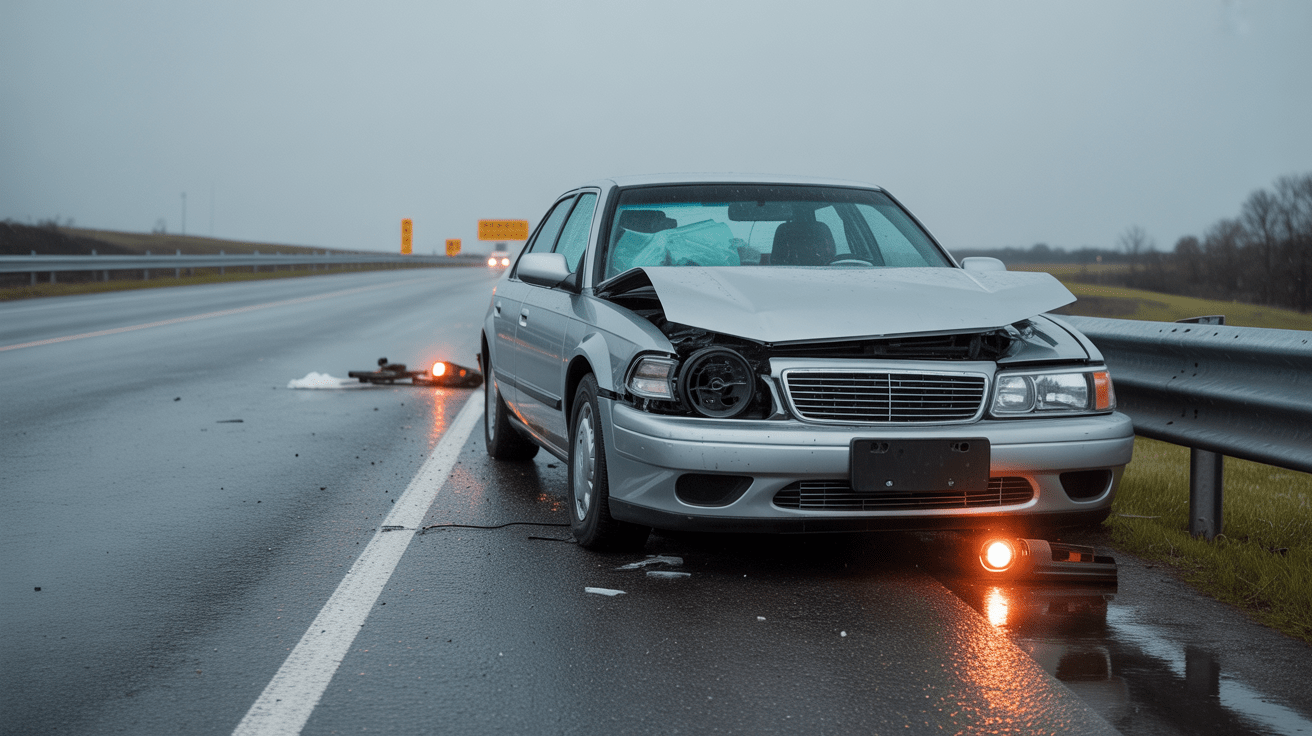
You know the scene. We’ve all seen it. A single car crashed up on the side of the road. And what’s the first thought that pops into your head?
Learn More: Tampa Single Vehicle Accident Injury Lawyer
Oof. That driver must have really messed up. But what if that simple, easy assumption is just completely wrong? Let’s peel back the layers and find out.
I mean, it’s a natural conclusion to jump to, isn’t it? If you’re the only one involved, you must be the only one to blame. Right? Your insurance gets a ding, you foot the bill, and that’s just the end of the story.
Yeah. But what you see on the surface is almost never the whole picture. As we’re about to find out, the person behind the wheel isn’t always the only one responsible for what happened, not by a long shot.
And this brings us to something you could call the one car crash myth. It’s this super common belief that the lone driver is automatically a hundred percent at fault. This idea is so powerful that it can actually stop people from figuring out what really caused the accident.
This quote really just nails the problem, doesn’t it? People automatically think, well, that’s it. I’ve got no options. It’s all on me.
But making that assumption could be a massive mistake. Okay. So if it’s not always the driver’s fault, then what else could it possibly be? This is where it starts to get really interesting.
See, there are often external factors, things completely out of the driver’s control that are the real culprits here. Let’s dig into a couple of the biggest ones.
First up, the road itself. I know it sounds a little weird, but you expect the road you’re driving on to be safe, right, to be predictable. But sometimes the government agencies in charge of them just fail to keep them maintained, and that’s when the road can essentially fight back, creating some incredibly dangerous situations. And look, we’re not talking about a few little bumps. We’re talking about serious hazards like huge potholes that can literally yank the steering wheel right out of your hands or poor drainage that sends you hydroplaning in a typical Florida downpour.
Think about faded lane markings at night or missing stop signs or poorly marked construction zones. Any one of those can cause a driver to lose control even if they were doing everything right. Okay, the second major hidden cause. It’s when your own car, the very machine you trust with your life, betrays you. You can be the safest, most offensive driver on the planet, but if a critical part suddenly fails without any warning, well, you’re just along for a very scary ride.
Just imagine this for a second. You’re coming up to a red light, you press the brake, and nothing happens. Or maybe your transmission goes haywire, and the car starts accelerating on its own. These kinds of catastrophic failures can come from a defective part that was bad from day one at the factory or even from sloppy, negligent work done by a mechanic. The point is, the fault might not be with the driver at all, but with the company that built the car or the shop that was supposed to fix it. So if the road is to blame or the car is to blame, who’s actually held responsible?
This is where the spotlight shifts away from the driver and onto other, sometimes very powerful, third parties. Think about it. A government entity could be on the hook for not fixing that dangerous pothole. A car manufacturer could be liable for a defective airbag or brake system, a repair shop for that botched brake job, even a construction company for setting up a hazardous confusing work zone.
All of a sudden, it’s pretty clear that a so called single vehicle accident can have multiple parties at fault. Now, I know what you might be thinking. Okay, but what if I was doing something wrong too? Like maybe I was going a little over the speed limit.
Does that mean everything is back on you? Well, not necessarily. And this brings us to a really important legal idea called shared fault.
In a place like Florida, this is handled by a rule called comparative negligence, and honestly, it’s a total game changer. It means you can still get compensation for your injuries and damages even if you were partially to blame. Your final recovery is just reduced by whatever percentage of fault is assigned to you. And while this is Florida’s specific role, a lot of other places have very similar principles of shared fault.
Let’s make this real. Let’s say you were a little distracted, so a court decides you were seventy percent at fault for the crash. But the county knew about a massive pothole on that road for months and did nothing, so they’re found to be thirty percent at fault. If your damages were, say, a hundred thousand dollars, you could still recover thirty thousand dollars from the county.
See, it’s not an all or nothing gain. However, and this is extremely important, you don’t have forever to act on this. There are very strict deadlines for filing these kinds of claims and they are no joke. For most personal injury lawsuits in Florida, that deadline is four years from the date of the accident.
And that might sound like a lot of time, but trust me, evidence disappears, people’s memories fade, and these legal processes can take a really long time. But here is the critical exception you absolutely have to know about. If you think a government entity is at fault, you know, for that pothole we talked about, the rules get way, way stricter. In many cases, you have to provide them with a formal notice of your claim within just ninety days. Ninety. If you miss that tiny little window, your right to sue could be gone forever no matter what that four year deadline set. So knowing all of this, what should you actually do if you find yourself in a single vehicle crash?
Well, here is a simple three step playbook to protect not only your health but also your legal rights. First things first, safety. Get yourself out of harm’s way if you can and call nine eleven. Second, become a detective.
Use your phone to take pictures of everything: your car, the road, any skid marks, faded signs, potholes, literally anything that seems off. If anyone stops to help, get their name and number. And third, go see a doctor. Right away.
Even if you feel fine, some injuries can show up later, and getting an official medical record is absolutely vital to connect those injuries to the accident. It turns out a single vehicle crash is rarely a simple story with a single villain. It’s often a much more complex story about accountability for our roads, for the cars we drive, and for everyone’s safety. It’s a powerful reminder that sometimes the most important details aren’t about the one car you can see, but about all the hidden factors you can’t.

