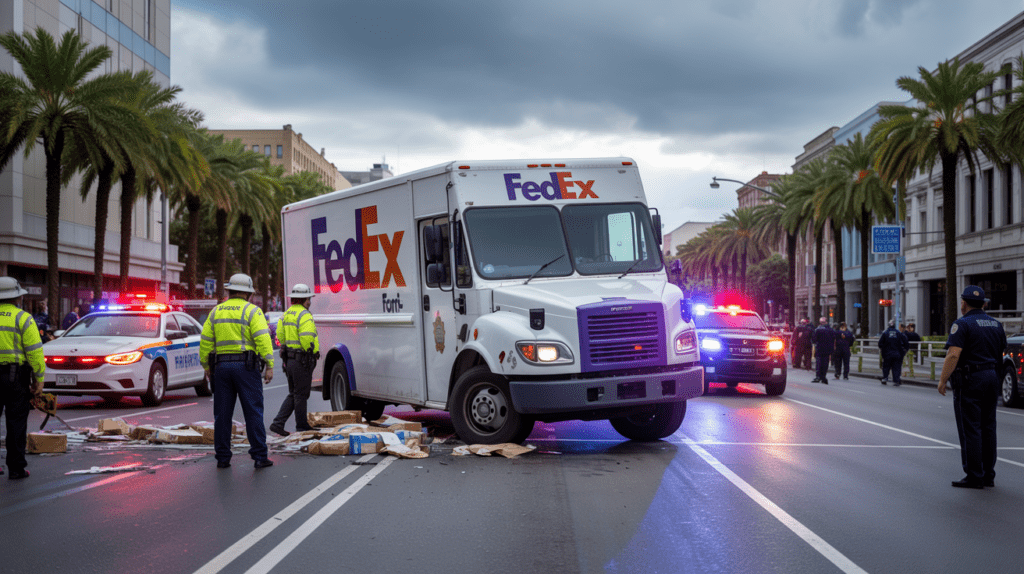
You see them everywhere, right? Those familiar white trucks, purple and orange logos zipping by. They’re just a part of our daily lives on the road. But what happens when one of those trucks is in a crash?
Learn More: Tampa FedEx Truck Accident Lawyer
Well, what comes next is anything but ordinary. It’s actually the first step into a really complex hidden legal maze. So it’s easy to think, okay, a FedEx truck crash, it’s basically just a car accident, but, you know, bigger. Right?
And that’s a fair question, but honestly, it totally misses the massive complexity that’s happening just beneath the surface.
Yeah. The real answer is it’s way, way more complicated. That moment of impact, that’s just the starting gun for a whole chain of events that makes these cases a completely different beast from your average fender bender. So let’s start peeling back the layers and see what’s really going on.
Okay. Our first big reveal is what I like to call the web of liability. See, in a normal car crash, it’s usually you and one other driver. Simple.
But with a commercial truck accident, the question of who’s responsible? Well, it explodes into this huge tangled mess.
I mean, just look at how many people could be on the hook here. You’ve got the driver, obviously. But then it could be FedEx Corporation itself. Or maybe it’s one of the third party contractors they hired to run the route.
And we’re just getting started. What if the brakes failed? Now you’re looking at the maintenance company. A design flaw in the truck?
The manufacturer could be liable. Heck, even the people who plan the delivery route might share some of the blame. It is a massive web. And this right here points to a major legal strategy.
FedEx, like a lot of big companies, often uses independent contractors. Now that’s not just about logistics. It’s a legal move. It creates what’s called a corporate shield, making it so much harder to hold the main corporation accountable when one of their drivers makes a mistake.
So we’ve looked at who could be responsible, but our second reveal gets into the why. Because it’s not always about one bad driver making one bad choice. It’s often about the insane pressures they are under every single day behind that wheel. Think about it.
The nonstop pressure to hit these crazy tight deadlines can push a driver to their absolute physical and mental edge. And when that happens, what do you think goes first? Judgment? Reaction time?
It is a recipe for disaster, plain and simple.
And you can see how that pressure leads directly to these common causes: you get driver fatigue from ridiculously long hours, you get trucks overloaded with packages which messes with braking and steering, you get distracted driving because they’re fiddling with navigation devices to save seconds, and of course, you get speeding to meet those quotas. It almost always traces back to that high pressure system. Now with stakes this high, you better believe there’s a special rule book just for these giants of the road. These massive commercial trucks, they don’t get to play by the same rules as your car.
Nope. They are held to a much, much higher standard of safety, and it’s all mandated by the federal government. And that official rulebook? It’s called the Federal Motor Carrier Safety Regulations, or FMCSRs for short.
You can think of it as the safety bible for the entire trucking industry. It’s designed specifically to prevent the exact kinds of horrible accidents we’re talking about.
And this is where things get really crucial in a legal case. Proving that one of these rules was broken is a huge deal. The hours of service rules, they exist to stop drivers from falling asleep at the wheel. The drug testing rules, to make sure they’re not impaired. The strict maintenance logs, they’re there to stop a mechanical failure from causing a wreck. Breaking one of these rules isn’t just a slip up, it’s powerful hard evidence of negligence.
And the reason this legal framework is so strict is because of the devastating human impact of these crashes. So now let’s talk about the true cost, which isn’t just measured in dollars and cents, but in shattered lives.
I mean, just because of the sheer physics involved, the size and weight of a commercial truck, the injuries are often catastrophic. We’re talking about traumatic brain injuries, spinal cord damage that leads to paralysis, traumatic amputations, severe internal bleeding. These aren’t injuries you just bounce back from. They change a person’s life forever.
So to even begin to address these horrific costs, the legal system looks at different kinds of compensation. You have economic damages, that’s the stuff you can put a price tag on like medical bills and lost income. Then there are noneconomic damages, which try to account for the pain and suffering. And sometimes in really awful cases of negligence, there are punitive damages, which are designed to punish the company and make sure it never ever happens again.
But trying to get that compensation means you’re stepping into a whole new battlefield. And that brings us to reveal number four, the insurance playbook. Because the second that crash happens, the company’s insurance carrier leaps into action with a very specific game plan. Let me be absolutely crystal clear on this one.
The insurance adjuster’s goal is not to make sure you’re taken care of. Their one single solitary goal is to protect their company’s bottom line, and they do that by making sure they pay out as little as possible on your claim, period. And to do this, they follow a tried and true playbook. Step one, they call you right away, sometimes while you’re still in the hospital, because they know you’re in shock and Step two, they’ll try to get you to give a recorded statement.
They’re hoping you’ll say just one little thing they can twist and use against you later. And step three, they’ll dangle a quick lowball settlement offer in front of you, preying on your financial stress, hoping you’ll take it and go away for pennies on the dollar. All of this leads us to our final and maybe the most critical reveal of them all. While this whole complicated maze is unfolding, you are in a desperate race against time.
The clock starts ticking the instant the crash happens, and those first few moments are everything.
Now you might see this number, two years. That’s the statute of limitations in Florida. And you might think, okay, two years, that’s plenty of time. But let me tell you, the window that actually matters, the one that will make or break your case, isn’t measured in years. It’s measured in hours.
Here’s why. In the first forty eight hours, essential evidence just vanishes. The accident scene gets cleaned up. Witnesses’ memories start to get fuzzy.
Crucial electronic data from the truck’s black box can be erased or lost. And you can bet that while all this is happening, FedEx and its insurance company already have their own investigators on the scene, building their case against you. And that leaves us with one last, really important question to think about. When that clock starts ticking and a massive corporation is already out there preserving evidence to protect itself, who is preserving the evidence for you?