

The Law Offices of Anidjar and Levine assist Orlando policyholders with denied, delayed, or underpaid property claims. Counsel reviews policy language, exclusions, deductibles, deadlines, and insurer obligations while organizing photographs, estimates, invoices, reports, and communications. Legal guidance may address mitigation, appraisal disputes, causation, valuation, and evidence preservation. When injuries or financial losses occur, consult an Orlando Personal Injury Lawyer to evaluate available remedies and compensation options. Additional information explains the causes of disputes, documentation requirements, legal rights, and how qualified representation may help.
Main Takeaways
- An Orlando property claims lawyer reviews policy language, exclusions, deductibles, deadlines, and insurer obligations that affect coverage.
- Legal support can organize photographs, estimates, invoices, witness statements, expert findings, and other evidence.
- Disputes commonly involve water intrusion, wind damage, mold, valuation, causation, delayed responses, and incomplete investigations.
- Policyholders should promptly mitigate damage, preserve evidence, document conditions, and comply with notice and inspection requirements.
- Injury-related claims may require medical documentation and evaluation of compensation involving owners, insurers, contractors, or other responsible parties.


How We Can Help With Your Orlando Property Claim Disputes & Process Injury Claim
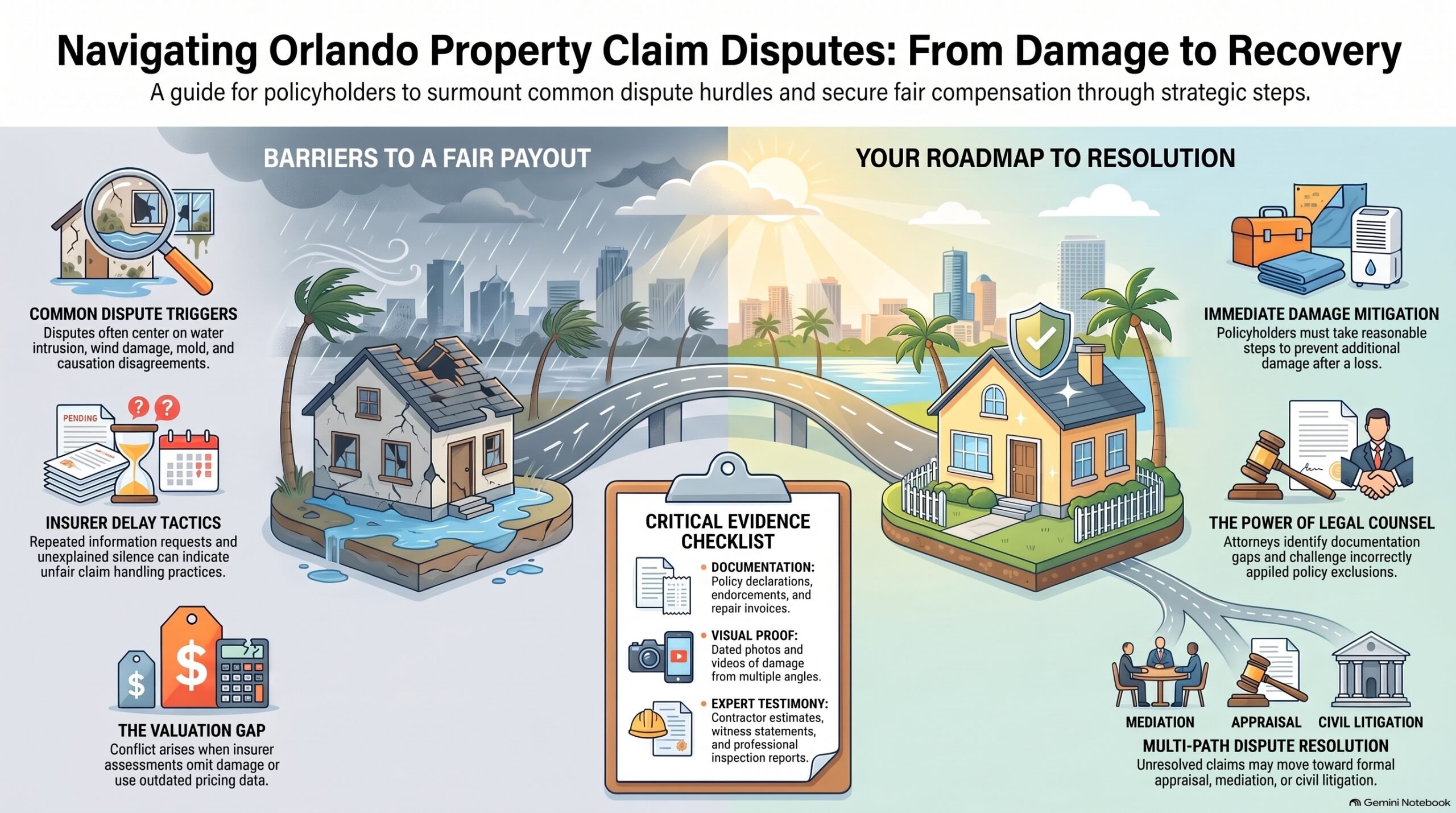
When an Orlando property claim is disputed or delayed, an experienced property insurance attorney can evaluate the policy, investigate the damage, and identify whether the insurer has failed to meet its contractual obligations. Counsel can organize evidence, clarify the requested remedy, and communicate with the carrier on the policyholder’s behalf. This support may help families, businesses, and community organizations pursue fair treatment while preserving resources for recovery.
An attorney can examine liability proof, including photographs, repair estimates, invoices, witness statements, and expert findings. Counsel may also assess adjuster tactics, such as repeated requests for information, inconsistent explanations, or undervaluation of covered damage. Careful review can reveal documentation gaps that require correction before they weaken the claim. Policy analysis may further distinguish legitimate coverage exclusions from provisions the insurer has applied incorrectly or too broadly. When negotiations do not resolve the dispute, counsel can explain available legal remedies and prepare a focused claim presentation based on the policy, evidence, and applicable law.
OUR CONSULTATIONSARE FREE
START YOUR FREE CASE REVIEW

Understanding Orlando Property Claim Disputes & Process Injury Cases
Understanding Orlando property claim disputes and process injury cases requires separating the insurance policy’s coverage terms from the conduct that may have affected the claim. A policyholder’s rights depend on covered property damage, applicable exclusions, deadlines, and the insurer’s obligations during investigation and adjustment.
The Duty to Mitigate generally requires reasonable steps to prevent additional damage after a covered event. Prompt temporary repairs, preservation of evidence, and accurate documentation can support a claim, while unnecessary delay may create questions about resulting losses. Policyholders should also review Pre Notice Requirements, which may require timely notice, specific forms, photographs, estimates, or cooperation with inspections.
Injury cases connected to property claims may involve physical harm, unsafe conditions, or disputes concerning whether an insurer handled related losses properly. Each matter requires careful review of policy language, records, communications, and medical documentation. A qualified attorney can help clarify available remedies, protect important deadlines, and present the claim in a manner that supports fair treatment for affected individuals and families.
Common Causes of Orlando Property Claim Disputes & Process
Common causes of Orlando property claim disputes include disagreements over policy coverage, incomplete or inconsistent claim documentation, and delayed insurer responses. Disputes may also arise when insurers and policyholders reach different conclusions about the value of property damage or the cost of necessary repairs. Understanding these issues can clarify the claims process and identify when legal guidance may be appropriate.
Policy Coverage Disputes
Policy coverage disputes arise when an insurer and policyholder disagree about whether a homeowners, commercial, or other property insurance policy covers the reported loss. Common disagreements involve exclusions, deductibles, policy limits, causation requirements, and interpretations of ambiguous terms. Water intrusion, wind damage, mold, ordinance-related costs, and losses involving gradual deterioration often require careful analysis of the policy’s language and applicable Florida law. Extra coverage options may alter the outcome by extending protection for specific risks, temporary living expenses, equipment breakdown, or other circumstances not included in basic coverage. Disputes may also involve whether a loss falls within a covered peril or an excluded condition. Appraisal clause disputes can arise when the parties disagree about valuation, scope, or the proper use of an appraisal, rather than about the interpretation of the coverage itself.
Claim Documentation Issues
Incomplete or inconsistent claim documentation can create significant disputes during the adjustment process. Missing photographs, unclear repair estimates, incomplete inventories, or conflicting descriptions may make it difficult to establish the property’s condition and the extent of covered damage. Effective evidence collection should begin promptly and include dated photographs, videos, receipts, maintenance records, contractor assessments, and detailed notes concerning when and how the loss occurred. Organized records allow the policyholder and representatives to present a consistent account supported by objective information. Insurer communication should also remain clear, accurate, and documented, including claim forms, requests for information, and responses to adjuster questions. Ambiguous statements or undocumented conversations can create misunderstandings about the loss. Careful documentation helps protect the claimant’s interests while enabling adjusters to evaluate the claim fairly and efficiently.
Delayed Insurer Responses
Delayed insurer responses can prolong the adjustment process and create uncertainty about coverage, repairs, and claim-related expenses. In Orlando property disputes, an insurer may take extended periods to acknowledge a notice, assign an adjuster, request information, or issue a coverage decision. Delays can result from incomplete submissions, internal reviews, staffing limitations, or coordination with outside experts. However, repeated requests for unnecessary materials, unexplained silence, and missed communication commitments may indicate unfair claim handling. Policyholders generally benefit from maintaining a written timeline, preserving correspondence, and requesting clear explanations for outstanding decisions. If the insurer ultimately issues Claim denial letters, the stated reasons should be examined against the policy language and available evidence. Prompt legal guidance can help identify procedural concerns, encourage meaningful responses, and protect the policyholder’s ability to pursue appropriate remedies.
Valuation And Damage Conflicts
How a property loss is valued often becomes a central source of Orlando property claim disputes when the insurer’s assessment differs substantially from the policyholder’s documented repair or replacement costs. Differences may arise from omitted damage, inaccurate measurements, outdated pricing data, or competing interpretations of necessary work. Depreciation disagreements are also common, particularly when an insurer applies deductions that the policyholder believes are excessive or inconsistent with the property’s condition and policy terms. In some matters, policy appraisal disputes develop when the parties cannot agree on the amount of loss, even though coverage is not contested. A careful review of estimates, photographs, invoices, expert opinions, and policy language can clarify the dispute. Legal guidance may help affected property owners secure a fair, well-supported valuation that serves their long-term interests.
Don’t Wait. Call Our Florida Personal Injury Lawyers Now!


Legal Rights of Orlando Property Claim Disputes & Process Injury Victims
When a dispute over an Orlando property claim results in physical injury, the injured individual may have legal rights under Florida premises liability, insurance, and personal injury laws. A careful review can clarify available remedies, responsible parties, and procedural deadlines.
Property owners, insurers, contractors, or other entities may share responsibility when evidence supports their involvement.
- The injured person may seek compensation for medical expenses, lost income, rehabilitation, pain, and diminished quality of life, subject to proof and applicable law.
- The person may obtain claim records, preserve photographs and medical documentation, and challenge inaccurate valuation or liability positions. Legal defenses raised by an opposing party should be evaluated against the available evidence.
- Counsel may assess insurance bad faith, communicate with insurers, and develop settlement strategies that protect the individual’s interests without sacrificing necessary care.
Prompt legal guidance can help preserve claims, support fair treatment, and coordinate informed decisions for those assisting injured community members through a difficult property-related dispute.
Why Do Orlando Property Claim Disputes & Process Injuries Happen?
Orlando property claim disputes and process-related injuries often arise from unclear policy terms, inadequate property maintenance, delayed investigations, or disagreements over the cause and extent of damage. Insurers and policyholders may interpret exclusions, valuation methods, deadlines, or coverage limits differently, creating conflict even when both parties acted in good faith.
Process-related injuries can develop when inspections are rushed, hazardous conditions remain unaddressed, or contractors perform incomplete repairs. Poor communication may lead to missed documentation, inconsistent damage assessments, and unnecessary delays, increasing financial and physical risks. In some matters, Fraudulent practices, including fabricated losses or deceptive claim handling, further complicate legitimate claims and undermine public trust.
Evidence spoliation may also affect disputes when photographs, damaged materials, inspection records, or electronic communications are destroyed, altered, or improperly preserved. Weather events, construction defects, plumbing failures, and negligent maintenance frequently produce competing explanations. These factors can make accountability difficult, particularly when multiple parties share responsibility for the property’s condition or the resulting injury.
Don’t Wait. Call Our Florida Personal Injury Lawyers Now!
What Should You Do After an Orlando Property Claim Disputes & Process Injury?
After a property-related injury, the injured individual should seek immediate medical care, even if symptoms initially appear minor. The incident should be documented through photographs, witness information, medical records, and written communications. Consulting a qualified property lawyer can help protect legal rights and evaluate potential claims.
Seek Immediate Medical Care
Prompt medical evaluation should follow any injury connected to an Orlando property claim dispute, even if the condition initially appears minor. A qualified clinician can identify hidden injuries, provide appropriate care, and explain warning signs requiring prompt attention. Early treatment may reduce complications and support a clearer medical timeline, particularly when symptoms develop gradually. The injured person should accurately describe what happened, report every symptom, and follow discharge instructions. A 911 call log may help establish when emergency assistance was requested, while contact with witnesses can help caregivers or authorized representatives understand the immediate circumstances. Treatment records, prescriptions, referrals, and follow-up notes should be retained in an organized manner. Medical care should remain the priority, and individuals should avoid minimizing symptoms or delaying evaluation for administrative convenience or due to concerns about expenses.
Document the Incident
When an injury occurs in connection with an Orlando property claim dispute, the injured person or an authorized representative should document the incident as soon as reasonably possible. A written Timeline of events should identify the date, time, location, conditions, people present, and actions taken before and after the injury. Photographs or videos may preserve relevant hazards, property damage, lighting, warning signs, and visible injuries, provided they can be obtained safely. Names and contact information for witnesses should also be recorded while memories remain clear. Loss documentation should include medical expenses, repair costs, damaged belongings, transportation expenses, and missed work, supported by receipts or other records. An organized Evidence checklist can help preserve photographs, correspondence, reports, statements, and claim-related notices without altering original materials or discarding potentially relevant evidence.
Consult a Property Lawyer
A property lawyer can evaluate the documented incident, insurance policy, claim correspondence, and available evidence to determine whether the insurer or property owner has failed to meet a legal obligation. The lawyer may review coverage limits, exclusions, deadlines, and proof requirements to clarify the available remedies. If the insurer has rejected or delayed payment, counsel can request records of the claim denial, internal explanations, and supporting documentation. Legal guidance may also help preserve photographs, repair estimates, receipts, witness statements, and expert assessments before evidence becomes unavailable. A lawyer can communicate with the insurer, challenge an inadequate investigation, and pursue negotiation, appraisal, mediation, or litigation when appropriate. Prompt consultation supports informed decisions and may protect a claimant’s rights while helping affected property owners, tenants, or community members seek fair treatment. It also reduces procedural errors in disputed claims.
Critical Evidence in an Orlando Property Claim Dispute & Process Injury Case
Critical evidence can establish the scope of a property loss and support the policyholder’s position during a dispute.
Critical materials include:
- Insurance policy documents and applicable endorsements
- Damage photos, videos, repair estimates, and invoices
- Witness statements, inspection findings, and professional reports
Together, these records help demonstrate coverage, causation, repair costs, and the insurer’s obligations.
Insurance Policy Documents
Insurance policy documents establish the contractual framework governing an Orlando property claim and may determine whether coverage applies, what exclusions limit recovery, and which duties each party must satisfy. A complete policy review should include declarations, endorsements, conditions, exclusions, renewal notices, and applicable amendments. These materials help clarify policy interpretation, including definitions that may change the meaning of damage, loss, or covered property. They also identify coverage obligations involving notice, documentation, mitigation, examinations, and cooperation. An accurate comparison of the policy language with the insurer’s position can reveal whether a denial, limitation, or payment decision aligns with the contract. Because policies may contain layered provisions and strict deadlines, careful organization is vital. Legal professionals can evaluate inconsistencies, explain available rights, and help affected property owners pursue a fair, orderly resolution.
Damage Photos and Videos
Photographs and videos provide contemporaneous evidence of the property’s condition and can support the scope, cause, and extent of an Orlando property claim. Clear images should document each affected area from multiple angles, including surrounding conditions that may explain how damage occurred. Close-ups can capture fine details, while wider views establish the location and relationships among damaged features. Photos taken before cleanup or temporary measures may help preserve an accurate record, provided safety remains the priority. Original files should be retained with available metadata, and evidence preservation should include secure backups that prevent alteration or accidental loss. Video timestamps can help establish when observations were made and may clarify changes over time. A written log identifying dates, locations, conditions, and witnesses can further strengthen the claim’s factual presentation.
Repair Estimates and Invoices
When documenting an Orlando property claim dispute, repair estimates and invoices can establish the anticipated cost, actual expense, and scope of necessary work. These records should identify materials, labor, quantities, dates, taxes, and completed tasks. Detailed documentation helps clarify whether claimed repairs relate to covered damage rather than unrelated maintenance or upgrades. Estimate accuracy issues may arise when pricing is outdated, measurements are incomplete, or required work is omitted. A contractor scope mismatch can also create disputes when an estimate describes fewer repairs than an invoice ultimately charges. Comparing multiple estimates, contracts, change orders, receipts, and payment records may reveal inconsistencies requiring explanation. Organized records can assist claimants, adjusters, and legal professionals in evaluating valuation disputes and presenting a reliable account of repair costs, thereby supporting fair treatment for affected property owners.
Witness Statements and Reports
Witness statements and professional reports can provide crucial evidence in an Orlando property claim dispute by documenting what was observed, when the condition occurred, and how the damage developed. Statements from residents, contractors, neighbors, and emergency personnel may clarify notice, causation, and the property’s condition before and after the loss. Careful report preparation should identify dates, locations, photographs, measurements, repair recommendations, and supporting records without speculation. When disputes proceed, deposition strategies can test whether each witness personally observed the relevant facts and whether later accounts remain consistent. Expert testimony may explain construction defects, water intrusion, storm damage, or necessary remediation in terms decision-makers can evaluate. Counsel also assesses witness credibility by considering knowledge, impartiality, memory, documentation, and potential conflicts. Accurate evidence helps serve affected property owners responsibly.
Long-Term Effects of Orlando Property Claim Disputes & Process Injuries
Long-term Orlando property claim disputes may create ongoing financial strain as unpaid benefits, repair expenses, and related costs accumulate. Prolonged uncertainty can also contribute to emotional and mental stress, particularly when claimants must repeatedly address unresolved insurance issues. Delayed property recovery may extend unsafe or unlivable conditions and interfere with a claimant’s ability to restore normal living arrangements.
Ongoing Financial Strain
Ongoing financial strain often arises when an Orlando property claim remains unresolved or when payment is delayed. Repair costs, temporary housing, damaged belongings, and ongoing mortgage obligations can disrupt household stability and limit funds available for crucial services. A prolonged dispute timeline may force property owners to use credit, postpone necessary repairs, or reduce spending on family and community responsibilities. Careful budgeting for recovery requires tracking every expense, preserving receipts, and distinguishing covered losses from unrelated costs. Adjuster tactics, including repeated requests for information or narrow damage evaluations, may prolong delays and increase administrative burdens. Documentation gaps can further weaken a claim, particularly when invoices, photographs, inspection reports, or communications are incomplete. Legal guidance may help organize evidence, address improper payment positions, and pursue a resolution that supports financial restoration without unnecessary delay.
Emotional and Mental Stress
Financial strain from a delayed Orlando property claim can also produce significant emotional and mental stress. Policyholders may experience anxiety during the claims process, particularly when uncertainty affects household stability, work responsibilities, and family relationships. Prolonged disputes can contribute to sleep difficulties, irritability, reduced concentration, and persistent feelings of helplessness. These effects may become more serious when individuals feel ignored, misunderstood, or unable to interpret policy requirements. Recognizing these concerns allows attorneys, caregivers, and community advocates to respond with patience and practical support. Helpful stress coping strategies may include maintaining organized records, seeking reliable legal guidance, communicating with supportive people, and consulting a qualified mental health professional when symptoms persist. Early attention to emotional well-being can also help affected individuals restore resilience and make informed decisions throughout the claims process, without letting stress control their daily lives.
Delayed Property Recovery
When an Orlando property claim remains unresolved, delayed recovery can extend far beyond the initial damage and interfere with the policyholder’s ability to restore safe, functional living or working conditions. Uncertainty about coverage, inspections, and payment may disrupt the repair timeline, leaving structural, water, fire, or mold-related conditions to worsen. Prolonged delays can also increase restoration costs, displace occupants, interrupt business operations, and create additional health or safety concerns. Policyholders and their advocates should preserve photographs, estimates, invoices, correspondence, and inspection reports while requesting clear explanations for claim denials or adjustment delays. A careful review of the policy, applicable deadlines, and insurer communications may help identify whether the handling process complied with contractual and legal duties. Prompt professional guidance can support practical recovery and protect available remedies.
Proving Liability in Orlando Property Claim Disputes & Process Injury Cases
Proving liability in Orlando property-claim disputes and process-injury cases requires clear evidence linking the property condition, procedural failure, or negligent act to the resulting harm. A claimant may need to establish that the responsible party owed a legal duty, failed to meet that duty, and caused injuries or covered losses as a result of that failure. Causation Proof can include photographs, maintenance records, inspection reports, witness statements, medical documentation, and timelines showing how the incident occurred. Evidence Preservation is equally important because damaged conditions may be repaired, records may be altered, and physical evidence can disappear. Prompt documentation, written notices, and properly secured records help protect the reliability of the claim. In process injury cases, procedural rules, service records, filings, and communication logs may demonstrate whether an avoidable error caused harm. Attorneys serving affected individuals often evaluate comparative fault, applicable deadlines, and governing duties before presenting a claim. Careful preparation supports accurate accountability and fair resolution.
Dealing With Insurance Companies After an Orlando Property Claim Dispute & Process Injury
After liability evidence has been documented, communication with the insurance company can materially affect the outcome of an Orlando property claim dispute or process injury case. A claimant should provide accurate statements, organized records, photographs, repair estimates, medical documentation, and correspondence that directly support the claimed loss. Speculation, inconsistent descriptions, or premature admissions may create avoidable obstacles.
Claim timeline tracking helps establish when notice was provided, requests were answered, inspections occurred, and coverage decisions were issued. Maintaining this record can identify unreasonable delays and preserve important evidence if a dispute develops. Written communication is generally preferable because it creates a verifiable account of each exchange.
When benefits are reduced or denied, Policy denial appeals should address the insurer’s stated reasons with policy language and supporting documentation. An attorney may review exclusions, valuation methods, deadlines, and required notices while communicating with adjusters on the claimant’s behalf. Professional, measured correspondence can protect the claimant’s interests and support a fair resolution without unnecessary confrontation or confusion.
What to Expect During an Orlando Property Claim Dispute & Process Injury Claim Process
The property claim process generally begins with filing a timely claim and documenting all damage, repair costs, and related losses. Policyholders can expect to discuss matters with insurance adjusters, who evaluate coverage and may negotiate proposed payments. When the insurer disputes liability or offers insufficient compensation, the matter may require further negotiation or formal resolution procedures.
Filing Your Property Claim
When a property owner reports damage in Orlando, the claim process generally begins with prompt notice to the insurer and careful documentation of the loss. The policyholder should review coverage terms, identify the claim deadline, and submit required forms through the insurer’s designated channel. Confirmation of receipt can help establish when the dispute timeline begins and clarify the insurer’s expected response dates. An assigned adjuster may request adjuster interviews with the owner, occupants, contractors, or other witnesses. The owner should answer accurately, avoid speculation, and keep communications organized. During this stage, evidence preservation remains important, including maintaining relevant records and, when reasonably possible, protecting damaged areas from further harm. If the insurer delays, limits, or denies coverage, a qualified attorney may evaluate policy language, procedural compliance, and available remedies.
Documenting Damage and Losses
Accurate documentation gives an Orlando property claim a reliable factual foundation and helps distinguish covered damage from preexisting conditions or unrelated repairs. Policyholders should photograph and record each affected area before discarding materials or beginning permanent repairs. Images should show wide views, close details, dates, and identifying features, while videos may capture water intrusion, structural movement, or damaged personal property. A written inventory should describe each item, its approximate age, purchase information, condition, and, when available, replacement cost. Receipts, contractor estimates, inspection reports, maintenance records, and invoices for temporary housing or emergency services can further support the claimed losses. Records of mitigation strategies, including drying, boarding, or securing property, demonstrate reasonable efforts to prevent additional damage. Organized files improve settlement readiness and preserve evidence for review.
Negotiating With Insurance Adjusters
During negotiations, an Orlando property claim policyholder can expect an adjuster to review the reported cause of loss, inspect the damage, request supporting records, and evaluate whether the policy provides coverage. The policyholder should maintain professional communication with the adjuster, answer factual questions accurately, and avoid speculation about conditions or repair costs. Effective negotiation tactics include organizing a clear timeline, separating covered damage from unrelated conditions, and presenting qualified estimates with photographs, invoices, and inventories. A focused documentation strategy helps demonstrate the scope and value of the claimed loss while reducing misunderstandings. Policy language, deadlines, exclusions, and proof-of-loss requirements should be reviewed carefully before making statements or accepting proposed terms. Consistent records and informed responses may strengthen settlement leverage, allowing the policyholder to advocate responsibly for a fair evaluation without unnecessarily escalating the disagreement.
Resolving Disputed Claim Payments
If negotiations do not result in a satisfactory payment, the policyholder may need to pursue the dispute through a structured claim-resolution process. This may involve submitting a formal appeal and providing estimates, photographs, receipts, expert opinions, and documentation of the property’s condition and losses. The policyholder should review the policy carefully, identify applicable exclusions, and request a written explanation of the insurer’s position. Understanding the reasons for coverage denial can clarify whether the disagreement involves causation, valuation, late notice, exclusions, or insufficient proof. If the insurer fails to investigate fairly, delays payment without justification, or misrepresents policy terms, the conduct may support an allegation of insurer bad faith. Mediation can sometimes resolve the matter efficiently. When those efforts fail, counsel may evaluate appraisal, litigation, or regulatory complaints while protecting the policyholder’s deadlines.
Compensation for Orlando Property Claim Disputes & Process Injury Damages
Compensation in Orlando property claim disputes may include payment for covered structural damage, personal belongings, additional living expenses, and related financial losses. The available recovery depends on the policy language, the cause of loss, the documentation, and the extent of the insurer’s responsibility. A careful evaluation can identify unpaid repairs, underpaid contents, delayed living-cost reimbursements, and other amounts supported by the claim file.
Claimants generally benefit from preserving photographs, receipts, repair estimates, inventories, correspondence, and records showing when notice was provided. These materials may help establish the scope of damage and clarify whether policy conditions were satisfied. Counsel can review exclusions, coverage limits, deductibles, proof-of-loss requirements, and the insurer’s stated reasons for reducing or denying payment.
The settlement timeline may vary according to inspections, document exchanges, expert opinions, and negotiations. A focused negotiation strategy can present organized evidence, address disputed valuation, and seek payment without unnecessary delay. If discussions fail, available legal remedies may include appraisal, mediation, or litigation, depending on the policy and circumstances. Prompt guidance can help protect deadlines and preserve a fair opportunity for resolution.
Economic vs Non-Economic Damages in Orlando Property Claim Disputes & Process Cases
Economic damages may include repair expenses, replacement costs, temporary housing, lost rental income, and other measurable financial losses. Non-economic losses can involve inconvenience, disruption, and diminished use or enjoyment of the property, depending on the claim and applicable law. Calculating property claim damages requires reliable documentation, policy analysis, and a careful assessment of both immediate and continuing losses.
Economic Damage Categories
In Orlando property claim disputes, economic damages generally refer to measurable financial losses resulting from covered property damage or an insurer’s failure to properly handle a valid claim. Common categories include reasonable repair or rebuilding costs, damaged personal property, debris removal, and expenses for temporary protection. Businesses may also seek business interruption losses, including lost income and continuing operating expenses supported by financial records. Additional recoverable amounts may include temporary housing, storage, transportation, and relocation expenses when the premises cannot be safely or practically occupied. Documentation is critical. Claimants should preserve invoices, receipts, estimates, payroll records, sales reports, and other evidence connecting each expense to the covered event. Careful evaluation helps ensure that individuals, families, and organizations receive funds needed to restore property, maintain operations, and serve affected communities.
Non-Economic Losses
Although property insurance claims primarily involve measurable financial harm, certain losses may extend beyond repair invoices and other documented expenses. Non-economic losses can include disruption of daily routines, loss of comfort, diminished use of a home, and significant stress caused by displacement or prolonged uncertainty. Unlike economic damages, these effects may not have a standardized monetary value and are not automatically covered under every property policy. Coverage depends on policy language, applicable law, and the connection between the claimed hardship and an insured event. Careful documentation, including records of relocation, interrupted household activities, and communications with the insurer, can help clarify the circumstances. Policyholders should also pursue reasonable loss-mitigation strategies and observe claim-filing deadlines, because procedural failures may limit consideration of otherwise legitimate non-economic impacts.
Calculating Property Claim Damages
Analyzing property-damage claims requires separating documented economic losses from non-economic effects that may be harder to value. Economic damages may include repair invoices, replacement costs, temporary housing, storage, debris removal, lost rental income, and professional inspection expenses. Accurate calculations should account for depreciation, policy limits, deductibles, and any applicable ordinance or code-upgrade coverage. Non-economic damages can include disruption, inconvenience, loss of use, and stress arising from unsafe or uninhabitable conditions. Although these effects may not have fixed receipts, contemporaneous records, photographs, communications, and witness statements can support a reasonable valuation. Evidence preservation steps should begin promptly and continue throughout the claim. Tracking insurance claim timelines helps identify delays, missed deadlines, and inconsistent assessments. A careful damages analysis enables fair negotiations and informed decisions serving affected property owners.
Don’t Wait. Call Our Florida Personal Injury Lawyers Now!
When an Orlando Property Claim Dispute & Process Injury Case Goes to Trial vs. Settlement
Whether an Orlando property claim dispute proceeds to trial or resolves through settlement depends on the strength of the evidence, the extent of the alleged damages, the applicable insurance policy language, and each party’s willingness to accept risk. A settlement may provide a faster, more predictable resolution, allowing property owners and insurers to avoid litigation expense, delay, and uncertainty. Counsel may evaluate repair records, photographs, expert opinions, correspondence, and claim-handling conduct before developing a negotiation strategy that supports a fair outcome.
Trial becomes more likely when the parties disagree about coverage, causation, valuation, or the credibility of important evidence. In that setting, jury trial prep may include organizing exhibits, preparing witnesses, consulting qualified experts, and presenting a clear account of the property’s condition and losses. A trial places the outcome in the hands of the court or jury and may produce a favorable judgment, but it also entails procedural demands and uncertain results. In either path, careful preparation helps protect the interests of those seeking a responsible resolution and ensures that decision-makers receive accurate, relevant information.
Florida Laws That May Affect Your Orlando Property Claim Disputes & Process Case
Florida law establishes the framework governing Orlando property claim disputes, including policy interpretation, notice requirements, claim investigations, damage valuation, and litigation deadlines.
Understanding these rules helps policyholders, advocates, and professionals serve affected property owners responsibly.
- Florida consumer protections may require insurers to communicate clearly, investigate claims fairly, and explain coverage decisions. Policy language, exclusions, endorsements, and proof-of-loss requirements can materially affect the dispute.
- Claims handling timelines establish expectations for acknowledgments, communications, investigations, and payment or denial decisions. Delays, inadequate explanations, or inconsistent requests for information may support concerns about improper handling.
- Florida regulations also address adjuster conduct, appraisal procedures, mediation opportunities, and remedies available when an insurer fails to meet legal or contractual duties. Accurate records, photographs, estimates, correspondence, and inspection reports can strengthen a claim’s presentation.
Because coverage disputes depend on specific facts and policy terms, a qualified legal review can clarify available options, promote fair resolution, and help protect property owners’ interests during negotiations or litigation.
The Statute of Limitations for Orlando Property Claim Disputes & Process Injury Cases
The statute of limitations determines whether an Orlando property dispute may proceed in court, making timely legal review essential. Florida deadlines vary depending on the nature of the claim, the insurance policy, and when the damage or injury was discovered. A missed deadline can bar recovery even when losses appear well documented. Property owners and injured individuals should identify the applicable filing period promptly rather than relying on ongoing negotiations or unanswered correspondence.
A detailed claim timeline can clarify the date of loss, notice to the insurer, inspections, payments, denials, and any later developments affecting accrual. Evidence preservation should begin immediately, including photographs, repair records, medical documentation, policy materials, and relevant electronic communications. Witness interviews may also be important because memories can fade and contact information may change. Careful communication with insurers is necessary, since statements, requests, and acknowledgments may affect the record without necessarily extending a statutory deadline. Early attention to these issues helps protect legal options and supports fair treatment of policyholders and affected community members.
How an Orlando Property Claim Disputes & Process Lawyer Can Help You
An Orlando property claim disputes and process lawyer can evaluate the policy, investigate the damage, and determine whether an insurer has handled the claim in accordance with its contractual and legal obligations.
The lawyer can organize the matter so the policyholder, family, or community organization understands available coverage and procedural requirements.
- Counsel can review exclusions, deadlines, endorsements, estimates, and correspondence to identify coverage issues and calculate supportable losses.
- Counsel can provide evidence-preservation tips, including documenting the condition, securing repair records, retaining damaged materials when practical, and maintaining a clear communications file.
- Counsel can address insurer negotiation tactics by presenting organized proof, challenging unsupported positions, and seeking a reasoned adjustment consistent with the policy.
A lawyer may also coordinate qualified contractors, engineers, accountants, and other professionals when specialized assessments are necessary. Through careful preparation and direct communication, counsel helps protect resources intended for restoration and service. This assistance promotes accountability while allowing the policyholder to make informed decisions throughout the claim process.
When to Contact an Orlando Property Claim Disputes & Process Lawyer
When an insurer delays, underpays, denies, or otherwise mishandles a property claim, prompt consultation with an Orlando property claim disputes and process lawyer may help preserve evidence and protect available rights. Early guidance can be particularly important after a fire, storm, water intrusion, or other covered event, when conditions may change quickly, and repair decisions become urgent.
A pre-claim investigation may help identify policy requirements, potential coverage issues, and the documentation needed before submitting a demand. Counsel can also advise on evidence preservation, including photographs, videos, receipts, repair estimates, inspection reports, and damaged materials. Early involvement may improve adjuster communication by keeping statements accurate, organized, and consistent with the claim record.
Contact may also be appropriate when an insurer requests examinations, proposes a questionable valuation, or issues a reservation of rights. A lawyer can assess available information and develop a settlement negotiation strategy suited to the documented loss, while helping the policyholder meet applicable notice and cooperation obligations.
Why You Need an Experienced Orlando Property Claim Disputes & Process Lawyer
Experience matters because property claim disputes often depend on policy language, coverage exclusions, valuation methods, and compliance with detailed claim procedures. An experienced Orlando property claims and disputes lawyer can interpret these requirements while protecting a policyholder’s interests throughout the claim process. The lawyer can identify missing documentation, challenge unsupported denials, and present damages in a manner grounded in reliable records and applicable coverage terms.
Professional guidance also supports the preservation of evidence before damaged property is repaired, discarded, or altered. Photographs, invoices, inspection reports, communications, and expert opinions may become critical when the insurer disputes causation or the amount owed. Counsel can recognize bad faith tactics, including unreasonable delays, inadequate investigations, or shifting explanations, and respond through appropriate legal channels.
For individuals seeking to serve families, businesses, or community organizations responsibly, informed representation helps prevent avoidable mistakes and promotes fair treatment. An experienced lawyer can organize the process, communicate clearly with insurers, and pursue remedies when contractual obligations are not honored. This assistance allows claimants to focus on recovery while their rights receive careful, capable protection.
How to Choose the Right Orlando Property Claim Disputes & Process Lawyer for Your Case
Selecting the right Orlando property claim disputes and process lawyer requires careful consideration of the attorney’s experience, communication practices, and familiarity with Florida insurance law. A suitable lawyer should understand how insurers evaluate covered losses, investigate damage, and apply policy provisions. Experience with similar residential or commercial claims can help counsel identify procedural issues and develop a focused strategy.
Client communication should be consistent, accessible, and sufficiently detailed to keep the policyholder informed about evidence, deadlines, negotiations, and possible outcomes. During an initial consultation, the client can ask who will handle the matter, how updates are delivered, and how quickly questions receive responses. Fee transparency is equally important. The lawyer should explain billing arrangements, potential costs, and whether fees depend on recovery, preferably in a written agreement.
The policyholder should also assess professional judgment, organizational ability, and willingness to provide realistic guidance. Comparing qualifications and asking precise questions allows individuals to select representation that serves their interests responsibly throughout the claim process.
About The Law Offices of Anidjar & Levine
The Law Offices of Anidjar & Levine represents policyholders in Orlando property claim disputes involving residential and commercial insurance losses.
The firm assists clients seeking fair treatment after hurricanes, fires, water damage, roof failures, and other covered events.
Its approach emphasizes careful review of policy language, evidence, communications, and insurer decisions.
What to expect may include an initial attorney consultation addressing the loss, coverage concerns, available records, and immediate steps to protect the property.
Counsel can explain the Florida claim timeline, including notice requirements, adjustment activity, settlement discussions, and potential litigation deadlines.
This guidance helps policyholders make informed decisions while serving families, businesses, and communities affected by property damage.
Frequently Asked Questions
Can I Change Attorneys During an Ongoing Orlando Property Claim Dispute?
Yes, a policyholder can change attorneys during an ongoing property claim dispute, although the handoff should be managed carefully. Switching representation may require written notice to current counsel, review of fee agreements, and court approval if litigation has already begun. The new attorney should promptly obtain the complete file, deadlines, expert reports, and insurer communications. Maintaining case continuity is critical, so the policyholder should avoid gaps in communication, preserve evidence, and confirm responsibility for upcoming hearings or filings.
Will My Property Claim Lawyer Communicate Directly With Contractors and Adjusters?
A property claim lawyer may communicate directly with contractors and adjusters when that involvement advances the client’s interests. Counsel can clarify coverage, document damage, review estimates, and address disputed findings during the insurer settlement process. The lawyer may also manage communications with contractors, helping to prevent inconsistent statements or unauthorized repairs. However, the client generally approves major decisions, including selecting contractors, accepting settlements, and authorizing litigation or other formal proceedings.
Are Attorney Fees Recoverable in Orlando Property Insurance Disputes?
Attorney fees may be recoverable in Orlando property insurance disputes, but eligibility depends on Florida law, the policy, litigation outcome, and compliance with required procedures. A policyholder should review whether the insurer wrongfully denied, delayed, or underpaid the insurance claim. Many attorneys work under a contingent fee arrangement, receiving payment only if recovery occurs, while costs and statutory requirements may vary. Qualified counsel can evaluate coverage, documentation, and potential fee recovery.
Can Policy Appraisal Resolve Disagreements About the Amount of Property Damage?
Yes, policy appraisal can resolve disagreements about the amount of covered property damage by allowing impartial appraisers to evaluate the loss and, if necessary, appoint an umpire. However, policy appraisal limitations are significant: the process generally addresses valuation, not coverage, causation, exclusions, policy interpretation, or claim-handling misconduct. Each party should provide an independent assessment supported by photographs, estimates, invoices, and other records. Legal guidance may help protect policyholder rights throughout the process.
What Happens if My Insurer Becomes Insolvent During My Property Claim?
If an insurer becomes insolvent during a property claim, the policyholder may face delayed payments, a change in administration, or a claim denial due to an incomplete review. State coverage guaranty associations may protect eligible claims, subject to statutory limits, deadlines, and policy exclusions. Insolvency effects vary by jurisdiction and claim type. Policyholder rights may include filing with the guaranty association, preserving documentation, and pursuing available legal remedies against responsible parties.
—————————
Orlando property claim disputes and process-related injuries can create serious financial, physical, and legal challenges.
Victims may encounter denied benefits, delayed payments, unsafe conditions, or disputes over responsibility and damages.
An experienced Orlando property claims and disputes lawyer can assess the circumstances, help protect your rights, communicate with insurers, and pursue appropriate compensation.
The Law Offices of Anidjar and Levine offer personalized legal guidance, helping clients make informed decisions throughout the claims process.
Learn more from an Orlando Personal Injury Lawyer.

