

The Law Offices of Anidjar and Levine help protect claimants when insurers dispute coverage, delay payment, or undervalue losses involving vessel damage, injury, theft, storm damage, collisions, or fire. A Fort Walton Beach Personal Injury Lawyer can organize records, preserve evidence, address policy exclusions, and present clear proof of liability and damages. Careful guidance also helps claimants avoid harmful statements to adjusters and missed deadlines. The sections below explain how these claims are evaluated, challenged, and pursued effectively.
Main Takeaways
- A Fort Walton Beach boat and marine property claim lawyer helps with denied, delayed, or undervalued insurance and liability claims.
- Legal help can preserve key evidence, including photos, repair estimates, maintenance records, witness statements, and insurer communications.
- Claims may involve hurricane damage, collisions, wake damage, theft, vandalism, fire, or mechanical failure affecting boats, docks, lifts, and gear.
- A lawyer evaluates liability, policy coverage, comparative fault, and damages for injuries, property loss, lost income, and pain and suffering.
- After a boating incident, early action matters to protect medical proof, repair documentation, salvage issues, and accurate insurance reporting.
How We Can Help With Your Fort Walton Beach Boat & Marine Property Claim Injury Claim
When a boat or marine property claim is disputed, delayed, or undervalued, experienced legal counsel can play a pivotal role in protecting the claimant’s interests. In Fort Walton Beach matters, counsel helps organize records, clarify losses, and present a disciplined claim strategy centered on fairness, accountability, and service to affected families. Attorneys often address Insurance claim denials by identifying policy obligations, correcting incomplete submissions, and responding to insurer requests with accurate, timely support. They also monitor evidence preservation timelines, helping secure photographs, repair estimates, maintenance records, and communications before key proof is lost or challenged. When witness credibility issues arise, counsel carefully evaluates statements, reconciles inconsistencies, and prepares reliable accounts that strengthen the claim presentation. Legal teams also review gaps in medical documentation, coordinate supporting records, and explain how incomplete treatment histories may affect valuation. Through careful preparation and principled advocacy, they help claimants pursue proper compensation while reducing avoidable delays, confusion, and unnecessary dispute throughout the process.
Understanding Fort Walton Beach Boat & Marine Property Claim Injury Cases
Often, Fort Walton Beach boat and marine property claim injury cases involve both physical harm and significant property loss, requiring a careful review of how the incident occurred and which insurance or liability issues govern recovery.


These matters commonly require analysis of medical records, repair estimates, vessel valuations, policy language, and witness accounts. A thorough evaluation helps determine whether losses are covered, how fault may affect compensation, and what duties each party owes after the event. In some claims, insurers raise boat insurance defenses based on exclusions, maintenance concerns, or alleged misstatements in an application. Other cases become more complex when damaged vessels are recovered or removed, creating salvage-rights disputes over ownership, reimbursement, and control of property. Careful documentation, prompt notice, and organized communication often strengthen a damages claim. For individuals focused on helping their families and communities recover, understanding these issues can promote fair outcomes and responsible resolution after a marine loss.
Common Causes of Fort Walton Beach Boat & Marine Property Claims
OUR CONSULTATIONSARE FREE
START YOUR FREE CASE REVIEW

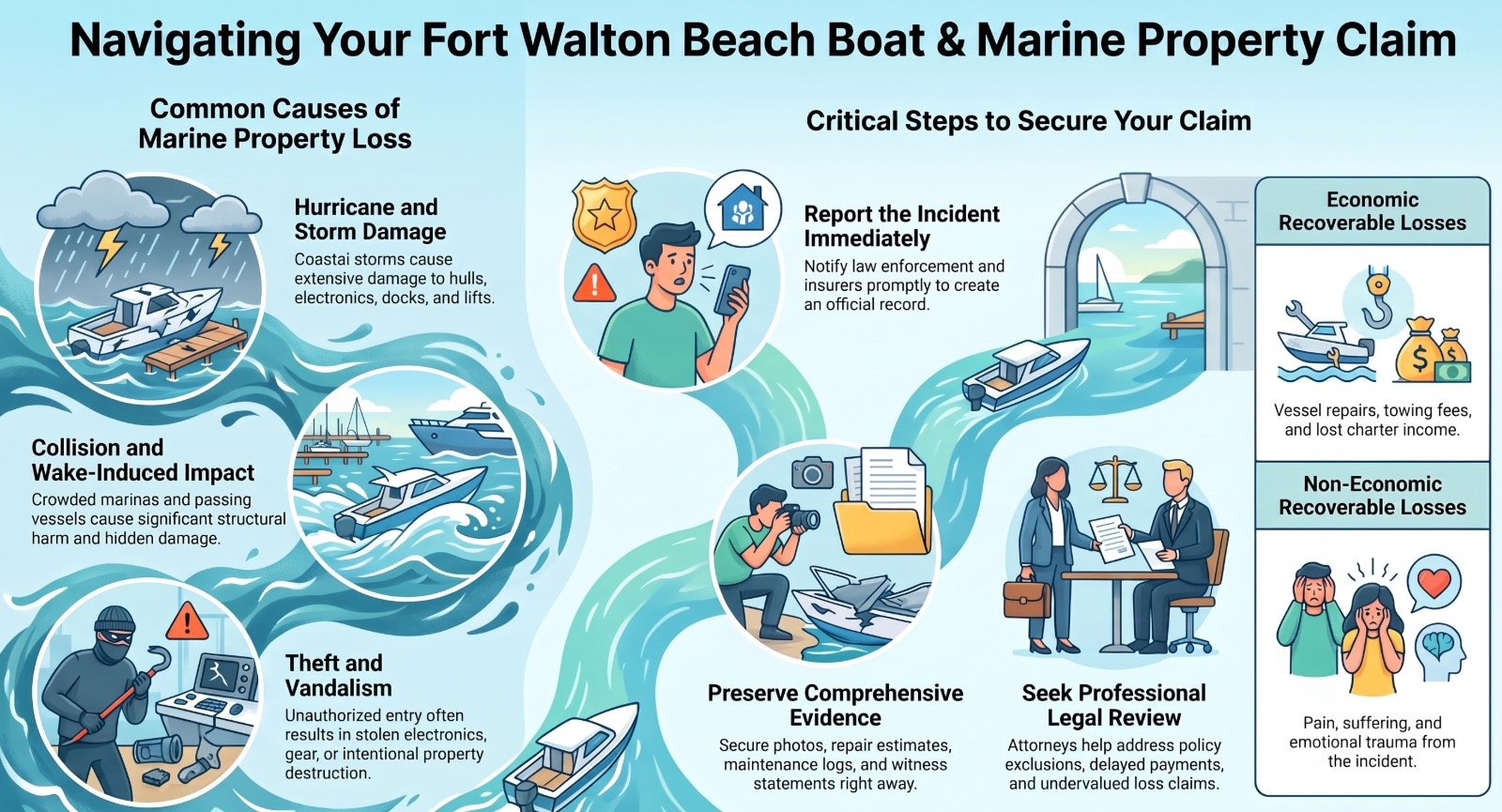
Fort Walton Beach boat and marine property claims often stem from recurring sources of loss that can significantly affect vessels and related equipment. Common causes include hurricane and storm damage, collision and impact losses, theft and vandalism, and fire and mechanical failures that can cause extensive property damage. Understanding these events helps clarify how insurers evaluate, document, and pursue claims.
Hurricane And Storm Damage
Because coastal weather systems can intensify rapidly along the Emerald Coast, hurricane and storm damage remains one of the most common causes of boat and marine property insurance claims in Fort Walton Beach. High winds, storm surge, heavy rainfall, and floating debris can compromise hulls, electronics, docks, lifts, and stored equipment, often producing extensive water damage and costly interruptions for owners and families who depend on safe marine access.


Effective weather preparedness may reduce losses, yet even diligent precautions cannot prevent every emergency. In many cases, policyholders must document conditions, protect remaining property, and pursue benefits available under storm insurance provisions. Claims may involve marina structures, personal watercraft, trailers, or onboard systems requiring immediate inspection and hurricane repairs. Careful claim handling helps affected individuals restore property and continue serving their households and communities.
Collision And Impact Losses
Beyond severe weather events, collision and impact losses represent another frequent basis for boat and marine property claims in Fort Walton Beach. These incidents often arise in crowded marinas, narrow channels, and busy launch areas where limited visibility, operator inattention, or shifting currents increase risk. A Dockside Collision may damage hulls, rails, propellers, or pilings, while contact with submerged objects can produce hidden structural harm that worsens over time.
Wake-induced damage also commonly supports claims when passing vessels create forceful waves that slam boats against docks, lifts, or neighboring watercraft. To support affected owners and families, careful documentation of impact points, repair estimates, and witness observations often helps establish the extent of loss. Accurate evaluation promotes fair recovery and supports responsible stewardship of valuable marine property.
Theft And Vandalism
While many marine losses involve weather or impact, theft and vandalism remain common sources of boat and marine property claims in Fort Walton Beach. Marinas, storage yards, and private docks may expose vessels to unauthorized entry, equipment removal, and intentional destruction. Vessel Theft can involve the entire boat, an attached trailer, or valuable electronics and gear.
Vandalism claims often arise from cut lines, broken windows, damaged upholstery, or Marine Graffiti Damage that affects appearance and value. These losses may interrupt planned work, recreation, or community service activities that depend on reliable marine transportation. Careful documentation, prompt reporting, and clear policy review often shape the outcome of a claim. When disputes arise over valuation, exclusions, or proof of loss, informed legal guidance can help protect the claimant’s interests and recovery.
Fire And Mechanical Failures
When fire or mechanical failure occurs aboard a vessel, the resulting damage can escalate quickly and produce complex insurance issues. Marine fires may begin from fuel leaks, faulty wiring, overheating engines, or neglected electrical systems, while mechanical failures often involve propulsion components, guidance assemblies, or cooling equipment. These events can endanger passengers, interrupt service, and create substantial repair costs.
Claims frequently turn on whether the owner followed reasonable care standards before the loss. Insurers may review maintenance records, prior repairs, equipment safety checks, and storage conditions to determine cause and coverage. In many cases, maintenance compliance planning helps demonstrate diligence and supports a stronger claim position. A careful legal assessment can help affected parties document losses, address exclusions, and pursue fair compensation for vessel damage and related property harm.
Legal Rights of Fort Walton Beach Boat & Marine Property Claim Injury Victims
Although marine accidents can involve complex questions of liability and insurance, injured boat owners, passengers, and other affected parties in Fort Walton Beach generally have the right to pursue compensation for medical expenses, lost income, property damage, pain and suffering, and other related losses caused by another party’s negligence or wrongful conduct.
These rights often include access to evidence, insurance information, and legal remedies that support accountability and community well-being. Responsible practices such as Boat maintenance, incident prevention, emergency response, and safety compliance may also inform how claims are evaluated and resolved fairly.
Access to evidence, insurance information, and legal remedies helps promote accountability, while safety-focused practices can shape fair claim outcomes.
- Recovery may include economic and non-economic damages.
- Victims may assert claims against negligent operators, owners, or companies.
- Timely documentation can protect both legal rights and public safety.
- Fair compensation can ease burdens on families and caregivers.
Why Do Fort Walton Beach Boat & Marine Property Claim Injuries Happen?
Because boating injuries and related marine property losses in Fort Walton Beach often result from preventable conditions, many claims arise from operator inattention, excessive speed, impaired boating, hazardous weather, equipment failure, or poor vessel maintenance. Crowded waterways, limited visibility, and unfamiliar channels also increase the likelihood of collisions, groundings, and serious onboard injuries for passengers and crew.
Claims can also arise when owners or operators overlook routine safety inspections, ignore manufacturer guidance, or continue using damaged equipment. In many matters, maintenance neglect contributes to steering problems, engine fires, fuel leaks, or trailer failures during transport. Rental vessels may present added risk when instructions are incomplete or emergency gear is missing. Commercial operators, tour providers, and private boaters each owe responsibilities that protect others using local waters. When those responsibilities are not met, preventable harm can affect families, visitors, and workers, while also causing substantial damage to nearby boats, docks, cargo, and other valuable marine property.
What Should You Do After a Fort Walton Beach Boat & Marine Property Claim Injury?
After a Fort Walton Beach boat or marine property claim injury, prompt medical attention is generally the first priority, both to protect health and to document the extent of the harm. You should also report the incident to the appropriate marine, law enforcement, or insurance authorities, as timely notice can affect both safety findings and claim handling. In addition, preserving photographs, witness information, repair estimates, medical records, and other related documentation can materially strengthen a claim’s evidentiary foundation.
Seek Immediate Medical Care
Prompt medical evaluation is often important following a boat or marine property injury, even when symptoms appear minor at first. Emergency room treatment can identify hidden trauma, reduce complications, and create records that support ongoing care needs. Medical providers also help Document injuries through examinations, imaging, and treatment notes, which may later clarify the extent and timing of harm.
Individuals should follow professional recommendations, attend follow-up appointments, and preserve discharge instructions, prescriptions, and receipts. Respect for Privacy and consent remains necessary when sharing health information with family members, caregivers, or legal representatives. Accurate medical records may also help when completing Insurance forms related to marine property claims. Seeking timely care reflects prudent judgment, supports personal well-being, and strengthens the foundation for informed decision-making after an incident.
Report The Marine Incident
When a boating or marine property incident causes injury, reporting it promptly to the appropriate authority is often a necessary next step. In Fort Walton Beach, this may involve notifying law enforcement, the Coast Guard, marina management, or an insurer, depending on where and how the event occurred. Prompt reporting helps create an official record and supports accountability for everyone involved.
Start by documenting accurate facts about the time, location, conditions, and vessels or equipment involved. Collecting witness information can also help authorities review what happened. Preserving relevant evidence and obtaining repair estimates may be appropriate considerations during the reporting process, especially when property damage is apparent. Clear, respectful communication helps protect injured individuals while also supporting a thorough response that serves others and the broader community.
Preserve Evidence And Records
Because physical evidence and contemporaneous records can strongly influence a boat or marine property injury claim, begin careful preservation as soon as conditions are safe. Those assisting should File incident log entries with dates, times, weather conditions, vessel movements, and visible injuries. They should photograph damage details, equipment placement, identifying numbers, and surrounding water or dock conditions from multiple angles.
Organize and retain witness names, contact information, repair estimates, medical records, towing invoices, and communications with insurers. Damaged gear, clothing, ropes, and electronic data should remain unaltered whenever possible, since later changes may invite disputes. If surveillance footage or marina records exist, prompt requests can help prevent loss. Thorough preservation supports accountability, protects those harmed, and equips advocates to pursue fair recovery for injured individuals and families.
Critical Evidence in a Fort Walton Beach Boat & Marine Property Claim Injury Case
In a Fort Walton Beach boat and marine property claim injury case, the strength of the claim often depends on whether essential evidence is preserved promptly and presented clearly.
Critical materials commonly include the following:
- Accident scene documentation
- Vessel damage records
- Witness statements
- Medical and repair reports
Each category can help establish how the incident occurred, the extent of the losses, and whether the supporting facts can withstand insurer scrutiny or litigation.
Accident Scene Documentation
At the scene of a boating or marine property accident, careful documentation often becomes the foundation of a strong injury claim. Timely photographs, video, witness names, exact location details, water conditions, and visible hazards can help preserve facts before conditions change. For individuals committed to protecting others, prompt note-taking may also support safer future practices across local waterways.
Accident scene documentation may include timestamps, emergency response information, communications with operators, and observations about lighting, signage, or dock conditions. Relevant background materials, such as maintenance logs and weatherproofing tips kept with vessel records, can sometimes provide context without replacing scene-based evidence. When gathered methodically, this information can help legal counsel, insurers, and investigators evaluate responsibility, causation, and the full circumstances surrounding reported injuries and subsequent recovery needs.
Vessel Damage Records
When a vessel sustains visible or structural damage, the resulting repair estimates, survey reports, maintenance histories, and photographs may serve as crucial evidence in a Fort Walton Beach boat and marine property claim involving personal injury. These records can help establish impact severity, mechanical failure, and whether prior defects contributed to the event. They may also clarify if neglected upkeep affected navigation safety or increased the risk of harm to passengers and crew.
Detailed vessel damage records often include haul-out inspections, engine assessments, hull measurements, and electronic data tied to incident logs. In a service-minded community, preserving these materials may support fair accountability and help injured individuals pursue resources needed for recovery. Organized documentation can also help legal counsel, insurers, and marine experts evaluate causation, damages, and the vessel’s condition before and after the incident.
Witness Statements
Beyond repair logs and survey findings, witness statements can provide a direct account of how a boating incident unfolded and how the resulting injuries occurred. Passengers, nearby boaters, marina staff, and first responders may describe weather conditions, vessel speed, operator conduct, visibility, warnings given, and actions taken after impact. Their observations can help establish the sequence, fault, and circumstances surrounding the harm.
In a Fort Walton Beach boat and marine property claim, Witness credibility often shapes the value of such evidence. Consistent narratives, prompt reporting, and neutral perspectives tend to strengthen reliability. Attorneys frequently review recorded statements carefully to identify omissions, contradictions, or outside influence. When preserved early, these accounts can clarify events and help those seeking accountability for injured individuals and affected families.
Medical And Repair Reports
How injuries and property damage are documented often determines the strength of a Fort Walton Beach boat and marine property claim. Medical records can connect an incident to physical harm through treatment documentation, physician notes, and Diagnostic imaging that confirms the nature and extent of injury. Consistent reporting also helps show whether symptoms persisted, improved, or required additional care over time.
Repair records serve a similar purpose for damaged vessels and equipment. Detailed repair estimates, photographs, and marine invoices can establish the boat’s condition, the cost of restoring it, and whether hidden damage was later discovered. When these reports are thorough and timely, they help insurers, courts, and legal counsel evaluate losses fairly, protect resources responsibly, and support outcomes that better serve injured individuals, families, and the broader community.
Long-Term Effects of Fort Walton Beach Boat & Marine Property Claim Injuries
Long-term injuries in Fort Walton Beach boat and marine property claim cases often extend well beyond the initial incident, affecting physical health, emotional stability, and financial security. Many injured individuals face chronic pain challenges and emotional trauma that interfere with daily activities, employment, and overall quality of life. These ongoing consequences often create lasting financial strain, especially when medical costs, reduced earning capacity, and ongoing care needs accumulate over time.
Chronic Pain Challenges
A persistent pain condition is one of the most difficult consequences of a serious boating or marine property injury, because it can continue well after the visible damage appears to have mended. Chronic pain may limit lifting, walking, sleep, and consistent employment, reducing a person’s ability to care for family members and contribute to the community. In these cases, careful evaluation often includes Pain management options such as medication oversight, physical therapy, injections, and structured rehabilitation plans. Effective documentation strategies are also necessary, including treatment records, physician observations, pain journals, and work restriction notes. Thorough records help demonstrate how symptoms affect daily function over time. For those assisting injured individuals, understanding these ongoing limitations supports more accurate claim presentation and encourages practical planning for long-term medical needs and household responsibilities ahead.
Emotional Trauma Impact
While physical injuries often receive immediate attention, emotional trauma can become an equally serious consequence of a boating or marine property incident in Fort Walton Beach. Survivors may experience Boat stress, persistent fear around water, and post incident anxiety that affects relationships, concentration, and daily routines. In many cases, sleep disruption develops as the mind replays the event, weakening patience, judgment, and the ability to assist others consistently. Emotional symptoms may remain hidden, yet they can interfere with treatment progress and overall well being long after visible wounds improve. Careful documentation, compassionate support, and timely mental health evaluation often play an important role in emotional recovery. When these effects are recognized early, injured individuals are better positioned to regain stability, restore confidence, and continue serving their families and communities well.
Lasting Financial Strain
Because serious boating and marine property injuries can interrupt employment, require ongoing medical care, and reduce a person’s ability to manage routine obligations, the financial consequences often extend far beyond the initial incident in Fort Walton Beach. Families may face reduced income, rising rehabilitation costs, transportation expenses, and continuing property repair burdens, all while trying to preserve stability and care for others.
In many cases, delayed payments and disputed valuations intensify hardship, especially when Insurance claim timelines are prolonged or unclear. Effective settlement negotiation strategies may help account for future treatment, diminished earning capacity, and necessary household support. Careful documentation, timely reporting, and informed advocacy often serve injured individuals and their families by protecting resources needed for recovery, daily responsibilities, and long-term financial security after a serious marine loss or boating injury.
Proving Liability in Fort Walton Beach Boat & Marine Property Claim Injury Cases
In Fort Walton Beach boat and marine property claim injury cases, proving liability requires clear evidence that a party owed a duty of care, failed to meet that duty, and directly caused the resulting harm. Establishing these elements often depends on accident reports, maintenance records, witness statements, medical documentation, and Surveillance Footage showing vessel conditions or conduct before impact.
Courts and claim evaluators also examine whether operators followed navigation rules, maintained proper lookout, and addressed known hazards with reasonable care. When service to others is a guiding value, careful fact development helps protect injured individuals and responsible families from bearing unfair losses alone. Comparative Fault may also affect recovery if multiple parties contributed to the incident, including the injured person. In those situations, courts measure each party’s actions against the surrounding circumstances. Strong liability evidence can clarify responsibility, support accountability, and help ensure injured community members receive fair consideration under Florida maritime and boating injury principles.
Dealing With Insurance Companies After a Fort Walton Beach Boat & Marine Property Claim Injury
Once liability evidence begins to take shape, attention often turns to the insurance process, where early communications can greatly affect a Fort Walton Beach boat and marine property claim injury case. Injured individuals are often encouraged to respond carefully, provide accurate facts, and avoid speculation when speaking with adjusters. A measured approach helps protect both financial recovery and broader accountability for those harmed.
Insurance companies may request statements, medical authorizations, repair estimates, photographs, and maintenance records. Strong claim documentation tips include preserving receipts, keeping a timeline of events, saving correspondence, and noting all conversations with representatives. These records can help families, caregivers, and advocates support the injured person clearly and consistently. Awareness of a possible Insurance denial strategy is also important, as insurers may question causation, policy scope, or the extent of losses. Carefully reviewing policy language and keeping organized records often strengthens your ability to respond to those challenges responsibly and effectively later.
What to Expect During a Fort Walton Beach Boat & Marine Property Claim Injury Claim Process
A Fort Walton Beach boat and marine property claim injury case generally begins with the initial claim filing, followed by the collection of records, witness statements, and other evidence during the injury investigation. The process then often moves into insurance negotiations, where parties evaluate and dispute liability, damages, and coverage issues as needed. If the parties cannot reach a fair resolution, the claim may move to settlement discussions or, when required, to trial.
Initial Claim Filing
When a boat or marine property injury claim is first filed in Fort Walton Beach, the process generally begins with a formal notice to the insurer and the submission of basic supporting information, including the date of the incident, the nature of the loss, and any available photographs, repair estimates, or medical records. At this stage, careful organization is necessary. A claimant is often guided by a filing checklist to help guarantee required forms, policy details, and contact information are submitted completely. Attention to the Claim deadline is also important, since late notice may affect available benefits or create avoidable disputes. Clear, timely filing supports efficient communication and helps those involved focus on recovery, accountability, and responsible service to others impacted by the incident, including family members, passengers, or workers directly affected.
Injury Investigation Steps
Because injury claims involving boats and marine property often turn on disputed facts, the investigation phase typically focuses on collecting and verifying evidence related to both liability and damages. Representatives commonly review incident reports, photographs, maintenance records, navigation data, and medical documentation to build a clear timeline. Scene safety planning may also guide site visits, especially when damaged vessels, docks, or equipment present continuing hazards to those assisting others.
A careful Witness contact strategy often follows, helping preserve accurate recollections from passengers, crew members, first responders, and nearby observers. Investigators may compare statements with physical evidence, weather conditions, and applicable boating rules. They also document visible injuries, treatment needs, and functional limitations so the claim reflects the practical impact on the injured person and any dependents, caregivers, or household responsibilities.
Insurance Negotiation Process
After the initial investigation clarifies the basic facts, the insurance negotiation process generally begins with notice to the relevant carriers and a structured review of liability, coverage, and damages. Adjusters typically request records, statements, photographs, repair estimates, and proof of medical loss to evaluate the claim fairly and consistently.
Counsel often organizes this information into a clear demand package that explains responsibility, documents losses, and anticipates Coverage denials or policy exclusions. Throughout this stage, careful communication can protect the claimant from misstatements and identify bad faith tactics, such as unreasonable delays or incomplete responses. The settlement timeline varies according to injury severity, vessel damage, disputed facts, and available coverage. A disciplined approach helps families and caregivers stay informed, preserve dignity, and pursue accountability while continuing to care for others during recovery.
Settlement Or Trial
Although many Fort Walton Beach boat and marine property injury claims resolve through settlement, some proceed to trial if liability, causation, damages, or insurance coverage remains genuinely disputed. During settlement, counsel typically exchanges evidence, evaluates medical records, and measures future losses to pursue a fair resolution that protects injured parties and supports family stability. If negotiations stall, formal trial preparation may include depositions, expert testimony, motions, and careful witness development. Courts may also address related issues, including boat ownership disputes and landlord liability claims, when those matters affect responsibility for unsafe conditions or access to coverage. At trial, a judge or jury reviews the facts and applies Florida law to determine fault and compensation. Along either path, disciplined preparation promotes accountability, informed decisions, and service to those harmed by preventable marine incidents.
Compensation for Fort Walton Beach Boat & Marine Property Claim Injury Damages
When a boating accident results in physical harm, compensation in a Fort Walton Beach boat and marine property claim may extend well beyond the cost of vessel repairs. A careful claim evaluation often considers medical treatment, rehabilitation needs, and other losses tied directly to the incident. Those assisting injured boaters often stress prompt reporting, preserving records, and using a thorough documentation checklist to support a clear presentation of harm.
Compensation may also depend on the terms of available insurance, the facts of fault, and any policy coverage disputes raised during the claim process. In service-oriented communities, pursuing fair recovery can help protect a family’s stability and keep needed care accessible. Photographs, incident reports, witness statements, and provider records often strengthen the claim and reduce unnecessary delay. Because marine incidents can involve overlapping legal and insurance issues, organized preparation is often crucial to securing appropriate compensation under Florida law.
Economic vs Non-Economic Damages in Fort Walton Beach Boat & Marine Property Claim Cases
In Fort Walton Beach boat and marine property claim cases, damages are generally divided into economic losses, such as repair costs, medical bills, lost income, and other measurable financial harm, and non-economic losses, including pain, suffering, and diminished quality of life. This distinction often affects how a claim is evaluated, negotiated, and presented in support of full compensation. Establishing the value of either category typically requires documentation, credible testimony, and clear evidence connecting the loss to the incident.
Economic Damage Categories
Because boat and marine property losses often extend beyond the cost of visible repairs, a Fort Walton Beach claim may involve both economic and non-economic damages, each serving a distinct purpose in measuring harm. Economic damages focus on measurable financial consequences tied to the incident. These may include vessel repair invoices, replacement of damaged equipment, towing charges, storage fees, surveyor assessments, and cleanup costs after fuel or debris contamination. In some situations, Lost Earnings may arise when the owner cannot use the boat for charter work, transport, or commercial fishing. Out-of-Pocket Expenses may also include temporary docking, rental equipment, transportation, and related administrative costs. Careful documentation of receipts, contracts, logs, and professional estimates helps present a clear claim and supports fair recovery for those working to protect others and property.
Non-Economic Loss Types
Although marine property claims are often centered on repair costs and other measurable expenses, non-economic damages address less tangible harm that may follow a serious boating loss in Fort Walton Beach. These losses may include emotional distress, anxiety, loss of enjoyment of life, and the strain placed on family relationships when a vessel accident disrupts daily routines or community service commitments.
In some matters, a boating event may contribute to trauma that results in long-term disability, altering independence and a person’s ability to continue helping others. When Insurance bad faith worsens that hardship through delay, denial, or unfair conduct, additional remedies may be considered. In rare cases involving especially reckless behavior, punitive damages may arise to promote accountability and protect the public from similar misconduct in the future.
Proving Damage Value
When a boat or marine property claim involves both financial loss and personal harm, proving the value of damages requires clear documentation and a disciplined evaluation of how the event affected the claimant. Economic damages are typically shown through repair invoices, replacement estimates, lost income records, storage fees, and expert opinions using accepted appraisal methods. Depreciation is also important, especially when insurers dispute pre-loss condition or fair market value. Non-economic damages, while less concrete, may be supported by medical records, treatment notes, testimony from family members, and evidence showing pain, stress, or reduced quality of life. A careful presentation helps decision-makers understand the full extent of harm. Thorough proof not only supports rightful compensation, but also promotes accountability and responsible recovery for those seeking to serve and protect others.
When a Fort Walton Beach Boat & Marine Property Claim Injury Case Goes to Trial vs Settlement
While many Fort Walton Beach boat and marine property claim injury cases resolve through negotiated settlement, some proceed to trial when liability is disputed, damages are contested, or an insurer refuses to offer fair compensation. In these matters, Liability disputes often shape the path forward, requiring careful review of witness statements, repair estimates, medical records, and policy terms before making informed decisions.
Settlement may serve injured parties and families by reducing delay, limiting cost, and providing certainty that supports recovery and continued care. Strong negotiation planning can improve settlement leverage, especially when evidence clearly connects vessel damage, physical injury, and financial loss. If meaningful offers do not emerge, counsel may prepare a focused trial strategy designed to present facts clearly and responsibly before a judge or jury. Trial may be appropriate when accountability matters, expert testimony is necessary, or private negotiations alone cannot capture the full value of the harm.
Florida Laws That May Affect Your Fort Walton Beach Boat & Marine Property Claim Case
In Florida, boat and marine property claims often turn on a mix of state insurance rules, negligence principles, filing deadlines, and statutes governing vessel operation and ownership. Florida maritime statutes may influence liability, registration duties, safety equipment compliance, and how fault is evaluated after collisions, storms, fires, theft, or dock incidents involving service-minded families and communities.
- Insurance policy terms may limit covered losses, exclusions, and post-loss duties.
- Comparative negligence rules can reduce recovery when multiple parties share fault.
- Registration, titling, and operation laws may affect proof of ownership and legal responsibility.
- Evidence preservation supports inspections, repair estimates, photographs, logs, and electronic data.
State and local regulations can also affect salvage questions, marina obligations, and reporting requirements after marine accidents. When insurers challenge causation or the scope of damage, careful documentation and prompt notice often become central issues. Understanding applicable Florida laws helps claimants protect assets, support fair outcomes, and continue serving others with stability and confidence.
The Statute of Limitations for Fort Walton Beach Boat & Marine Property Claim Injury Cases
Beyond the laws that shape liability and insurance obligations, filing deadlines can determine whether an injured boat owner, passenger, or operator may pursue compensation at all. In Florida, the statute of limitations may bar recovery if you file a lawsuit too late, even when injuries, property damage, and financial losses are substantial.
For Fort Walton Beach marine injury matters, careful attention to timing is crucial because facts often overlap with Comparative negligence questions and insurance coverage disputes. Deadlines can vary depending on whether the claim involves personal injury, wrongful death, property loss, or a government entity. Certain circumstances may pause or affect the limitations period, but those exceptions are narrow and fact-specific. Prompt reporting, preserving records, and documenting medical treatment and vessel damage can protect a claim’s integrity while time remains. A timely filing not only preserves legal rights, it also supports accountability and helps injured people seek resources needed to restore stability and continue serving their families and communities.
How a Fort Walton Beach Boat & Marine Property Claim Lawyer Can Help You
How can legal counsel affect the outcome of a boat or marine property claim after an accident in Fort Walton Beach? A Fort Walton Beach boat and marine property claim lawyer can provide structured guidance that protects both financial recovery and the broader interests of those affected. Through careful case development, counsel helps clients move forward with clarity and purpose.
A Fort Walton Beach boat and marine property claim lawyer helps protect recovery through clear guidance and carefully developed claims.
- Supports Evidence preservation to document vessel damage, maintenance history, and scene conditions
- Conducts liability determination by analyzing operator conduct, ownership issues, and contributing hazards
- Manages insurance handling through claim preparation, policy review, and insurer communication
- Builds a sound settlement strategy focused on fair valuation and responsible resolution
When to Contact a Fort Walton Beach Boat & Marine Property Claim Lawyer
After a boating accident or discovery of marine property damage in Fort Walton Beach, prompt legal review is often advisable, especially when fault is disputed, insurance coverage is unclear, or the extent of loss may increase over time. Early action can help preserve records, witness accounts, repair estimates, and photographs that may support a fair claim outcome for all involved.
Contact is also appropriate when Emergency contact timelines affect reporting duties to insurers, marina operators, or government agencies. Delay may complicate documentation and weaken efforts to protect passengers, crew members, owners, and others impacted by the loss. A lawyer may be consulted when repair costs escalate, salvage questions arise, multiple policies may apply, or communications from adjusters become inconsistent. Guidance may also be timely when claimants face requests for recorded statements, broad document releases, or uncertainty about charting insurance denials. Prompt consultation supports organized decision-making and responsible stewardship of valuable marine property interests.
Why You Need an Experienced Fort Walton Beach Boat & Marine Property Claim Lawyer
Because marine property claims often involve overlapping insurance provisions, disputed valuations, and fact-specific questions of causation, an experienced Fort Walton Beach boat and marine property claim lawyer can provide important structure to the process. Such representation helps organize Insurance documentation, identify policy obligations, and present loss evidence clearly and persuasively to insurers and adjusters.
Experience also matters when a claim includes storm damage, sinking events, theft, marina losses, or repair disputes. A knowledgeable lawyer can evaluate whether the insurer’s position reflects the policy language, the vessel’s condition, and the actual scope of damage. This guidance often promotes fairness, protects community-serving owners from preventable financial strain, and reduces confusion during a demanding period. Counsel may also monitor settlement timelines, respond to requests for additional information, and address unreasonable delay or undervaluation. In many cases, careful legal oversight helps preserve rights, strengthen communication, and support a more orderly path toward resolution for policyholders and families.
How to Choose the Right Fort Walton Beach Boat & Marine Property Claim Lawyer for Your Case
When selecting a Fort Walton Beach boat and marine property claim lawyer, policyholders should focus on practical indicators of capability, including relevant marine insurance experience, familiarity with vessel damage valuation, and a record of handling disputed property claims. When choosing a lawyer, verify bar standing, review prior property claim results, and confirm clear communication practices.
Local maritime experience matters because coastal weather patterns, marina operations, storage issues, and regional insurers can influence documentation and settlement strategy. A useful Case evaluation checklist may include policy review, damage evidence, repair estimates, depreciation concerns, deadlines, and likely points of dispute. Policyholders often benefit from asking how the attorney approaches expert inspections and valuation disagreements.
Handling insurance pushback is another important factor. A suitable lawyer should explain how denial letters are challenged, how undervalued losses are documented, and how negotiations proceed when insurers delay or narrow coverage. Careful selection supports fair outcomes and responsible stewardship.
About The Law Offices of Anidjar & Levine
While every marine property claim turns on its own facts, The Law Offices of Anidjar & Levine presents itself as a resource for Fort Walton Beach policyholders seeking disciplined legal guidance after boat and vessel damage losses. Its approach emphasizes service, responsiveness, and careful preparation for individuals, families, and organizations trying to protect property and continue helping others in their communities.
The firm describes its work as focused on Common Evidence, Liability Basics, and Damage Valuation, while addressing Insurance Delays that can burden claimants. It reviews Witness Credibility, relevant Medical Documentation when injuries overlap with property events, and relevant Settlement Factors that may affect recovery. The office also highlights Negotiation Tactics designed to move claims forward without losing sight of Trial Readiness if insurers remain unreasonable. Attention to Statute Deadlines is presented as vital, because missed filing periods can weaken otherwise valid claims. In that framework, the firm positions itself as practical, organized counsel.
Frequently Asked Questions
Can I Recover Losses for Damaged Fishing or Navigation Equipment?
Yes, losses for damaged fishing or navigation equipment may be recoverable when an insurance policy covers the incident and the damage can be documented. Recovery often extends to gear, navigation electronics, and related components affected by collision, storm, fire, theft, or electrical system failure. A careful review of policy language, exclusions, depreciation, and proof of value helps determine the available compensation. Prompt reporting and thorough records generally strengthen the claim.
Does Marina Storage Status Affect a Marine Property Insurance Claim?
Yes, marina storage status can affect a marine property insurance claim, particularly when marina access, storage documentation, and security conditions influence claim processing. Insurers often review whether the vessel was stored according to policy terms and whether any policy exclusions apply to theft, storm damage, or negligence. Clear records, including storage contracts and condition reports, help support accurate evaluation and promote fair outcomes for all parties involved in service and recovery efforts.
Are Boat Depreciation Disputes Common in Marine Property Damage Claims?
Yes, boat depreciation disputes are common in marine property damage claims. Insurers and policyholders often differ on Common depreciation, repair feasibility, and pre-loss condition, which leads to valuation disputes. Carefully reviewing maintenance records, survey reports, and policy language usually helps clarify fair compensation. Those assisting claimants should recognize that accurate documentation and objective assessments serve all parties, reduce avoidable conflict, and support equitable claim resolution.
Can Hurricane-Related Boat Damage Be Excluded Under Some Policies?
Yes, hurricane-related boat damage can be excluded under some policies, depending on Coverage exclusions, policy endorsements, and windstorm definitions. Insurers may also apply anti-concurrent causation language to deny payment when excluded and covered causes combine. Careful policy review helps families and communities understand their protections and obligations. A detached assessment often identifies whether storage conditions, named-storm clauses, or haul-out requirements affect recovery after a hurricane loss event.
Who Pays for Salvage, Towing, or Wreck Removal After Boat Damage?
Payment for salvage, towing, or wreck removal after boat damage usually comes from the boat owner’s insurer, if the policy includes those expenses and is subject to Insurance Policy Limits. When another party caused the loss, that party or its insurer may bear responsibility. Comparative Fault can reduce recovery if multiple parties contributed. Careful policy review and prompt documentation help families, marinas, and responders protect resources while meeting legal and safety obligations.
—————————
Boat and marine property claims in Fort Walton Beach may involve disputed liability, complex insurance issues, and substantial financial losses. A qualified lawyer can assess the circumstances, protect your rights, and pursue fair compensation through negotiation or litigation when appropriate. The Law Offices of Anidjar and Levine offer focused legal guidance tailored to these matters. If you need assistance with an injury-related claim, consult a Fort Walton Beach Personal Injury Lawyer for support in understanding your options and moving forward with confidence.

