
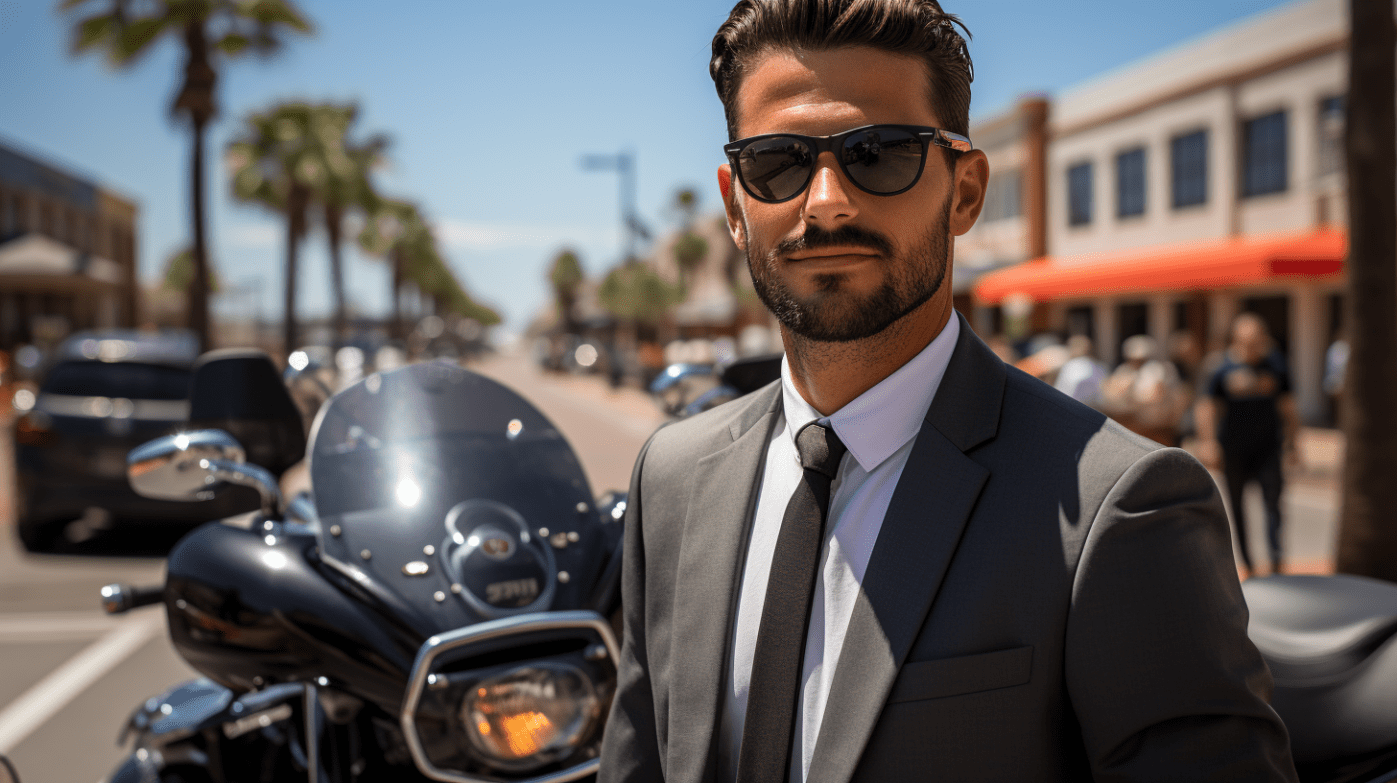
Every March, more than half a million riders come to Daytona Bike Week. If you were hurt in a Bike Week crash, Florida has strict rules that can hurt your case fast. Our Daytona Beach motorcycle accident lawyers know how to protect you.
Injured at Daytona Bike Week? Here Is What Actually Matters
Daytona Bike Week is one of the world’s biggest motorcycle rallies. Every March, hundreds of thousands of riders and passengers pour into Daytona Beach. They fill Main Street, International Speedway Boulevard, and A1A. They ride out to Ormond Beach and inland to the Daytona International Speedway. That much motorcycle traffic in one place, all at once, is why Volusia County ranks among Florida’s worst counties for motorcycle crash severity during Bike Week.
Many riders come from out of state. The roads are new to them. The bars and restaurants are packed. Local drivers are not used to seeing this many motorcycles at once. This leads to a familiar pattern of crashes: rear-end hits, left-turn collisions, lane-change strikes, and single-bike wrecks on the causeways. If you were hurt in one of these crashes, you are not alone, and you do not have to figure this out by yourself.


The legal clock starts ticking the moment you go down. Florida’s 2023 tort reform law, called HB 837, cut the deadline to file a lawsuit from four years to two years. Florida also has a rule that keeps motorcycles out of the state’s no-fault (PIP) system. That means you have no automatic insurance to help pay your first medical bills. And because so many Bike Week riders live in other states, your home insurance and Florida law can clash in confusing ways. An experienced Florida motorcycle accident lawyer can sort it all out.
Legal Term Defined
What Is the Florida Motorcycle PIP Exclusion?
Florida’s No-Fault Law (Fla. Stat. §627.736) says most drivers must carry $10,000 in Personal Injury Protection (PIP). PIP pays some of your medical bills no matter who caused the crash. But the law leaves motorcycles out. That means an injured Bike Week rider gets no PIP money to help with the first medical bills.
There is one silver lining. Because PIP does not apply, you do not have to pass Florida’s “serious injury” test before you sue the at-fault driver. You can go after the full range of damages from day one, including pain and suffering. Florida’s helmet law lets riders 21 and older ride without a helmet if they carry at least $10,000 in medical insurance. But insurers still try to use no-helmet status against you. Under HB 837, if a jury says you are 51% or more at fault, you get nothing. And you must file suit within 2 years.
What Are the First Steps Immediately After a Motorcycle Accident at Daytona Bike Week?
OUR CONSULTATIONSARE FREE
START YOUR FREE CASE REVIEW

The first thing to do is get to a safe spot and check for injuries. If you can move and it is safe, get out of the road. Turn on your bike’s hazard lights if they still work. Wave down another rider or a bystander to help block the lane so no one else hits you. Adrenaline is going to be pumping hard, so injuries you feel may be worse than they seem. Adrenaline also hides pain, so injuries you don’t feel may still be very real.
Next, call 911. Even if the crash looks minor, a police officer needs to come to the scene and write a crash report. That report becomes the backbone of any legal claim you file later. While you wait, do not move your motorcycle or the other vehicle unless it is blocking traffic and creating a bigger danger. Move only if you must. Keeping the scene the way it happened helps investigators later.


Finally, get medical care right away, even if you feel okay. Some of the worst motorcycle injuries, like brain bleeds, internal bleeding, or cracked vertebrae, do not always hurt right away. A hospital or urgent care visit creates a medical record on the same day as the crash. That record is what ties your injury to the accident later. If you skip it, an insurance company will argue you weren’t hurt very badly. Follow every discharge instruction and go to every follow-up visit. Missed appointments are the single easiest way for an adjuster to shrink your case.
How Do I Report a Motorcycle Injury at Daytona Bike Week to the Authorities?
Reporting the crash the right way is one of the most important steps you can take. Dial 911 if anyone is hurt. If injuries are minor, call the Daytona Beach Police non-emergency line at 386-671-5100 or the Volusia County Sheriff’s Office at 386-248-1777. An officer will come to the scene, gather statements, and file a Florida Traffic Crash Report. Florida law requires reporting a crash when there is injury, death, or vehicle damage over $500, and every Bike Week crash meets at least one of those tests.
When the officer arrives, give a short and honest account of what happened. Stick to facts. Do not guess about speeds, angles, or fault. If you are not sure, say “I’m not sure.” Do not apologize, because a simple “I’m sorry” can be twisted into an admission of fault later. Ask for the officer’s name, badge number, and the crash report number. You will need those numbers to pull the report from FLHSMV later. If English is not your first language, ask for a translator so nothing gets lost.
Photograph everything before the tow trucks arrive. Take pictures of both vehicles from every angle. Take photos of skid marks, debris, road gouges, traffic signals, road signs, and the surrounding area. Photograph your riding gear, your helmet, and any visible injuries. Get names, phone numbers, and email addresses from every witness on the scene. Bike Week witnesses often live in other states, so a phone number today is worth more than months of investigation later.
What Types of Injuries Are Most Common in Daytona Bike Week Motorcycle Accidents?
Motorcycle crashes cause more serious injuries than car crashes. Riders have no seat belts, no airbags, and no metal shell around them. When a motorcycle goes down, the rider takes the full impact. At Bike Week, most crashes happen at slow to moderate speeds in city traffic, but even a 25 mph fall can cause broken bones, brain injuries, and lifelong problems. The most common Bike Week injuries fall into three main groups: head injuries, spinal cord damage, and road rash.
Beyond those three, we also see broken wrists, arms, and legs, torn ligaments, crushed feet from bikes falling sideways, burns from hot exhaust pipes or fuel fires, and serious mental health effects like anxiety and PTSD after a crash. Some injuries show up right away. Others take days or weeks to appear. That is why prompt medical care and honest follow-up matter so much.
Head Injury Prevalence
Head injuries are the most common serious injury in Bike Week crashes. Even a helmet cannot fully prevent a concussion or traumatic brain injury (TBI) at highway speeds. The brain can slam into the inside of the skull during a fall, causing bruising and bleeding. Signs of a TBI can include headache, confusion, memory loss, nausea, changes in mood, trouble sleeping, and light or sound sensitivity. These symptoms may not appear for hours or days.
If you were riding without a helmet under Florida’s law, the insurance company will use that against you. But no-helmet status alone does not end your claim. A skilled attorney can push back on that argument, especially when the other driver was clearly at fault. Long-term effects of a TBI can include changes in personality, trouble concentrating, and even loss of the ability to work. Prompt treatment and neurological follow-up build the record you need to prove the injury.
Spinal Cord Damages
Spinal cord injuries can change a rider’s life in a single second. In a Bike Week crash, the neck and back take huge forces when the body twists or lands. Common spinal injuries include vertebra fractures, spinal cord bruising (contusion), tears in the spinal cord (laceration), pressure on the cord (compression), and, in the worst cases, complete severing (transection) that causes permanent paralysis.
Any suspected spinal injury should be treated as an emergency. Do not try to walk or stand if you feel numbness, tingling, or weakness in any limb. Let paramedics stabilize your neck and back before you move. Early imaging, such as MRI or CT scans, can show damage that regular X-rays miss. Long-term care may include surgery, physical therapy, and adaptive equipment. The cost of that care over a lifetime can reach into the millions of dollars, which is one of many reasons a full legal claim is so important.
Road Rash Incidents
Road rash sounds minor, but it is not. When a rider slides across the road, the skin scrapes off in wide patches. Deep road rash can expose muscle, damage nerves, and leave permanent scars. Infection is a real risk, especially in Florida’s warm and humid weather. Some road rash injuries require skin grafts, surgeries that move healthy skin from one part of the body to cover the wound.
Wearing full riding gear (a jacket with armor, gloves, riding pants, and boots) can greatly reduce road rash. But even the best gear cannot always prevent it. If you have road rash, wash the wound with clean water, cover it, and get to a hospital or urgent care as soon as possible. Take photos every day for the first week to document how it changes. Those photos help prove the pain and disfigurement that road rash causes, which is a real component of any pain-and-suffering claim.
Should I Seek Medical Attention Even if My Motorcycle Injury at Bike Week Seems Minor?
Yes. Always. Even if you feel fine after a Bike Week crash, a doctor should check you within 24 hours. Some of the most serious motorcycle injuries do not hurt right away. Brain bleeds can start slowly. Internal injuries can hide behind bruising. A cracked rib or vertebra may only ache a little at first, then become excruciating the next day. Adrenaline masks pain for hours after a crash, and a full medical exam is the only reliable way to find hidden problems.
You also have a legal reason to go to the hospital right away. When your medical record starts the same day as the crash, it is much harder for an insurance company to argue that you were “not really that hurt.” Any gap between the crash date and your first doctor’s visit gives the insurance company room to challenge your claim. If you wait a week, the adjuster will say your injuries came from something else. If you skip treatment altogether, they may pay nothing.
Keep every document you get. That includes emergency room paperwork, discharge instructions, prescriptions, imaging results, and bills. Save receipts for anything you pay out of pocket, including copays, medical devices, over-the-counter medicine, and rides to appointments. All of it becomes evidence for your claim. Your Daytona Beach motorcycle accident attorney will use those records to prove the full cost of your injury.
Event Data Recorder, ECM, and Body-Cam Evidence Preservation at Bike Week
Most cars and trucks built after 2012 have a small computer inside called an Event Data Recorder, or EDR. It records what the vehicle was doing in the seconds before, during, and after a crash. That includes speed, braking, throttle position, steering, and whether the driver was wearing a seat belt. In a Bike Week case, the other vehicle’s EDR is often the single most powerful piece of evidence. It can prove a driver ran a red light, failed to yield at a left turn, drifted into your lane, or was speeding up when they hit you.
The catch is that EDR data can be overwritten within days once the vehicle is driven, repaired, or scrapped. That is why moving fast matters. According to NHTSA, a qualified specialist can download EDR data and use it in court. But you need a lawyer who knows how to send a spoliation letter (a formal demand that says “preserve this evidence”) before the data is lost.
Many modern motorcycles carry an Engine Control Module (ECM) that records throttle, RPM, and speed. That data can help prove what you were doing in the seconds before the crash. Bike Week adds two more sources of evidence most motorcycle cases don’t have: heavy private and city surveillance camera coverage along Main Street, ISB, and the beachfront, plus police body-cam and dash-cam footage from the extra officers Volusia County brings in for the event. All of this evidence has to be requested formally, and most of it disappears fast if no one demands it.
Daytona Bike Week Motorcycle Crash Claims — Key Data at a Glance
Volusia County’s motorcycle crash numbers show two things at once: how big Florida’s motorcycle safety problem is overall, and how much worse the risk becomes during Bike Week. According to FLHSMV 2022 Florida Traffic Crash Facts, Florida had 401,523 crashes, 3,535 deaths, and more than 253,888 injuries in a single year. Motorcyclists make up a large share of the deaths and serious injuries. Florida averages about 9,000 motorcycle crashes and 600 rider deaths every year. Volusia County is a hot spot for both. Bike Week concentrates a lot of that yearly crash count into a single ten-day window.
National IIHS data shows motorcyclists are about 24 times more likely per mile ridden to die in a crash than people in cars. Add Bike Week’s dense traffic, unfamiliar riders, and after-hours bar traffic, and the risk climbs even higher. That is why our firm treats Bike Week crashes with the urgency they deserve. Every hour matters.
Florida HB 837’s 2023 rule changes hit motorcycle riders especially hard. The 2-year filing deadline, the 51% zero-recovery fault bar, and Florida’s long-standing motorcycle PIP exclusion stack on top of each other. Physical evidence like EDR data, ECM readings, dash-cam and traffic-camera footage, skid marks, debris, and helmet damage typically fades or disappears within 24 to 72 hours. The infographic below sums up the key data points every injured rider should know.
Florida PIP Exclusion and Bike Week Motorcycle Claims
Florida’s Personal Injury Protection (PIP) law requires most drivers to carry at least $10,000 in no-fault coverage. PIP pays 80 percent of medical bills and 60 percent of lost wages after a crash, no matter who caused it. But motorcycles are left out of the PIP system under Fla. Stat. §627.736. That is a big deal, and most Bike Week riders don’t learn it until after they get hurt.
Here is what the PIP exclusion means in real life. When you are hurt in a Florida car crash, PIP pays your first $10,000 in medical costs quickly. When you are hurt in a Florida motorcycle crash, no PIP coverage kicks in at all. You have to look elsewhere: your health insurance, any MedPay coverage on your motorcycle policy, the at-fault driver’s bodily injury liability policy, and your own uninsured/underinsured motorist (UM/UIM) coverage. Coordinating all of these is complicated, especially for out-of-state riders whose home policies were written under different rules.
There is a silver lining, though. Because PIP does not apply to motorcycles, the “serious injury threshold” that normally gates a Florida tort claim also does not apply. Car crash victims must show a permanent injury or severe scarring before they can sue for pain and suffering. Motorcycle riders do not. You can pursue the full range of damages, including pain and suffering, from day one. A skilled Florida motorcycle accident lawyer can identify every coverage source and use the no-threshold rule to your advantage.
How Long Do I Have to File a Personal Injury Claim After a Daytona Bike Week Motorcycle Accident?
Florida used to give injured people four years to file most negligence claims. That changed on March 24, 2023, when HB 837 took effect. Now, the deadline is two years from the date of the crash for most personal injury cases. If you were hurt at Bike Week, you have two years to file a lawsuit or your case is gone forever, no matter how strong the underlying facts are.
Two years sounds like plenty of time. But it goes fast. Between surgeries, physical therapy, out-of-state travel, insurance disputes, and the plain shock of a life-changing injury, many riders do not focus on the deadline until it is close. Building a strong case takes time, too. Evidence needs to be gathered. You need to line up doctors and experts. You need to negotiate with insurance companies before filing a lawsuit. All of that has to happen well before the two-year clock runs out.
The clock can be different if a rider dies from the crash. Under Florida’s Wrongful Death Act, families generally have two years from the date of death to file. Cases involving minors, government defendants (like a city bus), or dram-shop claims against bars that served visibly drunk patrons can have different rules and shorter notice deadlines. A local Daytona Beach motorcycle accident attorney can tell you exactly which deadline applies to your case.
What Legal Rights Do I Have If I’m Injured in a Motorcycle Accident During Daytona Bike Week?
If you were hurt in a Bike Week crash caused by someone else, you have the right to seek money damages. Florida law protects motorcyclists just as it protects drivers of cars and trucks. You can file a claim against the at-fault driver’s insurance company. If that does not resolve the case, you have the right to file a lawsuit and take the case to a jury. You also have the right to hire an attorney to protect you every step of the way.
Your right to recover damages covers many types of losses. That includes past and future medical bills, lost wages while you are out of work, loss of future earning capacity if the injury keeps you from returning to your career, pain and suffering, mental anguish, permanent scarring or disfigurement, and property damage to your motorcycle and gear. If a loved one dies from a Bike Week crash, close family members may have a wrongful death claim for their own losses.
You also have the right to refuse to give a recorded statement to the other side’s insurance company. You have the right to refuse to sign a medical release that gives the insurance company access to your entire medical history. And you have the right to reject any low settlement offer that does not fairly compensate you. Insurance companies are counting on injured riders not knowing these rights. Working with counsel who does know them levels the playing field.
How Do I Gather Evidence for a Motorcycle Accident Claim at Daytona Bike Week?
Strong Bike Week cases start with strong evidence. The first source is the crash scene itself. As soon as it is safe, take clear pictures with your phone from every angle. Take wide shots that show the whole scene and close-ups that show details like skid marks, fluid on the road, and damage to both vehicles. Photograph the traffic signals, road signs, and any obstructions to visibility. If your helmet or gear was damaged, save it. Do not throw it away, even if it looks trashed.
The second source is the official crash report. When police respond, they will create a Florida Traffic Crash Report with the drivers involved, witness statements, a diagram of the scene, and any citations issued. You can request a copy of this report from FLHSMV. The report is not the final word on fault, but it is the starting point for every insurance claim and lawsuit that follows.
The third source is witnesses. Bike Week draws people from all over the country, and witnesses often go home within a day or two. Get names, phone numbers, home cities, and email addresses on the scene. Ask them to send you a quick text describing what they saw while it is fresh in their mind. Beyond witnesses, your Daytona Beach motorcycle accident lawyer can subpoena surveillance video from nearby businesses, request police body-cam footage, pull EDR data from the other vehicle, and hire an accident reconstruction expert to tie it all together.
What Role Do Witnesses Play in a Daytona Bike Week Motorcycle Injury Claim?
Witnesses can make or break a Bike Week case. Insurance companies almost always try to shift blame onto the motorcyclist. When an independent witness tells the same story you do — that the other driver failed to yield, ran the light, or drifted into your lane — the insurance company has a much harder time denying the claim. Witnesses also help fill in details you may not remember, especially if you were knocked unconscious or dazed by the impact.
The problem at Bike Week is that most witnesses do not live in Florida. They came for the event, and they head home the next day. If you do not capture their contact information at the scene, they may be impossible to find weeks later. This is why the very first steps after a crash are so important. Even asking a witness to send a short text of what they saw creates a written record you can use.
Once your attorney is involved, they will contact each witness formally, take a recorded statement (with the witness’s permission), and, if needed, ask them to give a deposition later. A strong witness statement can settle a case without a lawsuit. In cases that do go to trial, credible witness testimony often decides the outcome. Bottom line: gather witness information early, then get it to your lawyer as soon as possible.
How Do Insurance Companies Evaluate Motorcycle Accident Claims From Daytona Bike Week?
Insurance carriers look at Bike Week claims through a very specific lens. They start with the crash report, medical records, photos of the scene and damage, and witness statements. They review any citations issued, whether alcohol or drugs were involved, and whether the rider was wearing a helmet. They pull the driver’s policy, including coverage limits, exclusions, and any endorsements. Then they build an internal reserve, which is the amount they think they may have to pay.
Adjusters weigh each piece of evidence differently. Official records like the crash report and medical records carry heavy weight. Witness statements and expert opinions carry moderate weight. Some factors carry very heavy weight, like whether the rider had alcohol in their system. Others carry less weight but can still influence the case, like prior insurance claim history or the motorcycle’s mechanical condition. Every factor gets built into the settlement number the adjuster proposes.
Here is what insurance companies do not tell injured riders. Their first offer is almost always low. They count on the rider being anxious, in pain, and stuck with medical bills. They know an out-of-state Bike Week attendee wants to close the case and go home. They know most riders don’t fully understand Florida’s HB 837 comparative fault rules. A skilled personal injury attorney knows these tactics and how to push back. Florida now follows a modified comparative fault system, so even if you were partly at fault (less than 51%), you can still recover, though your damages will be reduced by your fault percentage.
What Are the Common Challenges in Winning a Daytona Bike Week Motorcycle Accident Case?
Bike Week cases have some unique challenges. The first is bias. Some jurors, adjusters, and even judges hold negative views about motorcyclists, and even more so about riders in a large rally. That bias shows up in questions like “Were you speeding?” or “Were you drinking?” or “Why weren’t you wearing a helmet?” A good lawyer knows how to neutralize that bias early with clear evidence and a fact-based story.
The second challenge is fault disputes. Insurance carriers routinely argue that a rider was in the driver’s blind spot, rode too aggressively, followed too closely, or was somehow at fault for the crash. Under HB 837, if the jury puts more than half the blame on the rider, the rider gets nothing. Insurers now push comparative fault harder than ever, and beating that fight requires strong evidence: EDR data, camera footage, witness statements, and expert reconstruction.
The third challenge is coverage limitations. Many Bike Week crashes involve at-fault drivers with only Florida’s bodily injury minimum of $10,000 per person, which is nowhere near enough to cover a serious injury. Uninsured and underinsured motorist coverage becomes critical. If the rider’s own home-state UM/UIM policy has strong limits, that policy may end up paying more than the at-fault driver’s policy. Understanding how out-of-state UM/UIM interacts with Florida law is one of the trickiest parts of any Bike Week case.
Can I Claim Compensation if I Was Partially at Fault for the Daytona Bike Week Motorcycle Accident?
Yes, in most cases. Florida uses a modified comparative fault system under HB 837. That means you can still recover money as long as the jury finds you were less than 51% at fault. If the jury finds you were 51% or more at fault, you get nothing. If the jury finds you were, say, 20% at fault, you still recover, but your award is reduced by 20%. So a $500,000 verdict becomes $400,000.
Insurance companies know these rules and use them aggressively. They will look for anything that could be labeled “partial fault” on your part: a lane change, a speed reading, a moment of distraction, a decision not to wear a helmet. Then they build a story around it and push a low settlement offer. The key to protecting your recovery is having strong, clean evidence that shows the other driver was the primary cause of the crash.
Even if you think you may have been partly at fault, do not assume you have no case. Fault is a legal question, not a feeling. Riders often blame themselves right after a crash out of shock or embarrassment. Your attorney will look at the physical evidence, the crash report, the EDR data, and the witness statements to build the fault picture correctly. Do not admit fault to anyone (not the police, not the other driver, and not the insurance company) before speaking with counsel.
What Potential Damages Can I Claim After a Motorcycle Injury at Daytona Bike Week?
Florida law allows injured motorcycle riders to seek several kinds of damages. These fall into two big groups: economic damages (real dollars you can add up) and non-economic damages (harm that is not tied to a receipt but is still very real). Because Florida’s motorcycle PIP exclusion means the “serious injury threshold” does not gate your claim, you can pursue both types of damages from day one.
Every case is different, so the exact damages you can recover depend on the injuries, the coverage available, and the facts of the crash. An experienced personal injury attorney can evaluate your case and tell you what it’s worth. The three most common categories of damages in a Bike Week case are medical expenses, lost income, and pain and suffering.
Medical Expense Claims
Medical expenses are the most straightforward damages to prove. That includes ambulance costs, emergency room bills, hospital stays, surgeries, medications, follow-up doctor visits, imaging (CT, MRI, X-ray), physical therapy, occupational therapy, mental health counseling, and medical devices like braces, crutches, or wheelchairs. Keep every bill, every explanation of benefits from your health insurance, and every receipt for medical items you paid for yourself.
Future medical expenses are also recoverable. If your doctor says you will need more surgeries, ongoing pain management, or lifelong care, an expert can estimate the total future cost. That estimate becomes part of your claim. Because Florida’s motorcycle PIP exclusion means you have no built-in no-fault benefits, coordinating your health insurance with the at-fault driver’s liability policy is critical to avoid bills that shouldn’t be yours.
Lost Income Recovery
If your injuries kept you out of work, you can recover lost wages. Bring pay stubs, tax returns, and a letter from your employer showing the time you missed and your pay rate. If you are self-employed or run a small business, income records, invoices, and profit-and-loss statements from the months before the crash all help prove the loss.
Loss of future earning capacity is a bigger category. If your injuries permanently keep you from doing your job, or if they force you to move to a lower-paying job, you can recover the difference over your working life. A vocational expert and an economist may need to project those numbers based on your age, education, and career path. This is often the largest component of a serious Bike Week case for a working-age rider.
Pain and Suffering Compensation
Pain and suffering damages are harder to put a number on, but they are just as real. This category covers the physical pain of the injury and recovery, the emotional distress of going through a traumatic event, sleep problems, anxiety, depression, PTSD, and the loss of enjoyment that comes from not being able to ride, work, or spend time with family the way you used to.
Because Florida’s motorcycle PIP exclusion removes the serious-injury threshold, motorcycle riders can pursue pain-and-suffering damages from the start. Photos of your injuries over time, a journal describing the daily impact of the crash, statements from friends and family, and medical records from mental health providers all help build the case. An experienced attorney knows how to present this evidence in a way that gives a jury a clear sense of what you have been through.
How Can I Improve My Chances of a Successful Claim After a Motorcycle Accident at Daytona Bike Week?
The single biggest thing you can do to improve your case is contact a lawyer early. The sooner counsel is involved, the sooner spoliation letters can be sent to preserve evidence, the sooner witnesses can be contacted, and the sooner the insurance company knows a professional is on the other side. Cases that start with an attorney the same day or the day after the crash almost always turn out better than cases where the rider tries to handle things alone for weeks first.
Second, get medical care immediately and stick with it. Every skipped appointment, every canceled therapy session, and every gap in treatment is an argument for the insurance company. Follow your doctor’s instructions to the letter. Fill your prescriptions. Attend your follow-up visits. Do not push through the pain and try to “tough it out.” Toughness is admirable in most parts of life, but it hurts your case here.
Third, stay off social media about the crash. Insurance companies (and their lawyers) will search your Facebook, Instagram, and other accounts looking for pictures of you riding, working out, or having fun. Even harmless posts can be twisted into evidence that you are not really as injured as you say. Keep your accounts private, do not post about the crash or your recovery, and tell friends and family not to tag you in photos or posts either.
Are There Special Regulations or Laws Affecting Motorcycle Accidents at Daytona Bike Week?
Yes and no. Bike Week itself does not have a special set of laws that override Florida’s statutes. But several Florida laws come into sharper focus during the event. Florida’s helmet law (Fla. Stat. §316.211) is one. Riders 21 and older can go without a helmet if they carry at least $10,000 in medical insurance. Riders under 21 must wear a helmet at all times. Insurance companies use no-helmet status against riders, especially in head-injury cases.
Florida’s lane splitting rules also matter. Lane splitting (riding between lanes of slow or stopped traffic) is illegal in Florida. That differs from many other states, and out-of-state riders sometimes mistakenly split lanes in Bike Week traffic. If you were splitting lanes when the crash happened, the insurance company will use that against you hard. Florida allows two motorcycles to share a lane side by side (co-riding), so that isn’t the same as lane splitting.
Volusia County law enforcement also brings in extra officers during Bike Week to handle the extra traffic and crowds. That means more traffic stops, more DUI enforcement, and more crash-scene documentation than a typical week. All of that extra evidence, from body-cam footage to breathalyzer results, can end up in your case. A local Daytona Beach motorcycle accident lawyer who works in Volusia County knows how to get the good evidence and fight back against the bad.
What Should I Look for When Hiring a Lawyer for a Daytona Bike Week Motorcycle Injury?
Start with experience. You want a lawyer who has handled many Florida motorcycle cases, not just car accident cases with a motorcycle chapter thrown in. Ask how many motorcycle cases the firm handles each year. Ask about specific outcomes. Ask about the firm’s experience with Volusia County courts, the Seventh Judicial Circuit, and local hospitals and doctors. A firm with an actual Daytona Beach office (not just a virtual address) will know the local landscape better than a firm based far away.
Then look at credentials. Board Certification in Civil Trial Law from The Florida Bar is a serious credential held by fewer than 3% of Florida attorneys. An AV Preeminent rating from Martindale-Hubbell is the top peer-reviewed recognition for professional excellence and ethics. Both credentials are independent, meaning they cannot be bought or faked. Ask which attorneys at the firm hold them.
Finally, pay attention to communication. Your attorney should return calls, answer questions clearly, and update you regularly. You should not have to chase them down for information. Fee structure matters too. Most personal injury firms, including Anidjar & Levine, work on a contingency fee basis, which means you pay nothing unless you win. Get the fee agreement in writing before you sign anything, and make sure you understand the percentage, the costs, and how expenses are handled.
How to Choose the Right Florida Personal Injury Lawyer for Your Case
Start by carefully reviewing the lawyer’s relevant experience, case history, and ability to handle the specific type of injury, insurance dispute, or liability question in your claim. A suitable attorney should show organized case preparation, sound judgment, and a real commitment to protecting the client’s well-being while pursuing fair compensation. Ask specifically about their experience with Florida’s HB 837 comparative fault rules and how they approach fault disputes with insurers. Also ask about Board Certification in Civil Trial and an AV Preeminent rating from Martindale-Hubbell. These are independent credentials that confirm the highest levels of professional excellence and courtroom readiness.
Client communication is another important measure. The lawyer should explain options clearly, provide timely updates, and answer questions with honesty and respect. This approach helps injured people make informed decisions during a difficult period without feeling pressured or confused about what is happening with their case. Potential clients should also review fee agreements carefully before signing, understanding contingency arrangements, potential expenses, and how costs may affect the net recovery.
By considering experience, communication, availability, and fee structure, an injured rider can choose counsel prepared to serve their interests with diligence, integrity, and professional care throughout the full life of the claim. Handling a Bike Week case takes more than legal skill; it takes a firm that treats every rider like a person, not a case number.
About The Law Offices of Anidjar & Levine
Founded in 2005 by Marc Anidjar and Glen Levine, The Law Offices of Anidjar & Levine began as a two-person operation working out of a construction office conference room. Over the past 20 years, that modest start has grown into one of Florida’s most recognized personal injury practices, with more than $1 billion recovered in settlements on behalf of injury clients across the state. We bring that same determination and depth of experience to every Daytona Bike Week motorcycle accident case we handle.
Our Daytona Beach office sits at 128 Orange Avenue, a short ride from Main Street, the Speedway, and every hospital treating injured riders during Bike Week. That local presence matters. When something goes wrong at the event, our attorneys can be on the ground within hours, meeting with clients at the hospital, coordinating with treating physicians, and getting preservation letters out the same day. We also serve riders across all of Florida from offices in Fort Lauderdale, Jacksonville, Orlando, Tampa, Fort Myers, West Palm Beach, Miami, and Naples.
Marc Anidjar, Co-Founder & Personal Injury Attorney
Marc Anidjar co-founded the firm in 2005 and has spent two decades representing seriously injured people throughout Florida. He is Board Certified in Civil Trial Law by The Florida Bar, a distinction held by fewer than 3 percent of Florida attorneys. He also holds an AV Preeminent rating from Martindale-Hubbell, the legal industry’s highest peer-review recognition for professional excellence and ethical standards.
Glen Levine, Co-Founder & Personal Injury Attorney
Glen Levine co-founded the firm alongside Marc Anidjar and has represented injury clients across Florida for more than 20 years. He also holds an AV Preeminent rating from Martindale-Hubbell. He is committed to clear communication, thorough case preparation, and protecting each client’s right to full and fair compensation after a serious injury.
Frequently Asked Questions
What is the statute of limitations for a Daytona Bike Week motorcycle accident case?
Under Florida HB 837, effective March 24, 2023, most negligence-based motorcycle accident claims must be filed within 2 years from the date of the crash. Missing this deadline permanently bars recovery, regardless of how strong the underlying facts are. Out-of-state riders should be especially careful because Florida’s deadline is significantly shorter than the limitations period in many other states.
Does Florida PIP cover Daytona Bike Week motorcycle accidents?
No. Florida’s No-Fault PIP law (Fla. Stat. §627.736) leaves motorcycles out of the PIP system. Injured riders have no PIP benefits to cover initial medical bills, but they can pursue full tort damages, including pain and suffering, against the at-fault driver from day one without meeting the serious-injury threshold that applies to car crash victims.
How does Florida HB 837 affect Daytona Bike Week motorcycle cases?
Florida HB 837 (March 24, 2023) replaced pure comparative fault with modified comparative fault (51% bar) and reduced the statute of limitations from 4 years to 2 years. Insurers now argue aggressively over lane position, speed, visibility, no-helmet status, and group-ride behavior to push riders past the 51% threshold.
Do I need to wear a helmet to recover damages after a Florida motorcycle crash?
Florida law allows riders 21 and older to ride without a helmet if they carry at least $10,000 in medical insurance. Not wearing a helmet does not automatically bar recovery. But insurers routinely try to use no-helmet status to argue comparative fault, especially for head injuries. Experienced counsel is essential to shut down that argument.
Can I file a Daytona Bike Week motorcycle accident claim if I live out of state?
Yes. If the crash happened in Florida, the case is generally handled under Florida law, in Florida courts, on Florida’s 2-year deadline. You do not need to live in Florida to hire a Florida attorney or file a Florida claim. Retaining Florida-based counsel is usually the fastest and most effective way for an out-of-state rider to handle a Bike Week case.
Can I still recover if I was partially at fault for a Bike Week crash?
Yes, if your share of fault is less than 51%. Under Florida’s modified comparative fault system, a rider found 51% or more at fault recovers nothing. Any compensation for a rider found less than 51% at fault is reduced by that percentage. Building a case that assigns most of the fault to the responsible driver is one of your attorney’s most important jobs.
What if a drunk driver caused the Bike Week crash?
If the at-fault driver was drunk, that fact can significantly strengthen your case. You may be able to seek punitive damages, which are extra damages meant to punish reckless behavior. Under Florida’s dram-shop law, a bar or restaurant that served the drunk driver may also share liability if the driver was already noticeably drunk or is a known habitual drinker. These claims have short notice deadlines, so contact counsel quickly.
Daytona Beach and Volusia County Local Resources
The following local resources may help injured riders and their families in the days and weeks after a serious Bike Week crash. If you are experiencing an emergency, call 911 first.
Hospitals and Emergency Care
• Halifax Health Medical Center of Daytona Beach — Level II Trauma Center · 303 N Clyde Morris Blvd, Daytona Beach, FL 32114 · 386-254-4000
• AdventHealth Daytona Beach — 301 Memorial Medical Pkwy, Daytona Beach, FL 32117 · 386-231-6000
• Halifax Health Medical Center of Port Orange — 1041 Dunlawton Ave, Port Orange, FL 32127 · 386-254-4000
• AdventHealth New Smyrna Beach — 401 Palmetto St, New Smyrna Beach, FL 32168 · 386-424-4000
Police and Highway Patrol
• Daytona Beach Police Department — 129 Valor Blvd, Daytona Beach, FL 32114 · Non-emergency: 386-671-5100
• Volusia County Sheriff’s Office — 123 W Indiana Ave, DeLand, FL 32720 · 386-248-1777
• Florida Highway Patrol — Troop G (Daytona) · 386-238-2100
• Request a Florida Crash Report (FLHSMV)
Courts
• Seventh Judicial Circuit Court of Florida — Volusia County Courthouse, 101 N Alabama Ave, DeLand, FL 32724 · 386-736-5900
• Volusia County Clerk of the Circuit Court · 386-257-6096
Mental Health and Crisis Support
• 988 Suicide & Crisis Lifeline — 24/7 free confidential support · 988
• 211 Volusia / Flagler — 24/7 helpline · 211
• SMA Healthcare (Behavioral Health) — 1220 Willis Ave, Daytona Beach, FL 32114 · 1-800-539-4228
Victim Services and Additional Support
• Volusia County Victim Services · 24-hour crisis line: 386-254-1560
• Florida Department of Health in Volusia County · 386-274-0500
• Florida Department of Financial Services — Consumer Insurance Help · 877-693-5236
Motorcycle accident claims at Daytona Bike Week often involve catastrophic injuries, the Florida PIP exclusion, out-of-state insurance complications, and aggressive insurer defenses aimed at blaming the rider. A Daytona Beach Motorcycle Accident Lawyer from The Law Offices of Anidjar & Levine can identify every responsible party, coordinate available coverage sources across state lines, preserve EDR and ECM evidence, and pursue compensation for medical expenses, lost wages, and other damages. Prompt legal guidance can help protect an injured rider’s rights and strengthen the claim. Those harmed at Bike Week — whether they live in Florida or traveled in from out of state — should consider contacting an experienced attorney for a confidential case review. Our team is available 24/7 at 386-400-6000 or toll-free at 1-800-747-3733.
Real Reviews From Our Clients!
“I rode down to Bike Week from Georgia and got hit by a car that pulled out of a lot on Main Street. My home insurance was useless and I had no idea how to handle a Florida claim. Anidjar & Levine coordinated everything from their Daytona office, dealt with the Florida driver’s carrier, and made sure I did not sign anything that would have hurt me.”
— Wayne T., Bike Week Attendee
“A driver made a left turn in front of me on A1A during Bike Week and I went down hard. The insurance company tried to blame the group I was riding with. Anidjar & Levine pulled the EDR data from the other car, proved the driver never even looked, and got me a full recovery.”
— Rick D., Daytona Beach
“After my crash on ISB, the insurer kept bringing up that I was riding without a helmet even though it was legal for me. Anidjar & Levine knew exactly how to shut that argument down and secured a settlement that covered surgery, therapy, and the wages I lost while I was out of work.”
— Denise R., Volusia County

