

The Law Offices of Anidjar and Levine, a Boca Raton staffing and supervision failures injury law firm, evaluates whether inadequate staffing, insufficient training, negligent hiring, or ineffective oversight contributed to an injury.
An attorney may review employment records, schedules, policies, incident reports, surveillance footage, medical records, and witness statements to identify responsible parties and establish negligence.
Potential compensation may include medical expenses, lost income, diminished earning capacity, and other legally recognized losses.
Prompt legal guidance can also address insurers, evidence preservation, and applicable deadlines.
Learn more by consulting a Boca Raton Personal Injury Lawyer about available legal options.
Main Takeaways
- A Boca Raton injury lawyer can evaluate whether inadequate staffing, training, or supervision contributed to your injury.
- Attorneys may review employment records, schedules, policies, training materials, incident reports, surveillance, and witness statements.
- Claims generally examine duty, negligent conduct, causation, and damages under the specific facts and applicable Florida law.
- Potential compensation may include medical expenses, lost income, reduced earning capacity, pain and suffering, and other legally recognized losses.
- Promptly preserve medical records, photographs, communications, reports, and surveillance requests while discussing deadlines with a Florida attorney.


How We Can Help With Your Boca Raton Staffing & Supervision Failures Injury Claim
An experienced Boca Raton personal injury lawyer can help injured individuals pursue claims arising from negligent staffing or inadequate supervision. The lawyer can provide a focused Legal Consultation, listen carefully to the injured person’s account, and identify practical steps for protecting important interests.
Representation may include reviewing employment records, training materials, incident reports, witness statements, and available safety policies. This evaluation can help determine whether an organization took reasonable measures to support Workplace Safety and whether preventable oversight contributed to the harm. The lawyer may also communicate with insurers and other involved parties, reducing the burden on individuals who are recovering and serving their families or communities.
A legal representative can organize medical documentation, assess financial effects, and pursue compensation consistent with the available evidence. When appropriate, counsel may negotiate a resolution or prepare the matter for court proceedings. Throughout the process, professional guidance promotes informed decisions, respectful advocacy, and accountability for those responsible for maintaining safe environments.
OUR CONSULTATIONSARE FREE
START YOUR FREE CASE REVIEW

Understanding Boca Raton Staffing & Supervision Failures Injury Cases
When staffing levels, employee qualifications, or supervisory practices fall below reasonable safety standards, the resulting failures may contribute to serious injuries in Boca Raton workplaces and public settings. These cases generally examine whether an organization acted with reasonable care toward employees, customers, residents, patients, or visitors. The central issues may include the existence of a duty, a breach of that duty, the causal connection between the conduct and the injury, and the scope of resulting damages.
Evidence can include personnel records, training materials, schedules, incident reports, surveillance footage, witness statements, and relevant workplace policies. Workplace policy violations may support an argument that expected safety procedures were not followed, although legal responsibility depends on the facts and applicable law. Claims may also involve third-party negligence claims when an outside contractor, property manager, security provider, or other entity contributed to the harm. Careful evaluation helps identify responsible parties, preserve evidence, and determine whether compensation may be available for medical expenses, lost income, rehabilitation, and related losses.
Common Causes of Boca Raton Staffing & Supervision Failures
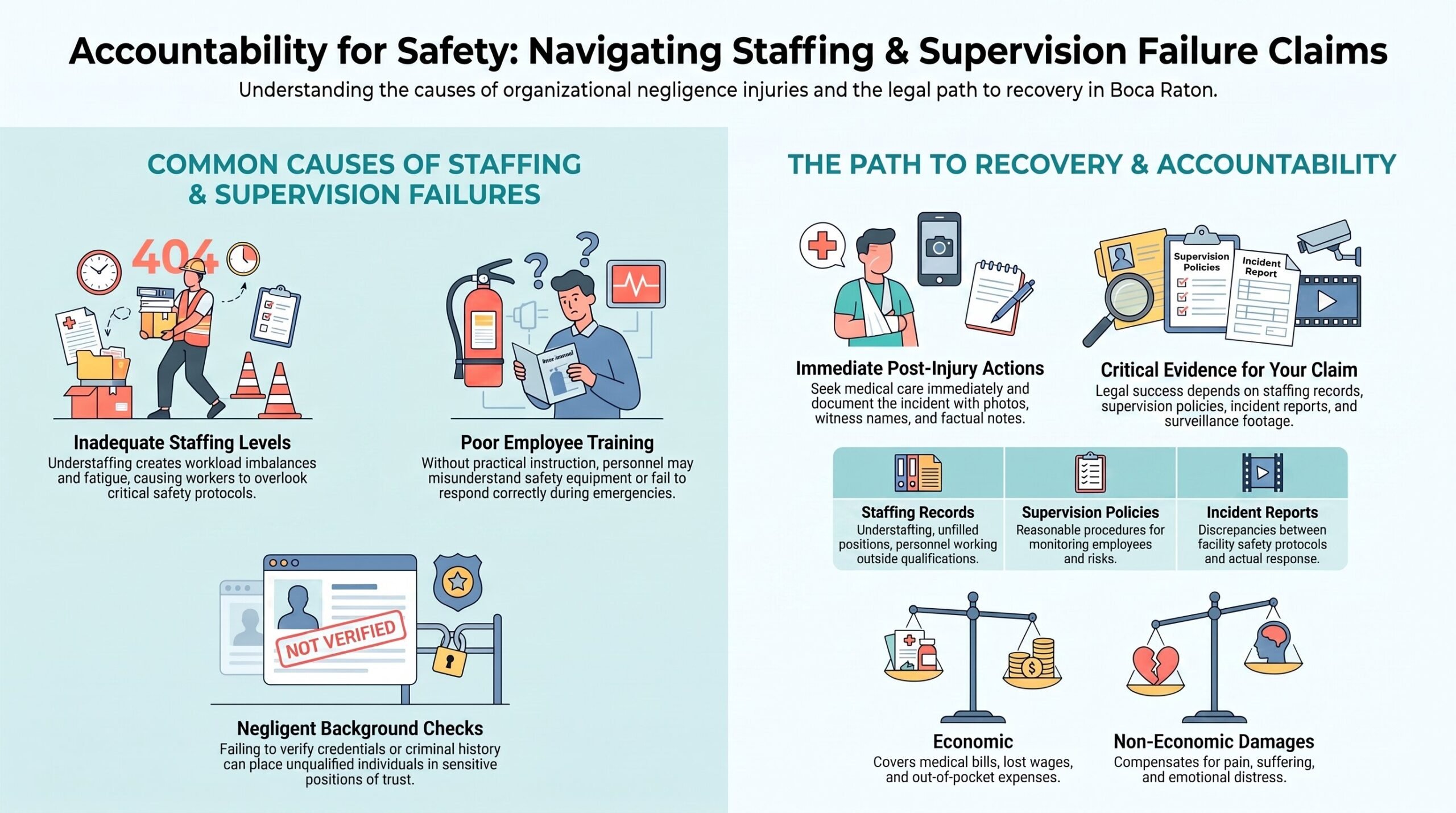
Common causes of staffing and supervision failures include inadequate staffing levels, which can leave employees unable to meet safety and care obligations. Poor training and negligent background checks may place unqualified or unsuitable personnel in positions of responsibility. A lack of effective supervision can further enable unsafe conduct, policy violations, and preventable injuries.
Inadequate Staffing Levels
Inadequate staffing levels can leave Boca Raton businesses, care facilities, and other organizations unable to supervise personnel, respond to hazards, or provide services safely. When too few workers cover an operational area, a workload imbalance may develop, requiring available personnel to manage competing duties without adequate time or support. Critical inspections, resident assistance, customer monitoring, and hazard response can then be delayed or overlooked. Extended understaffing may also produce fatigue, rushed decisions, and reduced attention to changing conditions.
Organizations serving the public have a responsibility to evaluate staffing needs according to anticipated demand, facility size, and the risks associated with each assignment. Scheduling should preserve coverage for breaks, absences, and emergencies. A written safety protocol is less effective when insufficient personnel are unable to implement it promptly and consistently.
Poor Employee Training
Poor employee training can prevent Boca Raton businesses, care facilities, and other organizations from recognizing hazards, following established procedures, or supervising others effectively. Without practical instruction and periodic refresher education, personnel may misunderstand safety protocols, mishandle equipment, or fail to respond appropriately when someone needs assistance. Training should address emergency procedures, communication expectations, Workplace harassment prevention, and responsibilities for protecting clients, patients, coworkers, and visitors. Supervisors also need guidance on identifying unsafe conduct, correcting errors, and promptly documenting concerns.
Weak instruction can contribute to inconsistent care, preventable accidents, and ineffective oversight, particularly when employees are expected to serve vulnerable individuals. Clear materials, hands-on practice, competency checks, and accessible reporting channels can strengthen the accuracy of incident reporting. Organizations that neglect these measures may face increased injury risks and difficulty demonstrating that they exercised reasonable care after an incident occurs.
Negligent Background Checks
Negligent background checks can allow Boca Raton organizations to place individuals in positions of trust without adequately evaluating their qualifications, work history, or relevant misconduct. When employers omit reference verification, criminal history review, or credential confirmation, they may expose clients, coworkers, and visitors to preventable harm. Careful screening supports community safety by identifying information that could affect a candidate’s suitability for sensitive duties.
Organizations should also establish consistent procedures, document decisions, and apply screening standards fairly to avoid discriminatory practices or Workplace retaliation against applicants who raise concerns. Although screening cannot predict every risk, failing to investigate reasonably available information may reflect employee negligence when foreseeable dangers result. Strong training accountability requires personnel responsible for hiring to understand screening obligations, preserve accurate records, and obtain appropriate authorization before making informed staffing decisions that protect those they serve.
Lack Of Supervision
When supervisors fail to monitor employees, provide direction, or respond to warning signs, Boca Raton organizations may expose clients, coworkers, and visitors to preventable harm. Lack of supervision can arise when staffing levels are inadequate, managers are poorly trained, or responsibilities are assigned without meaningful oversight. Employees may then disregard Workplace protocols, perform tasks beyond their training, or overlook conditions requiring immediate intervention.
Effective supervision supports safety compliance by reinforcing procedures, correcting unsafe conduct, and ensuring that personnel understand their responsibilities. Organizations also have a duty of care to maintain reasonable safeguards for individuals receiving services or entering the premises. After an incident, complete incident documentation can help identify missed warnings, establish a timeline, and guide corrective action. Consistent supervisory practices may reduce preventable injuries and demonstrate an organization’s commitment to responsible service.
Don’t Wait. Call Our Florida Personal Injury Lawyers Now!


Legal Rights of Boca Raton Staffing & Supervision Failures Injury Victims
Victims injured because an organization failed to maintain adequate staffing or supervision may have legal rights to pursue compensation under Florida law. Depending on the circumstances, a claim may seek payment for medical treatment, lost income, diminished earning capacity, pain, and other legally recognized losses. An attorney can evaluate evidence, identify responsible parties, and explain deadlines that may affect a potential action.
Potentially valuable evidence may include:
- Incident reports and workplace violence reporting records
- Safety compliance audits and inspection results
- Training materials, schedules, and supervisory policies
- Medical records, photographs, and witness statements
In some cases, claims may involve negligence, premises liability, negligent hiring, or negligent retention. Public entities and certain employers may receive special protections or be subject to pre-suit procedures, making timely legal guidance important. Individuals who assist injured people can support recovery by preserving documents, arranging appropriate care, and avoiding statements that speculate about responsibility. A qualified Florida personal injury lawyer can protect the victim’s interests while pursuing a fair resolution through negotiation or litigation.
Why Do Boca Raton Staffing & Supervision Failures Injuries Happen?
Staffing and supervision failures: injuries often occur when an organization assigns too few qualified personnel, provides inadequate training, or fails to monitor known safety risks. In Boca Raton workplaces, these failures may arise from budget pressures, rapid employee turnover, poor communication, or supervisors who overlook hazardous conduct. When duties exceed available personnel, workers may rush, skip required safeguards, or lack assistance during demanding tasks. Inadequate orientation can leave employees unaware of equipment hazards, emergency procedures, or appropriate reporting channels.
Workplace Standards require organizations to maintain reasonably safe conditions and competent oversight. Safety Protocols are ineffective when managers do not enforce them consistently or correct recurring violations. Employer Obligations also include providing suitable instruction, maintaining equipment, and responding to foreseeable dangers. When those responsibilities are neglected, employees’ rights to a reasonably safe workplace may be compromised, increasing the likelihood of preventable injuries. Such incidents can affect workers, colleagues, clients, and the broader community that depends on reliable service.
What Should You Do After a Boca Raton Staffing & Supervision Failure Injury?
After an injury resulting from a staffing or supervision failure, the injured person should seek immediate medical care, even if symptoms initially appear minor. The incident should be documented promptly by preserving records, photographs, witness information, and relevant communications. Consulting an experienced injury lawyer can help evaluate potential liability, protect legal rights, and guide the claim process.
Seek Immediate Medical Care
Prompt medical evaluation should be obtained as soon as possible after an injury related to inadequate staffing or supervision, even when the condition initially appears minor. A qualified healthcare professional can identify hidden harm, provide treatment, and explain symptoms requiring urgent attention. Timely care also supports workplace safety by reducing the risk that an untreated condition will worsen or affect others. The injured person should accurately describe what happened, identify all symptoms, and disclose relevant medical history without minimizing discomfort.
Medical records may later clarify the nature, timing, and necessary treatment of the injury. If transportation or assistance is needed, a trusted colleague, family member, or supervisor may help, provided that doing so does not delay emergency care. Incident documentation and witness outreach should be addressed separately after medical needs are stabilized.
Document the Incident
Once medical needs have been addressed, the injured person should promptly document the incident in detail. A written account should identify the date, time, location, circumstances, and individuals involved, including employees, supervisors, witnesses, and anyone who responded. The account should describe what occurred before, during, and after the injury without speculation or exaggerated conclusions. Photographs can document injuries, damaged property, hazardous conditions, and the surrounding area.
If permitted, the person should retain copies of surveillance footage requests, incident reports, medical records, discharge instructions, prescriptions, and communications with the facility. The person should also preserve records such as schedules, staffing information, safety notices, messages, and correspondence that may clarify supervision or operational conditions. Documentation should remain factual, organized, dated, and securely stored, with original files preserved whenever possible.
Consult an Injury Lawyer
A complete record of the incident can help an injury lawyer evaluate whether inadequate staffing, supervision, training, or facility procedures contributed to the harm. After preserving medical records, witness information, photographs, and communications, the injured person or family should seek a prompt consultation. An attorney can identify potential claims, explain applicable deadlines, and determine whether evidence supports allegations of Workplace neglect or wrongful supervision.
The lawyer may also investigate staffing levels, employee qualifications, prior complaints, incident reports, and organizational policies that are not readily available to the public. Early legal guidance can help prevent damaging statements, protect relevant records, and coordinate communication with insurers or responsible institutions. A qualified Boca Raton injury lawyer can further assess available compensation and pursue a resolution that supports recovery and accountability.
Critical Evidence in a Boca Raton Staffing & Supervision Failures Injury Case
Critical evidence can help establish whether inadequate staffing or supervision contributed to the injury. Relevant records may reveal operational failures, policy violations, and inconsistencies in the organization’s response.
Important evidence commonly includes:
- Staffing Records: Schedules, assignments, vacancy records, and training documentation.
- Supervision Policies: Written procedures, oversight requirements, and enforcement records.
- Incident Reports: Internal reports, safety logs, medical records, and prior complaint documentation.
- Witness Statements: Accounts from employees, residents, visitors, and other individuals who observed the events.
Staffing Records
Staffing records can provide decisive evidence in a Boca Raton staffing and supervision failures injury case by showing who was assigned to work, which duties were performed, and whether the facility maintained adequate coverage. Time sheets, schedules, call-out logs, payroll data, and assignment records may reveal understaffing, unfilled positions, or personnel performing duties outside their qualifications. These documents can help determine whether required care was delayed, omitted, or improperly delegated.
They may also identify recurring patterns rather than an isolated mistake, thereby supporting claims of compliance violations and breaches of duty. Counsel may compare staffing records with incident reports, medical documentation, and witness accounts to assess inconsistencies. Preserving these materials promptly is important because electronic records can be altered, overwritten, or lost, potentially obscuring how staffing conditions contributed to the injury.
Supervision Policies
Supervision policies can show whether a facility has established reasonable procedures for monitoring employees, assigning responsibilities, responding to warning signs, and protecting residents or visitors from foreseeable harm. These policies may address manager-to-worker ratios, shift oversight, escalation procedures, and required supervisory rounds. They can also identify expectations for worker screening, orientation, mentoring, and continuing education before personnel assume direct responsibilities.
Records showing policy approval, employee acknowledgment, training completion, and periodic compliance audits may help determine whether written safeguards were implemented consistently. A policy that appears adequate on paper may still reveal weaknesses if supervisors lack authority, resources, or meaningful accountability. Careful review can clarify whether the facility recognized foreseeable risks and provided practical guidance for serving vulnerable people safely. Such evidence may support evaluation of institutional responsibility and negligent supervision claims.
Incident Reports
When an injury occurs, incident reports can provide an initial account of what happened, who was present, and how facility personnel responded. These records may identify staffing levels, assigned responsibilities, observed hazards, and the timing of supervisory actions. They can also show whether required notifications, medical assistance, and protective measures were completed promptly. In a potential Boca Raton staffing and supervision failure case, discrepancies between an incident report and facility policies may warrant careful review.
Entries made shortly after an event can help preserve operational details before records change or memories fade. Attorneys may compare reports with schedules, training materials, inspection records, and Safety audits to evaluate whether compliance gaps contributed to the injury. Corrections, missing information, delayed completion, or inconsistent descriptions may raise questions about documentation practices and institutional oversight.
Witness Statements
Witness statements can supplement incident reports by providing firsthand accounts of the conditions, conduct, and events surrounding an injury. Employees, visitors, residents, or other observers may describe staffing levels, supervisory presence, warnings, and responses before and after the incident. Their accounts can help establish whether personnel recognized a risk, ignored required procedures, or failed to provide timely assistance. Written statements should identify the witness, explain the relationship to the injured person, and distinguish direct observations from assumptions.
Attorneys may compare statements with schedules, policies, surveillance footage, and medical records to evaluate consistency. Conflicting testimony does not automatically defeat a claim, but it may raise credibility issues that require careful investigation. Preserving contact information and obtaining statements promptly can reduce memory loss and support an accurate, fair evaluation of responsibility.
Don’t Wait. Call Our Florida Personal Injury Lawyers Now!
Long-Term Effects of Boca Raton Staffing & Supervision Failures Injuries
Staffing and supervision failures can produce lasting injuries that restrict mobility, strength, independence, and participation in daily activities. These conditions may require ongoing medical care, rehabilitation, medication, assistive devices, and other costly treatments. Survivors may also experience persistent emotional and psychological distress, including anxiety, depression, trauma-related symptoms, and reduced quality of life.
Chronic Physical Limitations
Chronic physical limitations can result from injuries linked to inadequate staffing or supervision, particularly when delayed assistance, unsafe conditions, or preventable incidents cause lasting damage. Affected individuals may experience reduced mobility, persistent weakness, limited range of motion, or difficulty performing routine tasks. These impairments can interfere with employment, caregiving, transportation, and participation in community activities. When workplace negligence contributes to an injury, evidence of staffing shortages, inadequate training, or ignored hazards may help establish how the incident occurred.
Careful documentation can also clarify the duration and effect of limitations on daily functioning. In settings dedicated to serving others, protecting employee safety requires attentive supervision, appropriate staffing levels, and prompt responses to hazards. Recognizing chronic limitations supports informed decisions about accommodations, rehabilitation goals, and future personal responsibilities without minimizing the injury’s lasting consequences.
Ongoing Medical Expenses
Ongoing medical expenses may arise when injuries resulting from inadequate staffing or supervision require ongoing treatment, rehabilitation, prescription medication, medical equipment, or periodic expert care. These obligations can persist after initial emergency services and may include expert visits, diagnostic testing, physical therapy, home-health assistance, and necessary mobility devices. Medical treatment costs should be documented through bills, treatment records, and provider statements that show the relationship between the injury and the recommended care.
A qualified attorney may consult medical professionals, life-care planners, and economists to develop future care estimates based on expected procedures, inflation, changing functional needs, and projected life expectancy. Accurate projections can help an injured person pursue resources needed for consistent care while preserving access to critical services. Responsible legal guidance also supports families and caregivers who coordinate long-term treatment and protect continuity of care.
Emotional And Psychological Distress
Injuries linked to inadequate staffing or supervision can produce lasting emotional and psychological distress, particularly when the affected person experiences pain, disability, loss of independence, or fear of another preventable incident. Workplace anxiety may develop when an individual questions whether unsafe conditions remain unresolved or whether assistance will be available when needed. Some injured people experience post-traumatic stress, including intrusive memories, sleep disruption, heightened alertness, and avoidance of similar environments.
These effects can interfere with employment, relationships, rehabilitation, and ordinary responsibilities. Compassionate support from family, caregivers, and qualified mental health professionals may help provide relief, while appropriate treatment can document the injury’s ongoing impact. Legal counsel may evaluate whether negligent staffing or supervision contributed to the distress and pursue compensation for counseling, lost income, diminished quality of life, and related damages.
Proving Liability in Boca Raton Staffing & Supervision Failures Injury Cases
To prove liability in a Boca Raton staffing and supervision failure case, an injured person generally must establish that the responsible party owed a duty of care, breached that duty, and caused compensable harm. Identifying liable parties may involve examining the conduct of employers, facility operators, contractors, managers, supervisors, or agencies that placed personnel in safety-sensitive roles. Establishing proof of negligence often requires showing that staffing levels were inadequate, qualifications were ignored, supervision was insufficient, or known risks were not addressed.
Relevant evidence can include schedules, training records, personnel files, policies, incident reports, surveillance footage, and witness testimony. Medical documentation can connect the failure to the injuries and demonstrate their nature, duration, and impact on daily life. Investigators may also compare the organization’s conduct with applicable regulations, professional standards, and customary safety practices. A careful review can reveal whether the harm resulted from an isolated mistake or a preventable systemic failure requiring accountability.
Dealing With Insurance Companies After a Boca Raton Staffing & Supervision Failure Injury
Insurance companies may respond to a Boca Raton staffing and supervision failures injury claim by investigating the incident, reviewing available records, and evaluating whether their policyholder acted negligently. Representatives may request medical documentation, employment records, witness statements, and information about prior conditions. An injured person should provide accurate information while avoiding speculation, recorded statements, or signed releases without informed guidance. The Wrong approach can include minimizing symptoms, accepting blame, or communicating directly about settlement before the full impact of the injury is understood.
A careful review of coverage, exclusions, and available evidence can help identify whether the insurer’s position is supported. If the claim is challenged, understanding the Claim denial process may clarify required explanations, documentation, and appeal opportunities. A settlement timeline overview can also help explain why negotiations may extend while treatment, damages, and liability remain under review. Counsel may communicate with adjusters, protect the claimant’s interests, and pursue a fair resolution consistent with the person’s need for recovery and continued service to others.
What to Expect During a Boca Raton Staffing & Supervision Failures Injury Claim Process
A claim generally begins with an assessment of the injury, responsible parties, and available legal remedies. The evidence-gathering process may include medical records, incident reports, witness statements, and documentation of staffing or supervision deficiencies, followed by negotiations concerning appropriate compensation. If a fair resolution cannot be reached, the claimant may need to prepare for litigation by filing formal pleadings, conducting discovery, and developing a trial strategy.
Initial Claim Assessment
During the initial claim assessment, a Boca Raton staffing and supervision failures injury lawyer typically reviews the circumstances of the incident, the claimant’s injuries, and the conduct of the responsible facility or employer. This evaluation helps determine whether inadequate staffing, poor training, negligent oversight, or policy violations may have contributed to the harm. The lawyer may discuss Workplace incident documentation, medical consequences, employment effects, and applicable deadlines, while clarifying the claimant’s goals and immediate concerns.
The assessment also considers potentially responsible parties, available legal theories, and whether the matter should proceed through negotiations, an administrative process, or litigation. Based on these factors, counsel can develop practical insurance claim strategies designed to present the claim accurately and protect the injured person’s interests. No outcome is guaranteed, and informed decisions depend on the full circumstances.
Evidence Gathering Process
At the outset of the evidence-gathering process, a Boca Raton staffing and supervision failures injury lawyer typically identifies and preserves records that may clarify how the incident occurred and whether inadequate staffing, training, or oversight contributed to the injury. Incident documentation may include photographs, witness statements, safety reports, staffing schedules, policies, and internal communications. The lawyer may request surveillance footage, inspection records, personnel files, and evidence of prior similar events, subject to applicable privacy and preservation requirements.
Medical record collection generally involves obtaining treatment notes, diagnostic images, billing statements, rehabilitation records, and prognosis information with proper authorization. Interviews with witnesses, coworkers, supervisors, and healthcare providers can help establish timing, responsibilities, and resulting harm. This organized process supports an accurate evaluation of the claim and helps protect relevant evidence for later proceedings.
Negotiating Injury Compensation
How compensation is negotiated depends on the documented severity of the injury, the evidence of inadequate staffing or supervision, and the parties responsible for the resulting harm. A representative may present medical records, wage documentation, care needs, and evidence showing how preventable failures contributed to the incident. The initial demand generally identifies economic losses, non-economic harm, and any continuing expenses. The insurer or opposing party may respond with questions, requests for additional records, or a counteroffer.
A careful Negotiation strategy evaluates liability, available coverage, future damages, and the injured person’s recovery rather than accepting an inadequate proposal. Settlement timelines vary depending on medical treatment, investigation, communication, and the claim’s complexity. Any agreement should clearly address payment terms, releases, and outstanding expenses. Professional guidance helps preserve fairness and accountability throughout discussions.
Preparing for Litigation
Litigation may become necessary when a Boca Raton staffing or supervision failure claim cannot be resolved through negotiation. During this stage, the injured person and legal team typically develop a structured case strategy, identify responsible parties, and establish how inadequate staffing or oversight contributed to the harm.
Evidence preservation becomes critical. Medical records, incident reports, staffing schedules, training materials, surveillance footage, electronic communications, and facility policies may help demonstrate what occurred and whether reasonable safeguards were absent. Prompt witness documentation can preserve names, contact information, observations, and statements before memories fade or personnel change.
The discovery process may involve written questions, document requests, and depositions. Medical evaluations and testimony from qualified professionals may address causation, treatment, future needs, and damages. Settlement discussions can continue during litigation, and preparation for trial proceeds if no fair resolution is reached.
Compensation for Boca Raton Staffing & Supervision Failures Injury Damages
Several forms of compensation may be available when inadequate staffing or supervision contributes to an injury in Boca Raton. An injured person may pursue recovery from parties whose negligent hiring, training, scheduling, or oversight created an unreasonable risk. Depending on the circumstances, premises liability principles may apply when unsafe conditions were overlooked, or assistance was not provided promptly. In another setting, workplace safety obligations may support a claim involving insufficient personnel, inadequate instruction, or failure to monitor hazardous activities.
Potential recovery can address necessary medical treatment, rehabilitation, and future care connected to the injury. Compensation may also account for lost earning capacity when the condition affects the person’s ability to work. In addition, damages may recognize physical pain, emotional distress, and reduced enjoyment of life. The responsible party’s insurer or counsel may dispute liability, causation, or the extent of harm. A careful review of records, incident reports, staffing policies, and witness accounts can help establish an appropriate claim.
Don’t Wait. Call Our Florida Personal Injury Lawyers Now!
Economic vs Non-Economic Damages in Boca Raton Staffing & Supervision Failures Cases
Damages in staffing and supervision failure cases generally include economic losses, such as medical expenses, lost income, and rehabilitation costs. Non-economic harm may involve pain, emotional distress, diminished quality of life, and other lasting effects. Establishing the value of both categories requires medical evidence, financial records, expert testimony, and documentation of the injury’s impact.
Economic Damage Categories
When a staffing or supervision failure causes an injury, economic damages generally cover the measurable financial losses resulting from the incident. These losses may include Medical Bills for emergency treatment, hospitalization, rehabilitation, prescriptions, medical equipment, and continuing care. Lost Wages can compensate for income missed during recovery, while diminished earning capacity may apply when lasting limitations reduce future employment opportunities.
Additional categories may include transportation expenses for medical appointments, necessary home modifications, and replacement services when an injured person cannot perform ordinary household or caregiving duties. Documentation is required. Pay records, invoices, receipts, employment statements, and medical documentation can help establish the amount of each expense and its connection to the injury. A careful evaluation also considers whether future treatment or income losses are reasonably foreseeable and supported by qualified evidence.
Non-Economic Harm
Non-economic damages address the personal effects of a staffing or supervision failure that cannot be measured through bills or pay records. These losses may include physical discomfort, emotional distress, diminished enjoyment of life, and disruption of personal relationships. Emotional damages can arise when inadequate staffing, poor oversight, or delayed assistance leaves an individual fearful, anxious, depressed, or unable to feel secure in ordinary settings. Pain and suffering may continue after visible injuries improve, particularly when trauma affects sleep, mobility, confidence, or independence.
Affected individuals may also experience embarrassment, frustration, and loss of dignity as they adapt to new limitations. In Boca Raton cases, these harms recognize that compassionate care and responsible supervision protect more than physical safety; they preserve autonomy, trust, and the individual’s ability to participate meaningfully in family and community life.
Proving Damage Value
Establishing the value of a claim involving staffing or supervision failures requires evidence that connects the breach of responsibility to both financial losses and personal harm. Economic damages may include emergency treatment, ongoing medical care, rehabilitation, lost wages, reduced earning capacity, property damage, and necessary assistance with daily activities. Records, expert opinions, employment documentation, and testimony can support these amounts.
Non-economic damages address pain, emotional distress, diminished quality of life, disability, disfigurement, and loss of companionship. Their valuation requires credible descriptions of the injury’s duration and impact. In workplace negligence cases, damages valuation must account for future consequences, not merely current bills. Counsel may evaluate insurance tactics, comparative responsibility, available coverage, and other settlement factors before presenting a demand. Organized proof helps serving parties pursue fair compensation while resisting unsupported reductions.
When a Boca Raton Staffing & Supervision Failures Injury Case Goes to Trial vs Settlement
The decision to resolve a Boca Raton staffing and supervision failures injury case through settlement or trial depends on the strength of the evidence, the parties’ willingness to negotiate, and the extent of the injured person’s losses. A settlement can provide predictable compensation, reduce stress, and allow the injured person to focus on recovery and service to others. The settlement timeline may vary according to medical progress, document collection, expert reviews, and discussions between representatives. Negotiation tactics typically address liability, documented losses, future needs, and the risks each side faces if no agreement is reached.
A trial may be appropriate when responsibility remains disputed or when proposed compensation does not fairly reflect the harm. Trial strategy includes preparing witnesses, organizing records, developing persuasive evidence, and anticipating opposing arguments. Effective jury presentation explains the injury’s consequences clearly and respectfully without exaggeration. Although a verdict may provide greater recovery, it also involves uncertainty, delay, public proceedings, and substantial preparation. The appropriate path depends on informed advice and the injured person’s priorities.
Florida Laws That May Affect Your Boca Raton Staffing & Supervision Failures Case
When staffing or supervision failures contribute to an injury, several Florida laws may affect liability, available damages, and the procedure for pursuing compensation. The applicable rules depend on the setting, employment relationship, and conduct involved.
- Workers’ compensation may provide medical benefits and partial wage replacement for employees injured on the job, while limiting certain claims against employers.
- Premises liability principles may require owners or occupiers to address dangerous conditions and provide reasonable warnings, particularly when inadequate supervision allows hazards to persist.
- Florida comparative negligence can reduce recovery if the injured person’s conduct contributed to the incident. Evidence must consequently address each party’s role carefully.
- A negligent hiring claim may arise when an organization fails to reasonably investigate, select, or retain personnel whose qualifications or history created a foreseeable risk.
Other laws may govern vicarious liability, workplace safety obligations, and claims against governmental entities. An attorney can evaluate the facts, identify responsible parties, and explain available legal protections while keeping the injured person’s recovery and well-being central.
The Statute of Limitations for Boca Raton Staffing & Supervision Failures Injury Cases
Although the deadline depends on the nature of the injury and the parties involved, Florida’s statute of limitations can determine whether a claim for staffing or supervision failure may proceed. In many negligence cases, Florida generally allows two years from the date of an accident to file suit, although statutory changes and specific claim types may affect that period. Claims involving wrongful death, medical care, public entities, minors, or delayed discovery can involve different deadlines, notice requirements, or exceptions.
A claim against a government agency may require earlier written notice before litigation begins. The limitations period can also be affected by when an injury was discovered or reasonably should have been discovered. Comparative negligence rules may reduce recovery when an injured person shares responsibility, but they generally do not extend a filing deadline. Similarly, employer liability defenses, including independent-contractor arguments or workers’ compensation exclusivity, may affect the legal theory without suspending limitations requirements. Accurate date assessment remains critical.
How a Boca Raton Staffing & Supervision Failures Injury Lawyer Can Help You
A Boca Raton staffing and supervision failures injury lawyer can evaluate how inadequate hiring, training, monitoring, or workplace oversight contributed to an accident and resulting injuries. The lawyer can organize evidence, identify responsible parties, and explain how an employer’s conduct may support a negligence claim. This work can help injured individuals and their families pursue accountability while protecting the interests of colleagues and community members.
Key services may include:
- Reviewing personnel records, safety policies, schedules, and training materials.
- Preserving Workplace incident reporting documents, surveillance, photographs, and witness statements.
- Consulting safety professionals, medical providers, and vocational experts when appropriate.
- Examining Supervisor compliance audits to determine whether known deficiencies were ignored.
Counsel can communicate with insurers, employers, and opposing counsel, reducing the pressure on the injured person to manage complex negotiations alone. The lawyer may also calculate medical expenses, lost income, rehabilitation needs, and other legally recoverable damages. By presenting a clear, evidence-based case, legal counsel supports fair treatment and encourages safer staffing and supervisory practices.
When to Contact a Boca Raton Staffing & Supervision Failures Injury Lawyer
Prompt legal guidance is important if an injury may have resulted from inadequate staffing, insufficient training, negligent supervision, or ignored safety concerns. A Boca Raton staffing and supervision failures injury lawyer may be contacted soon after medical needs are addressed, particularly when an organization’s conduct, policies, or response remains unclear. Early communication can help identify important deadlines and support Evidence preservation before records, schedules, messages, surveillance footage, or witness recollections become unavailable.
Individuals should also consider seeking counsel when an injury requires ongoing treatment, results in lost income, or affects daily responsibilities. Medical documentation can establish the nature, severity, and progression of harm, making timely appointments and complete records especially important. Reports of unsafe conditions, prior complaints, staffing shortages, or inadequate supervision may further warrant prompt attention.
A consultation may be appropriate before signing releases, providing recorded statements, or accepting payment. Careful review allows injured individuals and their families to understand available options while preserving information needed to pursue accountability and support responsible care within the community.
Why You Need an Experienced Boca Raton Staffing & Supervision Failures Injury Lawyer
Because staffing and supervision failures often involve incomplete records and multiple responsible parties, experienced legal guidance can be essential to evaluating an injury claim. A qualified Boca Raton attorney can examine schedules, training materials, incident reports, and communications to determine whether preventable deficiencies contributed to harm. This review may reveal Workplace policy violations, inadequate staffing levels, ignored warnings, or supervisory conduct that placed others at unreasonable risk.
An experienced lawyer can also preserve evidence before records change or disappear and coordinate testimony from people who understand the organization’s practices. Independent witness testimony may clarify what occurred, identify missed safety measures, and support a fair account of the injured person’s experience. Legal counsel can distinguish individual mistakes from broader institutional failures while reviewing available sources of compensation. This work helps injured individuals and their families seek accountability without placing the burden of investigation on those already coping with recovery, financial strain, and the need to serve their communities.
How to Choose the Right Boca Raton Staffing & Supervision Failures Injury Lawyer for Your Case
Selecting the right Boca Raton staffing and supervision failures injury lawyer requires careful evaluation of the attorney’s experience, investigative resources, and approach to complex liability claims. A qualified lawyer should understand negligent hiring, inadequate training, scheduling deficiencies, and failures to respond to known risks. The attorney should also explain how evidence will be preserved, including personnel records, incident reports, surveillance footage, electronic communications, and witness statements.
Clients should ask whether the lawyer has handled cases involving workplace injuries, coworker assault, workplace harassment, or unsafe conditions caused by insufficient supervision. Experience with related employment disputes, such as Wrongful termination and employment retaliation, may help identify connected facts, although each claim requires separate legal analysis. Clear communication, realistic case assessments, transparent fee arrangements, and demonstrated commitment to protecting vulnerable individuals are important selection factors. A lawyer who listens carefully and coordinates a thorough investigation can better present the client’s experiences while seeking accountability for preventable harm. The attorney should prioritize service, dignity, and informed decision-making throughout representation.
About The Law Offices of Anidjar & Levine
The Law Offices of Anidjar & Levine represent individuals and families seeking compensation for injuries resulting from negligent staffing, inadequate supervision, or other preventable failures.
The firm serves clients in Boca Raton and throughout South Florida, providing guidance when an organization’s staffing decisions or supervisory practices may have placed others at unreasonable risk.
Its attorneys assess available evidence, including incident reports, personnel records, training materials, policies, and witness statements.
A thorough Workplace investigation can help clarify what occurred, whether warning signs were overlooked, and which parties may bear responsibility.
The firm also examines applicable liability standards governing employers, property owners, healthcare providers, schools, and other institutions.
After evaluating the facts, counsel may communicate with insurers, identify responsible entities, and pursue an appropriate claim through negotiation or litigation.
The firm’s approach emphasizes informed decision-making, careful preparation, and respectful communication.
Individuals seeking to protect their rights while meeting their families’ needs can obtain a case evaluation and understand their potential legal options.
Frequently Asked Questions
Can Workplace Staffing Failures Affect Workers’ Compensation Eligibility in Florida?
Workplace staffing failures generally do not eliminate a Florida worker’s workers’ compensation rights. Eligibility usually depends on employment status, covered employment, and whether an injury arose out of work, rather than on staffing levels or supervisory errors. Independent eligibility may exist even when an employer violated safety procedures. However, inadequate staffing can support claims of third-party negligence, while insurance limits may affect available benefits or recovery. Prompt medical documentation and timely notice remain crucial.
Who May Be Responsible When Inadequate Supervision Involves a Government Facility?
Responsibility may extend to the government facility, supervisory personnel, contractors, or staffing agencies whose omissions contributed to inadequate oversight. Sovereign immunity can limit lawsuits against public entities, but statutory exceptions may permit claims involving negligent operation, maintenance, or supervision. Procedural violations, including missed notice deadlines or improper administrative filings, may defeat otherwise valid claims. A careful investigation should identify each responsible party, preserve records, and evaluate workers’ compensation and civil remedies separately under Florida law.
Can Family Members Bring Claims After a Staffing-Related Wrongful Death?
Family members may bring Wrongful Death claims after a staffing-related death, but eligibility depends on state law, relationship, and the deceased person’s circumstances. Family Standing commonly extends to a surviving spouse, children, or parents, while other relatives may qualify only under specific provisions. Claims can address lost financial support, medical and funeral expenses, and emotional losses. Government facilities may require prompt notice and compliance with special procedural rules, making timely legal review important.
Are Staffing Agencies and Host Employers Jointly Responsible for Workplace Injuries?
Staffing agencies and host employers may be jointly responsible for workplace injuries, depending on their contracts, duties, and conduct. Shared negligence can arise when an agency fails to screen, train, or properly assign workers, while the host neglects safety, supervision, or hazard correction. Vicarious liability may apply to either entity for an employee’s actions within assigned duties. Responsibility is determined through evidence, applicable law, and each party’s control over workplace conditions.
What Happens if a Staffing Failure Injury Involves a Minor?
A staffing failure injury involving a minor may trigger enhanced statutory protections because employers and agencies must address age-specific safety requirements. Minor consent generally cannot replace legally required safeguards or excuse hazardous assignments. A parent or legal guardian may possess guardian authority to approve representation, pursue compensation, and make certain decisions, subject to court oversight. Prompt injury reporting remains critical, preserving evidence and enabling investigations. Qualified counsel can assess responsibility, benefits, and available remedies.
—————————
Staffing and supervision failures can cause serious injuries when facilities disregard reasonable safety standards.
Victims may face substantial medical expenses, lost income, and lasting physical or emotional effects.
An experienced Boca Raton staffing and supervision failures injury lawyer can investigate the incident, identify responsible parties, preserve essential evidence, and pursue appropriate compensation.
Boca Raton Personal Injury Lawyer: The Law Offices of Anidjar and Levine evaluates each claim carefully and helps injured individuals understand their legal options while protecting their interests throughout the process.

