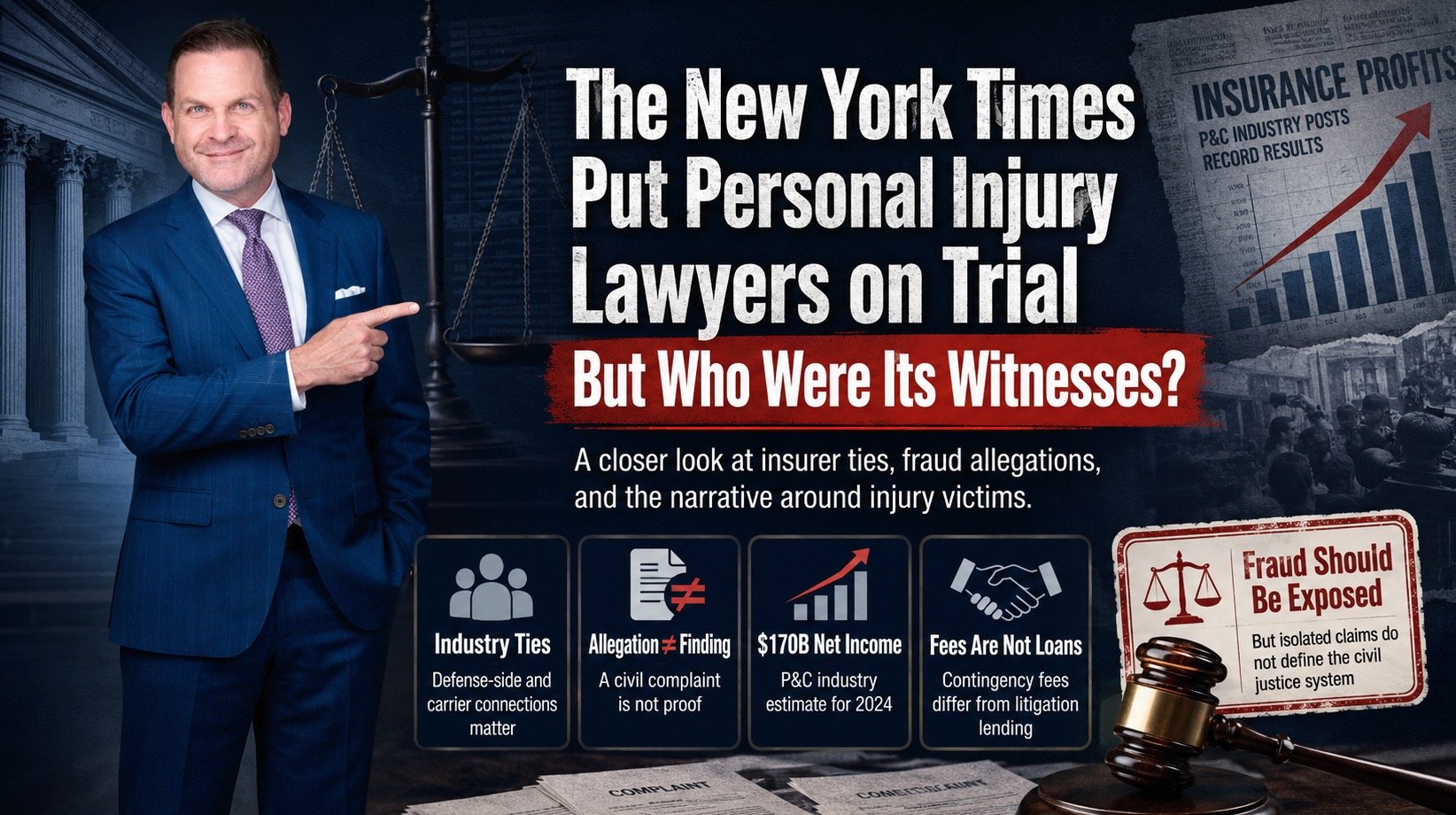
A Times investigation questioned who profits from injury claims. We’re asking the same question about the sources it quoted.
By Marc Anidjar, Managing Partner, The Law Offices of Anidjar & Levine | Posted On: 23 Aug, 2026 | Categories: Personal Injury, Media Response
Editor’s note: This piece responds to a New York Times investigation into personal injury litigation and litigation funding. We are not disputing that fraud and predatory litigation funding exist and deserve scrutiny. We are asking whether the story applied the same scrutiny to the financial interests of the insurance-side sources it relied on to make its case.
Have questions about your own injury claim? Call The Law Offices of Anidjar & Levine at 1-800-747-3733 for a free case review. We don’t charge a fee unless we recover for you.
Main Takeaways
- A source discussed in the reporting, Daniel Johnston of The Willis Law Group, serves as General Counsel of the Long Island Claims Association, an organization whose board includes representatives from Arch Insurance, Alliant, Safety National, ESIS, and Gallagher Bassett, among other carriers and defense-side firms.
- A civil complaint alleging fraud is an allegation, not a finding. Reporting that treats one the same as the other misleads readers about how much has actually been proven.
- The U.S. property-casualty insurance industry generated an estimated $170 billion in net income in 2024, with underwriting results swinging from a $21.8 billion loss in 2023 to a $24.8 billion gain in 2024, according to Verisk and the American Property Casualty Insurance Association.
- A contingency fee and a predatory litigation loan are not the same financial arrangement, and reporting that blurs the two obscures how ordinary injured people access a lawyer.
- Genuine fraud exists and should be exposed. That is not the same as using isolated allegations to characterize the entire civil justice system that legitimate injury victims rely on.
Who Were the Times’s Witnesses?
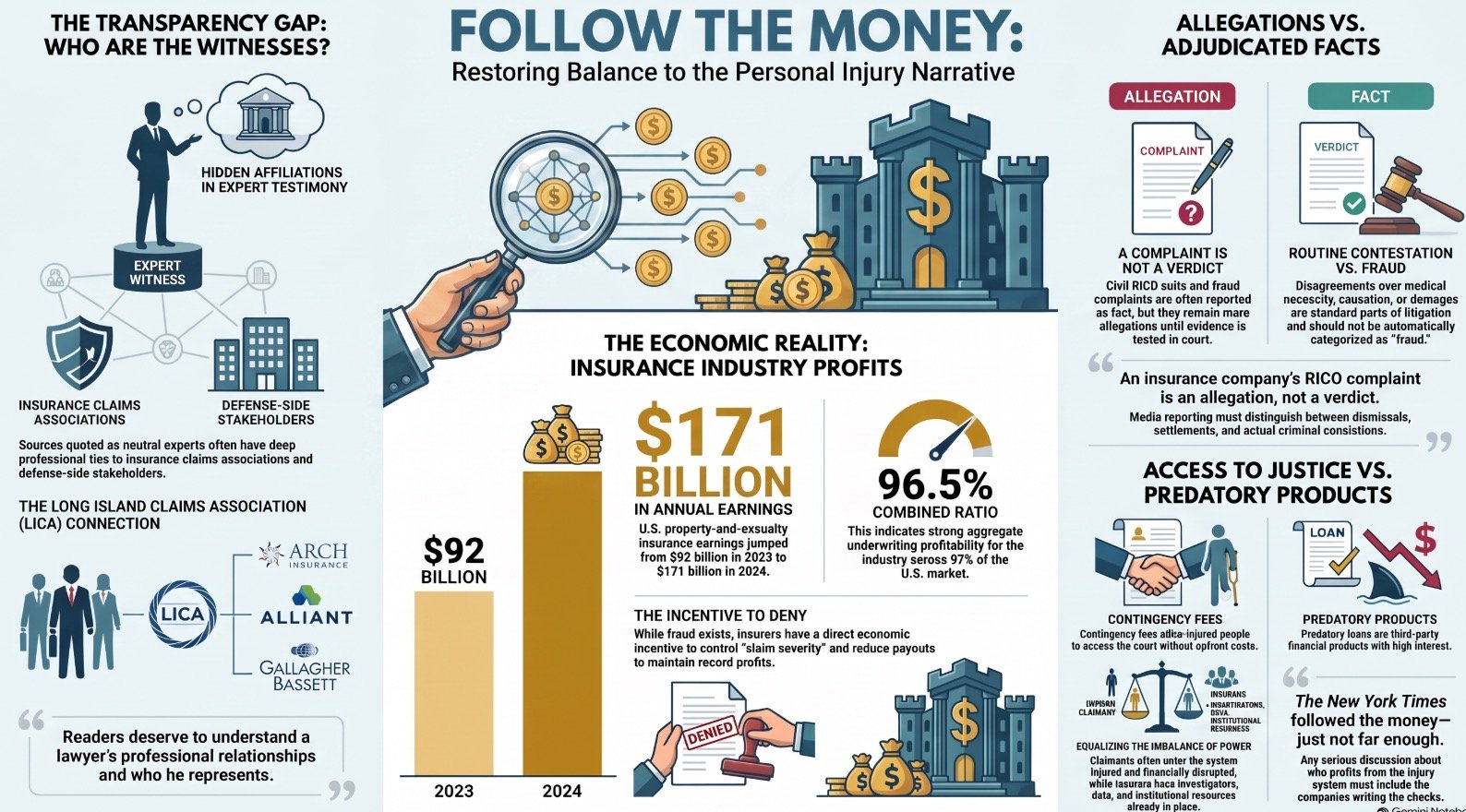
A recent New York Times investigation examined personal injury litigation, litigation funding, and allegations of fraud in the claims process. One of the sources discussed in that reporting, Daniel Johnston of The Willis Law Group, serves as General Counsel of the Long Island Claims Association (LICA), an organization that describes itself as an “insurance professionals community” composed of employers, carriers, brokers, and defense counsel. LICA’s board includes representatives from Arch Insurance, Alliant Insurance Services, Safety National, ESIS, Gallagher Bassett, and Celerity Risk, among others.
That affiliation does not, on its own, make Johnston’s statements wrong. It does, however, show that his professional context is closely tied to insurance claims, carriers, and defense-side stakeholders. When a story examines the financial interests of plaintiffs’ lawyers and litigation funders, it should apply the same scrutiny to the professional relationships and incentives of the insurance-side sources helping explain the supposed problem. Readers deserve to understand that context before they weigh his characterization of the personal injury system.
An Allegation Is Not a Verdict


Civil RICO complaints and insurer fraud suits can contain serious claims. They remain allegations until a judge or jury tests the evidence. There is a real difference between an allegation, a dismissal, a settlement, a judicial finding, a jury verdict, and a criminal conviction, and reporting on this subject should keep those categories distinct rather than summarizing an insurer-filed complaint as though a court had already found the alleged conduct occurred. A disagreement over causation, medical necessity, or the value of damages is not automatically proof of fraud. Those issues are routinely and lawfully contested in injury litigation every day.
An insurance company’s RICO complaint is an allegation, not a verdict.
Follow All the Money — Including the Insurance Industry’s
The “follow the money” instinct behind investigations like this one is a legitimate journalistic tool. It just has to point in every direction, not just one. The U.S. property-casualty insurance industry generated an estimated $170 billion in net income in 2024, according to Verisk and the American Property Casualty Insurance Association (APCIA), whose consolidated estimates cover about 97% of the business written by U.S. property-casualty insurers. The industry’s combined ratio improved to 96.4% in 2024, and underwriting results swung from a $21.8 billion loss in 2023 to a $24.8 billion gain in 2024 — the first underwriting gain in four years.
None of that proves any individual claim denial was improper, and it doesn’t mean litigation costs are insignificant. It does show that the broader economics of the insurance side of this industry belong in any serious discussion of who profits from the injury system. The Times followed the money. It just didn’t follow it far enough. If you are going to investigate the financial incentives behind personal injury litigation, investigate everyone’s financial incentives, including the insurance companies writing the checks.
A Litigation Loan Is Not a Contingency Fee


Predatory consumer litigation funding can and should be criticized where fees are excessive, or conflicts are hidden from the client. A contingency fee is fundamentally different. It lets an injured person who cannot afford to pay a lawyer by the hour obtain representation, and it puts the lawyer’s own fee at risk if there is no recovery. Reporting on this subject should resist any rhetorical slide that treats Wall Street funding products, medical financing arrangements, and contingency-fee representation as a single economic practice. They are not.
Marc Anidjar: “A predatory litigation loan and a contingency fee are not the same thing. One is a financial product. The other is a mechanism that gives ordinary people access to the courthouse.”
The Imbalance the Story Doesn’t Confront
Insurance companies enter a claim with adjusters, investigators, in-house and outside lawyers, experts, data, and institutional resources already in place. The claimant typically enters the same process injured, financially disrupted, and without any of that. Contingency representation exists to help equalize that imbalance by letting the claimant retain counsel without paying hourly fees up front. Insurers have a legitimate duty to investigate fraud. They also have a straightforward economic incentive to control claim severity and reduce payouts. Both can be true at the same time.
The right response to that reality is pro-consumer, not pro-lawyer: expose actual fraud, regulate abusive funding practices, require transparency from funders and firms alike. What shouldn’t happen is weakening a legitimate claimant’s ability to obtain counsel and medical care because some bad actors exist elsewhere in the system.
Marc Anidjar: “Insurance companies have every right to investigate fraud. Injured consumers have the same right to lawyers who can investigate insurers, challenge denials, and take legitimate cases to trial.”
Questions We’d Ask This Reporting
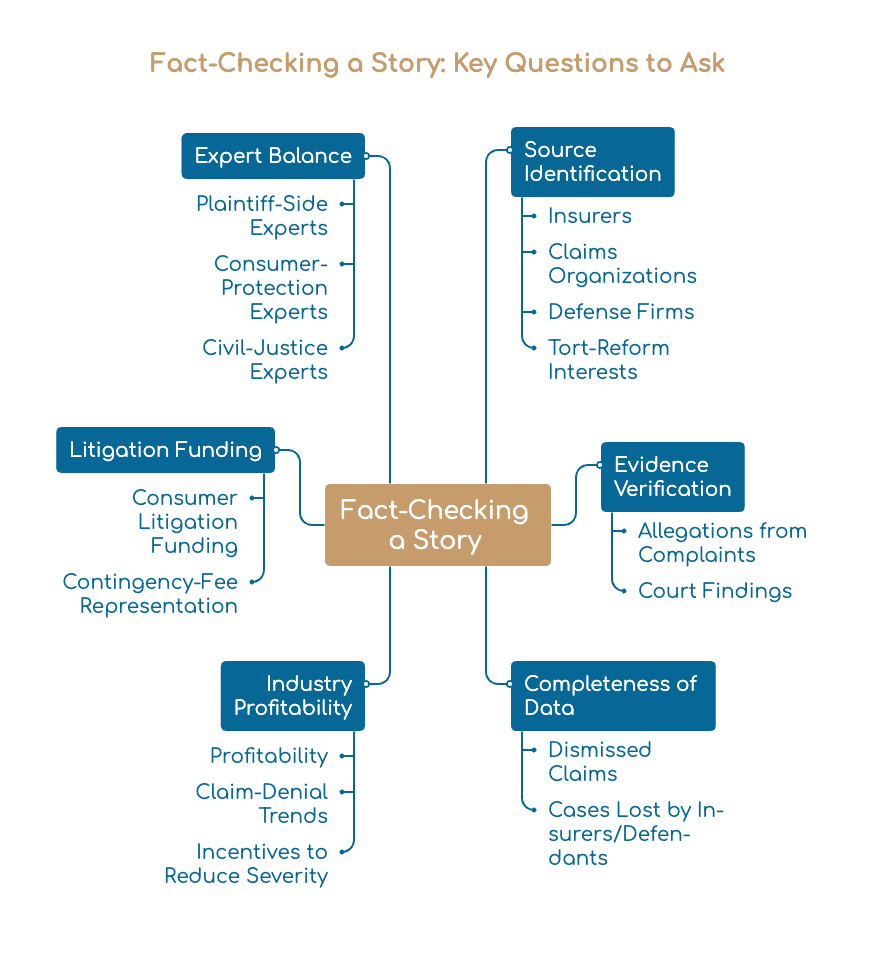
If we were fact-checking this story ourselves, here’s where we’d start:
- Which quoted sources represent insurers, claims organizations, defense firms, or tort-reform interests, and was that made clear enough for readers to weigh their perspective?
- How many of the story’s examples are allegations from complaints, versus conduct a court has actually found to have occurred?
- Were dismissed claims or cases where insurers or defendants lost included anywhere in the reporting’s dataset?
- Did the reporting quantify insurance-industry profitability, claim-denial trends, or insurers’ own incentive to reduce claim severity?
- Did it clearly separate consumer litigation funding products from ordinary contingency-fee legal representation?
- Did it include plaintiff-side, consumer-protection, or civil-justice experts with comparable prominence to its insurance-side sources?
About The Law Offices of Anidjar & Levine
Founded in 2005 by Marc Anidjar and Glen Levine, the firm began as a two-person operation working out of a construction office conference room. Over the past 20 years, that modest start has grown into one of Florida’s most recognized personal injury practices — with more than $1 billion recovered in settlements on behalf of injury clients across the state. We bring that same determination and depth of experience to every case we handle.
We don’t represent insurance companies. We represent people. That’s exactly why we’re asking these questions in the first place.
If You Have an Injury Claim, Here’s What This Doesn’t Change
Fraud should be exposed wherever it exists. But isolated allegations shouldn’t be used to characterize an entire civil justice system that legitimate injury victims depend on. If you were genuinely hurt in an accident, none of this news coverage changes your right to fair treatment, your filing deadlines, or your ability to have a lawyer investigate your claim and push back on a denial or lowball offer.
Questions about your own claim after reading this? Call The Law Offices of Anidjar & Levine at 1-800-747-3733 for a free, no-obligation case review. We don’t charge a fee unless we recover for you. Hablamos español.
Frequently Asked Questions
Is a contingency fee the same thing as consumer litigation funding?
No. A contingency fee is an arrangement where your attorney is paid only if you recover, allowing injured people who cannot afford hourly legal fees to obtain representation. Consumer litigation funding is a separate financial product, offered by third-party companies, that can carry high fees or hidden terms. Treating the two as interchangeable blurs a meaningful distinction.
Does an insurance company’s lawsuit against a claimant or law firm mean fraud occurred?
Not by itself. A civil complaint, including one alleging fraud or RICO violations, states allegations that a court has not yet tested. It becomes a finding of fraud only after a judge or jury rules on the evidence, or a party admits to it. Until then, it remains an allegation.
Does the personal injury system have a fraud problem?
Genuine fraud and predatory litigation funding practices exist and deserve scrutiny and regulation. The concern raised here is different: that isolated allegations, drawn largely from insurance-side sources, can be used to characterize an entire civil justice system that legitimate injury victims depend on to get fair treatment.
Why does it matter that a quoted source has ties to the insurance industry?
It doesn’t automatically make the source wrong. It does mean readers deserve enough context about a source’s professional affiliations to weigh the perspective being offered, the same way a story would normally disclose a source’s financial ties on any other topic.
Are insurance companies profitable right now?
Yes. Verisk and the American Property Casualty Insurance Association estimate the U.S. property-casualty insurance industry generated roughly $170 billion in net income in 2024, with a combined ratio of 96.4%, and industry underwriting results swung from a $21.8 billion loss in 2023 to a $24.8 billion gain in 2024.
Does reading this article affect my rights if I have an injury claim?
No. This article is commentary on press coverage of the personal injury industry generally. It does not change any deadline, coverage, or right you have in an individual claim. If you have questions about your own case, a free consultation with an attorney is the way to get an answer specific to your situation.
This article is a commentary and opinion piece responding to press coverage and does not constitute legal advice, nor does it guarantee any specific outcome or recovery amount in any case. It does not allege that any named individual, source, or organization committed a crime, acted dishonestly, or had an undisclosed financial relationship; affiliations described above (such as board membership or a General Counsel role) are stated as verifiable, publicly documented facts, not as claims of wrongdoing. References to civil complaints use “alleges” or “claims” deliberately, since those matters have not been adjudicated. We acknowledge that genuine insurance fraud and predatory litigation funding practices exist and should be investigated and regulated. Insurance industry financial data comes from Verisk and the American Property Casualty Insurance Association’s consolidated 2024 estimates; Long Island Claims Association board and affiliation information comes from the organization’s own published board page. Hiring a lawyer is an important decision and should not be based solely on advertisements. Before you decide, ask us to send you free written information about our qualifications and experience.
Sources:Long Island Claims Association – Board of Directors · Verisk / APCIA 2024 U.S. P&C Industry Results