Introduction: The Unique Challenges of U-Haul Collisions
While U-Haul trucks are a common sight on Miami’s roads, accidents involving these vehicles present a unique and complex intersection of commercial vehicle dynamics, contract law, and insurance disputes. Unlike standard car accidents, a U-Haul collision often involves multiple layers of liability, from the inexperienced driver behind the wheel to the rental corporation and its maintenance contractors.
Learn More: Miami U-Haul Truck Accident Lawyer
This document will serve as a detailed case study, walking through the strategic legal approach required to secure justice and fair compensation for victims caught in the aftermath of these challenging incidents.
Core Principles for a Successful Claim
- Securing the Factual Record: We immediately move to preserve ephemeral evidence—from black box data and surveillance footage to maintenance logs—creating an immutable factual foundation for the claim.
- Deconstructing the Liability Chain: A successful claim requires a meticulous analysis to identify all liable parties, which may include the driver, the rental company under theories of negligent entrustment, and any third-party maintenance or loading contractors.
- Comprehensive Damage Valuation: We coordinate comprehensive medical care to document injuries and build a case for full compensation that includes medical expenses, lost earning capacity, property damage, and non-economic damages like pain and suffering.
- Neutralizing Insurer Defenses: We take control of all insurer communications, analyzing policies to expose coverage gaps and bad-faith tactics, thereby preempting common strategies used to deny or devalue claims.
- Leveraging Litigation Readiness: A strong case is built by meeting Florida’s statute of limitations and preparing for trial from day one, using accident reconstruction and mechanical experts to validate the claim and maximize settlement leverage.
——————————————————————————–


1. The Scenario: Deconstructing a Common Miami U-Haul Accident
Understanding the root causes of a U-Haul accident is a critical strategic step. Liability often extends far beyond the individual driver, and a thorough investigation into all contributing factors is the foundation upon which a strong legal case is built. By deconstructing a representative scenario, we can identify the distinct points of negligence that lead to these preventable collisions.
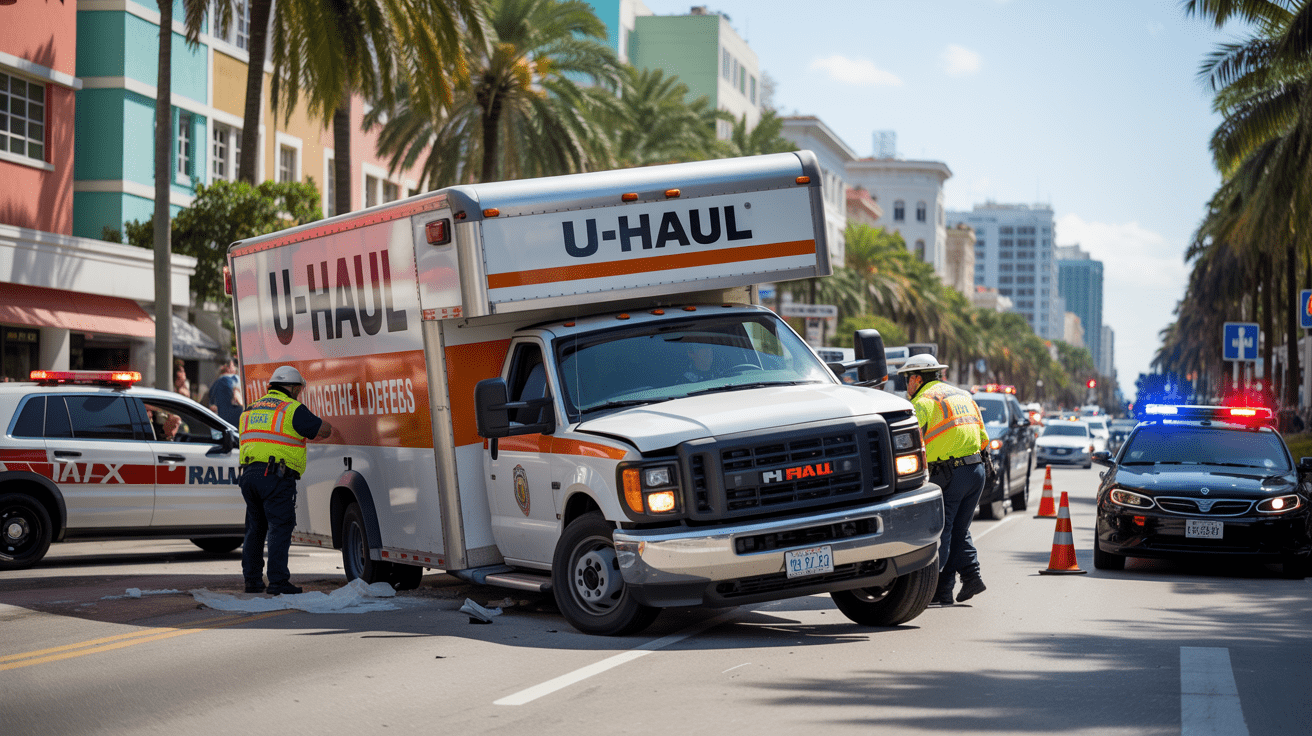
Imagine a U-Haul truck traveling on a congested Miami corridor during a sudden afternoon downpour. The driver, unfamiliar with the vehicle’s size and weight, misjudges the stopping distance required on the slick pavement and collides with a passenger car that had slowed for traffic. A closer analysis reveals a cascade of failures, not just a single mistake.
Driver Inexperience
The driver, who had rented the truck for a weekend move, lacked practical instruction on handling a vehicle with an elevated center of gravity and a longer wheelbase. They failed to account for the truck’s wide turning radius and significant blind spots, and their reaction time was eroded by fatigue after a long day of loading. This inexperience transformed a common traffic slowdown into a serious collision.
Overloaded or Unbalanced Cargo
An investigation reveals the truck was loaded improperly. The weight was not evenly distributed, placing excessive stress on the rear axle and tires. During the sudden braking maneuver, the unsecured cargo shifted dangerously. This improper loading created a dynamic instability that severely compromised the driver’s ability to maintain control during the braking maneuver.
Poor Vehicle Maintenance
Further examination of the truck’s maintenance logs shows that it was overdue for service. The brake pads were worn, and one tire was significantly underinflated—defects a competent pre-rental inspection should have caught. These maintenance failures meant the truck’s braking system could not perform as expected, dramatically increasing the stopping distance required to avoid the crash.
Adverse Weather Conditions
The heavy rain was a significant contributing factor. The slick roads and reduced visibility magnified the driver’s operational errors and the vehicle’s mechanical deficiencies. A prudent operator would have reduced speed and increased following distance, but the combination of inexperience and vehicle faults left no margin for error.
The actions taken in the first few hours following such a crash are critical to preserving the evidence needed to hold all responsible parties accountable.
2. The Aftermath: A Victim’s Guide to Protecting Health and Legal Rights
The moments following a crash are chaotic and stressful. However, a victim’s actions during this critical window can significantly impact both their physical recovery and their ability to secure fair compensation. This section serves as a crucial roadmap for navigating the immediate aftermath to protect one’s health and legal rights.
- Prioritize Safety and Seek Medical Care
- Move to a safe location away from traffic and check for hazards.
- Call 911 to request police and Emergency Medical Services (EMS).
- Accept an on-scene medical evaluation, as shock can mask serious injuries.
- Follow all recommended treatment plans and attend follow-up appointments.
- Keep organized records of all medical bills, medications, and treatments.
- It is vital to seek a prompt medical evaluation, as internal injuries may not present immediate symptoms and a clear medical record establishes a direct link between the accident and the harm suffered.
- Document the Scene and Preserve Evidence
- If safe, photograph the vehicles from multiple angles, including damage points, license plates, and VINs.
- Take pictures of the broader scene, including skid marks, road conditions, and any relevant traffic signals.
- Collect contact information from any witnesses, noting their observations.
- Preserve any physical evidence and note the location of nearby business or traffic cameras.
- Disciplined documentation prevents insurers from challenging the facts of the case later on and creates an objective record of what occurred.
- Notify Insurers and Authorities
- Ensure a police report is filed and obtain the report number for your records.
- Provide clear, factual statements to law enforcement, avoiding speculation about fault.
- Notify your insurance company and the rental company of the accident.
- Refrain from giving a recorded statement to any insurer until you have secured legal counsel.
- Prompt and accurate notification fulfills contractual and legal requirements, but controlling the narrative from the outset protects you from tactics designed to minimize your claim.
Navigating these steps is challenging, which is why professional legal intervention is essential to manage the complexities that follow and build a foundation for a successful claim.
3. The Legal Intervention: Mobilizing a Fact-Driven Strategy
U-Haul accident cases demand specialized legal expertise. The unique liability issues, multiple parties involved, and aggressive tactics often used by corporate insurers create a complex legal landscape that is difficult for a victim to navigate alone. The legal team’s intervention is the pivotal moment when a victim’s focus can shift to healing while a professional, fact-driven strategy is mobilized on their behalf.
| Challenge | Strategic Legal Response |
| Rapidly disappearing evidence | Preserving black box and telematics data, securing surveillance footage before it is overwritten, and conducting immediate witness interviews before memories fade. |
| Complex liability with multiple parties | Dissecting the Liability Chain: We analyze rental agreements for negligent entrustment provisions, scrutinize maintenance logs for patterns of neglect, and investigate third-party loading contractors to identify every potential defendant. |
| Aggressive insurer tactics | Managing all insurer communications to shield the client, challenging bad-faith tactics and improper claim denials, and countering efforts to minimize compensation based on policy exclusions. |
| Proving causation and damages | Deploying Expert Witnesses: We engage accident reconstructionists to model the collision dynamics and mechanical engineers to provide objective testimony on vehicle component failure, neutralizing defense arguments. |
The firm’s overall philosophy is proactive, meticulous, and relentlessly client-centered. Each case is prepared as if it will proceed to trial, a strategy that strengthens the firm’s negotiating posture and pressures insurers to secure fair outcomes through settlement.
With liability firmly established, the next logical step is to prove the full and devastating extent of the victim’s damages.


4. Quantifying the Harm: Building the Case for Full and Fair Compensation
A strategic legal claim must document every category of loss. Fair compensation goes far beyond the initial medical bills and must account for the long-term physical, emotional, and financial toll an accident exacts on a victim and their family. Building this comprehensive damages profile is essential to ensuring a recovery that supports true, long-term healing.
4.1. Chronic Physical and Cognitive Impacts
The most enduring consequences are often invisible. Victims may struggle with chronic stiffness, nerve irritation, and joint instability that limit mobility and independence. Concurrently, victims of significant trauma often exhibit cognitive and emotional impacts, including concentration deficits, slowed processing, and memory impairment. These symptoms can be compounded by mood changes such as anxiety, irritability, and emotional lability, all of which require ongoing treatment and strain personal and professional relationships.
4.2. Financial and Lifestyle Strain
The financial fallout can be devastating. Income is often disrupted by missed work, reduced hours, or even permanent job loss. Out-of-pocket costs for transportation, home modifications, and ongoing therapies accumulate quickly. These pressures consume time and energy, creating a significant lifestyle strain that affects not only the victim but also their entire family and support system.
4.3. The Legal Valuation of Damages
To secure a just recovery, a claim must meticulously document and value every loss. The legal team pursues compensation for all applicable categories, including:
- Past, present, and future medical expenses
- Lost income and reduced future earning capacity
- Property damage
- Pain and suffering
- Loss of enjoyment of life
- Household services and out-of-pocket costs
This meticulously built damages case is then used to navigate the final stages of the legal process, from negotiation to, if necessary, litigation.
5. Navigating to Resolution: Deadlines, Negotiation, and Litigation
Even a well-built case must navigate critical procedural hurdles and strategic negotiations to achieve a successful outcome. Adherence to legal deadlines is non-negotiable, and leveraging a state of litigation readiness is the key to compelling a fair settlement from otherwise reluctant insurers.
Florida’s Statute of Limitations
Florida law imposes a strict deadline for filing personal injury claims. For most U-Haul truck accident cases, the statute of limitations for negligence is two years from the date of the crash. Wrongful death actions also follow a two-year period, running from the date of death. Missing this deadline is strategically fatal, as it typically extinguishes a victim’s right to recover damages. This deadline is particularly critical in U-Haul cases, where evidence like telematics data degrades quickly and identifying all liable parties can be time-consuming. While this deadline can be subject to tolling exceptions(such as for a minor victim or a defendant’s concealment of facts), it is crucial to note that contractual claims or those against governmental entities can have different, often shorter, deadlines.
The Dual Path to Justice: Settlement and Litigation
The most effective approach is to prepare every case for trial from day one. This “litigation readiness” forces the development of an airtight case from the outset, signaling to insurers that the legal team is fully prepared to present the evidence in court. This methodical preparation reveals the strength of the evidence to the insurer during negotiation, creating significant leverage that often compels a higher settlement offer to avoid the risk and expense of a trial. While many cases resolve through disciplined negotiation, the willingness and ability to litigate is the ultimate safeguard for a client’s recovery.
This strategic approach prepares the case for any eventuality, including the complex scenarios that frequently arise in U-Haul litigation.
6. Addressing Complex Scenarios: Frequently Asked Questions
Many U-Haul cases involve unique circumstances that can complicate liability and insurance coverage. This section addresses some of the most common and complex questions to provide further clarity.
What if the At-Fault Driver Was an Unlisted U-Haul Operator?
If the at-fault driver was an unauthorized operator, liability and insurance implications become more complex. A key legal question is whether the authorized renter can be held liable under a theory of negligent entrustment for allowing an unsafe or unlicensed individual to operate the truck.
- Strategic Actions: We conduct an investigation to verify the rental agreement terms, assess policy exclusions for unlisted drivers, and identify all potential sources of coverage, including the renter’s personal auto policy or the driver’s personal assets.
Does Credit Card Rental Coverage Apply to U-Haul Truck Accidents in Florida?
Typically, no. Most credit card insurance benefits are structured for passenger vehicles and specifically exclude commercial-style trucks like those rented from U-Haul. It is a critical error to rely on this as a primary source of coverage.
- Key Considerations: A review of your card’s guide to benefits will almost always confirm commercial vehicle exclusions and vehicle weight limits. The primary applicable coverages will be U-Haul’s collision damage waivers and endorsements on a personal auto policy.
Can I Pursue Claims Against a Third-Party Loading Company or Mechanic?
Yes. If evidence demonstrates that negligent loading or faulty mechanic work was a proximate cause of the collision, a claim can be pursued directly against that third party. An unbalanced load that shifts in transit or a brake failure from a shoddy repair can establish clear, independent liability.
- Strategic Actions: We gather bills of lading, maintenance records, and expert analyses to establish duty, breach, causation, and damages. Critically, we promptly send spoliation letters to all potential third-party defendants to ensure critical records are not destroyed.
How Do U-Haul Telematics or GPS Data Affect My Case?
This data can be dispositive. Telematics and GPS records provide objective evidence of speed, routes, timelines, and hard-braking events, which can be used to corroborate or impeach driver testimony. This information is critical in reconstructing the accident and proving negligence.
- Strategic Actions: We immediately demand the preservation of all electronic data. We then analyze the records for gaps or anomalies that suggest tampering or negligence, such as patterns indicating driver fatigue.
Are Commercial Driver Logbook Rules Relevant to Rental Truck Accidents?
Often only indirectly. Due to rental exceptions under FMCSA rules, most individuals renting a U-Haul for a personal move are not bound by the same federal hours-of-service regulations as professional commercial drivers. However, these standards remain highly relevant as a benchmark for safe driving practices and can be used by experts to analyze driver fatigue and strengthen a liability argument.
——————————————————————————–
Conclusion: Securing Your Path to Recovery
U-Haul truck accidents in Miami are complex, but with expert legal guidance, victims can protect their rights and secure the compensation they deserve. Navigating the layers of corporate liability, insurance exclusions, and evidence preservation requires a proactive and meticulous approach from the very beginning. A successful outcome depends on a strategy built on thorough investigation, support from qualified experts, and aggressive advocacy in the face of insurer tactics.
Do not wait, as important timelines apply to your claim. Contact the Law Offices of Anidjar and Levine today to speak with a Miami Truck Accident Attorney for a free consultation, and let us put our experience, resources, and dedication to work for you.