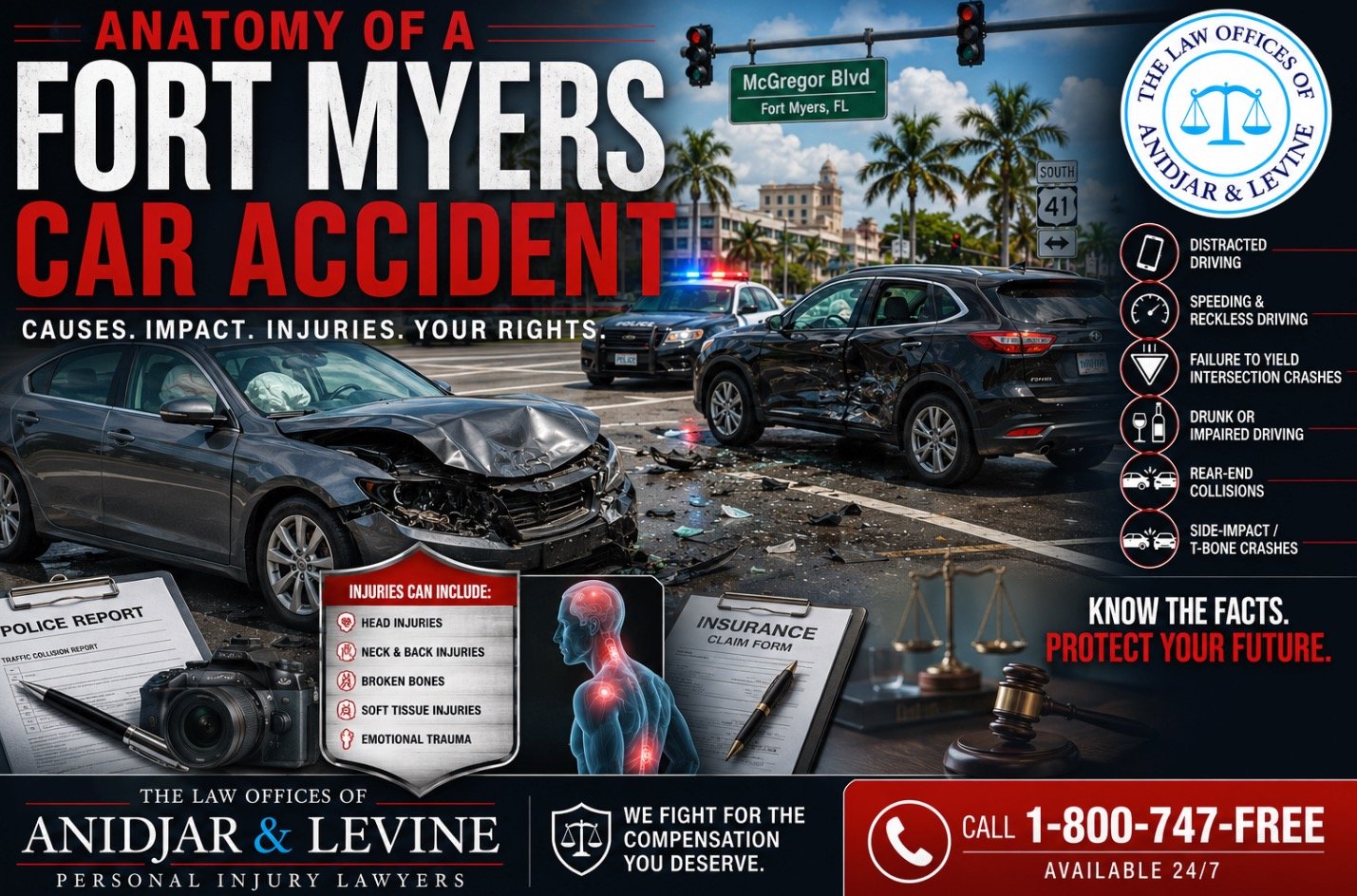
A car accident can change your life in seconds. Whether you are involved in a rear-end collision on Colonial Boulevard, a T-bone crash at a busy intersection near U.S. 41, or a high-speed accident on I-75, the aftermath can be physically, emotionally, and financially overwhelming.
Understanding the anatomy of a Fort Myers car accident can help you protect your health, preserve important evidence, and maximize your ability to recover compensation.
At The Law Offices of Anidjar & Levine, we help injury victims throughout Fort Myers and Southwest Florida understand their legal rights after serious collisions. This guide breaks down the common causes of crashes, the most frequent injuries, what happens after an accident, and how compensation claims work in Florida.
For more information, visit Fort Myers Car Accident Lawyer.
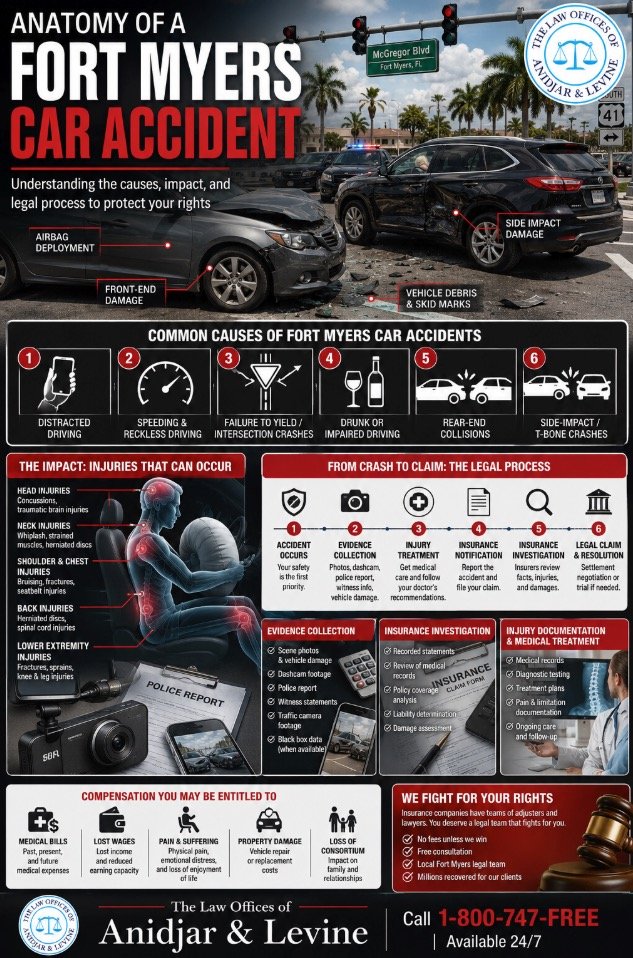
A car accident can unfold in seconds, but its consequences often last months—or even years. One distracted glance at a phone, a driver rushing through a yellow light, or a moment of poor judgment at a crowded intersection can lead to devastating injuries, overwhelming medical bills, lost income, and uncertainty about the future.
In a growing city like Fort Myers, serious car accidents happen every day. Busy roads such as Colonial Boulevard, U.S. 41, McGregor Boulevard, Daniels Parkway, and Interstate 75 regularly see congestion, heavy tourism traffic, commercial vehicles, and distracted motorists sharing the road. When those conditions combine with speeding, impaired driving, or failure to yield, the result can be catastrophic.
Understanding the anatomy of a Fort Myers car accident means understanding far more than the moment of impact. Every collision has a chain of events—from what caused the crash to how injuries develop, how insurance companies investigate claims, and ultimately how victims recover compensation. Knowing what happens at each stage may help protect both your health and your legal rights after an accident.
Car Accidents in Fort Myers Rarely Happen Without Warning
Most crashes are not truly “accidents” in the traditional sense. In many cases, collisions result from preventable human behavior. A split-second decision can set an entire chain reaction into motion.
Imagine a driver approaching an intersection in Fort Myers while checking a text message. At the same moment, another motorist attempts a left turn after misjudging oncoming traffic. Add wet pavement from a sudden Florida rainstorm or heavier-than-usual seasonal traffic, and the conditions for a serious collision quickly come together.
Many crashes begin with some form of negligence. Distracted driving remains one of the leading contributors to collisions across Florida, especially as smartphones continue to dominate daily life. A driver who looks down at a phone for only five seconds while traveling at highway speeds may travel the length of a football field without watching the road.
Speeding also plays a major role in serious crashes throughout Fort Myers. Excessive speed not only makes collisions more likely but significantly increases the severity of injuries when impact occurs. Drivers moving too fast have less time to react to traffic changes, pedestrians, sudden braking, or vehicles entering intersections.
Intersections themselves are particularly dangerous environments. Side-impact and T-bone crashes often happen when drivers fail to yield, run red lights, or make aggressive turns across traffic. These collisions are especially dangerous because the sides of vehicles provide less structural protection than the front or rear, leaving occupants more vulnerable to severe trauma.
Impaired driving continues to be another devastating factor in Florida crashes. Whether alcohol, illegal substances, or even prescription medications are involved, impaired motorists often experience slower reaction times, poor judgment, and reduced coordination. The consequences can be life-changing for everyone involved.
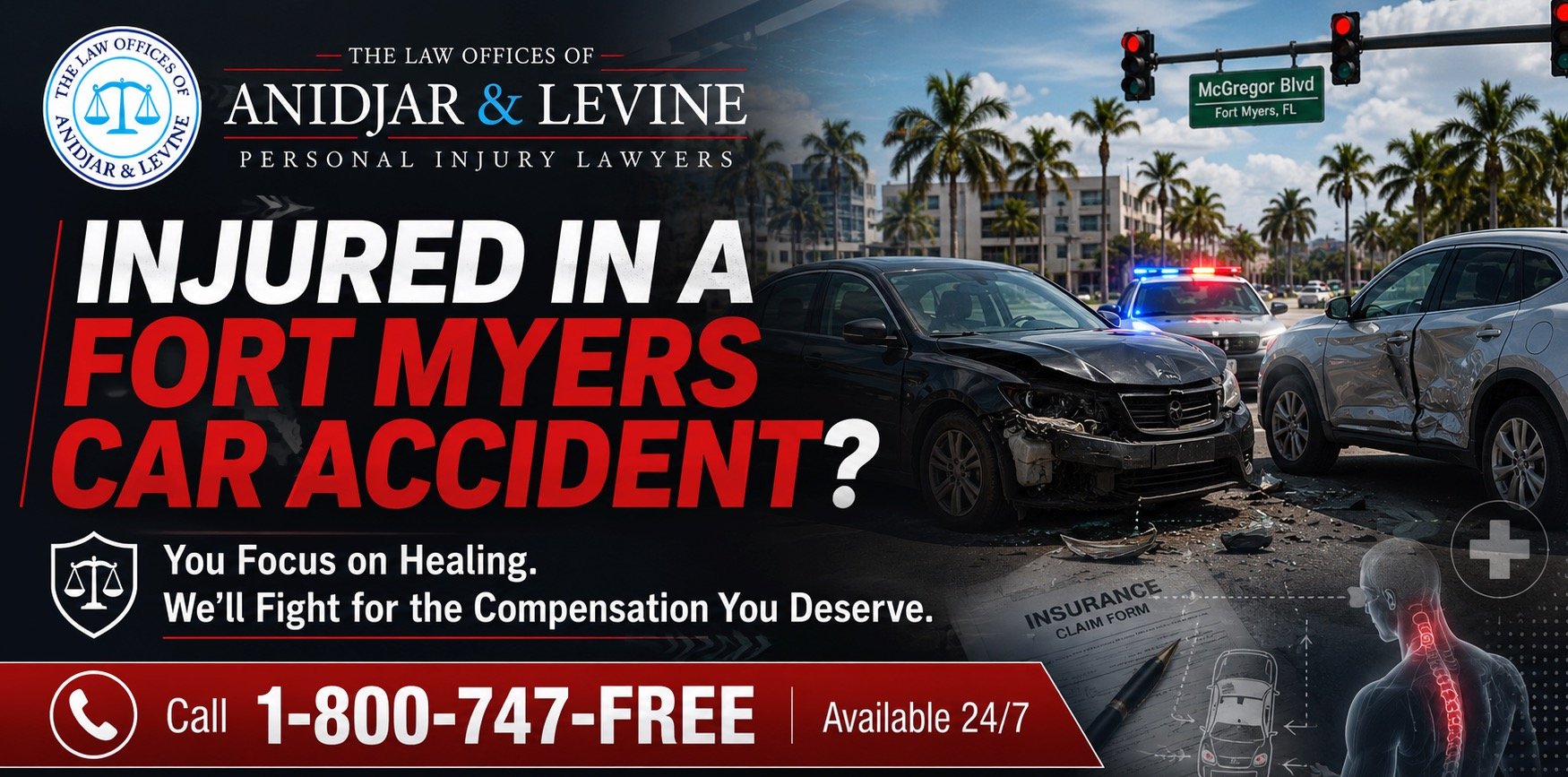
The Moment of Impact: What Happens to the Human Body in a Fort Myers Car Collision
To truly understand the anatomy of a Fort Myers car accident, it helps to understand what happens during impact.
Even when vehicles appear to suffer only moderate damage, the human body experiences an extraordinary amount of force in a collision. The physics involved are often violent and sudden.
When a vehicle crashes, the car itself stops abruptly, but the occupants inside continue moving forward due to momentum. Seat belts and airbags help reduce severe injuries, but they cannot eliminate the force transferred to the body.
In a rear-end accident, the neck may snap backward and forward in milliseconds, creating soft tissue damage commonly associated with whiplash. In side-impact collisions, occupants can experience force directly into the torso and pelvis, increasing the risk of fractures, internal injuries, and spinal trauma.
Head injuries are another major concern. Even when a person never strikes a window or steering wheel, the brain itself may move inside the skull during impact. This can result in concussions or traumatic brain injuries that may not present symptoms immediately.
Many victims walk away from an accident believing they are fine, only to experience worsening pain, dizziness, numbness, headaches, or mobility issues days later. Adrenaline often masks symptoms immediately after a crash, which is one reason medical evaluation is so important.
For more information, visit Fort Myers Car Accident Lawyer.
Why Some Fort Myers Car Accident Injuries Do Not Appear Right Away
One of the biggest mistakes accident victims make is assuming they escaped injury simply because they feel okay immediately after the crash.
The reality is that many serious injuries develop gradually.
Soft tissue injuries, spinal trauma, herniated discs, and traumatic brain injuries may take hours—or even days—to fully present symptoms. What initially feels like stiffness may eventually become chronic pain. Mild headaches can later reveal signs of concussion.
Doctors often emphasize the importance of immediate medical documentation because untreated injuries frequently worsen over time. More importantly, insurance companies often question the validity of delayed medical care. If too much time passes between an accident and treatment, insurers may argue the injuries were unrelated or not severe.
This is one of the reasons medical records become such powerful evidence after a crash. Imaging scans, physician notes, specialist evaluations, and physical therapy records often help establish both the seriousness of injuries and the long-term impact on a victim’s life.
The Hidden Investigation That Begins Immediately After a Fort Myers Car Crash
Most people focus on vehicle damage after an accident, but another process begins almost instantly behind the scenes: the insurance investigation.
Within days of a Fort Myers car accident, insurance adjusters may begin reviewing police reports, examining photographs, analyzing medical treatment, interviewing witnesses, and assessing fault.
Unfortunately, insurance companies are not always focused on maximizing compensation for injured victims.
Instead, insurers often look for opportunities to minimize payouts. They may argue that injuries were pre-existing, suggest that medical treatment was excessive, or attempt to shift blame to the injured driver.
Florida’s comparative negligence laws can further complicate matters. If an injured person is found partially responsible for a crash, their compensation may be reduced proportionately. Because of this, evidence often becomes one of the most important factors in determining the strength of a claim.
Photographs from the accident scene, dashcam footage, surveillance video, witness testimony, vehicle damage patterns, and electronic crash data can all play important roles in reconstructing what happened.
The Financial Fallout of a Serious Fort Myers Car Accident
The aftermath of a serious collision often extends far beyond medical treatment.
For many families, financial hardship begins almost immediately. Emergency room bills, ambulance fees, surgery costs, physical therapy, prescription medications, and specialist appointments can add up quickly. Meanwhile, injuries may prevent someone from returning to work, reducing household income at the exact moment expenses are rising.
Beyond financial losses, many accident victims experience profound emotional disruption. Chronic pain, anxiety, sleep disturbances, and fear of driving again are surprisingly common after traumatic crashes.
Florida law allows injury victims to seek compensation for these damages when negligence is involved. Depending on the circumstances, a claim may include medical expenses, lost income, future treatment costs, diminished earning capacity, pain and suffering, and property damage.
In catastrophic cases involving permanent injuries, compensation may also reflect long-term disability and diminished quality of life.
Why Contact The Law Offices of Anidjar & Levine After a Fort Myers Car Accident
After a serious collision, victims are often left trying to manage medical appointments, insurance calls, vehicle repairs, and financial stress all at once. It can quickly become overwhelming.
The Law Offices of Anidjar & Levine helps Fort Myers accident victims understand their rights and pursue compensation after serious crashes. From investigating accident causes to preserving evidence and negotiating with insurers, experienced legal guidance can help level the playing field.
Every car accident case is unique, but one thing remains consistent: early action matters. Evidence can disappear, witnesses become harder to locate, and insurance companies begin building defenses almost immediately.
If you or someone you love was injured in a Fort Myers collision, understanding the anatomy of a car accident is the first step toward protecting your recovery.
For more information, visit Fort Myers Car Accident Lawyer.
Call The Law Offices of Anidjar & Levine at 1-800-747-FREE for help 24/7.